
Pipelined Control with Interstage Buffers Pipeline Control Signals
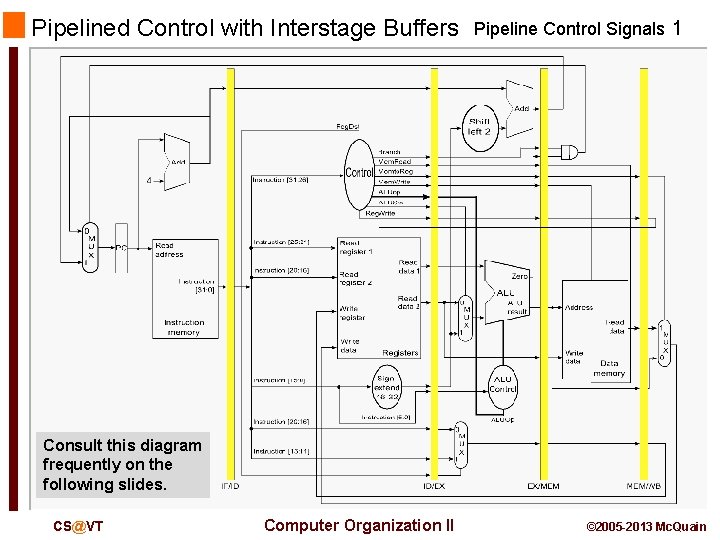
Pipelined Control with Interstage Buffers Pipeline Control Signals 1 Consult this diagram frequently on the following slides. CS@VT Computer Organization II © 2005 -2013 Mc. Quain
Pipelined Control Signals Pipeline Control Signals 2 Recall that we must ensure that each control signal “travels with” the instruction to which it applies. The interstage buffers provide support for this synchronization. We need to determine which signals each interstage buffers must store. The key is to determine to which stage a signal must be passed, then make sure it reaches that state in synchronization with the correct instruction. CS@VT Computer Organization II © 2005 -2013 Mc. Quain
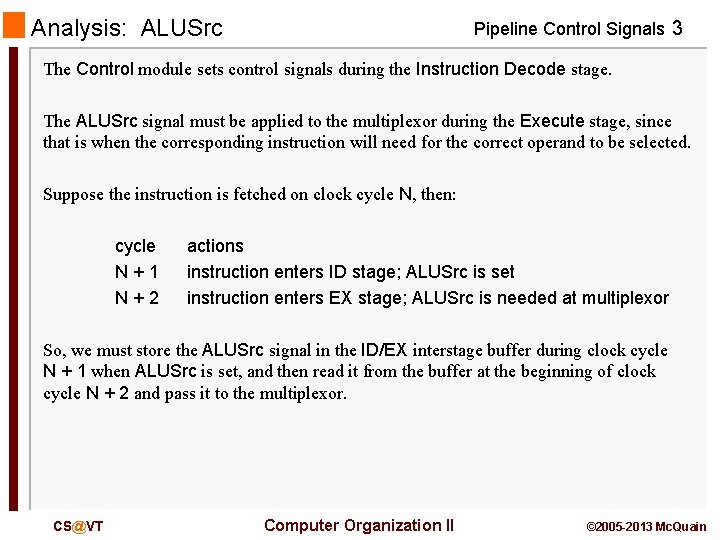
Analysis: ALUSrc Pipeline Control Signals 3 The Control module sets control signals during the Instruction Decode stage. The ALUSrc signal must be applied to the multiplexor during the Execute stage, since that is when the corresponding instruction will need for the correct operand to be selected. Suppose the instruction is fetched on clock cycle N, then: cycle N+1 N+2 actions instruction enters ID stage; ALUSrc is set instruction enters EX stage; ALUSrc is needed at multiplexor So, we must store the ALUSrc signal in the ID/EX interstage buffer during clock cycle N + 1 when ALUSrc is set, and then read it from the buffer at the beginning of clock cycle N + 2 and pass it to the multiplexor. CS@VT Computer Organization II © 2005 -2013 Mc. Quain
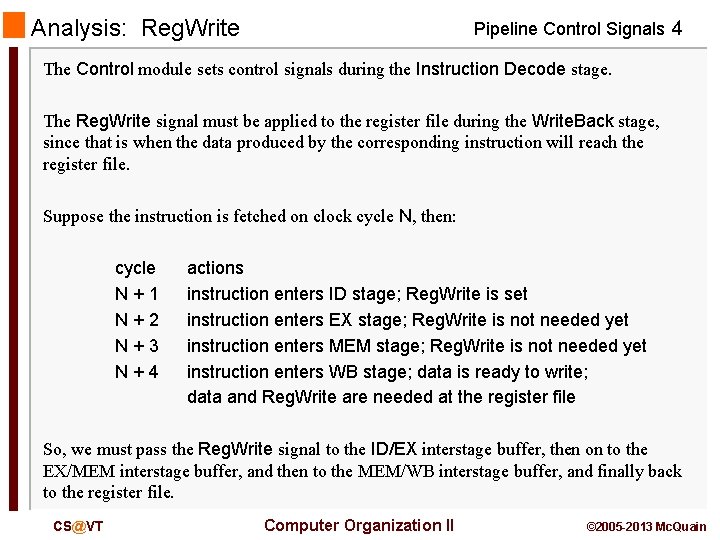
Analysis: Reg. Write Pipeline Control Signals 4 The Control module sets control signals during the Instruction Decode stage. The Reg. Write signal must be applied to the register file during the Write. Back stage, since that is when the data produced by the corresponding instruction will reach the register file. Suppose the instruction is fetched on clock cycle N, then: cycle N+1 N+2 N+3 N+4 actions instruction enters ID stage; Reg. Write is set instruction enters EX stage; Reg. Write is not needed yet instruction enters MEM stage; Reg. Write is not needed yet instruction enters WB stage; data is ready to write; data and Reg. Write are needed at the register file So, we must pass the Reg. Write signal to the ID/EX interstage buffer, then on to the EX/MEM interstage buffer, and then to the MEM/WB interstage buffer, and finally back to the register file. CS@VT Computer Organization II © 2005 -2013 Mc. Quain
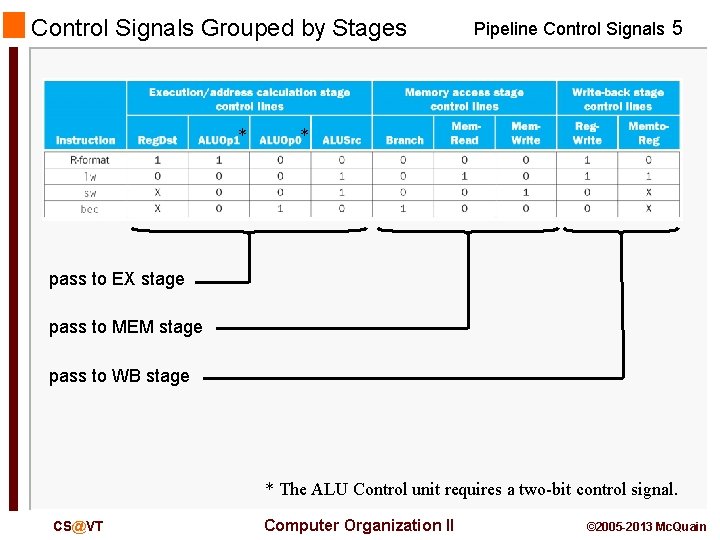
Control Signals Grouped by Stages * Pipeline Control Signals 5 * pass to EX stage pass to MEM stage pass to WB stage * The ALU Control unit requires a two-bit control signal. CS@VT Computer Organization II © 2005 -2013 Mc. Quain
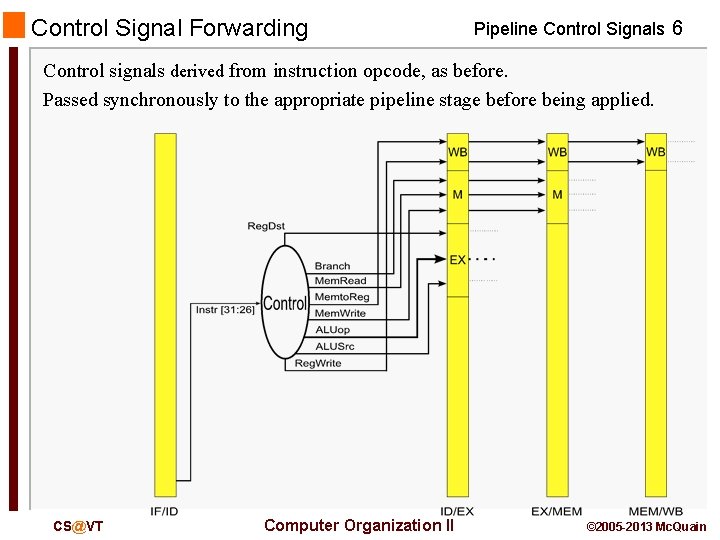
Control Signal Forwarding Pipeline Control Signals 6 Control signals derived from instruction opcode, as before. Passed synchronously to the appropriate pipeline stage before being applied. CS@VT Computer Organization II © 2005 -2013 Mc. Quain
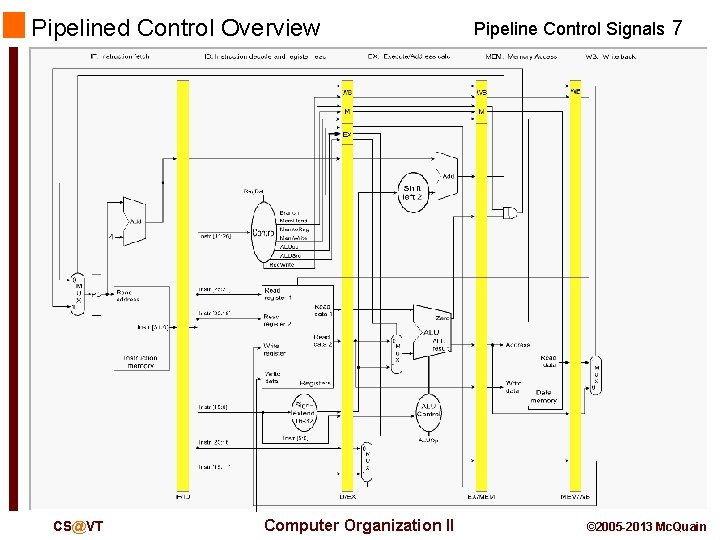
Pipelined Control Overview CS@VT Computer Organization II Pipeline Control Signals 7 © 2005 -2013 Mc. Quain
- Slides: 7