
PIPELINE QRA SEMINAR PIPELINE RISK ASSESSMENT RISK REDUCING

- Slides: 20
PIPELINE QRA SEMINAR
PIPELINE RISK ASSESSMENT RISK REDUCING MEASURES 2
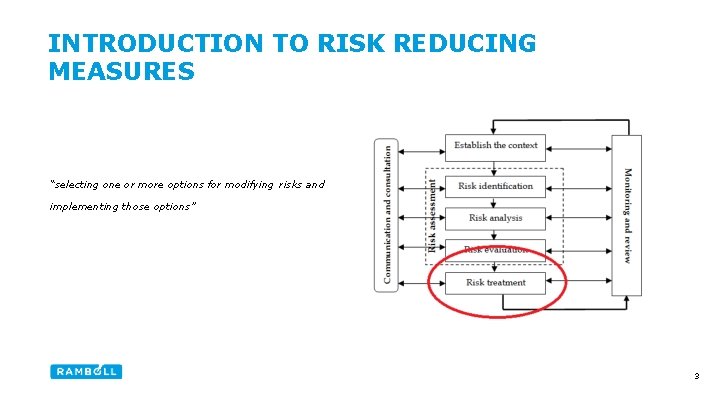
INTRODUCTION TO RISK REDUCING MEASURES “selecting one or more options for modifying risks and implementing those options” 3
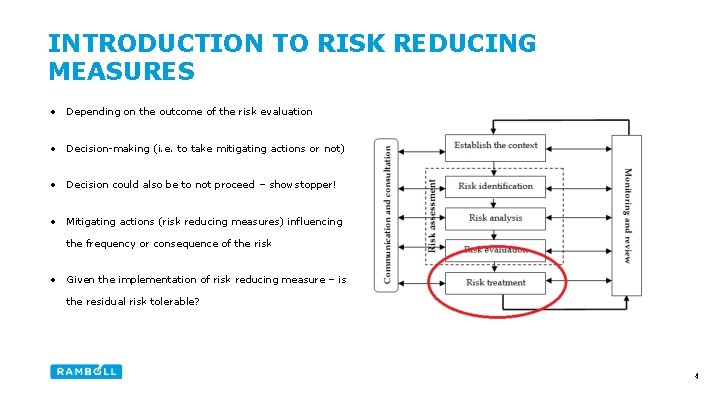
INTRODUCTION TO RISK REDUCING MEASURES • Depending on the outcome of the risk evaluation • Decision-making (i. e. to take mitigating actions or not) • Decision could also be to not proceed – showstopper! • Mitigating actions (risk reducing measures) influencing the frequency or consequence of the risk • Given the implementation of risk reducing measure – is the residual risk tolerable? 4
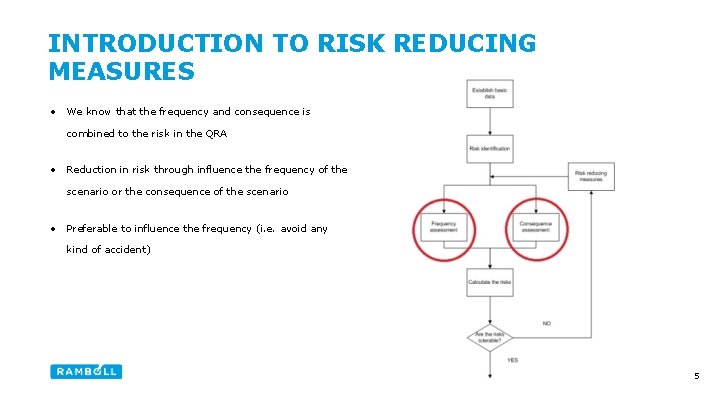
INTRODUCTION TO RISK REDUCING MEASURES • We know that the frequency and consequence is combined to the risk in the QRA • Reduction in risk through influence the frequency of the scenario or the consequence of the scenario • Preferable to influence the frequency (i. e. avoid any kind of accident) 5
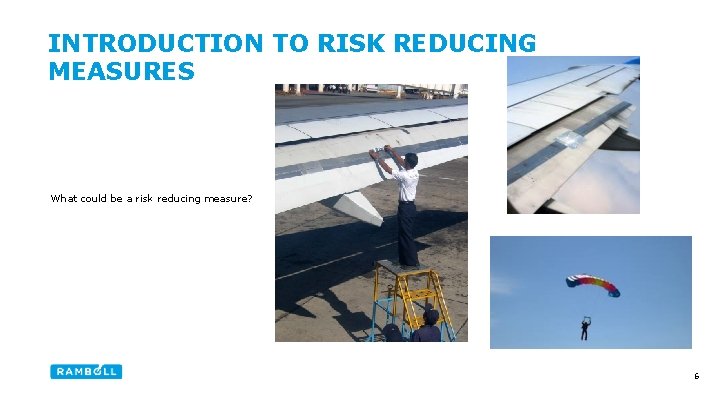
INTRODUCTION TO RISK REDUCING MEASURES What could be a risk reducing measure? 6
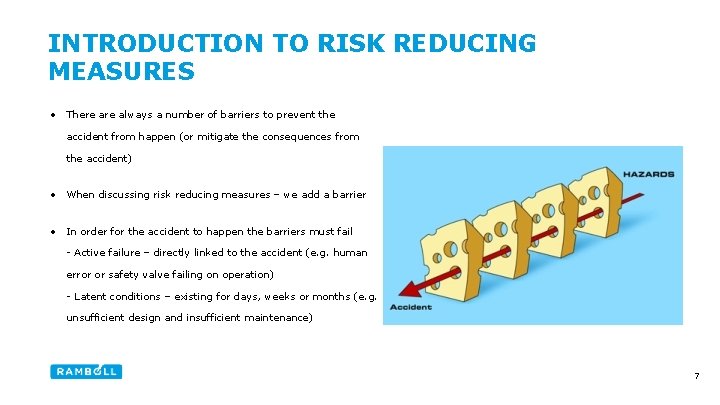
INTRODUCTION TO RISK REDUCING MEASURES • There always a number of barriers to prevent the accident from happen (or mitigate the consequences from the accident) • When discussing risk reducing measures – we add a barrier • In order for the accident to happen the barriers must fail - Active failure – directly linked to the accident (e. g. human error or safety valve failing on operation) - Latent conditions – existing for days, weeks or months (e. g. unsufficient design and insufficient maintenance) 7
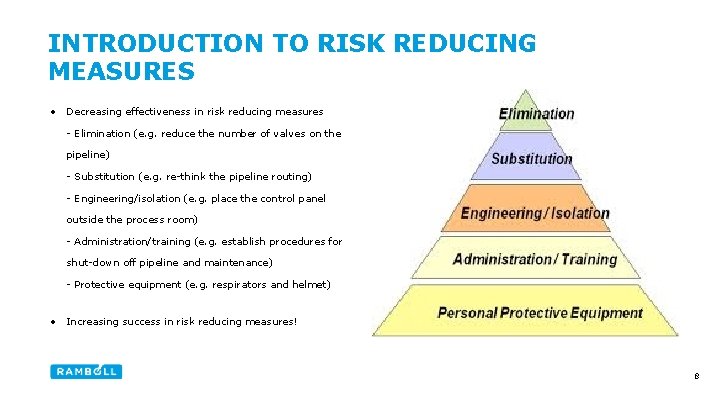
INTRODUCTION TO RISK REDUCING MEASURES • Decreasing effectiveness in risk reducing measures - Elimination (e. g. reduce the number of valves on the pipeline) - Substitution (e. g. re-think the pipeline routing) - Engineering/isolation (e. g. place the control panel outside the process room) - Administration/training (e. g. establish procedures for shut-down off pipeline and maintenance) - Protective equipment (e. g. respirators and helmet) • Increasing success in risk reducing measures! 8
INTRODUCTION TO RISK REDUCING MEASURES • Preferable risk reducing measure – elimination! • Preferable risk reducing measure – already implemented • HSE design – cross-disciplinary activities on design, risk reduction and operability - Increasing focus area - Previously design (engineering) and risk assessment (engineering) separated • The earlier risk reducing measures could be specified (compare with risk identification for early stage projects) – the easier implemented 9
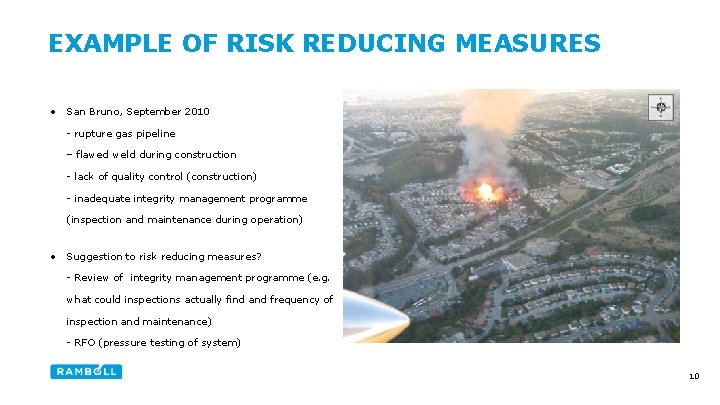
EXAMPLE OF RISK REDUCING MEASURES • San Bruno, September 2010 - rupture gas pipeline – flawed weld during construction - lack of quality control (construction) - inadequate integrity management programme (inspection and maintenance during operation) • Suggestion to risk reducing measures? - Review of integrity management programme (e. g. what could inspections actually find and frequency of inspection and maintenance) - RFO (pressure testing of system) 10
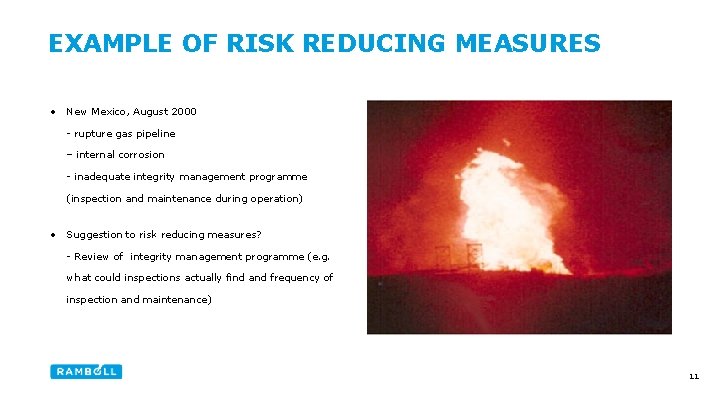
EXAMPLE OF RISK REDUCING MEASURES • New Mexico, August 2000 - rupture gas pipeline – internal corrosion - inadequate integrity management programme (inspection and maintenance during operation) • Suggestion to risk reducing measures? - Review of integrity management programme (e. g. what could inspections actually find and frequency of inspection and maintenance) 11
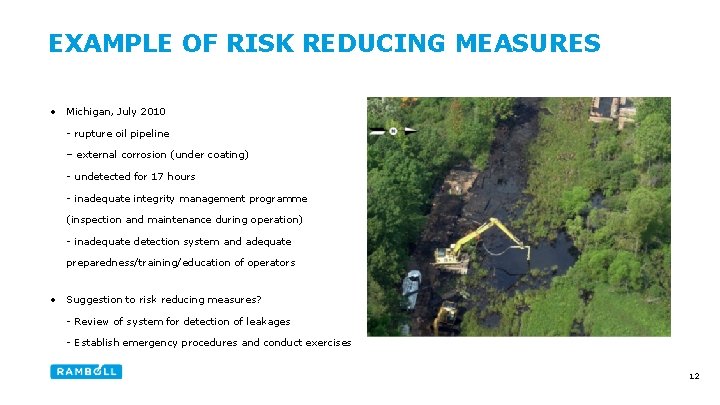
EXAMPLE OF RISK REDUCING MEASURES • Michigan, July 2010 - rupture oil pipeline – external corrosion (under coating) - undetected for 17 hours - inadequate integrity management programme (inspection and maintenance during operation) - inadequate detection system and adequate preparedness/training/education of operators • Suggestion to risk reducing measures? - Review of system for detection of leakages - Establish emergency procedures and conduct exercises 12
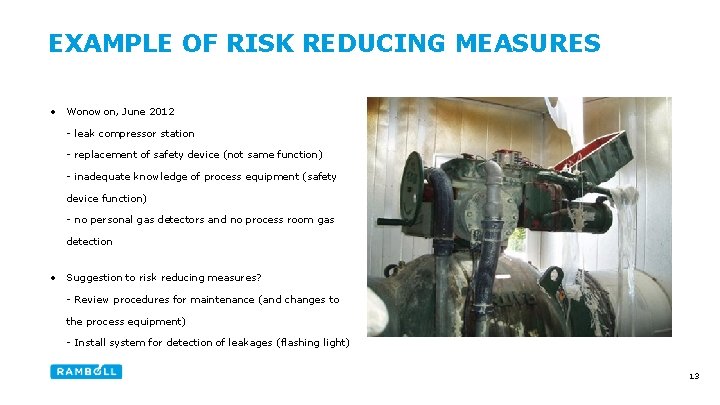
EXAMPLE OF RISK REDUCING MEASURES • Wonowon, June 2012 - leak compressor station - replacement of safety device (not same function) - inadequate knowledge of process equipment (safety device function) - no personal gas detectors and no process room gas detection • Suggestion to risk reducing measures? - Review procedures for maintenance (and changes to the process equipment) - Install system for detection of leakages (flashing light) 13
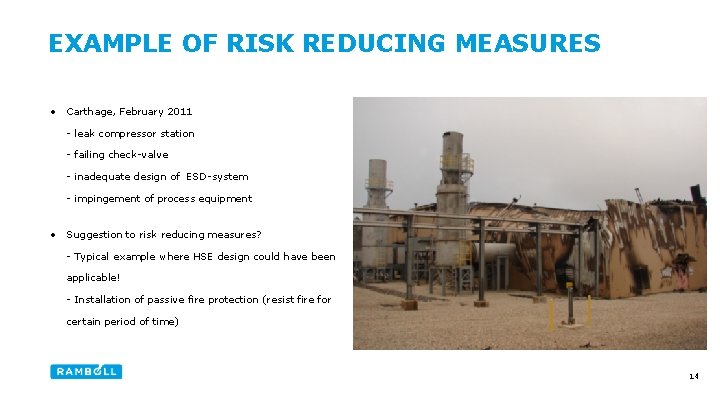
EXAMPLE OF RISK REDUCING MEASURES • Carthage, February 2011 - leak compressor station - failing check-valve - inadequate design of ESD-system - impingement of process equipment • Suggestion to risk reducing measures? - Typical example where HSE design could have been applicable! - Installation of passive fire protection (resist fire for certain period of time) 14
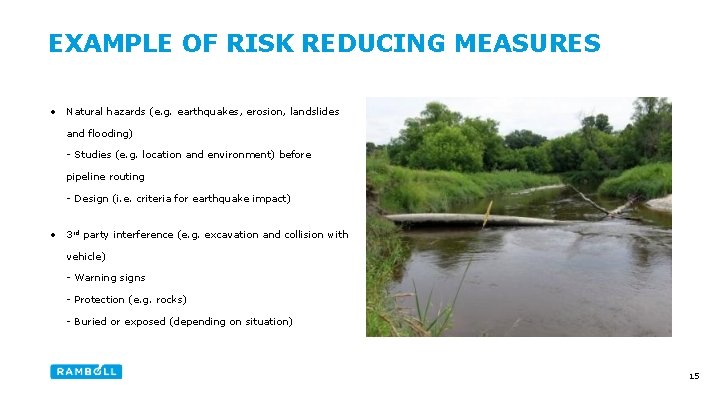
EXAMPLE OF RISK REDUCING MEASURES • Natural hazards (e. g. earthquakes, erosion, landslides and flooding) - Studies (e. g. location and environment) before pipeline routing - Design (i. e. criteria for earthquake impact) • 3 rd party interference (e. g. excavation and collision with vehicle) - Warning signs - Protection (e. g. rocks) - Buried or exposed (depending on situation) 15
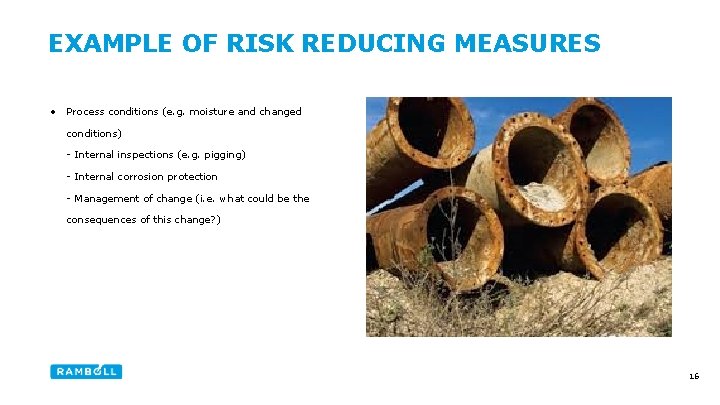
EXAMPLE OF RISK REDUCING MEASURES • Process conditions (e. g. moisture and changed conditions) - Internal inspections (e. g. pigging) - Internal corrosion protection - Management of change (i. e. what could be the consequences of this change? ) 16
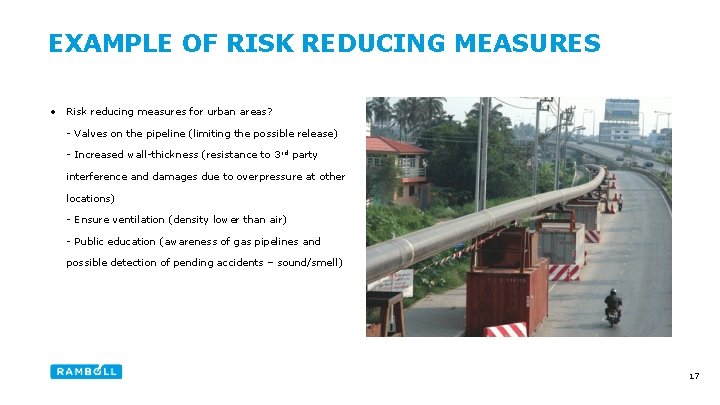
EXAMPLE OF RISK REDUCING MEASURES • Risk reducing measures for urban areas? - Valves on the pipeline (limiting the possible release) - Increased wall-thickness (resistance to 3 rd party interference and damages due to overpressure at other locations) - Ensure ventilation (density lower than air) - Public education (awareness of gas pipelines and possible detection of pending accidents – sound/smell) 17
EXAMPLE OF RISK REDUCING MEASURES • Awareness of multiple effects (and possible opposite effects) of risk reducing measures • Valves on the pipeline - Advantage – limit the release - Disadvantage – increasing release points • Buried or exposed pipeline - Easy to see or not? - Exposed to 3 rd party or not? 18
RISK REDUCING MEASURES • When is a risk tolerable (acceptable)? • What is a risk intolerable (unacceptable)? • How much risk reduction is possible? • How safe is safe enough? 19
QUESTIONS? 20