
Pipeline Hazardous Materials Safety Administration PHMSA Hazardous Materials
- Slides: 25
Pipeline & Hazardous Materials Safety Administration (PHMSA) Hazardous Materials Emergency Preparedness (HMEP) Grant Program Webinar for Tribes and Territories July 1, 2020
Agenda Purpose and Introductions Common Requests, and Post. Award Management Extensions and Updated Expenditure Allowances Other PHMSA Grants 2
Welcome Purpose: To perform continued outreach and keep open lines of communication between PHMSA and its grantees Objectives: Tribes and Territories gain knowledge on updates to the HMEP Program to increase effectiveness and ability to utilize funds. Agencies are enabled to virtually meet grantees that may have similar experiences, knowledge, and advice amongst each other. 3
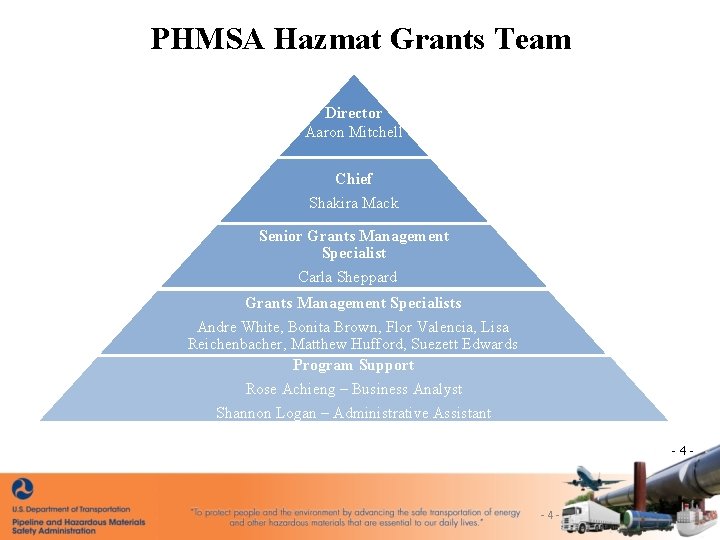
PHMSA Hazmat Grants Team Director Aaron Mitchell Chief Shakira Mack Senior Grants Management Specialist Carla Sheppard Grants Management Specialists Andre White, Bonita Brown, Flor Valencia, Lisa Reichenbacher, Matthew Hufford, Suezett Edwards Program Support Rose Achieng – Business Analyst Shannon Logan – Administrative Assistant -4 -
Frequent Topics for Post-Award Grant Management Activity Requests Cost Types Cost Sharing 5
Making Changes to your Project Plan https: //hazmatgrants. phmsa. dot. gov/ Otherwise known as a Post-Award Adjustment, Activity Requests (ARs)can be submitted to the HMEP program when the following occurs: • Budget Revision (2 CFR 200. 308) • Change in scope (2 CFR 200. 308) About the AR’s: • Common occurrence within the management of the HMEP Grant • Allows for additional approval of activities • Enables the program to provide detailed technical assistance Hot Tip Don’t forget to double check the HMEP Expenditures Guide https: //www. phmsa. dot. gov/sites/phmsa. dot. gov/files/docs/aboutphmsa/grants/hazmat/2956/2019 -hmep-expenditures-guide-032819. pdf 6
Understanding Direct and Indirect Costs Direct Costs (2 CFR, § 200. 413) • Specific • Identifiable • Incurred to provide services or products for a grant award of activity Indirect Costs (2 CFR, § 200. 414) Can not be identified for a specific grant award, service, or activity of an organization, but are incurred as a result of multiple grant awards, services, or activities. In general, Indirect Costs fall within two categories (2 CFR, § 200. 414) 1. Facilities 2. Administration *It is very important that agencies clearly segregate direct and indirect costs in the accounting system and when computing the indirect cost rate. 7
Indirect Cost Rate Agreement (ICRA) Quick Tips The HMEP Program accepts any current, active, and existing ICRA’s from another Federal agency. If an ICRA has never been certified, the 10% De Minimis Rate may be used What is the De Minimis Rate? • 10% of Modified Total Direct Costs (MTDC) • Must be used consistently across all federal awards • Does not apply to Territories Reminder: As ICRA’s expire, don’t forget to submit your most up to date ICRA HMEP. Grants@dot. gov and your Grant Specialist. 8
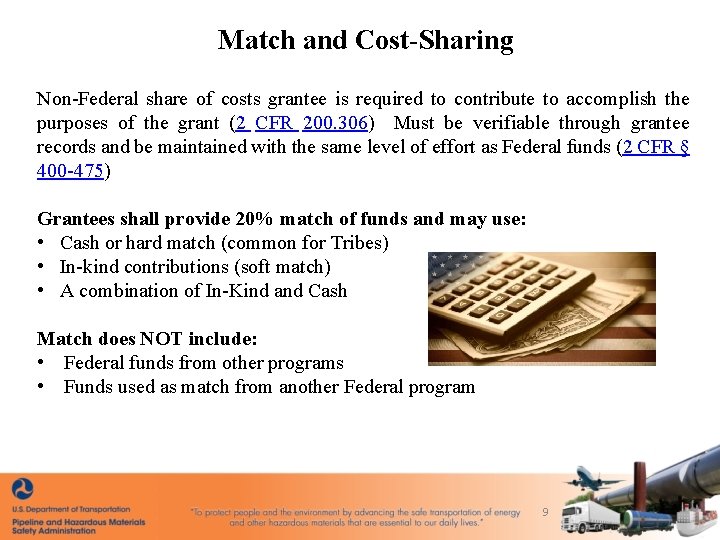
Match and Cost-Sharing Non-Federal share of costs grantee is required to contribute to accomplish the purposes of the grant (2 CFR 200. 306) Must be verifiable through grantee records and be maintained with the same level of effort as Federal funds (2 CFR § 400 -475) Grantees shall provide 20% match of funds and may use: • Cash or hard match (common for Tribes) • In-kind contributions (soft match) • A combination of In-Kind and Cash Match does NOT include: • Federal funds from other programs • Funds used as match from another Federal program 9
Cash and In-Kind Match Cash: Most common, easiest to track, and usually from general revenue, donations from non-federal third parties, or non-federal grants. In-Kind: • Value non-cash contributions • Personnel, goods, and services, including direct and indirect costs • May be in the form of real property, equipment, supplies, services, and other expendable property • Third party in-kind comes from other non-federal third parties and may also include those listed above Match Tips: • Do not overmatch • Match on the SF-425 (Financial Report) and SF-270 (invoice) shall include dollars as match is accumulated • Match is not required to be met at each invoice request, but must be fulfilled by the final invoice request 10
Performance Period Extension Request Submit an extension request as soon as you know you need more time, and at least 30 days prior to the end of your existing deadline. 1. Performance period extension requests shall be emailed to HMEP. grants@dot. gov 2. Extension Requests shall include the following: • Duration and end date of the extension request. • Grantees may request an extension up to a year. The proposed end date of the performance period must be identified in the request. • Extension date must be sufficient to complete grant activities. • For example, do not request a one month extension if remaining activities will take three months to complete. 11
Performance Period Extension Request • Justification for the extension. Grantees must provide a brief summary of the reason the extension is needed (e. g. delays in awarding subgrants, staff turnover, poor weather, state budget constraints, etc. ). • Summary and timeline of extension activities. Grantees must submit a brief summary and timeline of activities that will take place during the extended performance period. There must be a sufficient plan in place to complete the grant activities during the requested extension period. 12
HMEP Grant and COVID-19 PHMSA will allow HMEP funds to be used to purchase items related to the COVID-19 pandemic in order facilitate a safe training environment. Grantees must submit an Activity Request (AR) and receive approval prior to purchasing COVID-19 related supplies. Examples include, but are not limited to: Disposable Gloves Disinfectant Spray Soap Masks Disposable coveralls Hand Sanitizer Disinfectant wipes Paper towels Sneeze guards Contactless Thermometers • Items purchases must be used for HMEP planning or training activities and not for operational use. 13
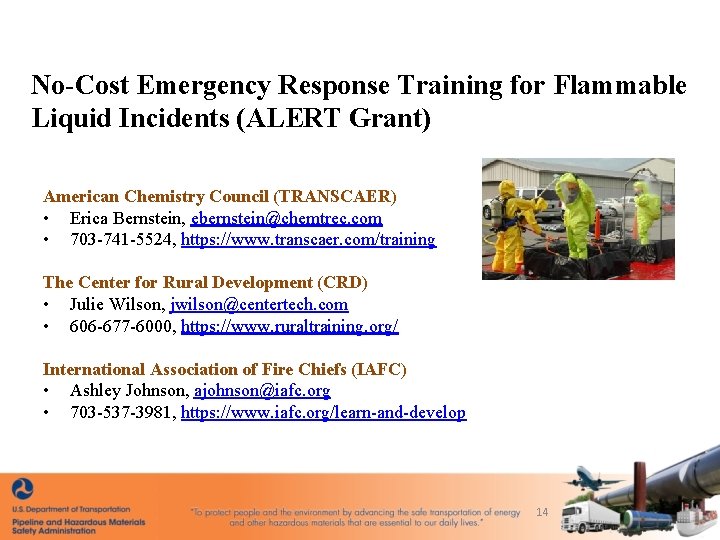
No-Cost Emergency Response Training for Flammable Liquid Incidents (ALERT Grant) American Chemistry Council (TRANSCAER) • Erica Bernstein, ebernstein@chemtrec. com • 703 -741 -5524, https: //www. transcaer. com/training The Center for Rural Development (CRD) • Julie Wilson, jwilson@centertech. com • 606 -677 -6000, https: //www. ruraltraining. org/ International Association of Fire Chiefs (IAFC) • Ashley Johnson, ajohnson@iafc. org • 703 -537 -3981, https: //www. iafc. org/learn-and-develop 14
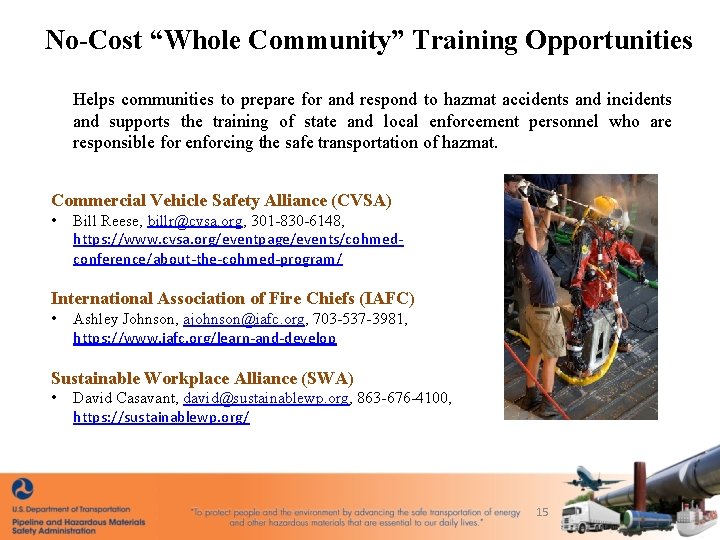
No-Cost “Whole Community” Training Opportunities Helps communities to prepare for and respond to hazmat accidents and incidents and supports the training of state and local enforcement personnel who are responsible for enforcing the safe transportation of hazmat. Commercial Vehicle Safety Alliance (CVSA) • Bill Reese, billr@cvsa. org, 301 -830 -6148, https: //www. cvsa. org/eventpage/events/cohmedconference/about-the-cohmed-program/ International Association of Fire Chiefs (IAFC) • Ashley Johnson, ajohnson@iafc. org, 703 -537 -3981, https: //www. iafc. org/learn-and-develop Sustainable Workplace Alliance (SWA) • David Casavant, david@sustainablewp. org, 863 -676 -4100, https: //sustainablewp. org/ 15
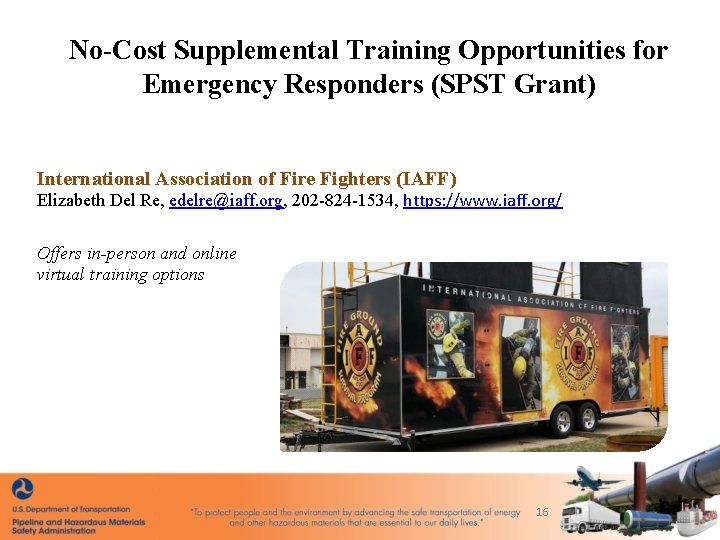
No-Cost Supplemental Training Opportunities for Emergency Responders (SPST Grant) International Association of Fire Fighters (IAFF) Elizabeth Del Re, edelre@iaff. org, 202 -824 -1534, https: //www. iaff. org/ Offers in-person and online virtual training options 16
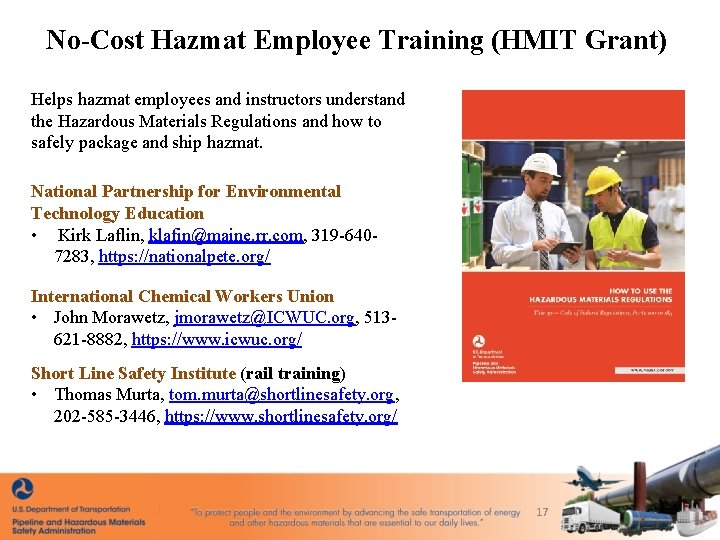
No-Cost Hazmat Employee Training (HMIT Grant) Helps hazmat employees and instructors understand the Hazardous Materials Regulations and how to safely package and ship hazmat. National Partnership for Environmental Technology Education • Kirk Laflin, klafin@maine. rr. com, 319 -6407283, https: //nationalpete. org/ International Chemical Workers Union • John Morawetz, jmorawetz@ICWUC. org, 513621 -8882, https: //www. icwuc. org/ Short Line Safety Institute (rail training) • Thomas Murta, tom. murta@shortlinesafety. org, 202 -585 -3446, https: //www. shortlinesafety. org/ 17
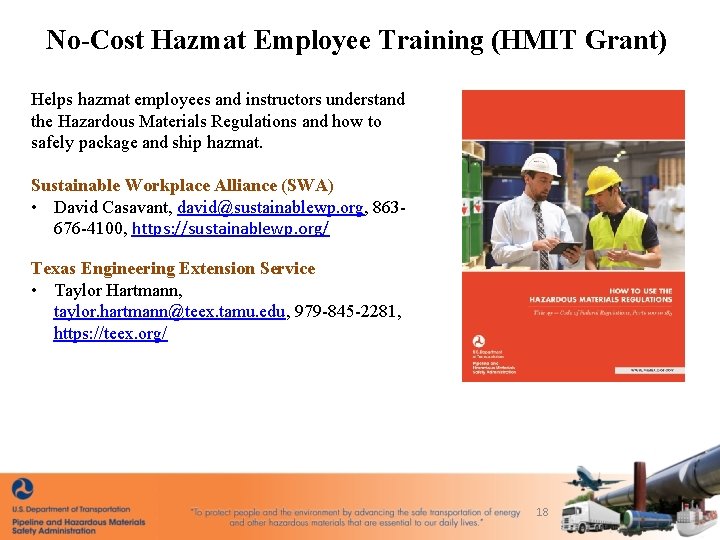
No-Cost Hazmat Employee Training (HMIT Grant) Helps hazmat employees and instructors understand the Hazardous Materials Regulations and how to safely package and ship hazmat. Sustainable Workplace Alliance (SWA) • David Casavant, david@sustainablewp. org, 863676 -4100, https: //sustainablewp. org/ Texas Engineering Extension Service • Taylor Hartmann, taylor. hartmann@teex. tamu. edu, 979 -845 -2281, https: //teex. org/ 18
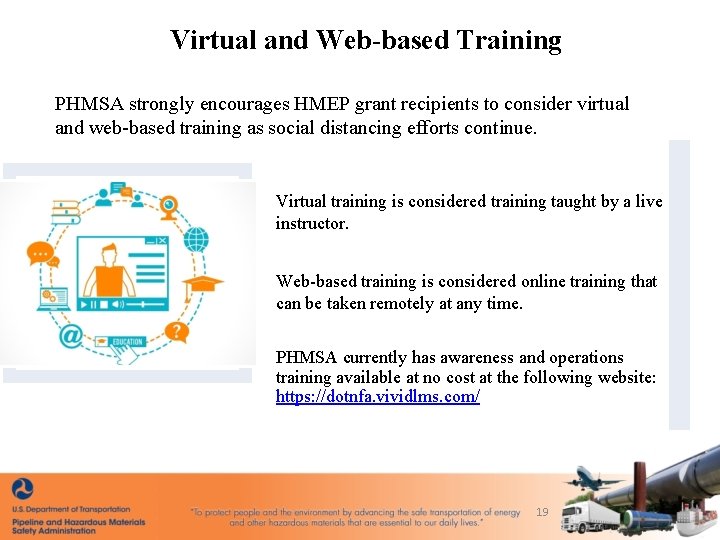
Virtual and Web-based Training PHMSA strongly encourages HMEP grant recipients to consider virtual and web-based training as social distancing efforts continue. Virtual training is considered training taught by a live instructor. Web-based training is considered online training that can be taken remotely at any time. PHMSA currently has awareness and operations training available at no cost at the following website: https: //dotnfa. vividlms. com/ 19
Overtime and Backfill Costs PHMSA will now allow HMEP recipients to be reimbursed for Overtime and Backfill Costs • These costs must be related to an HMEP training activity. • Planning activities are not eligible. • Grant recipients must retain a list of all individuals involved in these costs and their salary (individual trained and individual backfilling) • Grant recipients must provide PHMSA with an internal management plan to ensure adequate oversight for these costs prior to the activity occurring. • Volunteer stipends will also be allowed provided that grant recipients provide PHMSA with documentation showing how the stipend amount was determined. Prior-approval must be received before issuing stipends. 20
Hazmat Grant Program Contact Information General Grant Inquiries: HMEP. Grants@dot. gov Website: www. phmsa. dot. gov/hazmat/grants General Phone Number: (202)366 -1109 Chief: Shakira Mack, (202) 366 -5090, Shakira. Mack@dot. gov Team Lead: Carla Sheppard, (202) 366 -2738, Carla. Sheppard@dot. gov - 21 -
22
Q&A 1. Does PHMSA have a list of allowable COVID-19 items that can be purchased with HMEP funds? v No, currently we do not have a list of allowable COVID-19 items that can be purchased with HMEP fund; however as we receive request and approve COVID-19 purchases we will start compiling a list and share it with our grantees. 2. Can we purchase laptops to facilitate virtual trainings? v Yes, laptop purchases for HMEP approved activities are allowable. PHMSA will review each request to ensure that the costs per unit is reasonable. 3. Is internet subscription to facilitate the virtual trainings allowable cost to the HMEP grant? v Yes, internet subscription is an allowable cost to the HMEP grant program. However, PHMSA may not cover a 100% of the cost if the services will be used for more than conducting the approved HMEP activities. 23
Q&A 4. Does virtual training has to be a combination of hazmat transportation related and nontransportation related or can it be one or the other ? v No, trainings can be a combination or it can be only hazmat transportation related type of virtual trainings. HMEP does not allow trainings that does not have a component of the hazmat transportation related tie in. If a grantee is conducting a training that has a component of the hazmat transportation tie-in then PHMSA will cover a percentage of the cost based of how much of the training is HMEP related. 5. Are there significant differences between the states and tribes? v The biggest difference between the states and the tribes is performance period. Tribes are on a one year performance period, while the states are on a three year performance period. The one year performance period for tribes allow tribes that do not have an HMEP grant an opportunity to apply for the HMEP grant. 24
Q&A 5. If we are requesting an extension on an older grant performance period, do we also need to request an extension on the current grant performance period? v The territories are on a 3 year performance period with the states. All HMEP territories received an extension for their FY 16 -18 grant until September 30, 2020, so there is no need to submit an extension request at this time. For the FY 19 -21 grant cycle, the performance period does not end until September 29, 2022 so no extension is needed. v The tribes are on a 1 year performance period. Tribes can request an extension for any active grant cycle. 6. Can we have activities run concurrently using both the older and current grant? v Yes, you can use grant funds from two active grant cycle to fund an approved HMEP activity. 7. We had travel in our grant. Any advice? v Due to COVID-19 a grantees have suspended any travel that they had planned for the HMEP grant. Those funds that were allocated for travel can be repurposed for other things such as COVID-19 supplies for future HMEP trainings, or virtual platforms to conduct virtual trainings. If you are repurposing the funds remember that you must submit an activity request and receive approval prior to expending those funds for the new activity. 25