
PIPE WALL THICKNESS Pipe wall thickness is selected
- Slides: 7
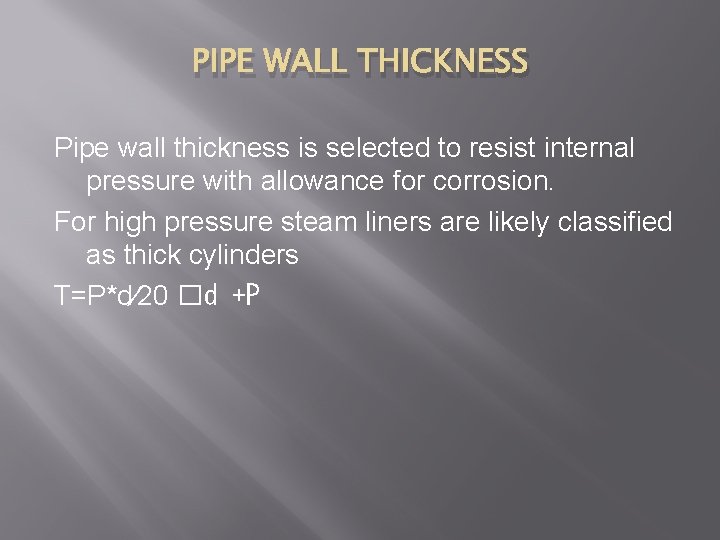
PIPE WALL THICKNESS Pipe wall thickness is selected to resist internal pressure with allowance for corrosion. For high pressure steam liners are likely classified as thick cylinders T=P*d⁄20 �d +P
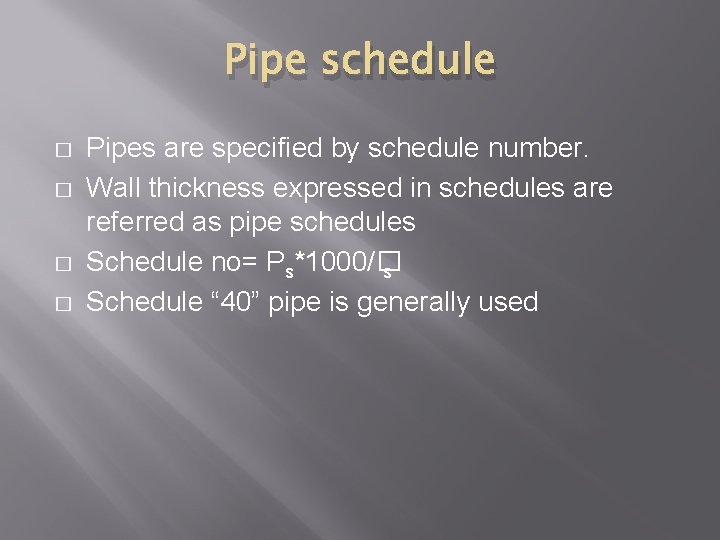
Pipe schedule � � Pipes are specified by schedule number. Wall thickness expressed in schedules are referred as pipe schedules Schedule no= Ps*1000/� s Schedule “ 40” pipe is generally used
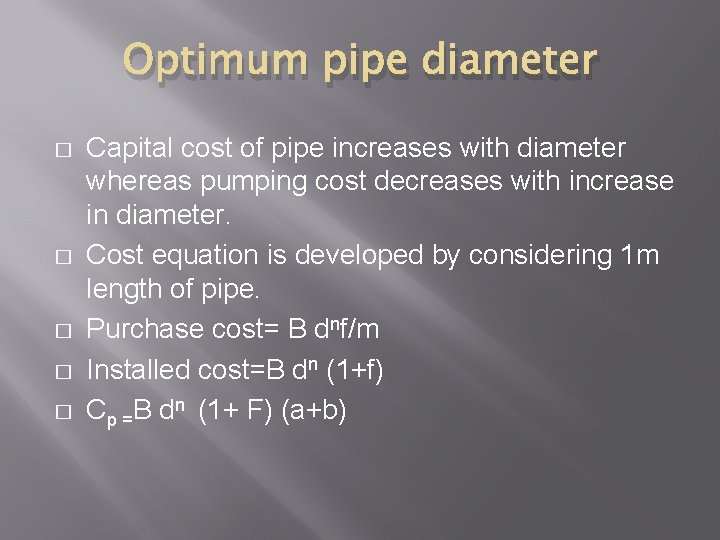
Optimum pipe diameter � � � Capital cost of pipe increases with diameter whereas pumping cost decreases with increase in diameter. Cost equation is developed by considering 1 m length of pipe. Purchase cost= B dnf/m Installed cost=B dn (1+f) Cp =B dn (1+ F) (a+b)
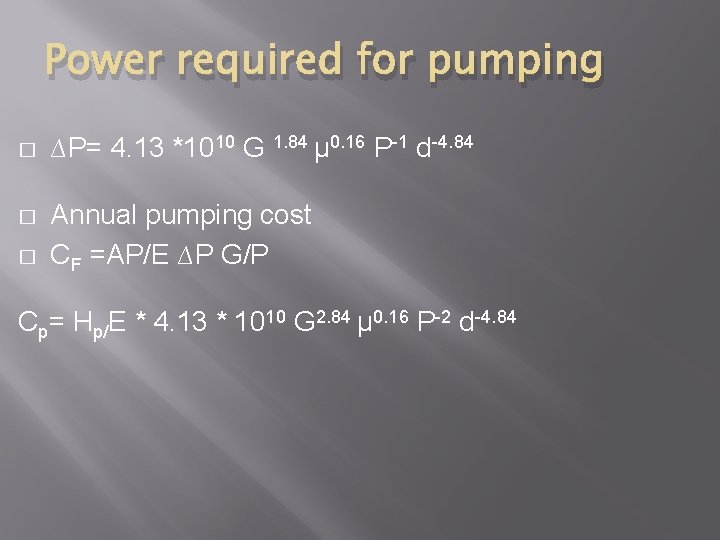
Power required for pumping � ∆P= 4. 13 *1010 G 1. 84 µ 0. 16 Ρ-1 d-4. 84 � Annual pumping cost CF =AP/E ∆P G/Ρ � Cp= Hp/E * 4. 13 * 1010 G 2. 84 µ 0. 16 Ρ-2 d-4. 84
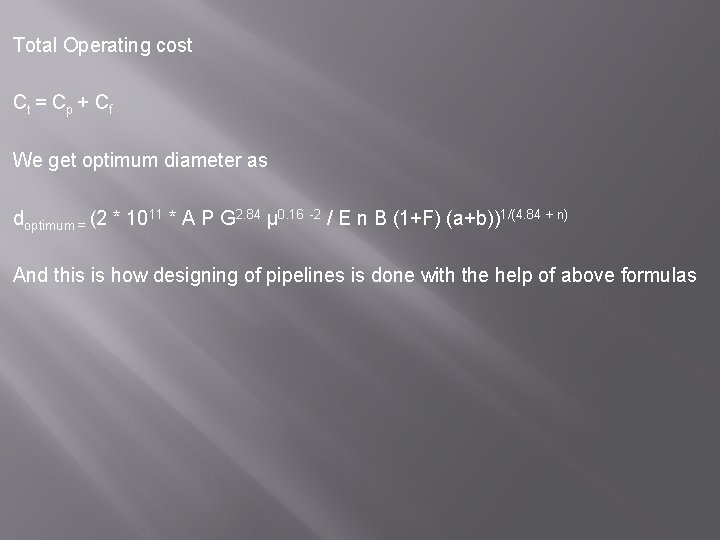
Total Operating cost Ct = C p + C f We get optimum diameter as doptimum = (2 * 1011 * A P G 2. 84 µ 0. 16 -2 / E n B (1+F) (a+b))1/(4. 84 + n) And this is how designing of pipelines is done with the help of above formulas
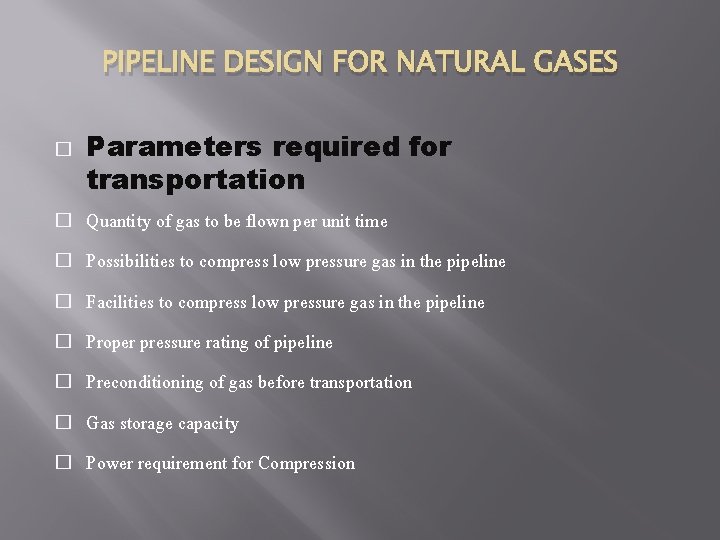
PIPELINE DESIGN FOR NATURAL GASES � � � � Parameters required for transportation Quantity of gas to be flown per unit time Possibilities to compress low pressure gas in the pipeline Facilities to compress low pressure gas in the pipeline Proper pressure rating of pipeline Preconditioning of gas before transportation Gas storage capacity Power requirement for Compression
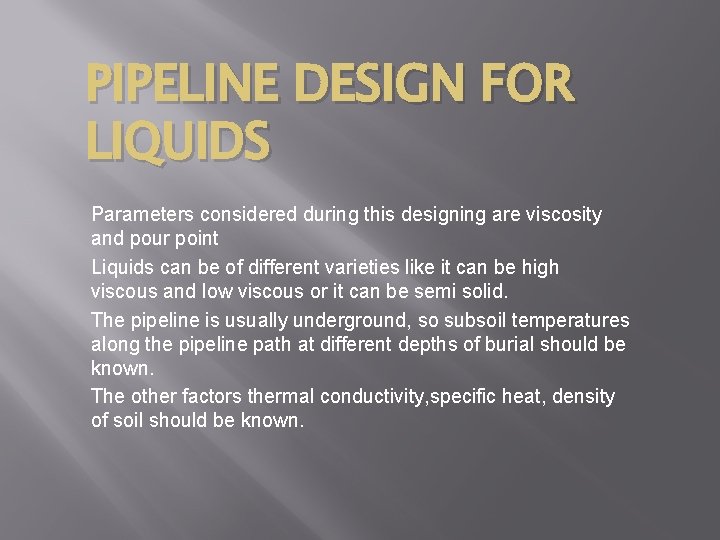
PIPELINE DESIGN FOR LIQUIDS Parameters considered during this designing are viscosity and pour point Liquids can be of different varieties like it can be high viscous and low viscous or it can be semi solid. The pipeline is usually underground, so subsoil temperatures along the pipeline path at different depths of burial should be known. The other factors thermal conductivity, specific heat, density of soil should be known.