
Pipe Rehabilitation by Trenchless Technology Introduction Ref HKIUSGEN020
Pipe Rehabilitation by Trenchless Technology Introduction Ref: HKIUS-GEN-020 Update: 13 April 2011 1

Why Pipe Rehabilitation (PR) • HK supplies portable and salt water through a water mains of more than 7200 km • 45% of the underground system are built 30 years ago approaching the end their service life • New service life/ design life is ≥ 50 years Ref: HKIUS-GEN-020 Update: 13 April 2011 2
Four stages to solve pipe problems ØDetermine the standard of performance needed ØIdentify the pipe problems via various surveys ØAccording to the problems, determine the rehabilitating solution ØImplement the rehabilitation and assess the effect (continued) Ref: HKIUS-GEN-020 Update: 13 April 2011 3
Strategies to Solve Pipe Problems Using 4 R Strategy Ø Right Skilled Persons – Skilled persons or Utilities Specialists can identify the Ø Right Planning/ Preparation Ø Right Equipment Ø Right Price Ref: HKIUS-GEN-020 pipe problem(s) by various survey methods i. e. CCTV, Pipe Condition Survey, Water Leakage Investigation Method(s) - Determine required standards - Based on the problem defined and required standards; Plan/Prepare the best rehabilitation method to overcome it - Implement the determined rehabilitation works in a most efficient/effective way - Tender Price should include all 3 R mentioned above - Adopt the right planning/preparation, right equipment then implementation by right skilled persons/Utilities Specialists, the determined pipe rehabilitation works could be completed on time, efficient and within cost budget Update: 13 April 2011 4
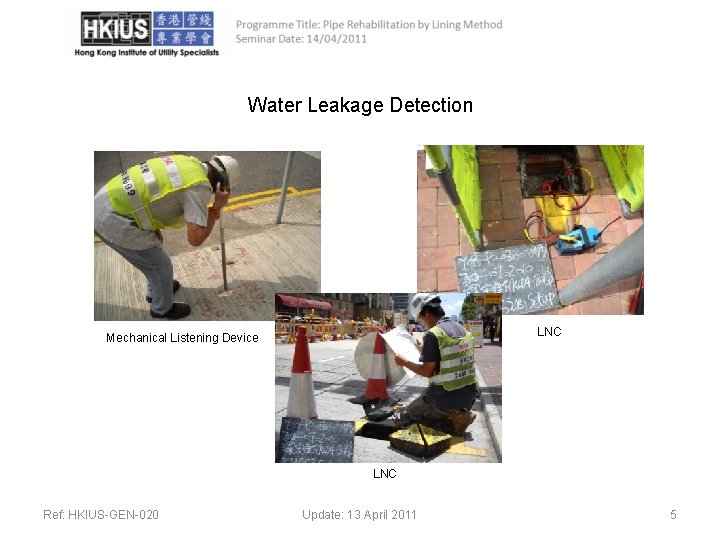
Water Leakage Detection LNC Mechanical Listening Device LNC Ref: HKIUS-GEN-020 Update: 13 April 2011 5
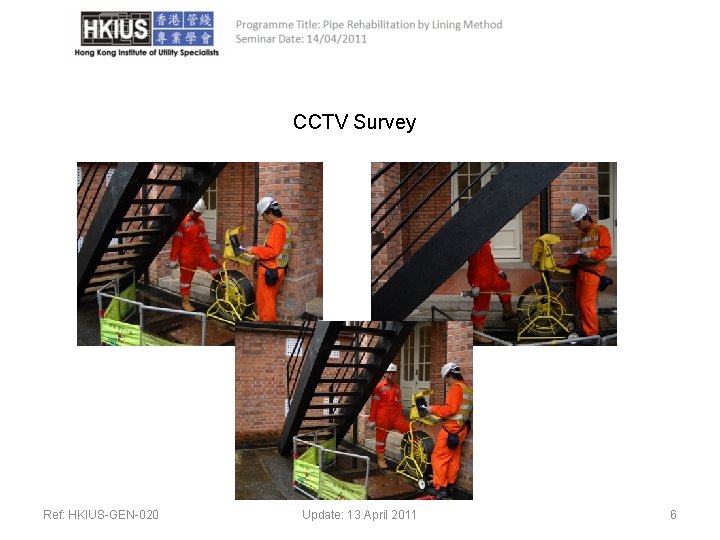
CCTV Survey Ref: HKIUS-GEN-020 Update: 13 April 2011 6
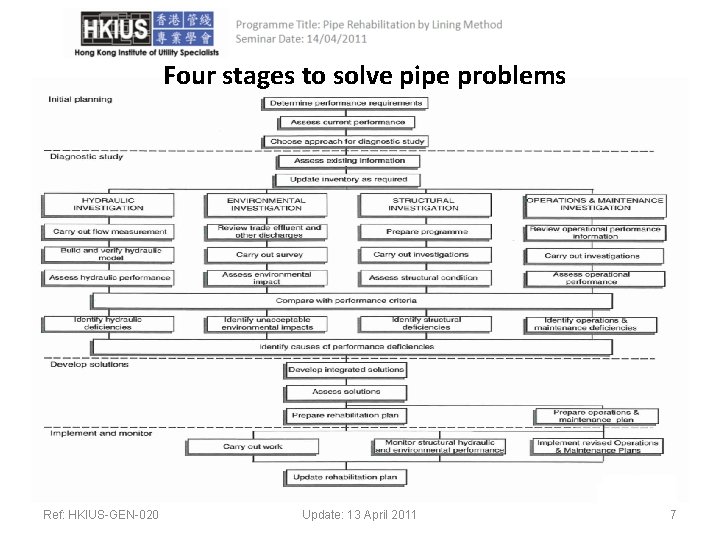
Four stages to solve pipe problems Ref: HKIUS-GEN-020 Update: 13 April 2011 7
Why Trenchless Technology (TT) • PR can be divided into pipe trench digging and TT • Advantages of TT over pipe trench digging: – Less open digs, less disturbance to traffic and public – More Economic – Faster installation Ref: HKIUS-GEN-020 Update: 13 April 2011 8

Types of TT • Two basic types: – If the pipe has serious structural problem → trenchless construction methods (TCM) – TCM: install a new pipe – If the pipe’s problem is structural but non-crucial → trenchless renewal methods (TRM) – TRM: renew the old pipe (Continued) Ref: HKIUS-GEN-020 Update: 13 April 2011 9
Types of TT We will only focus on 3 trenchless renewal methods/ lining methods: ØCured-in-place pipe (CIPP) ØSliplining (SL) ØClose-fit pipe (CFP) Ref: HKIUS-GEN-020 Update: 13 April 2011 10
Applications of TT • • • Sanitary sewer and waste pipelines Potable water, drainage and irrigation pipelines Gas transmission pipelines Industrial process pipelines Electrical conduits and marine vessel pipes (Continued) Ref: HKIUS-GEN-020 Update: 13 April 2011 11
Applications of TT • • Oilfield and containment pipelines Nuclear facility cooling systems Force mains and slurry pipelines High-rise building utilities (seldom use in H. K. ) Ref: HKIUS-GEN-020 Update: 13 April 2011 12
Limitations of TT • Size: 100 – 2800 mm in dia. , however it is not cost effective for bigger size due to cost of materials • Pull in area required for Slip Lining • Scaffold tower required for water curing process. • Diversion required for most systems. (Continued) Ref: HKIUS-GEN-020 Update: 13 April 2011 13
Limitations of TT • Temporary Traffic Arrangement required for most systems especially those using water or steam for curing process. • Polyester Resin may be adversely affected by water until they have cured. Ref: HKIUS-GEN-020 Update: 13 April 2011 14
Rehabilitation Design Considerations • • Type of pipe problem Pressure or gravity pipe Lining material to be applied Pipe characteristics: – Pipe diameter – Pipe shape – Pipeline with or without lateral connections – Straight or bended pipe – Varying or uniform pipe cross-sections, etc. (Continued) Ref: HKIUS-GEN-020 Update: 13 April 2011 15
Rehabilitation Design Considerations • • Lining installation length Type of fluid carried by the pipe Design life Cost, etc. Ref: HKIUS-GEN-020 Update: 13 April 2011 16
Polymeric materials for the liner of PR • Common materials for liner: – Polyethylene (PE) – Polyvinylchloride (PVC) – Glass reinforced plastic (GRP) (also named as fiberglass) – Polyester resin – Polyurethane (PU) – Etc. Ref: HKIUS-GEN-020 Update: 13 April 2011 17
Common Preparations Before Insertion of liner for Different Linings • Pits excavation & Preparation (the launch and reception pits or manholes for the insertion of the liner) • Pre-installation cleaning • Followed by a CCTV inspection (Continued) Ref: HKIUS-GEN-020 Update: 13 April 2011 18
Common Preparations Before Insertion of liner for Different Linings • The openings or connections in the middle of the pipe should be closed and not be in operation • Bypassing the existing flow/over-pumping if too long water suspension period or too large flow discharge rate Ref: HKIUS-GEN-020 Update: 13 April 2011 19
Launching & Receiving Pit / Manhole • The entry pit or manhole is the highest point in the pipeline to be renovated. This is the position of the support truck. • The winch (if necessary) is positioned at the reception manhole or pit to pull in the pipe. (Continued) Ref: HKIUS-GEN-020 Update: 13 April 2011 20
Launching & Receiving Pit / Manhole • The launching pit should be constructed to allow enough space for reconnecting lining into the available network. • The receiving pit should be constructed to allow enough space for winch accommodation and pipe reversion. Ref: HKIUS-GEN-020 Update: 13 April 2011 21
Pre-installation Cleaning • To remove all internal dirt, tuberculation and debris to promote bond between liner or grout and the inner wall of the existing pipe • High pressure water jetting is usually used • For the case of portable water pipe, the cleaning equipment need to be first sterilized Ref: HKIUS-GEN-020 Update: 13 April 2011 22
CCTV Inspection • After cleaning, the pipeline for lining undergoes a CCTV inspection and a video is taken (Continued) Ref: HKIUS-GEN-020 Update: 13 April 2011 23
CCTV Inspection • To check and note: – The pipe material & condition – The level of cleanliness – Location of all existing bends and defects – Location of any openings or connections in the middle of the pipe Ref: HKIUS-GEN-020 Update: 13 April 2011 24
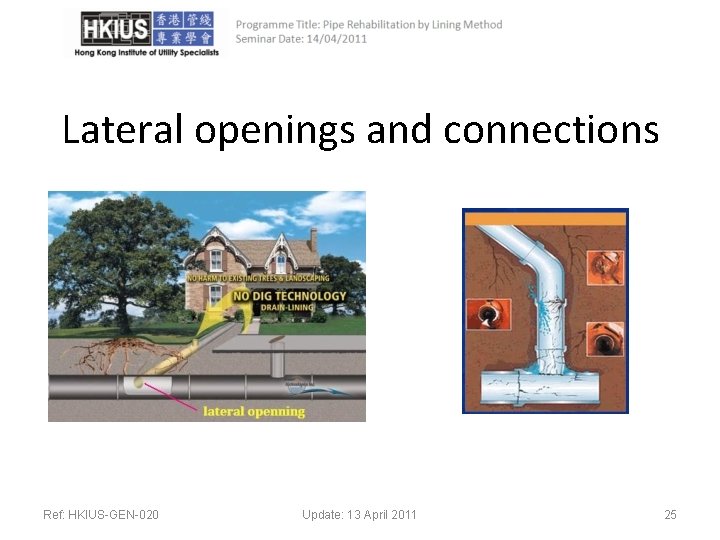
Lateral openings and connections Ref: HKIUS-GEN-020 Update: 13 April 2011 25
Pipe Rehabilitation by Trenchless Technology Cured-in-pipe (CIPP) Ref: HKIUS-GEN-020 Update: 13 April 2011 26
CIPP - Application • Applied to pipe diameter of 75 mm to 2500 mm • For both structural and non-structural pipe problem • Used in a wide range of pipes: sewers, portable water pipes, gas pipes, etc. • More common for gravity pipe than high pressure pipe • However, in HK, commonly for sewers and cooling mains Ref: HKIUS-GEN-020 Update: 13 April 2011 27
CIPP - Main Component of Liner • Main component of CIPP (liner): – a thermosetting resin system – and a flexible fabric tube (for carrying and supporting the resins till it is installed and cured) – Impermeable coating(not a must) (Continued) Ref: HKIUS-GEN-020 Update: 13 April 2011 28
CIPP - Main Component of Liner • 3 types of resin: – Unsaturated polyester – Vinyl ester – Epoxy • Material for fabric tube can be: – Nonwoven – Woven (Continued) Ref: HKIUS-GEN-020 Update: 13 April 2011 29
CIPP - Main Component of Liner • Impermeable coatings are commonly used on the exterior, or interior, or both of the tube to protect the resin during installation Ref: HKIUS-GEN-020 Update: 13 April 2011 30
CIPP - Key Steps of Liner Installation 1. Bypass the existing flow and clean the existing pipe by pipe jetting 2. CCTV inspection 3. Impregnation of the CIPP liner 4. Liner insertion by water inversion or compressed air inversion or winch cable pulling method 5. Curing by hot water or steam 6. Cool down, reconnect later connections and CCTV inspection Ref: HKIUS-GEN-020 Update: 13 April 2011 31
CIPP - Preparation of Liner • Steps of preparing CIPP liner: – Cut the liner to correct length – The resin is mixed with catalysts and retarder by electrical stirring equipment until thoroughly mixed – Impregnation: pump in the resin mix into the fabric tube. – The resin mix is spread evenly throughout by using calibration rollers (Continued) Ref: HKIUS-GEN-020 Update: 13 April 2011 32
CIPP - Preparation of Liner • Remarks: – All air is vacuumed out of the fabric tube as this allow resin to soak thoroughly into the tube – Impermeable coatings or other protective membrane must be applied as a pre-liner to protect the resin if CCTV shows infiltration occur (Continued) Ref: HKIUS-GEN-020 Update: 13 April 2011 33
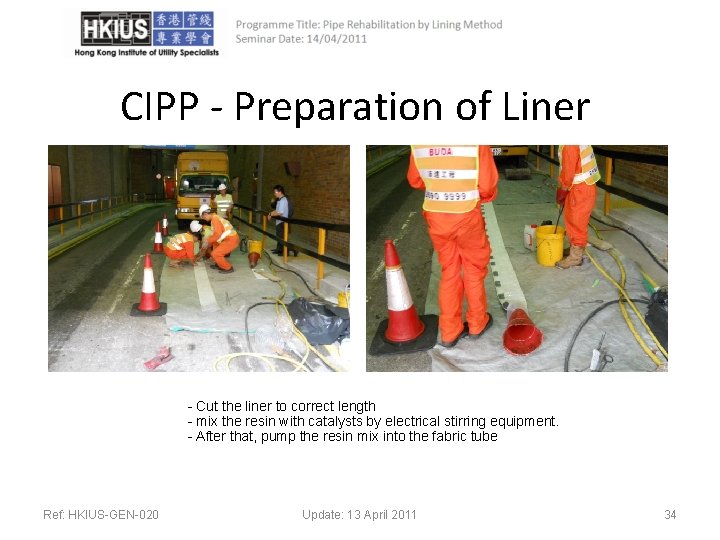
CIPP - Preparation of Liner - Cut the liner to correct length - mix the resin with catalysts by electrical stirring equipment. - After that, pump the resin mix into the fabric tube Ref: HKIUS-GEN-020 Update: 13 April 2011 34
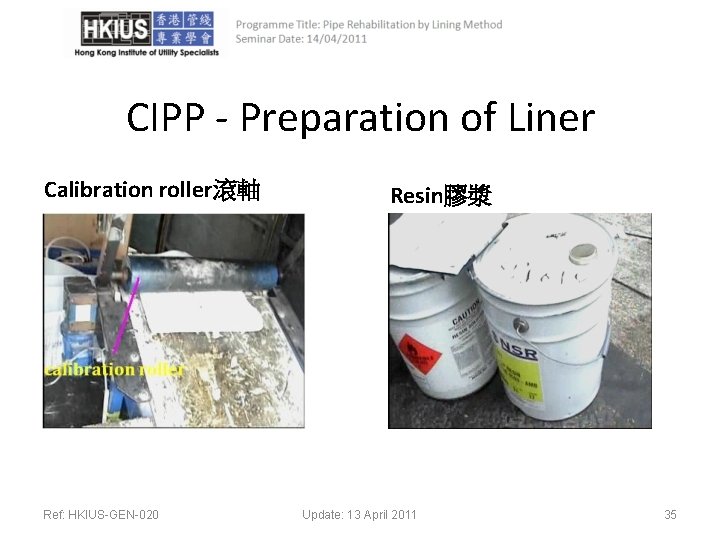
CIPP - Preparation of Liner Calibration roller滾軸 Ref: HKIUS-GEN-020 Resin膠漿 Update: 13 April 2011 35
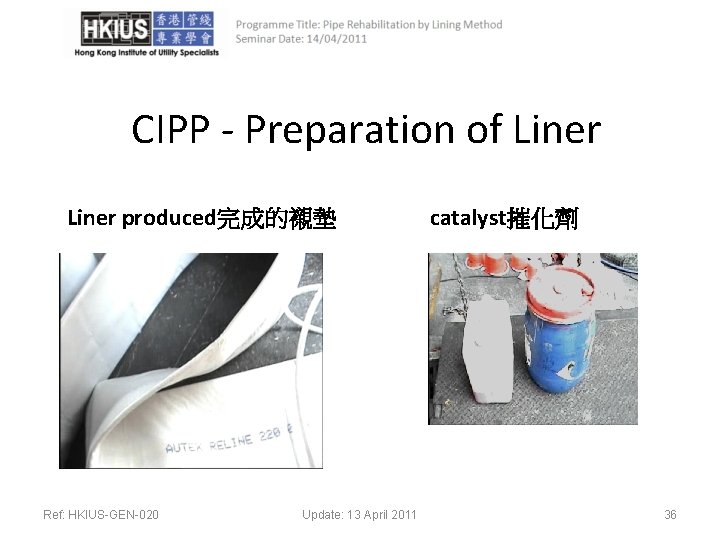
CIPP - Preparation of Liner produced完成的襯墊 Ref: HKIUS-GEN-020 Update: 13 April 2011 catalyst摧化劑 36
CIPP - Installation & Curing Methods • 3 different installation methods to insert the liner into the existing pipe: – Water inversion – Compressed air inversion – Winch pulling method (Continued) Ref: HKIUS-GEN-020 Update: 13 April 2011 37
CIPP - Installation & Curing Methods • 3 curing methods to cure liner with existing pipe: – Hot water curing – Steam curing – UV light curing (less common in HK) Ref: HKIUS-GEN-020 Update: 13 April 2011 38
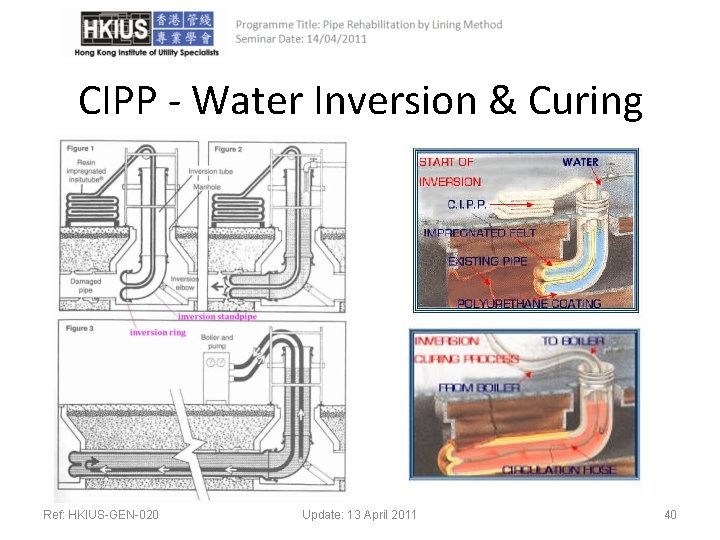
CIPP - Water Inversion & Curing • Insertion by water inversion : 1. 2. 3. 4. 5. 6. The end of liner is turned inside out and clamped around an inversion ring forming a turnback The turnback head around the ring is fitted to an inversion standpipe (also named as inversion tube) from the top of it The standpipe with turnback is connected to the existing pipe Water is then introduced into the standpipe and therefore onto the turnback Liner starts to turn inside out along the existing pipe and against the pipe wall A cable is attached to the end of the liner to guide the inversion (Continued) Ref: HKIUS-GEN-020 Update: 13 April 2011 39
CIPP - Water Inversion & Curing Ref: HKIUS-GEN-020 Update: 13 April 2011 40
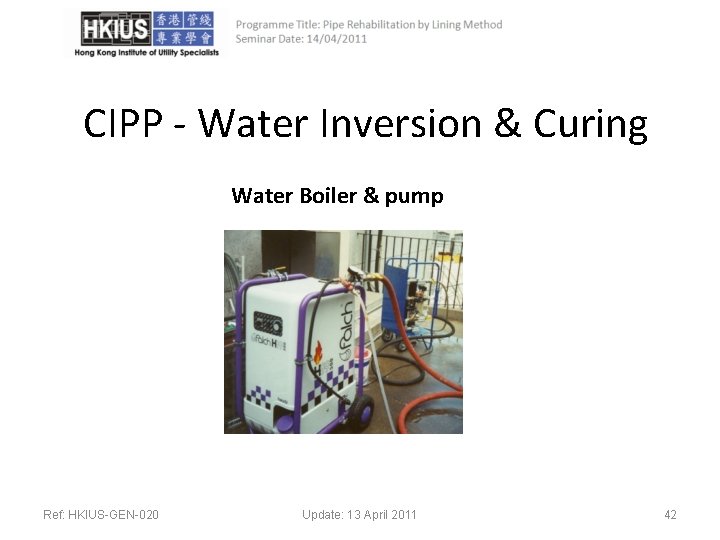
CIPP - Water Inversion & Curing • For water inversion, only hot water curing can be applied: – The water in liner is circulated to a water filtration unit and then mobile water boiler by a water circulation pump system – Water is heated by the boiler to the curing temperature (e. g. 65°C to 90°C for epoxy resin) gradually to achieve a controlled curing – Hot water circulates back to liner through a hose – Curing time (several hour usually) depends on: • The power of the boiler • The length and diameter of the pipe to be cured (Continued) Ref: HKIUS-GEN-020 Update: 13 April 2011 41
CIPP - Water Inversion & Curing Water Boiler & pump Ref: HKIUS-GEN-020 Update: 13 April 2011 42
CIPP – compressed air Inversion & Curing • Insertion by compressed air inversion: – The liner with resin is drawn into a reversing drum – The end of the liner is turned inside out and connected to the reversing flange on the outside of the drum – Reversion is by driving air into the turnback and air pressure force the liner forward along the wall of the existing pipe – A pulling cable is attached to the liner’s end to guide the inversion (Continued) Ref: HKIUS-GEN-020 Update: 13 April 2011 43
CIPP – compressed air Inversion & Curing • For compressed air inversion, hot water or steam curing can be applied (Continued) Ref: HKIUS-GEN-020 Update: 13 April 2011 44
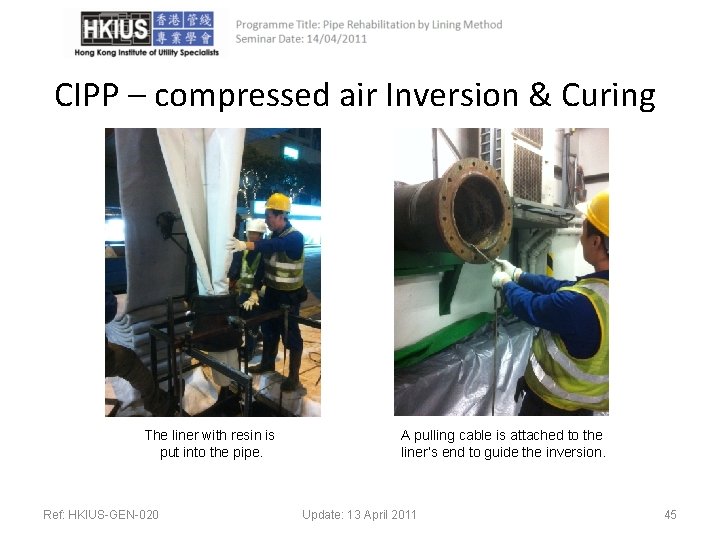
CIPP – compressed air Inversion & Curing The liner with resin is put into the pipe. Ref: HKIUS-GEN-020 A pulling cable is attached to the liner’s end to guide the inversion. Update: 13 April 2011 45
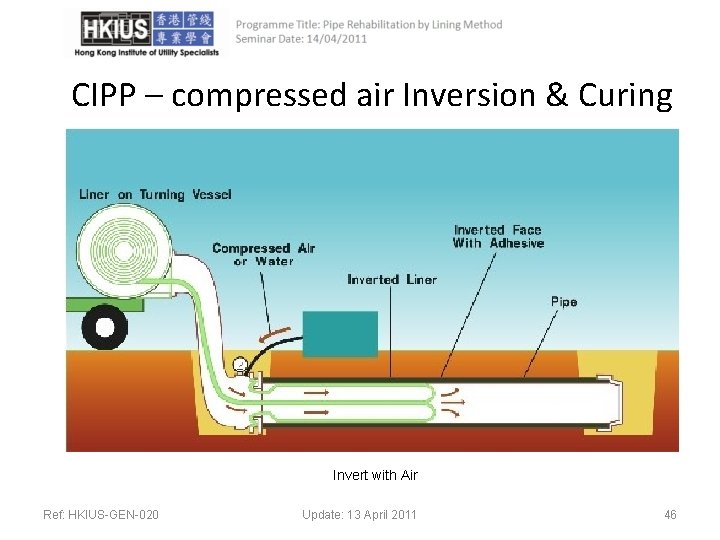
CIPP – compressed air Inversion & Curing Invert with Air Ref: HKIUS-GEN-020 Update: 13 April 2011 46
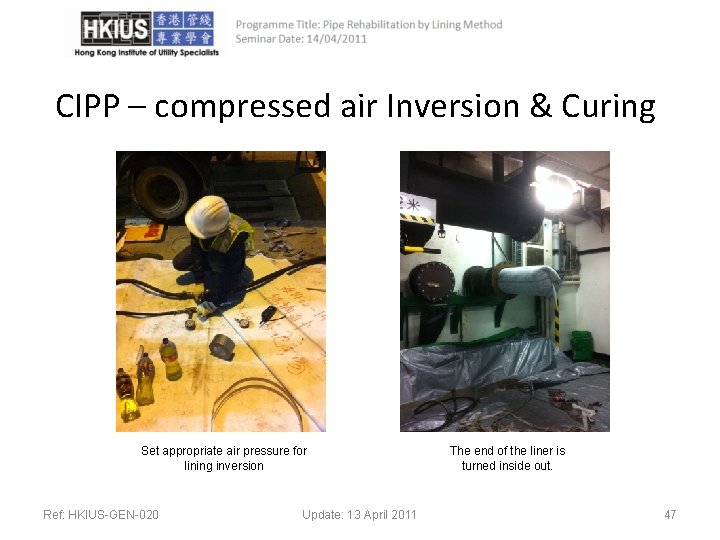
CIPP – compressed air Inversion & Curing Set appropriate air pressure for lining inversion Ref: HKIUS-GEN-020 Update: 13 April 2011 The end of the liner is turned inside out. 47
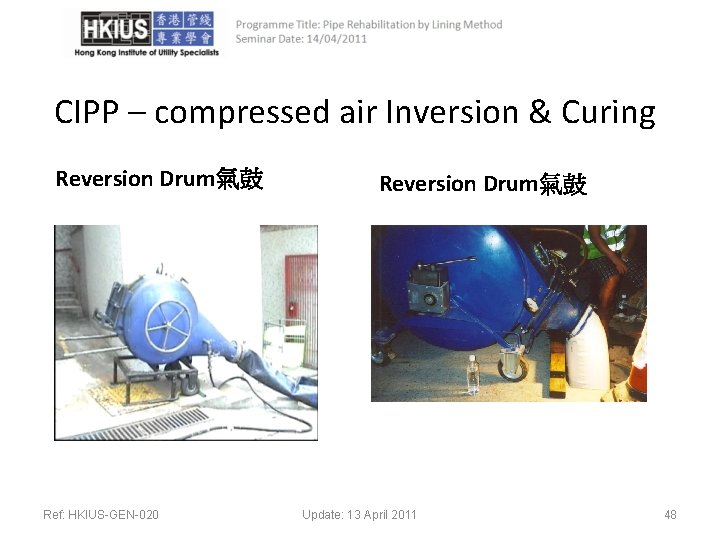
CIPP – compressed air Inversion & Curing Reversion Drum氣鼓 Ref: HKIUS-GEN-020 Reversion Drum氣鼓 Update: 13 April 2011 48
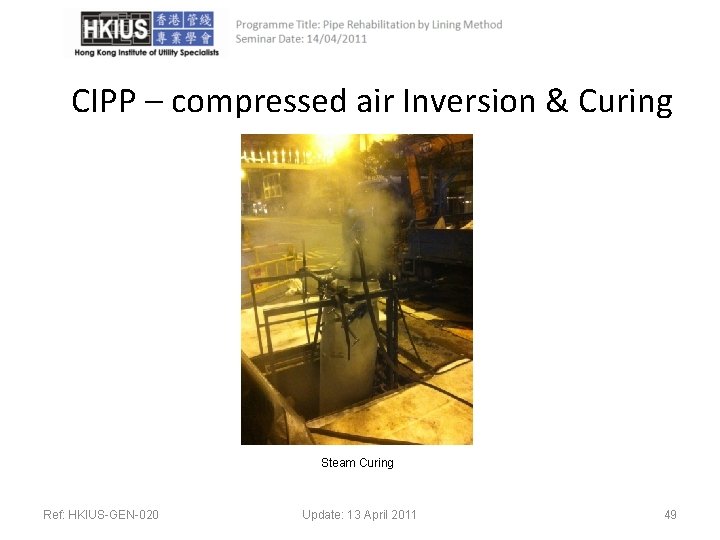
CIPP – compressed air Inversion & Curing Steam Curing Ref: HKIUS-GEN-020 Update: 13 April 2011 49
CIPP – compressed air Inversion & Curing • For steam curing: – When liner is in place, the within pressure is released – Then steam from a mini steam generator and through a compressor is circulated into the liner by pumping system with hose Ref: HKIUS-GEN-020 Update: 13 April 2011 50
CIPP – winch pulling inversion & Curing • Insertion by winch: – The liner first pulled into a protective membrane to prevent damage of resin by cracks and fractures and reduce friction – The liner with the membrane then pulled into the existing pipe by cable from a winch – When the liner is in place, it is inflated by compressed air and cured by steam (Continued) Ref: HKIUS-GEN-020 Update: 13 April 2011 51
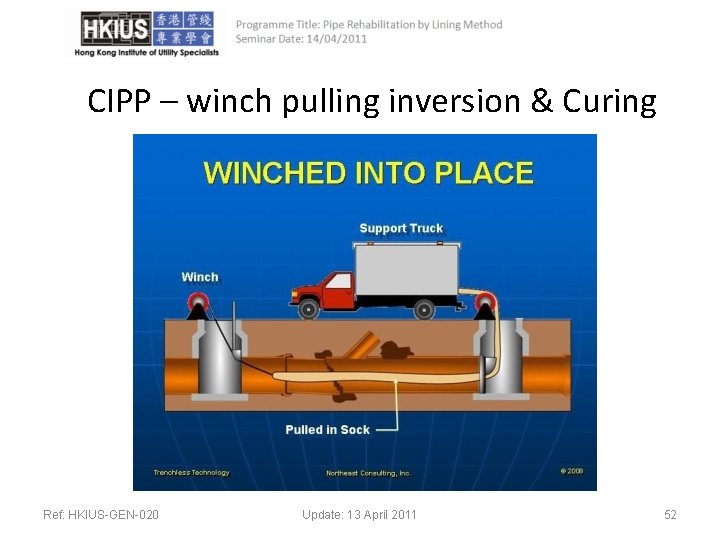
CIPP – winch pulling inversion & Curing Ref: HKIUS-GEN-020 Update: 13 April 2011 52
CIPP – final steps after curing • When curing ends, the pipe is cooled down and emptied • Invert the calibration hose out of the lined pipe • The ends of the newly formed pipe are cut and trimmed • For pipe with connections in the middle, dimples can be created at the connecting locations by the pressure during inversion and curing (Continued) Ref: HKIUS-GEN-020 Update: 13 April 2011 53
CIPP – final steps after curing • A special cutting device or robot with CCTV or man entry is employed to cut hole for lateral connection if necessary • A CCTV inspection is done to check the new pipe being without visual defects • Fill the annular gap with cement mortar between the liner and the host pipe at the manholes. Ref: HKIUS-GEN-020 Update: 13 April 2011 54
Advantages of CIPP • Quick and long-length installation • Suitable for irregularly shaped pipe and can negotiate bends • Grouting between the lining and the carrier pipe is normally not required • Smooth interior surface of CIPP can increase flow capacity (Continued) Ref: HKIUS-GEN-020 Update: 13 April 2011 55
Advantages of CIPP • Bends or pipe deformation can be adapted though localized wrinkling may appear • Small variation of pipe cross section can be adapted • Laterals remade in sewer Ref: HKIUS-GEN-020 Update: 13 April 2011 56
CIPP - Limitations • Full pumping needed in the installation • The existing flow must be bypassed during installation • Limited pipe diameter application for winched linings Ref: HKIUS-GEN-020 Update: 13 April 2011 57
Pipe Rehabilitation by Trenchless Technology Sliplining (SL) Ref: HKIUS-GEN-020 Update: 13 April 2011 58
Sliplining - Application • A smaller pipe inserted into the existing pipe and the annular space between the 2 pipes is grouted • Applied to pipe diameter of 20 mm to 2500 mm (Continued) Ref: HKIUS-GEN-020 Update: 13 April 2011 59
Sliplining - Application • For both structural and non-structural prolem • For both sewers and portable water pipes • Owing to cost consideration, more common for pressure pipe than gravity pipe Ref: HKIUS-GEN-020 Update: 13 April 2011 60
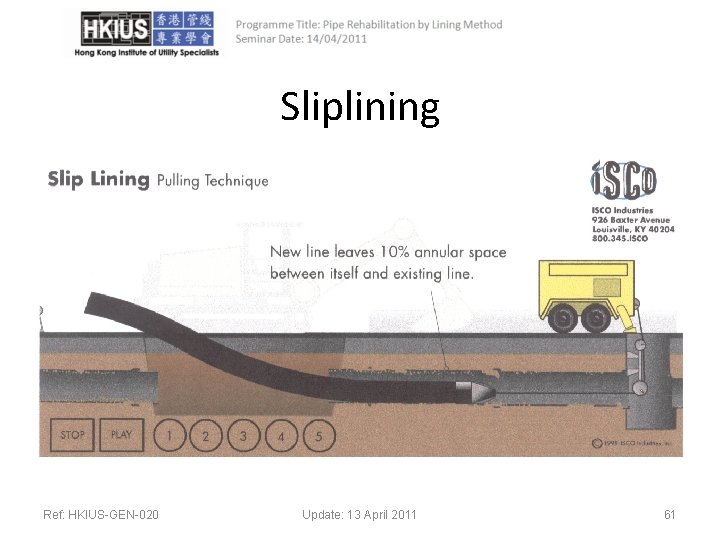
Sliplining Ref: HKIUS-GEN-020 Update: 13 April 2011 61
Sliplining – Types of Sliplining • 2 types of sliplining: continuous and segmental • Continuous sliplining: segmental pipes are joined into a continuous piece of any length which is then slipped into the existing host pipe (Continued) Ref: HKIUS-GEN-020 Update: 13 April 2011 62
Sliplining – Types of Sliplining • Segmental sliplining: – Highly similar to continuous sliplining – There are many short-length segmental pipes with a flush sleeve joint – They are connected at the launch pit and forced into the host pipe one by one – Choosing which method depends on the pit size and its nearby area available, i. e. the temporary traffic arrangement (Continued) Ref: HKIUS-GEN-020 Update: 13 April 2011 63
Sliplining – Types of Sliplining • Segmental method is applicable for diameters larger than 610 mm • For continuous sliplining, grouting may not be required while that for segmental sliplining is a must Ref: HKIUS-GEN-020 Update: 13 April 2011 64
Sliplining - Materials • The following are more common ones: – Polyethylene (PE) – Glassfibre reinforced polyester (GRP) – PVC Ref: HKIUS-GEN-020 Update: 13 April 2011 65
Sliplining – joining of Segmental Pipes • The segmental pipes can be joined by butt fusion, gasketed bell and spigot, or extrusion welding to form the long liner • The joining method depends on the type of liner material used. For instance, solid wall PE pipe is usually joined by butt fusion while PE profile walled pipe is usually integral gasketed bell and spigot or extrusion welding (Continued) Ref: HKIUS-GEN-020 Update: 13 April 2011 66
Sliplining – joining of Segmental Pipes • The joining is done either above ground or in the launch pit. If the launch pit is long enough to allow the liner pipe curve through the bends of the pit, the joining is usually done above ground • For large diameter PE pipes for a short pit, butt fusion in launch pit is usually applied (Continued) Ref: HKIUS-GEN-020 Update: 13 April 2011 67
Sliplining – joining of Segmental Pipes • However, the installation rate is slower as time is needed for fusing pipe segments and cooling welds. Cooling time cannot be too short as that can weaken the strength of the pipeline during installation and shorten the service life. • The external beads formed due to welding on the pipe are removed by special tool prior to the insertion. All beads add to the friction between the existing and the new pipes during installation. Ref: HKIUS-GEN-020 Update: 13 April 2011 68
Sliplining – Inversion Method • The liner are inserted by pushing or pulling or both from a launch pit to a reception pit. • Pushing generally uses manually or hydraulically powered machines (Continued) Ref: HKIUS-GEN-020 Update: 13 April 2011 69
Sliplining – Inversion Method • If the liner pipe uses the bell and spigot gasketed joint arrangement, the liner pipe must be inserted by pushing • After insertion, there are connecting services laterals, if there any, and also grouting Ref: HKIUS-GEN-020 Update: 13 April 2011 70
Sliplining – Installation Procedure • To show steps of sliplining, the installation of solid wall PE pipe by continuous sliplining in a launch pit is stated as an example: – – Cleaning of host pipe and CCTV inspection Segmental pipes joining by butt fusion welding in the launch pit Cooling down the joined liner Remove the external beads formed due to welding by special tool prior to the insertion – The jointed liner is pulled into the existing host pipe by the cable of winch. After pulled for a distance, it goes to welding again, and then pulling again – Grouting the space between the liner and the existing host pipe and reconnecting service laterals by excavation from outside Ref: HKIUS-GEN-020 Update: 13 April 2011 71
Sliplining - Advantages • Quick and simple to install • Cost-effective for pressurized pipes • Segmental slipining may not require bypassing of the existing flow. • It can be used to most types of pipes • It has an independent structural integrity and is not reliant on the integrity of the host pipe • It causes little disturbance to other utilities Ref: HKIUS-GEN-020 Update: 13 April 2011 72
Sliplining - Limitations • Grouting is usually needed • The reduction of diameter of the original pipe after rehabilitation • With pressure pipelines, it is sometimes possible to increase the working pressure and thus compensate for the loss in flow capacity. Ref: HKIUS-GEN-020 Update: 13 April 2011 73
Pipe Rehabilitation by Trenchless Technology Close-fit pipe (CFP) Ref: HKIUS-GEN-020 Update: 13 April 2011 74
CFP - Introduction • Another name: Formed-in place pipe (FIPP) lining • In a CFP lining, the liner’s outside diameter is slightly larger than the inside diameter of the existing host pipe (Continued) Ref: HKIUS-GEN-020 Update: 13 April 2011 75
CFP - Introduction • The cross section of the liner is temporarily deformed or reduced before insertion into the existing host pipe. The liner is later restored close to its original diameter, forming a close fit with the existing host pipe Ref: HKIUS-GEN-020 Update: 13 April 2011 76
CFP – Types of CFP linings • 3 types of CFP linings: – Deformed lining: cross section temporarily folded – Rolldown: diameter reduction by mechanical method – Swageling: diameter reduction by thermal method (Continued) Ref: HKIUS-GEN-020 Update: 13 April 2011 77
CFP – Types of CFP linings • Remark – There are 2 types of swagelining: hot swagelining & cold swagelining – One difference between rolldown and swagelining is that after reducing the diameter, the liner’s pipe wall becomes thicker in rolldown while that in swagelining remains the same (Continued) Ref: HKIUS-GEN-020 Update: 13 April 2011 78
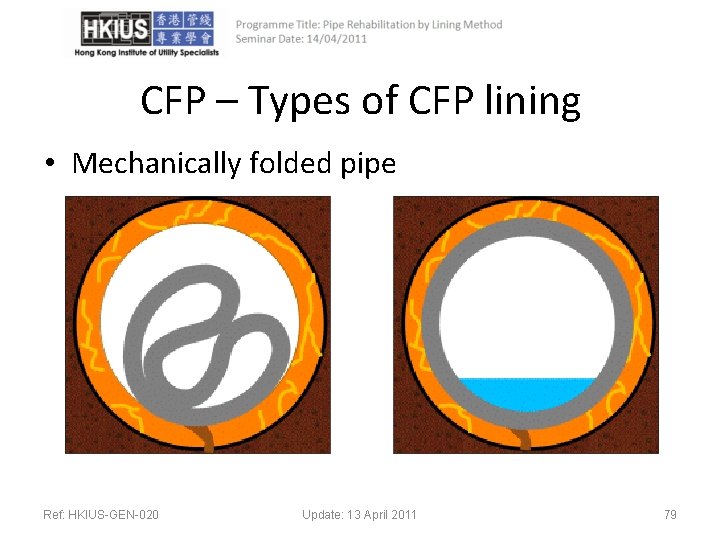
CFP – Types of CFP lining • Mechanically folded pipe Ref: HKIUS-GEN-020 Update: 13 April 2011 79
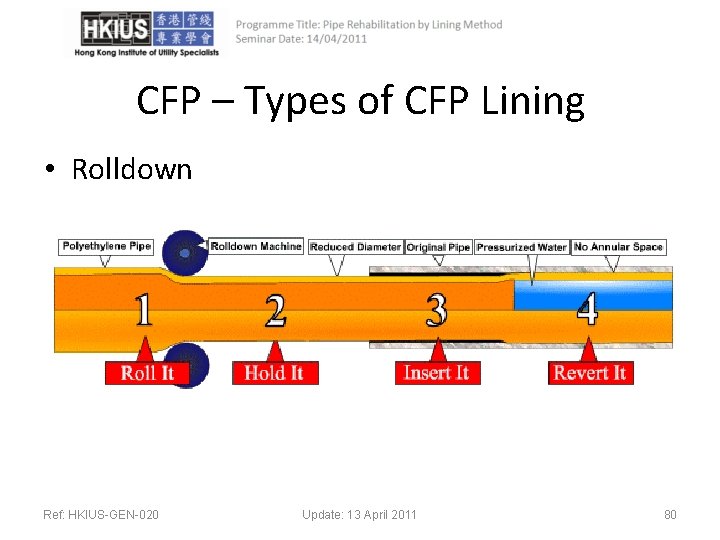
CFP – Types of CFP Lining • Rolldown Ref: HKIUS-GEN-020 Update: 13 April 2011 80
CFP – Installation Procedure • To show steps of CFP, the installation of compact pipe is stated as an example: – Insertion: At the entrance pit, the drum with pipe is handled with the dedicated drum dispensing unit, the drum trailer. The winch to pull in the pipe is positioned at the reception pit. – Heating: Saturated steam is feeded into the pipe to make pipe heat up and regain its original cross section. – Expansion: When the pipe is sufficiently heated up, steam is replaced by cold compressed air. Expansion takes place just after switching from steam to compressed air. The air pressure is set high enough to enable the pipe to radially expand, thus achieving a close-fit with the interior of the existing pipeline. – Cooling: Cooling down with air takes place simply by keeping the pressure on. The cooling phase ends when ambient temperature has been reached. – Fixation: Fixation of pipe ends by means of electrofusion is needed to prevent longitudinal shrinkage during or prior to reconnection. – Reconnection: Reconnection to the existing pipeline can be achieved by means of fusion techniques and mechanical assembly techniques Ref: HKIUS-GEN-020 Update: 13 April 2011 81
CFP - Advantages • Little reduction in diameter of pipe after lining • Little loss in flow capacity • It is rapid and causes little disturbance to other utilities • Improved hydraulic performance compared to the host pipe • No grouting required • The liner can be used in host pipes with bends up to 45° Ref: HKIUS-GEN-020 Update: 13 April 2011 82
CFP - Limitations • A large working area is required to lay the butt -fused liner before diameter reduction & insertion • Bypassing the existing pipe’s flow during installation is required • Not suitable for rehabilitating the existing pipe with varying cross-sections Ref: HKIUS-GEN-020 Update: 13 April 2011 83
Pipe Rehabilitation by Trenchless Technology Quality Control Ref: HKIUS-GEN-020 Update: 13 April 2011 84
Project Quality Plan Ø Prepare Project Quality Plan by qualified staff prior to lining works commencement i. e. MHKIUS or OMHKIUS in PR Division; Ø Monitor right steps, right skilled staff, right equipment are deployed for carrying out the lining works; Ø Qualified Project Manager (MHKIUS or OMHKIUS in PR Division) should use quality control technique namely Plan – Do – Check – Act to ensure the determined PQP is implemented and updated as required; Ø Final inspection/checking to endorse the completed lining works achieve the required standards/performance; Ref: HKIUS-GEN-020 Update: 13 April 2011 85
Quality Control • Proper records to ensure quality of lining work Daily record of work (equipment, skilled staff, progress, safety issues) Size and material of the existing host pipe Details of the lining including outside diameter, wall thickness, material Result of initial and final color CCTV inspection Reactivity/ mixing of resin control test result (CIPP only) Temperature (°C) of lining at installation(CIPP only) Temperature (°C) of lining during curing and upon completion of rehabilitation (CIPP only) – Etc. – – – – Ref: HKIUS-GEN-020 Update: 13 April 2011 86
4 R Strategy Ø Right Skilled Person – Implement the lining works comply with required PQP stipulated requirements Ø Right Planning/ - Qualified staff (MHKIUS or OMHKIUS in PR Division) Preparation prepare the best lining method in terms of time, cost, quality namely Iron Triangle Ø Right Equipment - Adopted to complete the lining works to achieve stipulated standards and performance Ø Right Price - Tender Price should be estimated using 3 R criteria as mentioned above - Final goal is achieved in terms of “On Time Completion, Within Budget Cost, Comply Quality Standards” Ref: HKIUS-GEN-020 Update: 13 April 2011 87
Pipe Rehabilitation by Trenchless Technology Conclusion Ref: HKIUS-GEN-020 Update: 13 April 2011 88
Conclusions • Trenchless techniques are gaining ground in capabilities & use. • Successful use of trenchless requires careful consideration of its strengths & weaknesses. • Ground, site and project conditions should be considered in the use of trenchless technologies. • For trenchless technologies careful planning is required. Ref: HKIUS-GEN-020 Update: 13 April 2011 89
Reference • http: //www. uti. hk • http: //www. gastechnology. org/ Ref: HKIUS-GEN-020 Update: 13 April 2011 90
- Slides: 90