
PIP 2 IT HEBT Final Design Review Introduction
PIP 2 IT HEBT Final Design Review Introduction Lionel PROST Final Design Review for the PIP-II Injector Test High Energy Beam Transport 13 February 2019 In partnership with: India/DAE Italy/INFN UK/STFC France/CEA/Irfu, CNRS/IN 2 P 3
Outline • Agenda • Introduction to PIP-II and PIP-II Injector Test (PIP 2 IT) • Charge & scope – Scope limitations • Team 2 2/13/2019 L. Prost | PIP 2 IT HEBT FDR | Introduction
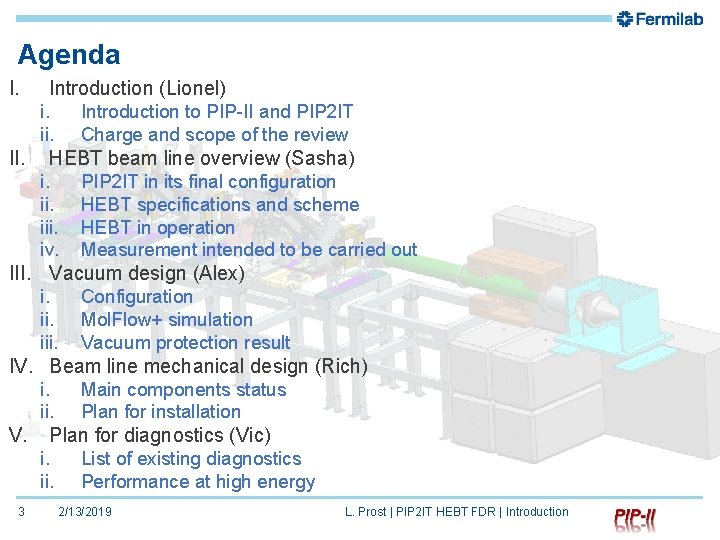
Agenda I. II. IV. V. 3 Introduction (Lionel) i. Introduction to PIP-II and PIP 2 IT ii. Charge and scope of the review HEBT beam line overview (Sasha) i. PIP 2 IT in its final configuration ii. HEBT specifications and scheme iii. HEBT in operation iv. Measurement intended to be carried out Vacuum design (Alex) i. Configuration ii. Mol. Flow+ simulation iii. Vacuum protection result Beam line mechanical design (Rich) i. Main components status ii. Plan for installation Plan for diagnostics (Vic) i. List of existing diagnostics ii. Performance at high energy 2/13/2019 L. Prost | PIP 2 IT HEBT FDR | Introduction

Proton Improvement Plan-II (PIP-II) • Upgrades to Fermilab’s accelerator complex – Central part: 800 Me. V, 2 m. A (average over ~ms) CWcompatible H- Superconducting Linac and transfer line to Booster • Present ‘warm’ Linac: 400 Me. V, 30 m. A, 40 ms× 15 Hz – MW-class accelerator with multi-user operation capability Linac Muon rings Booster • Platform for future upgrades – Higher Main Injector power, multiple experiments simultaneously PIP 2 linac and transfer line Layout of PIP-II and its possible future upgrades 4 2/13/2019 L. Prost | PIP 2 IT HEBT FDR | Introduction
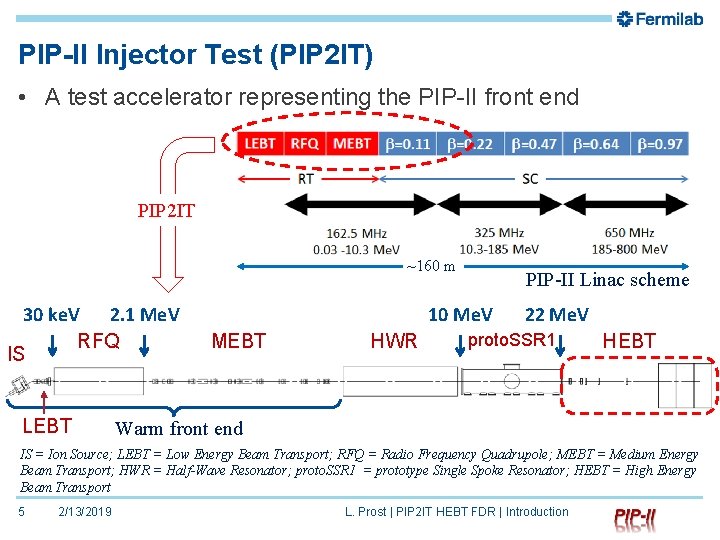
PIP-II Injector Test (PIP 2 IT) • A test accelerator representing the PIP-II front end PIP 2 IT ~160 m 30 ke. V 2. 1 Me. V RFQ IS LEBT PIP-II Linac scheme 10 Me. V MEBT HWR 22 Me. V proto. SSR 1 HEBT Warm front end IS = Ion Source; LEBT = Low Energy Beam Transport; RFQ = Radio Frequency Quadrupole; MEBT = Medium Energy Beam Transport; HWR = Half-Wave Resonator; proto. SSR 1 = prototype Single Spoke Resonator; HEBT = High Energy Beam Transport 5 2/13/2019 L. Prost | PIP 2 IT HEBT FDR | Introduction

PIP 2 IT at CMTF PIP 2 IT enclosure HEBT HWR Ion Source HV & LV cabinets MEBT RFQ MEBT 6 2/13/2019 proto. SSR 1 L. Prost | PIP 2 IT HEBT FDR | Introduction Beam dump in “dog house”

PIP 2 IT High-level goals • Demonstrate critical technologies for the PIP 2 project and integrate lessons learned into the final designs • Gain experience with installation, integrated testing, and operation of PIP 2 IT equipment, in particular SRF/RF systems and, develop and validate procedures – Avoid creating problems that would delay or make difficult the future conversion of the PIP 2 IT cave into a PIP-II cryomodule test facility (e. g. activation of large components) • Commission HWR and SSR 1 cryomodules with beam – Short (~6 months) run Anticipate longer commissioning run when installed in the PIP-II Building High-Bay High Energy Beam Transport line 7 2/13/2019 L. Prost | PIP 2 IT HEBT FDR | Introduction
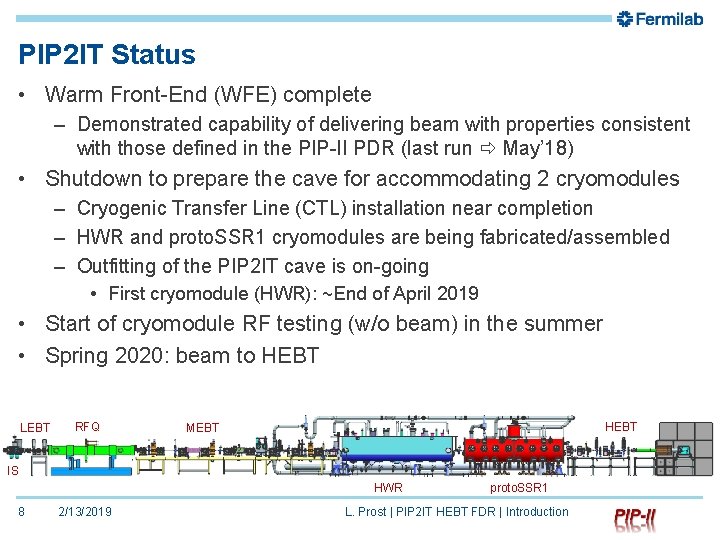
PIP 2 IT Status • Warm Front-End (WFE) complete – Demonstrated capability of delivering beam with properties consistent with those defined in the PIP-II PDR (last run May’ 18) • Shutdown to prepare the cave for accommodating 2 cryomodules – Cryogenic Transfer Line (CTL) installation near completion – HWR and proto. SSR 1 cryomodules are being fabricated/assembled – Outfitting of the PIP 2 IT cave is on-going • First cryomodule (HWR): ~End of April 2019 • Start of cryomodule RF testing (w/o beam) in the summer • Spring 2020: beam to HEBT LEBT RFQ HEBT MEBT IS HWR 8 2/13/2019 proto. SSR 1 L. Prost | PIP 2 IT HEBT FDR | Introduction
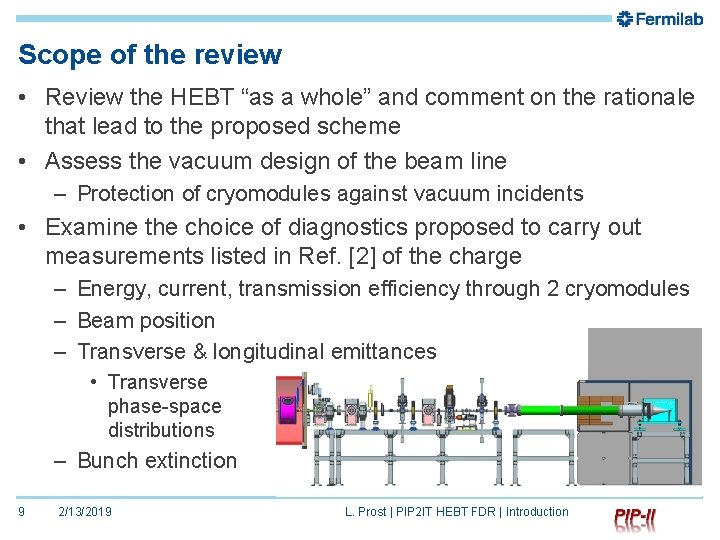
Scope of the review • Review the HEBT “as a whole” and comment on the rationale that lead to the proposed scheme • Assess the vacuum design of the beam line – Protection of cryomodules against vacuum incidents • Examine the choice of diagnostics proposed to carry out measurements listed in Ref. [2] of the charge – Energy, current, transmission efficiency through 2 cryomodules – Beam position – Transverse & longitudinal emittances • Transverse phase-space distributions – Bunch extinction 9 2/13/2019 L. Prost | PIP 2 IT HEBT FDR | Introduction
Context & constraints • The HEBT is a temporary beam line and will not be part of the PIP-II linac • The HEBT should use as much existing equipment as possible – The focusing and steering elements to be used are those destined for the PIP-II MEBT – Beam instrumentation used in the MEBT, and not part of its final configuration, will be relocated in the HEBT, if found adequate for measuring the beam properties after acceleration to 20‑ 25 Me. V – The HEBT will use the “SNS dump” as its high-power dump • The HEBT beam optics design should emphasize (passively) preventing tight focusing of the beam at the location of the beam dump 10 2/13/2019 L. Prost | PIP 2 IT HEBT FDR | Introduction
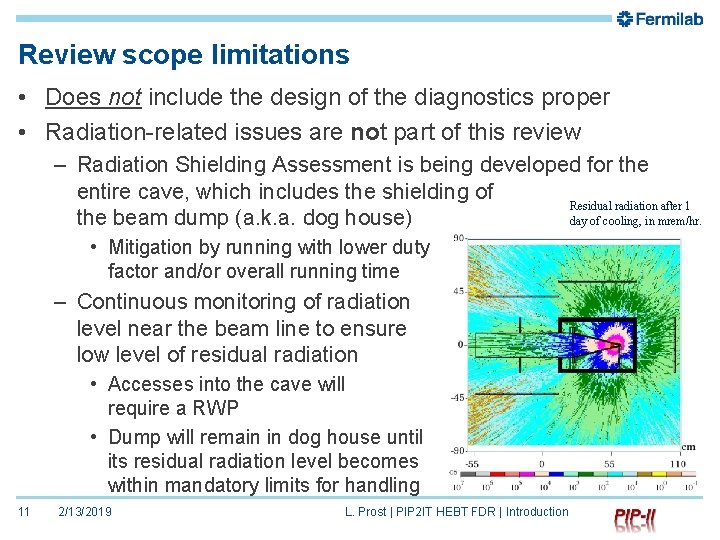
Review scope limitations • Does not include the design of the diagnostics proper • Radiation-related issues are not part of this review – Radiation Shielding Assessment is being developed for the entire cave, which includes the shielding of Residual radiation after 1 day of cooling, in mrem/hr. the beam dump (a. k. a. dog house) • Mitigation by running with lower duty factor and/or overall running time – Continuous monitoring of radiation level near the beam line to ensure low level of residual radiation • Accesses into the cave will require a RWP • Dump will remain in dog house until its residual radiation level becomes within mandatory limits for handling 11 2/13/2019 L. Prost | PIP 2 IT HEBT FDR | Introduction
Charge • Main questions: – Is the optics design sufficiently mature to satisfy the specifications [1]? • Is the design sufficiently optimized to conduct the measurements listed in Ref. [2]? • Does the design appropriately address concerns about controlling the power density deposited into the beam dump (and avoiding damaging the dump)? – Is the vacuum design likely to meet the performance expectations? • Is the vacuum protection scheme adequate in order to protect the upstream cryomodules from irreparable damages in case of a failure (e. g. joint failure between the beam tube and the beam dump)? • Are the measures in place to prevent contamination of the superconducting surfaces adequate? – Have installation issues been adequately addressed? 12 2/13/2019 L. Prost | PIP 2 IT HEBT FDR | Introduction
Design team • Matrixed across AD & TD departments – Optics and general layout • A. Shemyakin, A. Saini – Vacuum and vacuum protection • A. Chen, R. Andrews – Beam line components, stands, dog house (i. e. beam dump rad shielding) • R. Andrews, C. Baffes, S. Wesseln, T. Hamerla – Diagnostics • V. Scarpine, A. Shemyakin – Drafting • S. Wesseln – Radiation estimation • J. -P. Carneiro 13 2/13/2019 L. Prost | PIP 2 IT HEBT FDR | Introduction
- Slides: 13