
PIP 2 IT 650 MHz RF Distribution System
PIP 2 IT 650 MHz RF Distribution System Ding Sun For PIP-II PDR Review on PIP 2 IT 650 MHz RF Distribution System May 28, 2020

Introduction After the completion of PIP 2 IT beam operation, the PIP 2 IT cave will be converted to a test facility for high power test of PIP-II cryomodules (without beam). Both LB 650 and HB 650 cryomodules will be tested using the same RF system installed for PIP 2 IT test facility. The RF system consists of LLRF, RF power amplifiers and RF distribution system. This presentation is for distribution system only. Note: for high power test of cavities without beam, the RF system’s functional requirements for both low β and high β cavities are basically the same. Therefore this presentation may only mention HB 650 cavities but actually it applies to LB 650 cavities too. Ding Sun, PIP 2 IT 650 MHz RF Distribution System

Schematic of PIP 2 IT 650 MHz RF distribution system The PIP 2 IT test facility 650 MHz RF distribution system consists of six separate distribution lines. Each distribution line connects the output port of an RF power amplifier on one end and the input port of the input coupler of a cavity on the other end; and transports RF power from the amplifier to input coupler of the cavity (Figure 1). RF Distribution System Amplifier cavity Cryomodule Figure 1. PIP 2 IT Test Facility 650 MHz RF Distribution System (red color). Ding Sun, PIP 2 IT 650 MHz RF Distribution System

Functional requirement for each distribution line RF functional requirement • • • Capable of transporting power sufficient to test LB 650/HB 650 superconducting cavities to 110% of their specified gradient along beam line. Capable of operating with fully reflected RF power at any phase when each cavity is operated in either pulsed or CW mode. Provide an isolator to keep reflected power under maximum level required by SSA (Solid State Amplifier). Provide forward and reflected power signals of each cavity to LLRF system and meet LLRF required technical specifications. These signals will be used for LLRF control, measurement of cavity gradient etc. Provide necessary signals to SSA interlocks to protect distribution system from RF power should unsafe operation conditions exist before or during operation. Reference: “PIP 2 IT 650 MHz RF Distribution System Functional Requirement Specification” Ding Sun, PIP 2 IT 650 MHz RF Distribution System
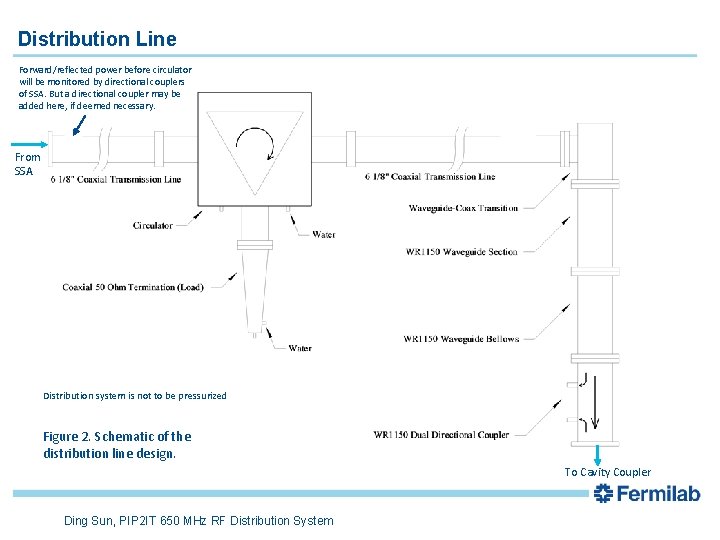
Distribution Line Forward/reflected power before circulator will be monitored by directional couplers of SSA. But a directional coupler may be added here, if deemed necessary. From SSA Distribution system is not to be pressurized Figure 2. Schematic of the distribution line design. To Cavity Coupler Ding Sun, PIP 2 IT 650 MHz RF Distribution System
RF components Each line consists of the following parts: Standard components (do not need special specification): • 6 1/8 inch coaxial straight section • 6 1/8” coaxial bellows • 6 1/8” coaxial elbow • 6 1/8” coaxial load, water cooled • WR 1150 waveguide straight section • WR 1150 waveguide bellows • WR 1150 waveguide transition (waveguide -> coax) “Custom-made” components (need special specification): • WR 1150 dual directional coupler • Ferrite circulator, water cooled Ding Sun, PIP 2 IT 650 MHz RF Distribution System
Technical specification for RF components To meet Functional Requirement, the following are technical specifications for components to be used: Overall specification (for all components): transport 40 k. W output power, operate in either pulsed or CW mode with full reflection at any phase. Total attenuation: ≤ 0. 4 db. Standard components’ power rating: 80 k. W for 6 1/8” coaxial line components and 62 MW for WR 1150 waveguide components. Capability of operating with full reflected power --- a similar distribution line has been built and operated up to 30 k. W at Meson Detector Building. Calculated total attenuation of all coaxial standard components in each line: ≤ 0. 17 db Calculated total attenuation of all WR 1150 standard component in each line: ~ 0. 02 db Measured insertion loss of a WR 1150 transition: < 0. 018 db Ding Sun, PIP 2 IT 650 MHz RF Distribution System
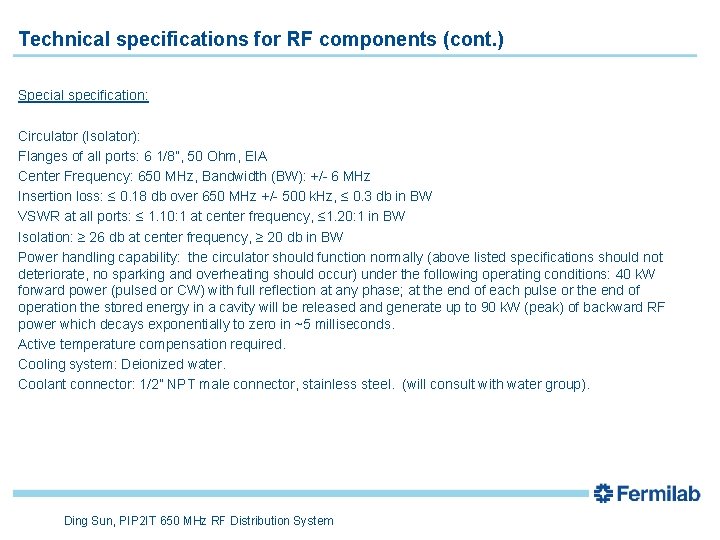
Technical specifications for RF components (cont. ) Special specification: Circulator (Isolator): Flanges of all ports: 6 1/8”, 50 Ohm, EIA Center Frequency: 650 MHz, Bandwidth (BW): +/- 6 MHz Insertion loss: ≤ 0. 18 db over 650 MHz +/- 500 k. Hz, ≤ 0. 3 db in BW VSWR at all ports: ≤ 1. 10: 1 at center frequency, ≤ 1. 20: 1 in BW Isolation: ≥ 26 db at center frequency, ≥ 20 db in BW Power handling capability: the circulator should function normally (above listed specifications should not deteriorate, no sparking and overheating should occur) under the following operating conditions: 40 k. W forward power (pulsed or CW) with full reflection at any phase; at the end of each pulse or the end of operation the stored energy in a cavity will be released and generate up to 90 k. W (peak) of backward RF power which decays exponentially to zero in ~5 milliseconds. Active temperature compensation required. Cooling system: Deionized water. Coolant connector: 1/2” NPT male connector, stainless steel. (will consult with water group). Ding Sun, PIP 2 IT 650 MHz RF Distribution System
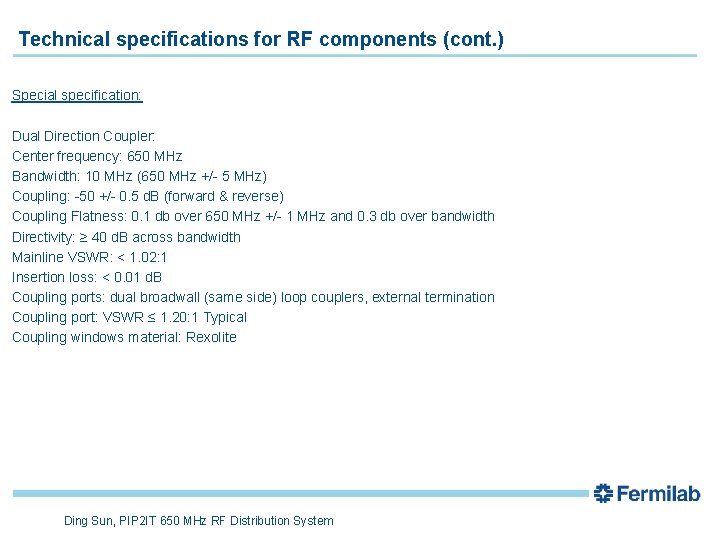
Technical specifications for RF components (cont. ) Special specification: Dual Direction Coupler: Center frequency: 650 MHz Bandwidth: 10 MHz (650 MHz +/- 5 MHz) Coupling: -50 +/- 0. 5 d. B (forward & reverse) Coupling Flatness: 0. 1 db over 650 MHz +/- 1 MHz and 0. 3 db over bandwidth Directivity: ≥ 40 d. B across bandwidth Mainline VSWR: < 1. 02: 1 Insertion loss: < 0. 01 d. B Coupling ports: dual broadwall (same side) loop couplers, external termination Coupling port: VSWR ≤ 1. 20: 1 Typical Coupling windows material: Rexolite Ding Sun, PIP 2 IT 650 MHz RF Distribution System
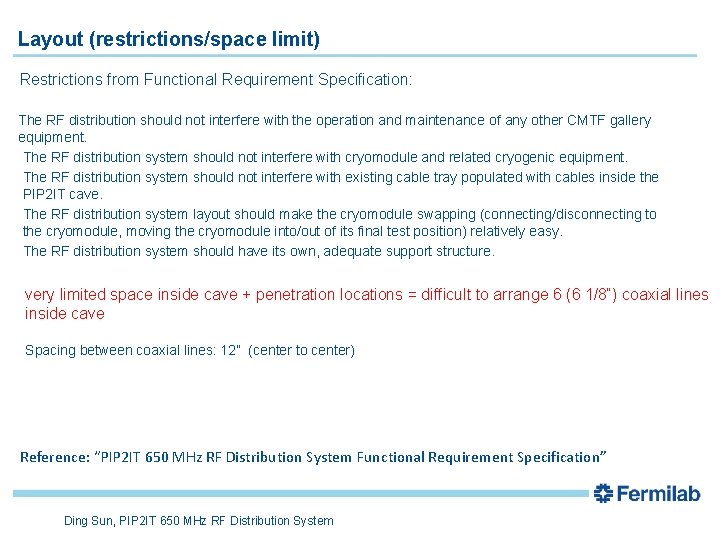
• • • Layout (restrictions/space limit) Restrictions from Functional Requirement Specification: The RF distribution should not interfere with the operation and maintenance of any other CMTF gallery equipment. The RF distribution system should not interfere with cryomodule and related cryogenic equipment. The RF distribution system should not interfere with existing cable tray populated with cables inside the PIP 2 IT cave. The RF distribution system layout should make the cryomodule swapping (connecting/disconnecting to the cryomodule, moving the cryomodule into/out of its final test position) relatively easy. The RF distribution system should have its own, adequate support structure. very limited space inside cave + penetration locations = difficult to arrange 6 (6 1/8“) coaxial lines inside cave Spacing between coaxial lines: 12” (center to center) Reference: “PIP 2 IT 650 MHz RF Distribution System Functional Requirement Specification” Ding Sun, PIP 2 IT 650 MHz RF Distribution System
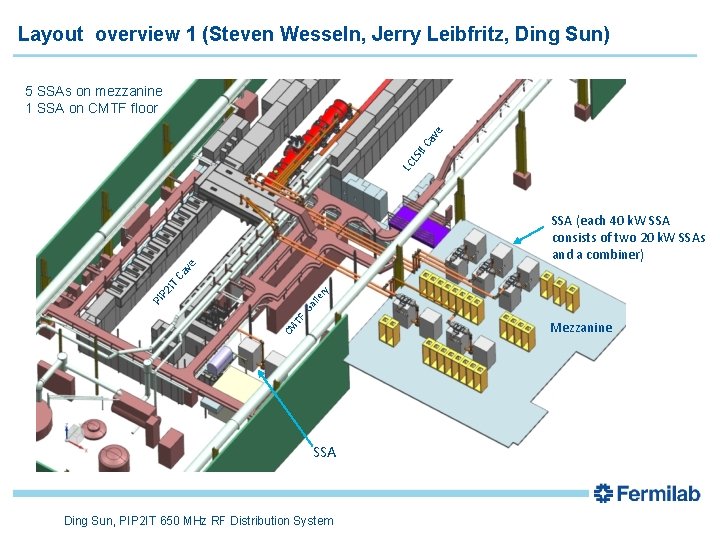
Layout overview 1 (Steven Wesseln, Jerry Leibfritz, Ding Sun) LC LS II C av e 5 SSAs on mezzanine 1 SSA on CMTF floor TF PI Ga lle ry P 2 IT Ca v e SSA (each 40 k. W SSA consists of two 20 k. W SSAs and a combiner) CM Mezzanine SSA Ding Sun, PIP 2 IT 650 MHz RF Distribution System
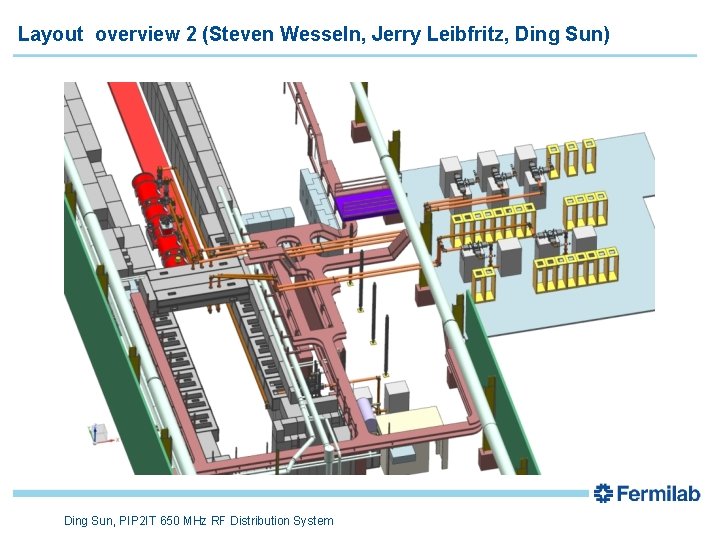
Layout overview 2 (Steven Wesseln, Jerry Leibfritz, Ding Sun) Ding Sun, PIP 2 IT 650 MHz RF Distribution System
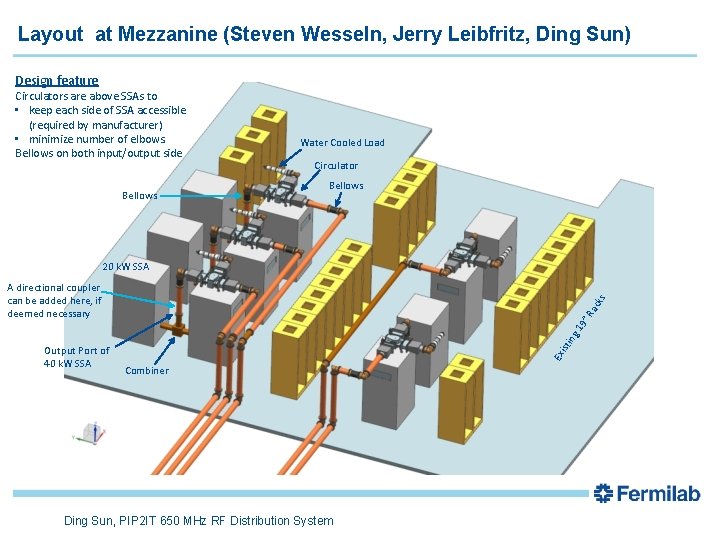
Layout at Mezzanine (Steven Wesseln, Jerry Leibfritz, Ding Sun) Design feature Circulators are above SSAs to • keep each side of SSA accessible (required by manufacturer) • minimize number of elbows. Bellows on both input/output side Bellows Water Cooled Load Circulator Bellows 20 k. W SSA ck Ra 19 ” ing ist Ex Output Port of 40 k. W SSA s A directional coupler can be added here, if deemed necessary Combiner Ding Sun, PIP 2 IT 650 MHz RF Distribution System
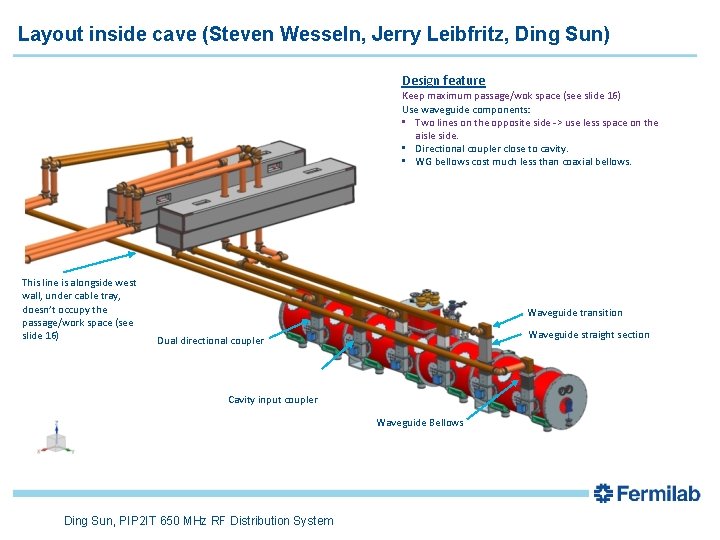
Layout inside cave (Steven Wesseln, Jerry Leibfritz, Ding Sun) Design feature Keep maximum passage/wok space (see slide 16) Use waveguide components: • Two lines on the opposite side -> use less space on the aisle side. • Directional coupler close to cavity. • WG bellows cost much less than coaxial bellows. This line is alongside west wall, under cable tray, doesn’t occupy the passage/work space (see slide 16) Waveguide transition Waveguide straight section Dual directional coupler Cavity input coupler Waveguide Bellows Ding Sun, PIP 2 IT 650 MHz RF Distribution System
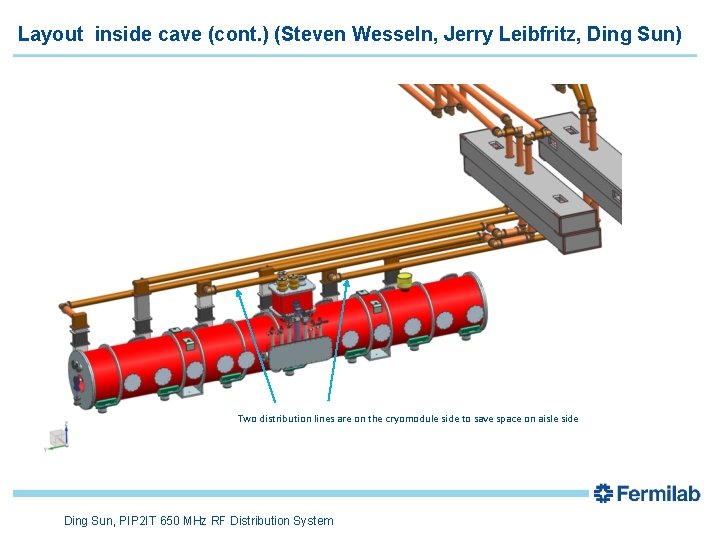
Layout inside cave (cont. ) (Steven Wesseln, Jerry Leibfritz, Ding Sun) Two distribution lines are on the cryomodule side to save space on aisle side Ding Sun, PIP 2 IT 650 MHz RF Distribution System
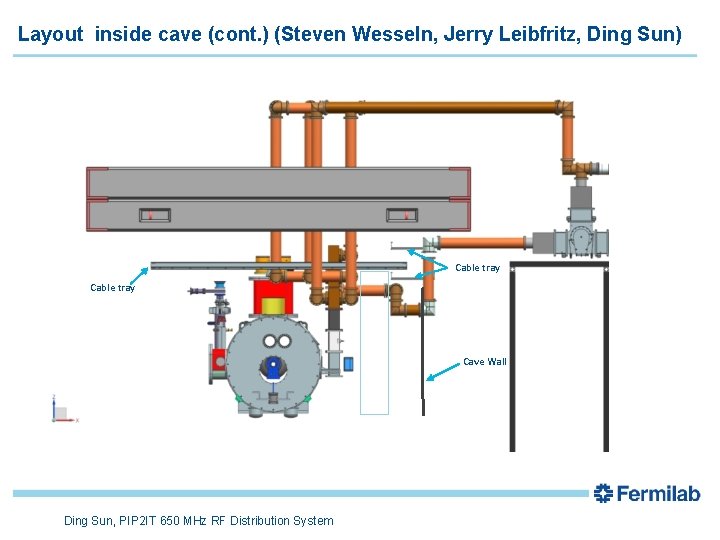
Layout inside cave (cont. ) (Steven Wesseln, Jerry Leibfritz, Ding Sun) Cable tray Cave Wall Ding Sun, PIP 2 IT 650 MHz RF Distribution System
Installation and prepare for error First 3 D survey. Install the coaxial lines across CMTF gallery first. Then Mezzanine, penetration, and inside cave. All cpaxial lines will be supported by aluminum slotted extrusion frame anchored to floor and pipe clamps from underneath of coaxial lines. On Mezzanine Second 3 D survey. X , Y direction offset: trim or replace short sections or move SSA a little. Z direction offset: trim or replace vertical section on output of SSA. Final closing point: at second coaxial bellows: rotate straight section and bend/push bellows. Inside cave: Second 3 D survey. X , Y direction offset: trim or replace short coaxial sections. Z direction offset: trim or replace waveguide sections. Final closing point: slid a waveguide component (WG transition or WG bellows) in/out. Minor (< 0. 25”) error may be offset by rotating/tilting long lines. X direction: East – West, Y direction: North – South, Z direction: vertical. Ding Sun, PIP 2 IT 650 MHz RF Distribution System
Reference 1. PIP-II L 3 FRS, ED 0008023, Rev. – 2. PIP-II LB 650, 650 MHz RF Amplifier Functional Requirement Specification ED 0003413, Rev. B 3. PIP 2 IT Test Facility 650 MHz RF Distribution System Functional Requirement Specification. 4. PIP 2 IT Test Facility 650 MHz RF Distribution System Technical Requirement Specification. 5. Fermilab drawing F 10129146 6. Fermilab drawing F 10135111 Ding Sun, PIP 2 IT 650 MHz RF Distribution System
- Slides: 18