
PionInduced Fission A Review Zafar Yasin Pakistan Institute


- Slides: 21
Pion-Induced Fission- A Review Zafar Yasin Pakistan Institute of Engineering and Applied Sciences (PIEAS) Islamabad, Pakistan
Outline Ø Importance of Nuclear Fission Ø Experimental Study of Pion Induced Fission Ø Theoretical Study Ø Systematical Analysis Ø Results and Discussion Ø Comparison of Pion Fission with Different Probes
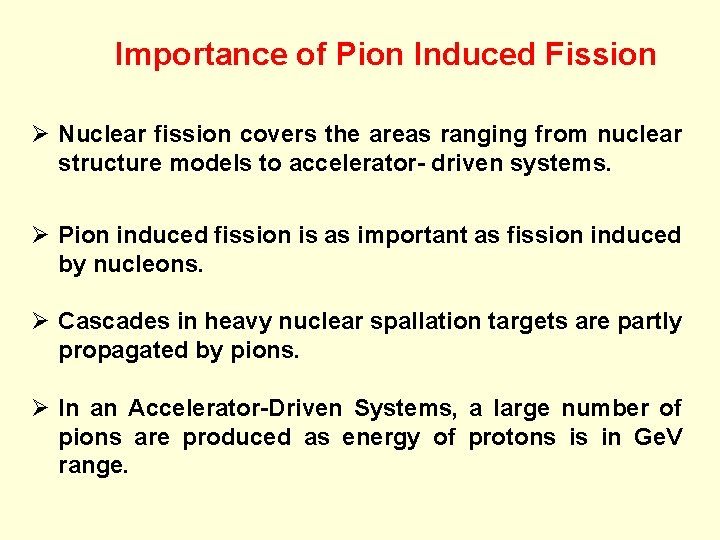
Importance of Pion Induced Fission Ø Nuclear fission covers the areas ranging from nuclear structure models to accelerator- driven systems. Ø Pion induced fission is as important as fission induced by nucleons. Ø Cascades in heavy nuclear spallation targets are partly propagated by pions. Ø In an Accelerator-Driven Systems, a large number of pions are produced as energy of protons is in Ge. V range.
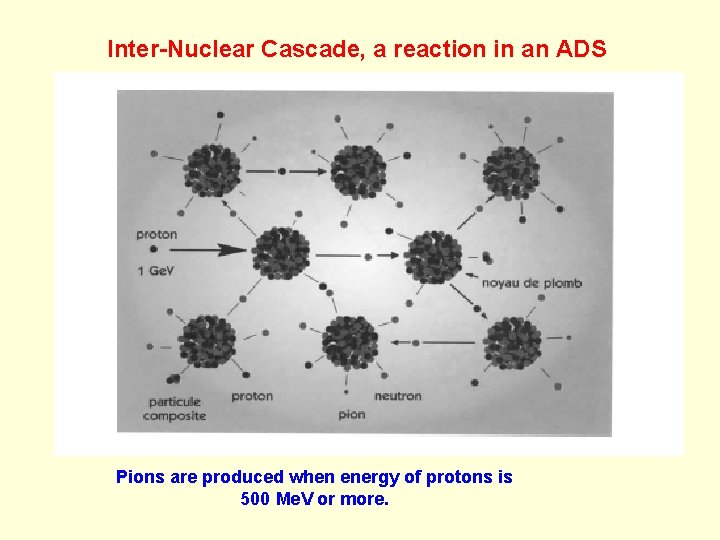
Inter-Nuclear Cascade, a reaction in an ADS Pions are produced when energy of protons is 500 Me. V or more.
Brief History of Pion fission Ø In 1958, pion-induced fission was observed with the first available pion beam. Ø In 1971, first time pion induced fission cross sections of energetic pions were measured. Ø 1976, fission by stopped negative pions was studied. Ø In 1985, Hicks et. al. , had tried to compare pion fission with the conventional nucleon induced fission. Ø In 1987, major work on pion fission was started by Dr. H. A. Khan and Prof. R. J. Peterson. Ø In 2006, Zafar Yasin, used cascade-exciton model CEM 95 to compute fission cross sections.
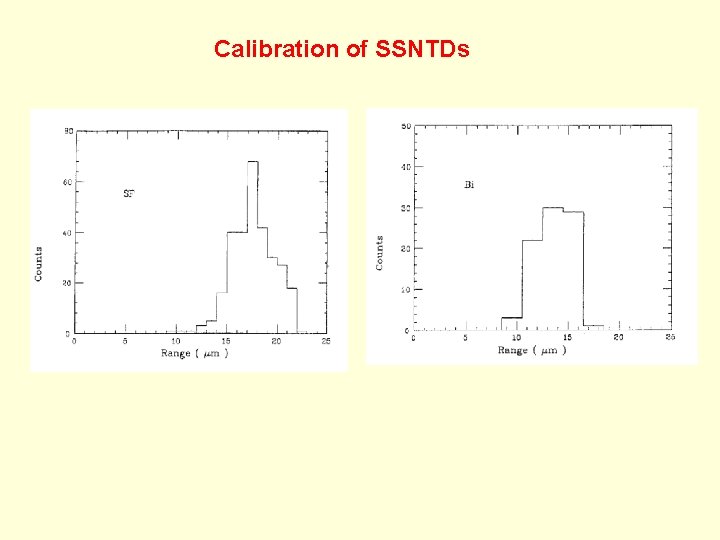
Calibration of SSNTDs
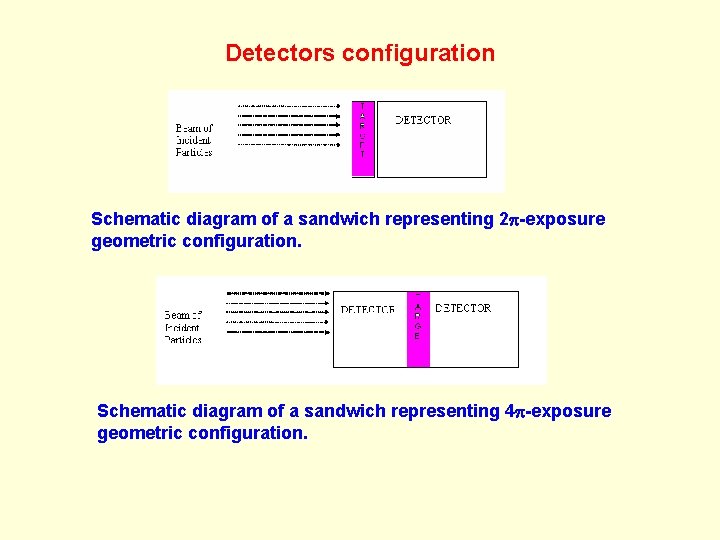
Detectors configuration Schematic diagram of a sandwich representing 2 -exposure geometric configuration. Schematic diagram of a sandwich representing 4 -exposure geometric configuration.
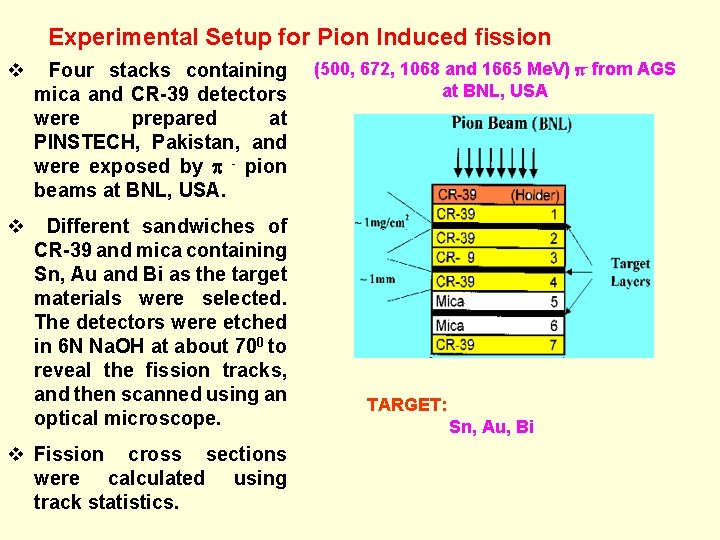
Experimental Setup for Pion Induced fission v Four stacks containing mica and CR-39 detectors were prepared at PINSTECH, Pakistan, and were exposed by - pion beams at BNL, USA. v Different sandwiches of CR-39 and mica containing Sn, Au and Bi as the target materials were selected. The detectors were etched in 6 N Na. OH at about 700 to reveal the fission tracks, and then scanned using an optical microscope. v Fission cross sections were calculated using track statistics. (500, 672, 1068 and 1665 Me. V) - from AGS at BNL, USA TARGET: Sn, Au, Bi
Theoretical Study Ø Cross-sections, up to 2500 Me. V, of different nuclei are calculated using the code CEM 95 and results are compared with the experimental data and with the cross-sections obtained using systematic analysis. Ø Three stages are incorporated in the code: the cascade, pre-equilibrium, and compound nucleus stage. Ø The model uses the Monte Carlo Method to simulate all three stages of the reactions. Ø Two methodologies have been incorporated in CEM 95, one is the direct Monte Carlo simulations and other is the Monte Carlo sampling by means of statistical functions.
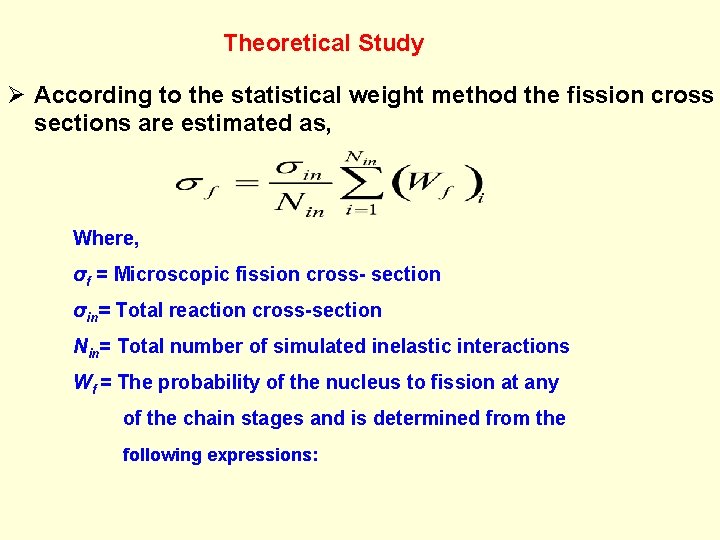
Theoretical Study Ø According to the statistical weight method the fission cross sections are estimated as, Where, σf = Microscopic fission cross- section σin= Total reaction cross-section Nin= Total number of simulated inelastic interactions Wf = The probability of the nucleus to fission at any of the chain stages and is determined from the following expressions:
Systematics of Fission Cross Sections Ø There is incongruity among the fission cross sections of the experimental data itself as well as among theoretical and experimental data-points. Ø The systematics and theoretical study is also necessary in the sense that the cost of experiments at accelerators is high, and beam time is short. Ø The systematics used to estimate the positive pioninduced fission is based on the systematics performed for proton induced fission. Ø The systematics used for proton induced fission is possible for pion-induced fission because, it is well known that the fission induced by protons is similar to pion-induced fission.
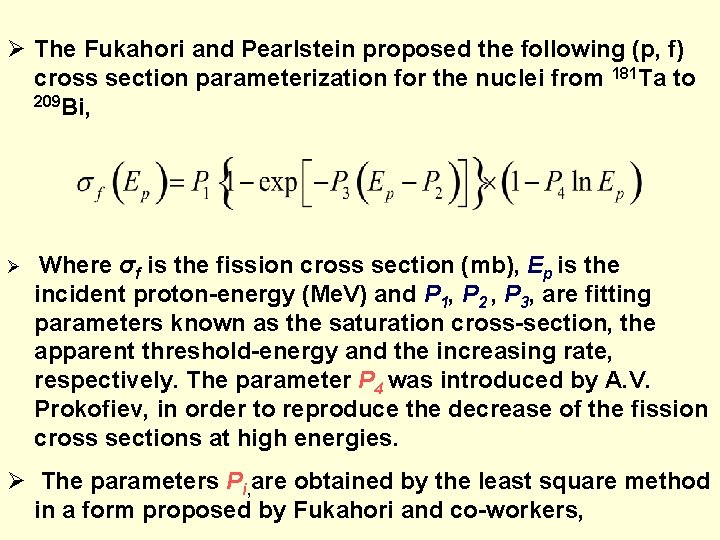
Ø The Fukahori and Pearlstein proposed the following (p, f) cross section parameterization for the nuclei from 181 Ta to 209 Bi, Ø Where σf is the fission cross section (mb), Ep is the incident proton-energy (Me. V) and P 1, P 2 , P 3, are fitting parameters known as the saturation cross-section, the apparent threshold-energy and the increasing rate, respectively. The parameter P 4 was introduced by A. V. Prokofiev, in order to reproduce the decrease of the fission cross sections at high energies. Ø The parameters Pi, are obtained by the least square method in a form proposed by Fukahori and co-workers,
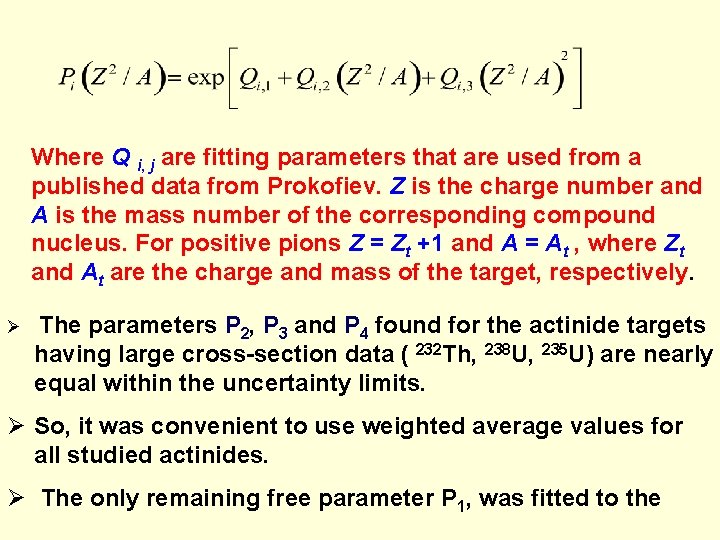
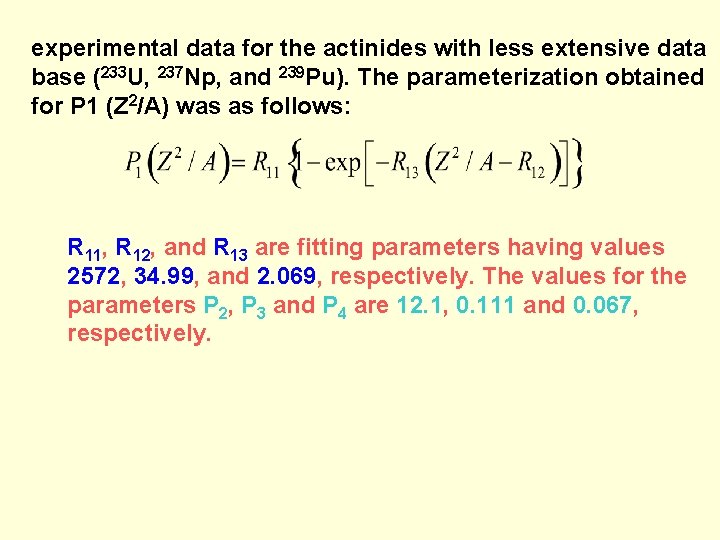
Where Q i, j are fitting parameters that are used from a published data from Prokofiev. Z is the charge number and A is the mass number of the corresponding compound nucleus. For positive pions Z = Zt +1 and A = At , where Zt and At are the charge and mass of the target, respectively. Ø The parameters P 2, P 3 and P 4 found for the actinide targets having large cross-section data ( 232 Th, 238 U, 235 U) are nearly equal within the uncertainty limits. Ø So, it was convenient to use weighted average values for all studied actinides. Ø The only remaining free parameter P 1, was fitted to the
experimental data for the actinides with less extensive data base (233 U, 237 Np, and 239 Pu). The parameterization obtained for P 1 (Z 2/A) was as follows: R 11, R 12, and R 13 are fitting parameters having values 2572, 34. 99, and 2. 069, respectively. The values for the parameters P 2, P 3 and P 4 are 12. 1, 0. 111 and 0. 067, respectively.
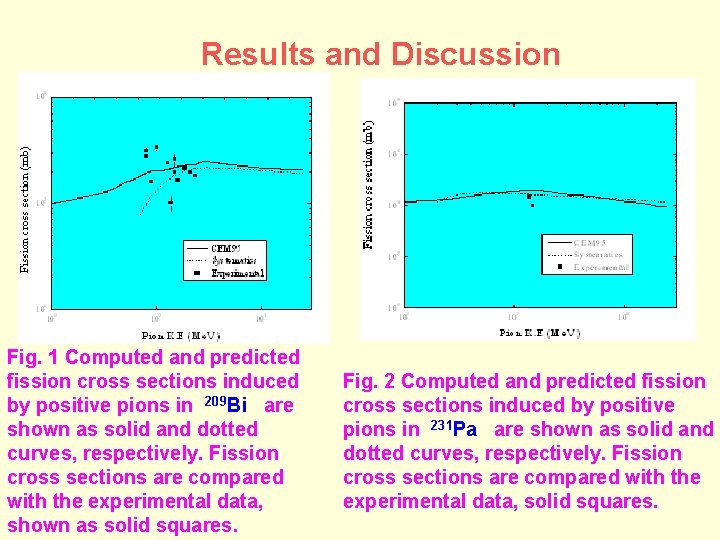
Results and Discussion Fig. 1 Computed and predicted fission cross sections induced by positive pions in 209 Bi are shown as solid and dotted curves, respectively. Fission cross sections are compared with the experimental data, shown as solid squares. Fig. 2 Computed and predicted fission cross sections induced by positive pions in 231 Pa are shown as solid and dotted curves, respectively. Fission cross sections are compared with the experimental data, solid squares.
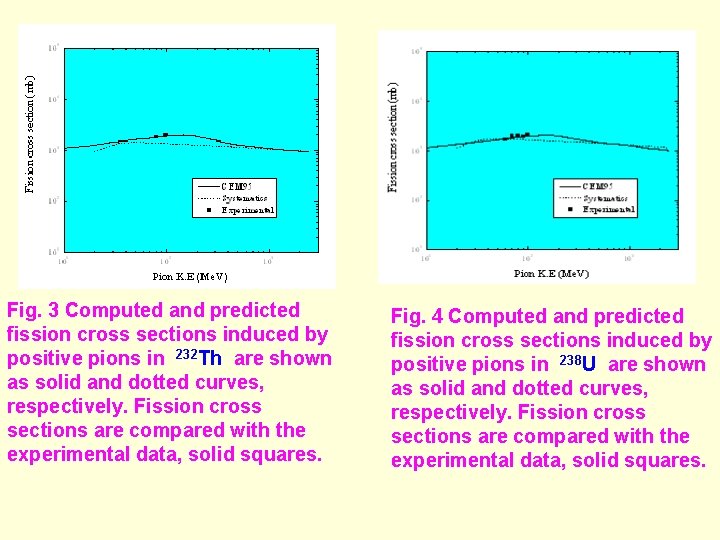
Fig. 3 Computed and predicted fission cross sections induced by positive pions in 232 Th are shown as solid and dotted curves, respectively. Fission cross sections are compared with the experimental data, solid squares. Fig. 4 Computed and predicted fission cross sections induced by positive pions in 238 U are shown as solid and dotted curves, respectively. Fission cross sections are compared with the experimental data, solid squares.
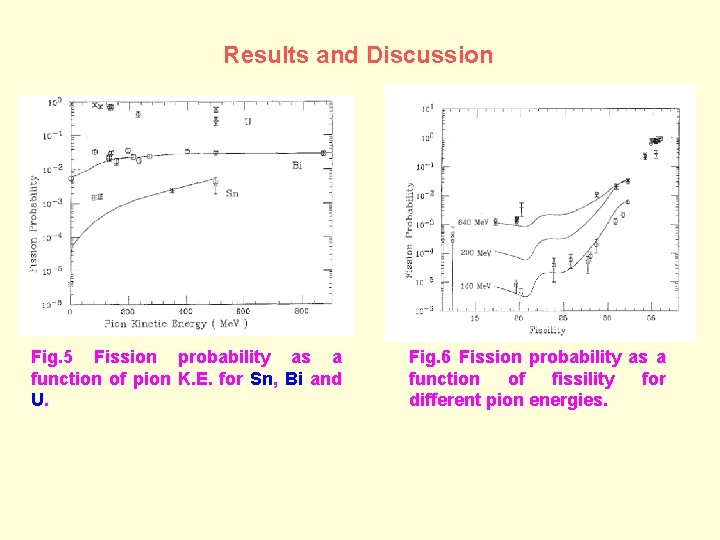
Results and Discussion Fig. 5 Fission probability as a function of pion K. E. for Sn, Bi and U. Fig. 6 Fission probability as a function of fissility for different pion energies.
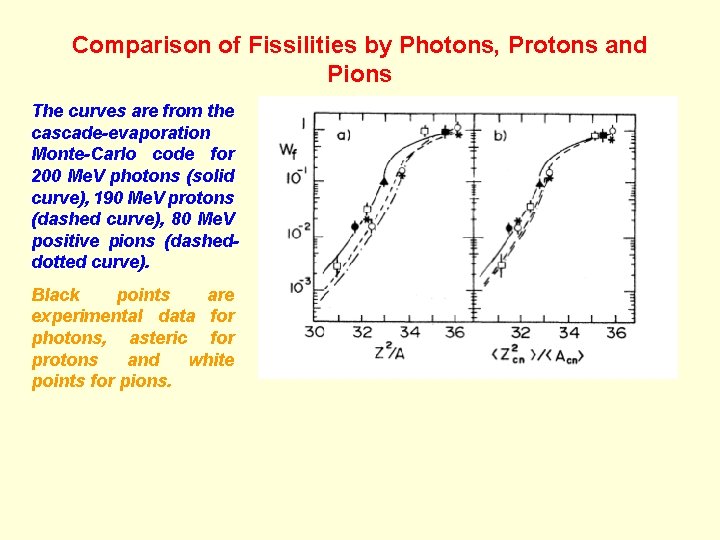
Comparison of Fissilities by Photons, Protons and Pions The curves are from the cascade-evaporation Monte-Carlo code for 200 Me. V photons (solid curve), 190 Me. V protons (dashed curve), 80 Me. V positive pions (dasheddotted curve). Black points are experimental data for photons, asteric for protons and white points for pions.
Comparison with other Probes Ø Across the (3, 3) resonance, no new mechanisms were observed for pion induced fission. Ø At the same excitation energy, angular momentum and nucleonic composition, the fissility values for photon, proton and pion induced fission are in substantial agreement. Ø A semi-empirical correlation for proton induced fission is also valid for positive pion induced fission, at least for actinides.
Conclusions Ø Firstly, the pion induced fission cross sections are useful to understand the basics of Nuclear Physics and for current Nuclear applications. Ø Secondly, the new approach used in CEM 95 to compute the fission cross sections shows a reasonable agreement between the computed and measured fission cross sections. Ø Thirdly, the systematic used to predict proton induced fission cross sections is also valid for positive pion induced fission cross sections, at least for actinides. Ø Thirdly, the comparison of computed, predicted and experimental values of fission cross- sections brings new information. For example, the experimental value for 231 Pa at 150 Me. V seems to be in error. A similar situation was found for many of the data points for 209 Bi.
Thank You