
Pion and Kaon Structure at the EIC Tanja
- Slides: 28
Pion and Kaon Structure at the EIC Tanja Horn (CUA & Jefferson Lab) and Rolf Ent (Jefferson Lab) EHM Workshop IV Perceiving the Emergency of Hadron Mass through AMBER@CERN November 30, 2020
Pion and Kaon Structure at the EIC Asked to include two topics in this talk: 1. EHM in the EIC Yellow Report 2. Synergy JLab-EIC-COMPASS++/AMBER 2
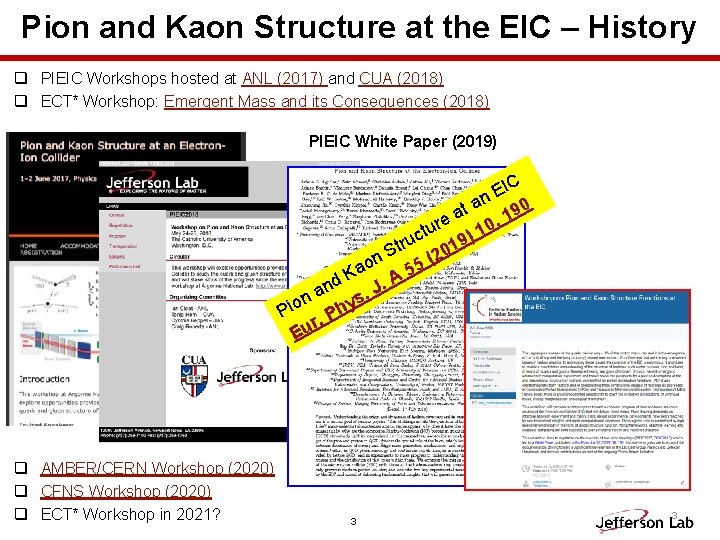
Pion and Kaon Structure at the EIC – History q PIEIC Workshops hosted at ANL (2017) and CUA (2018) q ECT* Workshop: Emergent Mass and its Consequences (2018) PIEIC White Paper (2019) IC E n t a 190 a re 0, u 1 t uc 9) r 1 t n S 5 (20 o a 5 K A d. an s. J n Pio. Phy r Eu q AMBER/CERN Workshop (2020) q CFNS Workshop (2020) q ECT* Workshop in 2021? 3 3
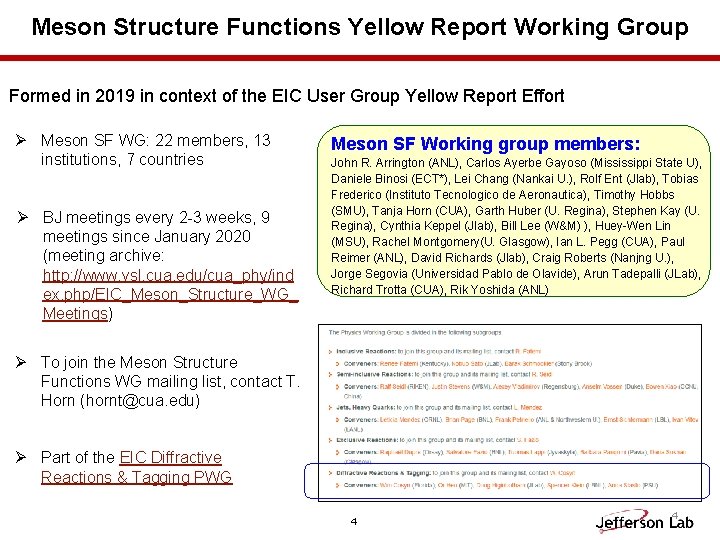
Meson Structure Functions Yellow Report Working Group Formed in 2019 in context of the EIC User Group Yellow Report Effort Ø Meson SF WG: 22 members, 13 institutions, 7 countries Ø BJ meetings every 2 -3 weeks, 9 meetings since January 2020 (meeting archive: http: //www. vsl. cua. edu/cua_phy/ind ex. php/EIC_Meson_Structure_WG_ Meetings) Meson SF Working group members: John R. Arrington (ANL), Carlos Ayerbe Gayoso (Mississippi State U), Daniele Binosi (ECT*), Lei Chang (Nankai U. ), Rolf Ent (Jlab), Tobias Frederico (Instituto Tecnologico de Aeronautica), Timothy Hobbs (SMU), Tanja Horn (CUA), Garth Huber (U. Regina), Stephen Kay (U. Regina), Cynthia Keppel (Jlab), Bill Lee (W&M) ), Huey-Wen Lin (MSU), Rachel Montgomery(U. Glasgow), Ian L. Pegg (CUA), Paul Reimer (ANL), David Richards (Jlab), Craig Roberts (Nanjng U. ), Jorge Segovia (Universidad Pablo de Olavide), Arun Tadepalli (JLab), Richard Trotta (CUA), Rik Yoshida (ANL) Ø To join the Meson Structure Functions WG mailing list, contact T. Horn (hornt@cua. edu) Ø Part of the EIC Diffractive Reactions & Tagging PWG 4 4
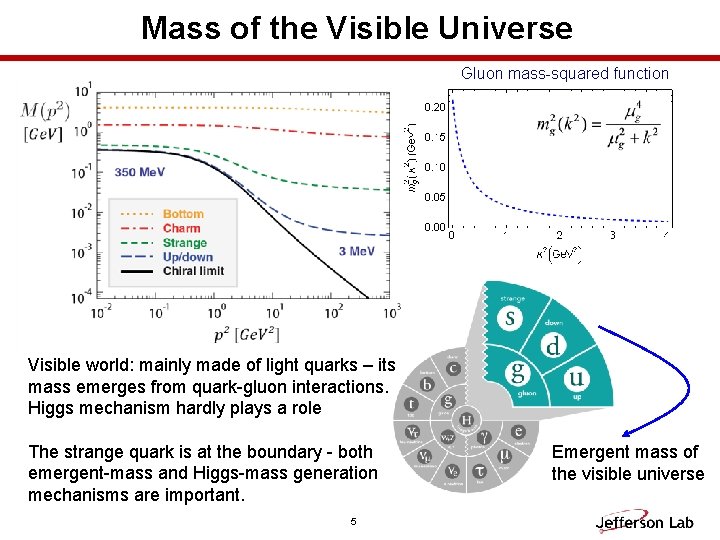
Mass of the Visible Universe Gluon mass-squared function Visible world: mainly made of light quarks – its mass emerges from quark-gluon interactions. Higgs mechanism hardly plays a role The strange quark is at the boundary - both emergent-mass and Higgs-mass generation mechanisms are important. 5 Emergent mass of the visible universe
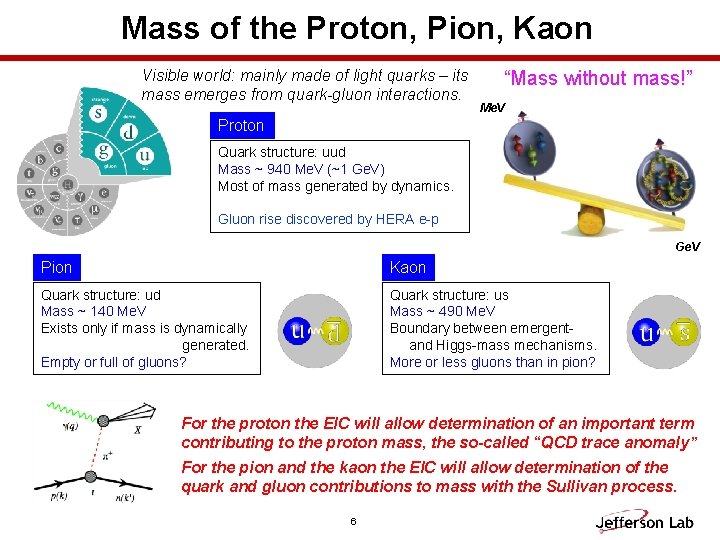
Mass of the Proton, Pion, Kaon Visible world: mainly made of light quarks – its mass emerges from quark-gluon interactions. “Mass without mass!” Me. V Proton Quark structure: uud Mass ~ 940 Me. V (~1 Ge. V) Most of mass generated by dynamics. Gluon rise discovered by HERA e-p Ge. V Pion Kaon Quark structure: ud Mass ~ 140 Me. V Exists only if mass is dynamically generated. Empty or full of gluons? Quark structure: us Mass ~ 490 Me. V Boundary between emergentand Higgs-mass mechanisms. More or less gluons than in pion? For the proton the EIC will allow determination of an important term contributing to the proton mass, the so-called “QCD trace anomaly” For the pion and the kaon the EIC will allow determination of the quark and gluon contributions to mass with the Sullivan process. 6
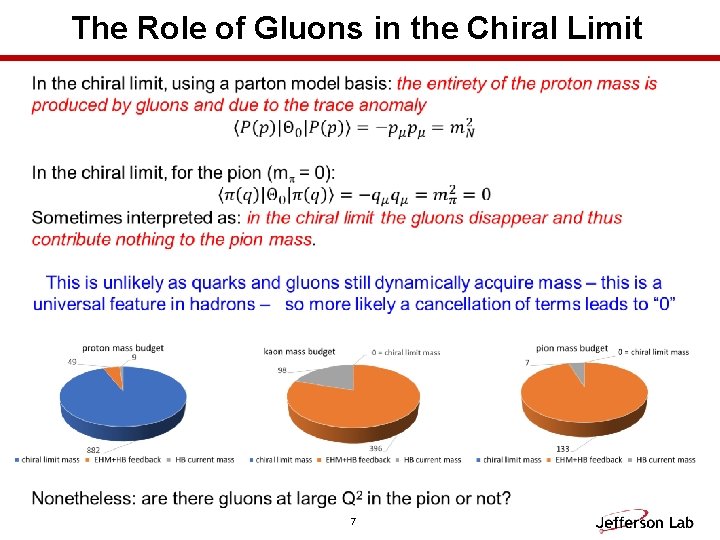
The Role of Gluons in the Chiral Limit 7
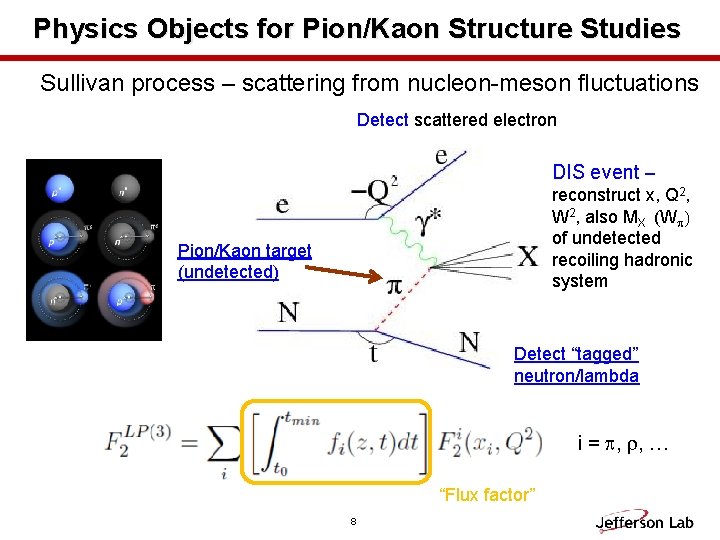
Physics Objects for Pion/Kaon Structure Studies Sullivan process – scattering from nucleon-meson fluctuations Detect scattered electron DIS event – reconstruct x, Q 2, W 2, also MX (Wp) of undetected recoiling hadronic system Pion/Kaon target (undetected) Detect “tagged” neutron/lambda i = p, r, … “Flux factor” 8
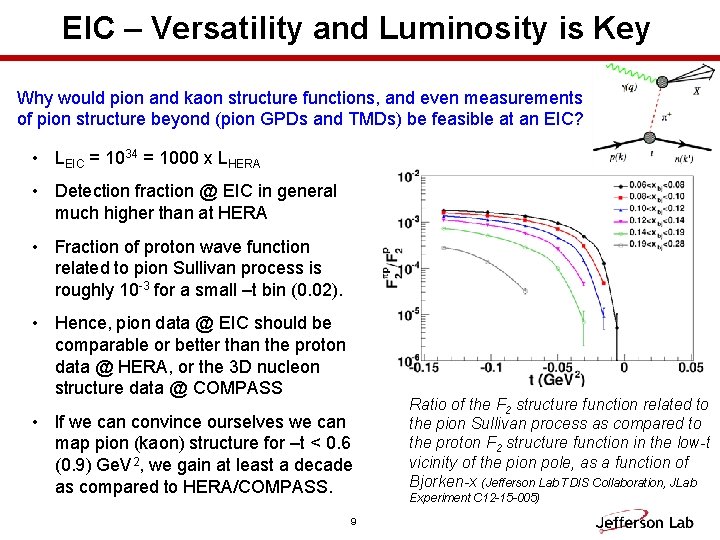
EIC – Versatility and Luminosity is Key Why would pion and kaon structure functions, and even measurements of pion structure beyond (pion GPDs and TMDs) be feasible at an EIC? • LEIC = 1034 = 1000 x LHERA • Detection fraction @ EIC in general much higher than at HERA • Fraction of proton wave function related to pion Sullivan process is roughly 10 -3 for a small –t bin (0. 02). • Hence, pion data @ EIC should be comparable or better than the proton data @ HERA, or the 3 D nucleon structure data @ COMPASS • If we can convince ourselves we can map pion (kaon) structure for –t < 0. 6 (0. 9) Ge. V 2, we gain at least a decade as compared to HERA/COMPASS. 9 Ratio of the F 2 structure function related to the pion Sullivan process as compared to the proton F 2 structure function in the low-t vicinity of the pion pole, as a function of Bjorken-x (Jefferson Lab TDIS Collaboration, JLab Experiment C 12 -15 -005)
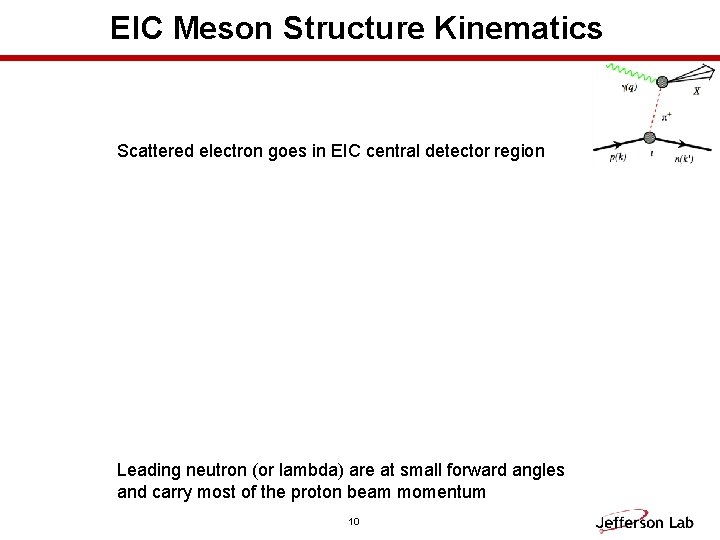
EIC Meson Structure Kinematics Scattered electron goes in EIC central detector region Leading neutron (or lambda) are at small forward angles and carry most of the proton beam momentum 10
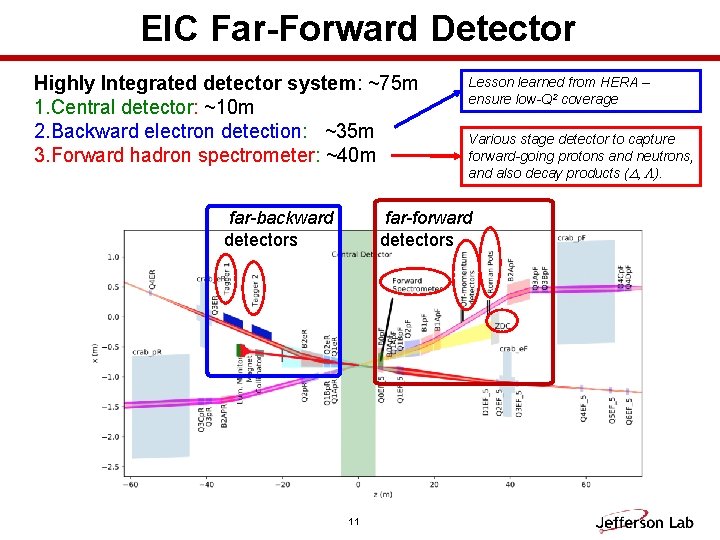
EIC Far-Forward Detector Highly Integrated detector system: ~75 m 1. Central detector: ~10 m 2. Backward electron detection: ~35 m 3. Forward hadron spectrometer: ~40 m far-backward detectors Lesson learned from HERA – ensure low-Q 2 coverage Various stage detector to capture forward-going protons and neutrons, and also decay products (D, L). far-forward detectors 11
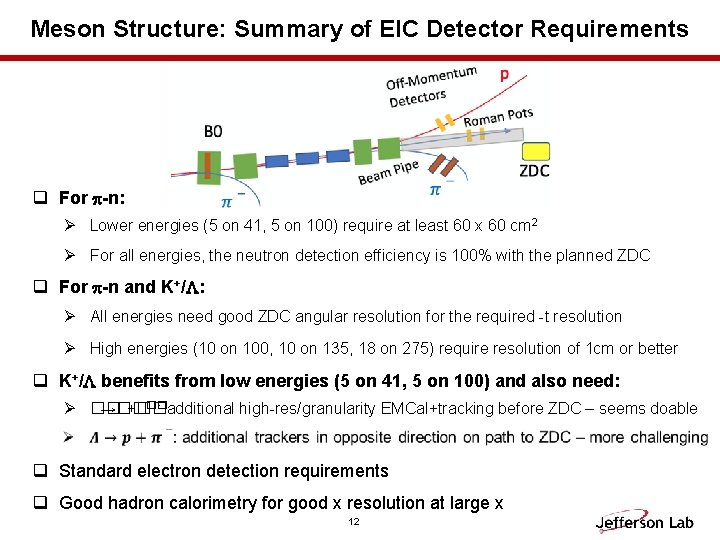
Meson Structure: Summary of EIC Detector Requirements q For p-n: Ø Lower energies (5 on 41, 5 on 100) require at least 60 x 60 cm 2 Ø For all energies, the neutron detection efficiency is 100% with the planned ZDC q For p-n and K+/L: Ø All energies need good ZDC angular resolution for the required -t resolution Ø High energies (10 on 100, 10 on 135, 18 on 275) require resolution of 1 cm or better q K+/L benefits from low energies (5 on 41, 5 on 100) and also need: �� Ø �� →�� +�� : additional high-res/granularity EMCal+tracking before ZDC – seems doable q Standard electron detection requirements q Good hadron calorimetry for good x resolution at large x 12
Pion Structure Function Projections vs x 13
Pion Structure Function Projections vs -t 14
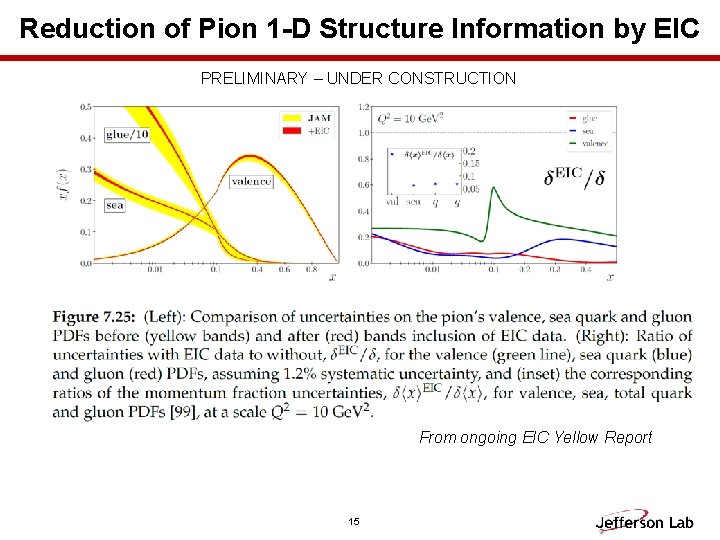
Reduction of Pion 1 -D Structure Information by EIC PRELIMINARY – UNDER CONSTRUCTION From ongoing EIC Yellow Report 15
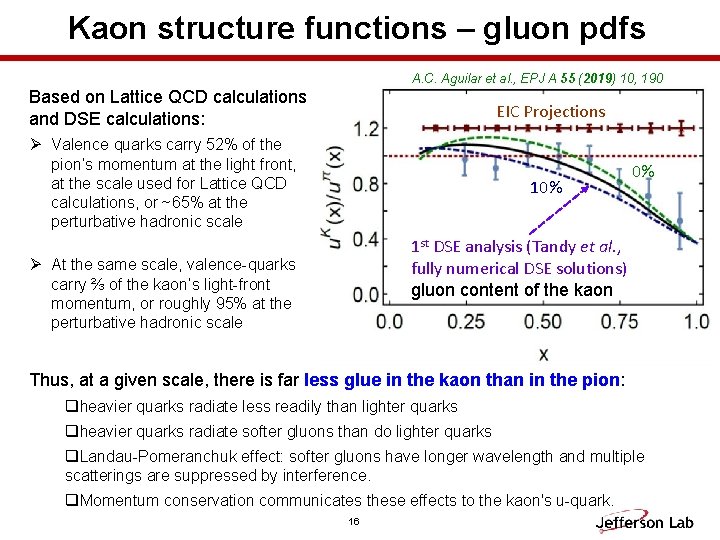
Kaon structure functions – gluon pdfs A. C. Aguilar et al. , EPJ A 55 (2019) 10, 190 Based on Lattice QCD calculations and DSE calculations: EIC Projections Ø Valence quarks carry 52% of the pion’s momentum at the light front, at the scale used for Lattice QCD calculations, or ~65% at the perturbative hadronic scale 10% 0% 1 st DSE analysis (Tandy et al. , fully numerical DSE solutions) gluon content of the kaon Ø At the same scale, valence-quarks carry ⅔ of the kaon’s light-front momentum, or roughly 95% at the perturbative hadronic scale Thus, at a given scale, there is far less glue in the kaon than in the pion: qheavier quarks radiate less readily than lighter quarks qheavier quarks radiate softer gluons than do lighter quarks q. Landau-Pomeranchuk effect: softer gluons have longer wavelength and multiple scatterings are suppressed by interference. q. Momentum conservation communicates these effects to the kaon's u-quark. 16
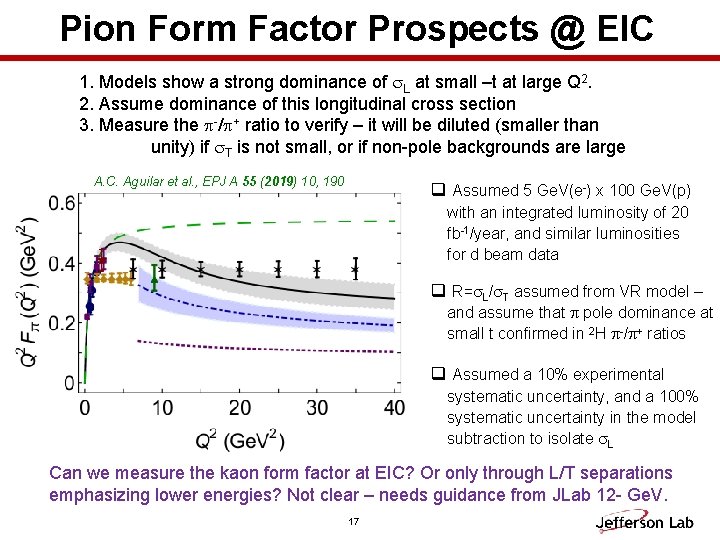
Pion Form Factor Prospects @ EIC 1. Models show a strong dominance of s. L at small –t at large Q 2. 2. Assume dominance of this longitudinal cross section 3. Measure the p-/p+ ratio to verify – it will be diluted (smaller than unity) if s. T is not small, or if non-pole backgrounds are large A. C. Aguilar et al. , EPJ A 55 (2019) 10, 190 q Assumed 5 Ge. V(e-) x 100 Ge. V(p) with an integrated luminosity of 20 fb-1/year, and similar luminosities for d beam data q R=s. L/s. T assumed from VR model – and assume that p pole dominance at small t confirmed in 2 H p-/p+ ratios q Assumed a 10% experimental systematic uncertainty, and a 100% systematic uncertainty in the model subtraction to isolate s. L Can we measure the kaon form factor at EIC? Or only through L/T separations emphasizing lower energies? Not clear – needs guidance from JLab 12 - Ge. V. 17
EIC – Meson Structure Questions 18
EIC – Meson Structure Questions Can we even do SIDIS or DES off meson target? 19
Intermezzo - Summary • Protons, neutrons, pions and kaons are the main building blocks of nuclear matter If we really want to claim we understand hadron structure as relevant for the visible world, we HAVE to understand at least the pion, kaon, proton, neutron (and likely the Lambda) at the same level. • The broad science program to understand pion and kaon structure and the QCD mechanism behind the emergent hadron masses requires a strong interplay between experiment and theory, matching experimental prospects by new theoretical insights, rapid computational advances, and high-level phenomenology • The EIC with its versatile large CM energy range will play a key role in the experimental program to chart in-pion and in-kaon distributions of interalia, mass, charge, magnetization and angular momentum, but. . . • … to provide experimental measurements guiding theoretical understanding requires a coherent, worldwide effort. 20
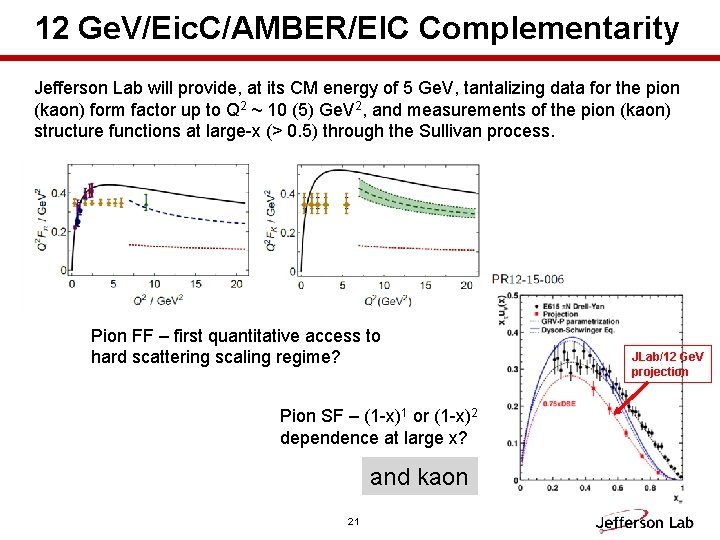
12 Ge. V/Eic. C/AMBER/EIC Complementarity Jefferson Lab will provide, at its CM energy of 5 Ge. V, tantalizing data for the pion (kaon) form factor up to Q 2 ~ 10 (5) Ge. V 2, and measurements of the pion (kaon) structure functions at large-x (> 0. 5) through the Sullivan process. Pion FF – first quantitative access to hard scattering scaling regime? Pion SF – (1 -x)1 or (1 -x)2 dependence at large x? and kaon 21 JLab/12 Ge. V projection
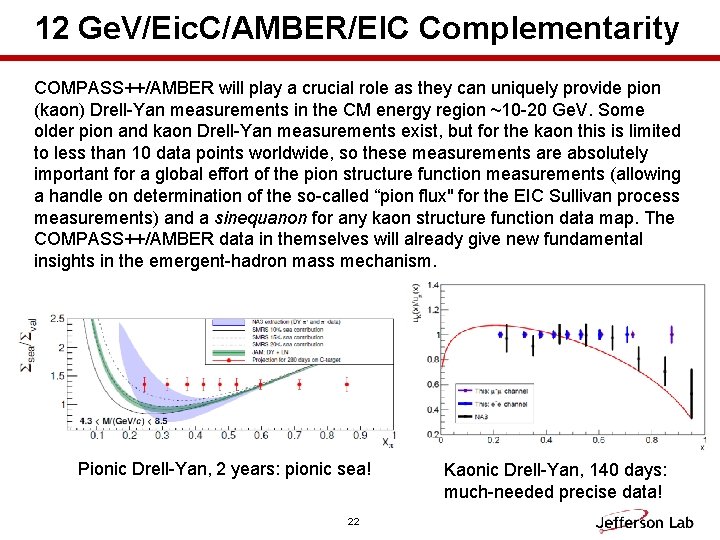
12 Ge. V/Eic. C/AMBER/EIC Complementarity COMPASS++/AMBER will play a crucial role as they can uniquely provide pion (kaon) Drell-Yan measurements in the CM energy region ~10 -20 Ge. V. Some older pion and kaon Drell-Yan measurements exist, but for the kaon this is limited to less than 10 data points worldwide, so these measurements are absolutely important for a global effort of the pion structure function measurements (allowing a handle on determination of the so-called “pion flux" for the EIC Sullivan process measurements) and a sinequanon for any kaon structure function data map. The COMPASS++/AMBER data in themselves will already give new fundamental insights in the emergent-hadron mass mechanism. Pionic Drell-Yan, 2 years: pionic sea! 22 Kaonic Drell-Yan, 140 days: much-needed precise data!
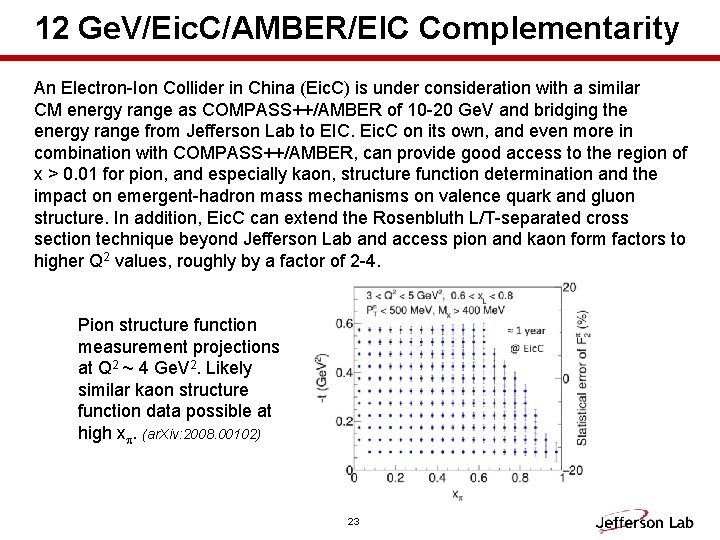
12 Ge. V/Eic. C/AMBER/EIC Complementarity An Electron-Ion Collider in China (Eic. C) is under consideration with a similar CM energy range as COMPASS++/AMBER of 10 -20 Ge. V and bridging the energy range from Jefferson Lab to EIC. Eic. C on its own, and even more in combination with COMPASS++/AMBER, can provide good access to the region of x > 0. 01 for pion, and especially kaon, structure function determination and the impact on emergent-hadron mass mechanisms on valence quark and gluon structure. In addition, Eic. C can extend the Rosenbluth L/T-separated cross section technique beyond Jefferson Lab and access pion and kaon form factors to higher Q 2 values, roughly by a factor of 2 -4. Pion structure function measurement projections at Q 2 ~ 4 Ge. V 2. Likely similar kaon structure function data possible at high xp. (ar. Xiv: 2008. 00102) 23
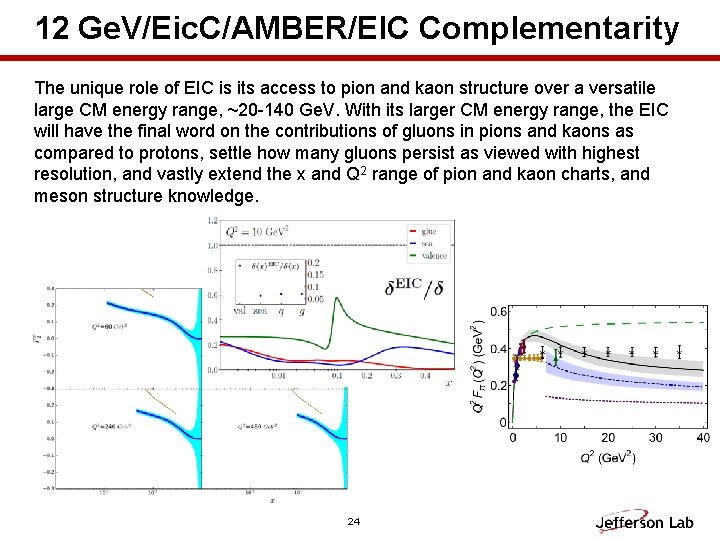
12 Ge. V/Eic. C/AMBER/EIC Complementarity The unique role of EIC is its access to pion and kaon structure over a versatile large CM energy range, ~20 -140 Ge. V. With its larger CM energy range, the EIC will have the final word on the contributions of gluons in pions and kaons as compared to protons, settle how many gluons persist as viewed with highest resolution, and vastly extend the x and Q 2 range of pion and kaon charts, and meson structure knowledge. 24
25
Kinematics of Interest • In general, a large range of CM energies is required to access a wide range in x and Q 2, as relevant for pion (kaon) structure function measurements or hadron multiplicity measurements for a transverse-momentum dependent parton distribution program. This has to be balanced against the requirement to uniquely determine the remnant neutron (or L or So) to ensure the scattering process occurs off a pion (kaon). The latter favors not-too-high CM energies to be able to uniquely determine the remnant L (or So)both for missing-mass determination and to ensure their decays occur before detection. In addition, there is need for both e-p and e-d measurements at similar CM energies to validate the reaction mechanism and understanding. This drives the “typical" CM energy range for pion and kaon structure function measurements to a ~10 -100 Ge. V range. On the other hand, to access the largest-x region to determine the behavior of the valence quarks in pions (or kaons), the lowest CM energy to reach a (sufficiently high and clean") Q 2 level has the highest Figure-Of-Merit folding in all kinematic effects. Higher CM energies will increase the range in Q 2. • For the pion (kaon) fragmentation processes, the collider (as opposed to fixed-target) kinematics greatly facilitate transverse-momentum dependent measurements at low transverse-momentum scales (< 1 Ge. V), and the largest range in CM energy is required. For some processes the exact CM energy is not that essential, as long as one obtains sufficient phase space to produce the electro-produced particles, to boost the experimental cross section. This is for example true for the (deep) exclusive J-Y measurements to possibly constrain the QCD trace anomaly, and also for access to charged-current cross sections. • For pion (kaon) form factor determination, the situation is different. The traditional method relies on Rosenbluth L/Tseparated cross sections as the longitudinal (L) cross section enhances pion (kaon) pole sensitivity. Such measurements are best done at a relatively low CM energy range (~10 -20 Ge. V). An alternate method to extract the pion form factor makes use of direct comparison of charged-pion cross sections for e-p and e-d. This method may be applicable up to higher CM energies (and higher Q 2 values). Similarly, for the kaon form factor it may be possible to increase the Q 2 range (as compared to that from L/T-separated cross sections) from the L/So cross section ratios. The latter requires further study, but is only possible at CM energies, ~10 -50 Ge. V, where the L and So may be cleanly isolated. 26
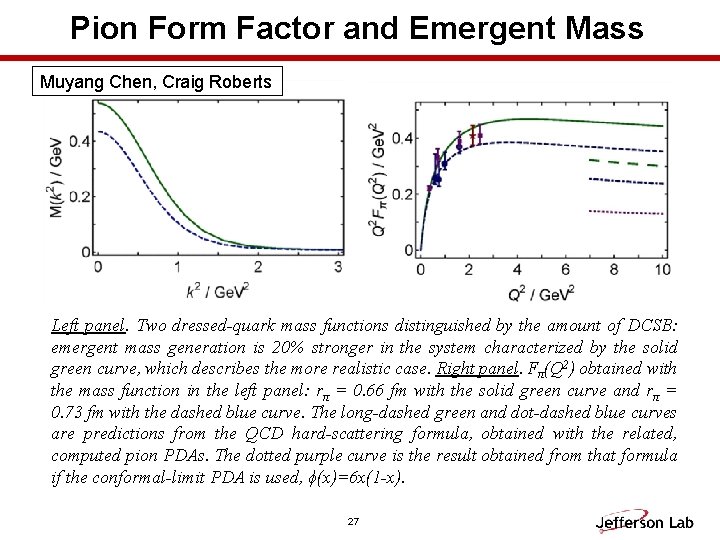
Pion Form Factor and Emergent Mass Muyang Chen, Craig Roberts Left panel. Two dressed-quark mass functions distinguished by the amount of DCSB: emergent mass generation is 20% stronger in the system characterized by the solid green curve, which describes the more realistic case. Right panel. Fπ(Q 2) obtained with the mass function in the left panel: rπ = 0. 66 fm with the solid green curve and rπ = 0. 73 fm with the dashed blue curve. The long-dashed green and dot-dashed blue curves are predictions from the QCD hard-scattering formula, obtained with the related, computed pion PDAs. The dotted purple curve is the result obtained from that formula if the conformal-limit PDA is used, ϕ(x)=6 x(1 -x). 27
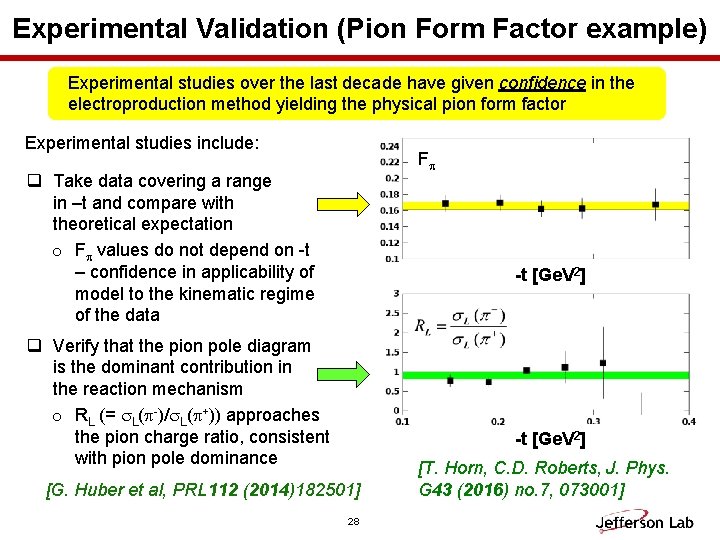
Experimental Validation (Pion Form Factor example) Experimental studies over the last decade have given confidence in the electroproduction method yielding the physical pion form factor Experimental studies include: Fp q Take data covering a range in –t and compare with theoretical expectation o Fp values do not depend on -t – confidence in applicability of model to the kinematic regime of the data -t [Ge. V 2] q Verify that the pion pole diagram is the dominant contribution in the reaction mechanism o RL (= s. L(p-)/s. L(p+)) approaches the pion charge ratio, consistent with pion pole dominance -t [Ge. V 2] [G. Huber et al, PRL 112 (2014)182501] 28 [T. Horn, C. D. Roberts, J. Phys. G 43 (2016) no. 7, 073001]