
PINUS Indoor Weighted Centroid Localization with Crowdsourced Calibration

PINUS: Indoor Weighted Centroid Localization with Crowdsourced Calibration Jehn-Ruey Jiang, Hanas Subakti, Ching-Chih Chen Dept. of Comp. Sci. and Inf. Eng. National Central University Taoyuan City, Taiwan Kazuya Sakai Dept. of Elec. Eng. and Comp. Sci. Tokyo Metropolitan University Tokyo, Japan
Outline ______ 1. 2. 3. 4. 5. Introduction Related Work Proposed Method Experiments Conclusion 2
Introduction The Indoor Localization system About PINUS or “PIN US” (ILS) is a popular topic • PINUS is based on the weighted centroid • Global Navigation Satellite localization (WCL) System, such as GPS, could • Instead of using estimated distances to not perform ILS derive the target position directly (which • • ILS should be redesigned Many ILS applications: guidance and navigation, AGV steering, and item tracking mostly inaccurate), PINUS performs distance estimation calibration on the basis of the Friis equation, and uses distance ratios (i. e. , weight) to derive target position • PINUS utilizes the crowdsourcing concept for devices to share calibration information Experiments using Bluetooth Low Energy (BLE) Beacon as an anchor and Smartphone as a target are conducted. Actually, other devices, such as Wi. Fi AP, Arduino and Raspberry PI, can also be applied to realize the PINUS system. 3
Outline ______ 1. 2. 3. 4. 5. Introduction Related Work Proposed Method Experiments Conclusion 4
![Weighted Centroid Localization Adopt WCL based on Blumenthal et al. [8] Using Friis Equation](http://slidetodoc.com/presentation_image_h2/d09044a8bbafff3dfa7f048c98ea4fdd/image-5.jpg "Weighted Centroid Localization Adopt WCL based on Blumenthal et al. [8] Using Friis Equation")
Weighted Centroid Localization Adopt WCL based on Blumenthal et al. [8] Using Friis Equation to estimates the distances • Pr is the power received by the receiver (i. e. , target) • Pt is the transmission power of the transmitter Received Signal Strength Indicator (RSSI) calculation for. Pr RSSI of Pr is of the unit of d. Bm and is the ratio of the received power to the reference power Pref, usually taken as 1 m. W. (i. e. , anchor) • Gt is the gain of the transmitter • Gr is the gain of the receiver • is the wavelength In this case we could put the Friis equation in relative decibel (d. B) unit, we have the following equation • d is the distance between the transmitter and the receiver. [8] J. Blumenthal, R. Grossmann, F. Golatowski and D. Timmermann, "Weighted Centroid Localization in Zigbee-based Sensor Networks, " 2007 IEEE International Symposium on Intelligent Signal Processing, Alcala de Henares, 2007, pp. 1 -6. doi: 10. 1109/WISP. 2007. 4447528. 5

Weighted Centroid Localization(2) On receiving signals from n anchors, a target can determine its position P=(Px, Py) according to the following equation, where n is usually taken as an integer at least 3. 6

Crowdsourced Indoor Localization Fingerprinting localization consists of two phases: offline site survey, and online positioning 1. In the site survey phase, a fingerprint (e. g. , the RSSI values of Wi. Fi APs) for every reference point (RP) is obtained 2. In the positioning phase, the observed fingerprint of a target (e. g. , smartphone) is used as the key to find out k nearest fingerprints of k RPs for estimating target position, where k 1. Advantage of Crowdsourcing Fingerprinting Crowdsourcing can relieve the burden of site survey by allowing common users to participate in fingerprinting. A challenge of fingerprinting crowdsourcing is device diversity. Since crowds own devices with diverse brands, models, and hardware specifications, inconsistency of fingerprint measurements is likely to happen. 7
Outline ______ 1. 2. 3. 4. 5. Introduction Related Work Proposed Method Experiments Conclusion 8
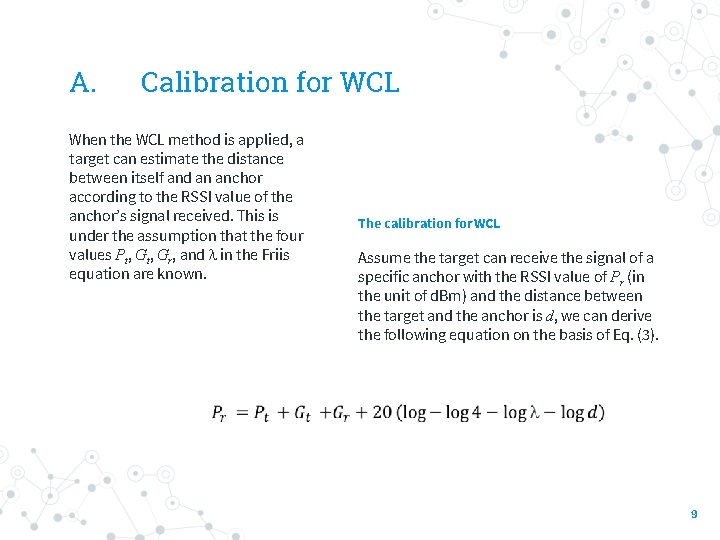
A. Calibration for WCL When the WCL method is applied, a target can estimate the distance between itself and an anchor according to the RSSI value of the anchor’s signal received. This is under the assumption that the four values Pt, Gr, and in the Friis equation are known. The calibration for WCL Assume the target can receive the signal of a specific anchor with the RSSI value of Pr (in the unit of d. Bm) and the distance between the target and the anchor is d, we can derive the following equation on the basis of Eq. (3). 9
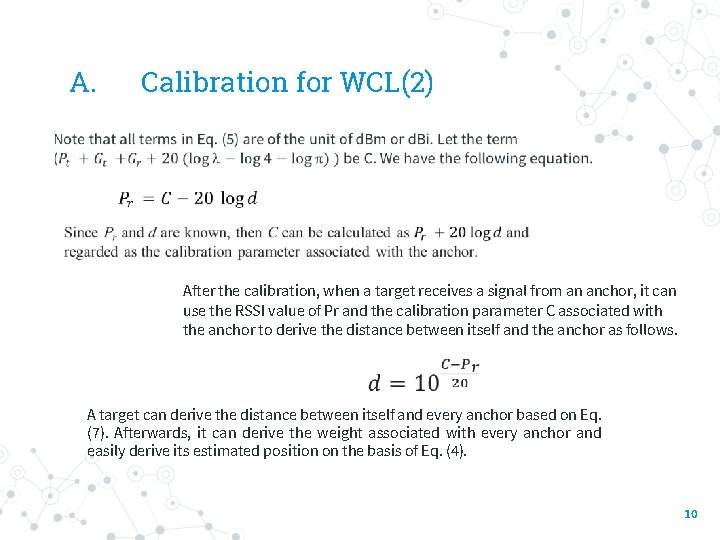
A. Calibration for WCL(2) After the calibration, when a target receives a signal from an anchor, it can use the RSSI value of Pr and the calibration parameter C associated with the anchor to derive the distance between itself and the anchor as follows. A target can derive the distance between itself and every anchor based on Eq. (7). Afterwards, it can derive the weight associated with every anchor and easily derive its estimated position on the basis of Eq. (4). 10

B. Crowdsourced Calibration for WCL Crowdsourcing can be utilized to help complete comprehensive calibration Crowdsourced calibration can be active or passive. In active crowdsource calibration, a participant standing at a calibration point enters the coordinate of the calibration point to complete the calibration for all anchors whose signals can be received by the participant device. In passive crowdsourced calibration, the sensors in the participant’s device can be used to derive location information or movement trajectory of the participant to allow the participant to do the calibration implicitly. After performing the calibration for WCL, a target may upload the calibration parameters associated with some anchors to a web site for future sharing. Note that a pseudo ID should also be uploaded or exchanged along with those parameters. 11
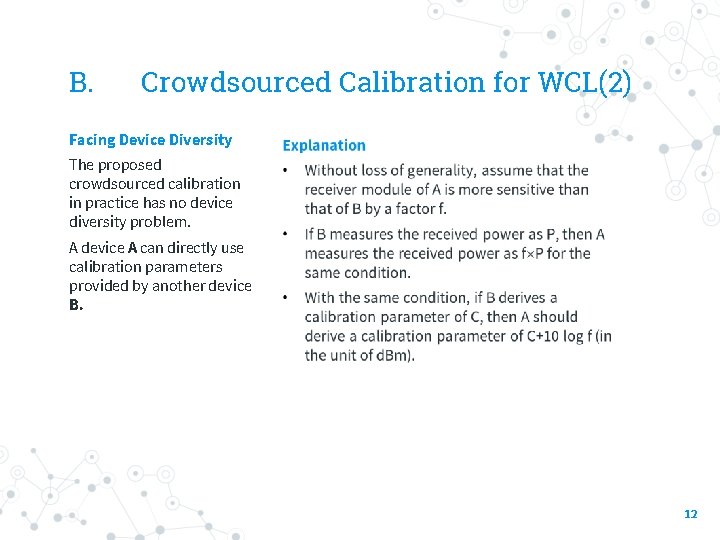
B. Crowdsourced Calibration for WCL(2) Facing Device Diversity The proposed crowdsourced calibration in practice has no device diversity problem. A device A can directly use calibration parameters provided by another device B. 12
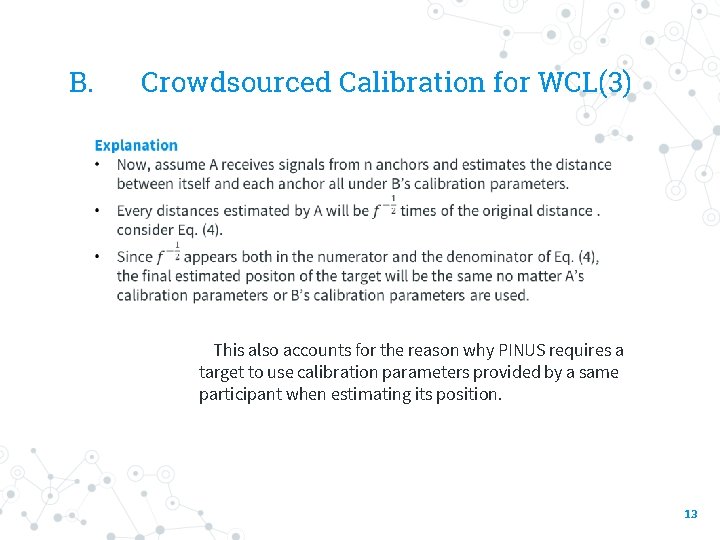
B. Crowdsourced Calibration for WCL(3) This also accounts for the reason why PINUS requires a target to use calibration parameters provided by a same participant when estimating its position. 13
Outline ______ 1. 2. 3. 4. 5. Introduction Related Work Proposed Method Experiments Conclusion 14
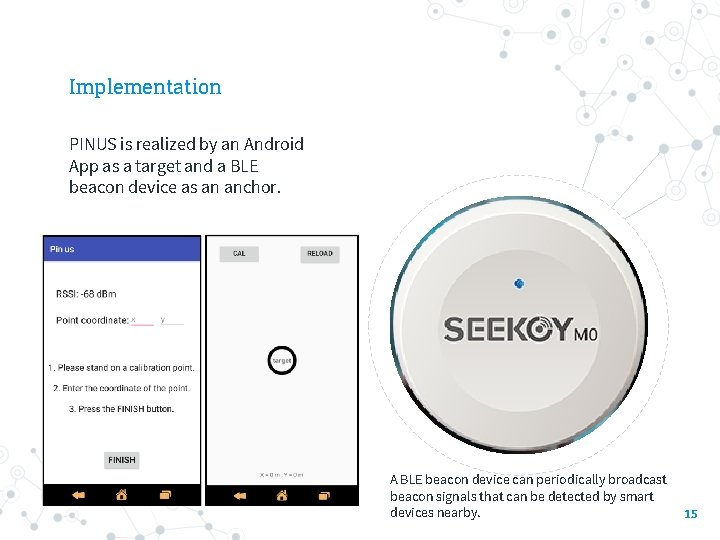
Implementation PINUS is realized by an Android App as a target and a BLE beacon device as an anchor. A BLE beacon device can periodically broadcast beacon signals that can be detected by smart devices nearby. 15
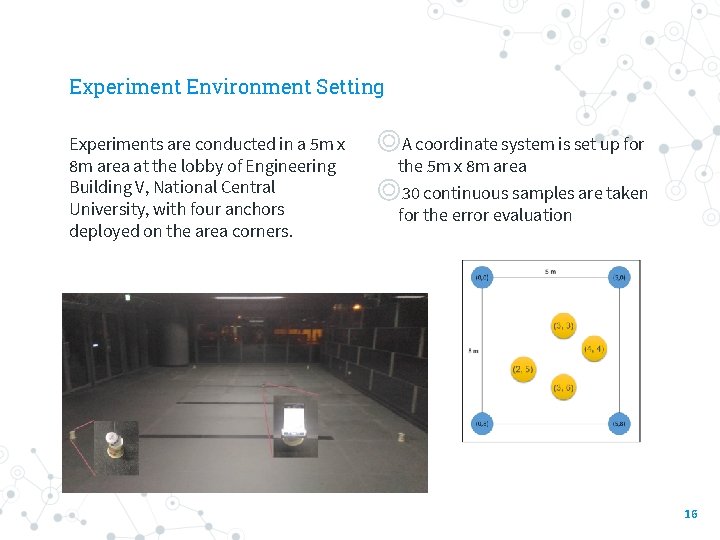
Experiment Environment Setting Experiments are conducted in a 5 m x 8 m area at the lobby of Engineering Building V, National Central University, with four anchors deployed on the area corners. ◎A coordinate system is set up for the 5 m x 8 m area ◎30 continuous samples are taken for the error evaluation 16
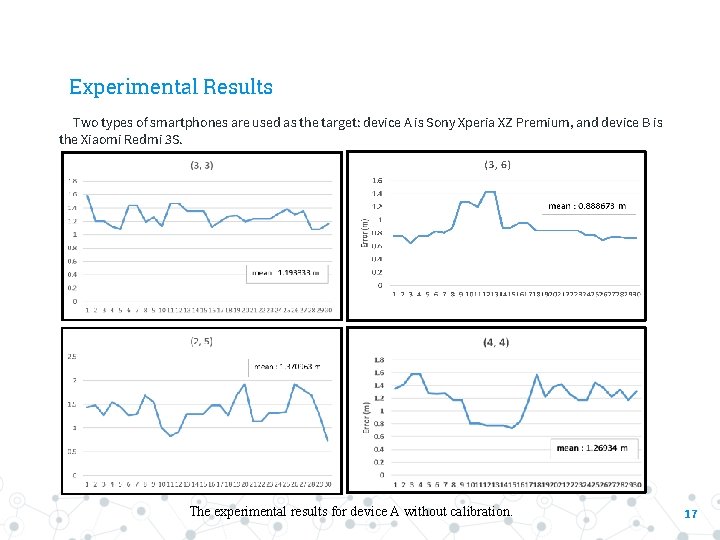
Experimental Results Two types of smartphones are used as the target: device A is Sony Xperia XZ Premium, and device B is the Xiaomi Redmi 3 S. The experimental results for device A without calibration. 17
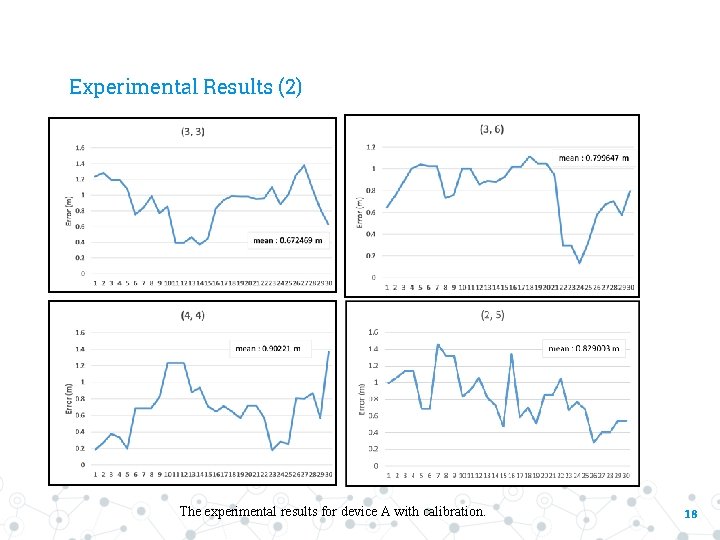
Experimental Results (2) The experimental results for device A with calibration. 18
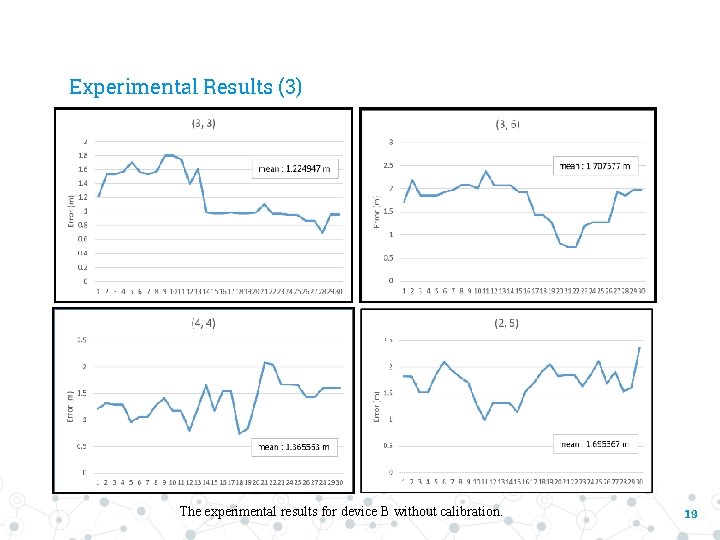
Experimental Results (3) The experimental results for device B without calibration. 19
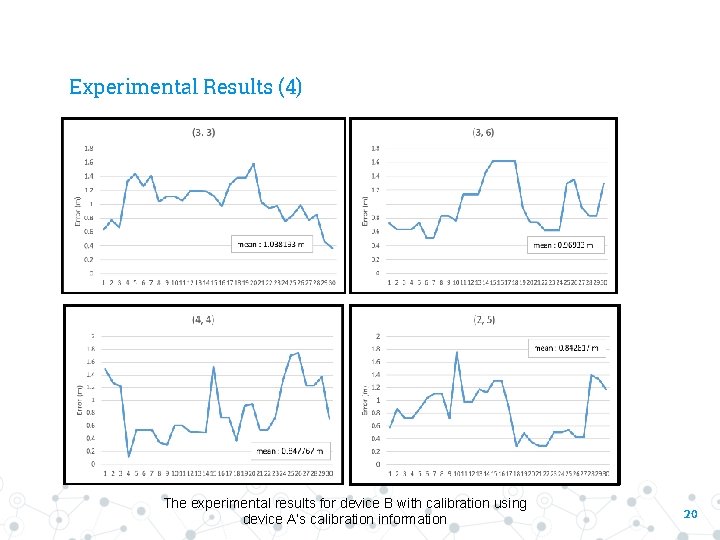
Experimental Results (4) The experimental results for device B with calibration using device A’s calibration information 20
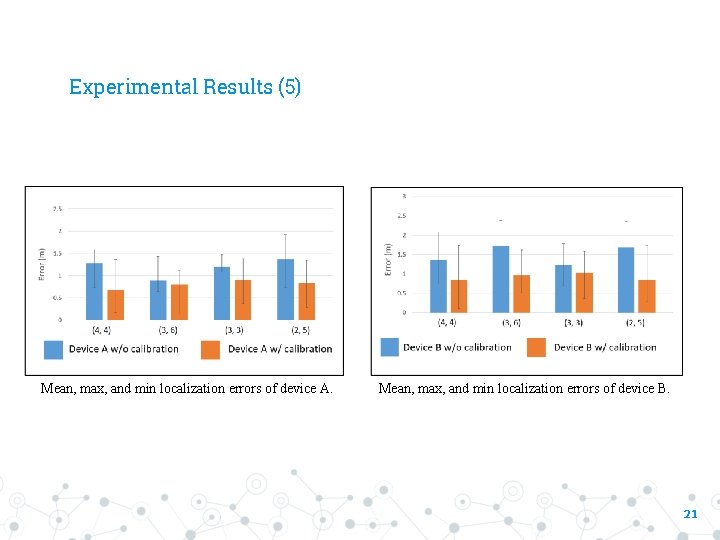
Experimental Results (5) Mean, max, and min localization errors of device A. Mean, max, and min localization errors of device B. 21
Outline ______ 1. 2. 3. 4. 5. Introduction Related Work Proposed Method Experiments Conclusion 22
“ This paper proposes PINUS, an indoor weighted centroid localization method with crowdsourced calibration, which does not have the device diversity problem. Errors are reduced significantly when the calibration is applied even when a device uses another device’s calibration parameters for all anchors involved in the location process. 23
“ Future Work 1. 2. 3. Setting up a coordinate system for the Engineering Building V Building of NCU and attaching every Wi. Fi AP to a unique coordinate Performing the calibration process using a single device for all APs Providing PINUS APP to all visitors or new-comers for the purpose of indoor navigation 24

Thanks! Any questions? 25
- Slides: 25