
PIN HOLE CAMERA PARTS OF A CAMERA VISUAL

- Slides: 16
PIN HOLE CAMERA / PARTS OF A CAMERA VISUAL COMMUNICATIONS GRAPHICS MR. SHEA www. Mr. Sheas. Page. weebly. com
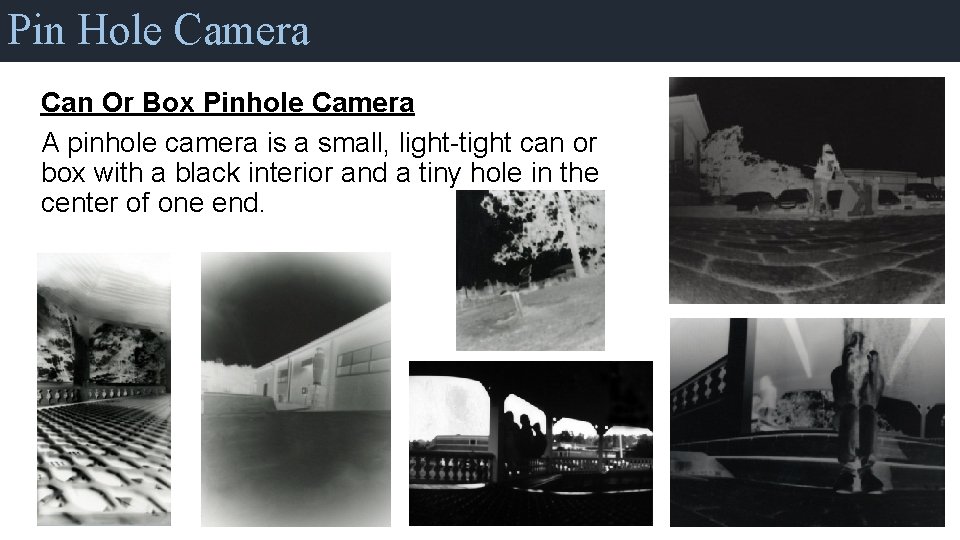
Pin Hole Camera Can Or Box Pinhole Camera A pinhole camera is a small, light-tight can or box with a black interior and a tiny hole in the center of one end.
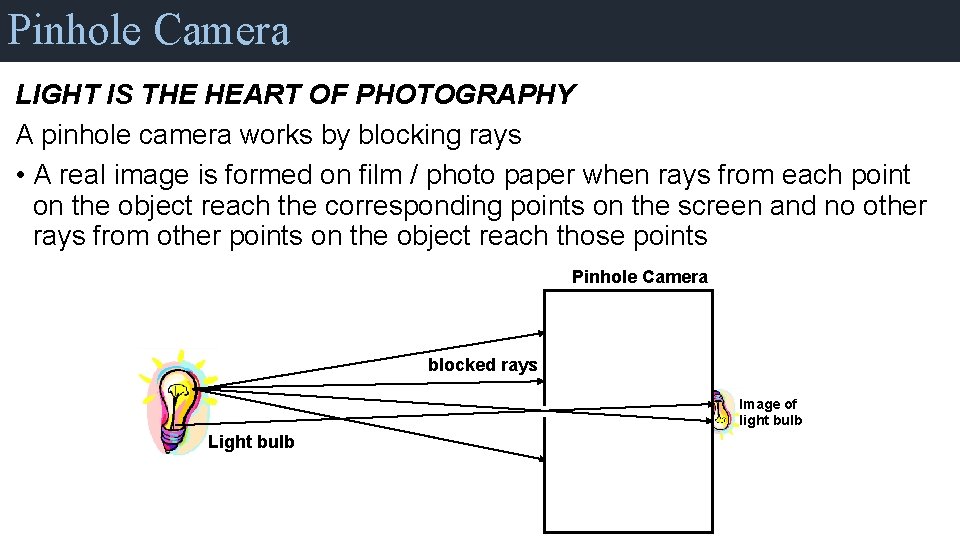
Pinhole Camera LIGHT IS THE HEART OF PHOTOGRAPHY A pinhole camera works by blocking rays • A real image is formed on film / photo paper when rays from each point on the object reach the corresponding points on the screen and no other rays from other points on the object reach those points Pinhole Camera blocked rays Image of light bulb Light bulb
Pin Hole Camera Process THE BOX • Use a small can or box as the camera body. You can use anything that has a tightfitting top - a clean paint can, a 2 -pound coffee can, a shoebox, or even a cylindrical Pringles can. • To make the can light-tight, paint the inside with dull black paint to prevent light reflections. If the can you use has a plastic lid, paint the lid black. • Be sure to paint it inside and out; then before using it, check to make sure no paint has chipped off. Chipped or peeling paint on the lid will allow light to enter the camera and ruin your pictures. The Pinhole •
Pin Hole Camera Process THE PINHOLE • The pinhole acts as the aperture. The aperture is a hole or an opening through which light travels. It controls the AMOUNT or VOLUME of light that comes into the camera. • The film will be attached to the inside, back of the can / box. You will need to make the pinhole in the opposite side of the can / box. • You can make the actual pinhole in the can itself, but it's much easier to make it in a separate piece of thin metal and fasten this piece over a larger hole cut in the center of the bottom end of the can. • The distance of the film from the pinhole and the diameter of the pinhole will determine the angle of view and sharpness of your final image. For a camera with the pinhole 3 to 6 inches from the film, you'll get the best results if the pinhole is about 1/75 inch in diameter. • Don't press too hard the tip should just barely break through the surface.
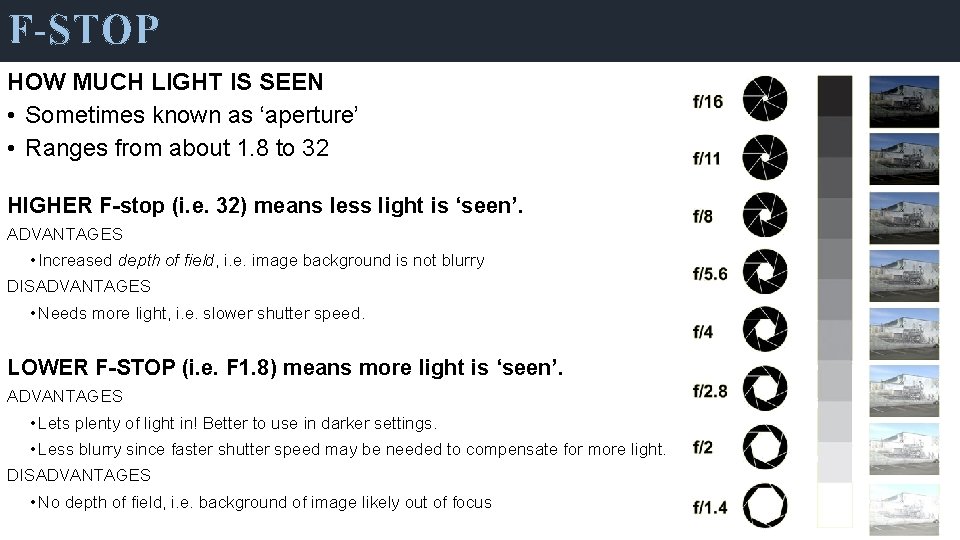
F-STOP HOW MUCH LIGHT IS SEEN • Sometimes known as ‘aperture’ • Ranges from about 1. 8 to 32 HIGHER F-stop (i. e. 32) means less light is ‘seen’. ADVANTAGES • Increased depth of field, i. e. image background is not blurry DISADVANTAGES • Needs more light, i. e. slower shutter speed. LOWER F-STOP (i. e. F 1. 8) means more light is ‘seen’. ADVANTAGES • Lets plenty of light in! Better to use in darker settings. • Less blurry since faster shutter speed may be needed to compensate for more light. DISADVANTAGES • No depth of field, i. e. background of image likely out of focus
Pin Hole Camera Process THE SHUTTER • The shutter for the camera is a device that allows light to pass for a determined period of TIME. • For our pinhole cameras, we will use a flap of opaque dark tape. • You will need to experiment with the amount of time the shutter needs to be open to get a good print depending on the type/ time of day and location of your camera / subject. LOADING A CAN OR BOX PINHOLE CAMERA • Paper, because it is less sensitive to light than film, will probably require an exposure of about 2 minutes for sunlit subjects. • Paper is easier to handle since you can load it into the camera under a safelight. • When you have the size of paper or film you need, tape it firmly to the inside of the end of your camera opposite the pinhole. The emulsion should face the pinhole.
Pin Hole Camera Process THE PINHOLE • The film will be attached to the inside of the lid so you will need to make the pinhole in the bottom end of the can. You can make the actual pinhole in the can itself, but it's much easier to make it in a separate piece of heavy black paper or thin metal and fasten this piece over a larger hole cut in the center of the bottom end of the can. Heavy-duty aluminum foil, a piece of aluminum cut from a soda can or the backing paper from Kodak 120 size roll film is good for this purpose. • The distance of the film from the pinhole and the diameter of the pinhole will determine the angle of view and sharpness of your final image. For a camera with the pinhole 3 to 6 inches from the film, you'll get the best results if the pinhole is about 1/75 inch in diameter. You can make a hole this size by pushing a No. 10 sewing needle through the paper or metal to a point halfway up the needle shank. The pinhole should as circular as possible. • TIP: You'll get a smoother hole if you rotate the needle as you push it through. If you're using aluminum foil or paper, sandwich it between two lightweight cards while you make the pinhole. This will help you make a smoother, rounder hole.
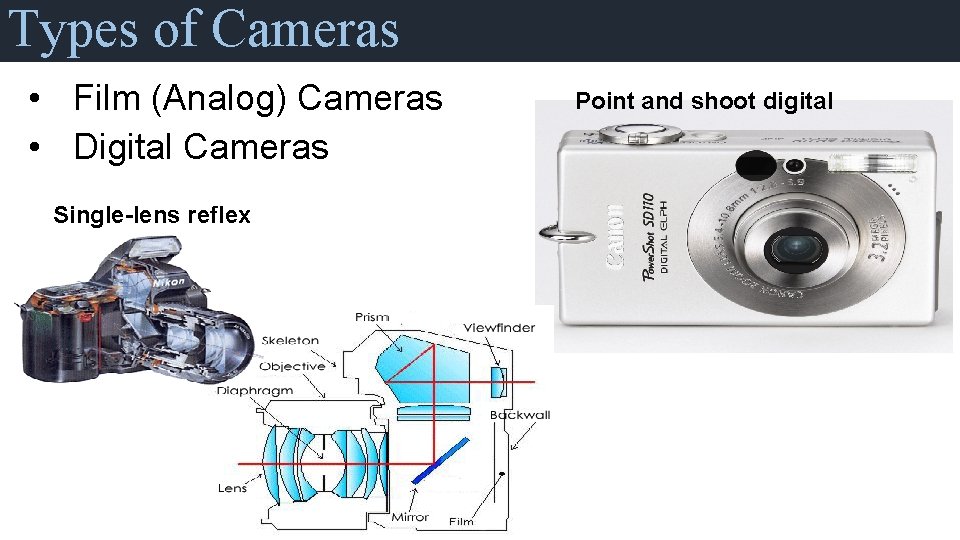
Types of Cameras • Film (Analog) Cameras • Digital Cameras Single-lens reflex Point and shoot digital
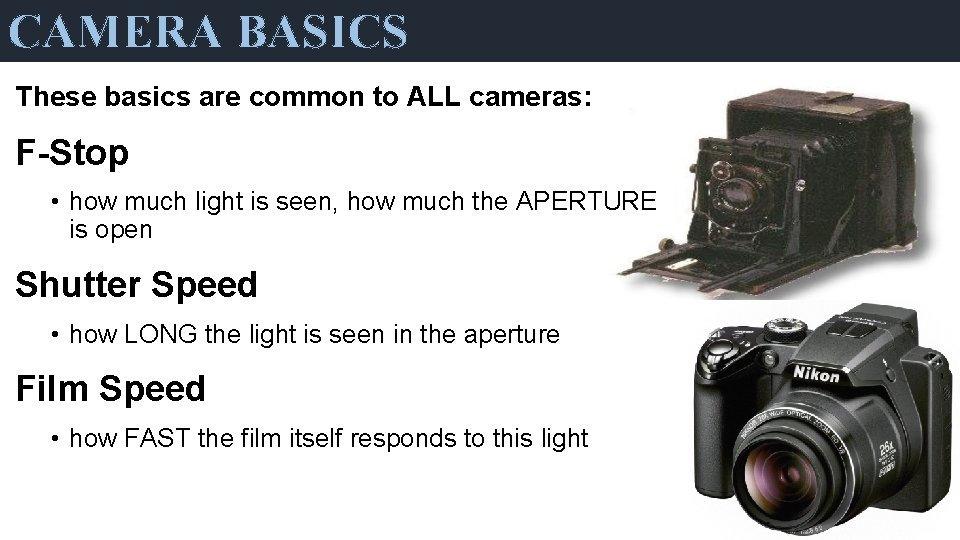
CAMERA BASICS These basics are common to ALL cameras: F-Stop • how much light is seen, how much the APERTURE is open Shutter Speed • how LONG the light is seen in the aperture Film Speed • how FAST the film itself responds to this light
Film (Analog) Camera • A film camera is made of three basic elements: 1. Optical (the lens) 2. Chemical (the film) 3. Mechanical (the camera body) • The three elements combine to create a printable image.
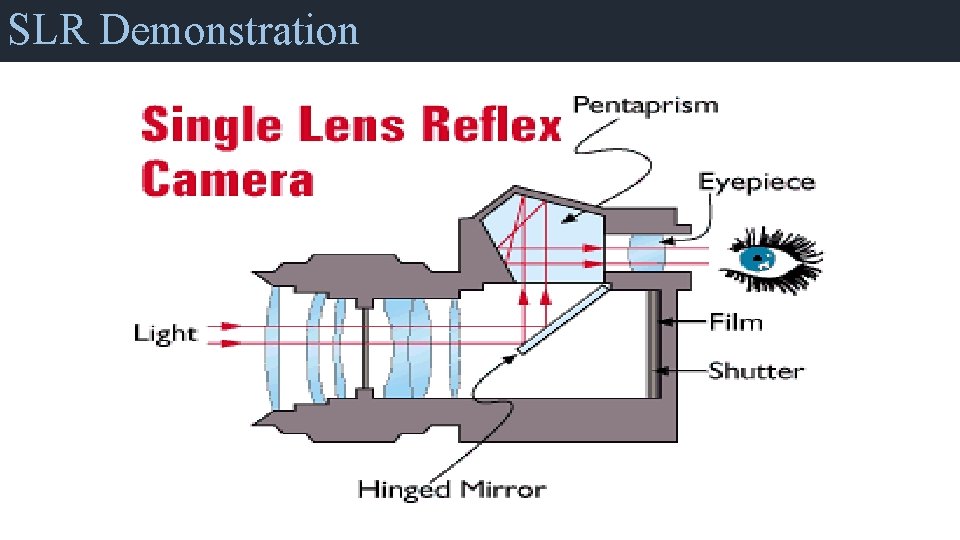
Two Types of Film Cameras Point and Shoot (P&S) ◦ The viewfinder provides a rough idea of what is in view, but not the real image. �Great for capturing memories Single Lens Reflex (SLR) ◦ You see the actual image that will be exposed onto the film. �Great for capturing images with real impact ◦ Provides more control and better images than P&S.
SLR Demonstration
Digital Camera • A digital camera records images electronically using a built in processor. • Has a lens like an analog camera • BUT, the lens refracts light onto computer chips rather than film. • Similar features to film counterparts • Relies on electronic processing and storage
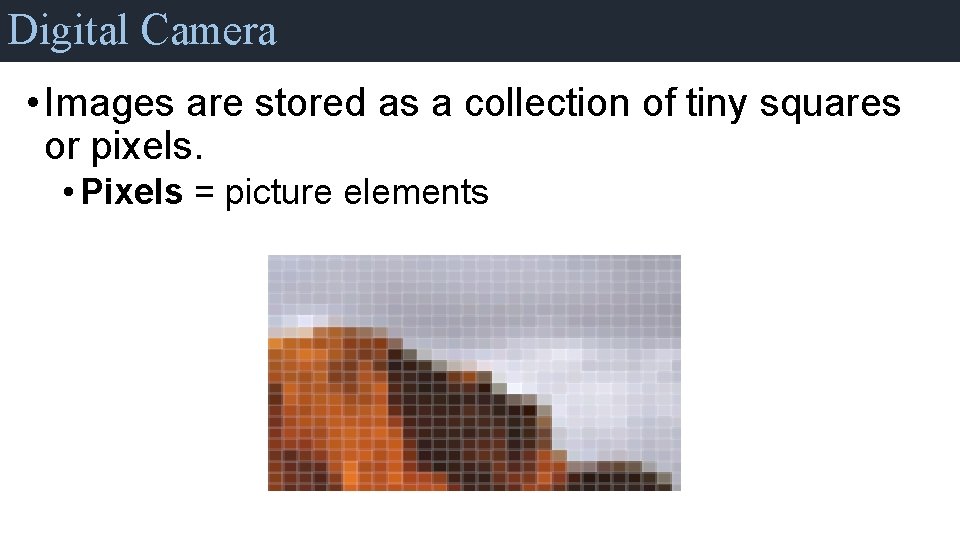
Digital Camera • Images are stored as a collection of tiny squares or pixels. • Pixels = picture elements
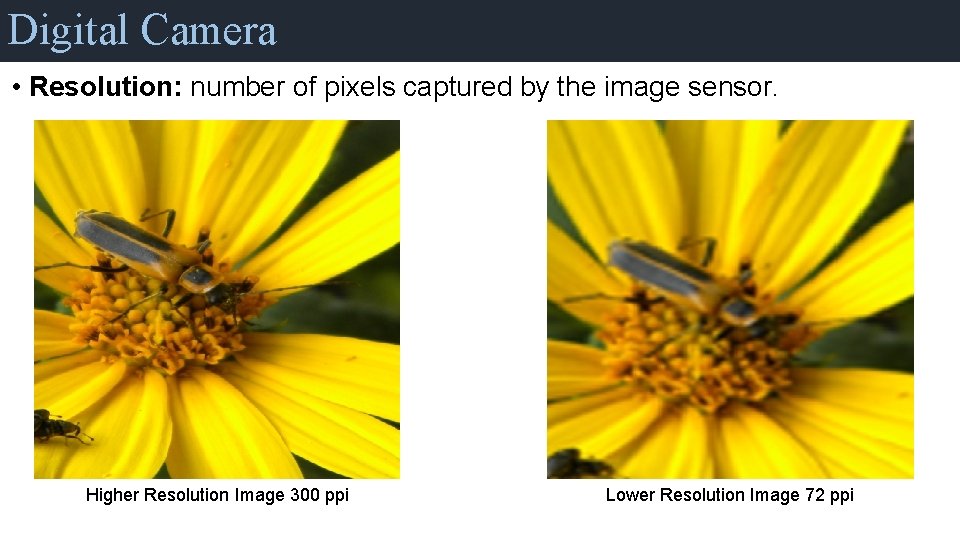
Digital Camera • Resolution: number of pixels captured by the image sensor. Higher Resolution Image 300 ppi Lower Resolution Image 72 ppi