
Pilot Studies What we need to know Sayem


- Slides: 33
Pilot Studies: What we need to know Sayem Borhan Biostatistician, DFM Research April 25, 2018 borhana@mcmaster. ca @Mc. Master. Fam. Med
Learning Objectives § Learn about the “what, why and how” of pilot studies; § Gain knowledge about challenges and issues (e. g. sample size, ethics, publication etc. ) related to pilot studies; § Learn about new developments in pilot studies;
Randomized Controlled Trial (RCT) § RCT is a planned experiment designed to assess the efficacy of an intervention by comparing the intervention to a control § Methodological steps Ø Ø Ø Ø Design of trial Sample size Eligibility and enrolment Consent Randomization Follow-up Outcome Analyses
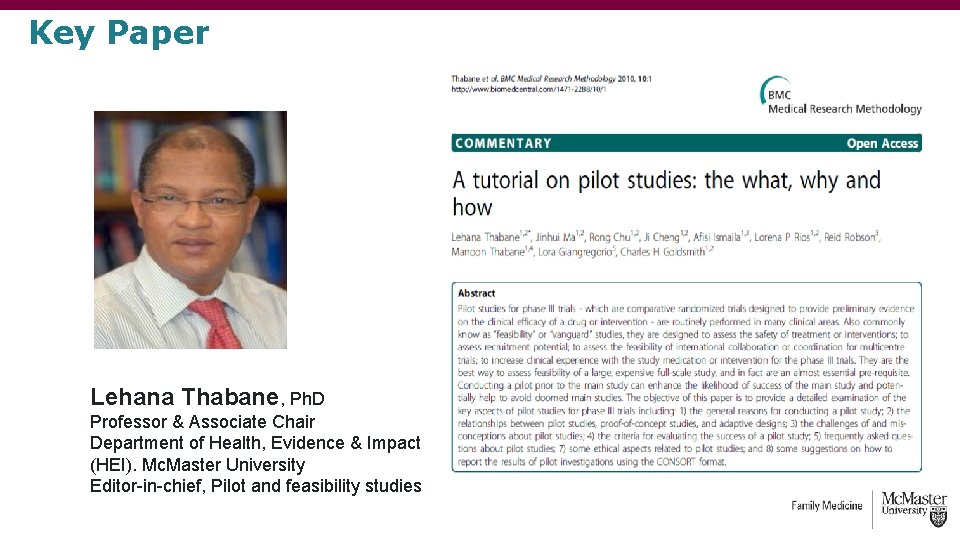
Key Paper Lehana Thabane, Ph. D Professor & Associate Chair Department of Health, Evidence & Impact (HEI). Mc. Master University Editor-in-chief, Pilot and feasibility studies
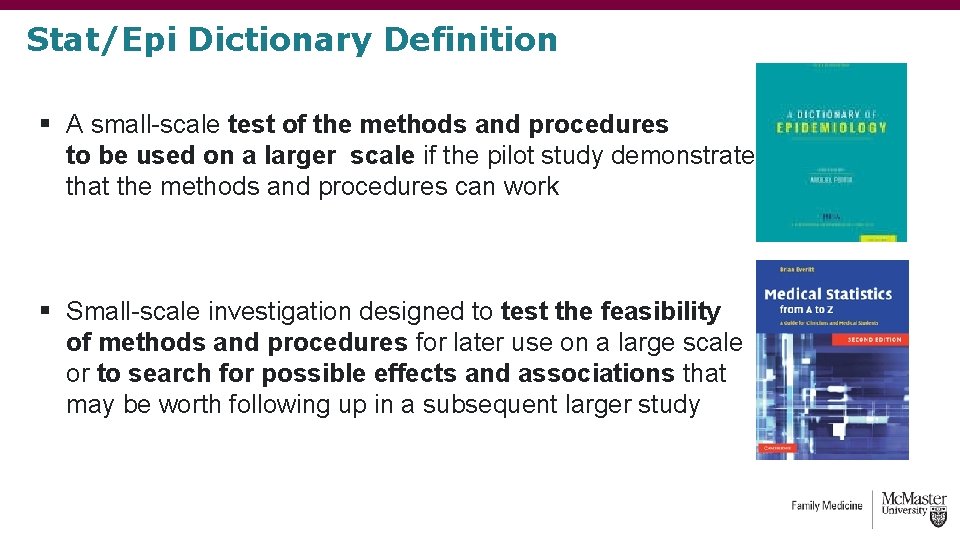
Stat/Epi Dictionary Definition § A small-scale test of the methods and procedures to be used on a larger scale if the pilot study demonstrates that the methods and procedures can work § Small-scale investigation designed to test the feasibility of methods and procedures for later use on a large scale or to search for possible effects and associations that may be worth following up in a subsequent larger study
Different types of “pre”-studies § Phase I/II trials § Proof-of-concept studies § Pilot studies – Qualitative – Quantitative
Pilot vs Proof-of-Concept Study § Proof-of-concept (POC) study – to determine if a treatment (drug) is biologically active or inactive Stat Med 2005; 24: 1815 -35 § Usually based on surrogate makers as endpoints § Usually Phase I/II studies –assessing safety, dose levels and response to new drugs Proof of concept is not necessarily proof of feasibility
The Focus § Pilot studies for phase III RCT – comparing two or more drugs or intervention strategies to assess efficacy and safety J Eval Clin Pract 2004; 10: 307 -12
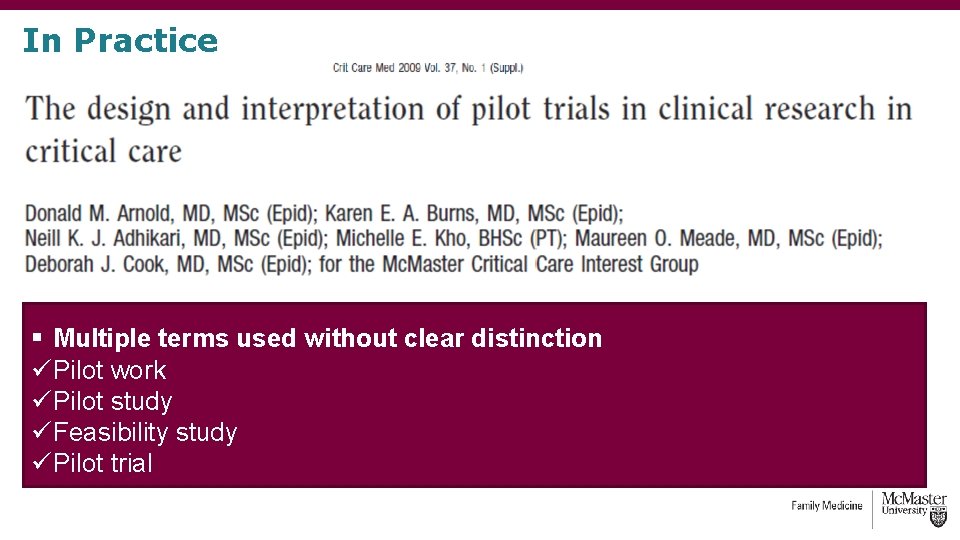
In Practice § Multiple terms used without clear distinction ü Pilot work ü Pilot study ü Feasibility study ü Pilot trial
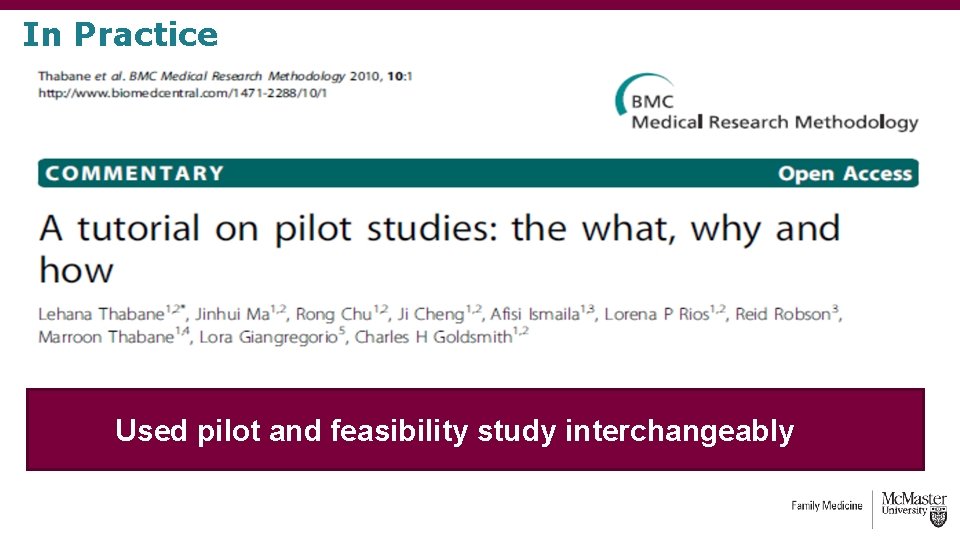
In Practice Used pilot and feasibility study interchangeably
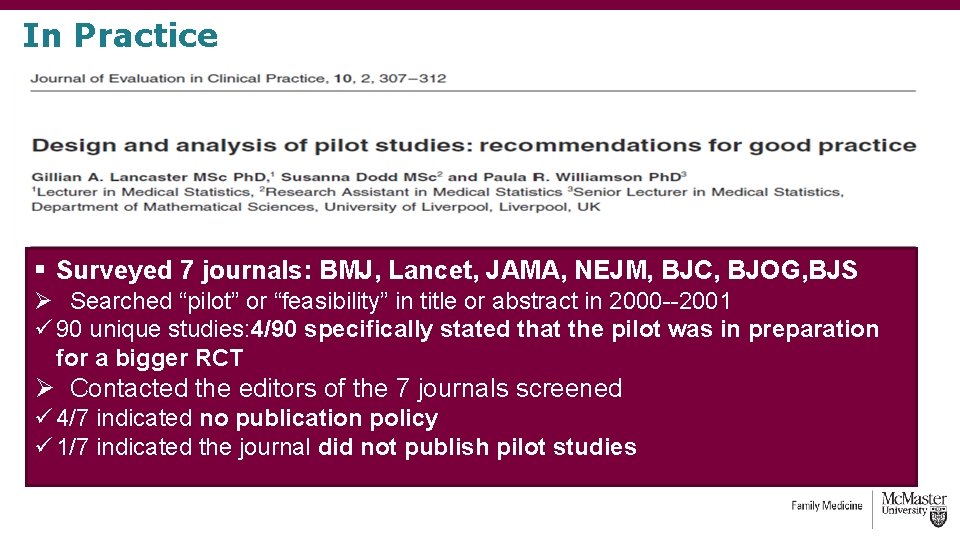
In Practice § Surveyed 7 journals: BMJ, Lancet, JAMA, NEJM, BJC, BJOG, BJS Ø Searched “pilot” or “feasibility” in title or abstract in 2000 --2001 ü 90 unique studies: 4/90 specifically stated that the pilot was in preparation for a bigger RCT Ø Contacted the editors of the 7 journals screened ü 4/7 indicated no publication policy ü 1/7 indicated the journal did not publish pilot studies
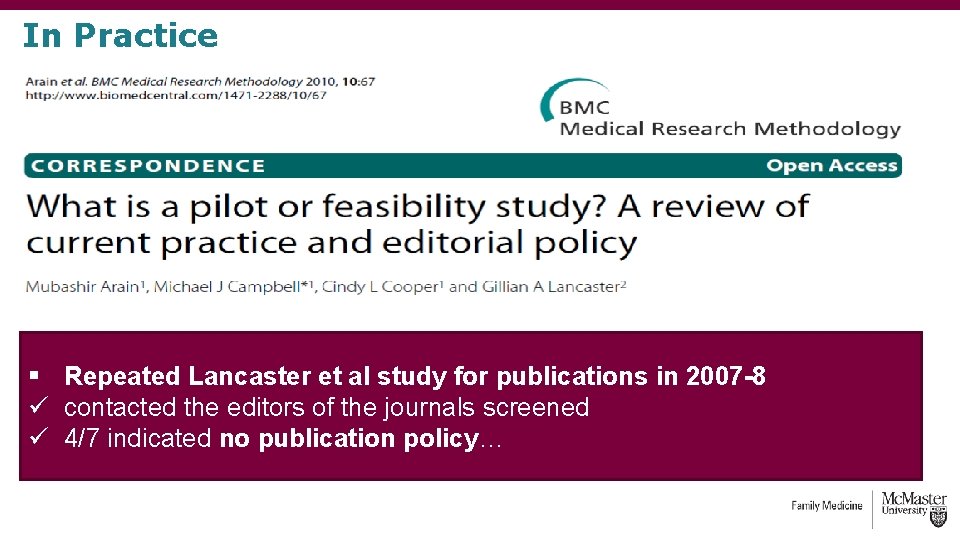
In Practice § Repeated Lancaster et al study for publications in 2007 -8 ü contacted the editors of the journals screened ü 4/7 indicated no publication policy…
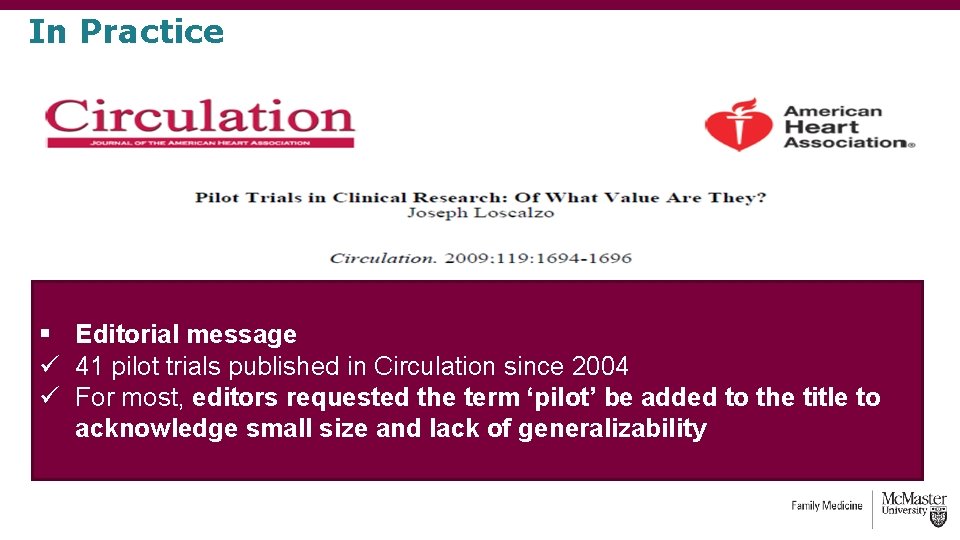
In Practice § Editorial message ü 41 pilot trials published in Circulation since 2004 ü For most, editors requested the term ‘pilot’ be added to the title to acknowledge small size and lack of generalizability
Reasons for conducting pilot or feasibility studies may be clinical, procedural or methodological
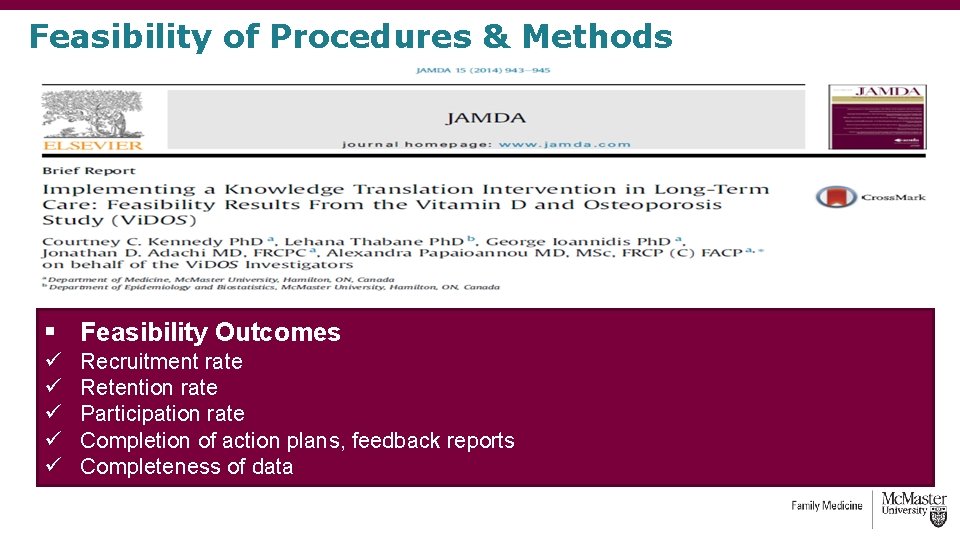
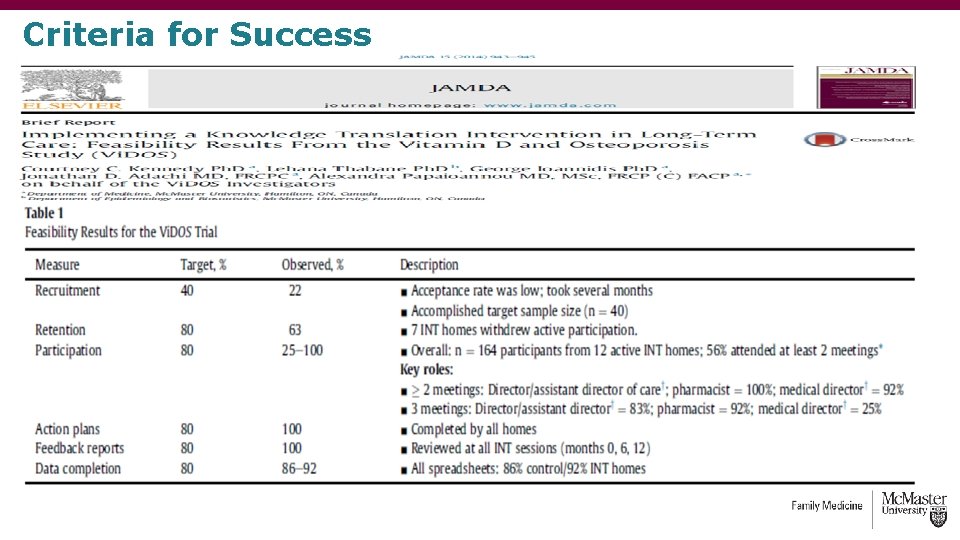
Feasibility of Procedures & Methods § Feasibility Outcomes ü ü ü Recruitment rate Retention rate Participation rate Completion of action plans, feedback reports Completeness of data
Criteria for Success § It is always important to state the criteria for success or feasibility § Outcome can be ü Stop - main study not feasible; ü Continue, but modify protocol – feasible with modifications; ü Continue without modifications – feasible § The criteria should be based on key primary feasibility aims
Criteria for Success
Sample Size for Pilot Studies § Sample Size calculations may not be required for some pilot studies ü A pilot study may be used to generate information to be used for sample size calculations § Sample needs to be representative of the target population ü It should also be based on the same inclusion/exclusion criteria § Sample used in the pilot may be carried to the main study ü Caution is needed to ensure that the key features of the main study are preserved in the pilot (eg blinding in RCTs) Stat Med 1990: 9(1 -2); 65 -71; discussion 71 -2.
Ethics of Pilot Studies § Conducting underpowered trials is unethical Halpern SD et al. JAMA 2002; 288(3): 358 -362 § Underpowered trials are ethical in only 2 situations: ü Small trials of interventions for rare diseases ü Early-phase trials in the development of drugs or devices § Pilot studies of phase III trials are not addressed ü Is it ethical to conduct a study whose feasibility can not be guaranteed? ü What obligation do we have to patients to disclose the feasibility nature of pilot studies? § Is it ethical to run phase III studies without piloting? ü No, it’s unethical to run phase III studies without looking into feasibility
Consent § Consent form should be explicit about the feasibility nature “The overall purpose of this pilot study is to assess the feasibility of conducting a large study to. . . [state primary objective of the main study]. A feasibility or pilot study is a study that… [state a general definition of a feasibility study]. The specific feasibility objectives of this study are …[state the specific feasibility objectives of the pilot study]. We will determine that it is feasible to carry on the main study if …[state the criteria for success of feasibility]. ”
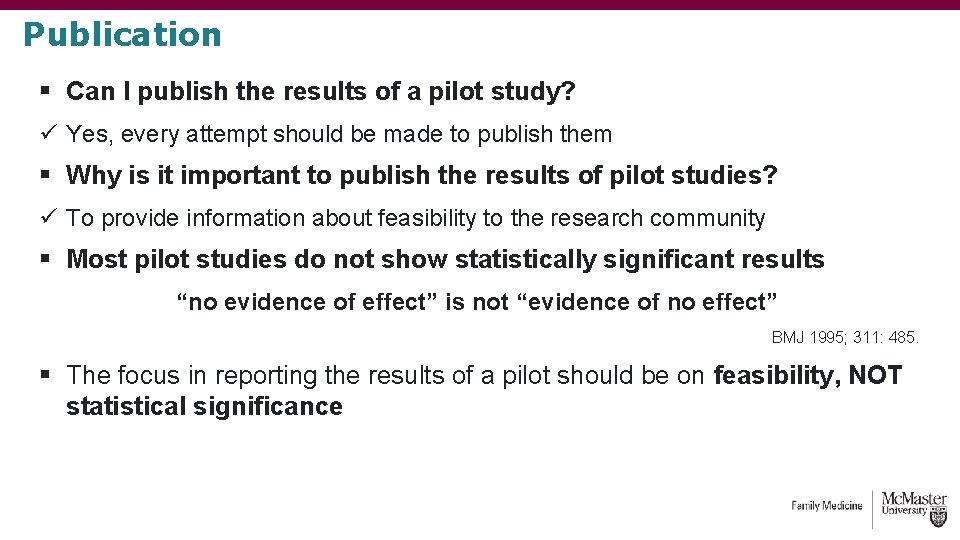
Publication § Can I publish the results of a pilot study? ü Yes, every attempt should be made to publish them § Why is it important to publish the results of pilot studies? ü To provide information about feasibility to the research community § Most pilot studies do not show statistically significant results “no evidence of effect” is not “evidence of no effect” BMJ 1995; 311: 485. § The focus in reporting the results of a pilot should be on feasibility, NOT statistical significance
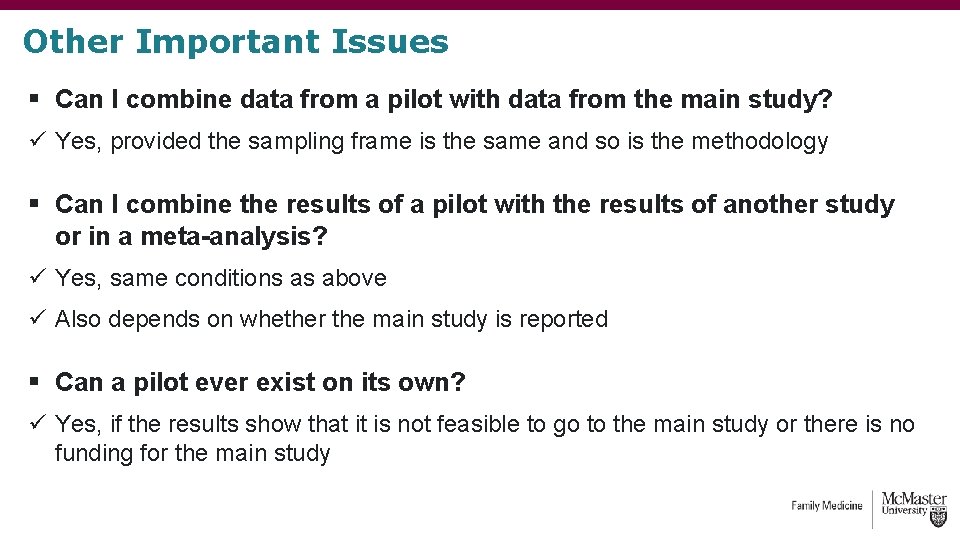
Other Important Issues § Can I combine data from a pilot with data from the main study? ü Yes, provided the sampling frame is the same and so is the methodology § Can I combine the results of a pilot with the results of another study or in a meta-analysis? ü Yes, same conditions as above ü Also depends on whether the main study is reported § Can a pilot ever exist on its own? ü Yes, if the results show that it is not feasible to go to the main study or there is no funding for the main study
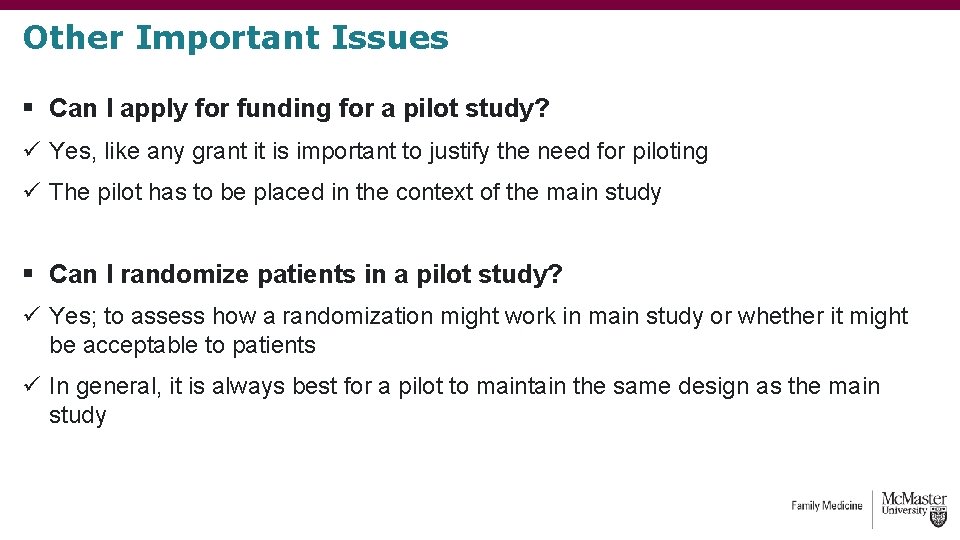
Other Important Issues § Can I apply for funding for a pilot study? ü Yes, like any grant it is important to justify the need for piloting ü The pilot has to be placed in the context of the main study § Can I randomize patients in a pilot study? ü Yes; to assess how a randomization might work in main study or whether it might be acceptable to patients ü In general, it is always best for a pilot to maintain the same design as the main study
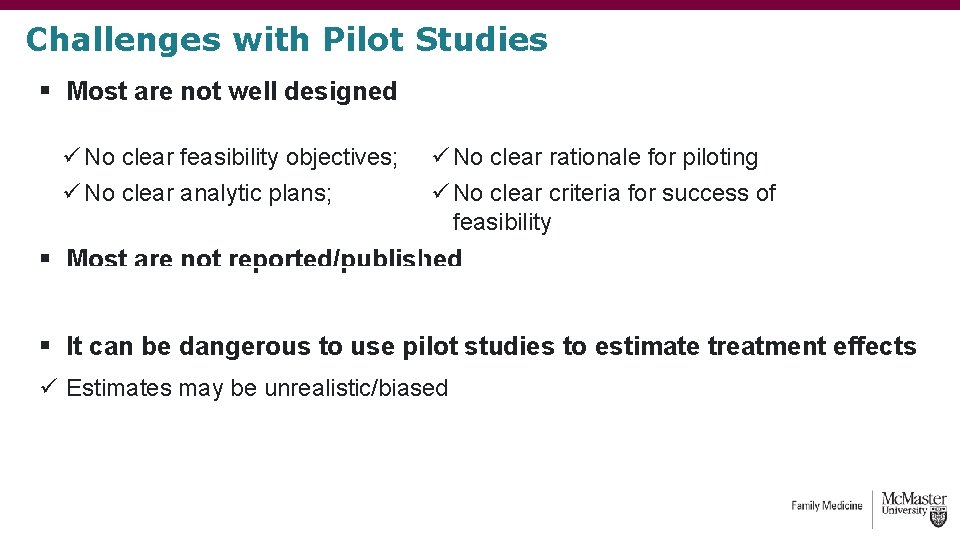
Challenges with Pilot Studies § Most are not well designed ü No clear feasibility objectives; ü No clear analytic plans; ü No clear rationale for piloting ü No clear criteria for success of feasibility § Most are not reported/published § It can be dangerous to use pilot studies to estimate treatment effects ü Estimates may be unrealistic/biased
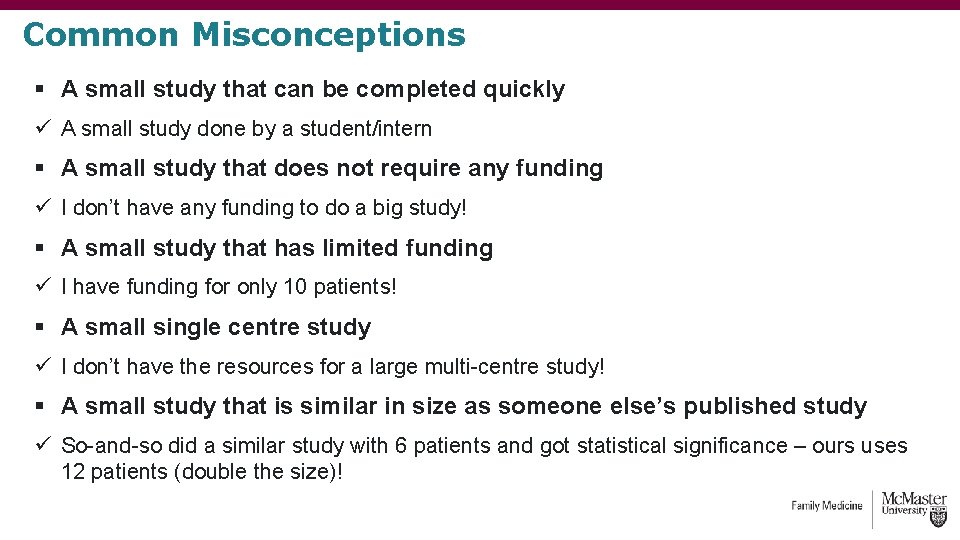
Common Misconceptions § A small study that can be completed quickly ü A small study done by a student/intern § A small study that does not require any funding ü I don’t have any funding to do a big study! § A small study that has limited funding ü I have funding for only 10 patients! § A small single centre study ü I don’t have the resources for a large multi-centre study! § A small study that is similar in size as someone else’s published study ü So-and-so did a similar study with 6 patients and got statistical significance – ours uses 12 patients (double the size)!
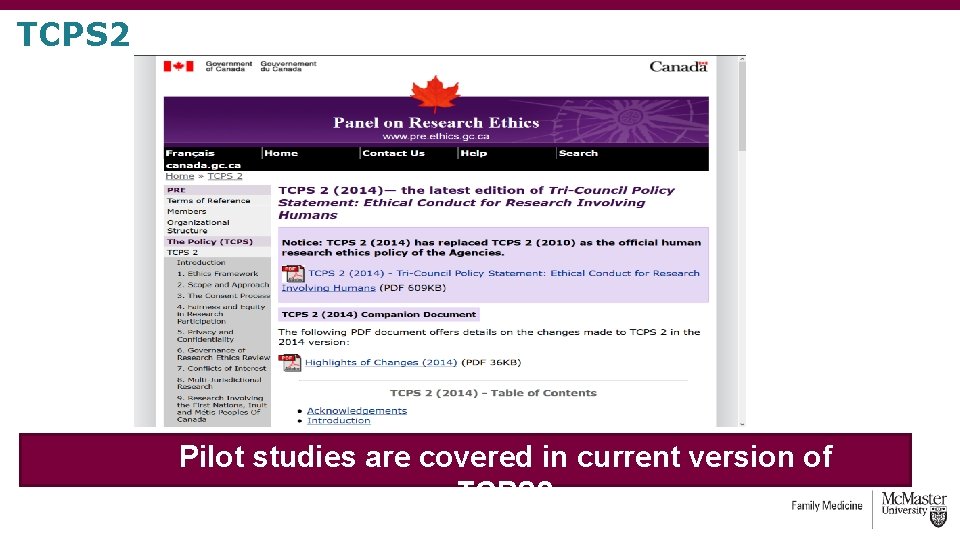
TCPS 2 Pilot studies are covered in current version of TCPS 2
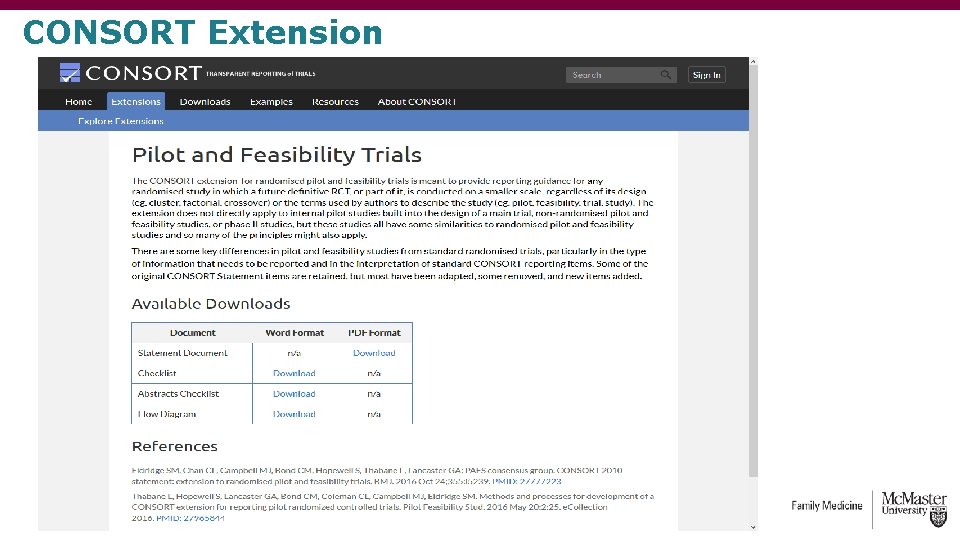
CONSORT Extension
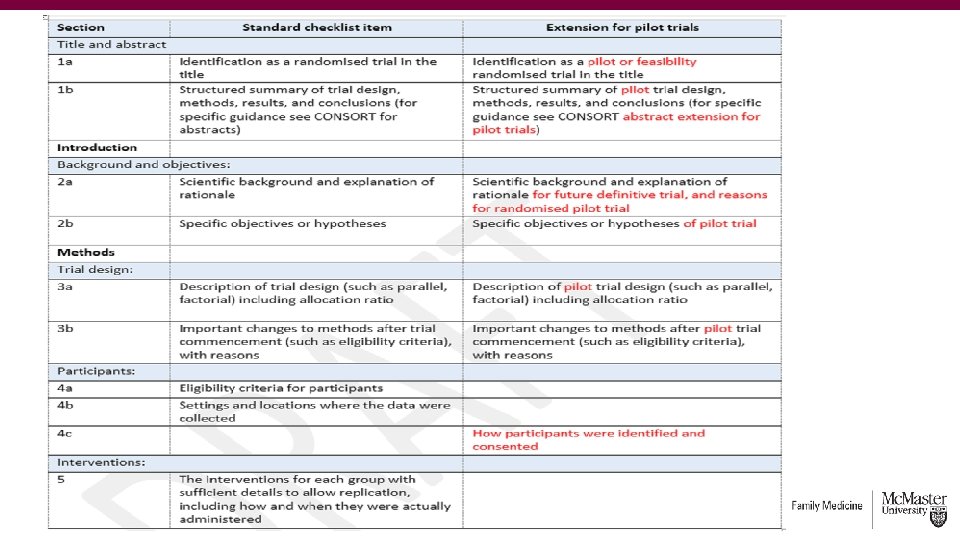
o s n o C x E rt n o i s n e t
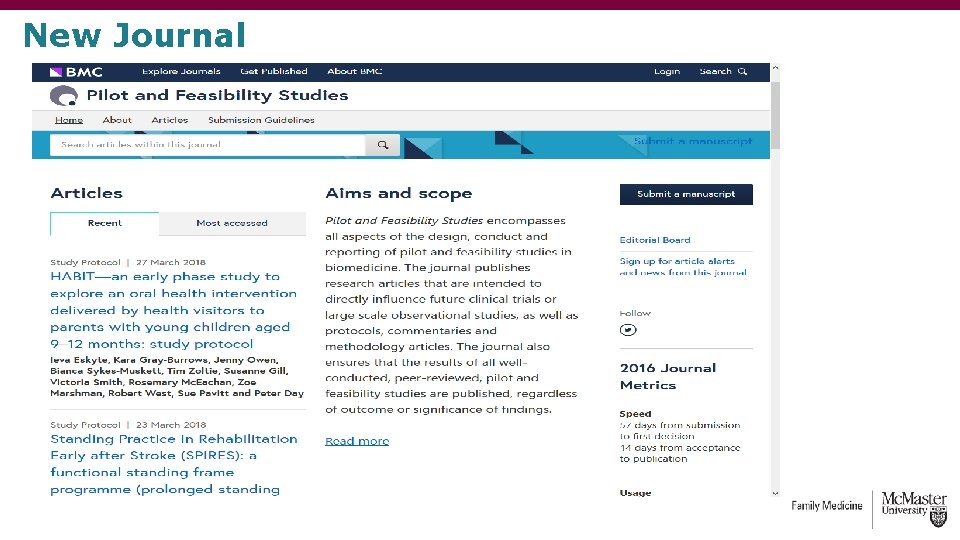
New Journal
Key Messages § Provide a good opportunity to assess feasibility of large fullscale phase III studies üIt can enhance the success probability of the main study § Pilot studies should be well designed üClear feasibility objectives üClear rationale for piloting – needs to be linked to main study üClear analytic plans üClear criteria for determining success of feasibility
Key Messages § Pilot studies should be used cautiously for determining üTreatment effects § They should be scrutinized the same way as full scale RCTs üRequire registration üThey should also be published/reported in peer-review journals
THANK YOU ALL