
Pilot Drilling procedure for all implants including Nobel
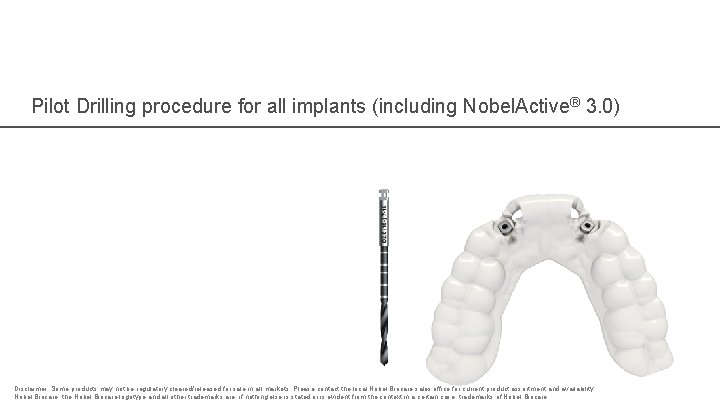
Pilot Drilling procedure for all implants (including Nobel. Active® 3. 0) Disclaimer: Some products may not be regulatory cleared/released for sale in all markets. Please contact the local Nobel Biocare sales office for current product assortment and availability. Nobel Biocare, the Nobel Biocare logotype and all other trademarks are, if nothing else is stated or is evident from the context in a certain case, trademarks of Nobel Biocare.

Pilot drilling procedure (for all implants*) Drill sequence The following procedure and illustrations show the use of Nobel. Active 4. 3 x 13 mm implants in medium bone * Surgical template with ∅ 2 mm pilot drill sleeves. For Nobel. Active 3. 0 a ∅ 1. 5 mm pilot drill sleeve is available when soft bone is confirmed
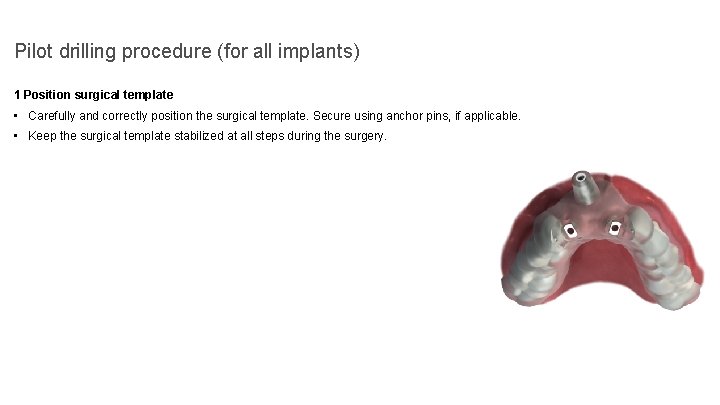
Pilot drilling procedure (for all implants) 1 Position surgical template • Carefully and correctly position the surgical template. Secure using anchor pins, if applicable. • Keep the surgical template stabilized at all steps during the surgery.

Pilot drilling procedure (for all implants) 2 Drill with Pilot Twist Drill • Drill with the Guided Twist Drill Ø 2. 0 x (10+)7 -18 mm* to the desired depth with an in-and-out motion under profuse irrigation. Maximum speed 800 rpm Note: The guided twist drills are identified by the (10+) on the shaft. This indicates that the drills extend an additional 10 mm. Warning: Correct guided drill depth information must be confirmed by referencing the printed treatment plan report from Nobel. Clinician and/or the Nobel. Guide Surgical Guidelines which is included in the surgical template package. * For Nobel. Replace Tapered and Replace Select Tapered implants use Guided Twist Drill Tapered Ø 2. 0 x (10+)8 -16 mm

Pilot drilling procedure (for all implants) 3 Remove surgical template • Carefully remove the surgical template. 4 Confirm orientation • Use the direction indicator to confirm orientation and inclination of the preparation.

Pilot drilling procedure (for all implants) 5 Identify osteotomy depth • Identify reference for osteotomy depth for free hand surgery. • Using a depth probe with depth markings and/or the Twist Drill Ø 2. 0 (not rotating) to identify the guided drilled depth for free hand surgery with reference to the patients anatomy. • Complete drill protocol according to bone density. Note: The following illustrations show Nobel. Active 4. 3 x 13 mm in medium bone. Please refer to appropriate free-hand drilling procedures for the selected implant system.
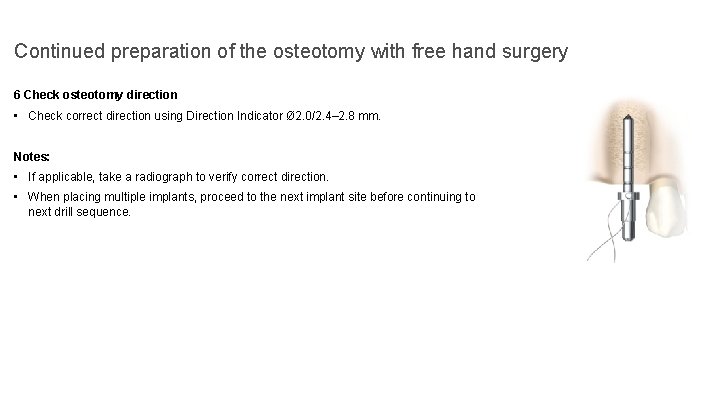
Continued preparation of the osteotomy with free hand surgery 6 Check osteotomy direction • Check correct direction using Direction Indicator Ø 2. 0/2. 4– 2. 8 mm. Notes: • If applicable, take a radiograph to verify correct direction. • When placing multiple implants, proceed to the next implant site before continuing to next drill sequence.
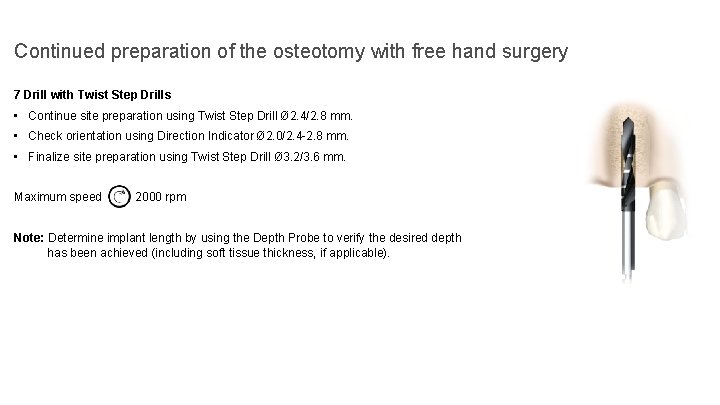
Continued preparation of the osteotomy with free hand surgery 7 Drill with Twist Step Drills • Continue site preparation using Twist Step Drill Ø 2. 4/2. 8 mm. • Check orientation using Direction Indicator Ø 2. 0/2. 4 -2. 8 mm. • Finalize site preparation using Twist Step Drill Ø 3. 2/3. 6 mm. Maximum speed 2000 rpm Note: Determine implant length by using the Depth Probe to verify the desired depth has been achieved (including soft tissue thickness, if applicable).
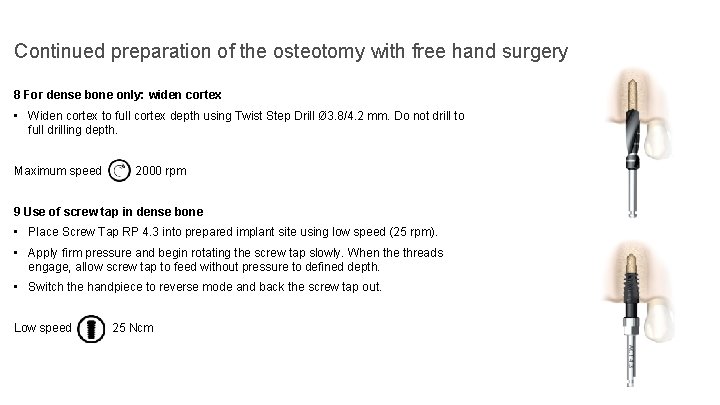
Continued preparation of the osteotomy with free hand surgery 8 For dense bone only: widen cortex • Widen cortex to full cortex depth using Twist Step Drill Ø 3. 8/4. 2 mm. Do not drill to full drilling depth. Maximum speed 2000 rpm 9 Use of screw tap in dense bone • Place Screw Tap RP 4. 3 into prepared implant site using low speed (25 rpm). • Apply firm pressure and begin rotating the screw tap slowly. When the threads engage, allow screw tap to feed without pressure to defined depth. • Switch the handpiece to reverse mode and back the screw tap out. Low speed 25 Ncm
- Slides: 9