
PILE FOUNDATION By C M GUPTA Sr ProfBr
PILE FOUNDATION By – C. M. GUPTA Sr. Prof/Br. 2 IRICEN 1
TYPE OF FOUNDATIONS • SHALLOW – SINGLE FOOTING – COMBINED FOOTING – RAFT – STRIP • DEEP – PILE – WELL 2
DEEP FOUNDATIONS • ADEQUATE GRIP- BELOW DEEPEST ANTICIPATED SCOUR • DEPTH OF FOUNDATION BELOW WATER LEVEL FOR Qf – • NOT LESS THAN 1. 33 X MAX DEPTH OF SCOUR • SHALL NOT REST ON SLOPING ROCK STRATA • DYNAMIC AUGMENT NEED NOT BE CONSIDERED 3
CLASSIFICATION OF PILES • BROAD CALSSIFICATION – DRIVEN – BORED (DISPLACEMENT PILES) (REPLACEMENT PILE) • ON THE BASIS OF MATERIAL – – – TIMBER STEEL PCC RCC PSC COMPOSITE 4
CLASSIFICATION OF PILES • Method of construction – Driven precast piles – Driven cast in situ piles – Bored precast piles – Bored cast in situ piles • Mode of load transmission – End bearing piles – Friction cum end bearing piles 5
CLASSIFICATION OF PILES • Sectional area – – – Circular Square Tubular Octagonal H-section • Size – Micro (mini) piles (<150 mm) – Small diameter pile (>150 mm < 600 mm) – Large diameter pile (>600 mm) 6
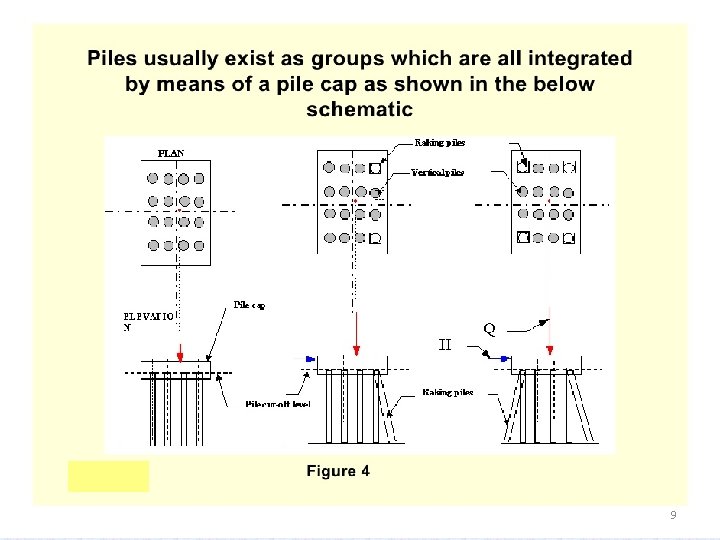
CLASSIFICATION OF PILES • INCLINATION – VERTICAL PILES – RAKER (BATTER PILES) 7

8
9
CONSTRUCTION OF PILE FOUNDATION • Driven precast piles – – Drop hammer Single/ double acting hammer Diesel hammer Vibratory hammer • Driven cast in situ piles – Steel casing pipe with shoe at bottom driven to reqd depth – Casting after placing reinforcement cage • Bored cast in situ piles – – – – GUIDE CASING OF 3 -4 m AT TOP OF BORE HOLE Bailer – chiesel Bentonite slurry for stabilisation Flushing Concreting after placing rein. Cage Tremie method of concreting Concrete grade m 20 or higher High slump concrete 10
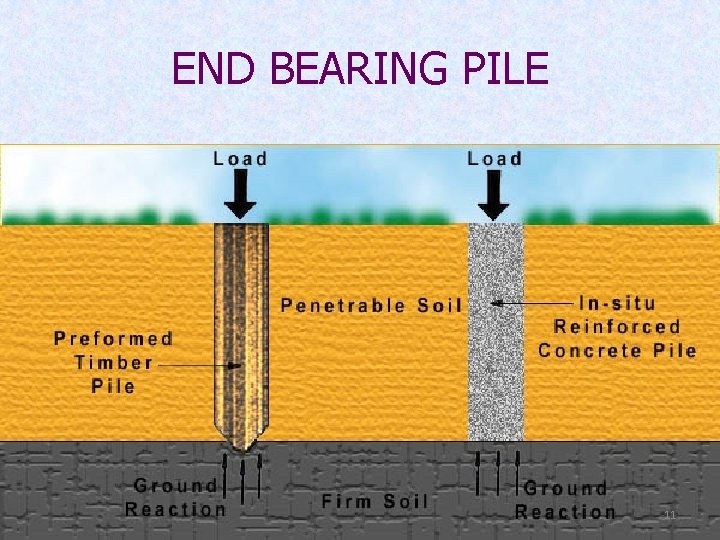
END BEARING PILE 11
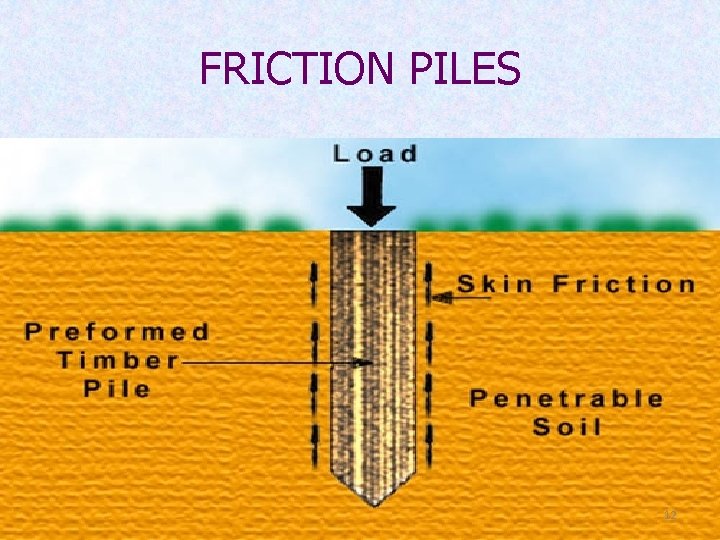
FRICTION PILES 12
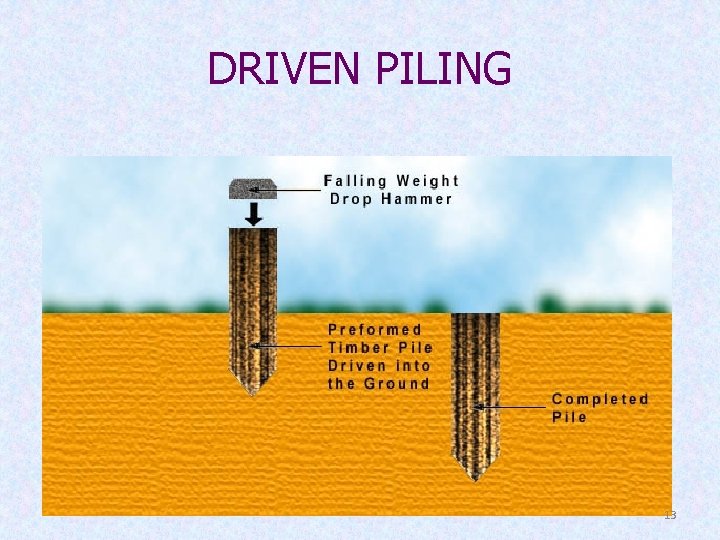
DRIVEN PILING 13
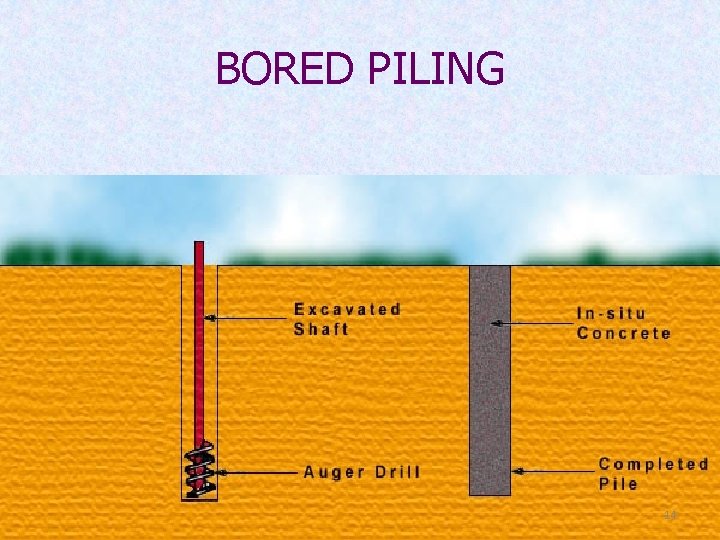
BORED PILING 14
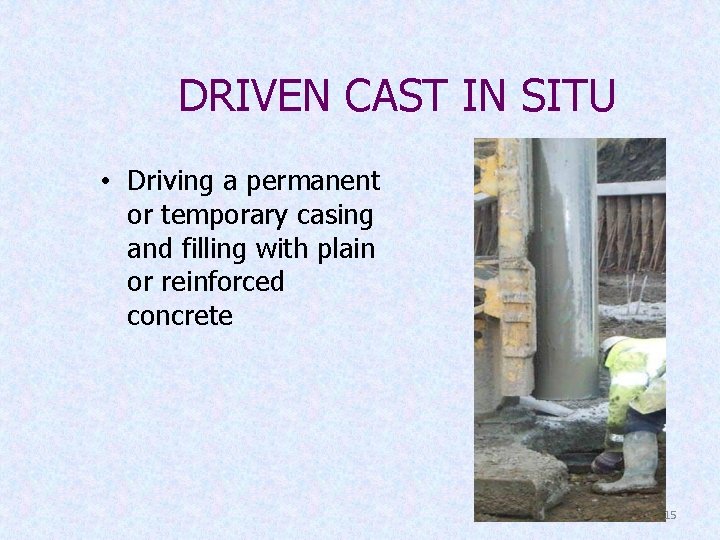
DRIVEN CAST IN SITU • Driving a permanent or temporary casing and filling with plain or reinforced concrete 15
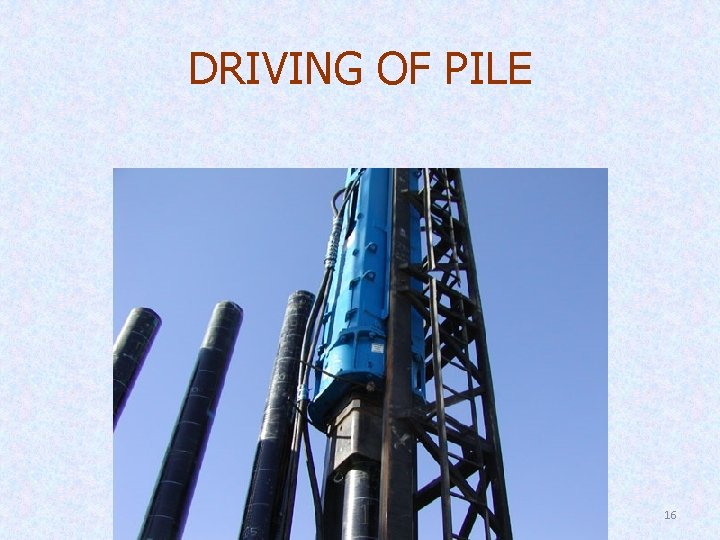
DRIVING OF PILE 16
INSTALLATION OF BORED CAST IN SITU PILES • • BAILER AND CHISEL METHOD AUGUR BORING USING OSCILLATORS VIBRATORY DRILLING RIGS 17
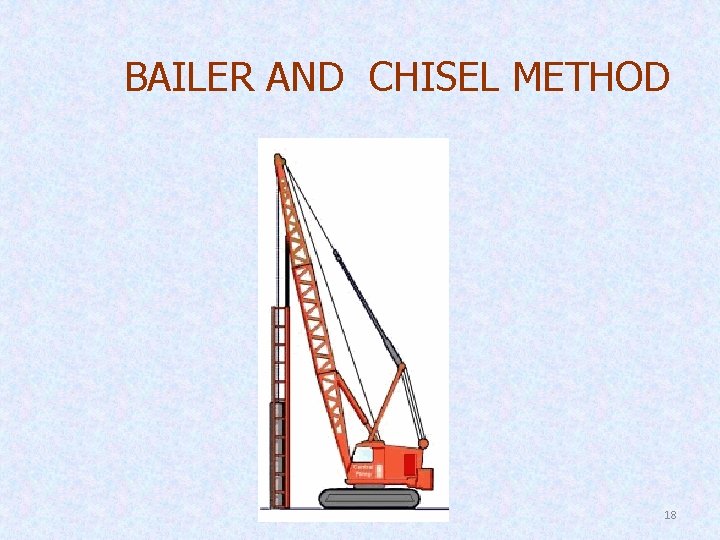
BAILER AND CHISEL METHOD 18
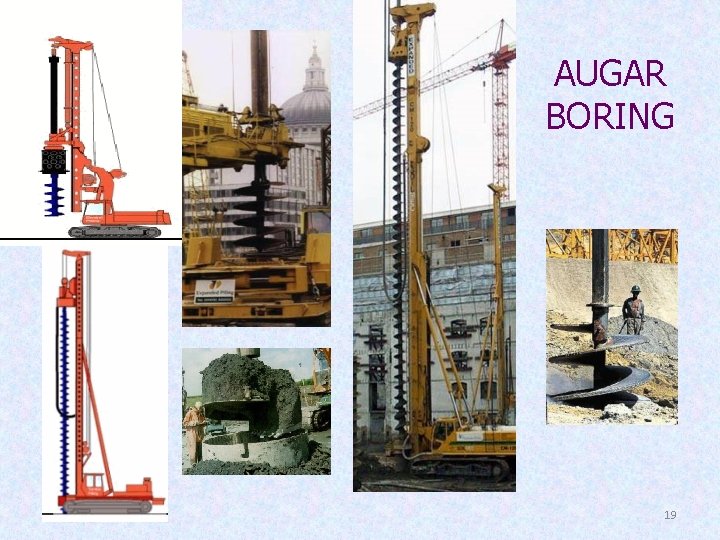
AUGAR BORING 19
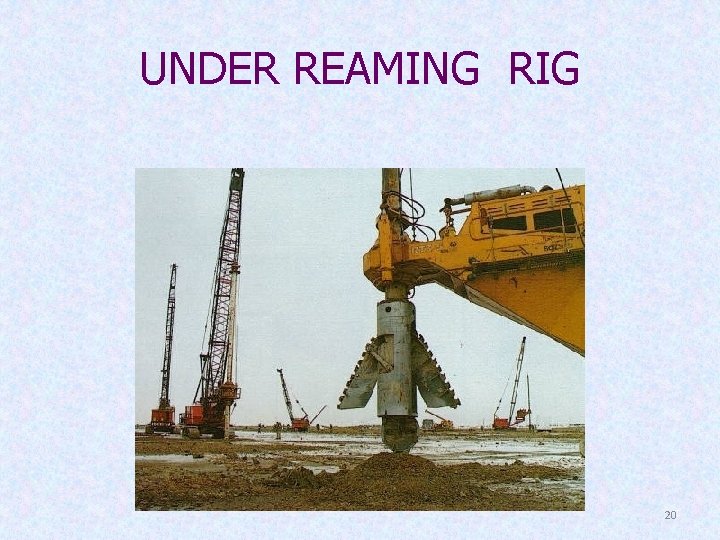
UNDER REAMING RIG 20
BORED CAST IN SITU PILES • Stabilization of bore –Drilling Mud Circulation (Bentonite Slurry) Bentonite is impure clay consisting of Montmorillonite. Na cation responsible for support 21
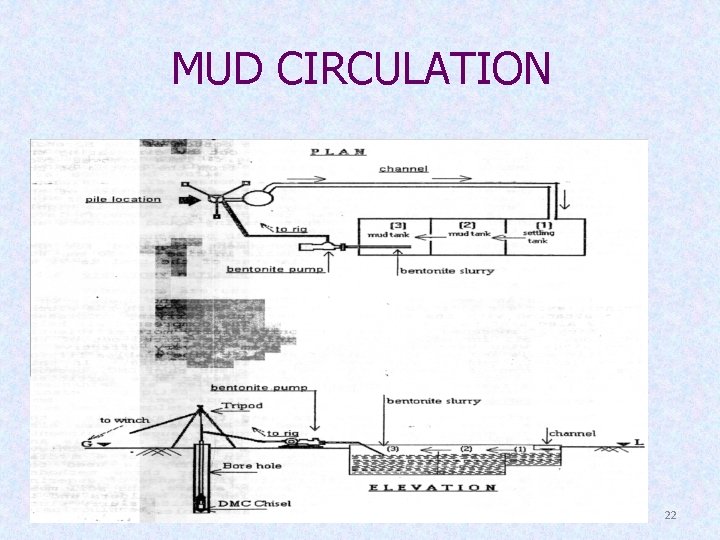
MUD CIRCULATION 22
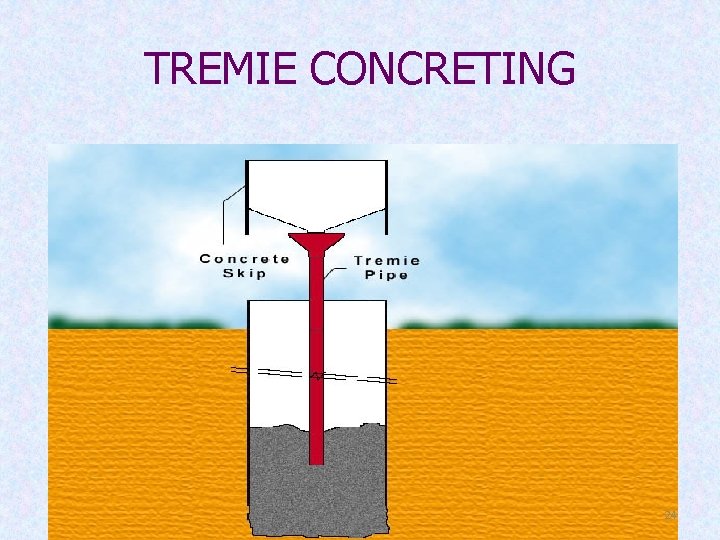
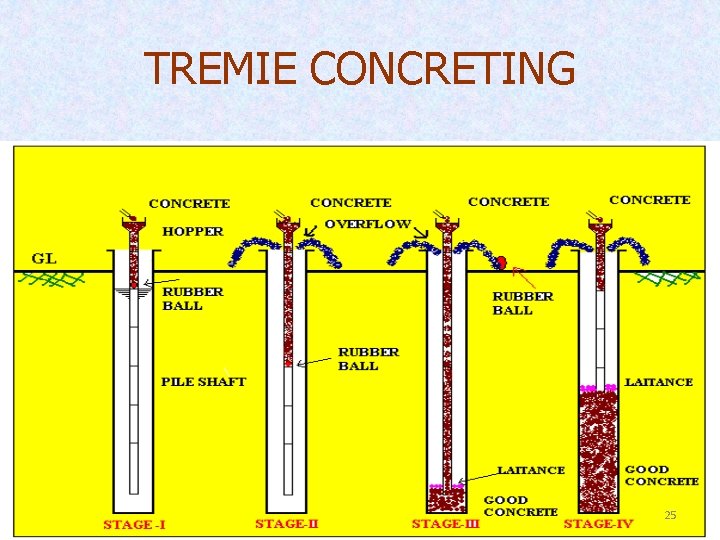
TREMIE CONCRETING • concrete to be rich in cement (min 370 kg/ m 3), slump – 150 -180 mm • casing- temp/permanent • sliding plug/steel plate flushed ahead of first charge – to prevent mixing of water • hopper and tremie should be closed system • dia of tremie pipe – 200 mm for 20 mm aggregare • concreting to be uninterrupted • top of concrete in pile – above cutoff level • min embedment in pile cap – 50 mm 23
TREMIE CONCRETING 24
TREMIE CONCRETING 25
SELECTION OF TYPE OF PILES • • Availability of space and head room Proximity to structures Reliability – driven precast better Limitation of length- driven piles – 25 - 30 m 26
SOCKETTING IN ROCK • For the end bearing piles – Sound relatively homogenous rock including granite and gneiss -- 1 to 2 D – Moderately weathered closely formed including schist & slate ---- 2 to 3 D – Soft rock --- 3 to 4 D 27
SEQUENCING OF PILING • Normally from centre to periphery or from one side to other • Possibility of harm to adjacent piles be considered. More damage in compact soils • Order of installation should avoid creating a compacted block of ground • In stiff clay or compacted sand layers – from center to outward or from one edge to across the group • In very soft soils – from outside to inside 28
SPACING OF PILES • Determined based on the – Type of soil – Empirical approach • Practical aspects of installing a pile • Nature of load transfer • Possible reduction in bearing capacity of a group of piles 29
SPACING OF PILES • For end bearing piles – Governed by competency of bearing strata – Not less than 2. 5 D • For friction piles – Sufficiently apart to avoid overlapping zones – Not less than 3 D • Closure spacing possible in loose sand or fillings for driven piles only • Max spacing 4 D 30
LOAD CARRYING CAPACITY OF PILE • In context of foundation engineering • Load that a pile can carry without undergoing continuous settlement for insignificant load increments – by virtue of its boundary conditions • Failure of surrounding soil occurs before failure of pile material 31
FACTORS INFLUENCING PILE CAPACITY • • Surrounding soil Installation technique Spacing of piles Symmetry of the group Location of pile cap Shape of pile cap Location of pile in a group Drainage conditions in soil 32
LOAD CARRYING CAPACITY OF SINGLE PILE • Dynamic pile formula – by using the data obtained during piling ( conservation of energy) – Hiley’s Formula • More reliable for non-cohesive soils • Not reliable for cohesive soils • Static formula – using soil test results • Load test – after 4 weeks of casting of pile • Resistance due to skin friction available only below scour line • Drag down force 33
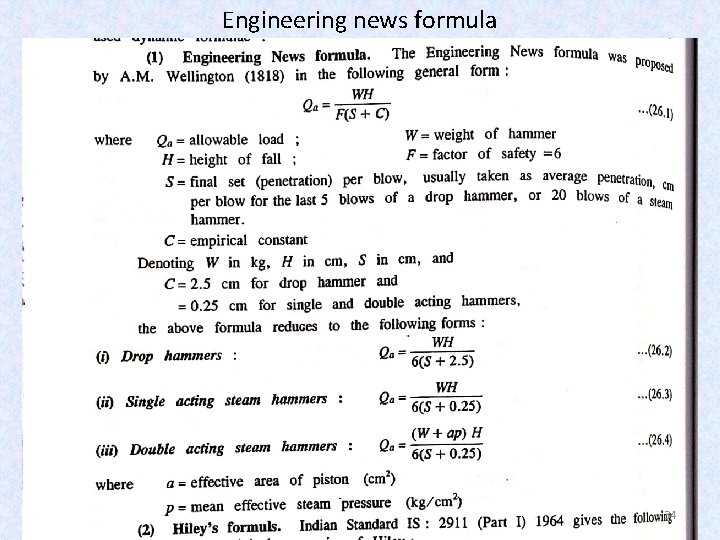
Engineering news formula 34
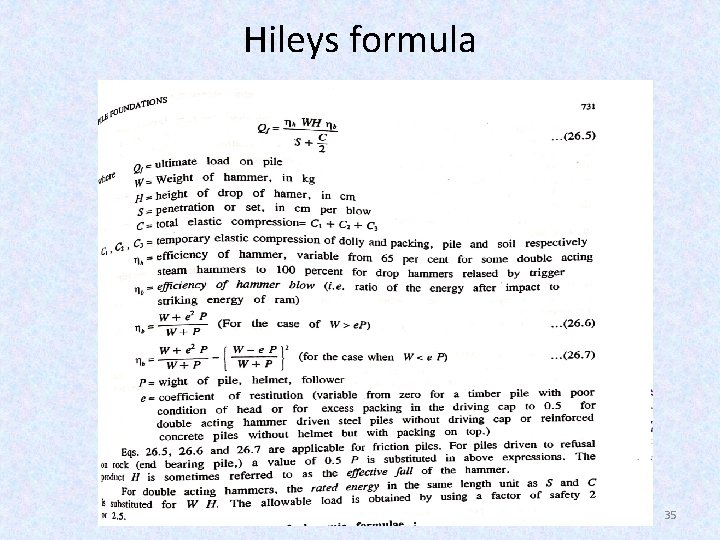
Hileys formula 35
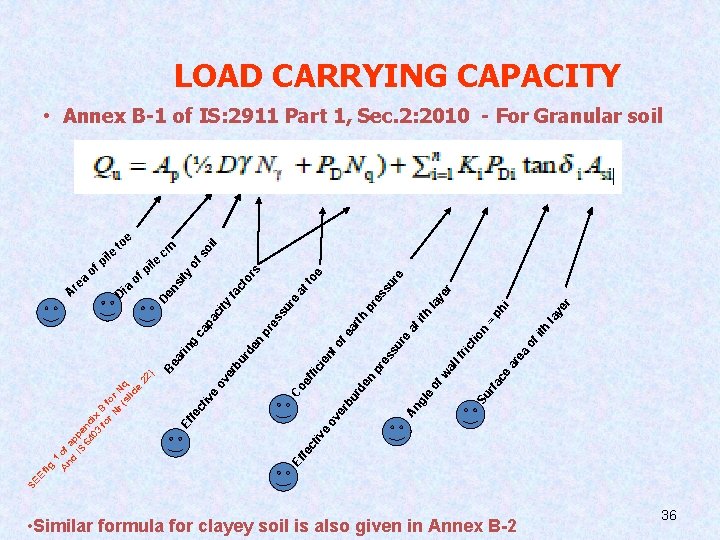
E SE ct fe Ef iv e ea ar of ith • Similar formula for clayey soil is also given in Annex B-2 r ye la i ph er re e to s or su es la y pr ith = at tio n ric al lf w re su es th ar at ct fa re su es pr fe to ie n pr ce of rfa Su gl e en bu rd An er ov fic ef Co en bu rd ty of il so cm er ov ci pa ity ns De a Di p iv e ca A of ct in g a re ile fe ar le pi f o Be ) e to Ef 1 An of d ap IS pe 64 nd 03 ix fo B f r N or r ( Nq sl id e 22 fig LOAD CARRYING CAPACITY • Annex B-1 of IS: 2911 Part 1, Sec. 2: 2010 - For Granular soil 36
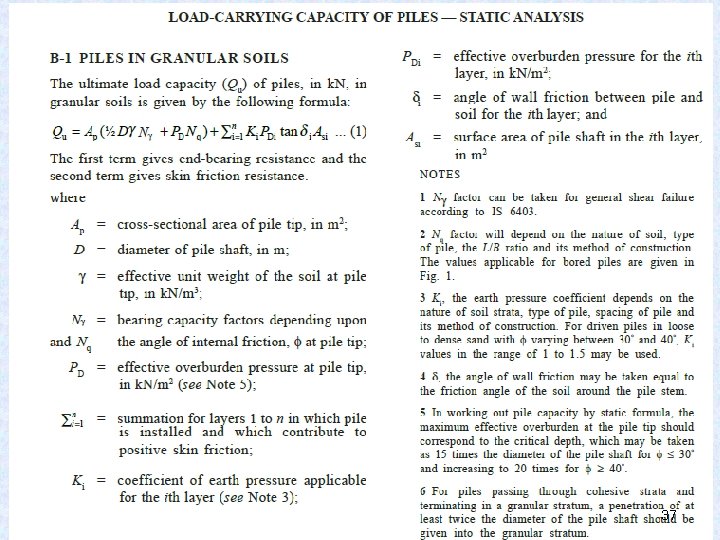
37
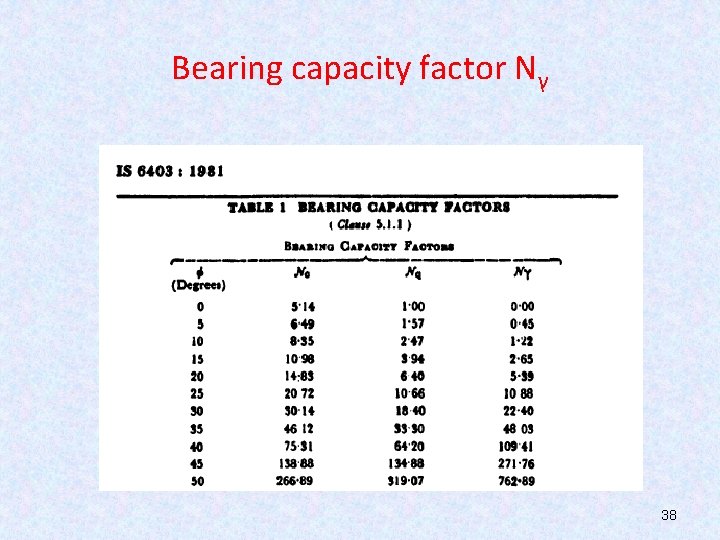
Bearing capacity factor Nγ 38
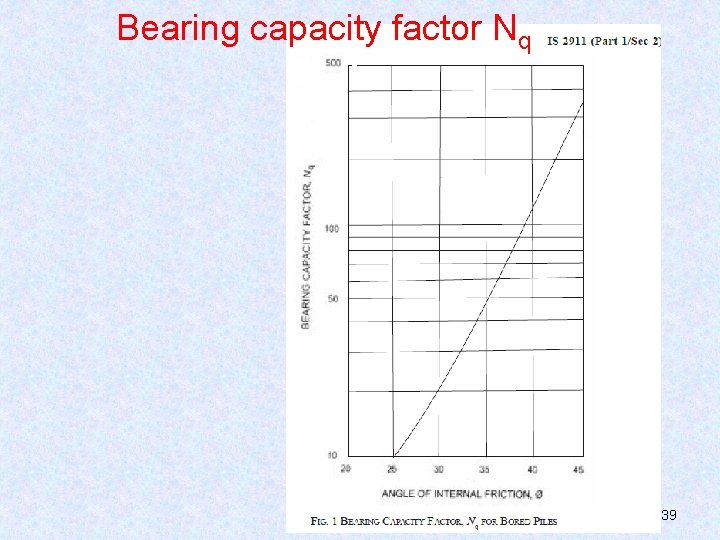
Bearing capacity factor Nq 39
40
41
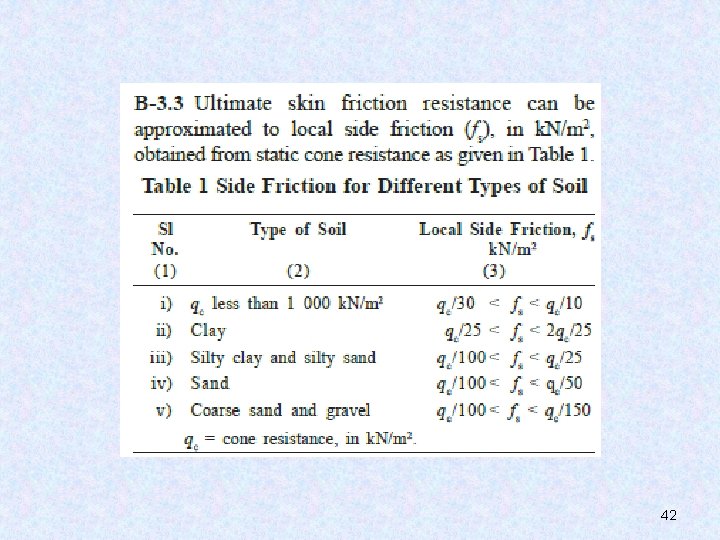
42
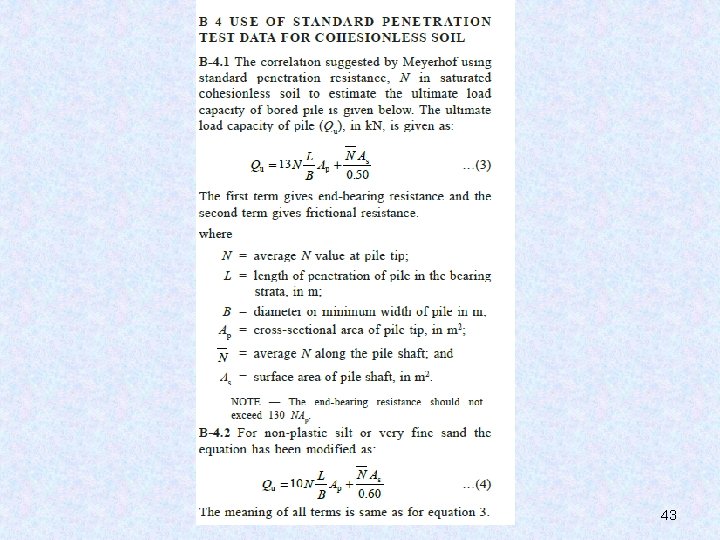
43
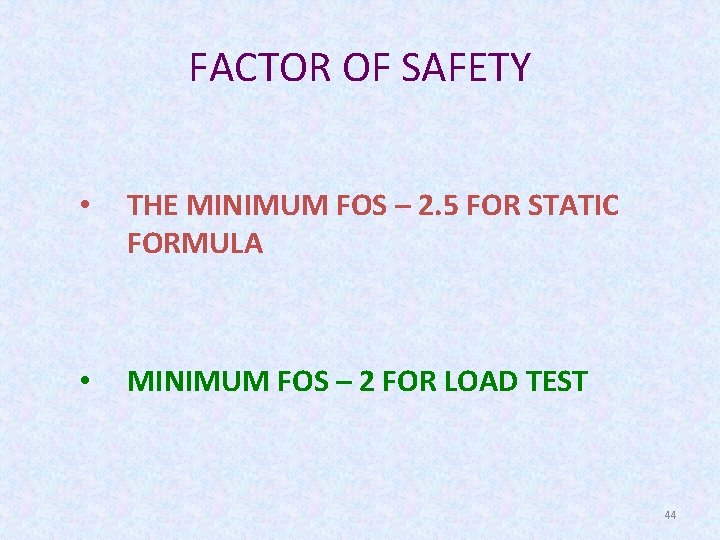
FACTOR OF SAFETY • THE MINIMUM FOS – 2. 5 FOR STATIC FORMULA • MINIMUM FOS – 2 FOR LOAD TEST 44
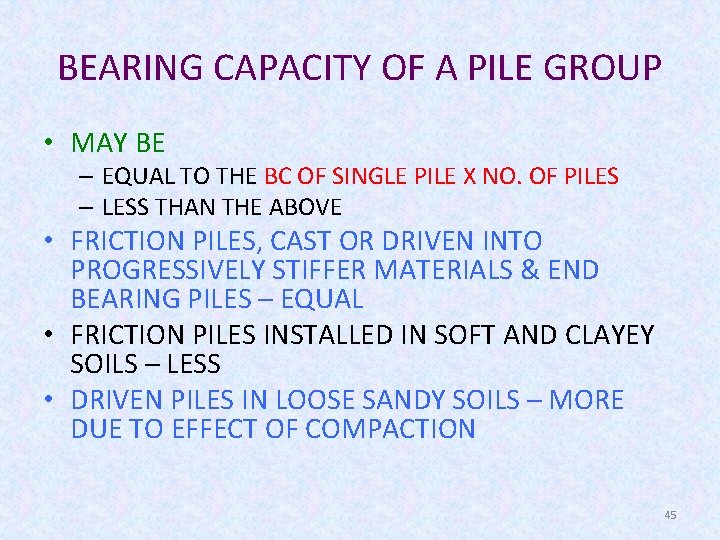
BEARING CAPACITY OF A PILE GROUP • MAY BE – EQUAL TO THE BC OF SINGLE PILE X NO. OF PILES – LESS THAN THE ABOVE • FRICTION PILES, CAST OR DRIVEN INTO PROGRESSIVELY STIFFER MATERIALS & END BEARING PILES – EQUAL • FRICTION PILES INSTALLED IN SOFT AND CLAYEY SOILS – LESS • DRIVEN PILES IN LOOSE SANDY SOILS – MORE DUE TO EFFECT OF COMPACTION 45
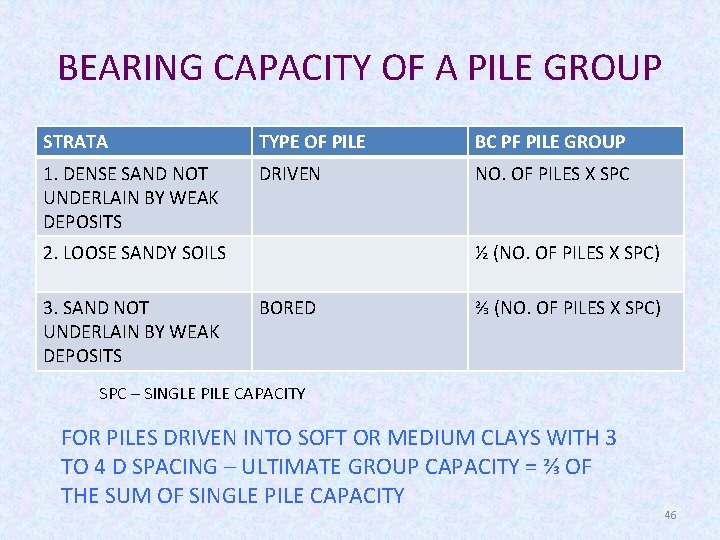
BEARING CAPACITY OF A PILE GROUP STRATA TYPE OF PILE BC PF PILE GROUP 1. DENSE SAND NOT UNDERLAIN BY WEAK DEPOSITS DRIVEN NO. OF PILES X SPC 2. LOOSE SANDY SOILS 3. SAND NOT UNDERLAIN BY WEAK DEPOSITS ½ (NO. OF PILES X SPC) BORED ⅔ (NO. OF PILES X SPC) SPC – SINGLE PILE CAPACITY FOR PILES DRIVEN INTO SOFT OR MEDIUM CLAYS WITH 3 TO 4 D SPACING – ULTIMATE GROUP CAPACITY = ⅔ OF THE SUM OF SINGLE PILE CAPACITY 46
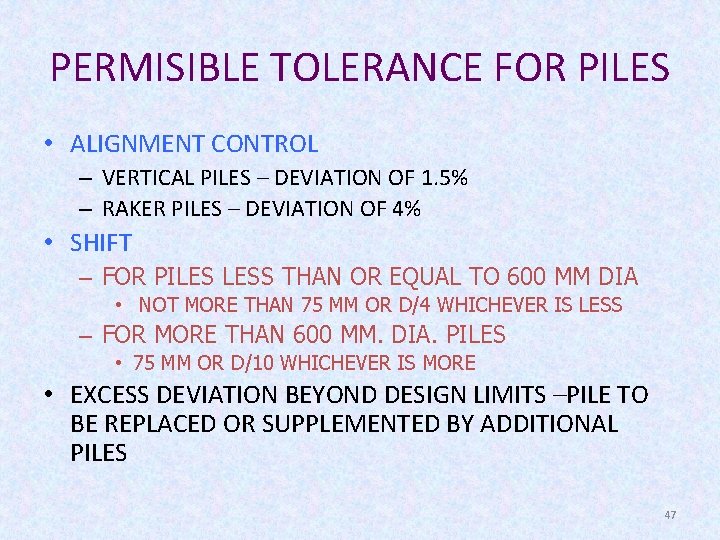
PERMISIBLE TOLERANCE FOR PILES • ALIGNMENT CONTROL – VERTICAL PILES – DEVIATION OF 1. 5% – RAKER PILES – DEVIATION OF 4% • SHIFT – FOR PILES LESS THAN OR EQUAL TO 600 MM DIA • NOT MORE THAN 75 MM OR D/4 WHICHEVER IS LESS – FOR MORE THAN 600 MM. DIA. PILES • 75 MM OR D/10 WHICHEVER IS MORE • EXCESS DEVIATION BEYOND DESIGN LIMITS –PILE TO BE REPLACED OR SUPPLEMENTED BY ADDITIONAL PILES 47
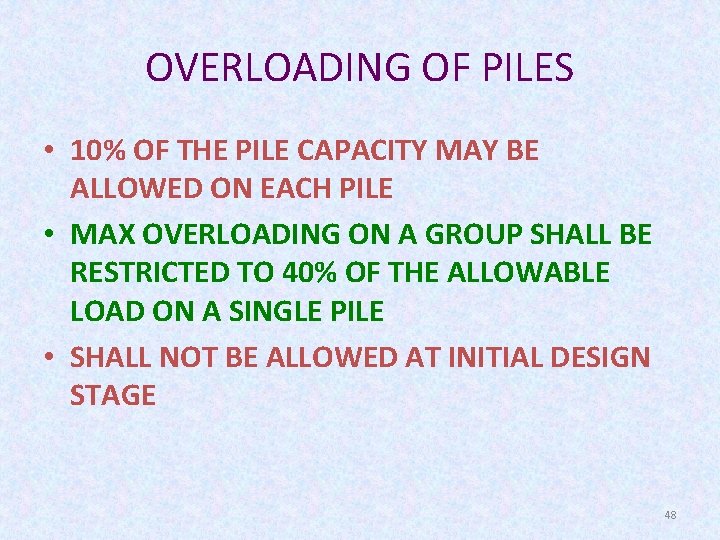
OVERLOADING OF PILES • 10% OF THE PILE CAPACITY MAY BE ALLOWED ON EACH PILE • MAX OVERLOADING ON A GROUP SHALL BE RESTRICTED TO 40% OF THE ALLOWABLE LOAD ON A SINGLE PILE • SHALL NOT BE ALLOWED AT INITIAL DESIGN STAGE 48
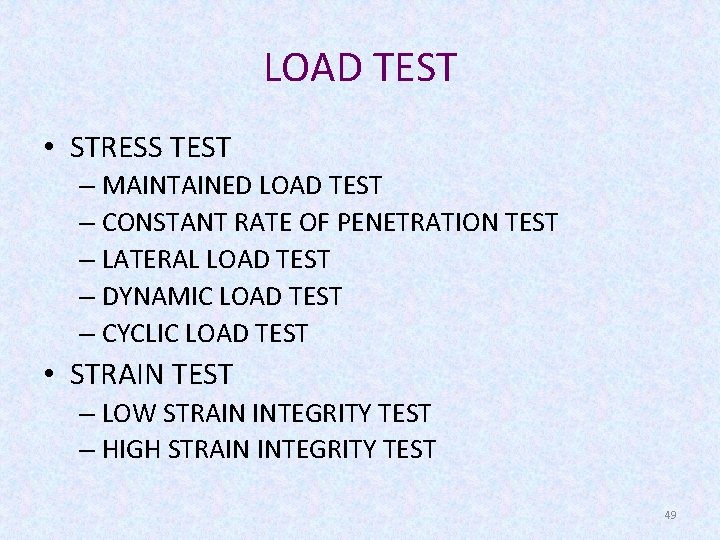
LOAD TEST • STRESS TEST – MAINTAINED LOAD TEST – CONSTANT RATE OF PENETRATION TEST – LATERAL LOAD TEST – DYNAMIC LOAD TEST – CYCLIC LOAD TEST • STRAIN TEST – LOW STRAIN INTEGRITY TEST – HIGH STRAIN INTEGRITY TEST 49
PILE LOAD TESTING (IS-2911 PART-IV) • Initial Test – On one or more piles – Min. 2 tests if past experience of piles in that area is not available • Purpose – To check safe load calculated by static or dynamic formulae – Arrive at safe load 50
PILE LOAD TESTING (IS-2911 PART-IV) • Routine Test – On ½ percent of piles, can be increased to 2% depending on strata • Purpose – To check safety of piles against safe load 51
PILE LOAD TESTING (IS-2911 PART-IV) • VERTICAL LOAD TEST – Maintained load method – Cyclic load test (To separate skin friction and end bearing) – CRP test (Uniform penetration) • LATERAL LOAD TEST • PULL OUT TEST 52
LOAD TEST-INITIAL TEST • THE SAFE LOAD ON A SINGLE PILE WILL BE LEAST OF THE FOLLOWING – TWO THIRD OF THE FINAL LOAD AT WHICH TOTAL DISPLACEMENT ATTAINS A VALUE OF 12 MM – 50 % OF THE FINAL LOAD AT WHICH THE TOTAL DISPLACEMNT EQUALS 10 % OF THE DIA. OF PILE 53
LOAD TEST - INITIAL • THE SAFE LOAD FOR GROUP OF PILES – FINAL LOAD AT WHICH TOTAL DISPLACEMENT IS 25 MM – TWO THIRD OF FINAL LOAD AT WHICH DISPLACEMENT IS 40 MM 54
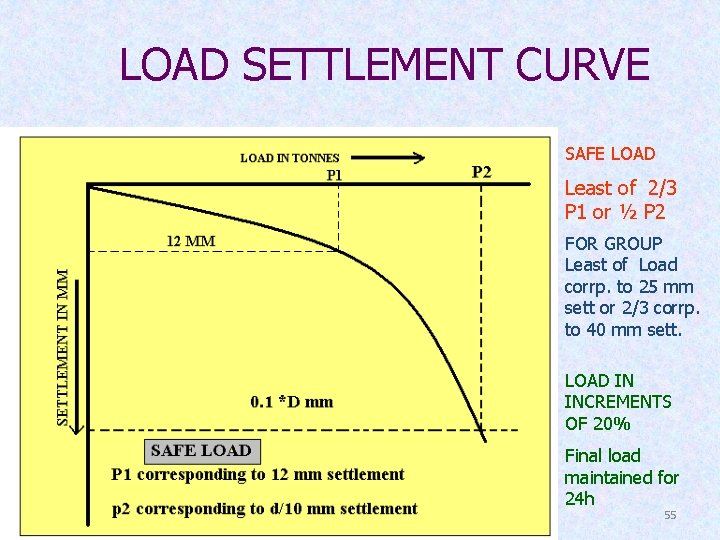
LOAD SETTLEMENT CURVE SAFE LOAD Least of 2/3 P 1 or ½ P 2 FOR GROUP Least of Load corrp. to 25 mm sett or 2/3 corrp. to 40 mm sett. LOAD IN INCREMENTS OF 20% Final load maintained for 24 h 55
LOAD TEST – ROUTINE TEST • TEST LOAD WILL BE ATLEAST 1. 5 TIMES THE WORKING LOAD • MAX. SETTLEMENT SHOULD NOT > 12 MM • FOR GROUP OF PILES MAX. SETTLEMENT SHOULD NOT > 25 MM 56
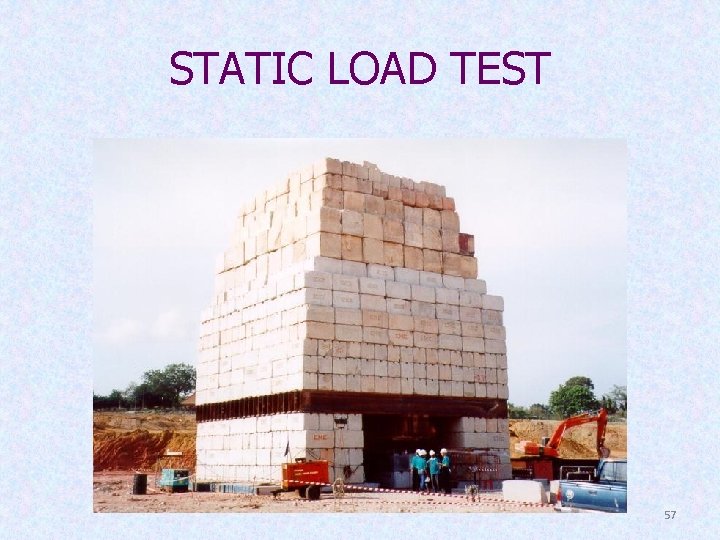
STATIC LOAD TEST 57
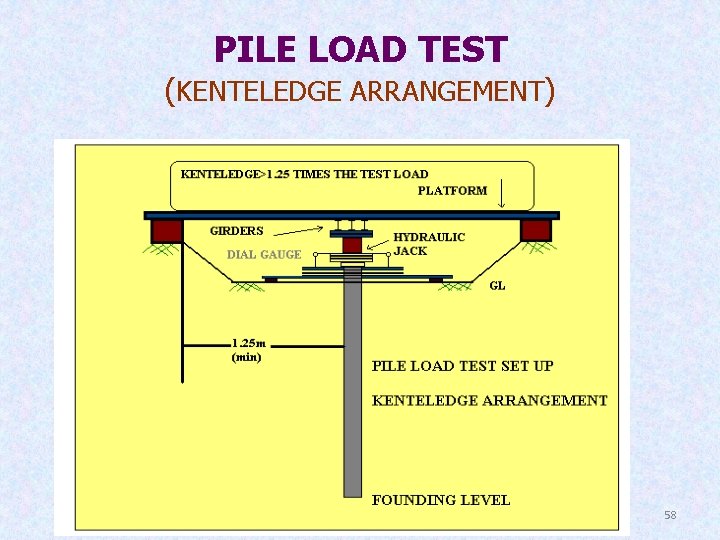
PILE LOAD TEST (KENTELEDGE ARRANGEMENT) 58
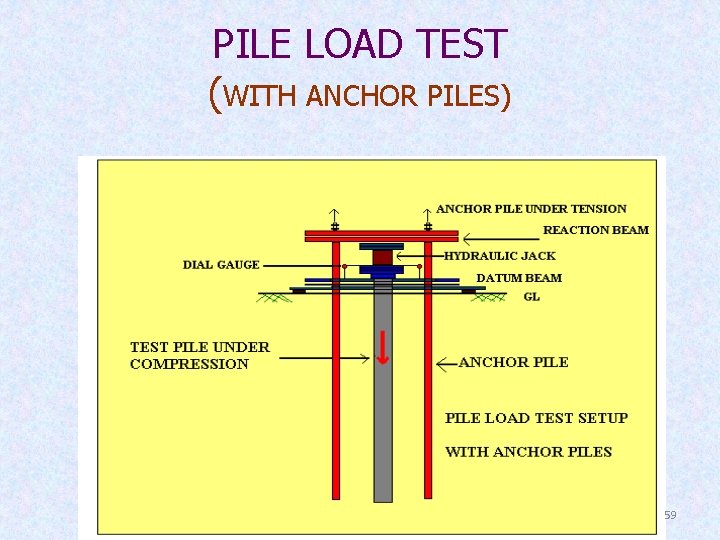
PILE LOAD TEST (WITH ANCHOR PILES) 59
DYNAMIC PILE TESTING • SUPPLEMENTS STATIC TESTING • HIGH STRAIN TESTING – PROVIDES DATA ON FORCE & ACCELERATION OF PILE – EVALUATION OF BEARING CAPACITY – FACILITATE IMMEDIATE DECISION ABOUT ACCEPTANCE OR REJECTION OF PILE • LOW STRAIN TESTING – FOR TESTING CONTINUITY OF PILE – INFORMATION ABOUT DIMENSIONS AND CONSISTANCY OF MATERIAL ASTM D 4945 60
DEFECTS IN CAST IN SITU PILES • HONEY COMBING DUE TO INADEQUATE VIBRATIONS • SEGREGATION DUE TO IMPROPER CONCRETE PLACEMENT METHODS • WASHOUT OF CEMENT DUE TO GROUNDWATER FLOW • CRACKS IN PILE SHAFT DUE TO SHRINKAGE • INCLUSION OF FOREIGN MATERIAL • NECKING DUE TO COLLAPSE OF SIDE WALLS DURING WITHDRAWAL OF TEMPORARY CASING 61
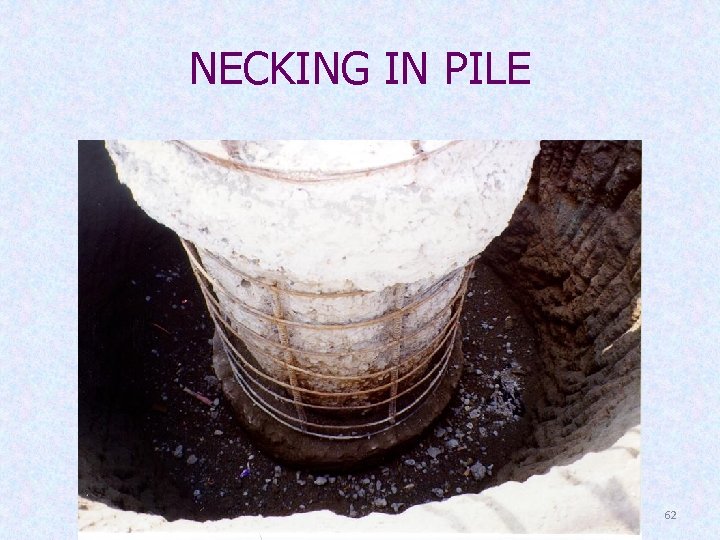
NECKING IN PILE 62
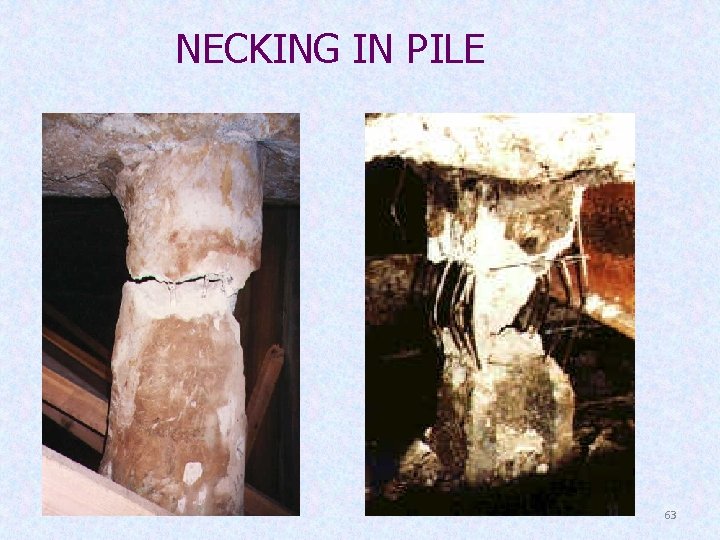
NECKING IN PILE 63

Y K N A H T U O 64

DESIGN OF PILES 65
RELEVENT STANDARDS • Manual on the Design and Construction of well and pile Foundations issued by RDSO • IS 2911 - Part I – Section I – Driven cast in situ piles – Section II- Bored cast in situ piles – Section III- Driven precast concrete piles • IS 2911 - Part IV- Load test 66
RELEVENT STANDARDS • Concrete Bridge code- For structural design • IRC- 78 - For Road bridge foundations, can be referred for guidance 67
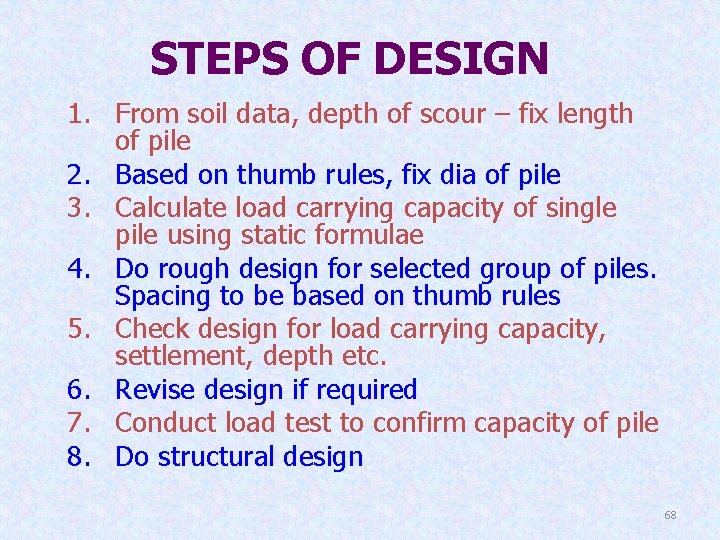
STEPS OF DESIGN 1. From soil data, depth of scour – fix length of pile 2. Based on thumb rules, fix dia of pile 3. Calculate load carrying capacity of single pile using static formulae 4. Do rough design for selected group of piles. Spacing to be based on thumb rules 5. Check design for load carrying capacity, settlement, depth etc. 6. Revise design if required 7. Conduct load test to confirm capacity of pile 8. Do structural design 68
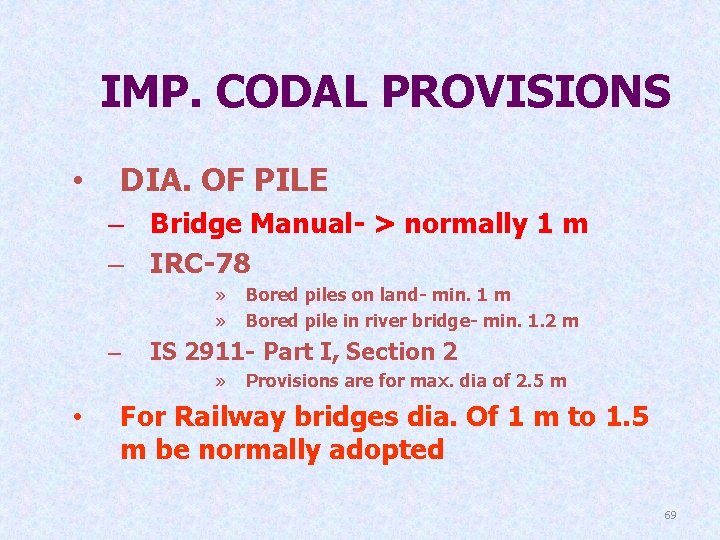
IMP. CODAL PROVISIONS • DIA. OF PILE – Bridge Manual- > normally 1 m – IRC-78 » » – IS 2911 - Part I, Section 2 » • Bored piles on land- min. 1 m Bored pile in river bridge- min. 1. 2 m Provisions are for max. dia of 2. 5 m For Railway bridges dia. Of 1 m to 1. 5 m be normally adopted 69
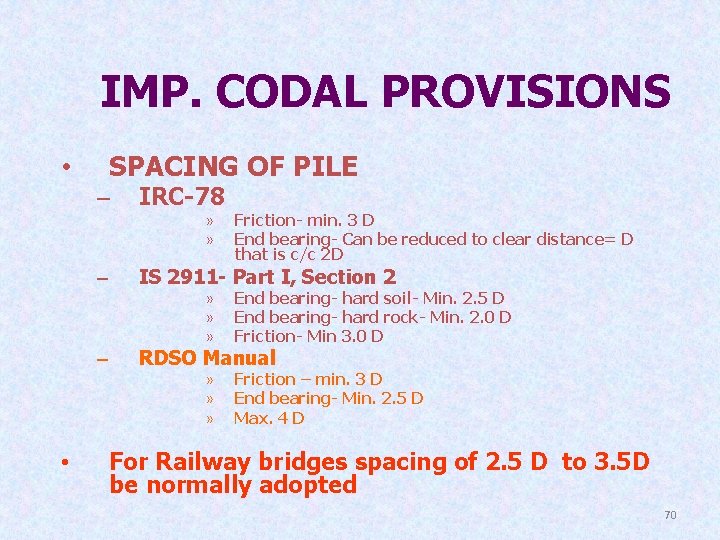
IMP. CODAL PROVISIONS SPACING OF PILE • – IRC-78 » » – – • Friction- min. 3 D End bearing- Can be reduced to clear distance= D that is c/c 2 D IS 2911 - Part I, Section 2 » » » End bearing- hard soil- Min. 2. 5 D End bearing- hard rock- Min. 2. 0 D Friction- Min 3. 0 D » » » Friction – min. 3 D End bearing- Min. 2. 5 D Max. 4 D RDSO Manual For Railway bridges spacing of 2. 5 D to 3. 5 D be normally adopted 70
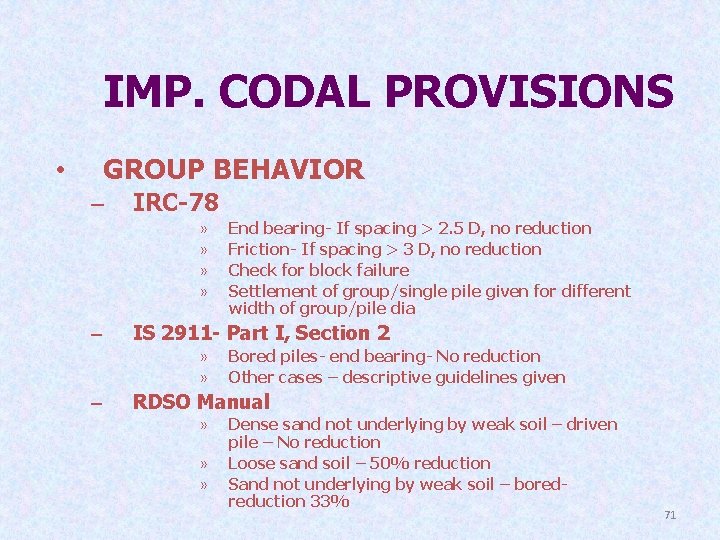
IMP. CODAL PROVISIONS GROUP BEHAVIOR • – IRC-78 » » – IS 2911 - Part I, Section 2 » » – End bearing- If spacing > 2. 5 D, no reduction Friction- If spacing > 3 D, no reduction Check for block failure Settlement of group/single pile given for different width of group/pile dia Bored piles- end bearing- No reduction Other cases – descriptive guidelines given RDSO Manual » » » Dense sand not underlying by weak soil – driven pile – No reduction Loose sand soil – 50% reduction Sand not underlying by weak soil – boredreduction 33% 71
IMP. CODAL PROVISIONS • PILE CAP – IRC-78 » » » – IS 2911 - Part I, Section 2 » » – Min. thickness 0. 6 m or 1. 5 times dia of pile, whichever is more max offset of 150 mm beyond outer face Pile to project 50 mm into pile cap Offset of 100 -150 mm beyond outer face Pile to project 50 mm into pile cap Should be rigid enough Can be designed by taking dispersion at 45 degrees both from substructure and pile upto centre line RDSO Manual » NIL 72
IMP. CODAL PROVISIONS CONCRETE AND STEEL • – IRC-78 » » » – IS 2911 - Part I, Section 2 » M 20, Min. cement 400 kg/m 3, 10% extra cement when under water, slump 100 - 180 mm (150 -180 for tremie) Min. long reinforcement 0. 4%, Min. spacing 100 mm, links min 6 mm @ 150 mm c/c. Min cover 40 mm. » » NIL CBC to be followed based on environment condition » » – M 35, Min. cement 400 kg/m 3, Max. W/C 0. 4, slump 50 mm (150 -200 for tremie) Min. long reinforcement 0. 4%, links min. 8 mm @ 150 mm c/c. Min cover 75 mm. RDSO Manual 73
IMP. CODAL PROVISIONS • FOS – IRC-78 » 2. 5 if derived from static formulae for soil. 5 for end bearing on rock and 10 for socket resistance. – IS 2911 - Part I, Section 2 » Appendix given for calculating strength with static formulae – RDSO Manual » 3 if derived from static formulae. » 2 if derived from load test 74
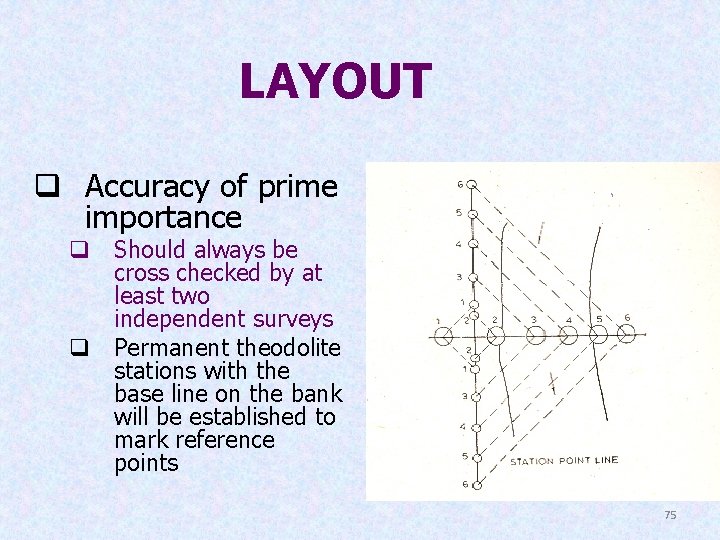
LAYOUT q Accuracy of prime importance q Should always be cross checked by at least two independent surveys q Permanent theodolite stations with the base line on the bank will be established to mark reference points 75
Well v/s Pile v In case of wells, it is possible to visually examine the strata through which sinking is done and material on which it is finally resting, hence the bearing capacity of a well is certain. On other hand bearing capacity of pile is generally uncertain v Concreting in the staining of wells is done under dry conditions and the quality of concrete is much better than in case of cast in situ piles. 76
Well v/s Pile v Size of well foundation cannot be reduced indefinitely and hence it uneconomical to use well foundation for very small loads, pile foundations are more suitable. 77
NORMAL SCOUR LACEY’s FORMULA- D = 0. 473 (Qf/f)1/3 IF (a)Design flood continues for sufficient time (b)River is flowing straight through incoherent alluvium and are free to adjust their width of flow and their depth (c) The width of the river is not less than the Lacey’s regime width i. e. L= 4. 85 Qf. • f is the silt factor = 1. 76 m • Where the width is less than Lacey’s regime width dc/d = (w/wc)0. 61 78
LOCAL SCOUR • The depth calculated shall be increased as under- Nature of the river Depth of scour - In a straight reach - At the moderate bend conditions e. g. along apron of guide bund 1. 25 D 1. 5 D - At a severe bend - At a right angle bend or at nose of piers 1. 75 D 2. 0 D - In severe swirls e. g. against mole head of a guide bund 2. 5 to 2. 75 D 79
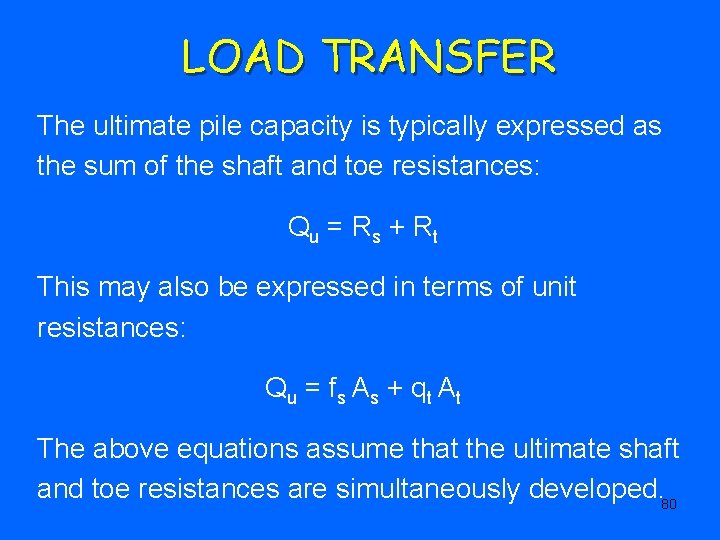
LOAD TRANSFER The ultimate pile capacity is typically expressed as the sum of the shaft and toe resistances: Qu = R s + R t This may also be expressed in terms of unit resistances: Qu = f s As + q t At The above equations assume that the ultimate shaft and toe resistances are simultaneously developed. 80
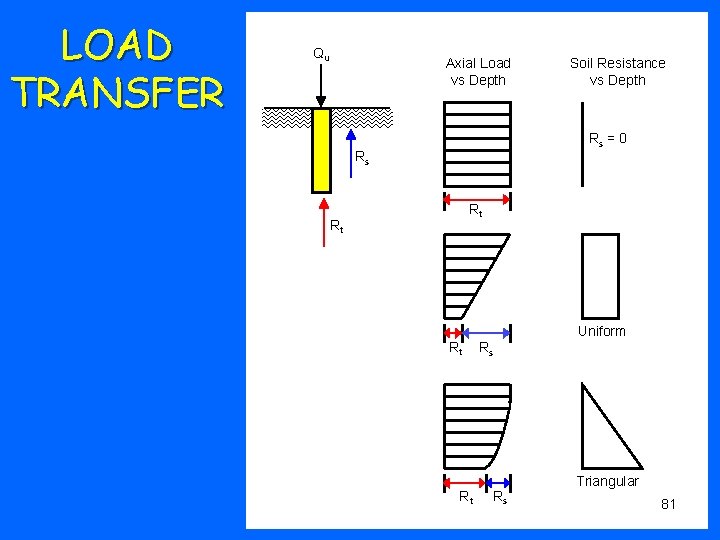
LOAD TRANSFER Qu Axial Load vs Depth Soil Resistance vs Depth Rs = 0 Rs Rt Rt Uniform Rs Rs Triangular 81
- Slides: 81