
Pigment Printing Problems Resolution Binder Application in Different
Pigment Printing Problems & Resolution
Binder Application in Different Style Pigment Printing Pigment Discharge Printing Gold Printing Silver Printing Foil / Metallic Printing Coating Paint Non-woven Tape industries Etc.
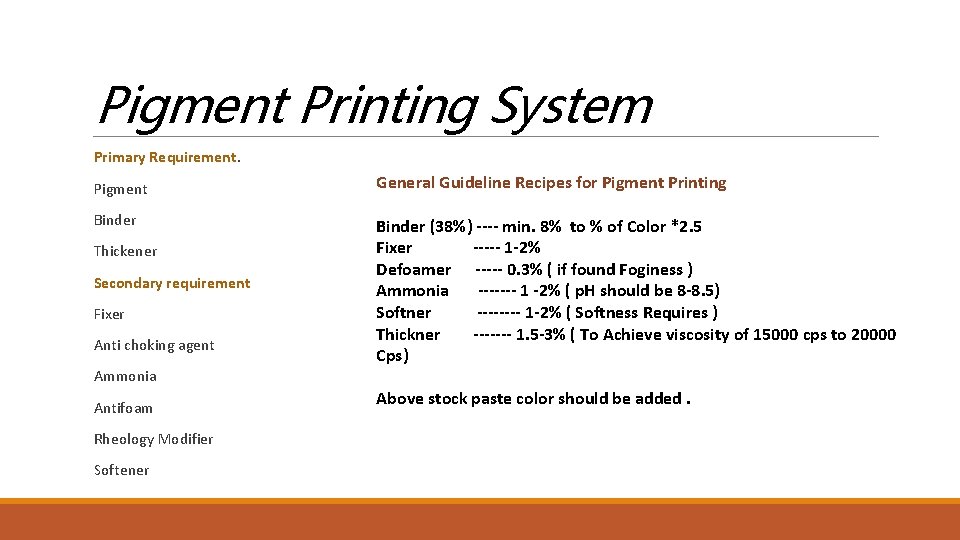
Pigment Printing System Primary Requirement. Pigment General Guideline Recipes for Pigment Printing Binder (38%) ---- min. 8% to % of Color *2. 5 Fixer ----- 1 -2% Defoamer ----- 0. 3% ( if found Foginess ) Ammonia ------- 1 -2% ( p. H should be 8 -8. 5) Softner ---- 1 -2% ( Softness Requires ) Thickner ------- 1. 5 -3% ( To Achieve viscosity of 15000 cps to 20000 Cps) Thickener Secondary requirement Fixer Anti choking agent Ammonia Antifoam Rheology Modifier Softener Above stock paste color should be added.
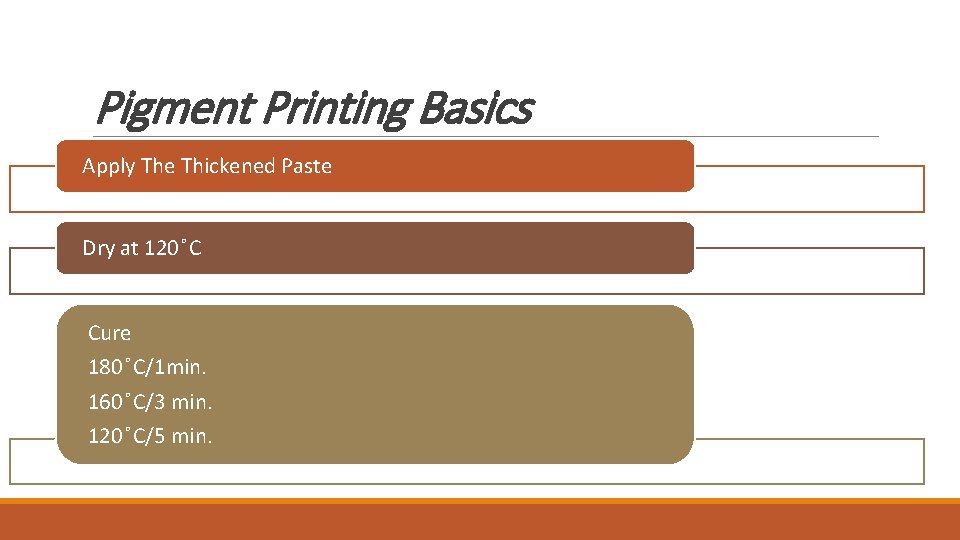
Pigment Printing Basics Apply The Thickened Paste Dry at 120 C Cure 180 C/1 min. 160 C/3 min. 120 C/5 min.
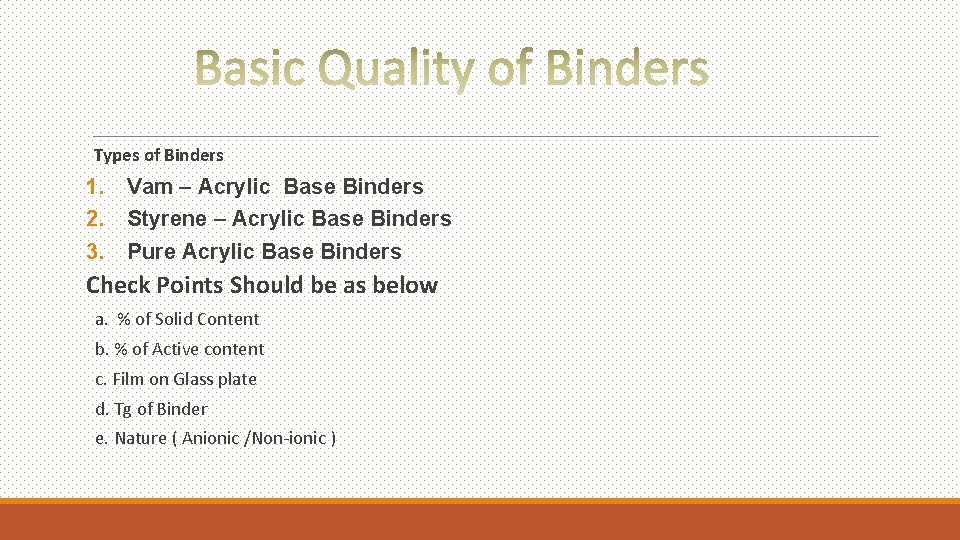
Types of Binders 1. Vam – Acrylic Base Binders 2. Styrene – Acrylic Base Binders 3. Pure Acrylic Base Binders Check Points Should be as below a. % of Solid Content b. % of Active content c. Film on Glass plate d. Tg of Binder e. Nature ( Anionic /Non-ionic )
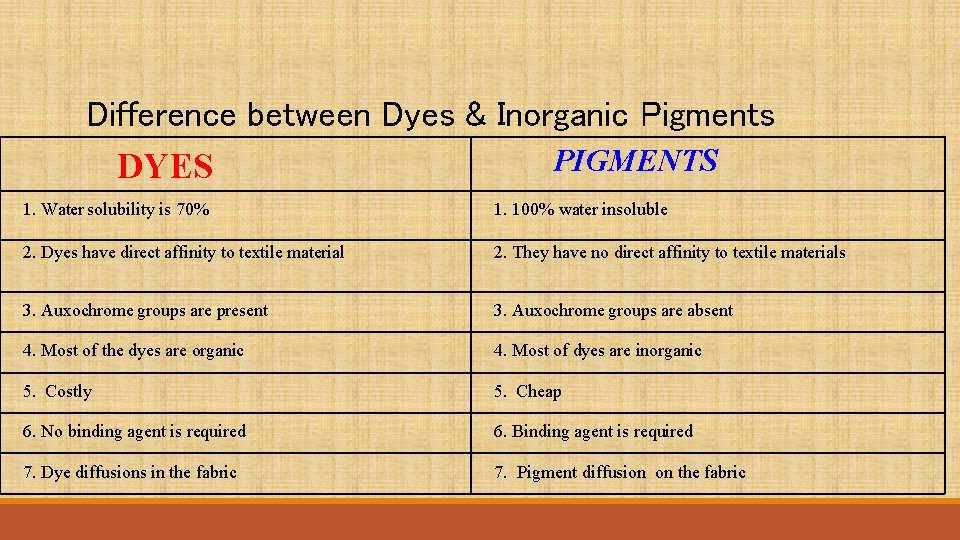
Difference between Dyes & Inorganic Pigments PIGMENTS DYES 1. Water solubility is 70% 1. 100% water insoluble 2. Dyes have direct affinity to textile material 2. They have no direct affinity to textile materials 3. Auxochrome groups are present 3. Auxochrome groups are absent 4. Most of the dyes are organic 4. Most of dyes are inorganic 5. Costly 5. Cheap 6. No binding agent is required 6. Binding agent is required 7. Dye diffusions in the fabric 7. Pigment diffusion on the fabric
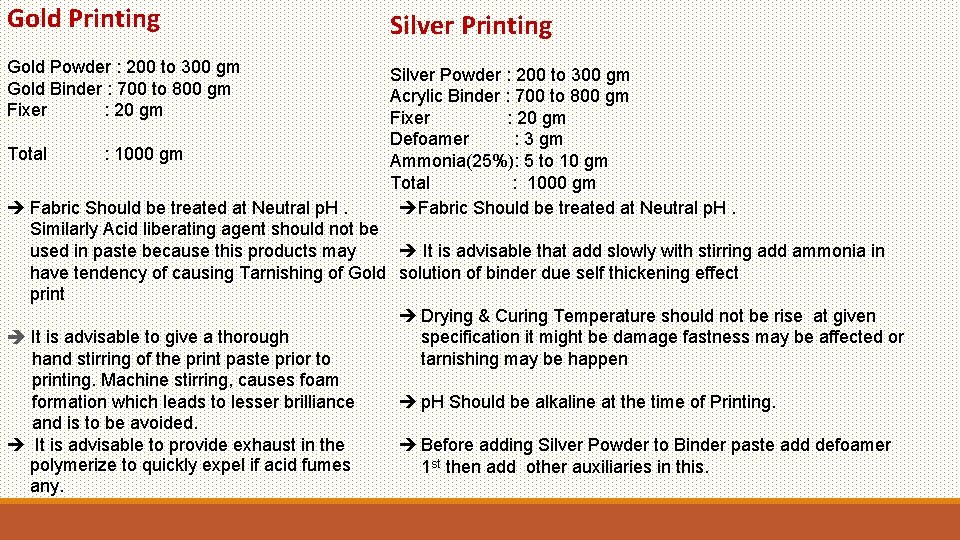
Gold Printing Silver Printing Gold Powder : 200 to 300 gm Gold Binder : 700 to 800 gm Fixer : 20 gm Silver Powder : 200 to 300 gm Acrylic Binder : 700 to 800 gm Fixer : 20 gm Defoamer : 3 gm Ammonia(25%): 5 to 10 gm Total : 1000 gm Fabric Should be treated at Neutral p. H. Total : 1000 gm Fabric Should be treated at Neutral p. H. Similarly Acid liberating agent should not be It is advisable that add slowly with stirring add ammonia in used in paste because this products may have tendency of causing Tarnishing of Gold solution of binder due self thickening effect print Drying & Curing Temperature should not be rise at given It is advisable to give a thorough specification it might be damage fastness may be affected or hand stirring of the print paste prior to tarnishing may be happen printing. Machine stirring, causes foam formation which leads to lesser brilliance p. H Should be alkaline at the time of Printing. and is to be avoided. It is advisable to provide exhaust in the Before adding Silver Powder to Binder paste add defoamer polymerize to quickly expel if acid fumes 1 st then add other auxiliaries in this. any.
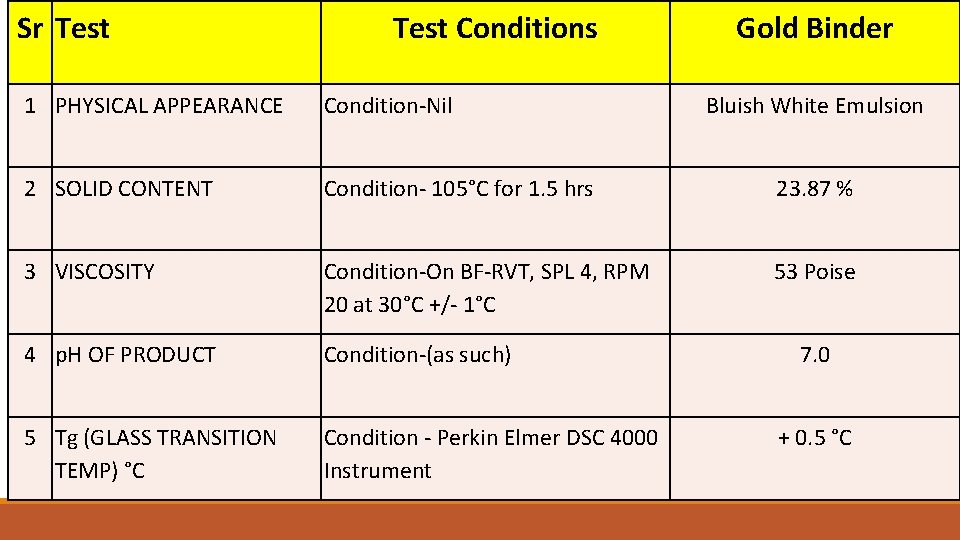
Sr Test Conditions Gold Binder 1 PHYSICAL APPEARANCE Condition-Nil Bluish White Emulsion 2 SOLID CONTENT Condition- 105°C for 1. 5 hrs 23. 87 % 3 VISCOSITY Condition-On BF-RVT, SPL 4, RPM 20 at 30°C +/- 1°C 53 Poise 4 p. H OF PRODUCT Condition-(as such) 5 Tg (GLASS TRANSITION TEMP) °C Condition - Perkin Elmer DSC 4000 Instrument 7. 0 + 0. 5 °C
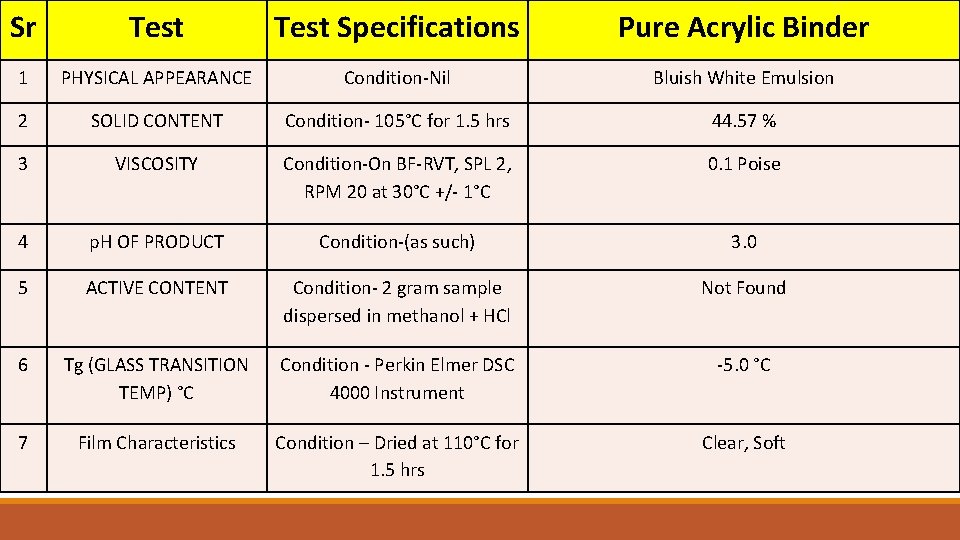
Sr Test Specifications Pure Acrylic Binder 1 PHYSICAL APPEARANCE Condition-Nil Bluish White Emulsion 2 SOLID CONTENT Condition- 105°C for 1. 5 hrs 44. 57 % 3 VISCOSITY Condition-On BF-RVT, SPL 2, RPM 20 at 30°C +/- 1°C 0. 1 Poise 4 p. H OF PRODUCT Condition-(as such) 3. 0 5 ACTIVE CONTENT Condition- 2 gram sample dispersed in methanol + HCl Not Found 6 Tg (GLASS TRANSITION TEMP) °C Condition - Perkin Elmer DSC 4000 Instrument -5. 0 °C 7 Film Characteristics Condition – Dried at 110°C for 1. 5 hrs Clear, Soft
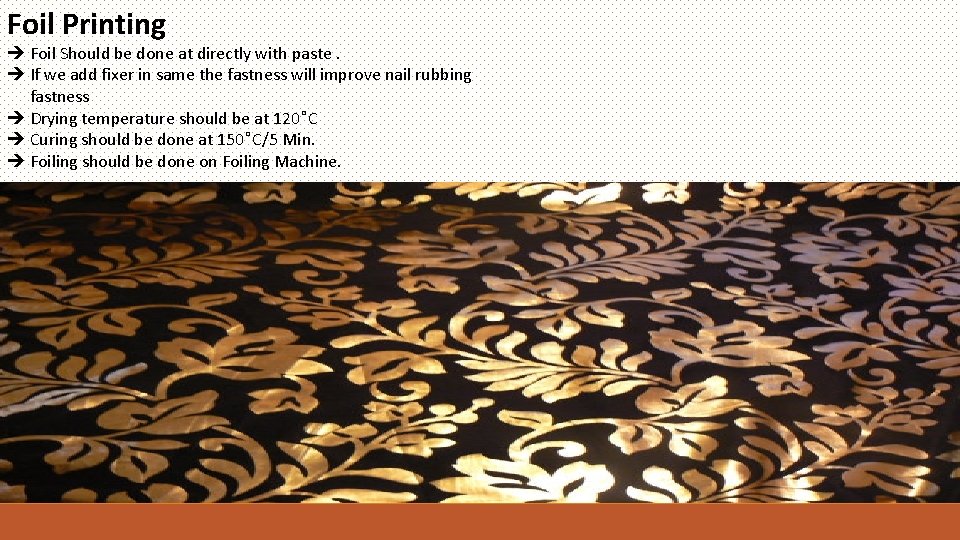
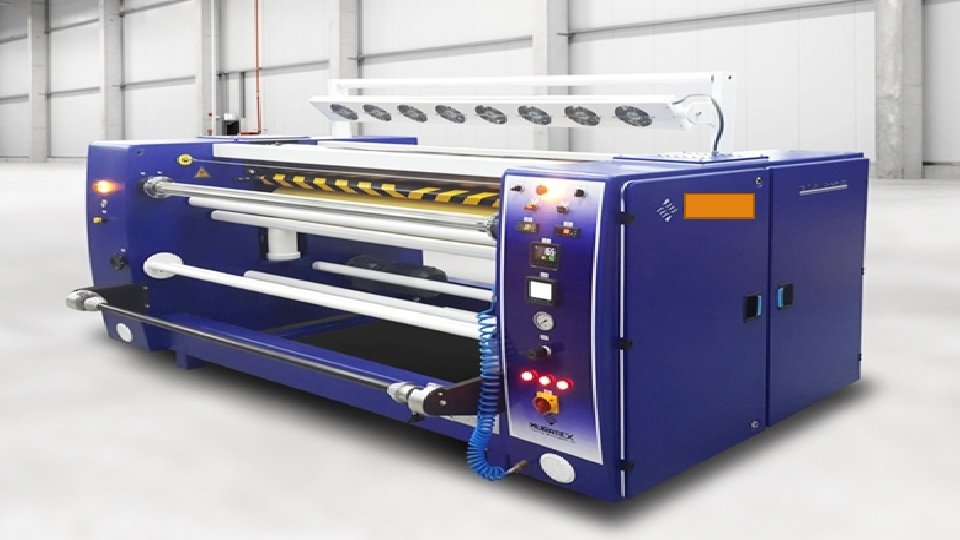
Foil Printing Foil Should be done at directly with paste. If we add fixer in same the fastness will improve nail rubbing fastness Drying temperature should be at 120 C Curing should be done at 150 C/5 Min. Foiling should be done on Foiling Machine.
General Problems finds in Pigment Printing
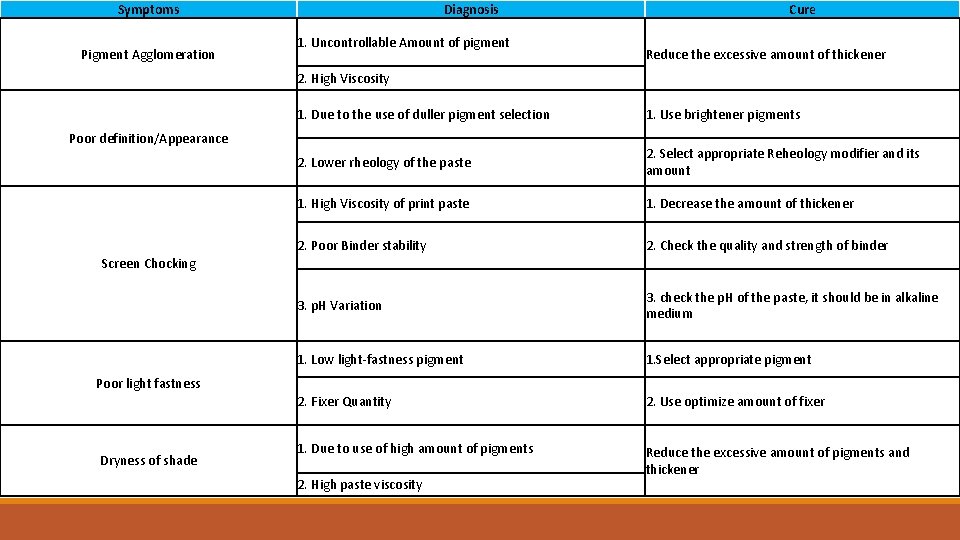
Symptoms Pigment Agglomeration Diagnosis 1. Uncontrollable Amount of pigment Cure Reduce the excessive amount of thickener 2. High Viscosity 1. Due to the use of duller pigment selection 1. Use brightener pigments 2. Lower rheology of the paste 2. Select appropriate Reheology modifier and its amount 1. High Viscosity of print paste 1. Decrease the amount of thickener 2. Poor Binder stability 2. Check the quality and strength of binder 3. p. H Variation 3. check the p. H of the paste, it should be in alkaline medium 1. Low light-fastness pigment 1. Select appropriate pigment 2. Fixer Quantity 2. Use optimize amount of fixer 1. Due to use of high amount of pigments Reduce the excessive amount of pigments and thickener Poor definition/Appearance Screen Chocking Poor light fastness Dryness of shade 2. High paste viscosity
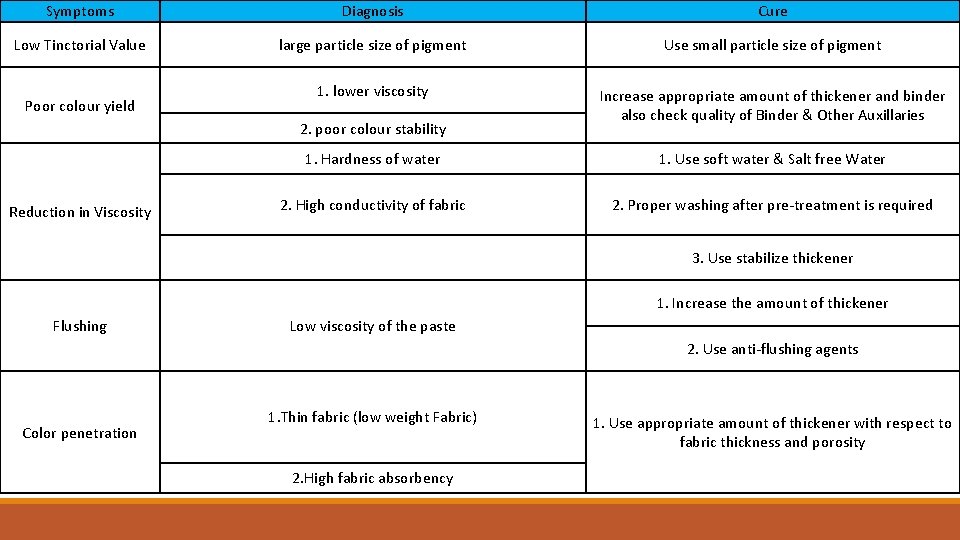
Symptoms Diagnosis Cure Low Tinctorial Value large particle size of pigment Use small particle size of pigment 1. lower viscosity Increase appropriate amount of thickener and binder also check quality of Binder & Other Auxillaries Poor colour yield 2. poor colour stability Reduction in Viscosity 1. Hardness of water 1. Use soft water & Salt free Water 2. High conductivity of fabric 2. Proper washing after pre-treatment is required 3. Use stabilize thickener 1. Increase the amount of thickener Flushing Low viscosity of the paste 2. Use anti-flushing agents Color penetration 1. Thin fabric (low weight Fabric) 2. High fabric absorbency 1. Use appropriate amount of thickener with respect to fabric thickness and porosity
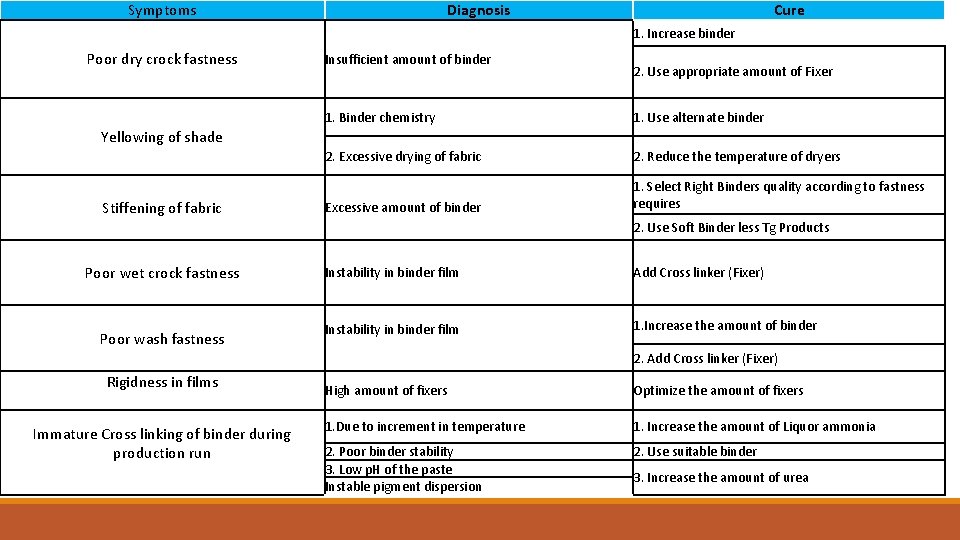
Symptoms Diagnosis Cure 1. Increase binder Poor dry crock fastness Insufficient amount of binder 2. Use appropriate amount of Fixer 1. Binder chemistry 1. Use alternate binder 2. Excessive drying of fabric 2. Reduce the temperature of dryers Excessive amount of binder 1. Select Right Binders quality according to fastness requires Yellowing of shade Stiffening of fabric 2. Use Soft Binder less Tg Products Poor wet crock fastness Poor wash fastness Instability in binder film Add Cross linker (Fixer) Instability in binder film 1. Increase the amount of binder 2. Add Cross linker (Fixer) Rigidness in films Immature Cross linking of binder during production run High amount of fixers Optimize the amount of fixers 1. Due to increment in temperature 1. Increase the amount of Liquor ammonia 2. Poor binder stability 3. Low p. H of the paste Instable pigment dispersion 2. Use suitable binder 3. Increase the amount of urea

Thank You
- Slides: 18