
PIGGYBACK LENS AFTER MULTIFOCAL IOL IMPLANTATION Eric C
PIGGYBACK LENS AFTER MULTIFOCAL IOL IMPLANTATION Eric C. Amesbury MD Kevin M. Miller MD The authors have no financial interest
PIGGYBACK LENS AFTER MULTIFOCAL IOL IMPLANTATION Introduction: Residual refractive error after multifocal IOL implantation cause visual symptoms and decreased satisfaction. Piggyback IOL implantation is an option for correction of postoperative hyperopia after multifocal IOL implantation.
PIGGYBACK LENS AFTER MULTIFOCAL IOL IMPLANTATION Purpose: To report the safety and efficacy of piggyback IOL implantation for residual hyperopia following cataract extraction and diffractive multifocal IOL implantation
PIGGYBACK LENS AFTER MULTIFOCAL IOL IMPLANTATION Methods: Case Report Ø 61 -year-old male ØRight eye phaco with in-the-bag multifocal IOL (Acry. Sof Re. STOR), 20/50 and J 1 uncorrected acuity Ø+1. 00 sphere 20/20; patient satisfied with spectacles (20/20 cataract left eye)
PIGGYBACK LENS AFTER MULTIFOCAL IOL IMPLANTATION Methods (continued): Ø 3 years later: Left eye phaco with multifocal IOL (Re. STOR), 20/15 and J 1 uncorrected acuity ØRight eye symptomatic with blur and ocular imbalance uncorrected Ø+1. 00 diopter 3 -piece, rounded-edge silicone piggyback IOL (Staar AQ 5010 V) implanted in the ciliary sulcus of the right eye
PIGGYBACK LENS AFTER MULTIFOCAL IOL IMPLANTATION Results: ØNo intraoperative complications Ø 20/15 and J 1 uncorrected acuity ØMild pigment dispersion at 2 weeks postop with 30 mm. Hg IOP
PIGGYBACK LENS AFTER MULTIFOCAL IOL IMPLANTATION Results (continued): ØAqueous suppressant + prednisolone acetate 1% therapy controlled IOP ØPigment resolved at 1 month postop ØOff all meds with normal IOP and no pigment dispersion at 3 months
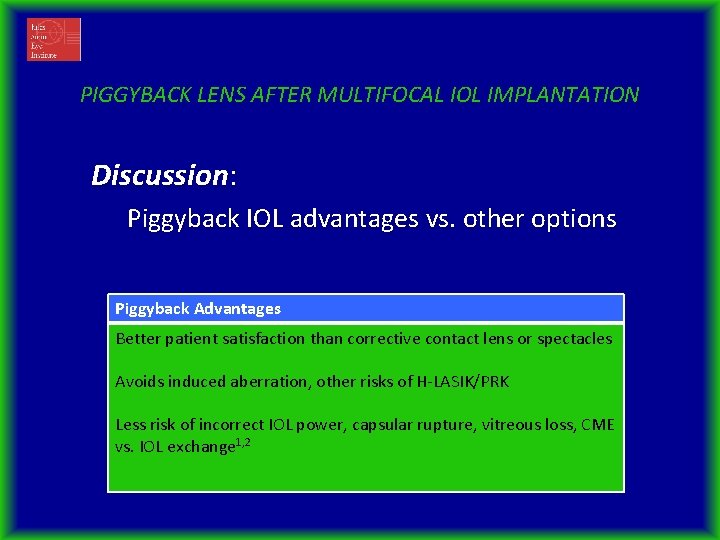
PIGGYBACK LENS AFTER MULTIFOCAL IOL IMPLANTATION Discussion: Piggyback IOL advantages vs. other options Piggyback Advantages Better patient satisfaction than corrective contact lens or spectacles Avoids induced aberration, other risks of H-LASIK/PRK Less risk of incorrect IOL power, capsular rupture, vitreous loss, CME vs. IOL exchange 1, 2
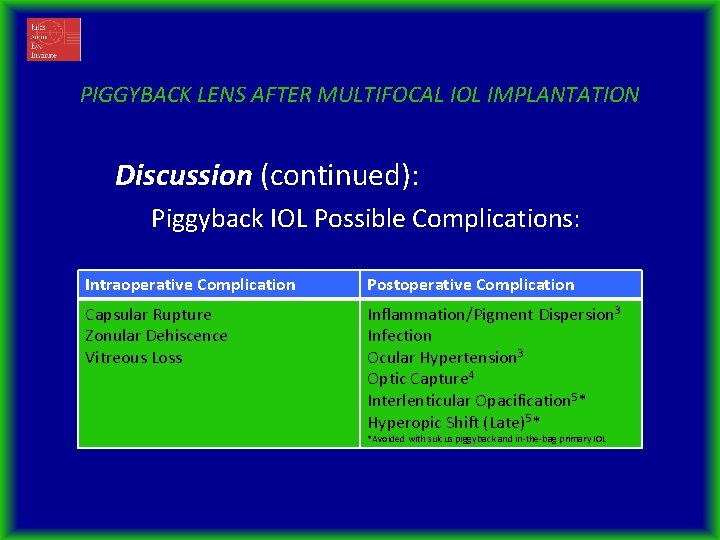
PIGGYBACK LENS AFTER MULTIFOCAL IOL IMPLANTATION Discussion (continued): Piggyback IOL Possible Complications: Intraoperative Complication Postoperative Complication Capsular Rupture Zonular Dehiscence Vitreous Loss Inflammation/Pigment Dispersion 3 Infection Ocular Hypertension 3 Optic Capture 4 Interlenticular Opacification 5* Hyperopic Shift (Late)5* *Avoided with sulcus piggyback and in-the-bag primary IOL
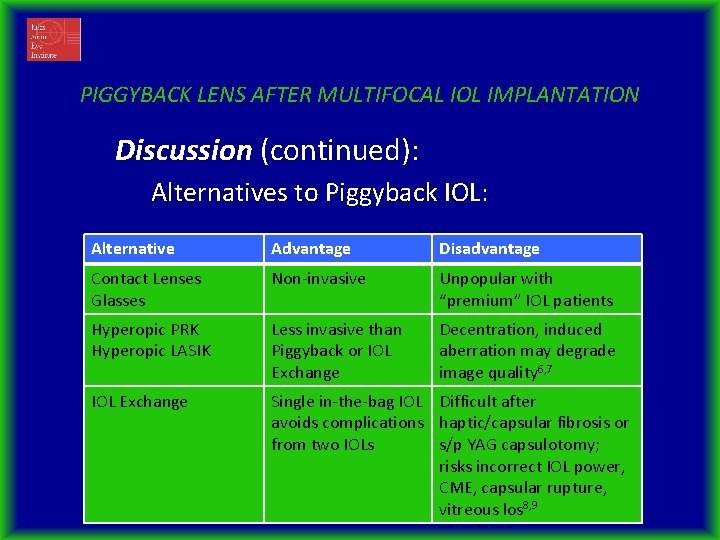
PIGGYBACK LENS AFTER MULTIFOCAL IOL IMPLANTATION Discussion (continued): Alternatives to Piggyback IOL: Alternative Advantage Disadvantage Contact Lenses Glasses Non-invasive Unpopular with “premium” IOL patients Hyperopic PRK Hyperopic LASIK Less invasive than Piggyback or IOL Exchange Decentration, induced aberration may degrade image quality 6, 7 IOL Exchange Single in-the-bag IOL Difficult after avoids complications haptic/capsular fibrosis or from two IOLs s/p YAG capsulotomy; risks incorrect IOL power, CME, capsular rupture, vitreous los 8, 9
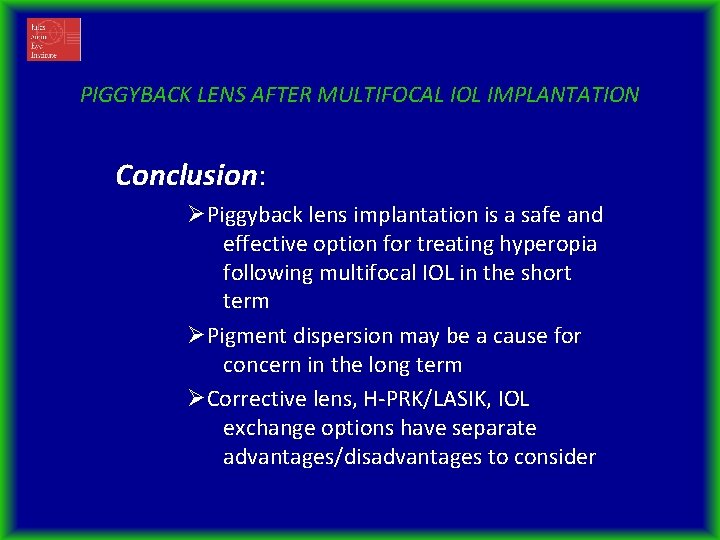
PIGGYBACK LENS AFTER MULTIFOCAL IOL IMPLANTATION Conclusion: ØPiggyback lens implantation is a safe and effective option for treating hyperopia following multifocal IOL in the short term ØPigment dispersion may be a cause for concern in the long term ØCorrective lens, H-PRK/LASIK, IOL exchange options have separate advantages/disadvantages to consider
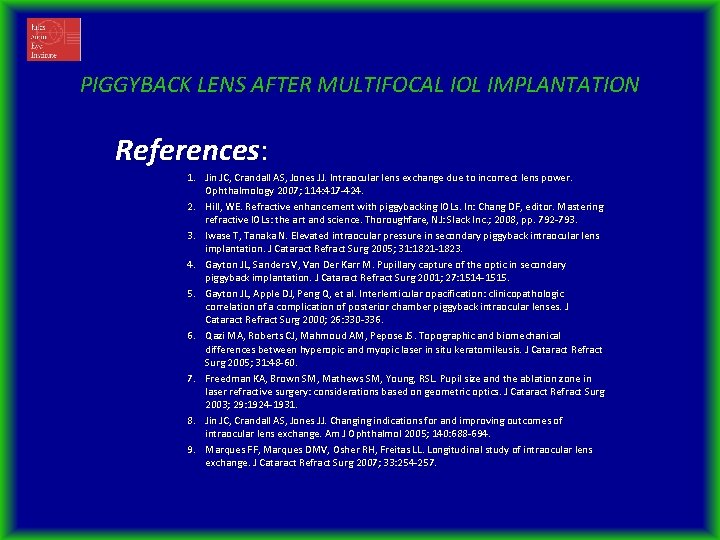
PIGGYBACK LENS AFTER MULTIFOCAL IOL IMPLANTATION References: 1. Jin JC, Crandall AS, Jones JJ. Intraocular lens exchange due to incorrect lens power. Ophthalmology 2007; 114: 417 -424. 2. Hill, WE. Refractive enhancement with piggybacking IOLs. In: Chang DF, editor. Mastering refractive IOLs: the art and science. Thoroughfare, NJ: Slack Inc. ; 2008, pp. 792 -793. 3. Iwase T, Tanaka N. Elevated intraocular pressure in secondary piggyback intraocular lens implantation. J Cataract Refract Surg 2005; 31: 1821 -1823. 4. Gayton JL, Sanders V, Van Der Karr M. Pupillary capture of the optic in secondary piggyback implantation. J Cataract Refract Surg 2001; 27: 1514 -1515. 5. Gayton JL, Apple DJ, Peng Q, et al. Interlenticular opacification: clinicopathologic correlation of a complication of posterior chamber piggyback intraocular lenses. J Cataract Refract Surg 2000; 26: 330 -336. 6. Qazi MA, Roberts CJ, Mahmoud AM, Pepose JS. Topographic and biomechanical differences between hyperopic and myopic laser in situ keratomileusis. J Cataract Refract Surg 2005; 31: 48 -60. 7. Freedman KA, Brown SM, Mathews SM, Young, RSL. Pupil size and the ablation zone in laser refractive surgery: considerations based on geometric optics. J Cataract Refract Surg 2003; 29: 1924 -1931. 8. Jin JC, Crandall AS, Jones JJ. Changing indications for and improving outcomes of intraocular lens exchange. Am J Ophthalmol 2005; 140: 688 -694. 9. Marques FF, Marques DMV, Osher RH, Freitas LL. Longitudinal study of intraocular lens exchange. J Cataract Refract Surg 2007; 33: 254 -257.
- Slides: 12