
Piezoelectric ceramics Piezoelectricity In a conventional solid a
![Piezoelectricity 3 [001]C d 31: polarization generated in the 3 direction P (vertical direction)](https://slidetodoc.com/presentation_image/105882850fb36323ced3f095c085cd68/image-5.jpg "Piezoelectricity 3 [001]C d 31: polarization generated in the 3 direction P (vertical direction)")
- Slides: 45
Piezoelectric ceramics
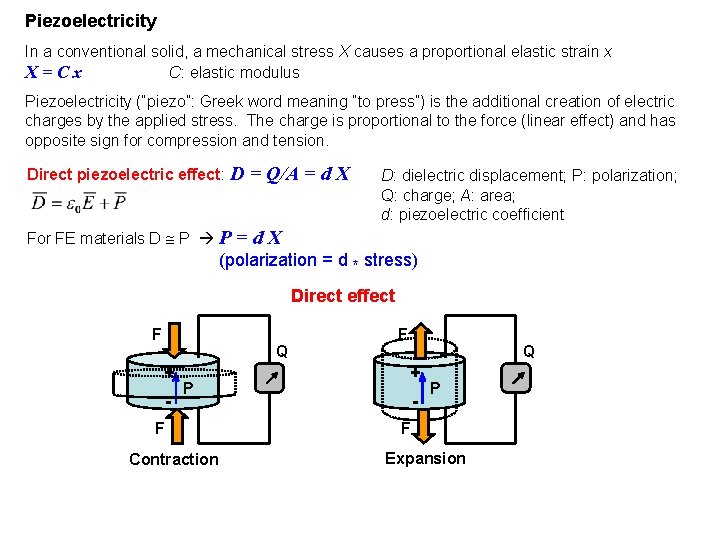
Piezoelectricity In a conventional solid, a mechanical stress X causes a proportional elastic strain x X=Cx C: elastic modulus Piezoelectricity (“piezo”: Greek word meaning “to press”) is the additional creation of electric charges by the applied stress. The charge is proportional to the force (linear effect) and has opposite sign for compression and tension. Direct piezoelectric effect: For FE materials D P D = Q/A = d X D: dielectric displacement; P: polarization; Q: charge; A: area; d: piezoelectric coefficient P=d. X (polarization = d * stress) Direct effect F Q + - P F Contraction F Q + - P F Expansion
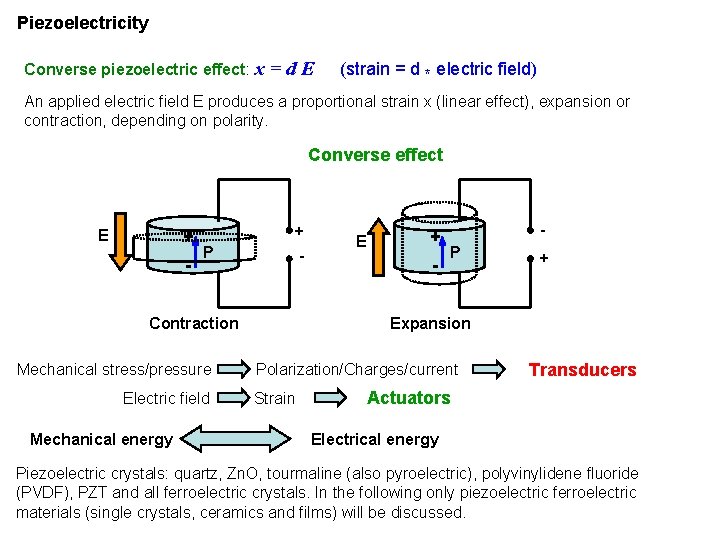
Piezoelectricity Converse piezoelectric effect: x=d. E (strain = d * electric field) An applied electric field E produces a proportional strain x (linear effect), expansion or contraction, depending on polarity. Converse effect E + - P + - Contraction Mechanical stress/pressure Electric field Mechanical energy E + - P + Expansion Polarization/Charges/current Strain Transducers Actuators Electrical energy Piezoelectric crystals: quartz, Zn. O, tourmaline (also pyroelectric), polyvinylidene fluoride (PVDF), PZT and all ferroelectric crystals. In the following only piezoelectric ferroelectric materials (single crystals, ceramics and films) will be discussed.
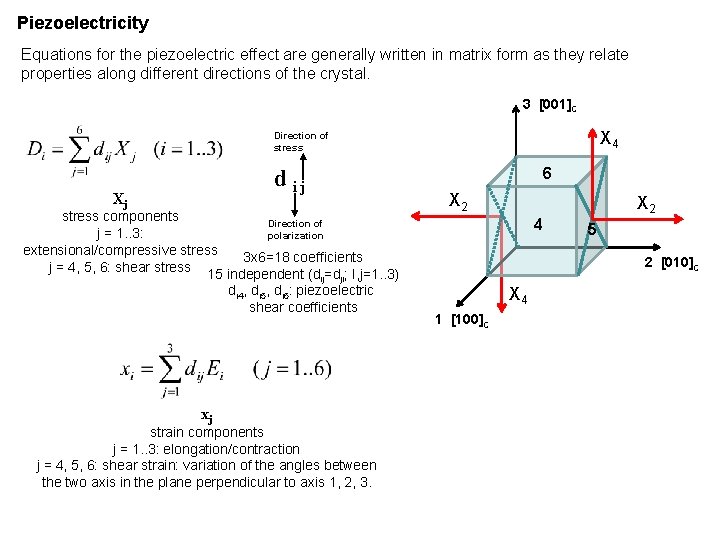
Piezoelectricity Equations for the piezoelectric effect are generally written in matrix form as they relate properties along different directions of the crystal. 3 [001]C X 4 Direction of stress 6 d ij Xj stress components Direction of j = 1. . 3: polarization extensional/compressive stress 3 x 6=18 coefficients j = 4, 5, 6: shear stress 15 independent (d =d ; I, j=1. . 3) ij 4 strain components j = 1. . 3: elongation/contraction j = 4, 5, 6: shear strain: variation of the angles between the two axis in the plane perpendicular to axis 1, 2, 3. X 2 5 2 [010]C ji di 4, di 5, di 6: piezoelectric shear coefficients xj X 2 X 4 1 [100]C
Piezoelectricity 3 [001]C d 31: polarization generated in the 3 direction P (vertical direction) as a result of a stress applied in a lateral direction (1 or 2) (6) (4) d 33: polarization generated in the 3 direction (vertical direction) as a result of a stress applied in vertical direction (3) (5) 2 [010]C d 15 : polarization generate along axis 1 (or 2) by a shear stress (d 15 = d 24) 3 1 [100]C 1 (5) Ceramics. Poling is needed for the alignment of the electrical dipoles inside each grain or domain. A piezoelectric ceramic is a poled ferroelectric ceramic material. For a poled ceramic ( mm symmetry ) sample there are only 3 piezoelectric coefficients d 31, d 33, d 15 as in tetragonal 4 mm crystals. 3 P P 1 P (5) Poling direction 4 mm 3 ≡ Polar axis For a tetragonal crystal (4 mm symmetry), there are only 3 piezoelectric coefficients: d 31, d 33, d 15 3 1 2
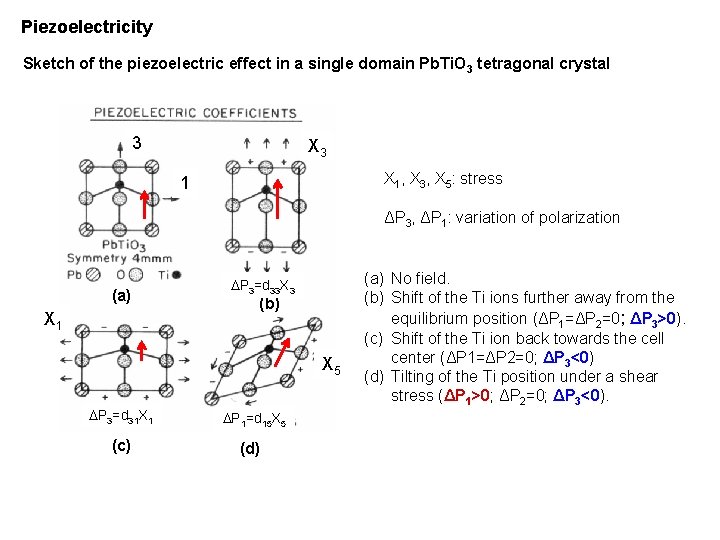
Piezoelectricity Sketch of the piezoelectric effect in a single domain Pb. Ti. O 3 tetragonal crystal 3 X 1, X 3, X 5: stress 1 ΔP 3, ΔP 1: variation of polarization (a) X 1 P 3=d 33 X 3 (b) X 5 P 3=d 31 X 1 (c) P 1=d 15 X 5 (d) (a) No field. (b) Shift of the Ti ions further away from the equilibrium position (ΔP 1=ΔP 2=0; ΔP 3>0). (c) Shift of the Ti ion back towards the cell center (ΔP 1=ΔP 2=0; ΔP 3<0) (d) Tilting of the Ti position under a shear stress (ΔP 1>0; ΔP 2=0; ΔP 3<0).
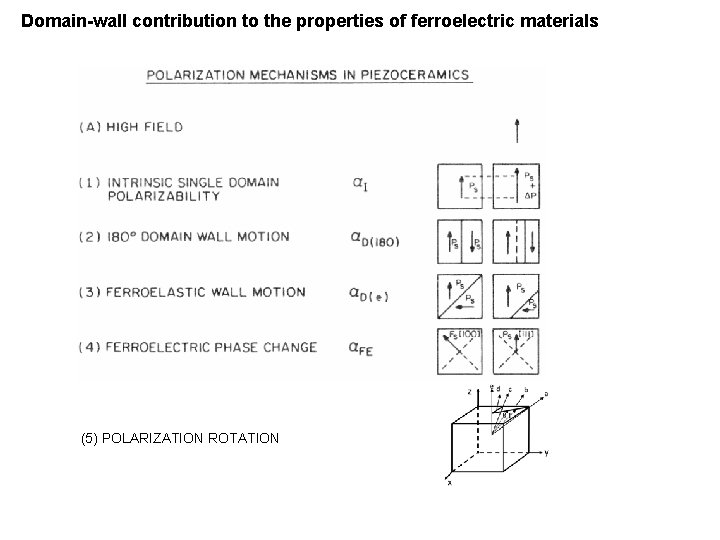
Domain-wall contribution to the properties of ferroelectric materials (5) POLARIZATION ROTATION
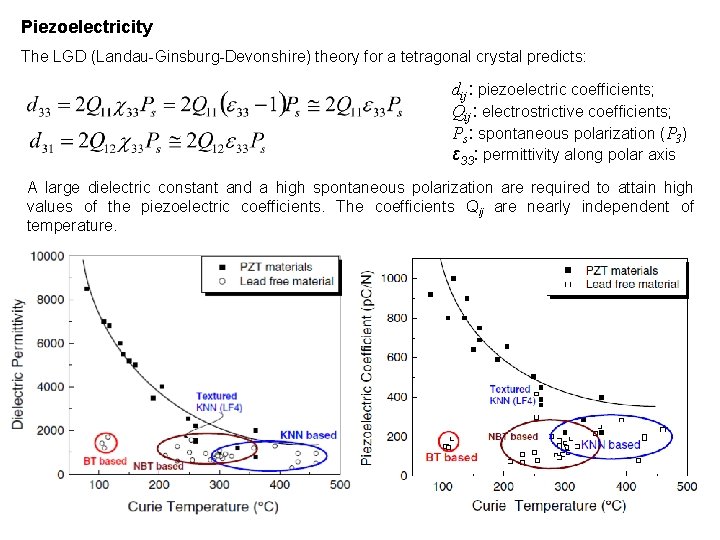
Piezoelectricity The LGD (Landau-Ginsburg-Devonshire) theory for a tetragonal crystal predicts: dij: piezoelectric coefficients; Qij: electrostrictive coefficients; Ps: spontaneous polarization (P 3) ε 33: permittivity along polar axis A large dielectric constant and a high spontaneous polarization are required to attain high values of the piezoelectric coefficients. The coefficients Qij are nearly independent of temperature.
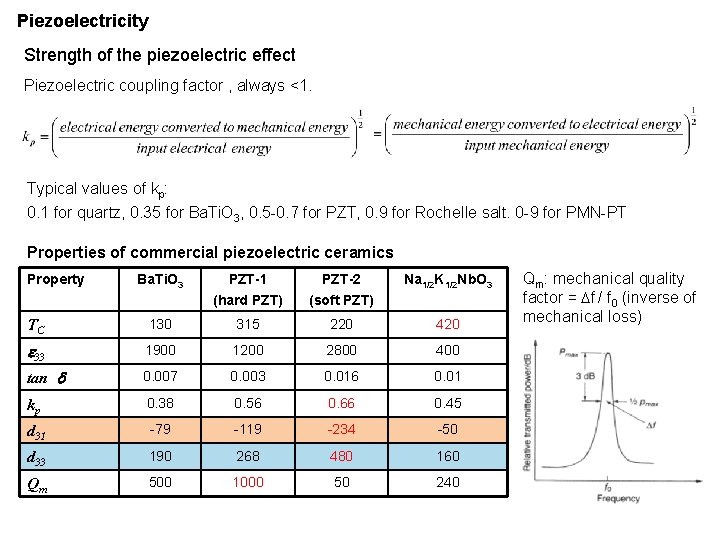
Piezoelectricity Strength of the piezoelectric effect Piezoelectric coupling factor , always <1. Typical values of kp: 0. 1 for quartz, 0. 35 for Ba. Ti. O 3, 0. 5 -0. 7 for PZT, 0. 9 for Rochelle salt. 0 -9 for PMN-PT Properties of commercial piezoelectric ceramics Property Ba. Ti. O 3 PZT-1 (hard PZT) PZT-2 (soft PZT) Na 1/2 K 1/2 Nb. O 3 TC 130 315 220 420 33 1900 1200 2800 400 tan 0. 007 0. 003 0. 016 0. 01 kp 0. 38 0. 56 0. 66 0. 45 d 31 -79 -119 -234 -50 d 33 190 268 480 160 Qm 500 1000 50 240 Qm: mechanical quality factor = f / f 0 (inverse of mechanical loss)
Properties of PZT and piezoelectric ceramics
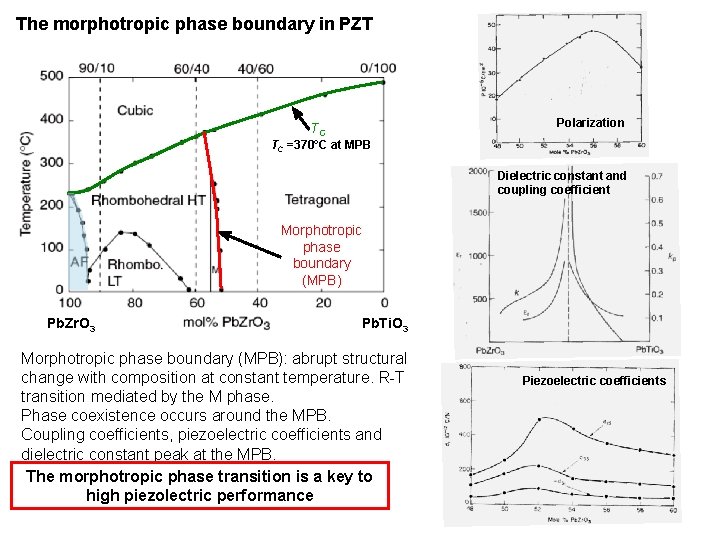
The morphotropic phase boundary in PZT Polarization TC TC =370°C at MPB Dielectric constant and coupling coefficient Morphotropic phase boundary (MPB) Pb. Zr. O 3 Pb. Ti. O 3 Morphotropic phase boundary (MPB): abrupt structural change with composition at constant temperature. R-T transition mediated by the M phase. Phase coexistence occurs around the MPB. Coupling coefficients, piezoelectric coefficients and dielectric constant peak at the MPB. The morphotropic phase transition is a key to high piezolectric performance Piezoelectric coefficients
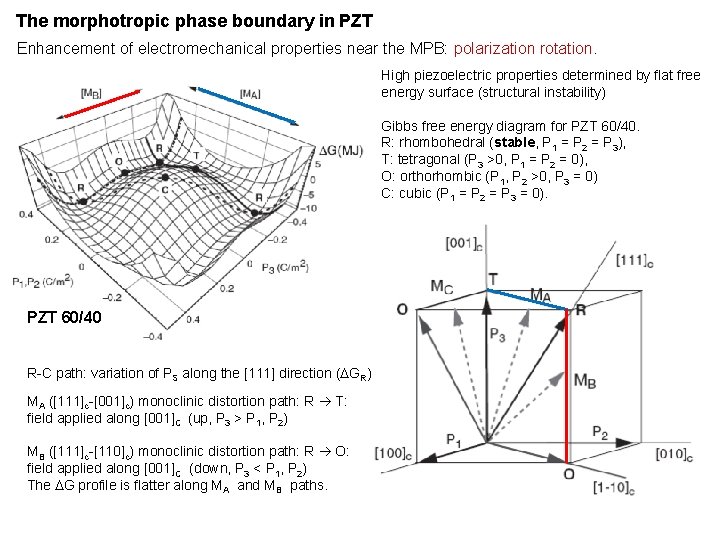
The morphotropic phase boundary in PZT Enhancement of electromechanical properties near the MPB: polarization rotation. High piezoelectric properties determined by flat free energy surface (structural instability) Gibbs free energy diagram for PZT 60/40. R: rhombohedral (stable, P 1 = P 2 = P 3), T: tetragonal (P 3 >0, P 1 = P 2 = 0), O: orthorhombic (P 1, P 2 >0, P 3 = 0) C: cubic (P 1 = P 2 = P 3 = 0). PZT 60/40 R-C path: variation of PS along the [111] direction ( GR) MA ([111]c-[001]c) monoclinic distortion path: R T: field applied along [001]C (up, P 3 > P 1, P 2) MB ([111]c-[110]c) monoclinic distortion path: R O: field applied along [001]C (down, P 3 < P 1, P 2) The G profile is flatter along MA and MB paths.
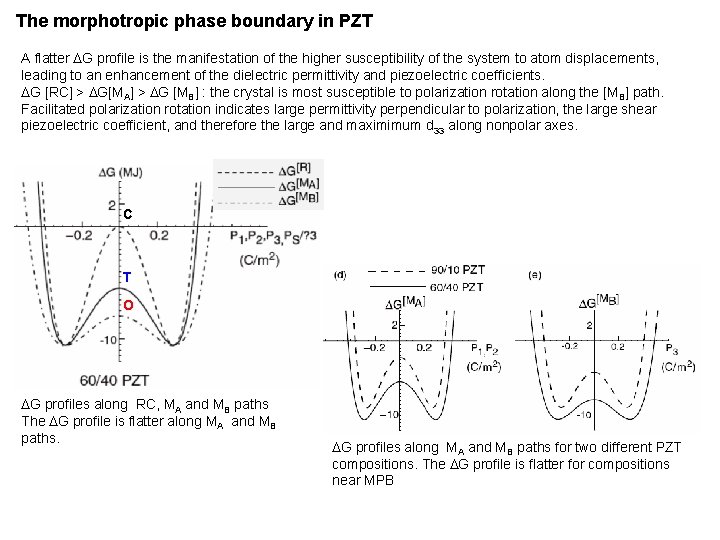
The morphotropic phase boundary in PZT A flatter G profile is the manifestation of the higher susceptibility of the system to atom displacements, leading to an enhancement of the dielectric permittivity and piezoelectric coefficients. G [RC] > G[MA] > G [MB] : the crystal is most susceptible to polarization rotation along the [MB] path. Facilitated polarization rotation indicates large permittivity perpendicular to polarization, the large shear piezoelectric coefficient, and therefore the large and maximimum d 33 along nonpolar axes. C T O G profiles along RC, MA and MB paths The G profile is flatter along MA and MB paths. G profiles along MA and MB paths for two different PZT compositions. The G profile is flatter for compositions near MPB
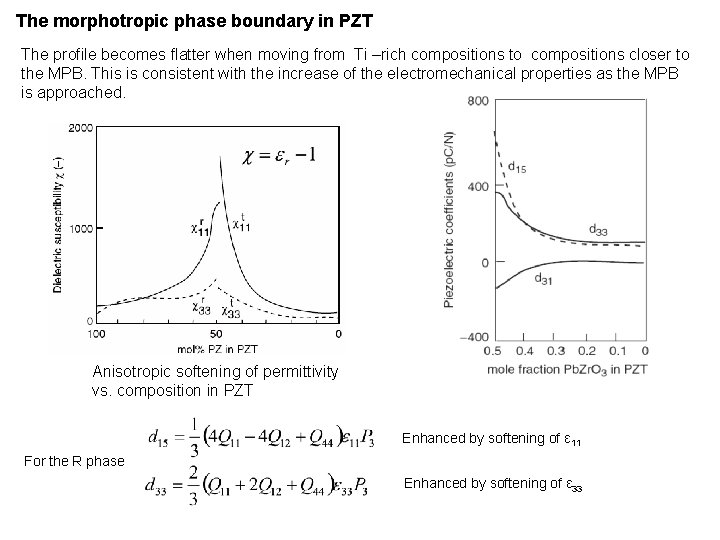
The morphotropic phase boundary in PZT The profile becomes flatter when moving from Ti –rich compositions to compositions closer to the MPB. This is consistent with the increase of the electromechanical properties as the MPB is approached. Anisotropic softening of permittivity vs. composition in PZT Enhanced by softening of ε 11 For the R phase Enhanced by softening of ε 33
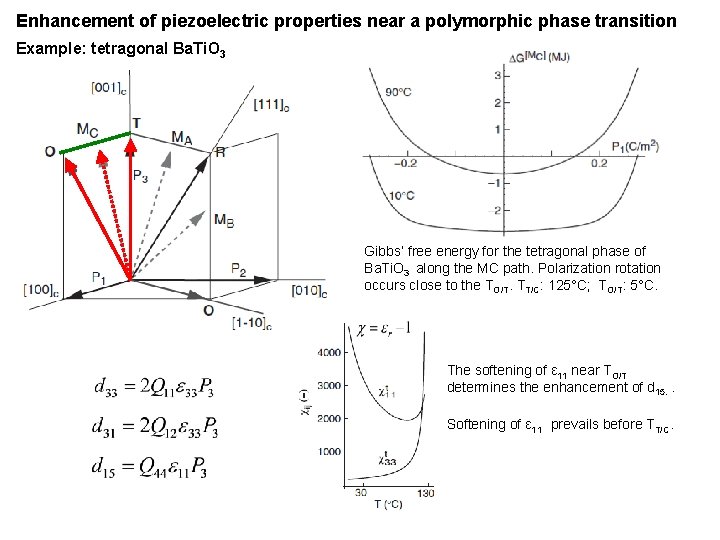
Enhancement of piezoelectric properties near a polymorphic phase transition Example: tetragonal Ba. Ti. O 3 Gibbs’ free energy for the tetragonal phase of Ba. Ti. O 3 along the MC path. Polarization rotation occurs close to the TO/T. TT/C: 125°C; TO/T: 5°C. The softening of ε 11 near TO/T determines the enhancement of d 15. . Softening of ε 11 prevails before TT/C.
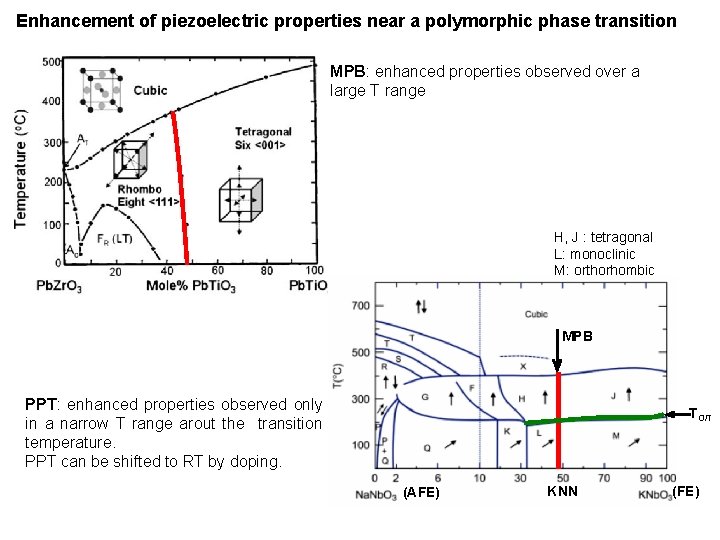
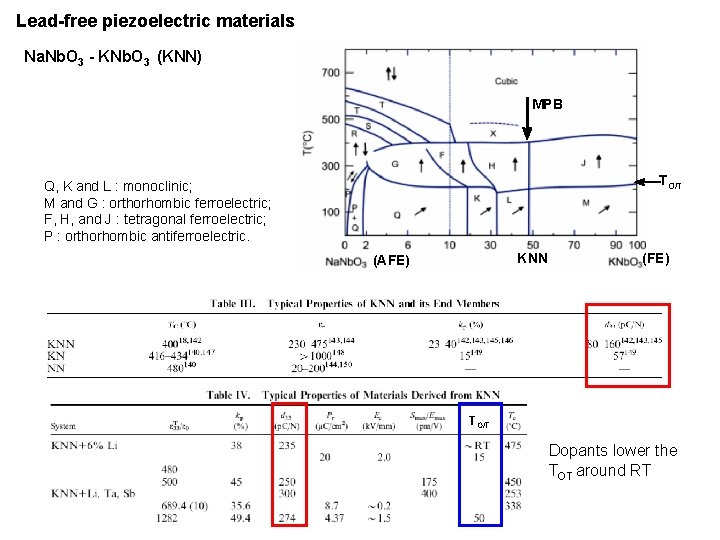
Enhancement of piezoelectric properties near a polymorphic phase transition MPB: enhanced properties observed over a large T range H, J : tetragonal L: monoclinic M: orthorhombic MPB PPT: enhanced properties observed only in a narrow T range arout the transition temperature. PPT can be shifted to RT by doping. TO/T (AFE) KNN (FE)
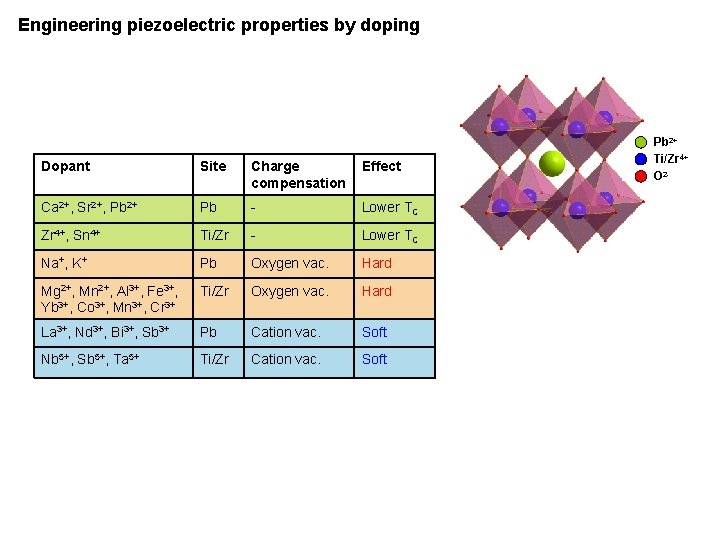
Engineering piezoelectric properties by doping Dopant Site Charge compensation Effect Ca 2+, Sr 2+, Pb 2+ Pb - Lower TC Zr 4+, Sn 4+ Ti/Zr - Lower TC Na+, K+ Pb Oxygen vac. Hard Mg 2+, Mn 2+, Al 3+, Fe 3+, Yb 3+, Co 3+, Mn 3+, Cr 3+ Ti/Zr Oxygen vac. Hard La 3+, Nd 3+, Bi 3+, Sb 3+ Pb Cation vac. Soft Nb 5+, Sb 5+, Ta 5+ Ti/Zr Cation vac. Soft Pb 2+ Ti/Zr 4+ O 2 -
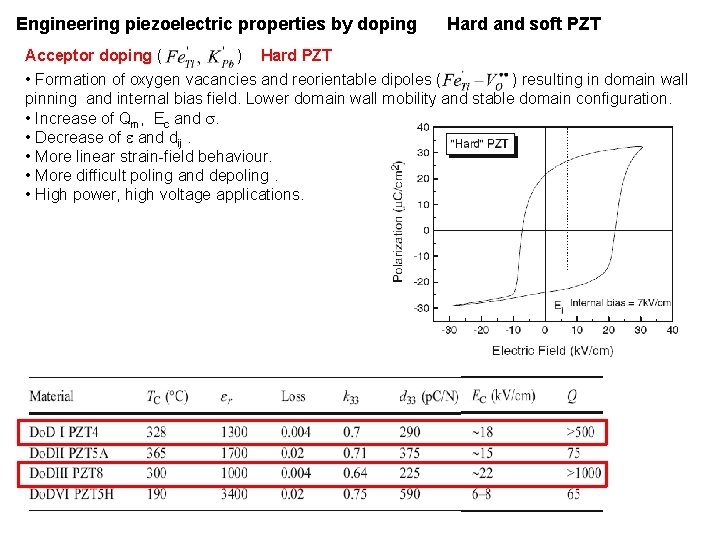
Engineering piezoelectric properties by doping Hard and soft PZT Acceptor doping ( ) Hard PZT • Formation of oxygen vacancies and reorientable dipoles ( ) resulting in domain wall pinning and internal bias field. Lower domain wall mobility and stable domain configuration. • Increase of Qm, Ec and . • Decrease of and dij. • More linear strain-field behaviour. • More difficult poling and depoling. • High power, high voltage applications.
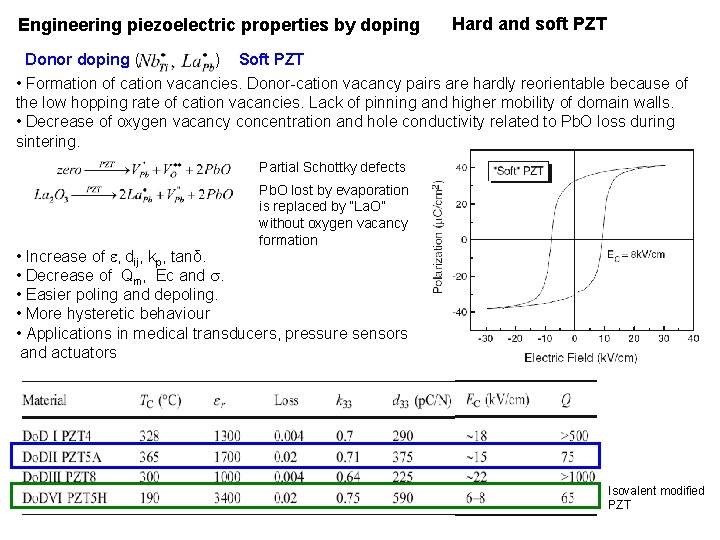
Engineering piezoelectric properties by doping Donor doping ( ) Hard and soft PZT Soft PZT • Formation of cation vacancies. Donor-cation vacancy pairs are hardly reorientable because of the low hopping rate of cation vacancies. Lack of pinning and higher mobility of domain walls. • Decrease of oxygen vacancy concentration and hole conductivity related to Pb. O loss during sintering. Partial Schottky defects Pb. O lost by evaporation is replaced by “La. O” without oxygen vacancy formation • Increase of , dij, kp, tanδ. • Decrease of Qm, Ec and . • Easier poling and depoling. • More hysteretic behaviour • Applications in medical transducers, pressure sensors and actuators Isovalent modified PZT
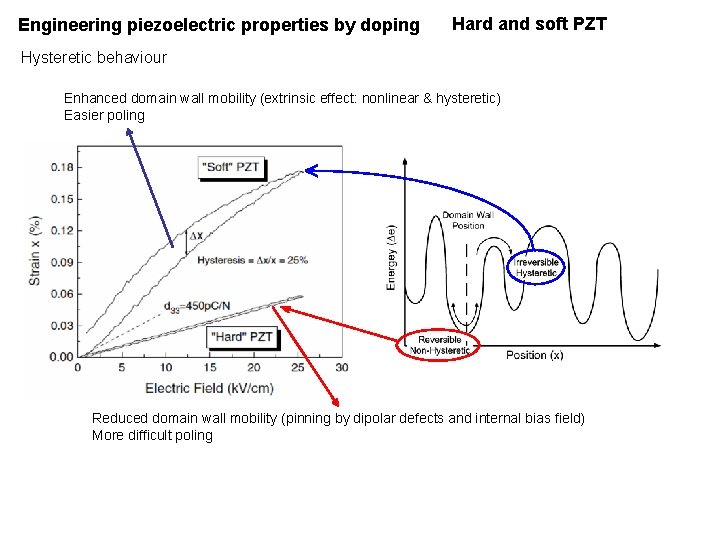
Engineering piezoelectric properties by doping Hard and soft PZT Hysteretic behaviour Enhanced domain wall mobility (extrinsic effect: nonlinear & hysteretic) Easier poling Reduced domain wall mobility (pinning by dipolar defects and internal bias field) More difficult poling
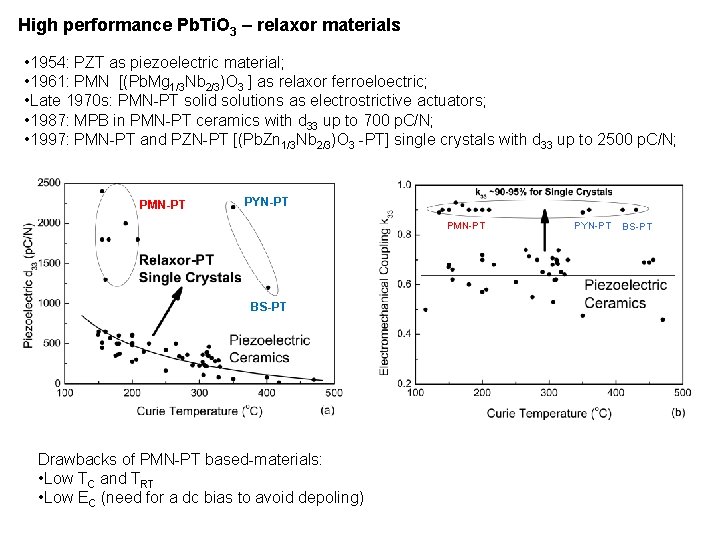
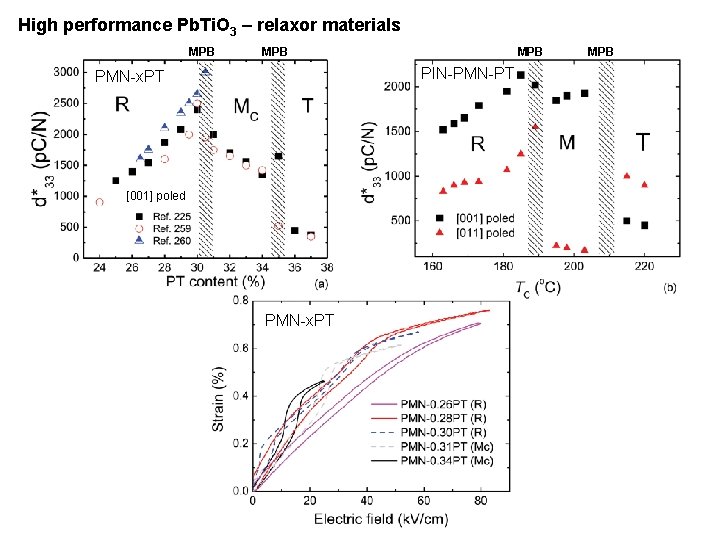
High performance Pb. Ti. O 3 – relaxor materials • 1954: PZT as piezoelectric material; • 1961: PMN [(Pb. Mg 1/3 Nb 2/3)O 3 ] as relaxor ferroeloectric; • Late 1970 s: PMN-PT solid solutions as electrostrictive actuators; • 1987: MPB in PMN-PT ceramics with d 33 up to 700 p. C/N; • 1997: PMN-PT and PZN-PT [(Pb. Zn 1/3 Nb 2/3)O 3 -PT] single crystals with d 33 up to 2500 p. C/N; PMN-PT PYN-PT PMN-PT BS-PT Drawbacks of PMN-PT based-materials: • Low TC and TRT • Low EC (need for a dc bias to avoid depoling) PYN-PT BS-PT
High performance Pb. Ti. O 3 – relaxor materials MPB MPB PIN-PMN-PT PMN-x. PT [001] poled PMN-x. PT MPB
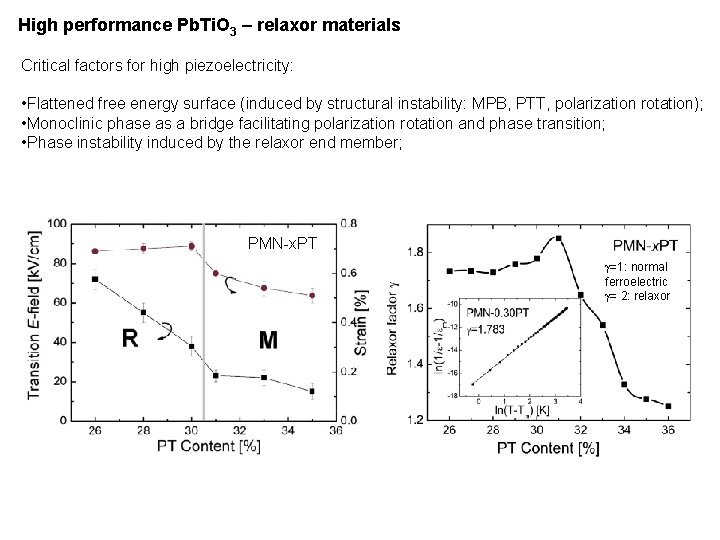
High performance Pb. Ti. O 3 – relaxor materials Critical factors for high piezoelectricity: • Flattened free energy surface (induced by structural instability: MPB, PTT, polarization rotation); • Monoclinic phase as a bridge facilitating polarization rotation and phase transition; • Phase instability induced by the relaxor end member; PMN-x. PT =1: normal ferroelectric = 2: relaxor
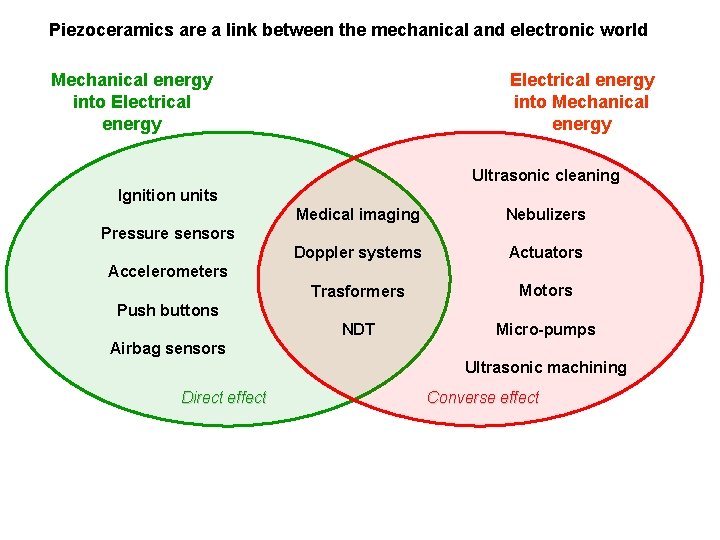
Piezoceramics are a link between the mechanical and electronic world Mechanical energy into Electrical energy into Mechanical energy Ultrasonic cleaning Ignition units Medical imaging Nebulizers Doppler systems Actuators Trasformers Motors NDT Micro-pumps Pressure sensors Accelerometers Push buttons Airbag sensors Ultrasonic machining Direct effect Converse effect
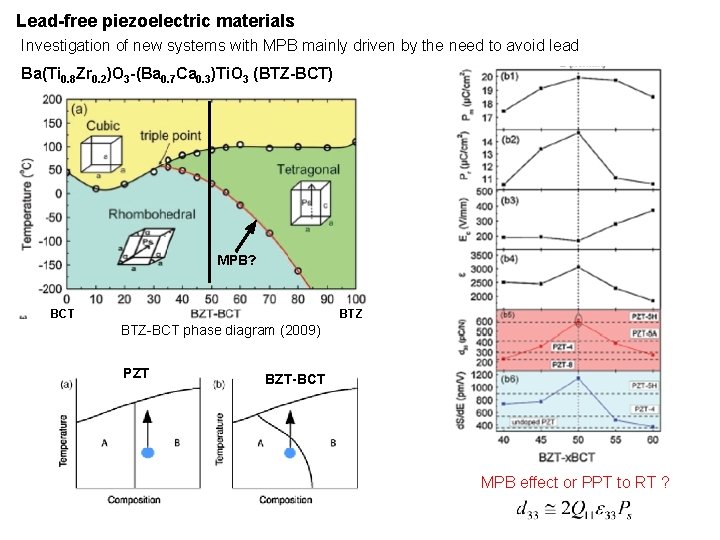
Lead-free piezoelectric materials Investigation of new systems with MPB mainly driven by the need to avoid lead Ba(Ti 0. 8 Zr 0. 2)O 3 -(Ba 0. 7 Ca 0. 3)Ti. O 3 (BTZ-BCT) MPB? BCT BTZ-BCT phase diagram (2009) PZT BZT-BCT MPB effect or PPT to RT ?
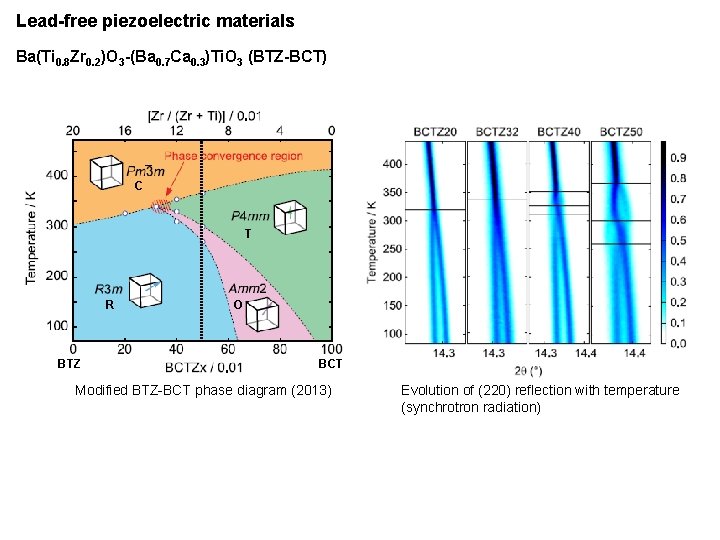
Lead-free piezoelectric materials Ba(Ti 0. 8 Zr 0. 2)O 3 -(Ba 0. 7 Ca 0. 3)Ti. O 3 (BTZ-BCT) C T R BTZ O BCT Modified BTZ-BCT phase diagram (2013) Evolution of (220) reflection with temperature (synchrotron radiation)
Lead-free piezoelectric materials Na. Nb. O 3 - KNb. O 3 (KNN) MPB TO/T Q, K and L : monoclinic; M and G : orthorhombic ferroelectric; F, H, and J : tetragonal ferroelectric; P : orthorhombic antiferroelectric. KNN (AFE) (FE) TO/T Dopants lower the TOT around RT
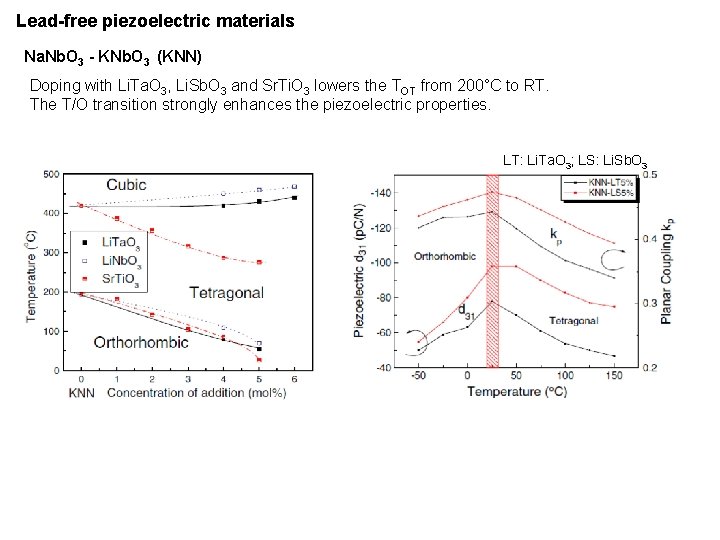
Lead-free piezoelectric materials Na. Nb. O 3 - KNb. O 3 (KNN) Doping with Li. Ta. O 3, Li. Sb. O 3 and Sr. Ti. O 3 lowers the TOT from 200°C to RT. The T/O transition strongly enhances the piezoelectric properties. LT: Li. Ta. O 3; LS: Li. Sb. O 3
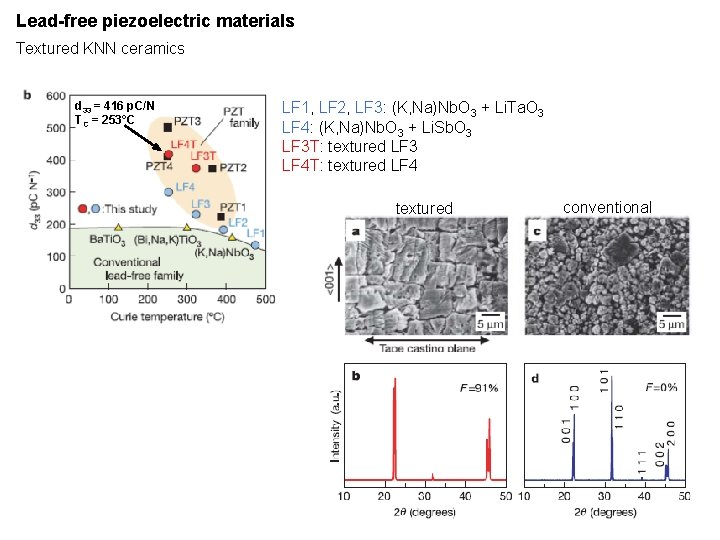
Lead-free piezoelectric materials Textured KNN ceramics d 33 = 416 p. C/N TC = 253°C LF 1, LF 2, LF 3: (K, Na)Nb. O 3 + Li. Ta. O 3 LF 4: (K, Na)Nb. O 3 + Li. Sb. O 3 LF 3 T: textured LF 3 LF 4 T: textured LF 4 textured conventional
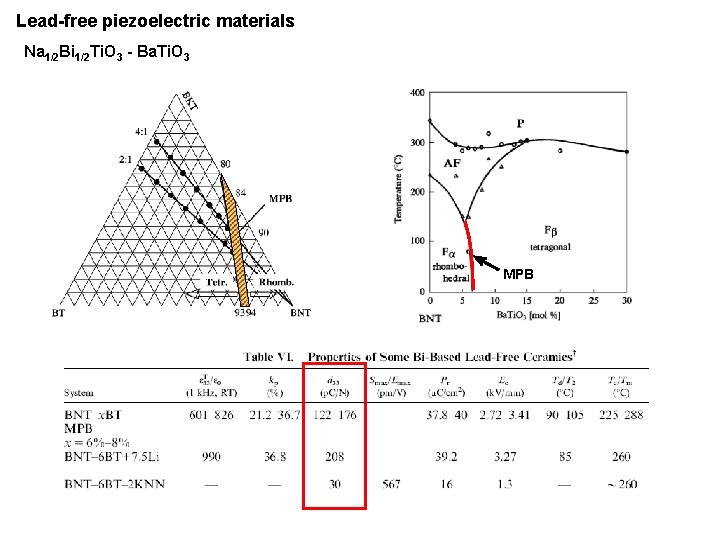
Lead-free piezoelectric materials Na 1/2 Bi 1/2 Ti. O 3 - Ba. Ti. O 3 MPB
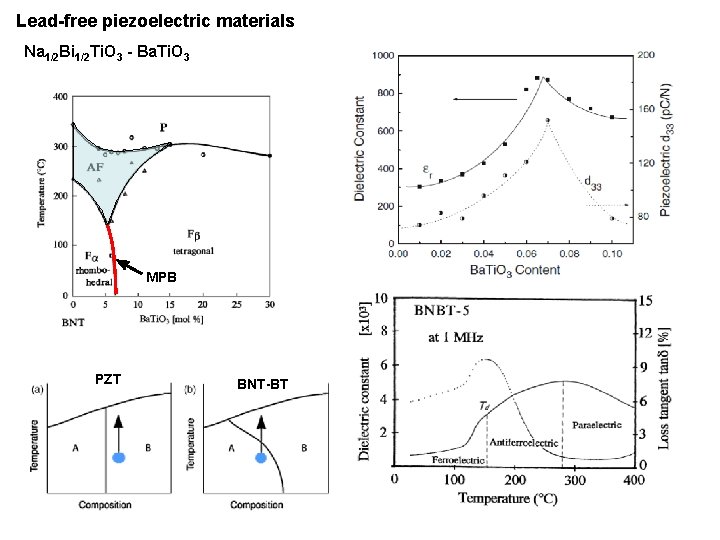
Lead-free piezoelectric materials Na 1/2 Bi 1/2 Ti. O 3 - Ba. Ti. O 3 MPB PZT BNT-BT
Medical ultrasonic transducers
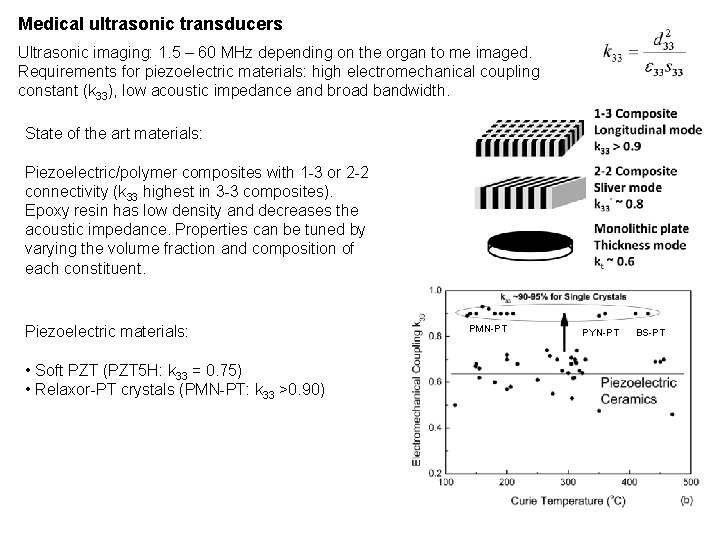
Medical ultrasonic transducers Ultrasonic imaging: 1. 5 – 60 MHz depending on the organ to me imaged. Requirements for piezoelectric materials: high electromechanical coupling constant (k 33), low acoustic impedance and broad bandwidth. State of the art materials: Piezoelectric/polymer composites with 1 -3 or 2 -2 connectivity (k 33 highest in 3 -3 composites). Epoxy resin has low density and decreases the acoustic impedance. Properties can be tuned by varying the volume fraction and composition of each constituent. Piezoelectric materials: • Soft PZT (PZT 5 H: k 33 = 0. 75) • Relaxor-PT crystals (PMN-PT: k 33 >0. 90) PMN-PT PYN-PT BS-PT
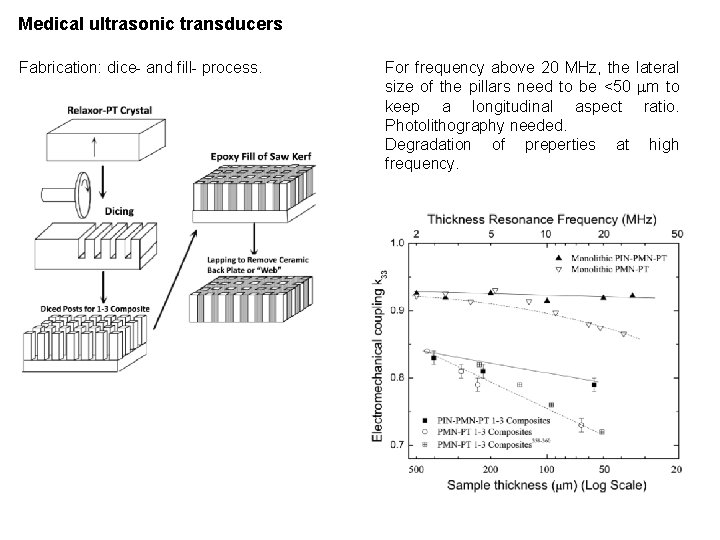
Medical ultrasonic transducers Fabrication: dice- and fill- process. For frequency above 20 MHz, the lateral size of the pillars need to be <50 m to keep a longitudinal aspect ratio. Photolithography needed. Degradation of preperties at high frequency.
Multilayer Piezoelectric Actuators
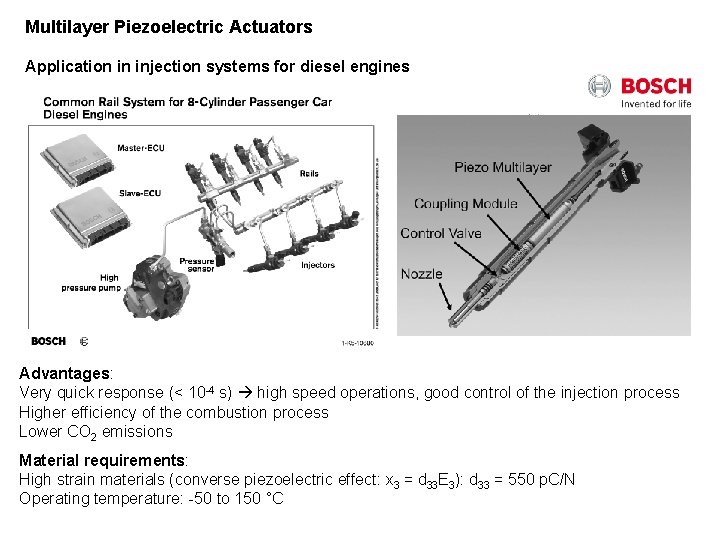
Multilayer Piezoelectric Actuators Application in injection systems for diesel engines Advantages: Very quick response (< 10 -4 s) high speed operations, good control of the injection process Higher efficiency of the combustion process Lower CO 2 emissions Material requirements: High strain materials (converse piezoelectric effect: x 3 = d 33 E 3): d 33 = 550 p. C/N Operating temperature: -50 to 150 °C
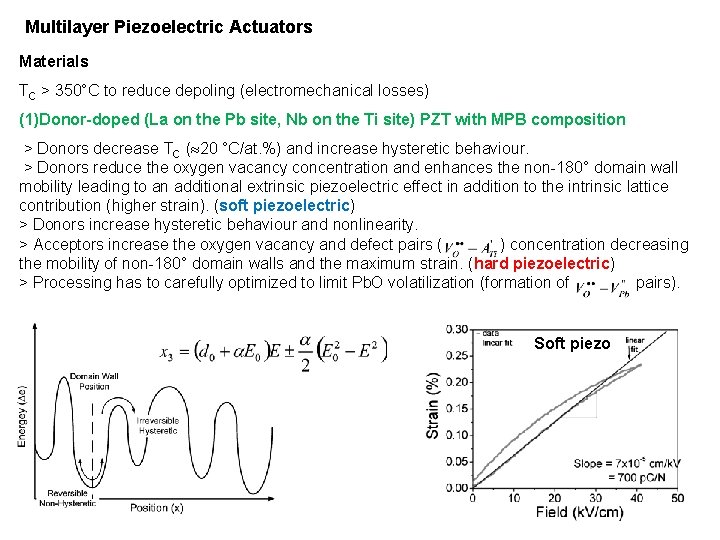
Multilayer Piezoelectric Actuators Materials TC > 350°C to reduce depoling (electromechanical losses) (1)Donor-doped (La on the Pb site, Nb on the Ti site) PZT with MPB composition > Donors decrease TC ( 20 °C/at. %) and increase hysteretic behaviour. > Donors reduce the oxygen vacancy concentration and enhances the non-180° domain wall mobility leading to an additional extrinsic piezoelectric effect in addition to the intrinsic lattice contribution (higher strain). (soft piezoelectric) > Donors increase hysteretic behaviour and nonlinearity. > Acceptors increase the oxygen vacancy and defect pairs ( ) concentration decreasing the mobility of non-180° domain walls and the maximum strain. (hard piezoelectric) > Processing has to carefully optimized to limit Pb. O volatilization (formation of pairs). Soft piezo
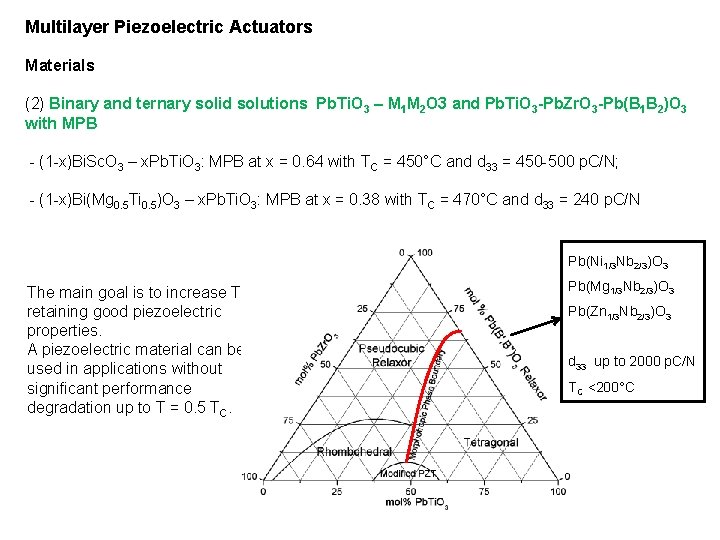
Multilayer Piezoelectric Actuators Materials (2) Binary and ternary solid solutions Pb. Ti. O 3 – M 1 M 2 O 3 and Pb. Ti. O 3 -Pb. Zr. O 3 -Pb(B 1 B 2)O 3 with MPB - (1 -x)Bi. Sc. O 3 – x. Pb. Ti. O 3: MPB at x = 0. 64 with TC = 450°C and d 33 = 450 -500 p. C/N; - (1 -x)Bi(Mg 0. 5 Ti 0. 5)O 3 – x. Pb. Ti. O 3: MPB at x = 0. 38 with TC = 470°C and d 33 = 240 p. C/N Pb(Ni 1/3 Nb 2/3)O 3 The main goal is to increase TC retaining good piezoelectric properties. A piezoelectric material can be used in applications without significant performance degradation up to T = 0. 5 TC. Pb(Mg 1/3 Nb 2/3)O 3 Pb(Zn 1/3 Nb 2/3)O 3 d 33 up to 2000 p. C/N TC <200°C
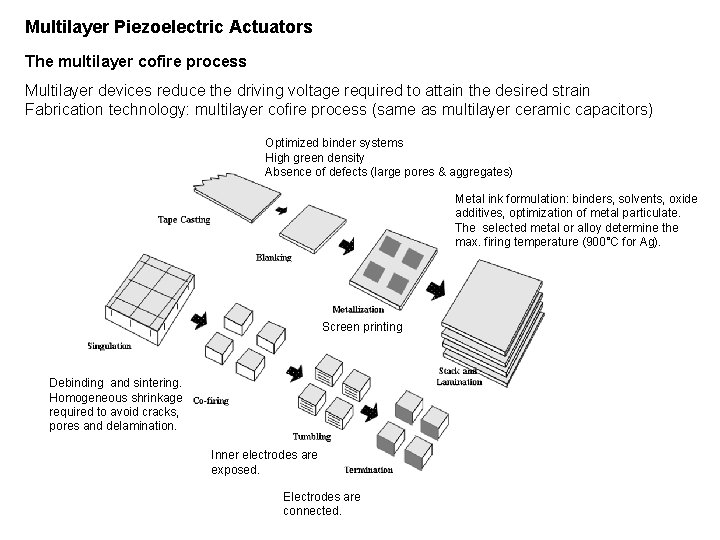
Multilayer Piezoelectric Actuators The multilayer cofire process Multilayer devices reduce the driving voltage required to attain the desired strain Fabrication technology: multilayer cofire process (same as multilayer ceramic capacitors) Optimized binder systems High green density Absence of defects (large pores & aggregates) Metal ink formulation: binders, solvents, oxide additives, optimization of metal particulate. The selected metal or alloy determine the max. firing temperature (900°C for Ag). Screen printing Debinding and sintering. Homogeneous shrinkage required to avoid cracks, pores and delamination. Inner electrodes are exposed. Electrodes are connected.
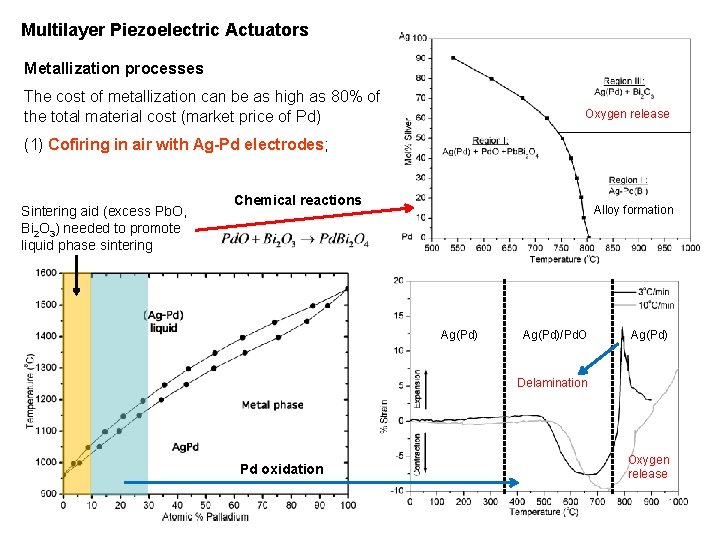
Multilayer Piezoelectric Actuators Metallization processes The cost of metallization can be as high as 80% of the total material cost (market price of Pd) Oxygen release (1) Cofiring in air with Ag-Pd electrodes; Sintering aid (excess Pb. O, Bi 2 O 3) needed to promote liquid phase sintering Chemical reactions Alloy formation Ag(Pd)/Pd. O Ag(Pd) Delamination Pd oxidation Oxygen release
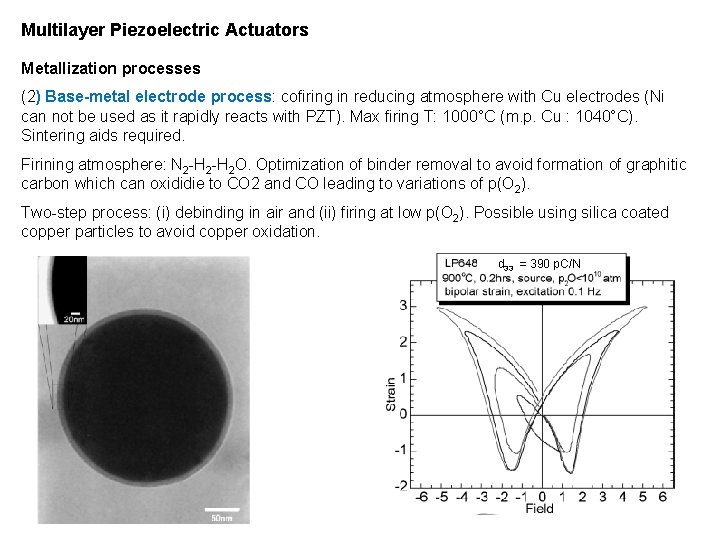
Multilayer Piezoelectric Actuators Metallization processes (2) Base-metal electrode process: cofiring in reducing atmosphere with Cu electrodes (Ni can not be used as it rapidly reacts with PZT). Max firing T: 1000°C (m. p. Cu : 1040°C). Sintering aids required. Firining atmosphere: N 2 -H 2 O. Optimization of binder removal to avoid formation of graphitic carbon which can oxididie to CO 2 and CO leading to variations of p(O 2). Two-step process: (i) debinding in air and (ii) firing at low p(O 2). Possible using silica coated copper particles to avoid copper oxidation. d 33 = 390 p. C/N
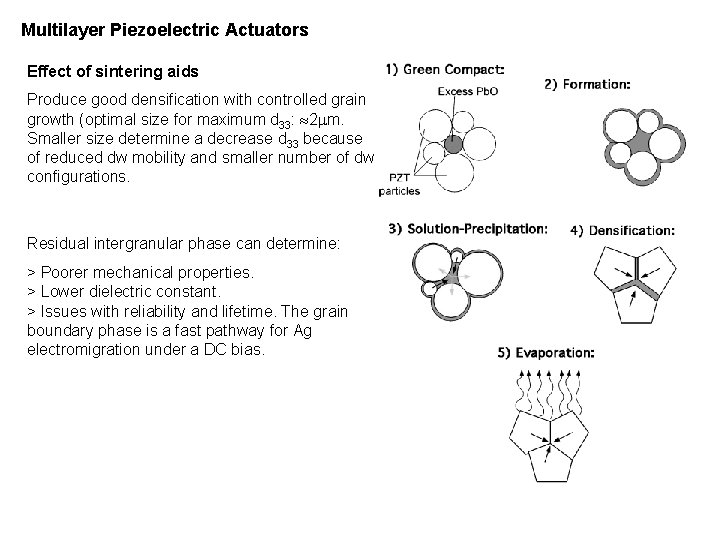
Multilayer Piezoelectric Actuators Effect of sintering aids Produce good densification with controlled grain growth (optimal size for maximum d 33: 2 m. Smaller size determine a decrease d 33 because of reduced dw mobility and smaller number of dw configurations. Residual intergranular phase can determine: > Poorer mechanical properties. > Lower dielectric constant. > Issues with reliability and lifetime. The grain boundary phase is a fast pathway for Ag electromigration under a DC bias.
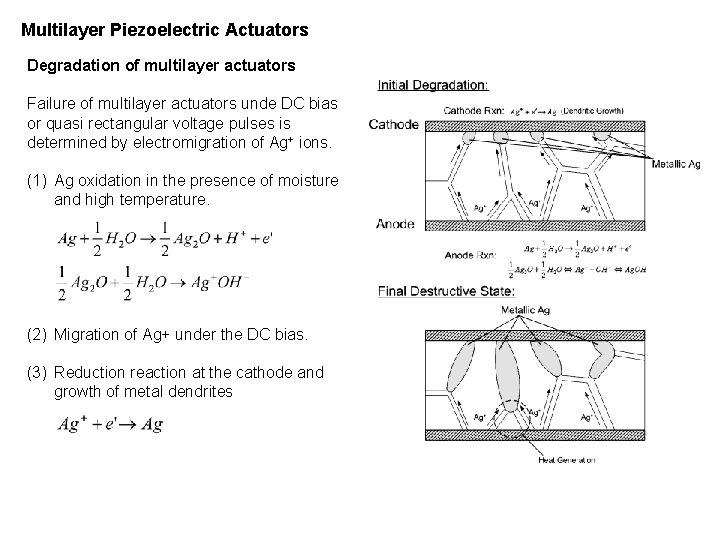
Multilayer Piezoelectric Actuators Degradation of multilayer actuators Failure of multilayer actuators unde DC bias or quasi rectangular voltage pulses is determined by electromigration of Ag+ ions. (1) Ag oxidation in the presence of moisture and high temperature. (2) Migration of Ag+ under the DC bias. (3) Reduction reaction at the cathode and growth of metal dendrites
The morphotropic phase boundary in PZT What is the MPB ? There are four different, even somewhat opposing, views of what an MPB is in ferroelectrics, and in PZT in particular. 1. The MPB region in PZT consists of a monoclinic phase, which bridges Zr-rich rhombohedral and Ti-rich tetragonal phases. (B. Noheda, Appl. Phys. Lett. , 74 [14] 2059 -61 (1999). ). 2. The Monoclinic distortion observed in X-ray diffraction experiments is only apparent and due to the coexistence of tetragonal microdomains and rhombohedral nanodomains. (K. A. Schonau, Phys. Rev. B, 75 [18] 184117 (2007). ). 3. There is no sharp boundary across the MPB in the PZT phase diagram. All three phases (tetragonal, monoclinic, and rhombohedral) can be considered as monoclinically distorted, with progression from short-range to long-range order across the MPB region. (A. M. Glazer, Phys. Rev. B, 70 [18] 184123 (2004). ). 4. Pb. Ti. O 3 is crucial for appearance of an MPB in all lead-based systems. Lead titanate exhibits a pressure-induced transition from tetragonal to monoclinic to rhombohedral phases at 0 K. The other end member (e. g. , Pb. Zr. O 3) simply tunes this phase transition to room temperature (M. Ahart, Nature, 451 [7178] 545– 8 (2008). ).