
Piezo tuner test at S 1 Global Proposal
Piezo tuner test at S 1 Global Proposal for test setup A. Bosotti – R. Paparella Lab LASA – INFN Milano 29/12/2021 Biweekly Webex meeting (S 1 -global, Cryomodule and Cryogenics)- 39 th 1
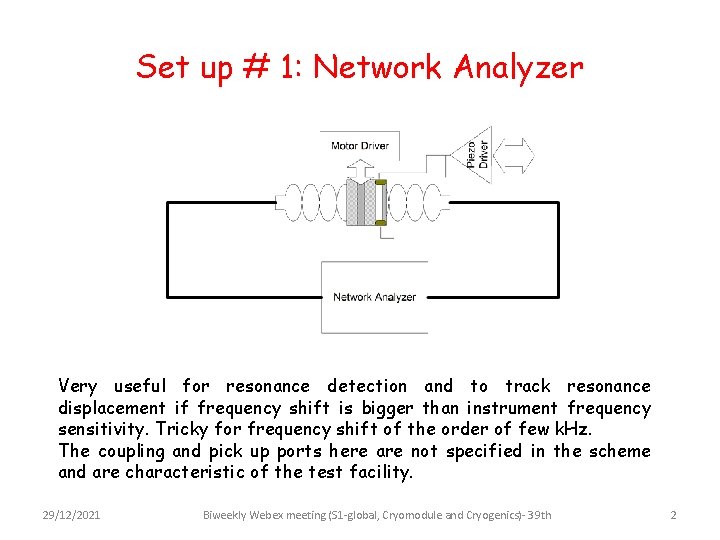
Set up # 1: Network Analyzer Very useful for resonance detection and to track resonance displacement if frequency shift is bigger than instrument frequency sensitivity. Tricky for frequency shift of the order of few k. Hz. The coupling and pick up ports here are not specified in the scheme and are characteristic of the test facility. 29/12/2021 Biweekly Webex meeting (S 1 -global, Cryomodule and Cryogenics)- 39 th 2
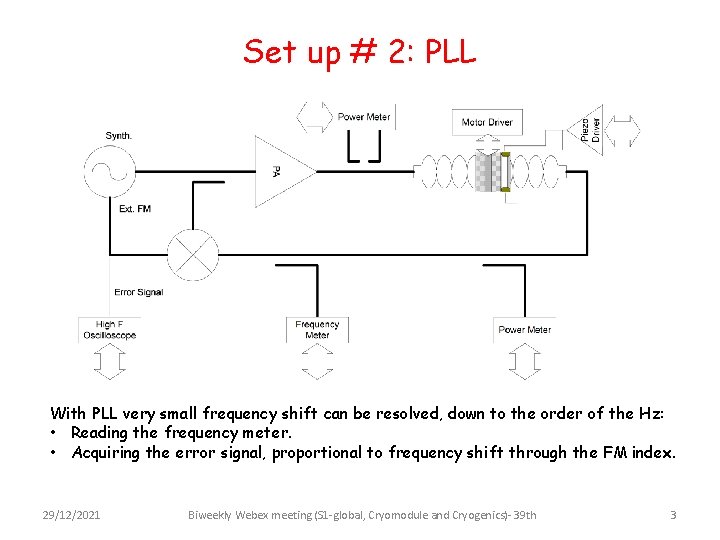
Set up # 2: PLL With PLL very small frequency shift can be resolved, down to the order of the Hz: • Reading the frequency meter. • Acquiring the error signal, proportional to frequency shift through the FM index. 29/12/2021 Biweekly Webex meeting (S 1 -global, Cryomodule and Cryogenics)- 39 th 3
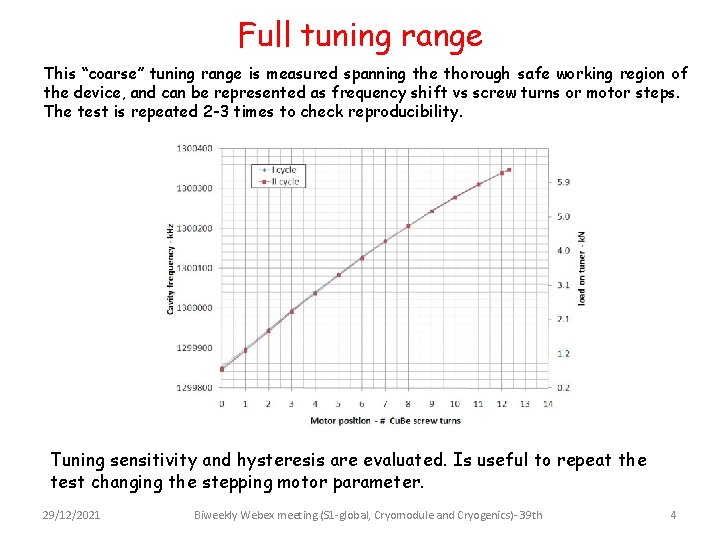
Full tuning range This “coarse” tuning range is measured spanning the thorough safe working region of the device, and can be represented as frequency shift vs screw turns or motor steps. The test is repeated 2 -3 times to check reproducibility. Tuning sensitivity and hysteresis are evaluated. Is useful to repeat the test changing the stepping motor parameter. 29/12/2021 Biweekly Webex meeting (S 1 -global, Cryomodule and Cryogenics)- 39 th 4
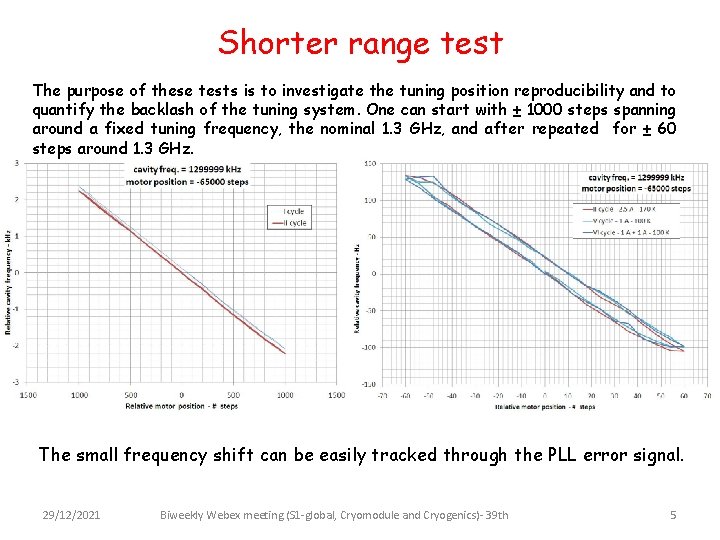
Shorter range test The purpose of these tests is to investigate the tuning position reproducibility and to quantify the backlash of the tuning system. One can start with ± 1000 steps spanning around a fixed tuning frequency, the nominal 1. 3 GHz, and after repeated for ± 60 steps around 1. 3 GHz. The small frequency shift can be easily tracked through the PLL error signal. 29/12/2021 Biweekly Webex meeting (S 1 -global, Cryomodule and Cryogenics)- 39 th 5
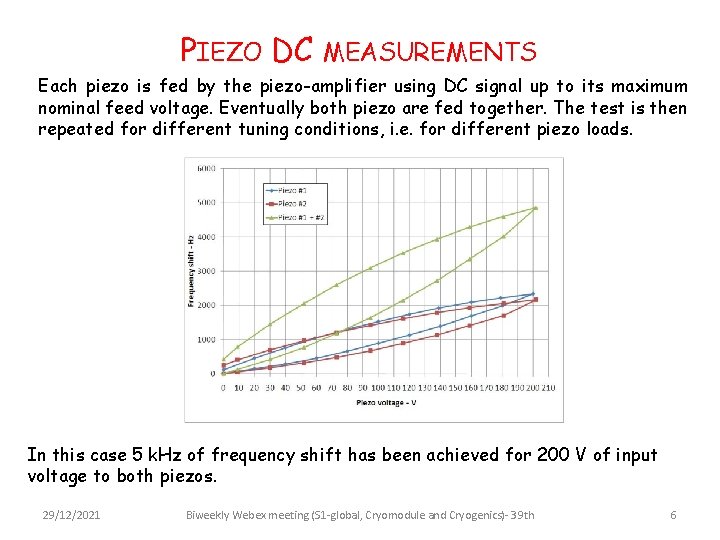
PIEZO DC MEASUREMENTS Each piezo is fed by the piezo-amplifier using DC signal up to its maximum nominal feed voltage. Eventually both piezo are fed together. The test is then repeated for different tuning conditions, i. e. for different piezo loads. In this case 5 k. Hz of frequency shift has been achieved for 200 V of input voltage to both piezos. 29/12/2021 Biweekly Webex meeting (S 1 -global, Cryomodule and Cryogenics)- 39 th 6
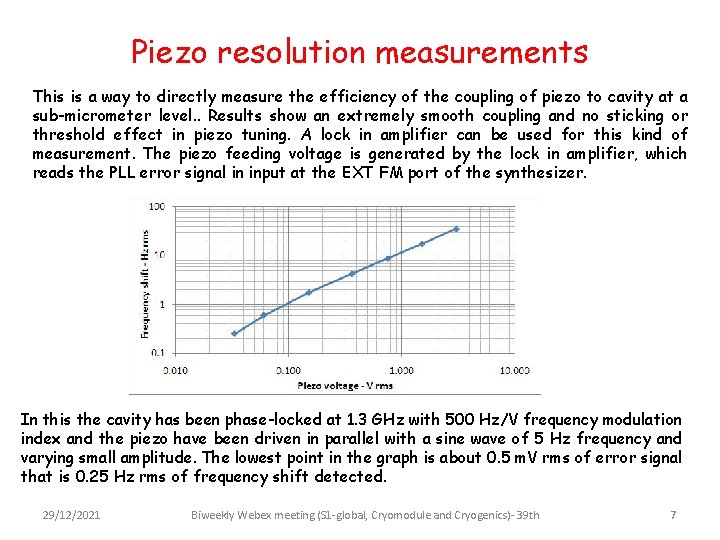
Piezo resolution measurements This is a way to directly measure the efficiency of the coupling of piezo to cavity at a sub-micrometer level. . Results show an extremely smooth coupling and no sticking or threshold effect in piezo tuning. A lock in amplifier can be used for this kind of measurement. The piezo feeding voltage is generated by the lock in amplifier, which reads the PLL error signal in input at the EXT FM port of the synthesizer. In this the cavity has been phase-locked at 1. 3 GHz with 500 Hz/V frequency modulation index and the piezo have been driven in parallel with a sine wave of 5 Hz frequency and varying small amplitude. The lowest point in the graph is about 0. 5 m. V rms of error signal that is 0. 25 Hz rms of frequency shift detected. 29/12/2021 Biweekly Webex meeting (S 1 -global, Cryomodule and Cryogenics)- 39 th 7
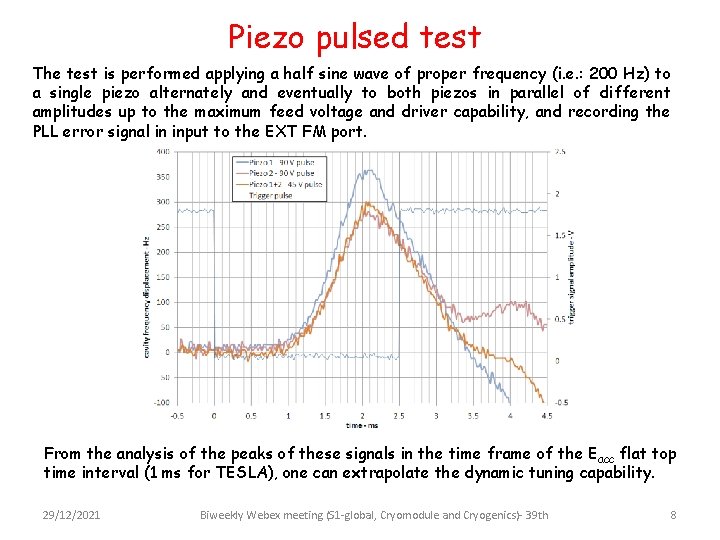
Piezo pulsed test The test is performed applying a half sine wave of proper frequency (i. e. : 200 Hz) to a single piezo alternately and eventually to both piezos in parallel of different amplitudes up to the maximum feed voltage and driver capability, and recording the PLL error signal in input to the EXT FM port. From the analysis of the peaks of these signals in the time frame of the Eacc flat top time interval (1 ms for TESLA), one can extrapolate the dynamic tuning capability. 29/12/2021 Biweekly Webex meeting (S 1 -global, Cryomodule and Cryogenics)- 39 th 8
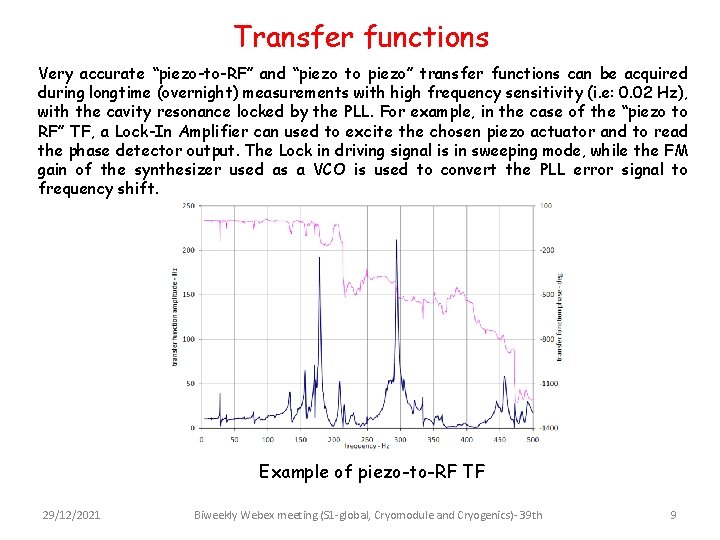
Transfer functions Very accurate “piezo-to-RF” and “piezo to piezo” transfer functions can be acquired during longtime (overnight) measurements with high frequency sensitivity (i. e: 0. 02 Hz), with the cavity resonance locked by the PLL. For example, in the case of the “piezo to RF” TF, a Lock-In Amplifier can used to excite the chosen piezo actuator and to read the phase detector output. The Lock in driving signal is in sweeping mode, while the FM gain of the synthesizer used as a VCO is used to convert the PLL error signal to frequency shift. Example of piezo-to-RF TF 29/12/2021 Biweekly Webex meeting (S 1 -global, Cryomodule and Cryogenics)- 39 th 9
Summary of proposed measurements • DC piezo test: Voltage of 50 and 100 V applied to both and separately to each piezo and record of the frequency shift. Mandatory to see if piezos work correctly. • Full range tuner test: full range forth and back, repeated 2 -3 times. Evaluation of the hysteresis. • Short range tuning test, i. e. : ± 1000 and ± 60 steps forth and back across selected positions. Backlash evaluation and reproducibility tests (PLL needed for the last). For the following points can be useful to lock the cavity in a PLL. Can KEK arrange a (even simple) PLL for us? • Piezo DC measurements spanning feed voltage forth and back and evaluation of piezo fine tuning range. To be done at different tuning positions to evaluate piezo strokes as a function of the cavity load. • Piezo resolution measurements: phase locked at a given frequency (say 5 Hz) with small feed voltage amplitude. • Transfer Functions piezo to piezo and piezo to RF. We have to clarify which instruments we will use with KEK people. • Pulsed RF excitation, Lorentz Force detuning tests. If this is not possible we can test • Phase Oscillations with pulsed piezo signal, with cavity locked in PLL. • Microphonics noise test. 29/12/2021 Biweekly Webex meeting (S 1 -global, Cryomodule and Cryogenics)- 39 th 10
- Slides: 10