
Pies and Pastries I History A pastry is
- Slides: 35
Pies and Pastries
I. History • A pastry is a flexible crust that covers any kind of filling. • A. The first pies were known as coffyns. They were highly flavored meat pies with straight sides, a top, and a bottom. Open crust pastry without the top were known as traps. • The purpose of the pastry was to serve as a storage and serving container, and so it was tough, hard, and usually inedible. • Read Sections B, C, D, and E and answer them.
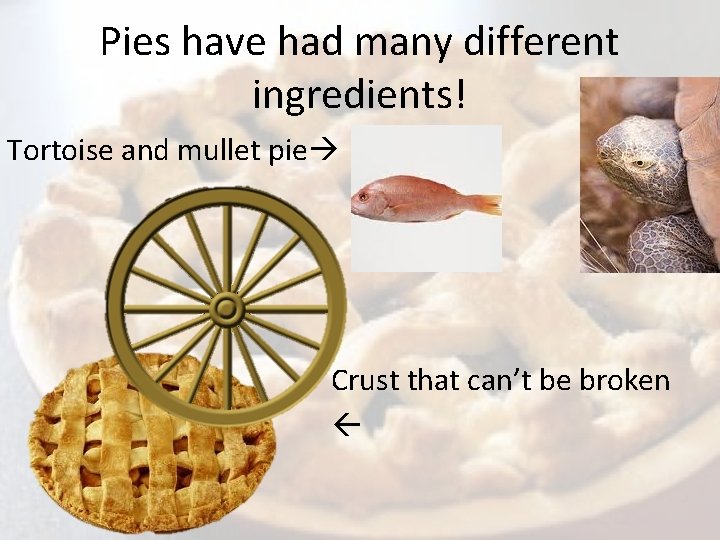
Pies have had many different ingredients! Tortoise and mullet pie Crust that can’t be broken
There are 4 Types of Pies: • Fruit • Custard • Cream • Chiffon
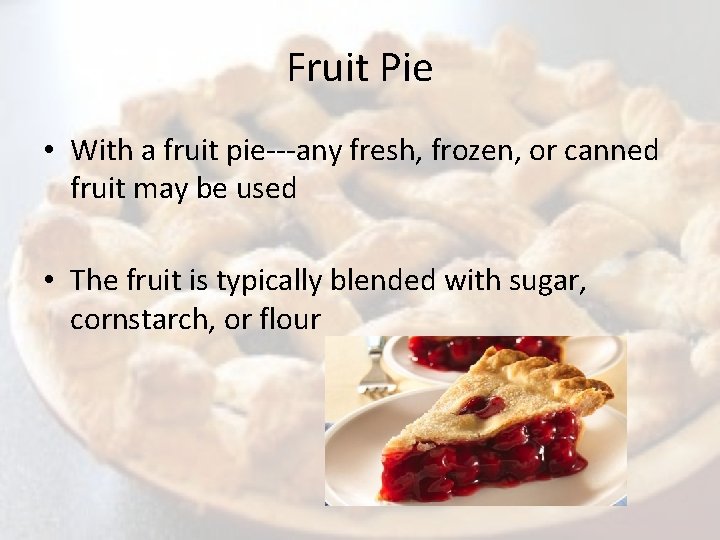
Fruit Pie • With a fruit pie---any fresh, frozen, or canned fruit may be used • The fruit is typically blended with sugar, cornstarch, or flour
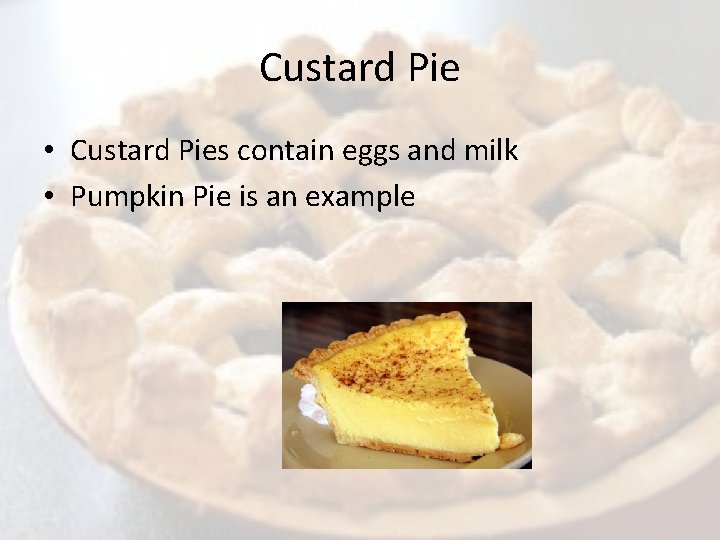
Custard Pie • Custard Pies contain eggs and milk • Pumpkin Pie is an example
Cream Pies • • Cream pies have a baked crust The crust is then filled with pudding It is topped with meringue or whipped cream Lemon Meringue or banana cream pie is an example
Chiffon Pie • This type of pie is very light and airy • They contain gelatin and beaten eggs • Some chiffon pies have whipped cream • Lime Chiffon Pie in an example
III. Types of Pie Crusts A. Single crust- This has an open face, with the filling fully visible. B. Double crust- The filling is wrapped with pastry both top and bottom. C. Lattice top- The top has strips of pastry woven like a basket. D. Crumb crust- The crust is made of finely crushed cracker or cookie crumbs, cemented together with melted butter and sugar.
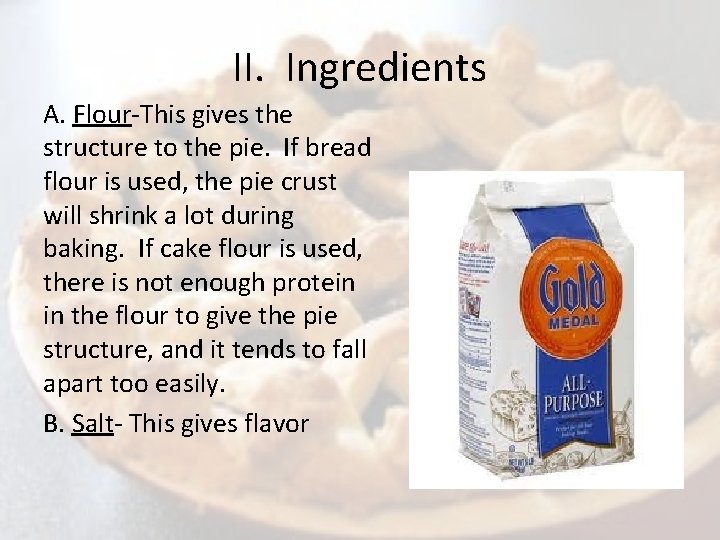
II. Ingredients A. Flour-This gives the structure to the pie. If bread flour is used, the pie crust will shrink a lot during baking. If cake flour is used, there is not enough protein in the flour to give the pie structure, and it tends to fall apart too easily. B. Salt- This gives flavor
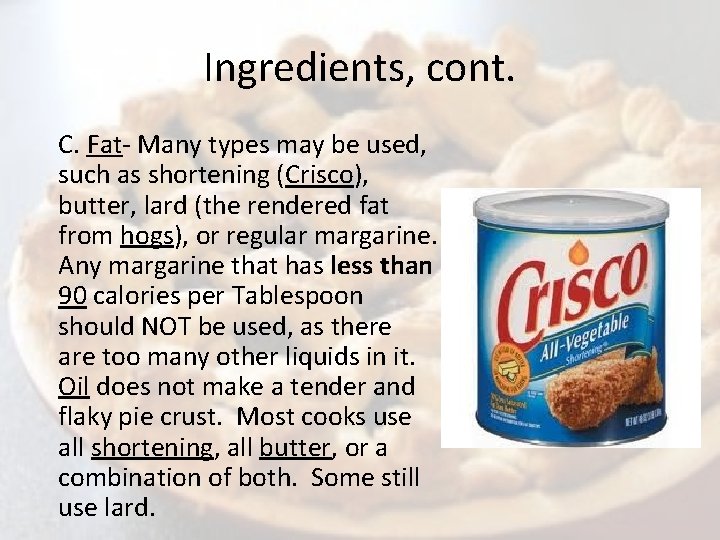
Ingredients, cont. C. Fat- Many types may be used, such as shortening (Crisco), butter, lard (the rendered fat from hogs), or regular margarine. Any margarine that has less than 90 calories per Tablespoon should NOT be used, as there are too many other liquids in it. Oil does not make a tender and flaky pie crust. Most cooks use all shortening, all butter, or a combination of both. Some still use lard.
Ingredients, cont. D. Water- You need to keep this as cold as possible, in order to keep the fat from softening in the dough. It dissolves the salt, develops the gluten in the flour, and controls the consistency and temperature of the dough. Too much water will make the crust tough and make it take longer to bake.
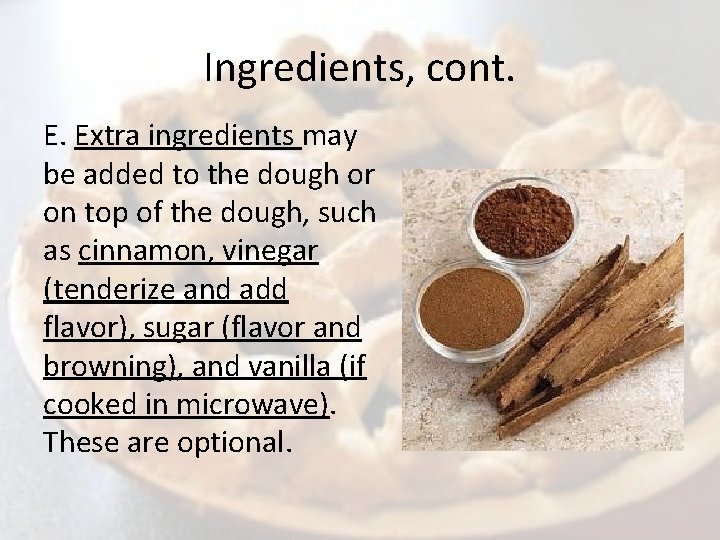
Ingredients, cont. E. Extra ingredients may be added to the dough or on top of the dough, such as cinnamon, vinegar (tenderize and add flavor), sugar (flavor and browning), and vanilla (if cooked in microwave). These are optional.
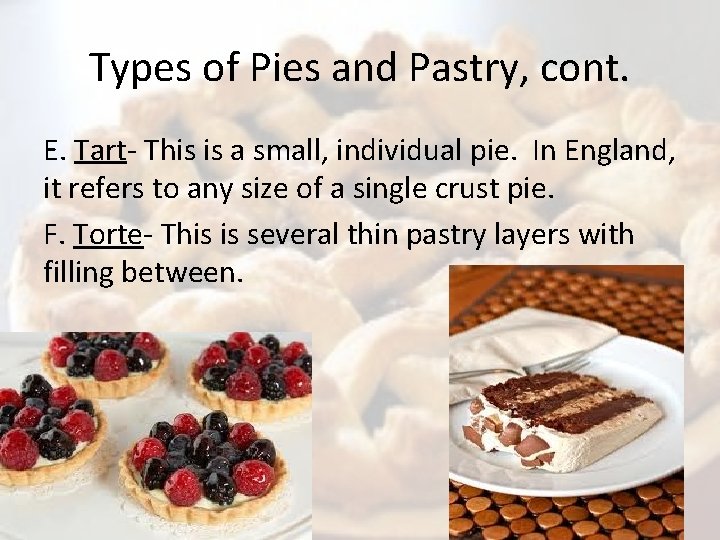
Types of Pies and Pastry, cont. E. Tart- This is a small, individual pie. In England, it refers to any size of a single crust pie. F. Torte- This is several thin pastry layers with filling between.
V. More about fillings- Thickeners These are used to keep the filling from becoming too runny. a. Flour- used in and in baked fruit pies and in entrée pies. b. Cornstarch – Used in fillings cooked on the microwave or stove top. c. Tapioca- occasionally used in baked fruit pies. d. Eggs- used in custard and quiche pies. e. Gelatin- used when filling is refrigerated.
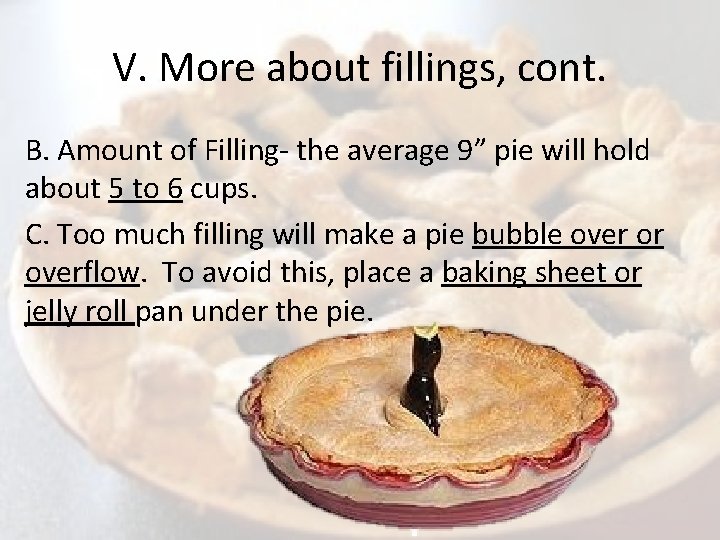
V. More about fillings, cont. B. Amount of Filling- the average 9” pie will hold about 5 to 6 cups. C. Too much filling will make a pie bubble over or overflow. To avoid this, place a baking sheet or jelly roll pan under the pie.
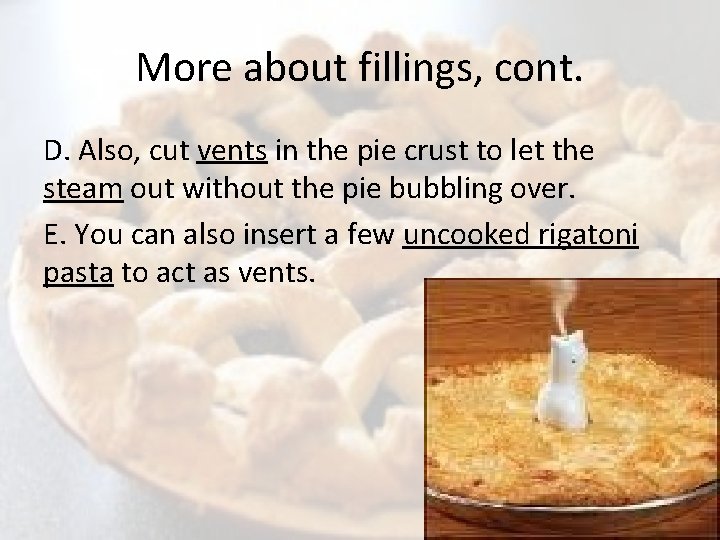
More about fillings, cont. D. Also, cut vents in the pie crust to let the steam out without the pie bubbling over. E. You can also insert a few uncooked rigatoni pasta to act as vents.
VI. How to Prepare Pie Crust and Pastry A. First get out all of your ingredients and utensils. The colder they are, the better your crust will be. B. You MUST measure accurately! C. Measure the flour and salt into a large bowl and blend together. Any spices or sugar used are added at this time. Place the fat on top of the flour/salt mixture. http: //www. youtube. com/watch? v=Ujc 0 XJIJit. I
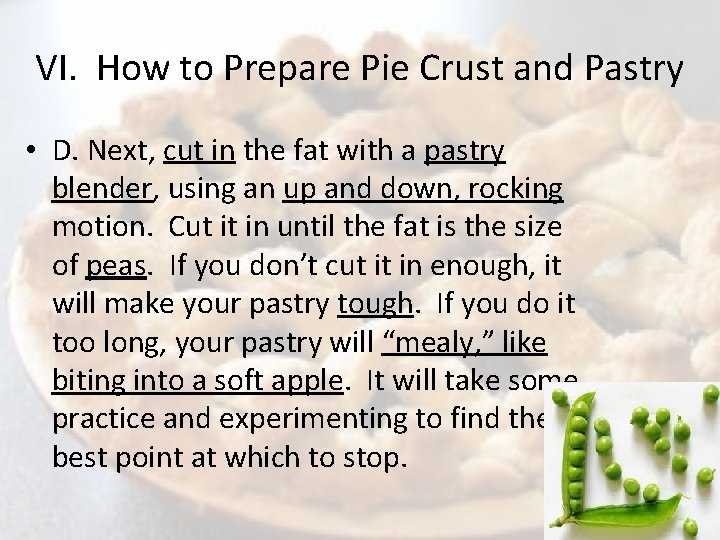
VI. How to Prepare Pie Crust and Pastry • D. Next, cut in the fat with a pastry blender, using an up and down, rocking motion. Cut it in until the fat is the size of peas. If you don’t cut it in enough, it will make your pastry tough. If you do it too long, your pastry will “mealy, ” like biting into a soft apple. It will take some practice and experimenting to find the best point at which to stop.
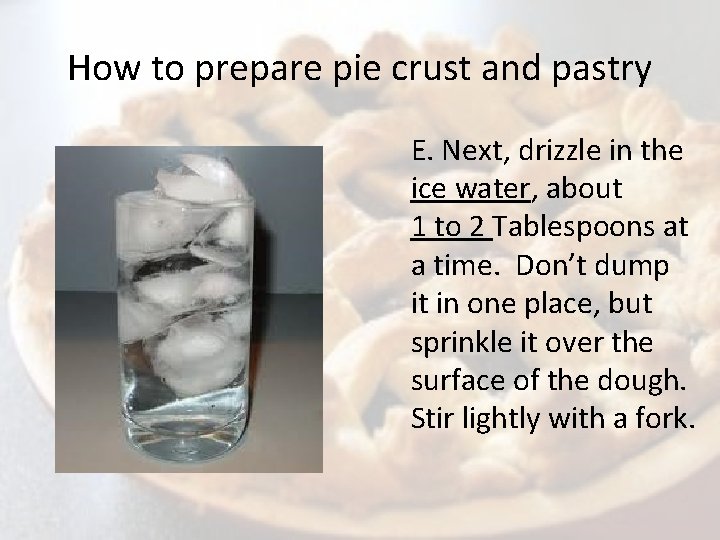
How to prepare pie crust and pastry E. Next, drizzle in the ice water, about 1 to 2 Tablespoons at a time. Don’t dump it in one place, but sprinkle it over the surface of the dough. Stir lightly with a fork.
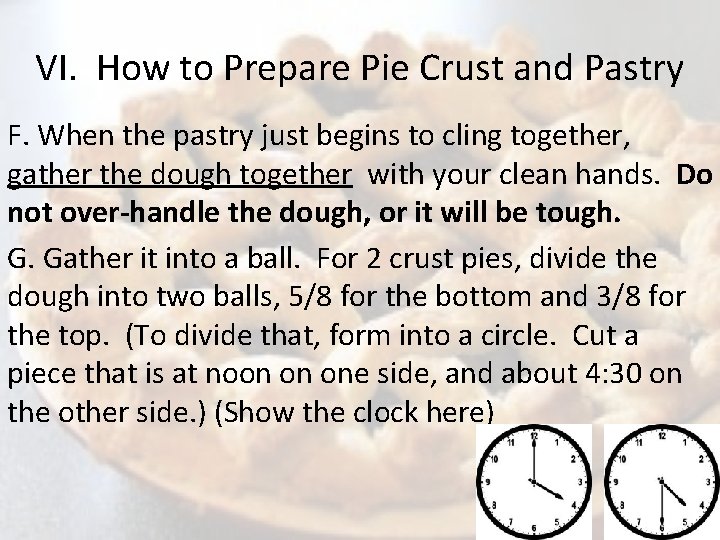
VI. How to Prepare Pie Crust and Pastry F. When the pastry just begins to cling together, gather the dough together with your clean hands. Do not over-handle the dough, or it will be tough. G. Gather it into a ball. For 2 crust pies, divide the dough into two balls, 5/8 for the bottom and 3/8 for the top. (To divide that, form into a circle. Cut a piece that is at noon on one side, and about 4: 30 on the other side. ) (Show the clock here)
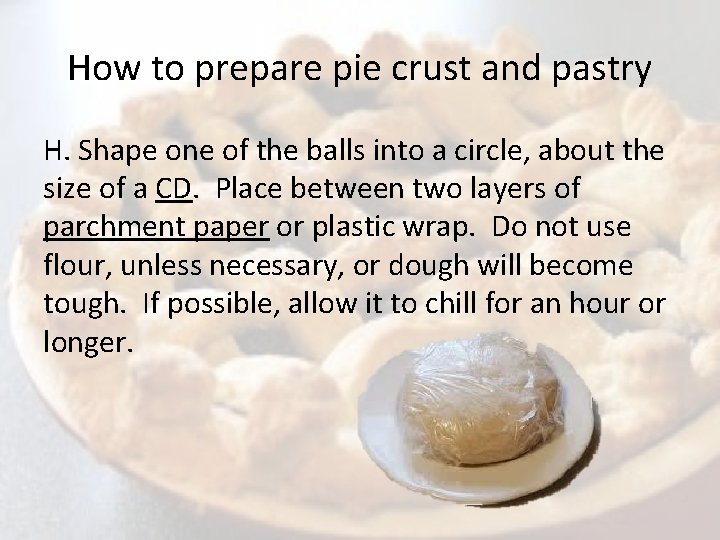
How to prepare pie crust and pastry H. Shape one of the balls into a circle, about the size of a CD. Place between two layers of parchment paper or plastic wrap. Do not use flour, unless necessary, or dough will become tough. If possible, allow it to chill for an hour or longer.
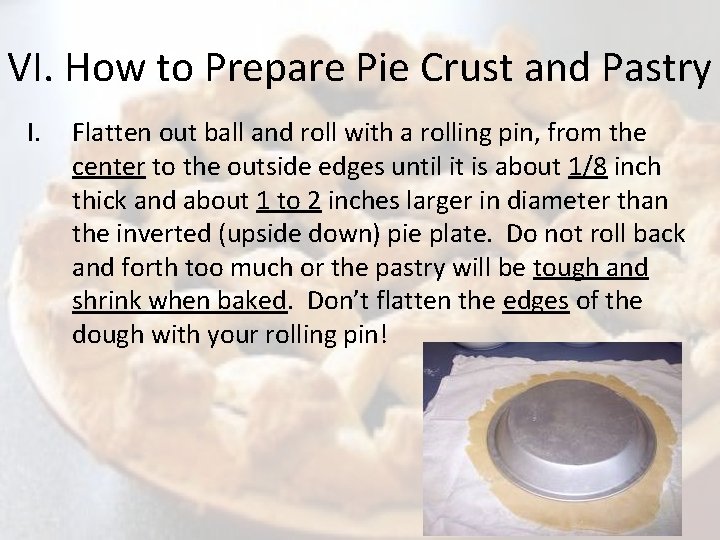
VI. How to Prepare Pie Crust and Pastry I. Flatten out ball and roll with a rolling pin, from the center to the outside edges until it is about 1/8 inch thick and about 1 to 2 inches larger in diameter than the inverted (upside down) pie plate. Do not roll back and forth too much or the pastry will be tough and shrink when baked. Don’t flatten the edges of the dough with your rolling pin!
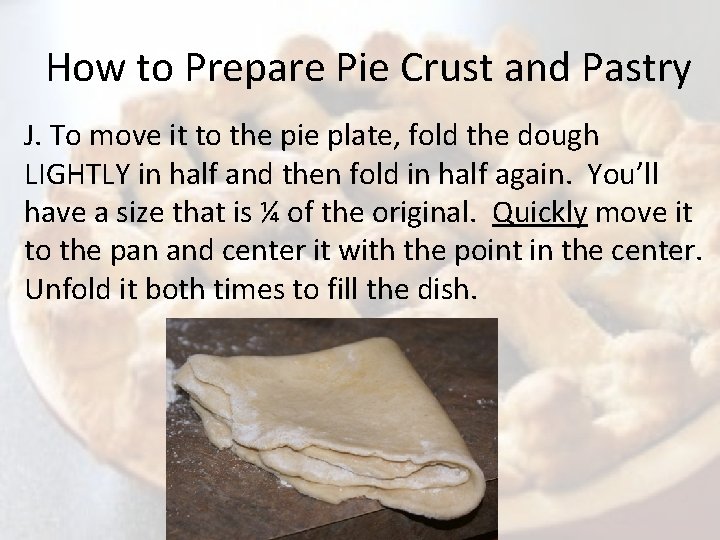
How to Prepare Pie Crust and Pastry J. To move it to the pie plate, fold the dough LIGHTLY in half and then fold in half again. You’ll have a size that is ¼ of the original. Quickly move it to the pan and center it with the point in the center. Unfold it both times to fill the dish.
VI. How to Prepare Pie Crust and Pastry K. Shape the dough to fit the bottom and sides of the dish. Do not stretch the dough, as this will cause it to shrink when baked. Add the filling and top crust (if used). Crimp the edges together with the tines or a fork, or make an edge by fluting the crust. http: //www. youtube. com/watch? v=o. Oix 5 ue. VO Qw
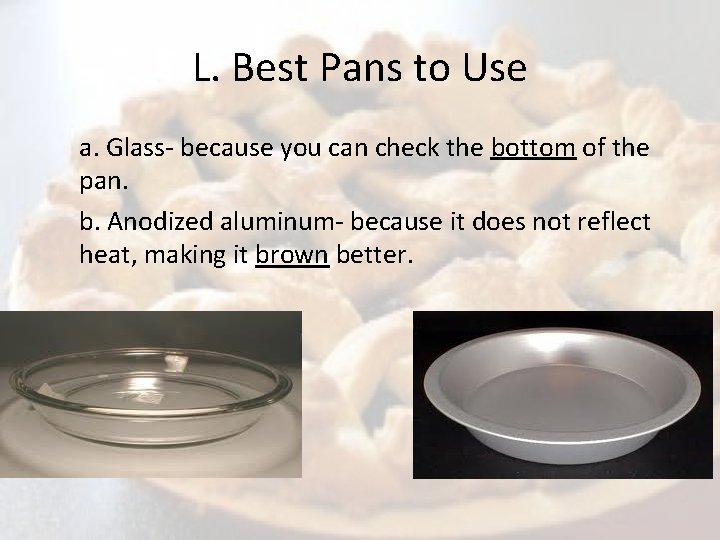
L. Best Pans to Use a. Glass- because you can check the bottom of the pan. b. Anodized aluminum- because it does not reflect heat, making it brown better.
M. Baking Pies a. Bake at temperature of 425 degrees F. for the crust to brown better. b. Use a foil collar around the edge, so it doesn’t get burnt. Remove during last 15 minutes so it can brown properly. c. Poke holes in an unfilled pie crust before baking, to prevent puffing and shrinking.
VII. Toppings for Pies • A. Meringue- This is whipped sweetened egg whites over cooked cream or ice cream desserts. To make it, remember to: a. Have absolutely no fat or oil! Do not use plastic bowls, as there may be an oily film you cannot detect. Rewash mixer beaters. b. Separate egg whites one at a time. Have no traces of yolk in them. Remove egg yolk bits with half of the egg shell.
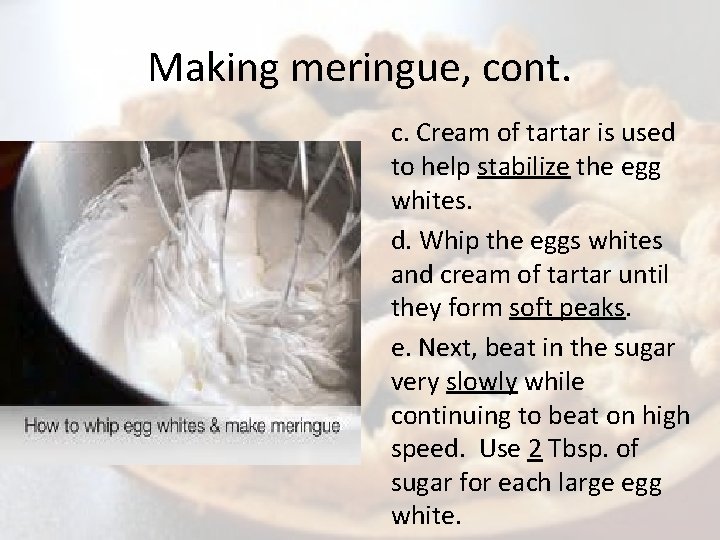
Making meringue, cont. c. Cream of tartar is used to help stabilize the egg whites. d. Whip the eggs whites and cream of tartar until they form soft peaks. e. Next, beat in the sugar very slowly while continuing to beat on high speed. Use 2 Tbsp. of sugar for each large egg white.
Making meringue, cont. f. Place the meringue on the hot filling, so it can begin to cook. Swirl and arrange the meringue, sealing the edges down to the pastry. g. Cook in a preheated oven following recipe directions until lightly browned. h. Cool in a draft-free area, but NOT the refrigerator, to prevent shrinkage and “weeping. ” After it has cooled, store it in the refrigerator. http: //www. foodnetwork. com/videos/how-tomake-meringue-video/85016. html
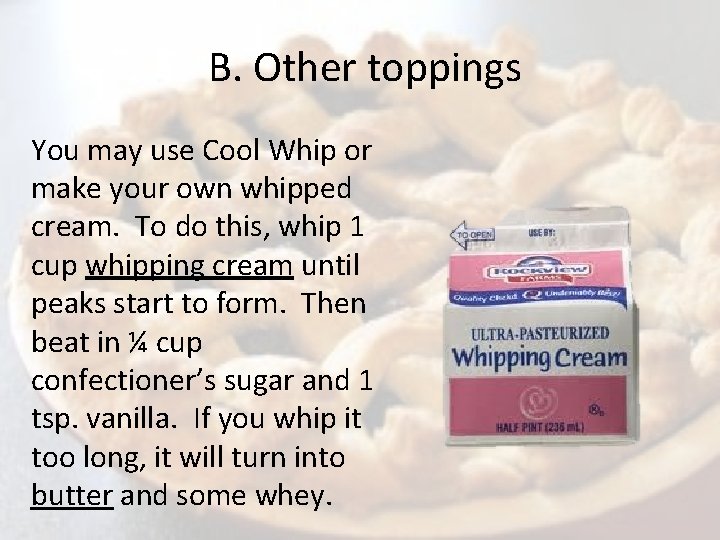
B. Other toppings You may use Cool Whip or make your own whipped cream. To do this, whip 1 cup whipping cream until peaks start to form. Then beat in ¼ cup confectioner’s sugar and 1 tsp. vanilla. If you whip it too long, it will turn into butter and some whey.
VIII. How to Store Pies and Pastry • A. Pies are best if eaten the day they are made. a. Cool first- before cutting, so filling will set and hold its shape when served. b. Be sure to refrigerate which pies? Cream pies, custard pies, quiches, and entrée pies. c. Pies can be rewarmed by baking uncovered at 350 degrees for 12 -15 minutes to freshen day old pies.
How To Store Pies and Pastry, cont. B. Most pies will freeze well, whether they are baked or raw. If the pie is frozen, be sure to wrap well by using freezer-weight plastic bags or heavy foil, wrapped properly to keep out air. This will prevent “freezer burn, ” which is when air can get into a frozen food over time, causing it to loose moisture, dry out, and get tough.
How to store pies and pastry, cont. C. To thaw and bake an uncooked pie, do NOT thaw before baking. Then place it frozen into the oven and add 30 minutes to the normal cooking time. D. Extra pie dough can be rolled into circles about the size of a CD, wrapped and frozen. When needed, you can thaw it in the refrigerator overnight.
The End