
PID meeting SNATS to SCATS New front end

- Slides: 11
PID meeting SNATS to SCATS New front end design Introduction to Integration May 31 2010 Christophe Beigbeder PID meeting 1
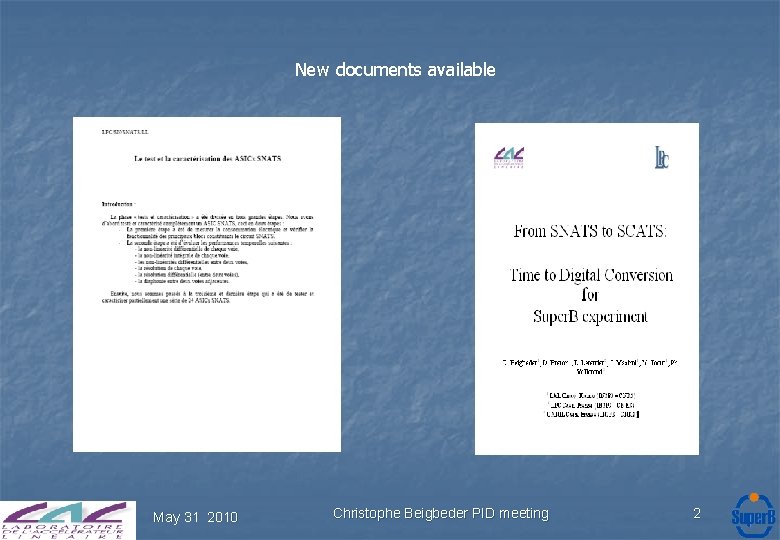
New documents available May 31 2010 Christophe Beigbeder PID meeting 2
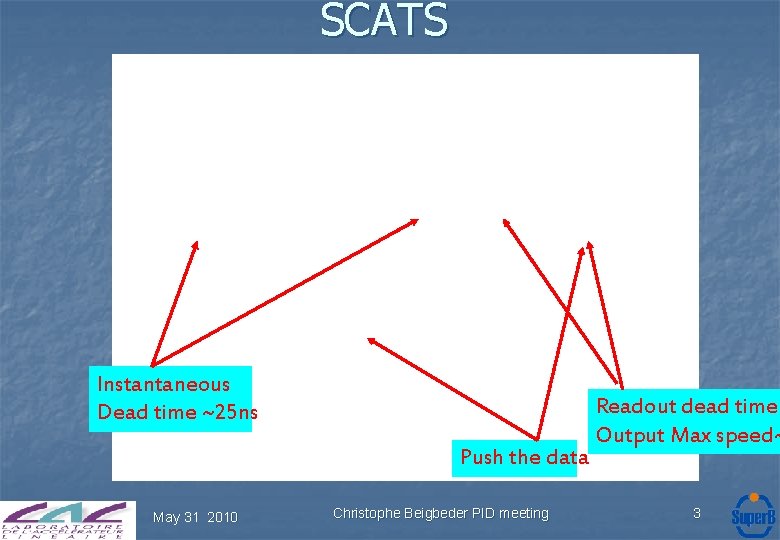
SCATS Instantaneous Dead time ~25 ns Push the data May 31 2010 Christophe Beigbeder PID meeting Readout dead time Output Max speed~ 3
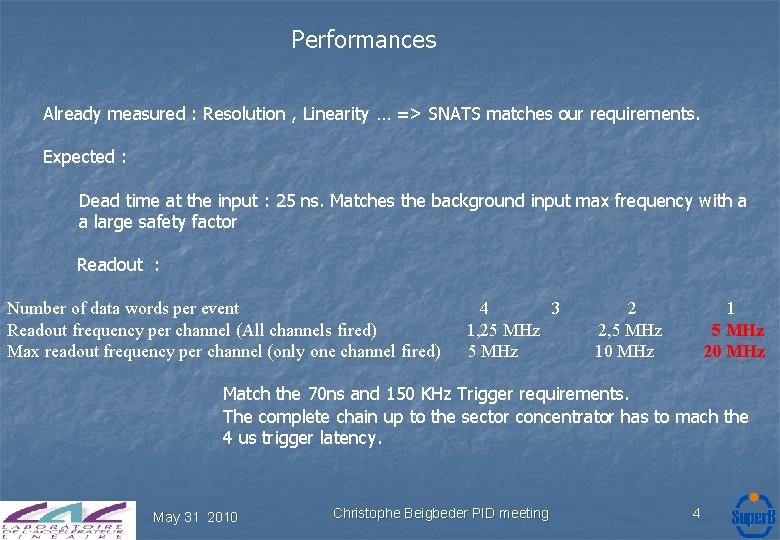
Performances Already measured : Resolution , Linearity … => SNATS matches our requirements. Expected : Dead time at the input : 25 ns. Matches the background input max frequency with a a large safety factor Readout : Number of data words per event Readout frequency per channel (All channels fired) Max readout frequency per channel (only one channel fired) 4 3 1, 25 MHz 2 2, 5 MHz 10 MHz 1 5 MHz 20 MHz Match the 70 ns and 150 KHz Trigger requirements. The complete chain up to the sector concentrator has to mach the 4 us trigger latency. May 31 2010 Christophe Beigbeder PID meeting 4
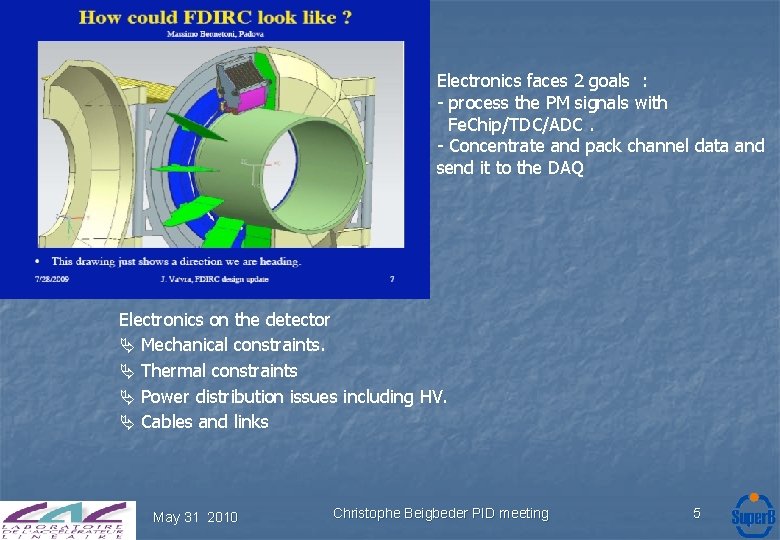
Electronics faces 2 goals : - process the PM signals with Fe. Chip/TDC/ADC. - Concentrate and pack channel data and send it to the DAQ Electronics on the detector Ä Mechanical constraints. Ä Thermal constraints Ä Power distribution issues including HV. Ä Cables and links May 31 2010 Christophe Beigbeder PID meeting 5
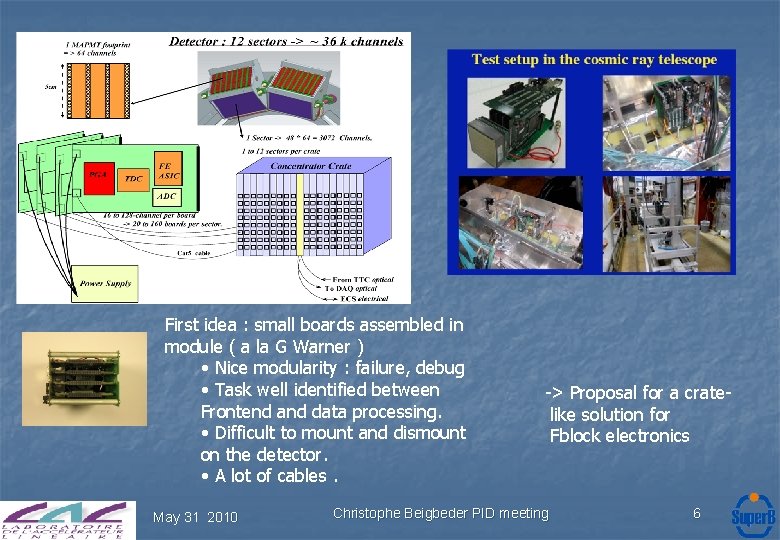
First idea : small boards assembled in module ( a la G Warner ) • Nice modularity : failure, debug • Task well identified between Frontend and data processing. • Difficult to mount and dismount on the detector. • A lot of cables. May 31 2010 -> Proposal for a cratelike solution for Fblock electronics Christophe Beigbeder PID meeting 6
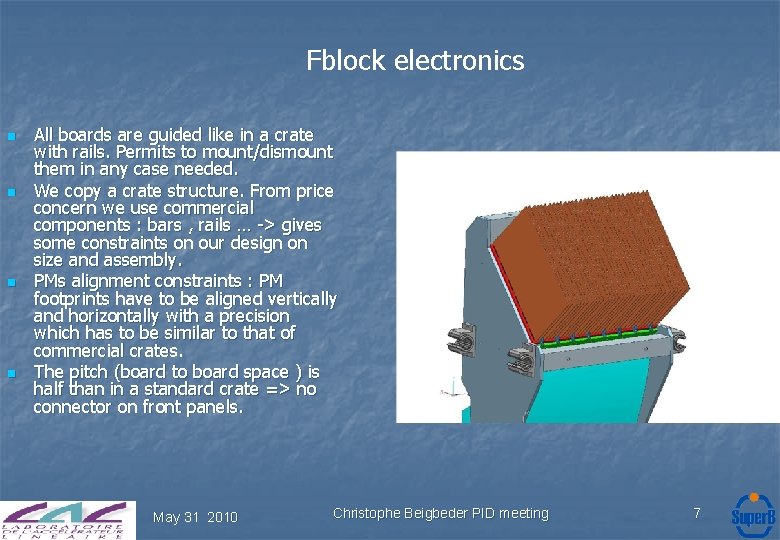
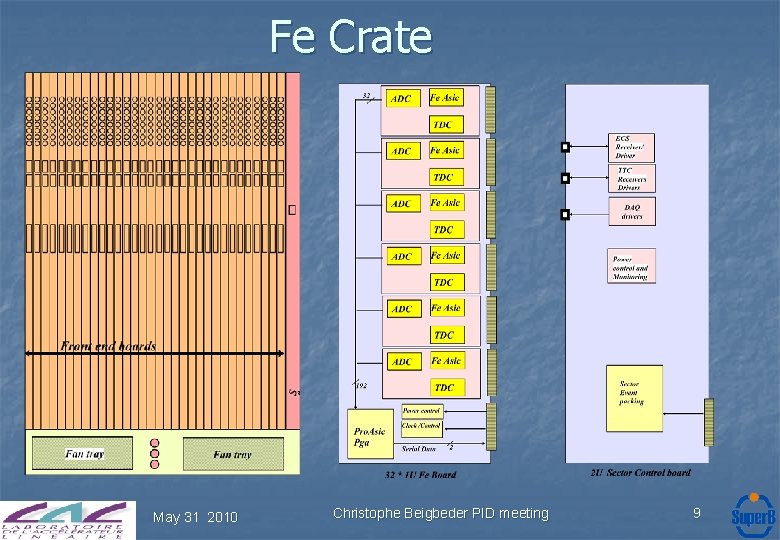
Fblock electronics n n All boards are guided like in a crate with rails. Permits to mount/dismount them in any case needed. We copy a crate structure. From price concern we use commercial components : bars , rails … -> gives some constraints on our design on size and assembly. PMs alignment constraints : PM footprints have to be aligned vertically and horizontally with a precision which has to be similar to that of commercial crates. The pitch (board to board space ) is half than in a standard crate => no connector on front panels. May 31 2010 Christophe Beigbeder PID meeting 7
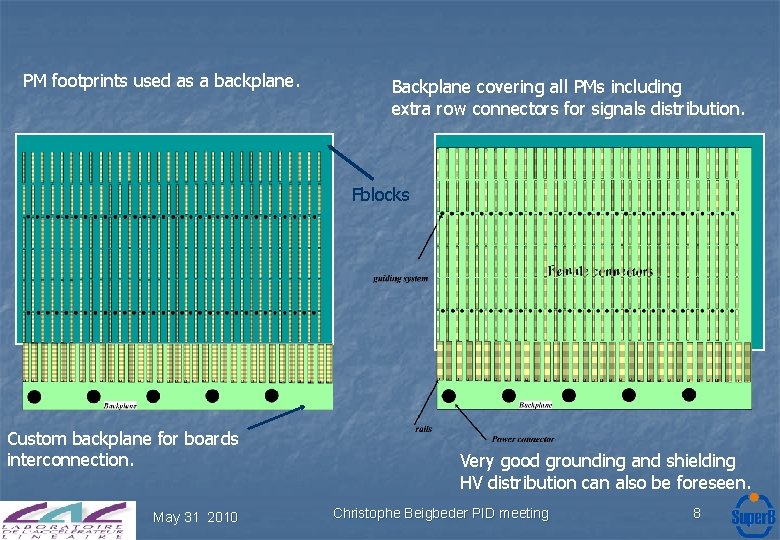
PM footprints used as a backplane. Backplane covering all PMs including extra row connectors for signals distribution. Fblocks Custom backplane for boards interconnection. May 31 2010 Very good grounding and shielding HV distribution can also be foreseen. Christophe Beigbeder PID meeting 8
Fe Crate May 31 2010 Christophe Beigbeder PID meeting 9
Data flow consideration n TDC (16 channels ) : 16 bits@80 MHz + Chan Add + Charge … -> 32 bits per events @ 80 MHz. -> 6 rows -> Bus of 192 bits entering one ( 2 ? ) FEPGA housing L 1 buffer. n 150 k. Hz Trigger / 32 bit data per event -> 5 kbits per pixel 5 k * 16 pixels * 6 PM rows -> ~ 5 Mbits per board on backplane. May 31 2010 Christophe Beigbeder PID meeting 10
Requirements on fan trays and heat exchanger. n n A rough estimation gives : n Fe : 500 m. W / 16 Channels n PGA : 1 W / 16 channels n TDC : 500 m. W / 16 channels n `+ glue => Total 3 W / 16 channels. n => Sector ( ~ 3 kchannels ) = ~ 600 W ( 350 W on Babar/~600 ch) n => Less than 8 k. W in total. From Wiener data sheet n Q = ( 3. 1 P) / T n Q= airflow in m 3 / h n P = Dissipated power ( W) n T = Temperature change at given air flow n -> 1 k. W power , a specified difference T = 10 degrees requires a airflow of 300 m 3/h 0 May 31 2010 Christophe Beigbeder PID meeting 11