
Picture Basics Disclaimer I am NOT a camera
Picture Basics Disclaimer: I am NOT a camera guy (but I own a couple of cameras. . . )
You know some of this Frequency and intensity Light's behaviour can be modeled as a wave Different frequencies = different colors
Some differences 300, 000 km/s vs 340 m/s Electromagnetic vs. acoustic energy You could never hear a light wave anymore than you could see a sound wave What we “see” is reflections of light off of objects; what we identify as a sound comes right from its source
Some things I've noticed lighting/framing = microphones/placement Lens/sensor = preamp/converter
Setting up for a shot Perspective – what angle? Level – make sure camera is level White Balance – effects color & “temperature” Exposure – important not to lose detail in light or shadow Frame – what you will show in the shot (vs. what you won't show in the shot) Focus – what's in? What's out?

Exposure Three controls Aperture: size of lens opening gain/ISO: boost from camera electronics Shutter speed: faster = smoother motion Size and type of sensor matter Bigger sensor = better in low light Three chips are better than one
Aperture Size of the hole in the lens over the sensor Larger Aperture lets in more light Measured in “f-stops” Smaller f-stop = larger opening
ISO/gain ISO was a measure of film grain Larger ISO number is the equivalent of more gain. More gain can mean more “noise” or graininess in the shot Don't use more gain than you have to.
Field of view Determined by distance from subject and focal length of lens Knowing what a certain focal length means in terms of “tightness” allows you to know what microphone or techniques you might have to use. Larger number = longer length 20 mm = wide; 50 mm = “normal”; 100 mm = “telephoto”
Depth of field Refers to the range at which things will be in (or out) of focus i. e. subject in focus, background out-of-focus Helps to determine what a viewer will be focused on in the shot Focus “peaking”
White balance Determines the “color temperature” White is not quite the same in different lights – white balancing sets the baseline Bluer = colder; orange = warmer
Shutter Speed Slower shutter speed = more time for light to “soak in” to the sensor Too slow can result in anomalies
Frame Rates SMPTE HH: MM: SS: FF Film is shot at 24 frames per second (23. 97 fps) Color video is shot at 30 frames per second (29. 97 fps) Two flavors: drop and non-drop Know what frame rate is being used! “p” vs. “i” - progressive vs. interlaced scanning - “p” is better (30 p is the same as 60 i)
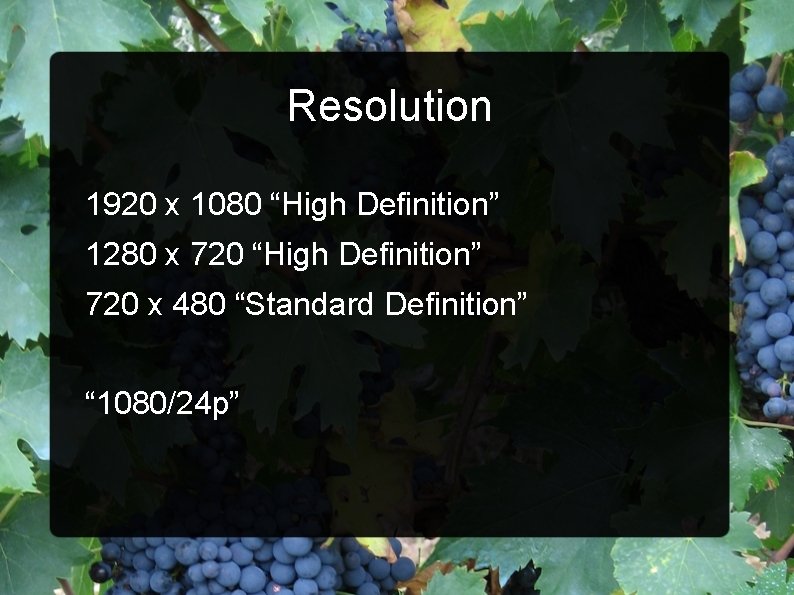
Resolution 1920 x 1080 “High Definition” 1280 x 720 “High Definition” 720 x 480 “Standard Definition” “ 1080/24 p”
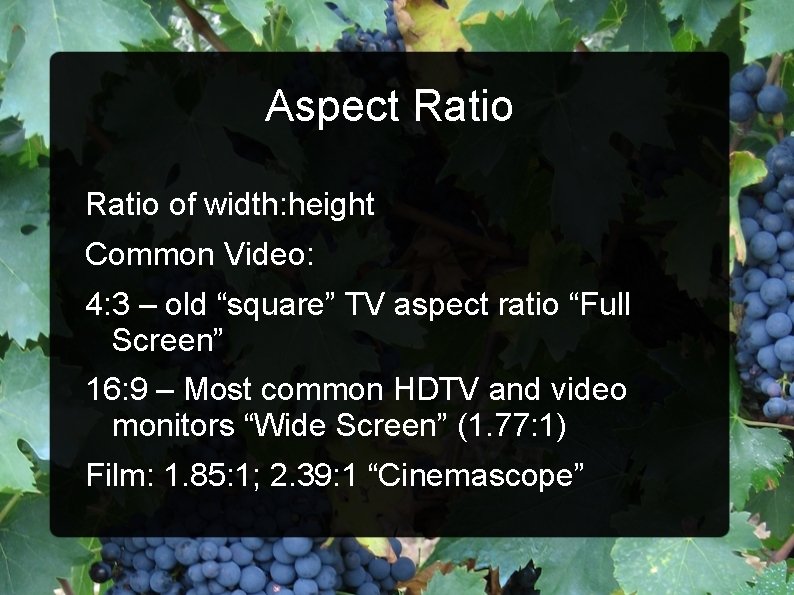
Aspect Ratio of width: height Common Video: 4: 3 – old “square” TV aspect ratio “Full Screen” 16: 9 – Most common HDTV and video monitors “Wide Screen” (1. 77: 1) Film: 1. 85: 1; 2. 39: 1 “Cinemascope”
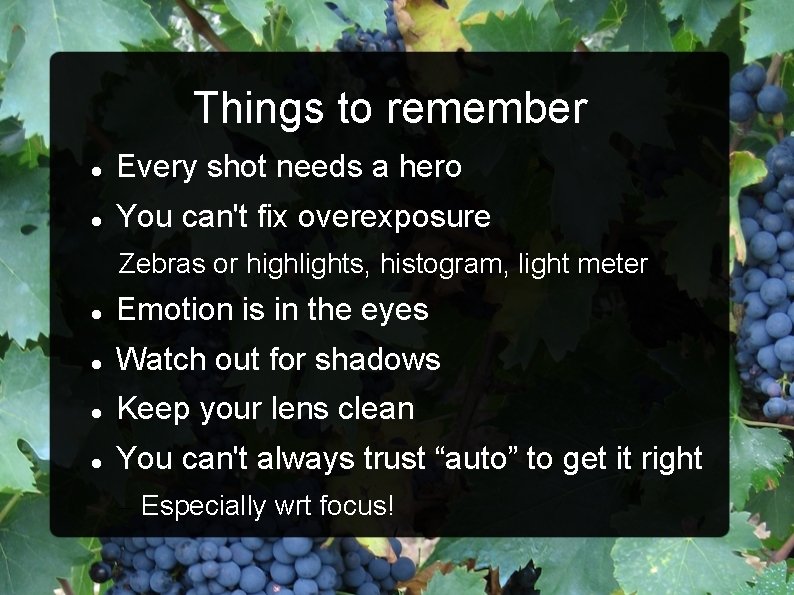
Things to remember Every shot needs a hero You can't fix overexposure Zebras or highlights, histogram, light meter Emotion is in the eyes Watch out for shadows Keep your lens clean You can't always trust “auto” to get it right – Especially wrt focus!
- Slides: 16