
PICO presentation CREATED BY SHANNON DEMBOWSKE Objectives Recognize

PICO presentation CREATED BY: SHANNON DEMBOWSKE
Objectives: Recognize the inter-relationship of research and theory and its impact on the development of the healthcare research. Assess current healthcare research findings for applicability to a variety of clinical practice. Analyze the research process as a framework for clinical reasoning to improve quality and safety measures in healthcare practice. (A. Njoku, personal communication, August 25, 2014)

What is PICO? PICO is a systematic process for converting information needs/problems into clinical questions that define the: – Patient problem/population – Intervention – Comparison – Outcome Problem or patient concern: Intervention or exposure –treatment of clinical condition of interest Comparison –problem or concern where an answer is sought –alternative treatment or control Outcome –measure(s) used to assess effects (Source: J. L. Forrest & S. A. Miller, 2002)
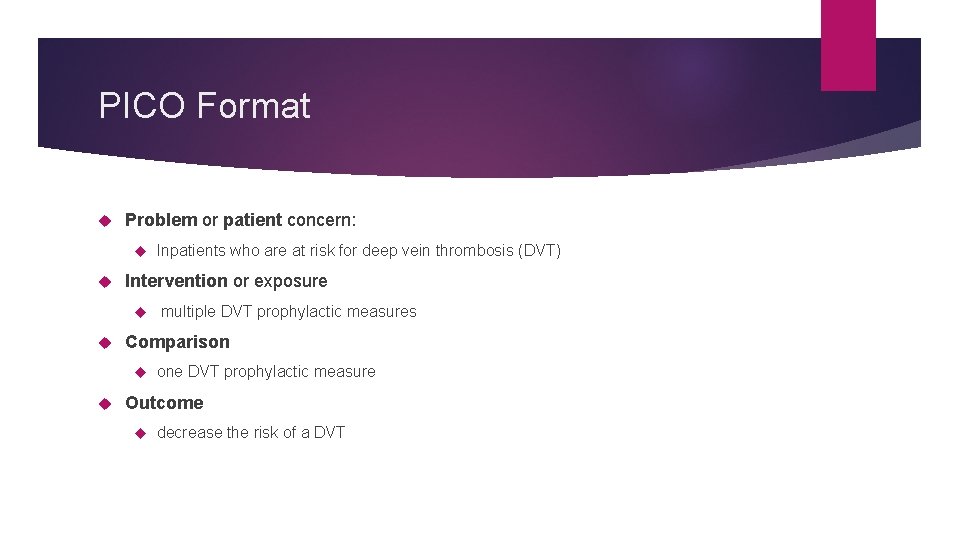
PICO Format Problem or patient concern: Intervention or exposure multiple DVT prophylactic measures Comparison Inpatients who are at risk for deep vein thrombosis (DVT) one DVT prophylactic measure Outcome decrease the risk of a DVT
Clinical Question: "In inpatients who are at risk for deep vein thrombosis (DVT), does using multiple DVT prophylactic measures further decrease the risk of a DVT as compared to using just one DVT prophylactic measure. "
Literature Search Results Search engines used: Search words: Google, Pub. Med, Cochrane Library DVT prophylaxis, venous thromboembolism, VTE, thromboprophylaxis Research articles: “Preventing deep vein thrombosis in hospital inpatients” by William Cayley “Combined modalities in the prevention of venous thromboembolism: a review of the literature” by S. K. Kakkos, J. Caprini, A. N. Nicolaides and D. Reddy
Rationale I chose these two studies because they combine multiple studies. This gives me a larger spectrum of the patient population and research already provided on the topic of deep vein thrombosis (DVT) and emboli prevention. Venous thromboembolism (VTE) is a multi-factorial process, so it is important to have a large background of research and information. I think these studies do a good job a reviewing the multiple studies already completed on this subject and conclude on what the standard of practice should be.

Article #1: “Preventing deep vein thrombosis in hospital inpatients” Evaluation of study: Type of study- Clinical Review Peer-Reviewed Level VII Free of bias Design- Systematic Review Method- Meta-analysis

Article #1 Findings & Credibility

Relevance:
Article #2: “Combined modalities in the prevention of venous thromboembolism: a review of the literature” Evaluation of study: Type of study- Clinical Review Peer-Reviewed Level VII Free of bias Design- Systematic Reviews Method- Meta-analysis

Article #2: Findings & Credibility

Relevance:
Conclusion: The results of these studies answered my clinical question, however it was not the answer I was hoping for. They concluded that depending on the patient and health status, multiple DVT prophylactic measures are indeed better than just one. The greatest reduction in DVTs were achieved when the use of at least one pharmacological measure and one mechanical measure were used at the same time.
References: Cayley, W. (2007). Preventing deep vein thrombosis in hospital inpatients. BMJ, 335, 147 -151. doi: 10. 1136/bmj. 39247. 542477. AE Forrest, J. L. & Miller, S. A. (2002). Evidence based decision making in action: part 1 finding the best clinical evidence. The journal of contemporary dental practice, 3(3). Kakkos, S. K. , Caprini, J. , Nicolaides, A. N. , & Reddy, D. (2006). Combined modalities in the prevention of venous thromboembolism: a review of the literature. Phlebology, 21 (suppl 1), 1 -6.
- Slides: 15