
PICO Power Point Presentation Jessica Collings Introduction In

- Slides: 14
PICO Power Point Presentation Jessica Collings
Introduction �In homebound patients, is the use of Braden Scale a valid and reliable tool for preventing pressure ulcers, as opposed to not being valid or reliable in the home care setting?
Literature search � 1. search words: Braden Scale, pressure ulcer prevention in home care, Braden Scale and home care. � 2. search engines used were through the Ferris Library page, smart search and Elsevier. � 3. results of the search included articles on the Braden Scale in acute care settings, long term settings and home care. Difficult to find articles on specifically home care relating to the Braden Scale.
2 Research Articles: � 1. Dassen, T. , Halfens, R. , and Kottner, J. (2009). An interrater reliability study of the assessment of pressure ulcer risk using the Braden scale and the classification of pressure ulcers in a home care setting. International Journal of Nursing Studies, 46, 1307 -1312. doi: 10. 1016/j. ijnurstu. 2009. 03. 014 � 2. Bergquist, S. , & Frantz, R. (2001). Braden Scale: Validity in community-based older adults receiving home health care. Applied Nursing Research, 14, 36 -43. doi: 10. 1053/apnr. 2001. 21079
Articles were chosen on the following criteria: � 1. research that related to the Braden scale and home health care. � 2. research that studied the validity or reliability and usefulness of the Braden in the home care setting.
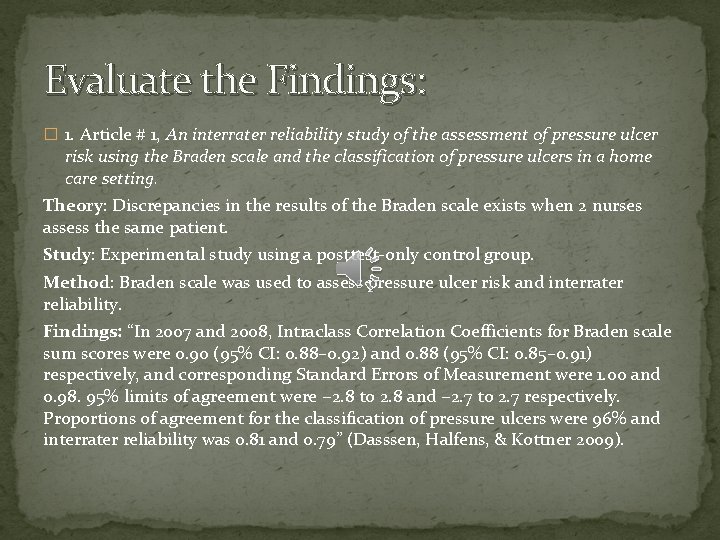
Evaluate the Findings: � 1. Article # 1, An interrater reliability study of the assessment of pressure ulcer risk using the Braden scale and the classification of pressure ulcers in a home care setting. Theory: Discrepancies in the results of the Braden scale exists when 2 nurses assess the same patient. Study: Experimental study using a posttest-only control group. Method: Braden scale was used to assess pressure ulcer risk and interrater reliability. Findings: “In 2007 and 2008, Intraclass Correlation Coefficients for Braden scale sum scores were 0. 90 (95% CI: 0. 88– 0. 92) and 0. 88 (95% CI: 0. 85– 0. 91) respectively, and corresponding Standard Errors of Measurement were 1. 00 and 0. 98. 95% limits of agreement were − 2. 8 to 2. 8 and − 2. 7 to 2. 7 respectively. Proportions of agreement for the classification of pressure ulcers were 96% and interrater reliability was 0. 81 and 0. 79” (Dasssen, Halfens, & Kottner 2009).
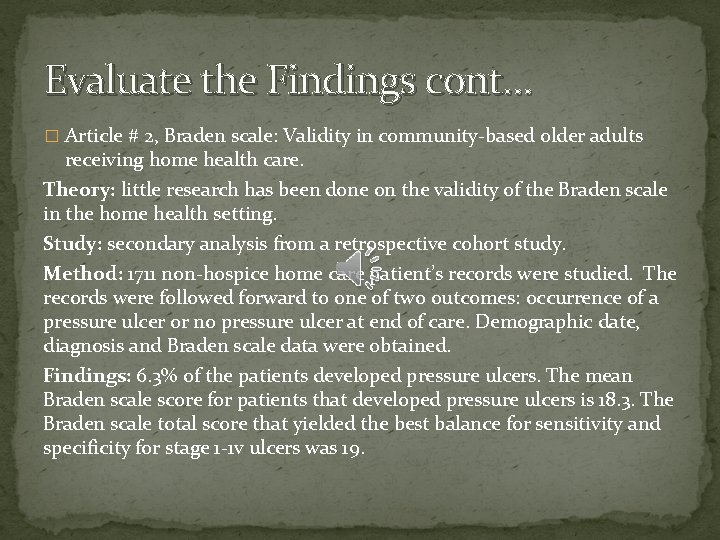
Evaluate the Findings cont… � Article # 2, Braden scale: Validity in community-based older adults receiving home health care. Theory: little research has been done on the validity of the Braden scale in the home health setting. Study: secondary analysis from a retrospective cohort study. Method: 1711 non-hospice home care patient’s records were studied. The records were followed forward to one of two outcomes: occurrence of a pressure ulcer or no pressure ulcer at end of care. Demographic date, diagnosis and Braden scale data were obtained. Findings: 6. 3% of the patients developed pressure ulcers. The mean Braden scale score for patients that developed pressure ulcers is 18. 3. The Braden scale total score that yielded the best balance for sensitivity and specificity for stage 1 -1 v ulcers was 19.
Ethical considerations: � Informed consent was obtained from participants, and permission was given by the University Hospital Maastricht’s Medical Ethical Committee for the study done in Dassen, Halfens and Kottner. � The study done in Bergquist and Frantz was approved by the university’s Institutional review board and by the agency’s professional practice committee.
Strength, quality and credibility, and Evidenced based practice (EBP): �Both studies reviewed today contribute to evidenced based practice. 1. article 1 proves interrater reliability for a home care agency. This is great for home health care agencies to prove probable accuracy of field nursing staff. 2. article 2 tests when the Braden scale is most sensitive and specific and states home care nurses should do a full skin Braden scale assessment in week one of care for the best results.
Strength, quality and credibility, and Evidenced based practice cont. . �Article 1 is credible, the study has good quality and it is comparable with previous findings from similar research. - limitations - credibility: the authors are affiliated with the departments of nursing at their affiliated institutions.
Strength, quality and credibility, and Evidenced based practice cont. . �Article 2 showed good strength in the findings that suggest the Braden scale is most accurate for assessing risk for pressure ulcers in the first week of home health care, when using the cut off score of 19. - limitations: less validity after week 1. - credibility: the authors are both Registered nurses and affiliated with schools of nursing in the U. S.
Relevance: �both studies relevant to my practice as a home care nurse. �Braden scale is standard of care at Munson Home Health care, upon admission, recertification, and upon any change in condition. �Implications: after reviewing the studies discussed today, nurses would benefit from understanding the importance of and the Braden scale, and use of the standardized tool. �Quality of care
Relevance cont… �Barriers could include poor education on use of Braden scale, no using it appropriatly. �Additional PICO questions: 1. In home health care patients, is there an optimal time to conduct the Braden scale assessment, and to conduct reassessments? 2. In patients who are at risk for pressure ulcers, what is the most cost effective prevention program?
Conclusion: �The Braden scale is a reliable, valid and useful tool in the home health care setting, when first assessment is done during the first week of care. �More research needs to be done on frequency of Braden scale assessments, and cost effective patient education and prevention. �Pressure ulcers are preventable, effect 1 million people each year and can cost any where from $1000 - $55, 000 to treat.