
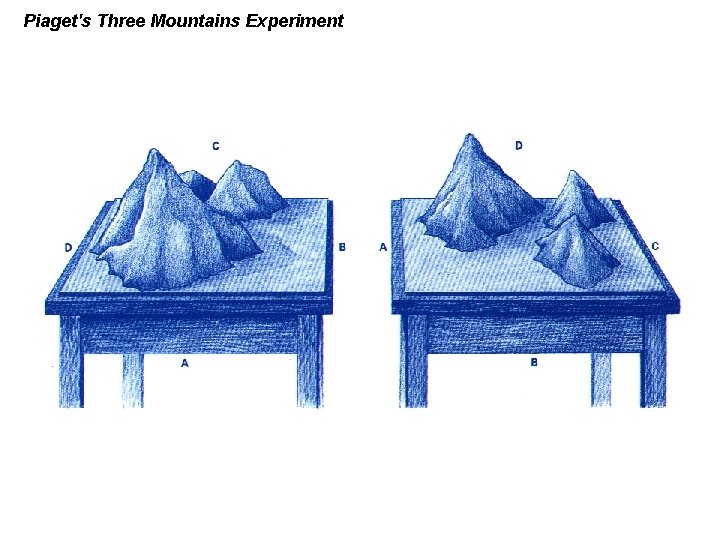
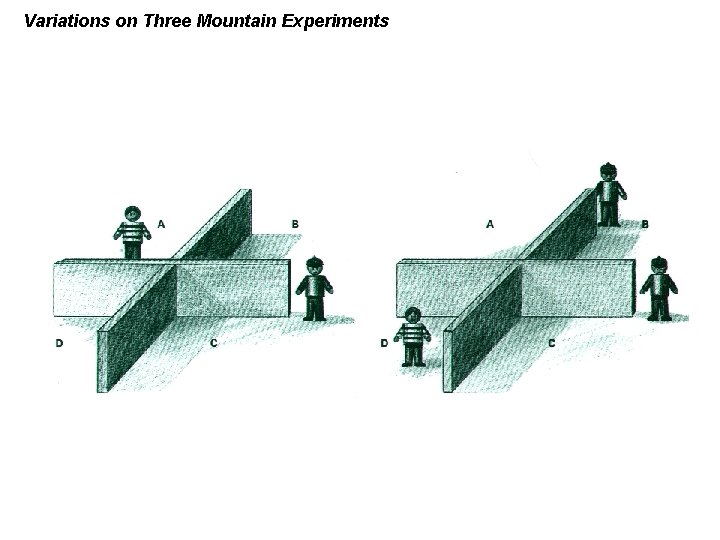
Piagets Three Mountains Experiment Variations on Three Mountain
- Slides: 7
Piaget's Three Mountains Experiment
Variations on Three Mountain Experiments
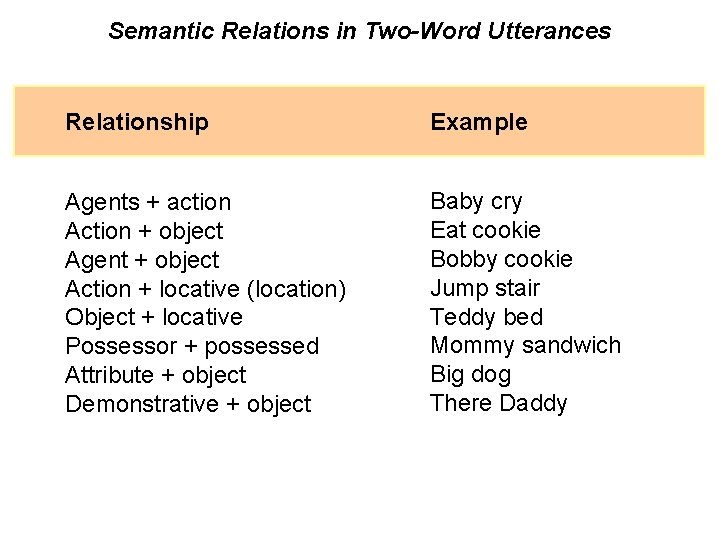
Semantic Relations in Two-Word Utterances Relationship Example Agents + action Action + object Agent + object Action + locative (location) Object + locative Possessor + possessed Attribute + object Demonstrative + object Baby cry Eat cookie Bobby cookie Jump stair Teddy bed Mommy sandwich Big dog There Daddy
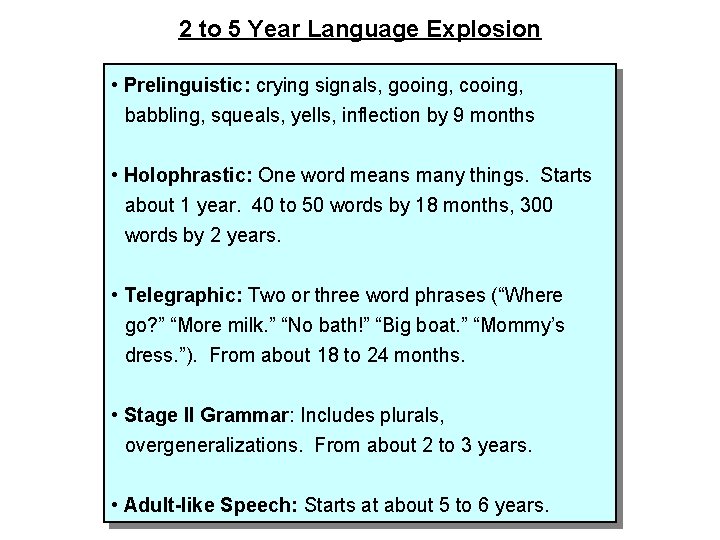
2 to 5 Year Language Explosion • Prelinguistic: crying signals, gooing, cooing, babbling, squeals, yells, inflection by 9 months • Holophrastic: One word means many things. Starts about 1 year. 40 to 50 words by 18 months, 300 words by 2 years. • Telegraphic: Two or three word phrases (“Where go? ” “More milk. ” “No bath!” “Big boat. ” “Mommy’s dress. ”). From about 18 to 24 months. • Stage II Grammar: Includes plurals, overgeneralizations. From about 2 to 3 years. • Adult-like Speech: Starts at about 5 to 6 years.
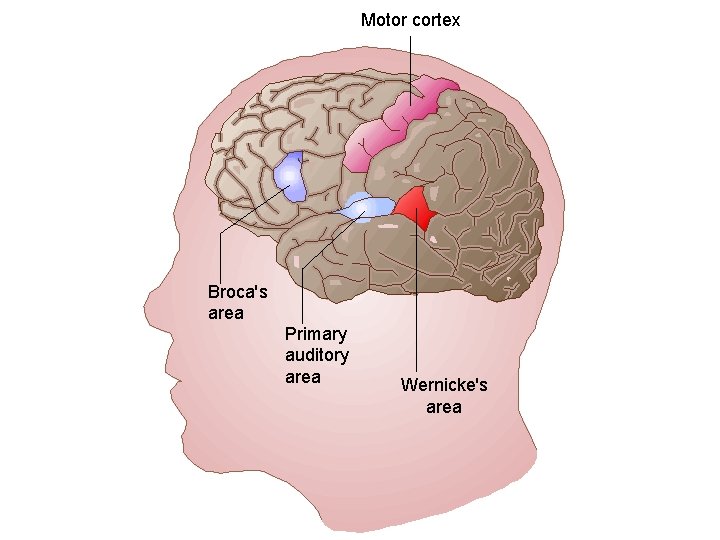
Motor cortex Broca's area Primary auditory area Wernicke's area
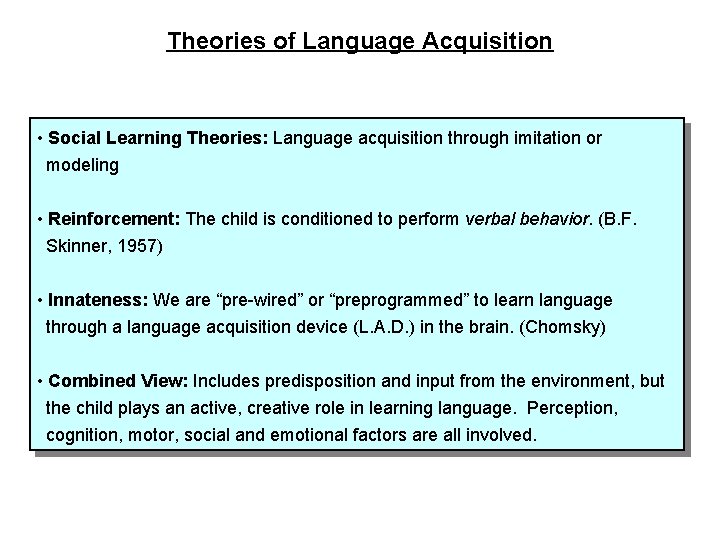
Theories of Language Acquisition • Social Learning Theories: Language acquisition through imitation or modeling • Reinforcement: The child is conditioned to perform verbal behavior. (B. F. Skinner, 1957) • Innateness: We are “pre-wired” or “preprogrammed” to learn language through a language acquisition device (L. A. D. ) in the brain. (Chomsky) • Combined View: Includes predisposition and input from the environment, but the child plays an active, creative role in learning language. Perception, cognition, motor, social and emotional factors are all involved.
Summary of Early Childhood Cognitive Development • Preoperational thinking, not yet logical, unable to see another’s viewpoint. • Child has gone through “language explosion, ” emerging with vocabulary of over 14, 000 words, and syntactically correct usage.