
Piagets Theory of Moral Development part2 PGDCP SEMESTER

- Slides: 11
Piaget’s Theory of Moral Development (part-2) PGDCP; SEMESTER- II COURSE: Life Span Paper VI ; Unit IV By Dr. Priyamvada Part Time/Guest Faculty Institute of Psychological Research and Service Patna University Email-priyamvadapreet@gmail. com Contact-9693299059
PIAGET'S THEORY OF MORAL DEVELOPMENT The Premoral Period. In Piaget’s theory the first 5 years of life, when children are said to have little respect for or awareness of socially defined rules. According to Piaget, preschool children show little concern for or awareness of rules. In a game of marbles, these premoral children do not play systematically with the intent of winning. Instead, they seem to make up their own rules, and they think the point of the game is to take turns and have fun.
PIAGET'S THEORY CONT…ED Heteronomous morality Piaget’s first stage of moral development, in which children view the rules of authority figures as sacred and unalterable. Between the ages of 5 and 10, children develop a strong respect for rules as they enter Piaget’s stage of heteronomous morality (“heteronomous” means “under the rule of another”). Children now believe that rules are laid down by powerful authority figures such as God, the police, or their parents, and they think that these regulations are sacred and unalterable. Try breaking the speed limit with a 6 -year old at your side and you may see what Piaget was talking about. Even if you are rushing to the hospital in a medical emergency, the young child may note that you are breaking a rule and consider your behavior unacceptable conduct that deserves to be punished. Heteronomous children think of rules as moral absolutes. They believe that there is a “right” side and a “wrong” side to any moral issue, and right always means following the rules.
HETERONOMOUS MORALITY CONT…ED Heteronomous children are also likely to judge the naughtiness of an act by its objective consequences rather than the actor’s intent. For example, many 5 - to 9 -year-olds judged John, who broke 15 cups while performing a well-intentioned act, to be naughtier than Henry, who broke one cup while stealing jam. Heteronomous children also favor expiatory punishment—punishment for its own sake with no concern for its relation to the nature of the forbidden act. So a 6 year-old might favor spanking a boy who had broken a window rather than making the boy pay for the window from his allowance. Furthermore, the heteronomous child believes in immanent justice—the idea that violations of social rules will invariably be punished in one way or another (see, e. g. , Dennis’s warning to Joey in the cartoon). Life for the heteronomous child is fair and just.
AUTONOMOUS MORALITY By age 10 or 11, most children have reached Piaget’s second moral stage— Autonomous Morality. Older autonomous children now realize that social rules are arbitrary agreements that can be challenged and even changed with the consent of the people they govern. They also feel that rules can be violated in the service of human needs. Thus, a driver who speeds during a medical emergency is no longer considered immoral, even though she is breaking the law. Judgments of right and wrong now depend more on the actor’s intent to deceive or to violate social rules rather than the objective consequences of the act itself. So 10 - year-olds reliably say that Henry, who broke one cup while stealing some jam (bad intent), is naughtier than John, who broke 15 cups while coming to dinner (good or neutral intent).
AUTONOMOUS MORALITY CONT…ED When deciding how to punish transgressions, the morally autonomous child usually favors reciprocal punishments—that is, treatments that tailor punitive consequences to the “crime” so that the rule breaker will understand the implications of a transgression and perhaps be less likely to repeat it. So an autonomous child may decide that the boy who deliberately breaks a window should pay for it out of his allowance (and learn that windows cost money) rather than simply submitting to a spanking. Finally, autonomous youngsters no longer believe in immanent justice, because they have learned from experience that violations of social rules often go undetected and unpunished.
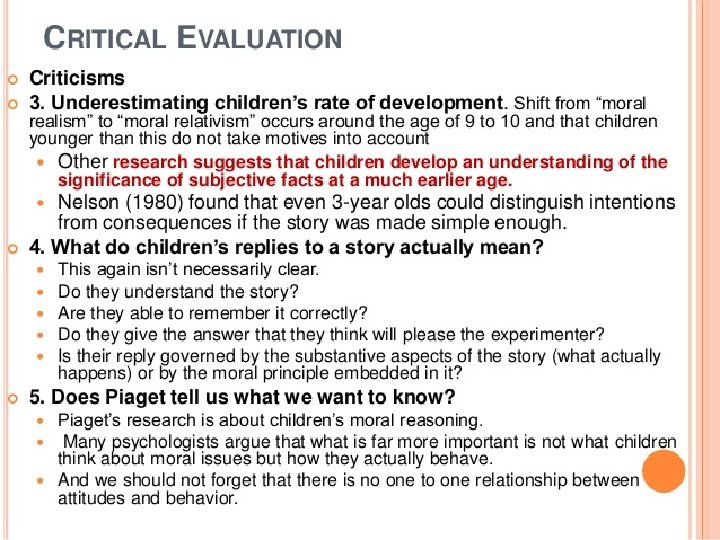
EVALUATION OF PIAGET’S THEORY Developmentalists are indebted to Piaget for suggesting that children’s moral reasoning develops in stages that are closely tied to cognitive growth. Even today, his theory continues to stimulate research and new insights—including findings that children younger than 10 are considerably more sophisticated in their moral reasoning than Piaget made them out to be. But is moral reasoning fully developed by age 10 to 11, as Piaget had assumed?
References Ø Shaffer. David. R. , and Kipp. Katherine. , Developmental Psychology, Childhood and adolescence, 8 th edition, Wadsworth cengage learning. Ø Google images and Google search Thank you