
Piagets theory of cognitive development DEVELOPMENTAL PSYCHOLOGY Piaget
- Slides: 14
Piaget’s theory of cognitive development. DEVELOPMENTAL PSYCHOLOGY.
Piaget Believed there was a pattern to growth of intellect in childhood. believed that children experience a series of developmental stages from childhood to through to adolescence. According to Piaget at each of these stages children become able to reason in a qualitatively different and more advanced way.
Schemas Piaget considered that we build an understanding of our world and develop our thinking skills through active interaction with our environment. This leads to building concepts (or schemas). A schema is an idea about what something is and how to deal with it.
Metal Adaption. Intellect grows through processes Piaget called assimilation and accommodation. Assimilation – the application of existing mental patterns to new situations (that is, the new situation is assimilated to existing mental schemes). Accommodation – the modification of existing mental patterns to fit new demands (that is, mental schemes are changed to accommodate new information or experiences.
Piaget Four Stages. Sensorimotor stage 0 -2 years. The preoperational stage 2 -7 years. The concrete operation stage 7 -11 years. The formal operations stage 11+ years.
sensorimotor stage (0 -2 years) First two years of life is mostly non-verbal. During sensorimotor stage children are mainly concerned with learning to coordinate purposeful movements with information from the senses by looking at, touching and mouthing objects in their immediate environment. During this stage they gradually learn that there is a relationship between their actions and the external world. Object permanence (the understanding that objects still exist when they are not in sight)
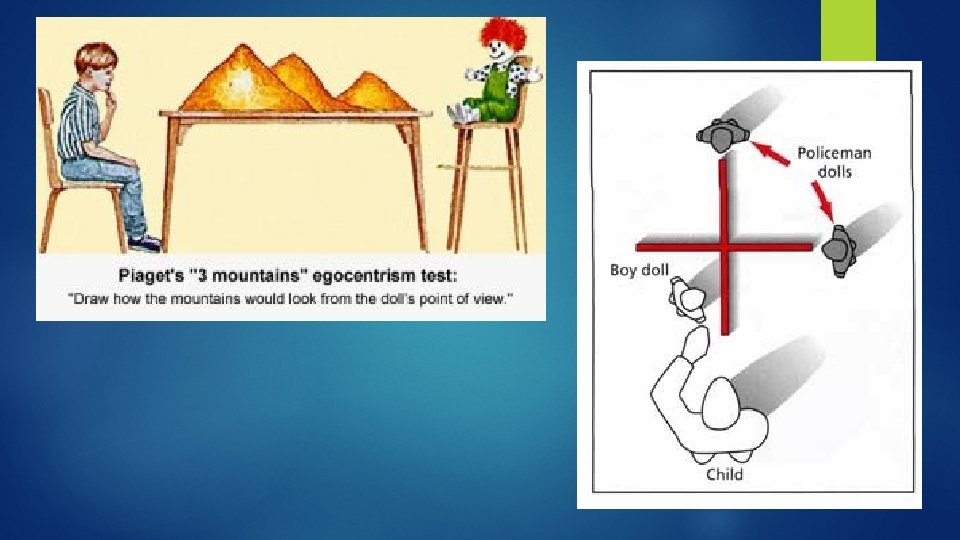
preoperational stage (2 -7 years). stage children begin to think symbolically and use language. The child’s thinking is still very intuitive (able to make sense of something without using reasoning). Language is not as sophisticated. Child is ego-centric.
Concrete operational stage (7 -11 years) children begin to understand conservation – the concept that weight, mass and volume of matter remain unchanged (are conserved) even when the shape or appearance of object changes During this stage children begin to use concepts such as time, space and number Child can think logically about concrete objects or situations, categories and principles. Reverse thought
Formal operations stage (11+). Moving away from concrete objects and specific examples, thinking is based more on abstract principles – thinking in terms of concepts that cannot be necessarily seen. (i. e. democracy, honour). in this stage children can think about their thought and they become less egocentric. Can think of hypothetical situations. Full adult intellectual ability is attained during this stage. They can comprehend more advanced maths/science/other abstract systems.
Evaluation of Piaget – strengths Theory has received longitudinal/cross sectional/cross cultural support. The fundamental aspects are still valid contributions today. Generated a huge amount of critical research to increase our understanding of cognitive development. theory can be applied education – has made education more effective.
Evaluation of Piaget – weaknesses Many of the stages outlined in theory appear to occur much earlier than expected. Over estimated peoples formal operational abilities (some researchers believe that only ever 1/3 of the population actually reach that stage) Theory is more of a description of the process not an explanation.
Evaluation of Piaget – weaknesses Neglects cognitive factors that could have accounted for the individual differences in development that children show. i. e. memory span, memory, motivation, impulsiveness. Overall underestimates the effect of social factors. Unscientific method – lack of controls, small samples, absence of statistical analysis in his research.
Criticisms of the TASKS Piaget used to gain his results. Tasks are not realistic/not familiar to children/outside children’s everyday experiences Tasks that involve an adult repeatedly asking children the same question might put pressure on children to change their answer Tasks do not take into consideration social interaction that is an import ant part of children’s learning/world. Tasks rely on verbal expression of understanding and so can underestimate competence in children who have difficulties expressing themselves