
Piaget Vygotsky Erikson Kohlberg Overview of developmental psychology
Piaget, Vygotsky. Erikson, Kohlberg Overview of developmental psychology. A. Kent Van Cleave, Jr. , Ph. D.
Human Development Physical, Cognitive, Psychosocial and Moral Development from the perspectives of Piaget, Vygotsky, Erikson, and Kohlberg For a fairly comprehensive timeline for the first five years, see http: //www. talaris. org/timeline. htm Information on adolescent brain development at http: //www. pbs. org/wgbh/pages/frontline/shows/t eenbrain/work/adolescent. html
Piaget: Basic Concepts • Scheme: – Organized pattern of behavior or thought • Organization: – Tendency to coherently systematize and combine processes into general systems • Adaptation: – Process of creating a good fit between one’s conception of reality and one’s experiences • Equilibration: – Tendency to organize schemes to allow better understanding of experiences
Cognitive Development Piaget and Vygotsky are the major theorists. Cognitive development is tied to brain development. Observable brain development milestones are tied closely to changes in how the brain processes.
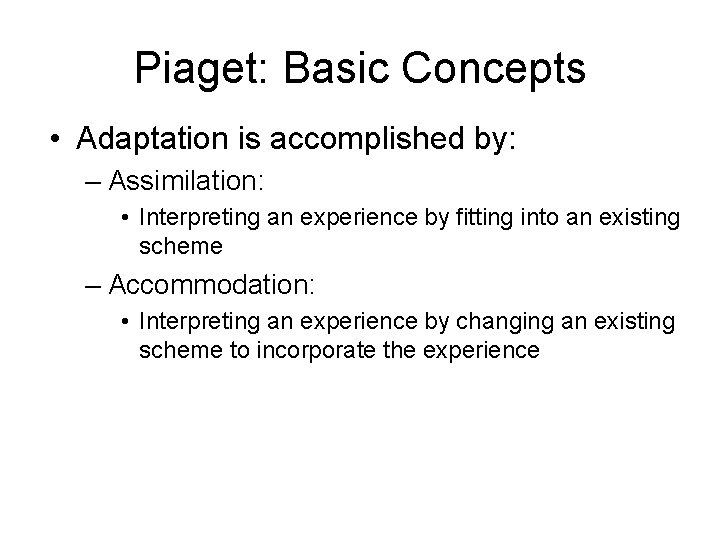
Piaget: Basic Concepts • Adaptation is accomplished by: – Assimilation: • Interpreting an experience by fitting into an existing scheme – Accommodation: • Interpreting an experience by changing an existing scheme to incorporate the experience
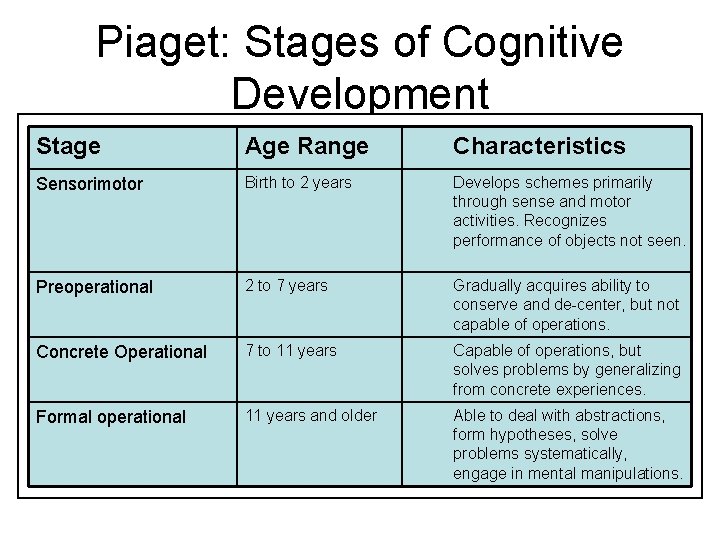
Piaget: Stages of Cognitive Development Stage Age Range Characteristics Sensorimotor Birth to 2 years Develops schemes primarily through sense and motor activities. Recognizes performance of objects not seen. Preoperational 2 to 7 years Gradually acquires ability to conserve and de-center, but not capable of operations. Concrete Operational 7 to 11 years Capable of operations, but solves problems by generalizing from concrete experiences. Formal operational 11 years and older Able to deal with abstractions, form hypotheses, solve problems systematically, engage in mental manipulations.
Piaget: Criticisms • • Underestimated children’s capabilities Overestimated adolescents’ capabilities Vague explanations for cognitive growth No consideration for cultural differences
Vygotsky: Basic Assumptions • Thinking is influenced by one’s culture (social forces, historical forces) • Psychological tools aid and change one’s thought processes • Social interaction is the primary cause/means of cognitive development • An internalized offshoot is self-talk, in which we learn by talking to ourselves.
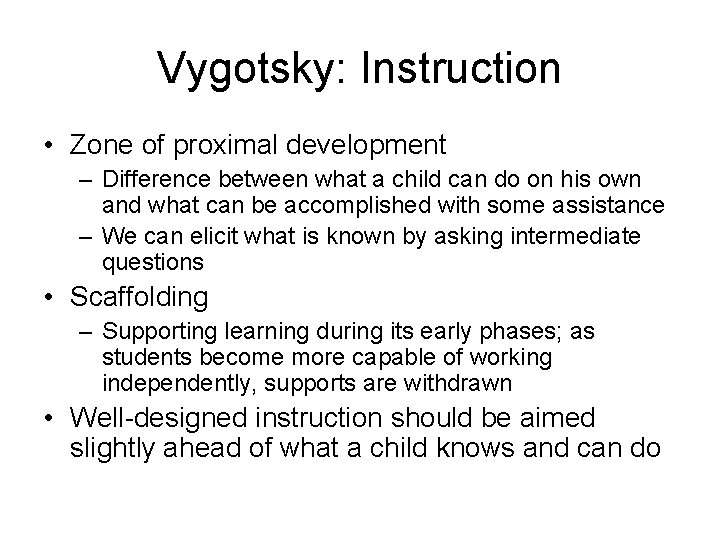
Vygotsky: Instruction • Zone of proximal development – Difference between what a child can do on his own and what can be accomplished with some assistance – We can elicit what is known by asking intermediate questions • Scaffolding – Supporting learning during its early phases; as students become more capable of working independently, supports are withdrawn • Well-designed instruction should be aimed slightly ahead of what a child knows and can do
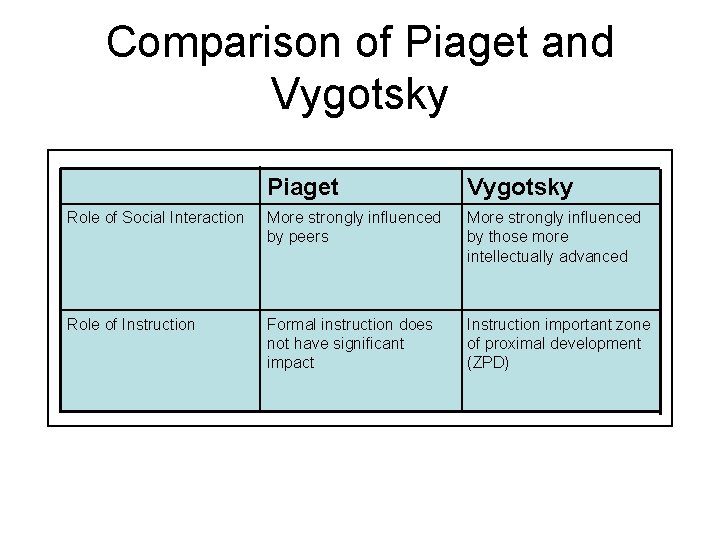
Comparison of Piaget and Vygotsky Piaget Vygotsky Role of Social Interaction More strongly influenced by peers More strongly influenced by those more intellectually advanced Role of Instruction Formal instruction does not have significant impact Instruction important zone of proximal development (ZPD)
Erikson’s Stages of Psychosocial Development For an excellent discussion of Erikson online, see Boeree on Erikson
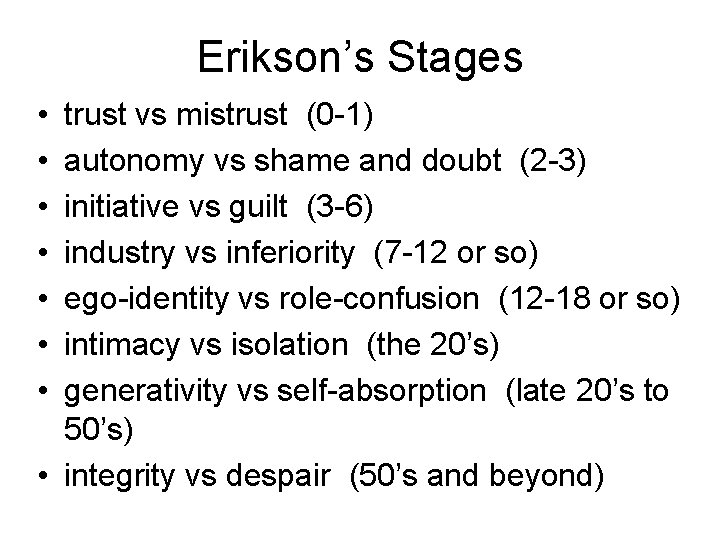
Erikson’s Stages • • trust vs mistrust (0 -1) autonomy vs shame and doubt (2 -3) initiative vs guilt (3 -6) industry vs inferiority (7 -12 or so) ego-identity vs role-confusion (12 -18 or so) intimacy vs isolation (the 20’s) generativity vs self-absorption (late 20’s to 50’s) • integrity vs despair (50’s and beyond)
Erikson’s Stages Trust vs Mistrust (0 -1) • Can I trust my senses? . . . the world around me? • Can I trust my parents to care for me? Sense of self is impacted by how this is resolved. • If trust, self is trusting and prosocial • If mistrust, self is unsociable and suspicious
Erikson’s Stages Autonomy vs Shame and Doubt (2 -3) • Child discovers autonomy (terrible twos) • If child experiences some autonomy, will have positive self-esteem. • If child is not allowed to experience some control over his/her world, will have external locus of control and poor self concept and self esteem.
Erikson’s Stages Initiative vs Guilt (3 -6) • Children learn they can have ideas (plans) and carry them out. • If they learn initiative, they form positive self concept that includes a sense of self efficacy. • If they don’t, they develop a negative self concept that includes a sense of not being in control of their lives.
Erikson’s Stages Industry vs Inferiority (7 -12 ish) • Must learn that ideas are not enough; must actually carry them out (industry) and experience success. • If learn carry things out, develop a positive sense of self. • Else may feel inferior and powerless.
Erikson’s Stages Ego-identity vs Role-confusion (12 -18) • Take all you've learned about life and yourself and mold it into a unified self-image that others find meaningful. • Look mostly to peers at this stage. • Develop a sense of a strong adult identity, form strong self-concept. • If fail, an uncertainty about one's place in society and the world—identity crisis.
Erikson’s Stages Intimacy vs Isolation (the 20’s) • Must develop the ability to be close to others, to love, to share your self with others and gain their love and acceptance. • Success means you have good source of positive feedback about your self but also that you can recognize and accept your shortcomings (after all, others you are intimate with do…)
Erikson’s Stages Generativity vs Self-absorption (late 20’s to 50’s) • an extension of love into the future, concern for future generations • teaching, writing, invention, the arts and sciences, social activism • Success at this means you feel good about who you are and what you do. • Failure may lead to “mid-life crisis, ” a rejection of the self.
Erikson’s Stages Integrity vs Despair (50’s and beyond) • Looking back on life and coming to terms with the choices you made and the things you did or did not do. Accepting death. • If we feel good about what we have done, we accept the disengagement of old age and impending death. Our sense of self includes a feeling of completeness. • If not, we face despair. Our sense of self includes a feeling of incompleteness.
Moral Development Piaget and Kohlberg Piaget studied moral development as part of overall cognitive development. Kohlberg views moral development as a hierarchical series of stages
Piaget: Moral Development • Morality of constraint (moral realism) – Rules are sacred; consequences determine all guilt • Morality of cooperation (moral relativism) – Rules are flexible; intent is important in determining guilt
Kohlberg: Heinz Dilemma • “In Europe a woman was near death from cancer. One drug might save her, a form of radium that a druggist in the same town had recently discovered. The druggist was charging $2, 000, ten times what the drug cost him to make. The sick woman’s husband, Heinz, went to everyone he knew to borrow the money, but he could only get together about half of what it cost. He told the druggist that his wife was dying and asked him to sell it cheaper or let him pay later, but the druggist said “No. ” The husband got desperate and broke into the man’s store to steal the drug for his wife. Should the husband have done that? ” (Kohlberg, 1969, p. 376).

Kohlberg: Stages of Moral Reasoning • Level 1: Preconventional morality – Stage 1: Punishment-obedience orientation – Stage 2: Instrumental relativist orientation • Level 2: Conventional morality – Stage 3: Good boy-nice girl orientation – Stage 4: Law-and-order orientation • Level 3: Postconventional morality – Stage 5: Social contract orientation – Stage 6: Universal ethical principle orientation
Kohlberg: Criticisms • Moral dilemmas are too removed from everyday social interactions • Theory does not adequately address micromoral issues • Too much emphasis on moral reasoning and not enough on moral behavior • Research sample (white males) limits the generalizability of the findings
Gilligan: Moral Development • Believes that females are less concerned about separation and independence and more concerned about remaining loyal through expressions of caring, understanding, and sharing experiences • More likely to resolve identity vs. role confusion and intimacy vs. isolation at the same time
- Slides: 26