
Piaget Theory of cognitive development Psychology ATAR Unit


- Slides: 30
Piaget: Theory of cognitive development Psychology ATAR Unit 4
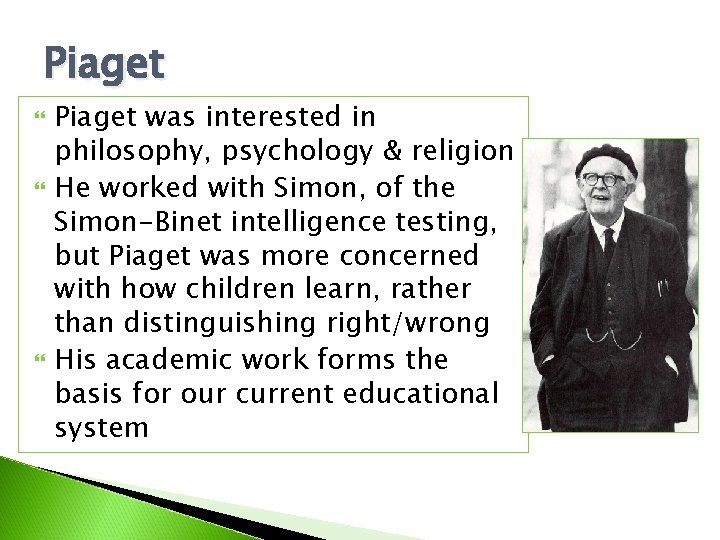
Piaget Piaget was interested in philosophy, psychology & religion He worked with Simon, of the Simon-Binet intelligence testing, but Piaget was more concerned with how children learn, rather than distinguishing right/wrong His academic work forms the basis for our current educational system
Stages Sensorimotor stage Birth – 2 years Pre-operational stage 2 -7 years Concrete operational stage 7 -11 years Formal operational stage 11 & up
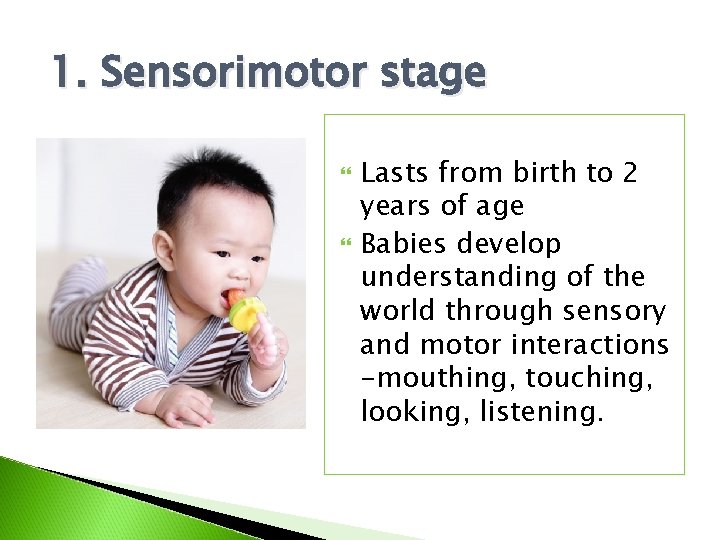
1. Sensorimotor stage Lasts from birth to 2 years of age Babies develop understanding of the world through sensory and motor interactions -mouthing, touching, looking, listening.
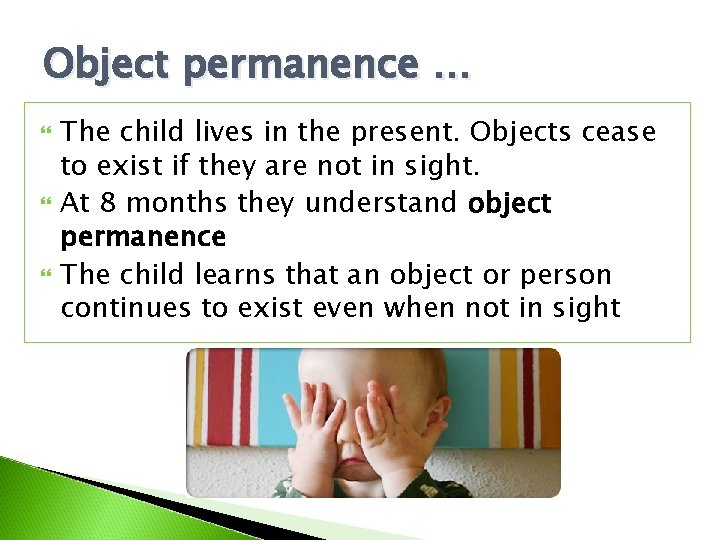
Object permanence … The child lives in the present. Objects cease to exist if they are not in sight. At 8 months they understand object permanence The child learns that an object or person continues to exist even when not in sight
2. Pre-operational stage From 2 – 7 years of age The child can speak and print words Memory and imagination develops
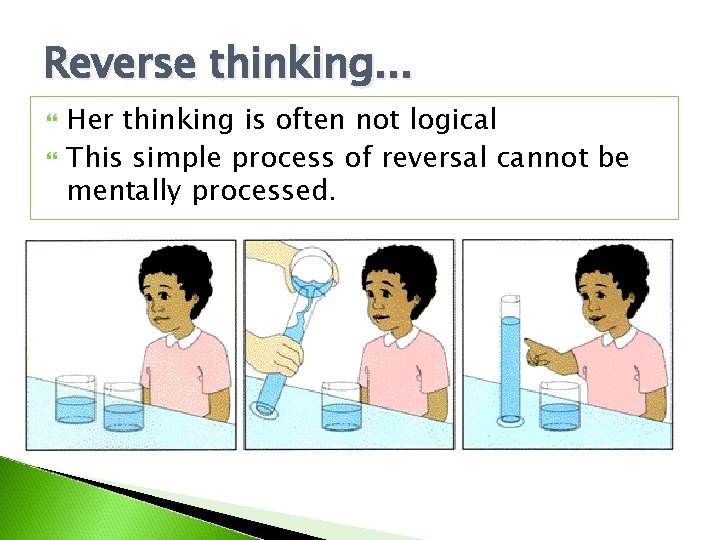
Reverse thinking. . . Her thinking is often not logical This simple process of reversal cannot be mentally processed.
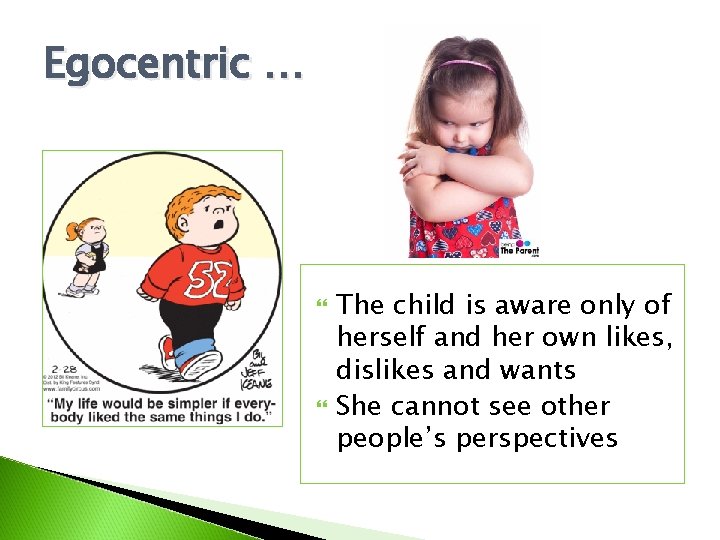
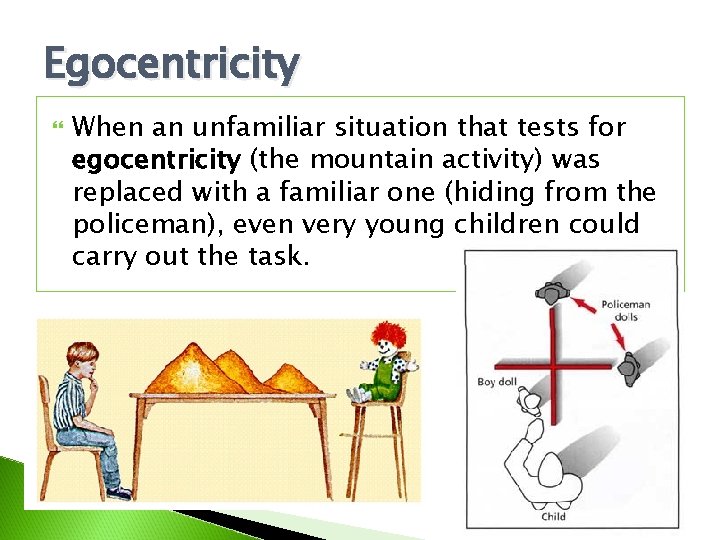
Egocentric … The child is aware only of herself and her own likes, dislikes and wants She cannot see other people’s perspectives
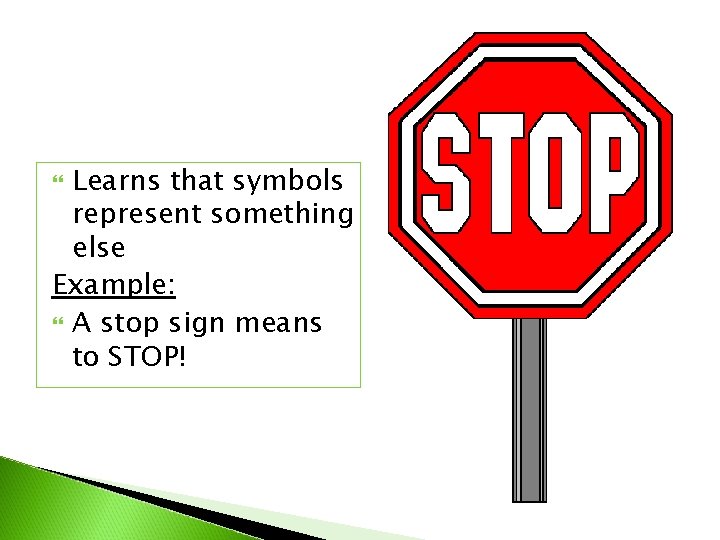
Learns that symbols represent something else Example: A stop sign means to STOP!
3. Concrete operational stage 7 -11 years of age The child has the ability to do simple math and measurement Able to think logically Begins to understand cause & effect Can think about real, concrete things in systematic ways, but cannot understand abstract concepts No longer egocentric
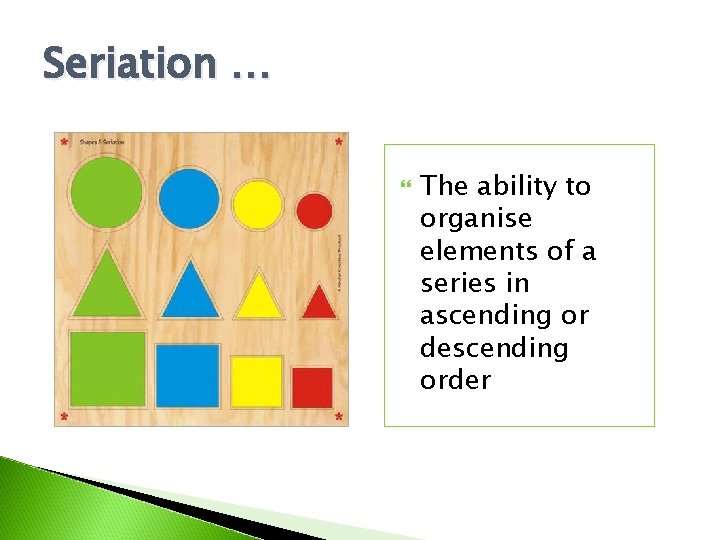
Seriation … The ability to organise elements of a series in ascending or descending order
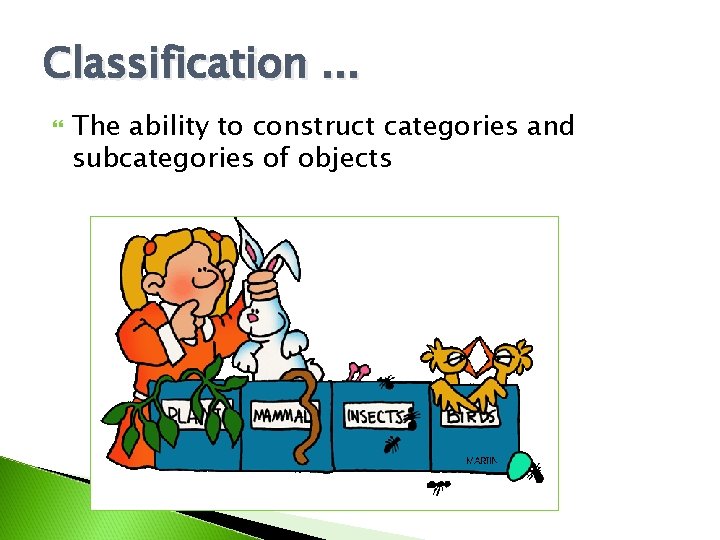
Classification. . . The ability to construct categories and subcategories of objects
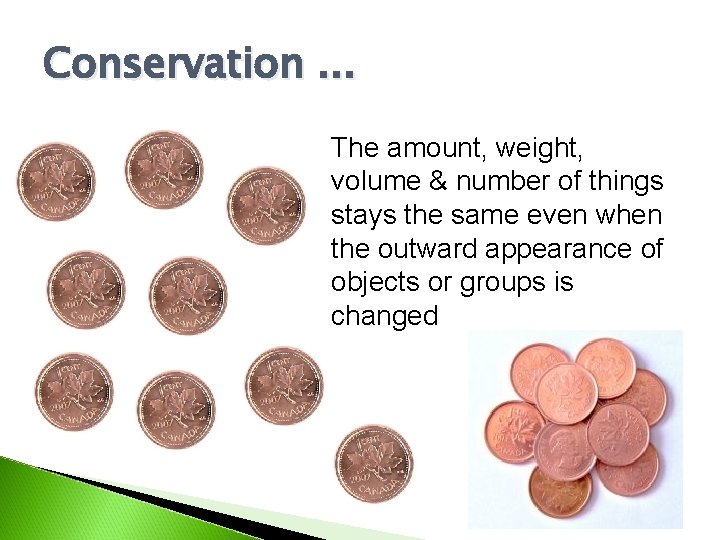
Conservation. . . The amount, weight, volume & number of things stays the same even when the outward appearance of objects or groups is changed
A short glass of water is the same amount as a tall glass half full of water
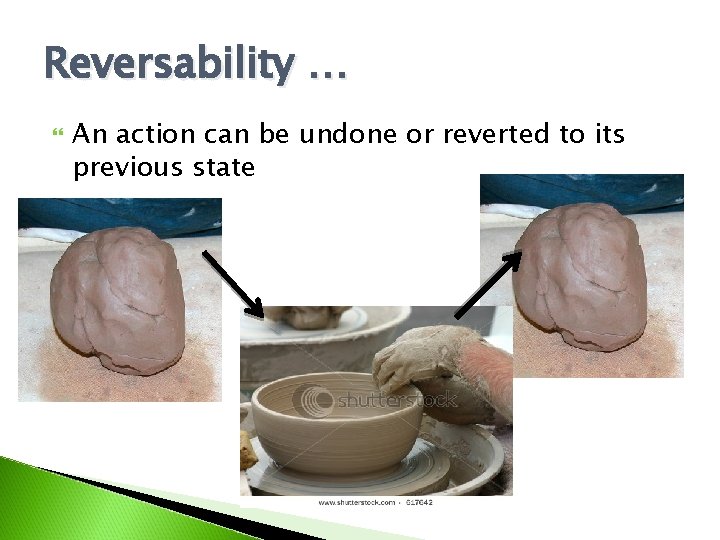
Reversability … An action can be undone or reverted to its previous state
4. Formal operational stage 11 years & up A child is able to think and reason in purely abstract terms Is able to use logic and abstract thinking Questions previously accepted thoughts, ideas and values Can talk about honesty and morality. Possible outcomes of actions can be discussed without having to experience them.
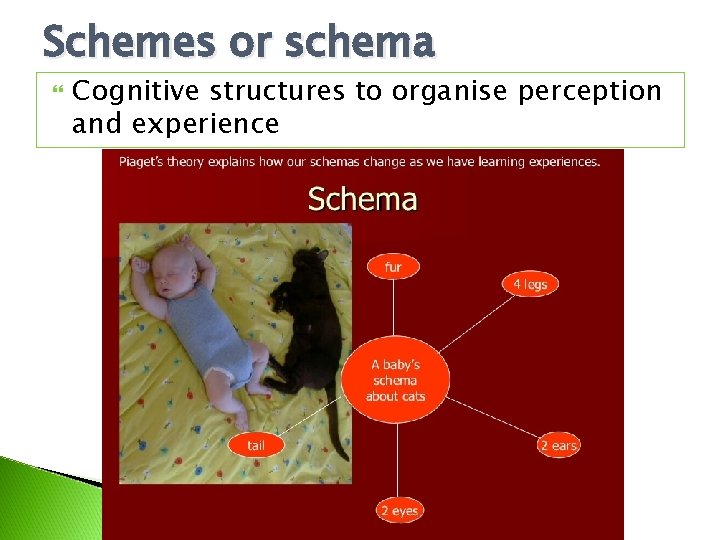
Schemes or schema Cognitive structures to organise perception and experience
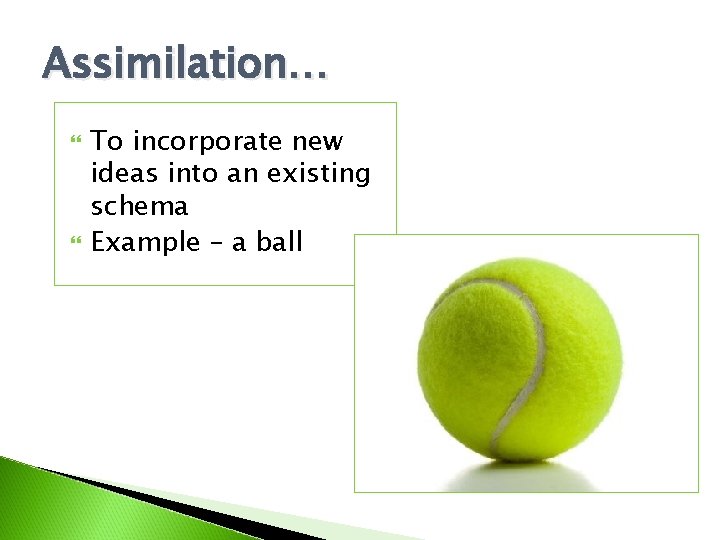
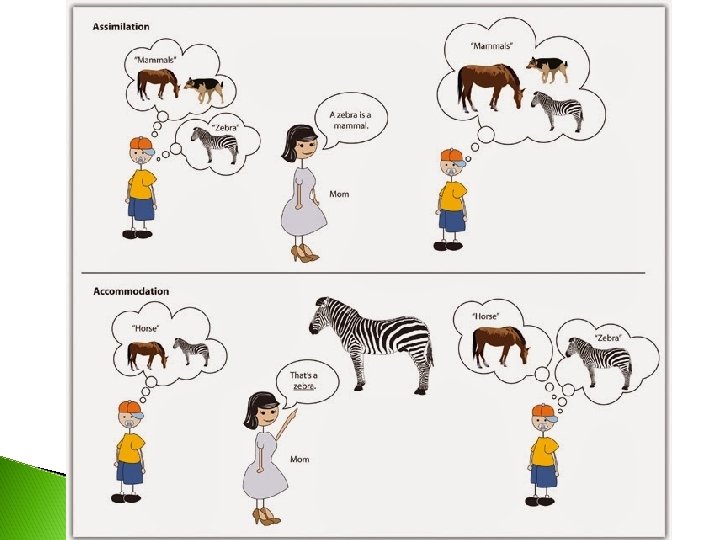
Assimilation… To incorporate new ideas into an existing schema Example – a ball
Accommodation… To adapt old schema and develop new schema for interacting with it When a child adapts his/her existing ideas to fit new understandings For example…
In conclusion … According to Piaget: Assimilation + Accommodation = Learning Discussion How does a baby’s schema of a cat expand develop over time? Include the concepts of assimilation, accommodation and classification in your answer
You tube clip Piaget’s 4 stages of development (6 minutes) https: //www. youtube. com/watch? v=TRF 27 F 2 bn-A
Limitations & criticisms Researchers who criticised Piaget suggest that he: ØUnderestimated young minds ØFailed to distinguish between competence and performance ØGave insufficient attention to social influences on performance
GROUP WORK Why would critics say Piaget underestimated the minds of young children? Consider the way in which the tasks are conducted, the setting and the questioning techniques. What is the difference between competence and performance? Can someone be competent yet not perform well? What factors would influence a child’s performance? How would social factors influence a child’s cognitive development & performance? Think of some of theories and concepts you have learned in Semester 1 and apply these to your answer.
Moving on from Piaget Evidence that shows Piaget’s theory is not universal: Seagrim & Lendon longitudinal study of Australian Aboriginal children. Results showed that only those children who had been totally immersed in white culture were as capable as white children. In all other situations, Aboriginal children lagged behind white children. Conclusion Formal schooling plays a large role in the development of the types of thinking as described by Piaget.
Egocentricity When an unfamiliar situation that tests for egocentricity (the mountain activity) was replaced with a familiar one (hiding from the policeman), even very young children could carry out the task.
Conservation When testing for conservation, the experimenter breaks conversational rules by repeating the same question. Children may then become unsure, thinking they have given the wrong answer, and change their answer. If the way questions are asked is changed, there is evidence that children show understanding of conservation at an earlier age. (Siegal, 1991)
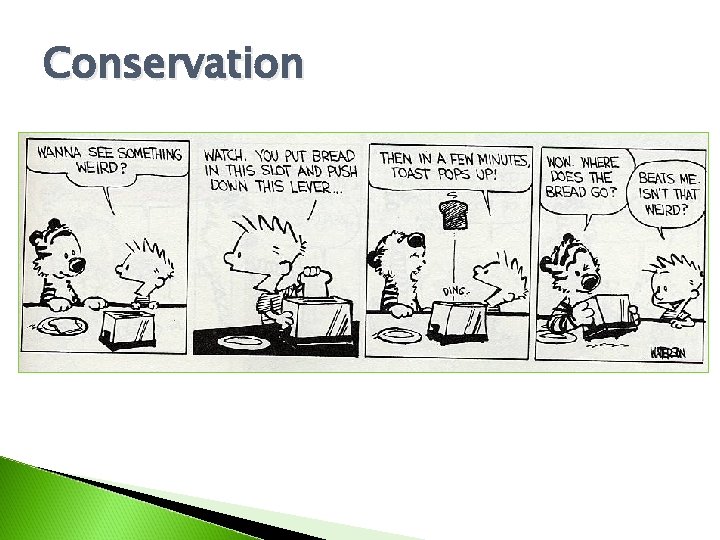
Conservation
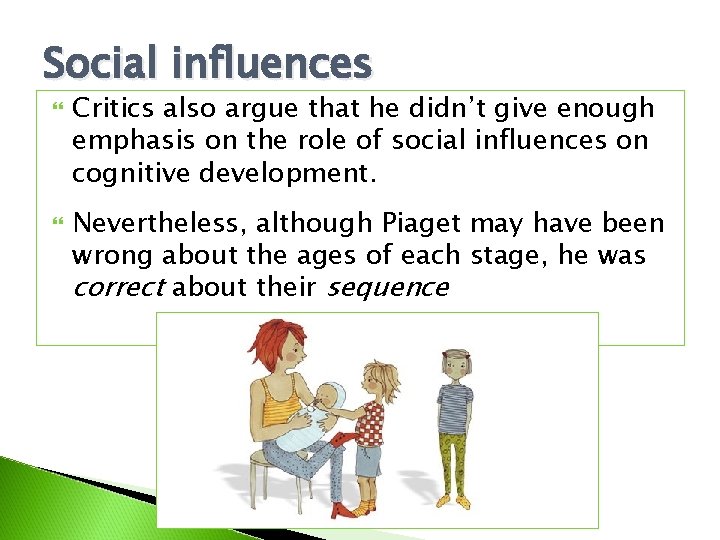
Social influences Critics also argue that he didn’t give enough emphasis on the role of social influences on cognitive development. Nevertheless, although Piaget may have been wrong about the ages of each stage, he was correct about their sequence