
Piaget contest Give the stage and approximate age



- Slides: 42
Piaget contest Give the stage and approximate age
Answer Michelle and Gary separately n Michelle complains because her brother Gary has taken two cookies when he only gave her one. Gary takes her cookie and breaks it in half saying, “Now we both have two”. Michelle yells at him “Not fair, all you did was break mine into two pieces!” n Stages: n Gary – pre-operational/early concrete 5 ish n Michelle – late concrete operational 9+
n Jenny sits in class and daydreams about what kind of society could be created if a group of humans from all over the world moved to a newly discovered planet. n Stage: Formal Operational – abstract thinking – age 12+
n Heather’s ball rolls out of sight under the sofa. She stares at the sofa for a few seconds and then turns and starts to play with her doll. n Stage: Sensorimotor, age less than 8 months
n Elissa becomes upset because her sister’s scoop of ice cream looks taller than her own. Her mother squashes down the sister’s scoop and Elissa is happy now that it looks like they have the same amount. n Stage: Preoperational/early concrete 3 -7
n Matthew’s teacher decides that since the math class is so bright, he will introduce them to algebra. Matthew can’t understand what his teacher means when he says that x is a number. Matthew thinks to himself, “Silly Mr. Morphett doesn’t know that x is a letter. ” n Stage: late concrete, 9/10
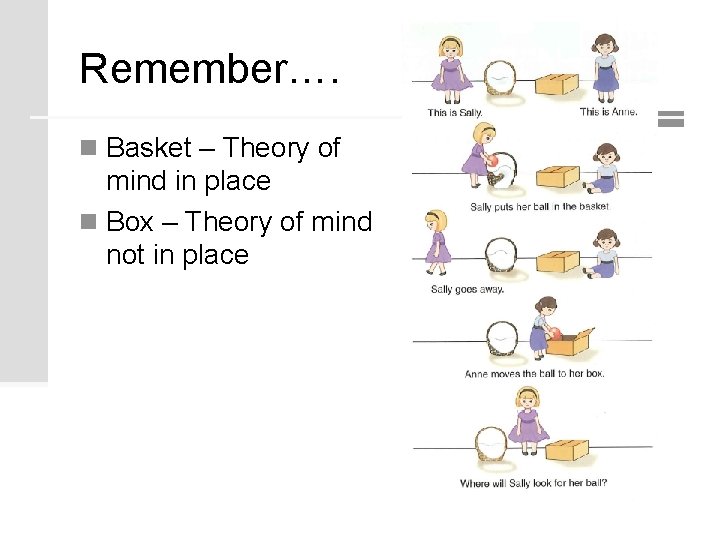
Remember…. n Basket – Theory of mind in place n Box – Theory of mind not in place
Lawrence Kholberg
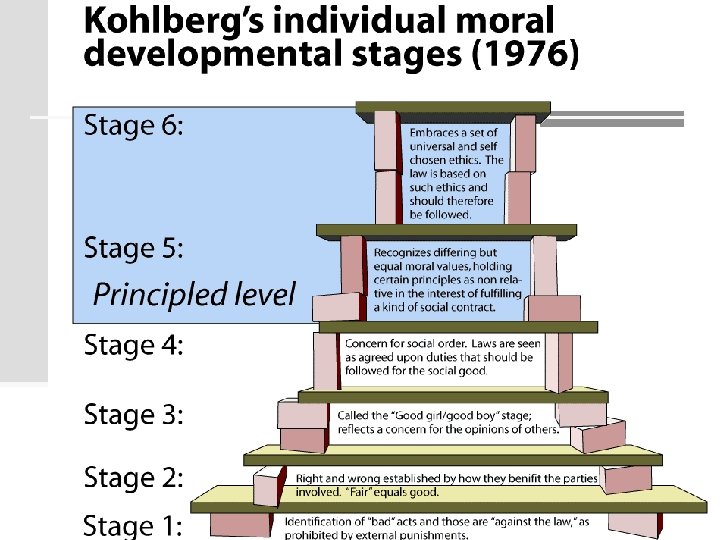
Lawrence Kohlberg n Inspired by the work of Piaget n Moral reasoning progresses sequentially through a series of developmental stages n Method was to use moral dilemmas (ex. Heinz) to investigate children’s reasoning n Identified six stages (2 per level)
Method n 72 Chicago boys aged 10– 16 years, 58 of whom were followed up at three-yearly intervals for 20 years (Kohlberg, 1984). n One two-hour interview based on ten hypothetical moral dilemmas n Studied the answers and was mainly interested in were the reasons for their decisions, not whether the boys judged the actions wrong or right n reasons tended to change as the children got older.
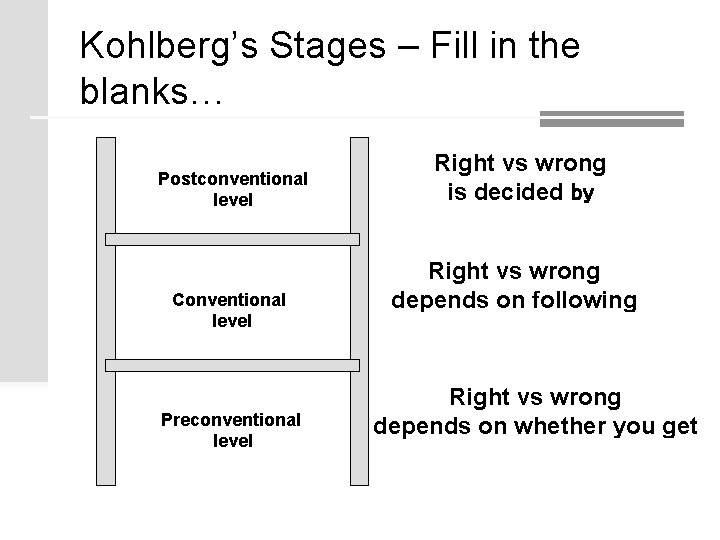
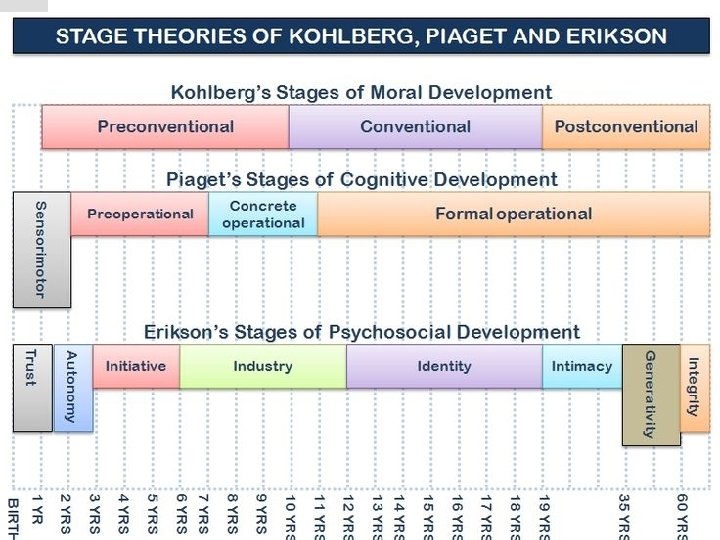
Kohlberg’s Stages – Fill in the blanks… Postconventional level Conventional level Preconventional level Right vs wrong is decided by universal values Right vs wrong depends on following rules and laws Right vs wrong depends on whether you get punished or rewarded
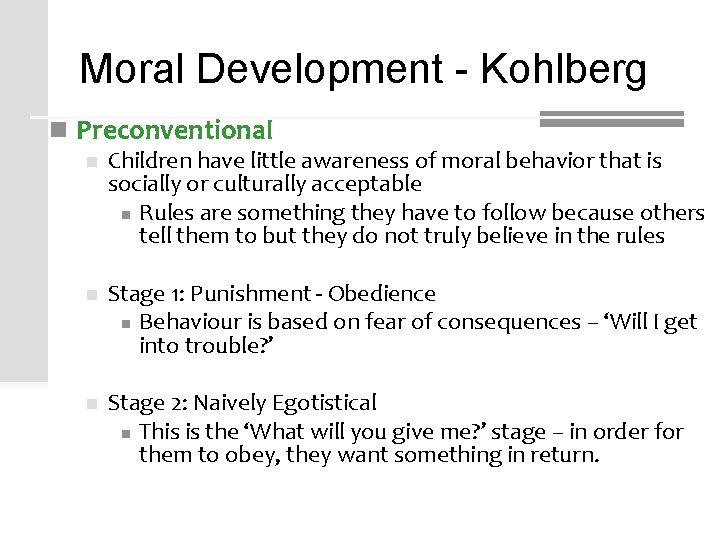
Moral Development - Kohlberg n Preconventional n Children have little awareness of moral behavior that is socially or culturally acceptable n Rules are something they have to follow because others tell them to but they do not truly believe in the rules n Stage 1: Punishment - Obedience n Behaviour is based on fear of consequences – ‘Will I get into trouble? ’ n Stage 2: Naively Egotistical n This is the ‘What will you give me? ’ stage – in order for them to obey, they want something in return.
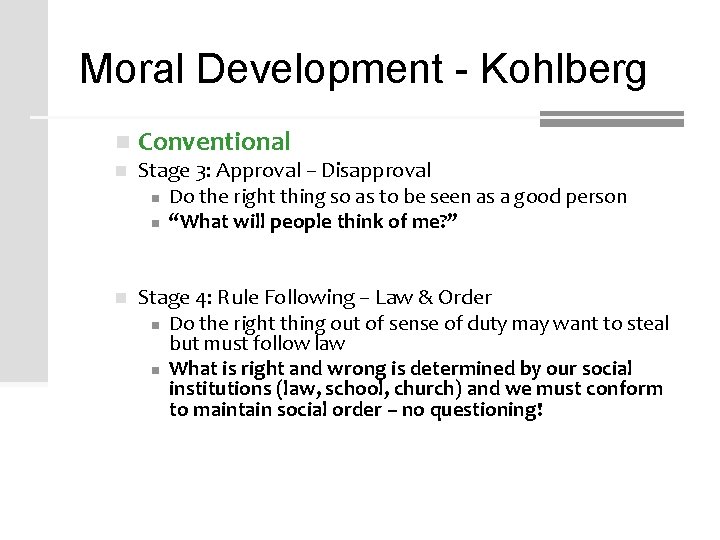
Moral Development - Kohlberg n Conventional n Stage 3: Approval – Disapproval n Do the right thing so as to be seen as a good person n “What will people think of me? ” n Stage 4: Rule Following – Law & Order n Do the right thing out of sense of duty may want to steal but must follow law n What is right and wrong is determined by our social institutions (law, school, church) and we must conform to maintain social order – no questioning!
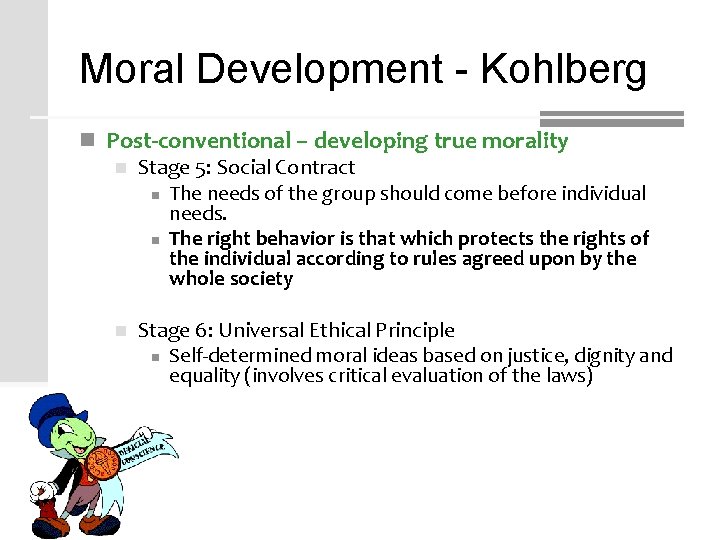
Moral Development - Kohlberg n Post-conventional – developing true morality n Stage 5: Social Contract n The needs of the group should come before individual needs. n The right behavior is that which protects the rights of the individual according to rules agreed upon by the whole society n Stage 6: Universal Ethical Principle n Self-determined moral ideas based on justice, dignity and equality (involves critical evaluation of the laws)
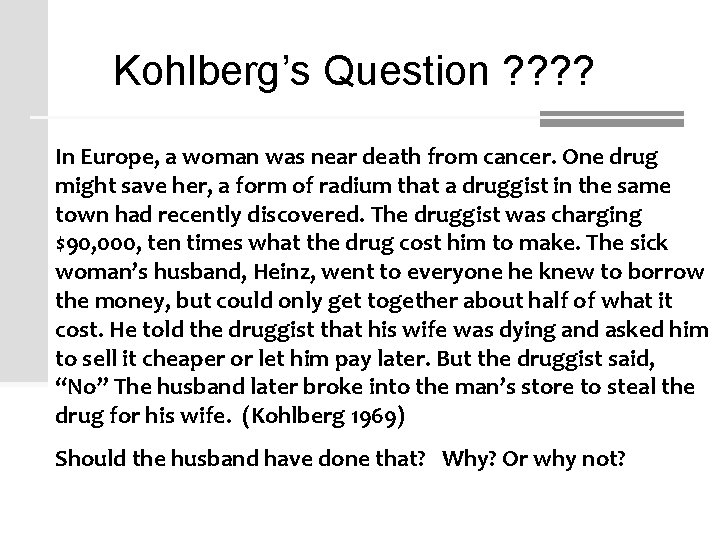
Kohlberg’s Question ? ? In Europe, a woman was near death from cancer. One drug might save her, a form of radium that a druggist in the same town had recently discovered. The druggist was charging $90, 000, ten times what the drug cost him to make. The sick woman’s husband, Heinz, went to everyone he knew to borrow the money, but could only get together about half of what it cost. He told the druggist that his wife was dying and asked him to sell it cheaper or let him pay later. But the druggist said, “No” The husband later broke into the man’s store to steal the drug for his wife. (Kohlberg 1969) Should the husband have done that? Why? Or why not?
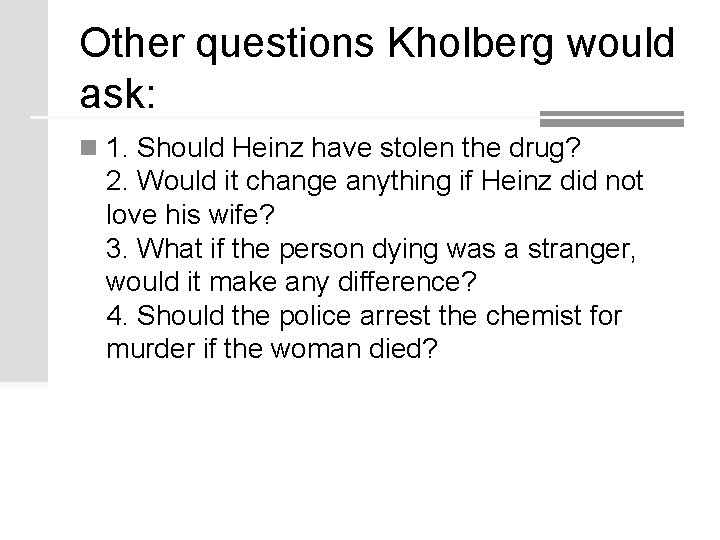
Other questions Kholberg would ask: n 1. Should Heinz have stolen the drug? 2. Would it change anything if Heinz did not love his wife? 3. What if the person dying was a stranger, would it make any difference? 4. Should the police arrest the chemist for murder if the woman died?
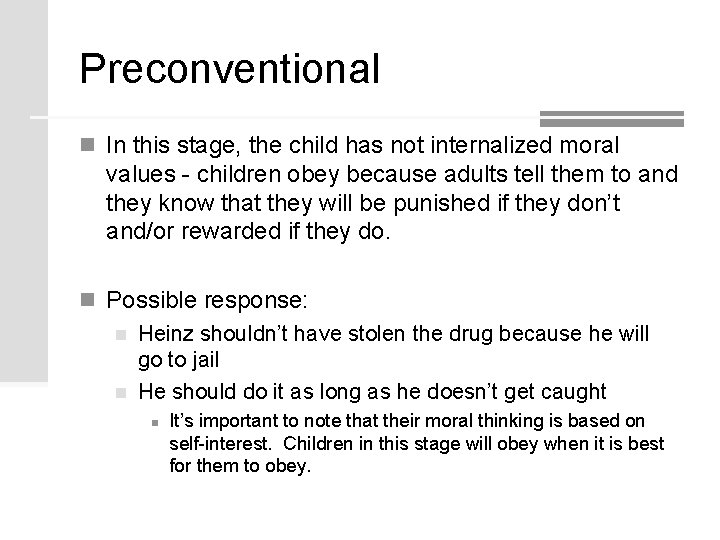
Preconventional n In this stage, the child has not internalized moral values - children obey because adults tell them to and they know that they will be punished if they don’t and/or rewarded if they do. n Possible response: n Heinz shouldn’t have stolen the drug because he will go to jail n He should do it as long as he doesn’t get caught n It’s important to note that their moral thinking is based on self-interest. Children in this stage will obey when it is best for them to obey.
Conventional n Older children are at an intermediate level of internalization where they see rules as needed to maintain social order. n Typically in early adolescence, there is reliance on interpersonal norms of trust, caring, and loyalty to make moral judgments n Possible responses: n Heinz should have stolen the drug because that is what is expected of him as a husband. n It may be good for Heinz to want to steal to help his wife, but it is still wrong because stealing is against the law
Post-conventional n Moral development is completely internalized supported by the ability to recognize alternative moral courses, explore options, and personal moral codes n The individual weighs the community rights versus personal rights. Values and laws are relative and standards may vary but some values (such as freedom) are more important than the law n Possible responses: n The law wasn’t set up for circumstances such as the ones presented and so Heinz has the right to steal the drug. n Heinz shouldn’t steal the drug as the druggist may stop manufacturing cancer fighting drugs and then many people would die
Post-conventional… n They see a justification for technically illegal behavior when it is in the best interest of society to save a human life, for example. n They also make moral judgments based on universal human rights. n During an ethical dilemma between law and conscience – a personal, individual conscience is followed.
Stage 6 example n At 24, Richard says: "A human life takes precedence over any other moral or legal value, whoever it is. A human life has inherent value whether or not it is valued by a particular individual. The worth of the individual human being is central where the principles of justice and love are normative for all human relationships. " n Stage 6 in seeing the value of human life as absolute in representing a universal and equal respect for the human as an individual. He has moved step by step through a sequence culminating in a definition of human life as centrally valuable rather than derived from or dependent on social or divine authority.
Criticisms of Kohlberg n The dilemmas lack ecological validity Life situations that children would not have encountered n Hypothetical nature brings questions to the validity n What you say you would do and what you actually do may differ when there are real consequences n Inherent Western bias (individualistic culture) n Unclear that there are set stages n n Different stories elicited responses at different levels n Gender bias - Masculine point of view n detached reasoning rather than including emotional considerations
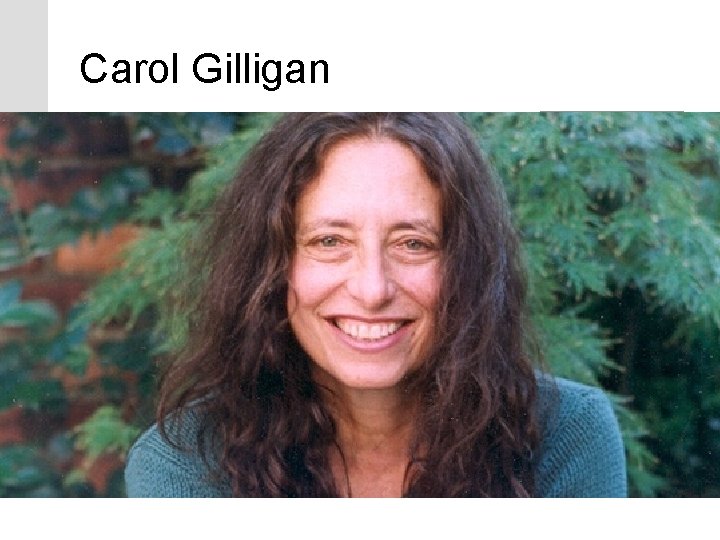
Carol Gilligan
Gilligan’s Moral Stages n Gilligan’s theory of moral development includes 3 general phases (stages) which humans can develop. They are: n morality as individual survival n morality as self-sacrifice n morality as equality n Gilligan’s theory is often considered to be a feminist view of moral development.
Gilligan expanded n Morality as individual survival n The young child’s first sense of what is good for them. Young children follow rules to obtain rewards for themselves and avoid punishment n Morality as self-sacrifice n This is attained after becoming aware of the needs of others. In this stage, the person believes that to be good and to be approved of by others, they must sacrifice their own needs and meet the needs of others
Gilligan expanded n Morality as equality n the person views their own needs as equal to those of others. n People at this stage have progressed from believing that they must always please others at the expense of their own wishes to a belief that everyone’s needs should be met when possible – sacrifices should be shared equally when the needs of all cannot be met n This involves advocacy of non-violence
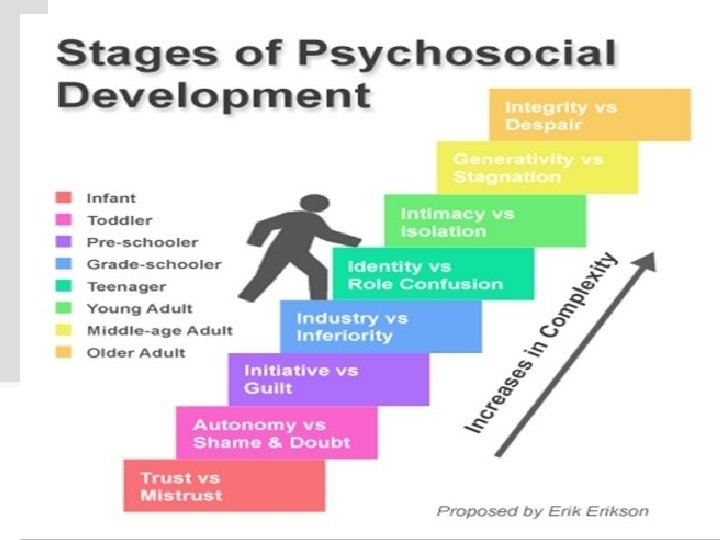
Erikson’s Stages of Development n Trust vs. mistrust n Birth to 1 year n Treatment by caregivers creates trust in a good world n Autonomy vs. shame and doubt n 1 to 2 years n Child is allowed to make independent decisions or is made to feel ashamed/full of doubt about own decisions n Initiative vs. guilt n 3 to 6 years n Child either develops own purpose/direction or is made to feel guilty by overly controlling caregivers
Erikson’s Stages of Development n Industry vs. inferiority n 6 to 11 years n Child either feels competent working with others or inferior n Identity vs. role confusion n Adolescence n Adolescent either grasps sense of identity or becomes confused about possible future roles as adult n Intimacy vs. isolation n Young adulthood (ages 20 to 40) n Forming deep/intimate relationships with others or becoming socially isolated
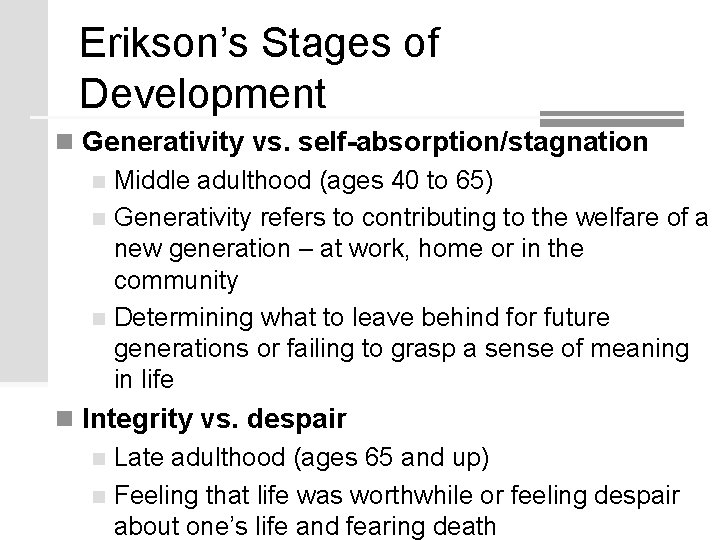
Erikson’s Stages of Development n Generativity vs. self-absorption/stagnation n Middle adulthood (ages 40 to 65) n Generativity refers to contributing to the welfare of a new generation – at work, home or in the community n Determining what to leave behind for future generations or failing to grasp a sense of meaning in life n Integrity vs. despair n Late adulthood (ages 65 and up) n Feeling that life was worthwhile or feeling despair about one’s life and fearing death
As an exercise… n Create a scenario where you have an individual that conforms to each of the stage theories n Decide on the age then describe their capabilities or challenges n Cognitively what can they do, morally how do they reason, psychosocially, what do they need to resolve? § Create your scenarios then justify your description by connecting them to theories
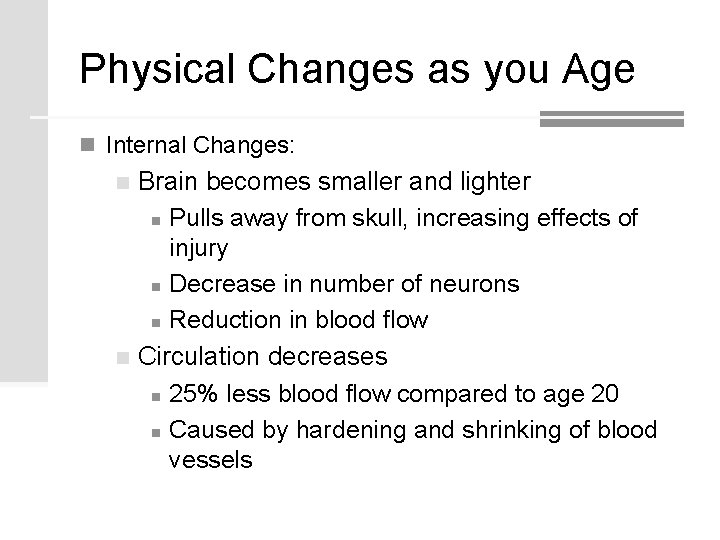
Physical Changes as you Age n Internal Changes: Brain becomes smaller and lighter n Pulls away from skull, increasing effects of injury n Decrease in number of neurons n Reduction in blood flow n Circulation decreases n 25% less blood flow compared to age 20 n Caused by hardening and shrinking of blood vessels n
Future of aging n Alzheimer’s Video n Using Young blood video n To what extent do you find these videos hopeful?
Poor Homer n https: //www. youtube. com/watch? v=j. YN 4 Cll. W ui. M
Grief: Kübler-Ross “Stages of Acceptances” n Kubler-Ross (1969) studied the feelings of relatives after someone close had died as well as observing those who had been told they are dying. n She found that we all go through the same set of n n n emotions over a period of many months. 1. Denial 2. Anger 3. Bargaining 4. Depression 5. Acceptance
Evaluation of Kubler-Ross n Enormous impact n Applies only to those aware of pending death n Not very useful in cases with ambiguous prognosis n May be too restrictive Role of anxiety n Role of chronic severe pain n