
Phytochemical Screening And Biocidial Studies Of Stem Bark
Phytochemical Screening And Biocidial Studies Of Stem Bark Chrysophyllum Albidum (Linn) And Straw Aristolochia Ringens Moses S. Owolabi 1*, Omowonuola, A. Adenike 1, Oladipupo A. Lawal 1, Avoseh N. Opeyemi 1. , Ogunwande I. Ajani 1. and William N. Setzer 2 1 Department 2 Department of Chemistry, Lagos State , University, PMB 001, Ojo, Lagos, Nigeria of Chemistry, University of Alabama in Huntsville, Alabama 35899, USA.
OUTLINE • Introduction • Materials and Methods • Results and Discussion • Conclusion • Acknowledgement • References
Introduction • Medicinal plants play a significant role in the health maintenance in underdeveloped countries, Extracts from herbs and spices continue to serve as a new sources for herbal medicines in all divisions of human population as folk medicines. • Chrysophyllum albidum (Linn) commonly known as white star apple is a Tropical forest fruit tree belongs to the Sapotaceae family with about 800 species (Ehiagbonare et al, 2008). Native to West and central Africa countries • Locally the plant is named ‘Agbalumo’, (Yoruba) been used traditionally as antimalaria and yellow fever concoction, as an emollient for skin eruption, treatment of stomach ache and diarrhea (Idowu et al. , 2006). • Studies have reported that seeds and roots extracts of C. albidium have demonstrated good antimicrobial, anti-inflammatory, anti-diarrheal and antihemorrhoidal properties (Okoli and Okere, 2010).
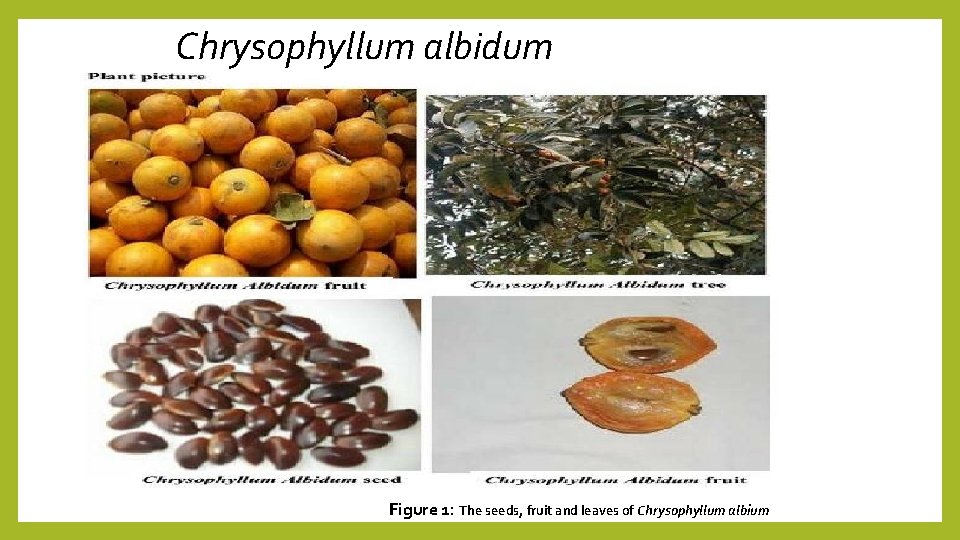
Chrysophyllum albidum Figure 1: The seeds, fruit and leaves of Chrysophyllum albium
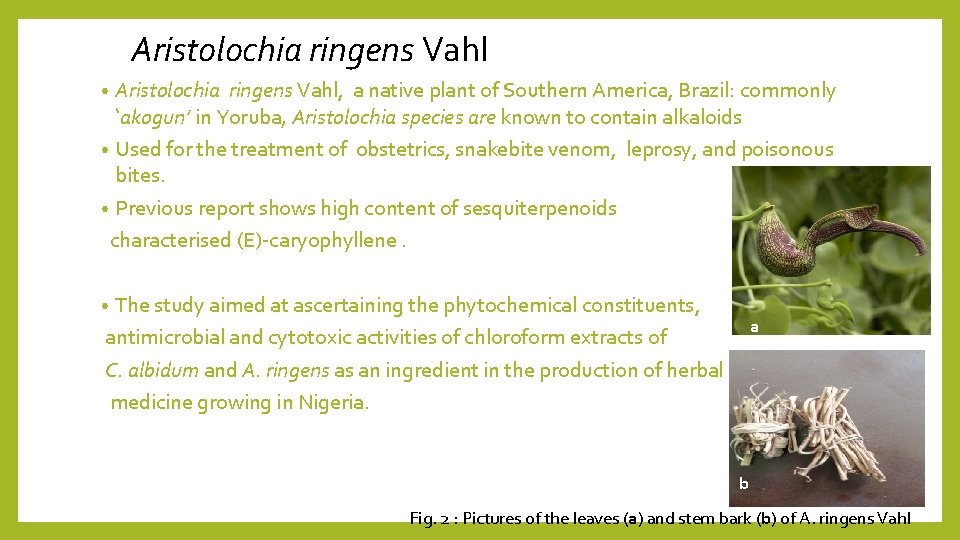
Aristolochia ringens Vahl, a native plant of Southern America, Brazil: commonly ‘akogun’ in Yoruba, Aristolochia species are known to contain alkaloids • Used for the treatment of obstetrics, snakebite venom, leprosy, and poisonous bites. • Previous report shows high content of sesquiterpenoids characterised (E)-caryophyllene. • The study aimed at ascertaining the phytochemical constituents, a antimicrobial and cytotoxic activities of chloroform extracts of C. albidum and A. ringens as an ingredient in the production of herbal medicine growing in Nigeria. • b Fig. 2 : Pictures of the leaves (a) and stem bark (b) of A. ringens Vahl
MATERIALS AND METHODS • Plant preparation and extraction: Chrysophyllum albidum and Aristoclohia ringens • Phytochemical screening : (Sofowora, 1993 b, : Trease and Evans, 1989 and Harborne, 1973) methods with little modification. Ø(Screening for alkaloids, flavonoids, phenols, tannins, anthraquinones, Cardiac Glycosides, Phlobatannins, Terpenoids and Steroids. • Quantification of Phytochemicals v Preparation of fat free sample: using diethylether v. Determination of total alkaloids using (Harborne, 1973) method : reagent (CH 3 COOH /ethanol and NH 3 ) v. Flavonoid determination by (Boham and Kocipai, 1974) method : reagent (CH 3 OH )
Antimicrobial Screening v. The chloroform extract was screened for antimicrobial activity against Gram- positive bacteria( Bacillus cereus, Staphylococcus aureus, Staphylococcus epidermidis) Gram-negative bacteria, (Pseudomonas aeruginosa, Serratia marcescens and Escherichia coli ) v. Minimum inhibitory concentrations (MIC) were determined using the microbroth dilution technique (Satyal et al. , (2012) in which the crude extract were prepared in cation-adjusted Mueller Hinton broth (CAMHB)and serially diluted in 96 -well plates. v. Microorganisms were added to each well. Plate were incubated at 37 o. C for 24 hr. v. Gentamicin was used as a positive antibiotic control; DMSO was used as a negative control. v. Antifungal activity was determined as described above using Candida albicans in yeast-mold (YM). Amphotericin B was the positive control.
• Cytotoxicity Test Hepatocarcinoma cell line of human being marked (Hep. G 2, CRL-11997™) Cells were grown in DMEM: F 12 made up of L-glutamine and sodium bicarbonate, 10% of FBS, with 1% penicillin/streptomycin v Once about 90% confluent is observed, the cells were risen with phosphate buffered saline and were suspended in a fresh complete media. 5 105 cells/well (100 µL) were seeded in a 96 -well plates and warmed for 24 hr to attach to the wall. v Cells were treated with chloroform extracts at varying concentration for 72 hrs. v • DMEM: F 12 media was replaced by MTT assay (3 -(4, 5 -dimethylthiazol-2 -yl)-2, 5 -diphenyl tetrazolium bromide) and then DMSO. Absorbance was measured at 550 nanometer. All extracts were tested in triplicate. • MCF-7 (human breast tumor marked ATCC No. HTB-22) cell v About 80% cell growth was achieved after culturing of cells in a 96 -well culture plates for 2 days. v Growing medium, DMSO, and tingenone (100 μg/m. L) were used as negative and positive control compounds, respectively. Eight replicate solutions were added to wells. The percent kill ratios (% killcompound / % killcontrol) were determined and average absorbance, standard deviations were also calculated.
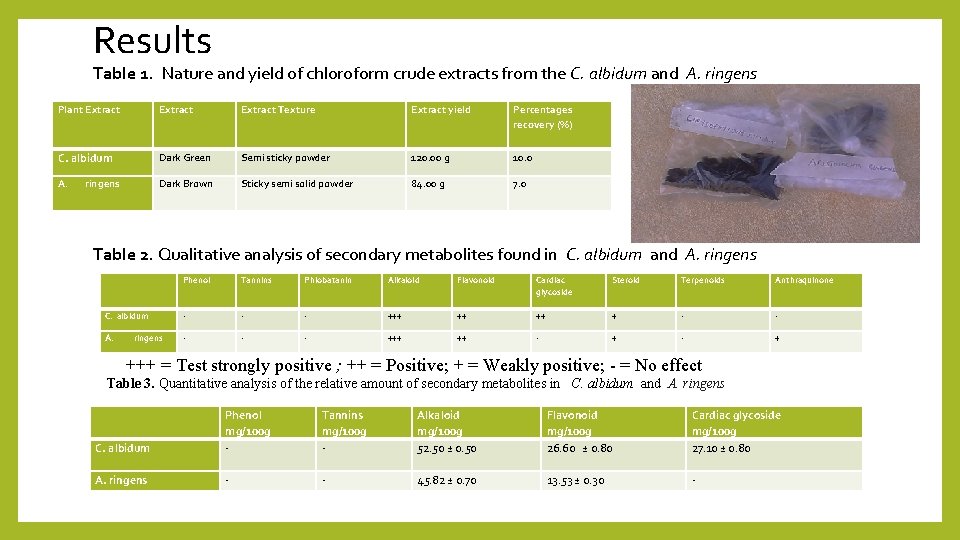
Results Table 1. Nature and yield of chloroform crude extracts from the C. albidum and A. ringens Plant Extract Texture Extract yield Percentages recovery (%) C. albidum Dark Green Semi sticky powder 120. 00 g 10. 0 A. Dark Brown Sticky semi solid powder 84. 00 g 7. 0 ringens Table 2. Qualitative analysis of secondary metabolites found in C. albidum and A. ringens Phenol Tannins Phlobatanin Alkaloid Flavonoid Cardiac glycoside Steroid Terpenoids Anthraquinone C. albidum - - - +++ ++ ++ + - - A. - - - +++ ++ - + ringens +++ = Test strongly positive ; ++ = Positive; + = Weakly positive; - = No effect Table 3. Quantitative analysis of the relative amount of secondary metabolites in C. albidum and A. ringens C. albidum Phenol mg/100 g - Tannins mg/100 g - Alkaloid mg/100 g 52. 50 ± 0. 50 Flavonoid mg/100 g 26. 60 ± 0. 80 Cardiac glycoside mg/100 g 27. 10 ± 0. 80 A. ringens - - 45. 82 ± 0. 70 13. 53 ± 0. 30 -
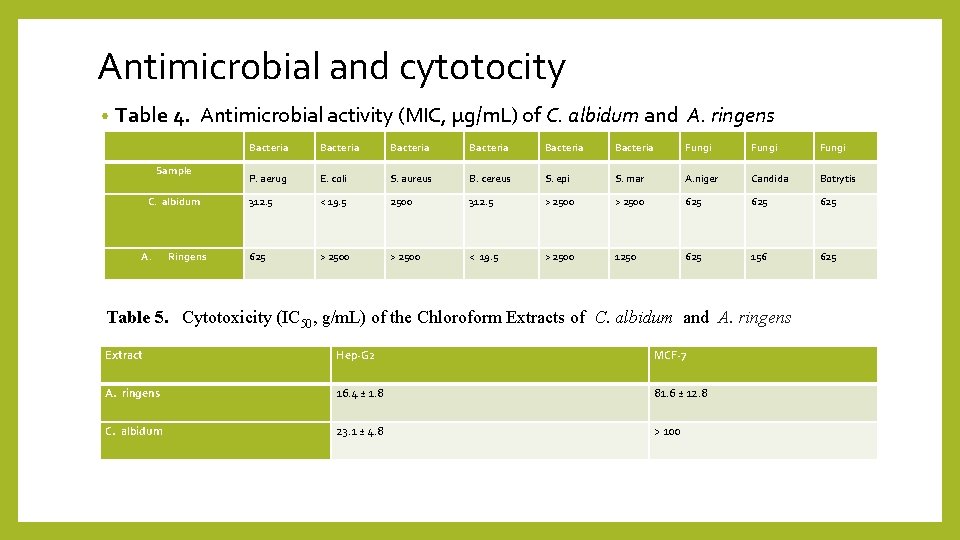
Antimicrobial and cytotocity • Table 4. Antimicrobial activity (MIC, μg/m. L) of C. albidum and A. ringens Sample C. albidum A. Ringens Bacteria Bacteria Fungi P. aerug E. coli S. aureus B. cereus S. epi S. mar A. niger Candida Botrytis 312. 5 < 19. 5 2500 312. 5 > 2500 625 625 > 2500 < 19. 5 > 2500 1250 625 156 625 Table 5. Cytotoxicity (IC 50, g/m. L) of the Chloroform Extracts of C. albidum and A. ringens Extract Hep-G 2 MCF-7 A. ringens 16. 4 ± 1. 8 81. 6 ± 12. 8 C. albidum 23. 1 ± 4. 8 > 100
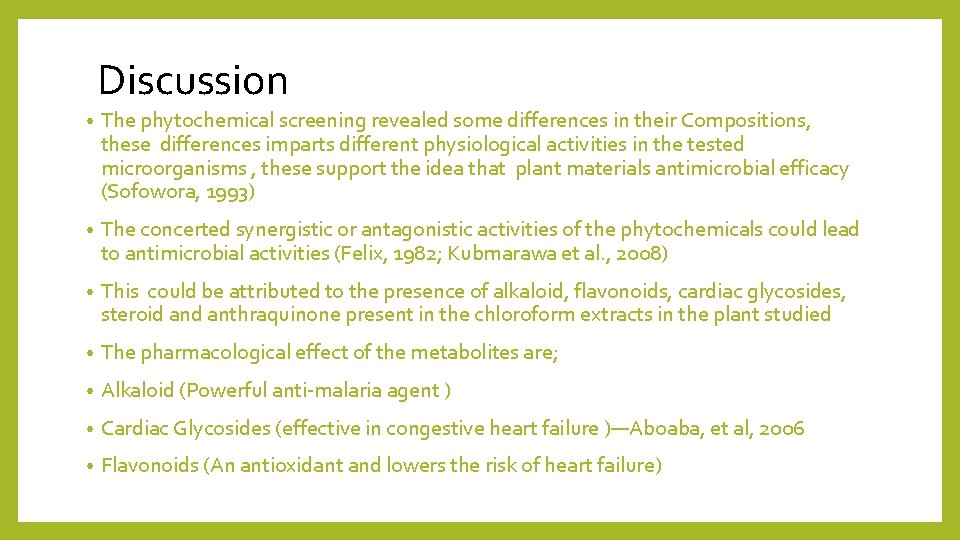
Discussion • The phytochemical screening revealed some differences in their Compositions, these differences imparts different physiological activities in the tested microorganisms , these support the idea that plant materials antimicrobial efficacy (Sofowora, 1993) • The concerted synergistic or antagonistic activities of the phytochemicals could lead to antimicrobial activities (Felix, 1982; Kubmarawa et al. , 2008) • This could be attributed to the presence of alkaloid, flavonoids, cardiac glycosides, steroid anthraquinone present in the chloroform extracts in the plant studied • The pharmacological effect of the metabolites are; • Alkaloid (Powerful anti-malaria agent ) • Cardiac Glycosides (effective in congestive heart failure )—Aboaba, et al, 2006 • Flavonoids (An antioxidant and lowers the risk of heart failure)
Conclusion • The Medicinal plants studied demonstrated the presence of secondary metabolites with good potential biological activities , support the idea that traditional medicines remain useful healthcare in developing countries. • Further research work is ongoing towards bio-guided column chromatography and in-vivo studies of these plants.
Acknowledgment We are grateful to Elizabeth Jaiyeola for botanical identification and collection of Chrysophyllum albidum and Aristoclohia ringens, used in this study and also to W. N. S group for carrying out the biological experiments and analysing of the data.
References • Aboaba, S. O. , Smith, S. I. , Olide, F. O. , 2006. Antimicrobial effect of edibles plant extracts on escherichia coli 0157: H 7 Pakistan. Journal of Nutrition. 5(4), 325 -327. • Boham, B. A. , Kocipai, A. C. , 1974. Flavonoids and Condensed Tannins from Leaves of Hawaiian Vaccinium Vaticulatum and V. Calycinium. Pacific Sci. (48) 458 - 463. • Kubmarawa, D. , Khan, M. E. , Punah, A. M. , Hassan, M. , 2008. Phytochemical Screening And Antimicrobial Efficiency Of Extracts From Khaya Senegalensis Against Human Pathogenic Bacteria. African Journal Of Biotechnology. 7(24), 4563 -4566 • Felix, M. T. , 1982. Medicinal Microbiology. Churchill Livingstone Publishers, London. 7 -8. • Harbone, J. B. , 1973. Phytochemical methods, London. Chapman and Hall, Ltd. 49 -188. • Akter, R. ; Uddin, S. J. ; Grice, I. D. 2014. Tiralongo, E. Cytotoxic activity screening of Bangladeshi medicinal plant extracts. Journal of Natural Medicines, 68, 246– 252. • Idowu, T. O. , Iwalewa, E. O. , Aderogba, M. A. , Akinpelu, B. A. , Ogundaini, A. O. , 2006. Biochemical And Behavioural Effects Of Eleagnine From Chrysophyllum Albidum. J. Biol. Sci. , (6) 1029 -1034. • Ehiagbonare, J. E. , Onyibe, H. I. , Okoegwale, E. E. , 2008. Studies On The Isolation Of Normal And Abnormal Seedlings Of Chrysophyllum Albidum: A Step Towards Sustainable Management of The Taxon In The 21 st Century. Sci. Res Essay. 3(12), 567 -570.

THANK YOU
- Slides: 15