
PHYSISORPTION SURFACE AREA AND POROSITY Brunauer Emmett and
PHYSISORPTION, SURFACE AREA AND POROSITY

Brunauer Emmett and Teller (BET equation): n amount of adsorbate (g) at the pressure P nm amount of adsorbate corresponding to the formation of a monolayer C BET constant P 0 saturation pressure Mw è Molecular weight of the adsorbate Na Avogadro Number am “cross section area” of the adsorbate.
4
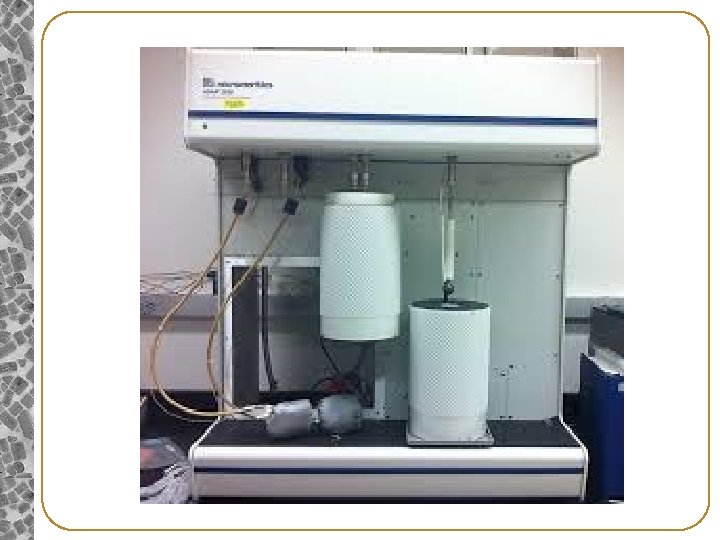
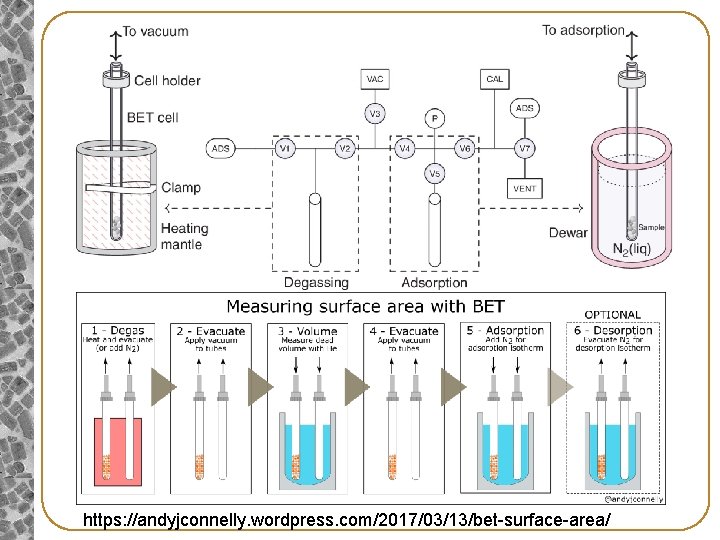
What is a Gas Sorption Analyzer? Does it actually measure surface area and pore size? NO!! It simply records various pressures of gas in the sample cell due to adsorption and desorption. The instrument then calculates the amount (as STP volume) of gas adsorbed/desorbed. Surface area, pore size are calculated by PC software Pressure measurements are critical! 5
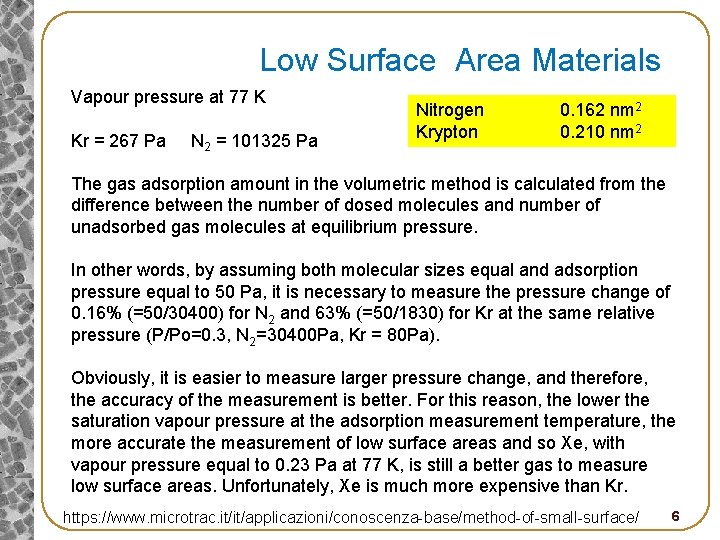
Low Surface Area Materials Vapour pressure at 77 K Kr = 267 Pa N 2 = 101325 Pa Nitrogen Krypton 0. 162 nm 2 0. 210 nm 2 The gas adsorption amount in the volumetric method is calculated from the difference between the number of dosed molecules and number of unadsorbed gas molecules at equilibrium pressure. In other words, by assuming both molecular sizes equal and adsorption pressure equal to 50 Pa, it is necessary to measure the pressure change of 0. 16% (=50/30400) for N 2 and 63% (=50/1830) for Kr at the same relative pressure (P/Po=0. 3, N 2=30400 Pa, Kr = 80 Pa). Obviously, it is easier to measure larger pressure change, and therefore, the accuracy of the measurement is better. For this reason, the lower the saturation vapour pressure at the adsorption measurement temperature, the more accurate the measurement of low surface areas and so Xe, with vapour pressure equal to 0. 23 Pa at 77 K, is still a better gas to measure low surface areas. Unfortunately, Xe is much more expensive than Kr. https: //www. microtrac. it/it/applicazioni/conoscenza-base/method-of-small-surface/ 6
https: //andyjconnelly. wordpress. com/2017/03/13/bet-surface-area/
Degas Important step before measurement of surface area or pore size/volume Surfaces armust be ‘cleaned’ of water/organic vapours in two ways: 1. With heating under a vacuum 2. Under a flow of dry, inert gas. No modification must be induced
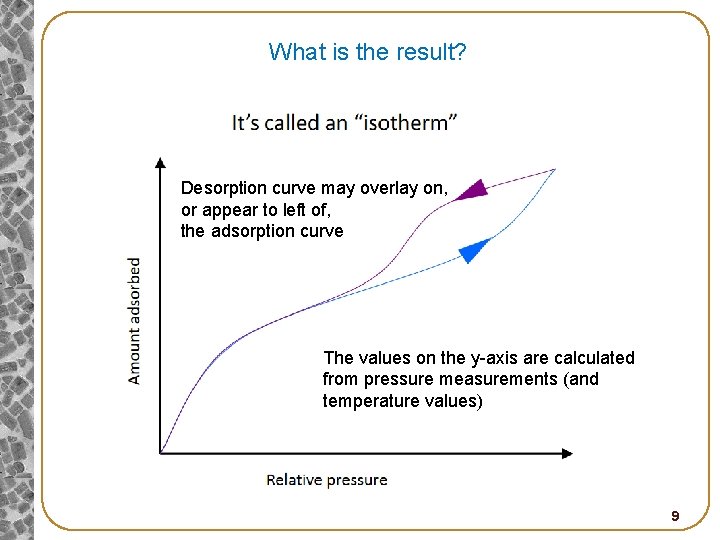
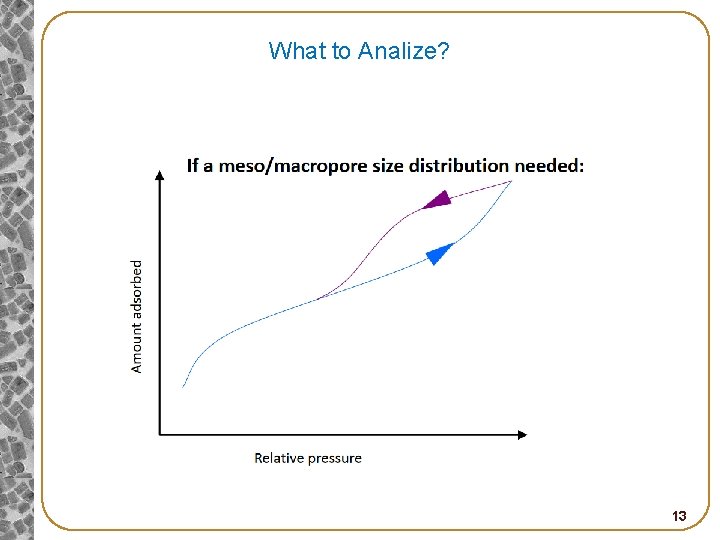
What is the result? Desorption curve may overlay on, or appear to left of, the adsorption curve The values on the y-axis are calculated from pressure measurements (and temperature values) 9
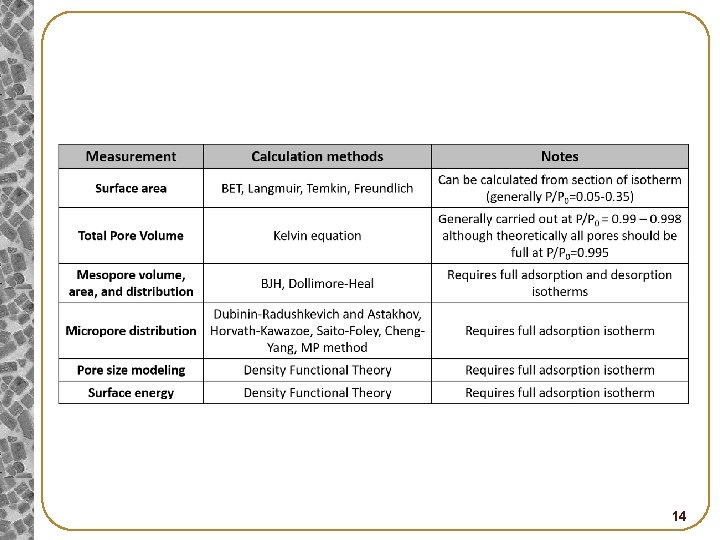
What to Analize? 10
What to Analize? 11
What to Analize? 12
What to Analize? 13
14
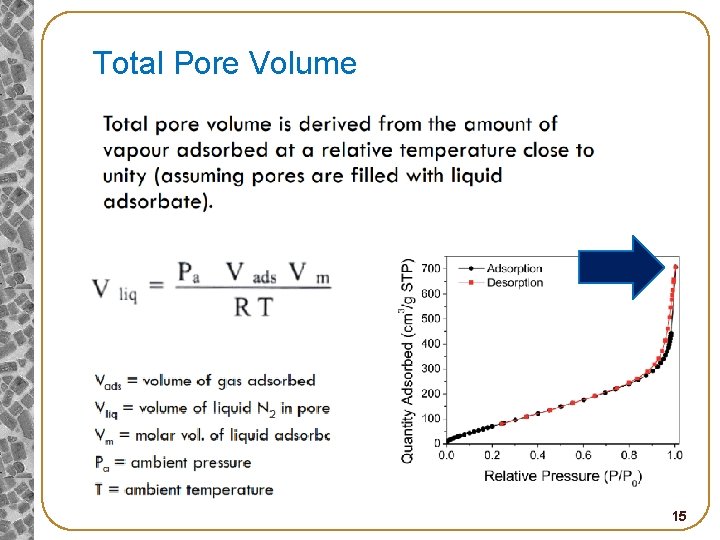
Total Pore Volume 15

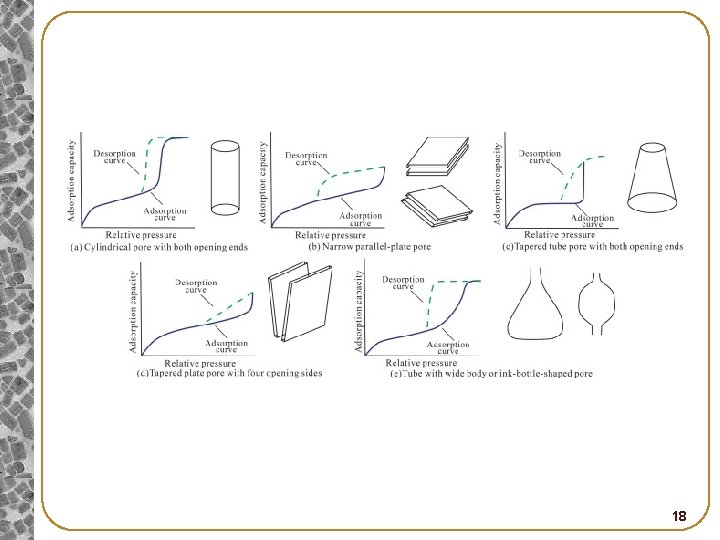
Pore Size: Kelvin Equation 16

Pore Size: Kelvin Equation 17
18
- Slides: 18