
Physiotherapy Electrotherapy Equipment Dr Nashrul Fazli Mohd Nasir

- Slides: 41
Physiotherapy & Electrotherapy Equipment Dr Nashrul Fazli Mohd Nasir Notes adapted from Access Engineering, Mc. Graw Hill
HIGH FREQUENCY HEAT THERAPY • Heat is used in physiotherapy • Two types: simple heat radiation or by the application of high frequency energy obtained from special generators. • High frequency energy in thermotherapy has better penetration compared to 'simple' heat application. • Can penetrate deeper lying tissues, e. g. muscles, bones, internal organs. • High frequency energy for heating is obtained by shortwave therapy unit making use of either the condenser field or the inductor field method. • Microwaves and ultrasonic waves are also used for heating purposes in special cases.
SHORT-WAVE DIATHERMY MACHINE Definition/Concept: • ‘Diathermy' means 'through heating' or producing deep heating directly in the tissues of the body. • In the diathermy technique, the subject's body becomes a part of the electrical circuit & the heat is produced within the body & not transferred through the skin
SHORT-WAVE DIATHERMY MACHINE • The advantage of diathermy -the treatment can be controlled precisely where electrodes placement permits localization of the heat to the region that has to be treated. • The amount of heat can be closely adjusted by means of circuit parameters. • The heating originates from high frequency alternating current which has a frequency of 27. 12 MHz & a wavelength of 11 m. • Currents of this high frequencies do not stimulate motor or sensory nerves, nor produce muscle contraction. • The current being alternating, will pass through the tissues currents with greater intensity to produce direct heating in the tissues similar to any other electrical conductor. • The method consists in applying the output of a radio frequency (RF) oscillator to a pair of electrodes which are positioned on the body over the region to be treated. Thus, promotes healing of injured tissues and inflammations.
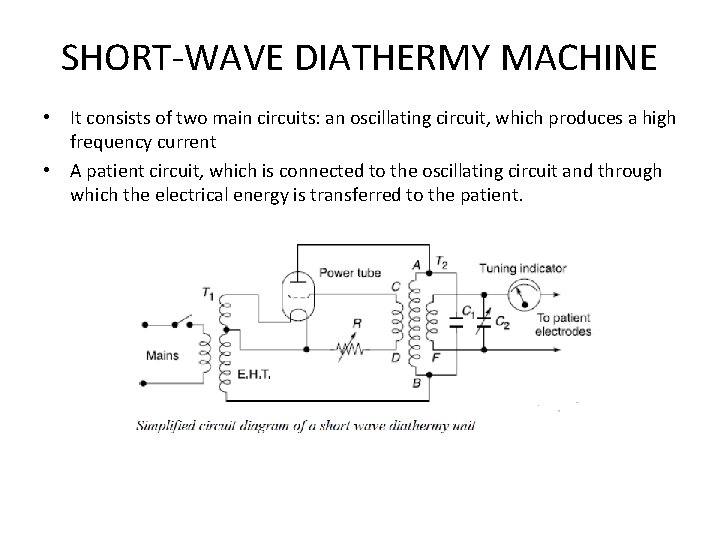
SHORT-WAVE DIATHERMY MACHINE • It consists of two main circuits: an oscillating circuit, which produces a high frequency current • A patient circuit, which is connected to the oscillating circuit and through which the electrical energy is transferred to the patient.
Automatic Tuning in Short-wave Diathermy Machines Any short-wave therapy unit would give out the desired energy to the patient only if & as long as, the unit is correctly tuned to the electrical values of the part of the body. Therefore, tuning must be carefully carried out at the beginning of the treatment & continuously monitored during the treatment. There is a possibility of the tuning getting affected due to unavoidable but involuntary movements of the patients & the resultant fall of dosage. In order to overcome the problem of making tuning adjustments during the course of treatment, an additional circuit is fitted in the machine. The RF current in the patient circuit changes a capacitor to a voltage, whose polarity and magnitude is a measure of the detuning of the patient circuit. This voltage accordingly moves a servo-motor, adjusting the tuning capacitor so that resonance is restored.
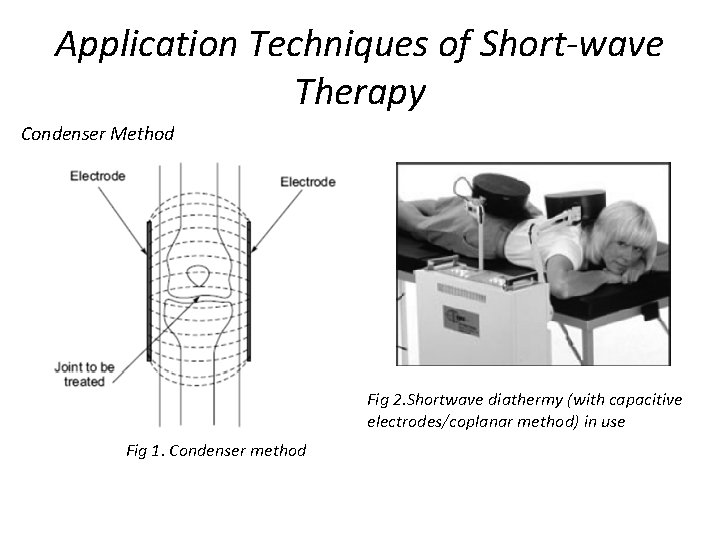
Application Techniques of Short-wave Therapy Condenser Method Fig 2. Shortwave diathermy (with capacitive electrodes/coplanar method) in use Fig 1. Condenser method
Condenser/Capacitor Method In the capacitor plate method, the output of the short-wave diathermy machine is connected to metal electrodes which are positioned on the body over the region to be treated (Fig. 2). These electrodes are called 'PADS‘ & do not directly come into contact with the skin. Layers of towels are interposed between the metal & the surface of the body. The position of the body to be treated is like been sandwiched between them ('Condenser Method' [Fig. 1]). The metal pads act as two plates while the body tissues between the pads as 'dielectric' of the capacitor. When the radio frequency output is applied to the pads, the dielectric losses of the capacitor manifest themselves as heat in the intervening tissues. This may be due to vibration of ions & rotation of dipoles in the tissue fluids (electrolytes) & molecular distortion in tissues such as fats.
Condenser Method There are two types of electrode arrangements for condenser method. In the Contraplanar technique, the electrodes are placed over the opposite aspects of the trunk or limb, so that the electric field is directed through the deep tissues. On the other hand, in the coplanar technique, the electrodes are placed side by side on the same aspect of the part, provided there is an adequate distance between them. Fig. 2 shows a shortwave diathermy in use with coplanar electrodes.
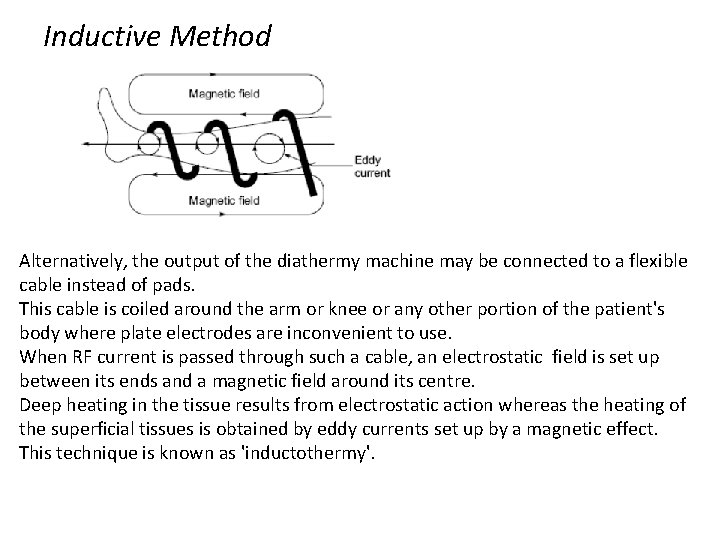
Inductive Method Alternatively, the output of the diathermy machine may be connected to a flexible cable instead of pads. This cable is coiled around the arm or knee or any other portion of the patient's body where plate electrodes are inconvenient to use. When RF current is passed through such a cable, an electrostatic field is set up between its ends and a magnetic field around its centre. Deep heating in the tissue results from electrostatic action whereas the heating of the superficial tissues is obtained by eddy currents set up by a magnetic effect. This technique is known as 'inductothermy'.
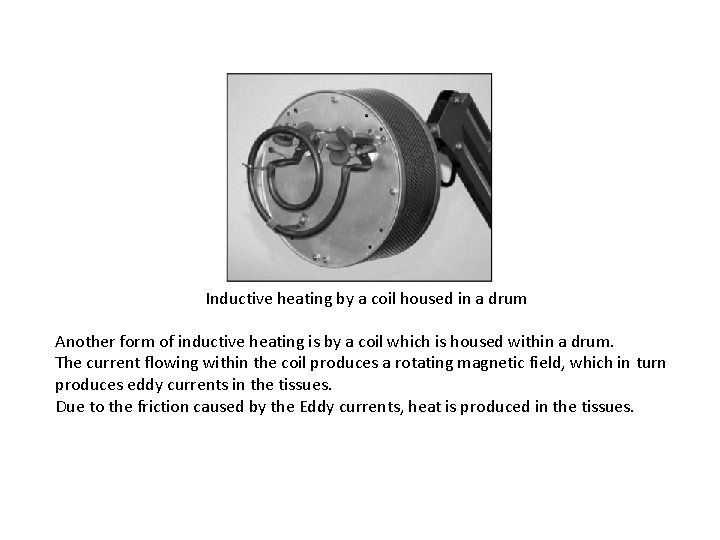
Inductive heating by a coil housed in a drum Another form of inductive heating is by a coil which is housed within a drum. The current flowing within the coil produces a rotating magnetic field, which in turn produces eddy currents in the tissues. Due to the friction caused by the Eddy currents, heat is produced in the tissues.
Pulsed Shortwave Therapy Why? A severe limitation of diathermic machines is that they direct continuous high frequency radio waves, & if a high enough output of energy is sustained for even a brief time, they can cause burns. Thus, the wattage has to be lowered to tolerable limits. Also, the heat resulting from diathermy has many contraindications & limitations because the heat limits the amount of energy that can be used. The increase in energy output, while avoiding the dangers of heat, achieved thru 'Pulsed Shortwave Therapy' (PSWT).
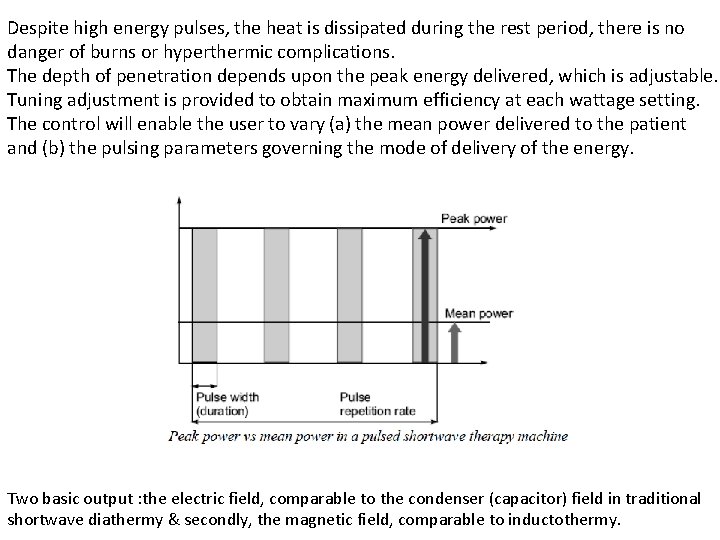
How Does It Works? ? ? • Pulsed therapy apparatus works at 27. 12 MHz, the frequency of short-wave diathermy machine. • However, the energy is delivered in the form of pulses of 65 ms with an interval between pulsations at a maximum setting of 1600 ms. • The rate of pulsations is adjustable in steps from 80 -600 pulses per second. • At this setting, the power is provided no more than 4% of the total time during operation. • The peak instantaneous wattage can be varied from 290 to 975 W. • The effect of the rest periods is to reduce the output to a maximum average of only 40 W. • The result is an intermittent, relatively athermic, electrotherapy
Despite high energy pulses, the heat is dissipated during the rest period, there is no danger of burns or hyperthermic complications. The depth of penetration depends upon the peak energy delivered, which is adjustable. Tuning adjustment is provided to obtain maximum efficiency at each wattage setting. The control will enable the user to vary (a) the mean power delivered to the patient and (b) the pulsing parameters governing the mode of delivery of the energy. Two basic output : the electric field, comparable to the condenser (capacitor) field in traditional shortwave diathermy & secondly, the magnetic field, comparable to inductothermy.
MICROWAVE DIATHERMY • Microwave diathermy consists in irradiating the tissues of the patient's body with very short wireless waves having frequency in the microwave region. • The most commonly used microwave frequency for therapeutic heating is 2450 MHz corresponding to a wavelength of 12. 25 cm. • The heating effect is produced by the absorption of the microwaves in the region of the body under treatment. • Better results are obtained by using microwave compared to shortwave diathermy technique. • The microwaves are transmitted from an emitter, & directed towards the portion of the body to be treated. • The special design of the treatment heads & shapes focuses the field directly at the target area. The whole device is used to direct the waves onto the tissues. • In this kind of treatment, the patient does not form a part of the circuit, so no tuning is necessary as in short wave application. • Microwave penetrates more than infrared rays but not deeply as shortwave diathermy. Not suitable for deeply placed structures.
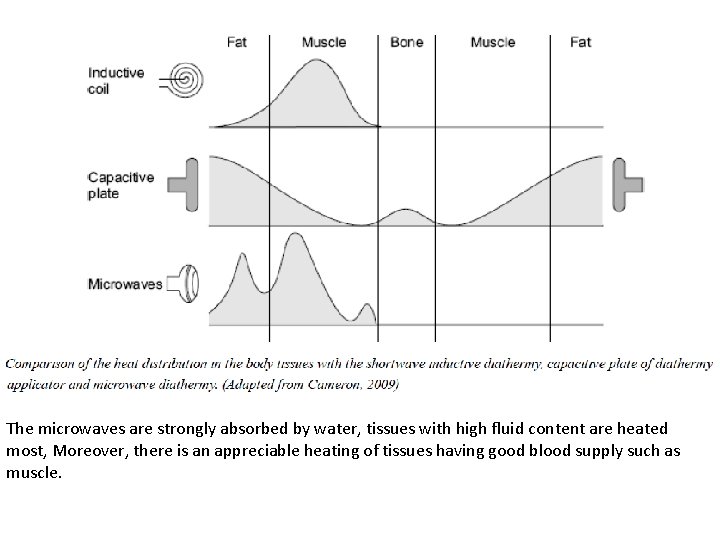
The microwaves are strongly absorbed by water, tissues with high fluid content are heated most, Moreover, there is an appreciable heating of tissues having good blood supply such as muscle.
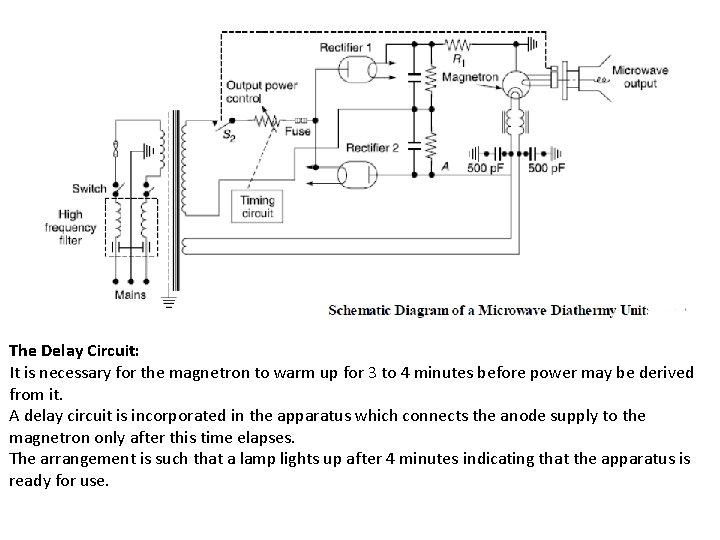
The Delay Circuit: It is necessary for the magnetron to warm up for 3 to 4 minutes before power may be derived from it. A delay circuit is incorporated in the apparatus which connects the anode supply to the magnetron only after this time elapses. The arrangement is such that a lamp lights up after 4 minutes indicating that the apparatus is ready for use.
The Magnetron Circuit: The magnetron filament heating voltage is obtained directly from a separate secondary winding of the transformer. The filament cathode circuit contains interference-suppression filters. The anode supply to the magnetron can be either DC or AC. A DC voltage is obtained by a full wave rectifier followed by a voltage doubler circuit. A high wattage variable resistance is connected in series which controls the current applied to the anode of the magnetron. When using AC, the voltage is applied to the anode of the magnetron through a series connected thyratron so that the AC voltages of both tubes are equal in phase. By shifting the phase of the control grid voltage with respect to the phase of the anode voltage, the amount of current through the magnetron can be determined and thus the output power can be varied. The phase shift can be achieved by using a capacitor resistor network. Safety Circuits & Precautions: There are chances of the magnetron being damaged due to an excessive flow of current. It is thus protected by inserting a fuse (500 m. A) in the anode supply circuit of the magnetron. The protection of both the patient and the radiator is ensured by the automatic selection of the control range depending on the type of the radiator used. Excessive dosage can cause skin burns, the skin should be dry , duration of irradiation 10 -25 mins
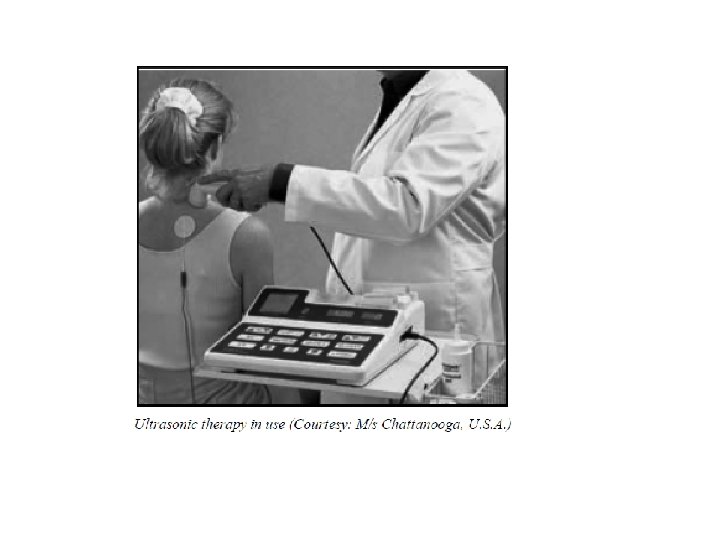
ULTRASONIC THERAPY UNIT The heating effect is produced by ultrasonic energy absorption property of the tissues. The effect of ultrasonics on the tissues -high speed vibration of micromassage. Massage is used to treat tissue lesions. Ultrasonic energy enables massage, firstly to a greater depth than manual, & secondly (in acute injuries) when pressure cannot be exerted by hand because of intolerable pain. The thermal effects of ultrasound are dependent on: the amount of energy absorbed, the length of time of the ultrasound application the frequency of the ultrasound generator. The electrical power required is usually less than 3 W/cm 2 of the transducer area that is in contact with the part of the body to be treated.
ULTRASONIC THERAPY UNIT • Ultrasonic generators are constructed on the piezoelectric effect. • A high-frequency alternating current (e. g. , 0. 75 -3. 0 MHz) is applied to a crystal whose acoustic vibration causes the mechanical vibration of a transducer head, which itself is located directly in front of the crystal. • These mechanical vibrations then pass through a metal cap & into the body tissue through a coupling medium. • The therapeutic ultrasonic intensity varies from 0. 5 to 3. 0 W/cm 2. • Applicators range from 70 to 130 mm in diameter. The larger the diameter of the applicator, the smaller would be the angle of divergence of the beam & the less the degree of penetration.
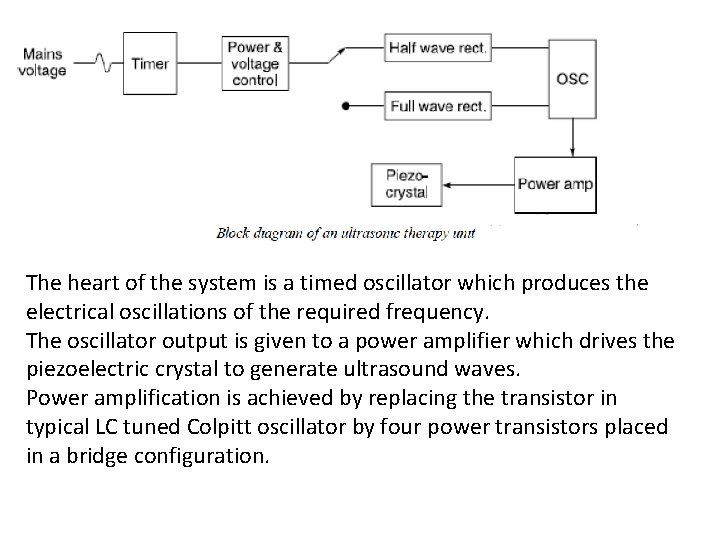
The heart of the system is a timed oscillator which produces the electrical oscillations of the required frequency. The oscillator output is given to a power amplifier which drives the piezoelectric crystal to generate ultrasound waves. Power amplification is achieved by replacing the transistor in typical LC tuned Colpitt oscillator by four power transistors placed in a bridge configuration.
The output of the oscillator can be controlled by either of the following two methods: • Using a transformer with a primary winding having multi-tapped windings & switching the same as per requirement; • Controlling the firing angle of a triac placed in the primary circuit of the transformer, & thereby varying the output of the transformer. v The machine can be operated in either continuous or pulsed mode. v A full-wave rectifier comes in the circuit for continuous operation. v The mains supply is given to the oscillator without any filtering. v The supply voltage is therefore at 100 Hz which causes the output 1 MHz to be amplitude modulated by this 100 Hz. v In pulsed mode, the oscillator supply is provided by the half-wave rectifier & the oscillator gets the supply only for a half cycle. v Thus the output 1 MHz is produced only for one half of the cycle & is pulsed.
Ø The amount of energy absorption in the human tissue has been measured experimentally & in soft tissue, a reduction of 50% occurs with a 1 MHz ultrasonic transmission at a depth of 5 cm. Ø The higher the frequency, the quicker the energy loss Ø Thus with a transmission of 3 MHz, 50% reduction occurs at a depth of 1. 5 cm. Ø Below a frequency of 1 MHz, the beam of ultrasonic energy tends to diffuse & no efficient treatment can be expected. Ø A frequency in the range of 800 k. Hz to 1 MHz is, therefore, most widely adopted. Ø Unlike the operation of a short-wave therapy unit, no tuning is necessary while the treatment is in progress. Ø The operating frequency is also not very critical & may vary to the extent ± l 0%.
Ultrasonic Transducer • The transducer is a lead zirconate titanate crystal, having 5 -6 cm effective radiating area. • In front of the crystal lies a metal face plate which is made to vibrate by the oscillations of the crystal. • Ultrasonic waves are emitted from this plate. • The crystal has a metal electrode pressed against its back surface by a coiled spring. • Voltage is applied to the crystal via this electrode. • The front diaphragm is grounded & provides a return path for the excitation voltage.
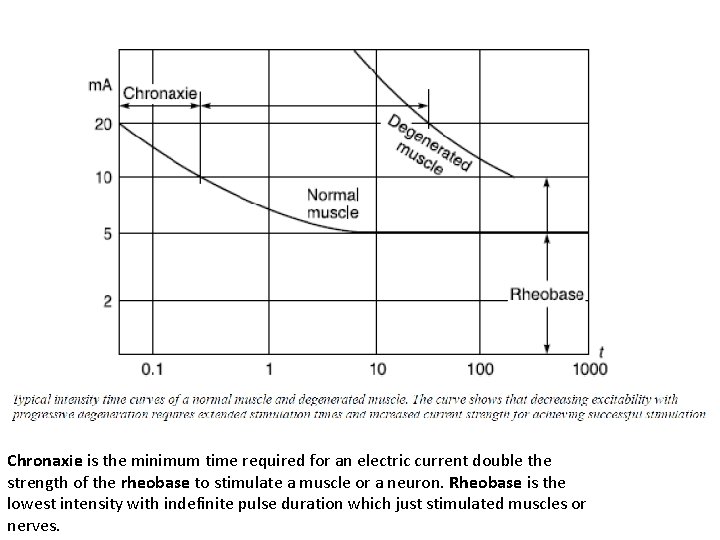
Electrodiagnosis In order to examine the conditions of excitability & to obtain a good picture of the degeneration & regeneration process of neuro-muscular units, modern stimulation current diagnosis plots the so called i-t curves based on the intensity of the stimulus & its duration. These curves are determined by means of rectangular & triangular pulses in such a manner that the threshold values are measured at progressively decreasing stimulation durations. The i-t curves have characteristic shapes & deviations from the standard form which lead to an indication of the state of the tissues. It also shows the shape of the curve for a totally denervated muscle having an advanced state of degeneration and required excitability. With degenerated muscle, the curve obtained is shifted to the right and upwards. The intermediate stages of degeneration and regeneration are characterized by curves lying in between these two limits.
Chronaxie is the minimum time required for an electric current double the strength of the rheobase to stimulate a muscle or a neuron. Rheobase is the lowest intensity with indefinite pulse duration which just stimulated muscles or nerves.
The types of waveforms required for electrodiagnosis are: § Galvanic current for qualitative and quantitative determination of the galvanic excitability (rheobase and chronaxie); § Rectangular pulses for checking nervous conduction as a control of functioning, also of prognostic importance; § Exponentially progressive current for checking the accommodability or its loss as a symptom of the degree of degeneration & for prognosis of the reinnervation of totally denervated muscles; & § Faradic current for qualitative & quantitative determination of the faradic excitability.
Electrotherapy • Electrotherapy, employing low-volt, low-frequency impulse currents, has become an accepted practice in the physiotherapy departments. • The biological reactions produced by low-volt currents have resulted in the adoption of this therapy in the management of many diseases affecting muscles & nerves. • The technique is used for the treatment of paralysis with totally or partially degenerated muscles, for the treatment of pain, muscular spasm & peripheral circulatory disturbances, & for several other applications.
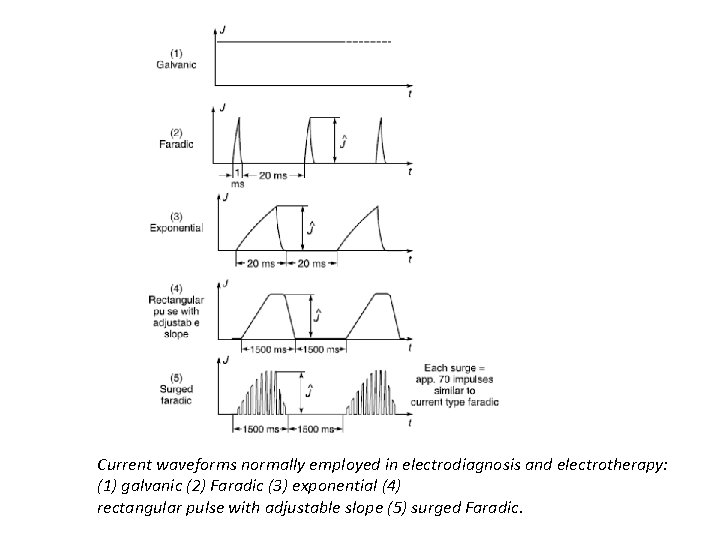
Galvanic Current Electrotherapy • When a steady flow of direct current is passed through a tissue, its effect is primarily chemical. • It causes the movement of ions & their collection at the skin areas lying immediately beneath the electrodes. • The effect is manifested most clearly in a bright red coloration which is an expression of hyperaemia (increased blood flow). • The duration of the treatment is generally 10– 20 minutes. • Galvanic current may be used for the preliminary treatment of atonic paralysis and for the treatment of disturbance in the blood flow. • It is also used for iontophoresis, which means the introduction of drugs into the body through the skin by electrolytic means. • In general, the intensity of the current passed through any part of the body does not exceed 0. 3 to 0. 5 ma/sq cm of electrode surface.
Faradic Current Electrotherapy • Faradic current is a sequence of pulses with a defined shape & current intensity. • The pulse duration is about 1 minute with a triangular waveform & an interval duration of about 20 minutes. • Faradic current acts upon muscle tissue & upon the motor nerves to produce muscle contractions. • There is no ion transfer & consequently, no chemical effect. • This may be used for the treatment of muscle weakness after lengthy immobilization & of disuse atrophy
Surging Current Electrotherapy • If the peak current intensity applied to the patient increases & decreases rhythmically, & the rate of increase & decrease of the peak amplitude is slow, the resulting shape of the current waveform is called a surging current. • The main field of application of the Faradic surge current is in the treatment of functional paralysis. • The surge rate is usually from 6 -60 surges per minute in most of the instruments. • The ratio of interval to the duration of the surging is also adjustable so that graded exercise may be administered. This type of current is usually required for the treatment of spasm & pain.
Exponentially Progressive Current Electrotherapy • This current is useful for the treatment of severe paralysis. • The main advantage of this method lies in the possibility of providing selective stimulation for the treatment of the paralysed muscles. • This means that the surrounding healthy tissues even in the immediate neighbourhood of the diseased muscles are not stimulated. • The slope of the exponential pulse is kept variable.
Biphasic Stimulation Current Electrotherapy • The cell recovery from the effect of a stimulus current can be hastened by the passage of a lower intensity current of opposing polarity over a longer period so that the net quantity of electricity is zero. • Such type of combination of positive & negative pulses is called biphasic stimulation. In a typical case, the stimulating pulse may be followed by a pulse of opposite polarity of one-tenth the amplitude and 10 times the width. • Biphasic stimulation also helps to neutralize the polarization of the recording electrodes in case silver-silver chloride electrodes are not used. • This means that there are no electrolytic effects, nor are any macroscopic changes affecting either the skin or the electrodes observed. • Also, there is reduced muscle fatigue, since each current pulse is immediately followed by an opposite current phase of the same magnitude. • The stimulation current intensity required during treatment is less as compared with monophasic currents. • Monophasic current forms, however, retain their importance in electro-diagnostic evaluation since the necessary pulse shapes are defined monophasically
Current waveforms normally employed in electrodiagnosis and electrotherapy: (1) galvanic (2) Faradic (3) exponential (4) rectangular pulse with adjustable slope (5) surged Faradic.
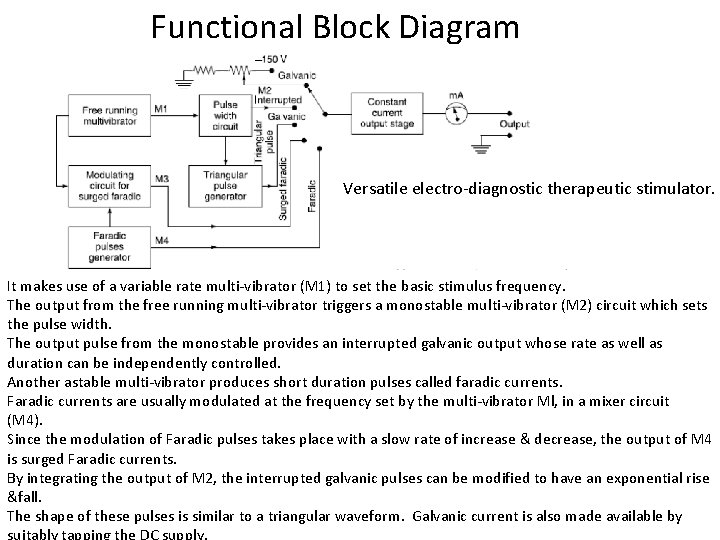
Functional Block Diagram Versatile electro-diagnostic therapeutic stimulator. It makes use of a variable rate multi-vibrator (M 1) to set the basic stimulus frequency. The output from the free running multi-vibrator triggers a monostable multi-vibrator (M 2) circuit which sets the pulse width. The output pulse from the monostable provides an interrupted galvanic output whose rate as well as duration can be independently controlled. Another astable multi-vibrator produces short duration pulses called faradic currents. Faradic currents are usually modulated at the frequency set by the multi-vibrator Ml, in a mixer circuit (M 4). Since the modulation of Faradic pulses takes place with a slow rate of increase & decrease, the output of M 4 is surged Faradic currents. By integrating the output of M 2, the interrupted galvanic pulses can be modified to have an exponential rise &fall. The shape of these pulses is similar to a triangular waveform. Galvanic current is also made available by
Transcutaneous Electrical Nerve Stimulator (TENS) The electrical impulses required for electrotherapy to treat the pain are provided by an instrument called TENS (Transcutaneous Electrical Nerve Stimulator). Investigations on a great variety of electrical impulse parameters have indicated that two waveforms, the square wave & the spike wave are optimally & equally effective in relieving pain. Most stimulators feature adjustable settings to control the amplitude (intensity) of stimulation by controlling voltage, current & the width (duration) of each pulse. Electrodes are placed at specific sites on the body for treatment of pain. The current travels through the electrodes & into the skin stimulating specific nerve pathways to produce a tingling or massaging sensation that reduces the perception of pain.
• The stimulator is based around a 500 ms spike pulse, adjustable amplitude of 0 - 75 m. A & adjustable frequency of 12 - 100 pulses per second. • Instruments having similar specifications except that they produce square waveform, have a pulse frequency range of 20– 200 Hz, pulse width from 0. 1 to 1. 0 ms & pulse amplitude of 0– 120 V with maximum output current as 25 m. A. • The instrument powered by three standard flashlight batteries of 1. 5 V each gives about 100 hours of continuous operation. • Transcutaneous or skin surface application of electrical stimulus is accomplished by application of the conducting pads to various trigger- zone areas, acupuncture sites or even peripheral nerves.
• Skin irritation at the site of electrode application is diminished by the use of carbonized rubber electrodes applied with a tincture of Benzoin interface. • The skin electrode system would minimize impedance variations with motion, to conform to the body surface to provide a uniform impedance across the surface of the electrode and to have an adequate surface area. • (TENS) electrodes are commonly molded from an elastomer such as silicon rubber, loaded with carbon particles to provide conductance. • Conformability is achieved by making the electrode thin. • Useful carbon-loaded silicon rubbers have a minimum resistivity near 10 Ω cm. • The frequency-dependence of the electrode performance also has to be considered since the impedance between the electrode & subcutaneous contains capacitance.
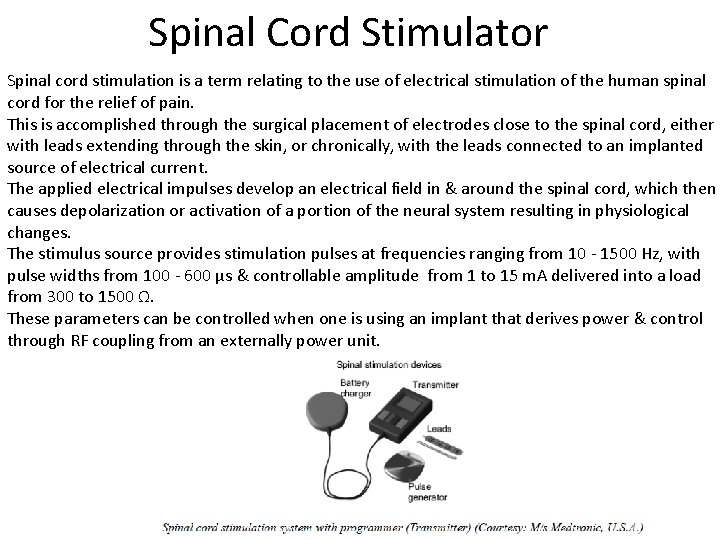
Spinal Cord Stimulator Spinal cord stimulation is a term relating to the use of electrical stimulation of the human spinal cord for the relief of pain. This is accomplished through the surgical placement of electrodes close to the spinal cord, either with leads extending through the skin, or chronically, with the leads connected to an implanted source of electrical current. The applied electrical impulses develop an electrical field in & around the spinal cord, which then causes depolarization or activation of a portion of the neural system resulting in physiological changes. The stimulus source provides stimulation pulses at frequencies ranging from 10 - 1500 Hz, with pulse widths from 100 - 600 μs & controllable amplitude from 1 to 15 m. A delivered into a load from 300 to 1500 Ω. These parameters can be controlled when one is using an implant that derives power & control through RF coupling from an externally power unit.
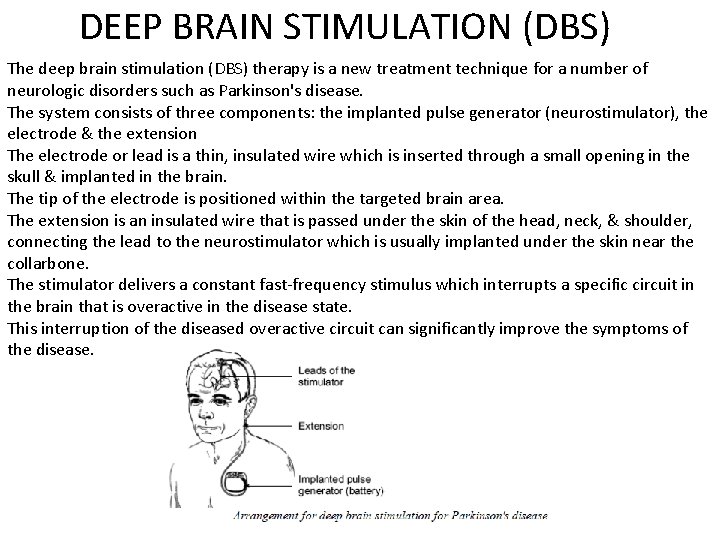
DEEP BRAIN STIMULATION (DBS) The deep brain stimulation (DBS) therapy is a new treatment technique for a number of neurologic disorders such as Parkinson's disease. The system consists of three components: the implanted pulse generator (neurostimulator), the electrode & the extension The electrode or lead is a thin, insulated wire which is inserted through a small opening in the skull & implanted in the brain. The tip of the electrode is positioned within the targeted brain area. The extension is an insulated wire that is passed under the skin of the head, neck, & shoulder, connecting the lead to the neurostimulator which is usually implanted under the skin near the collarbone. The stimulator delivers a constant fast-frequency stimulus which interrupts a specific circuit in the brain that is overactive in the disease state. This interruption of the diseased overactive circuit can significantly improve the symptoms of the disease.