
Physiology Team 436 Renal Block Values and Equations
Physiology Team 436 Renal Block Values and Equations File Color Index: Equation Number Unit Notes Only female slides Only males slide Both female and males slides Done by: Rana Barasain - Laila Mathkour ﺩﻋﻮﺍﺗﻜﻢ ﻟﻨﺎ ﺑﺎﻟﺘﻮﻓﻴﻖ 1 This work was done by students, so if there any mistakes please inform us.
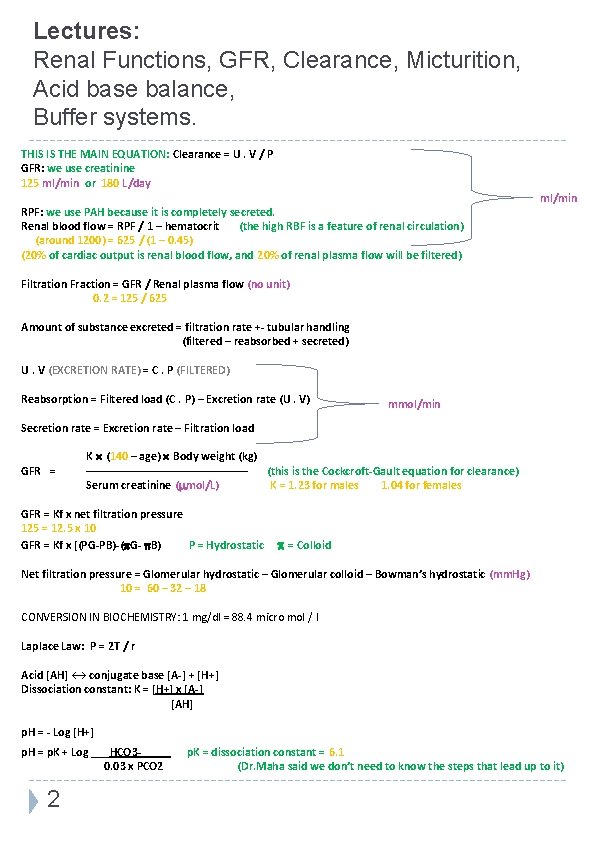
Lectures: Renal Functions, GFR, Clearance, Micturition, Acid base balance, Buffer systems. THIS IS THE MAIN EQUATION: Clearance = U. V / P GFR: we use creatinine 125 ml/min or 180 L/day RPF: we use PAH because it is completely secreted. Renal blood flow = RPF / 1 – hematocrit (the high RBF is a feature of renal circulation) (around 1200) = 625 / (1 – 0. 45) (20% of cardiac output is renal blood flow, and 20% of renal plasma flow will be filtered) ml/min Filtration Fraction = GFR / Renal plasma flow (no unit) 0. 2 = 125 / 625 Amount of substance excreted = filtration rate +- tubular handling (filtered – reabsorbed + secreted) U. V (EXCRETION RATE) = C. P (FILTERED) Reabsorption = Filtered load (C. P) – Excretion rate (U. V) mmol/min Secretion rate = Excretion rate – Filtration load GFR = K (140 – age) Body weight (kg) ────────────── (this is the Cockcroft-Gault equation for clearance) Serum creatinine ( mol/L) K = 1. 23 for males 1. 04 for females GFR = Kf x net filtration pressure 125 = 12. 5 x 10 GFR = Kf x [(PG-PB)-( G- B) P = Hydrostatic = Colloid Net filtration pressure = Glomerular hydrostatic – Glomerular colloid – Bowman’s hydrostatic (mm. Hg) 10 = 60 – 32 – 18 CONVERSION IN BIOCHEMISTRY: 1 mg/dl = 88. 4 micro mol / l Laplace Law: P = 2 T / r Acid [AH] ↔ conjugate base [A-] + [H+] Dissociation constant: K = [H+] x [A-] [AH] p. H = - Log [H+] p. H = p. K + Log ___HCO 3 -___ 0. 03 x PCO 2 2 p. K = dissociation constant = 6. 1 (Dr. Maha said we don’t need to know the steps that lead up to it)

Lecture #1 Renal functions & GFR KIDNEYS weight 150 grams Each kidney has 1 million nephrons Blood flows through juxta medullary nephrons 1 -2 % Renal blood flow to the kidney represents 20% of cardiac output Blood flow rate of renal circulation 1200 ml/min GFR 125 ml/min = 20% renal plasma flow. Glomerular hydrostatic pressure 60 mm. Hg Hydrostatic pressure in bowman’s capsule 18 mm. Hg Colloid osmotic pressure of glomerular plasma proteins 32 mm. Hg Net filtration pressure 60 -18 -32= 10 mm. Hg Kidney filter 200 liters of blood daily

Lecture #2 Regulation of GFR The volume of filtrate produced by both kidneys per min Averages 125 ml/min Totals about 180 L/day (45 gallons) GFR remains constant over a large range of values of BP 75 -160 mm. Hg systemic cardiac output flows through the kidneys each minute 1200 ml plasma entering the glomerulus 20% is filtered fluid 125 ml/min Sodium reabsorption of filtered sodium is absorbed 99. 5% • Proximal tubules (67%) • Loop of Henle (25%) • Distal/Collecting tubules (8%) Forces in capillaries: hydrostatic pressure PGC 60 mm. Hg oncotic pressure � GC - 29 mm. Hg 4
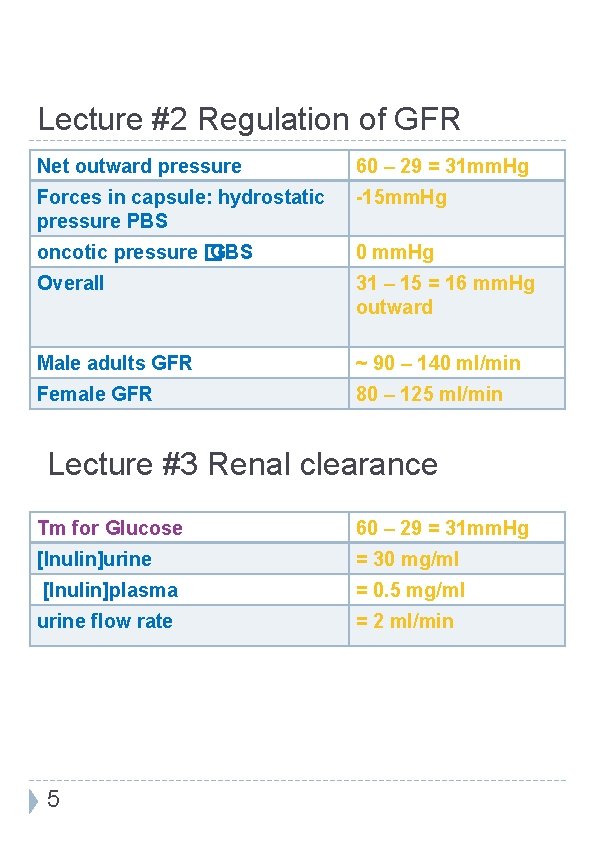
Lecture #2 Regulation of GFR Net outward pressure 60 – 29 = 31 mm. Hg Forces in capsule: hydrostatic pressure PBS -15 mm. Hg oncotic pressure � GBS 0 mm. Hg Overall 31 – 15 = 16 mm. Hg outward Male adults GFR ~ 90 – 140 ml/min Female GFR 80 – 125 ml/min Lecture #3 Renal clearance Tm for Glucose 60 – 29 = 31 mm. Hg [Inulin]urine = 30 mg/ml [Inulin]plasma = 0. 5 mg/ml urine flow rate = 2 ml/min 5
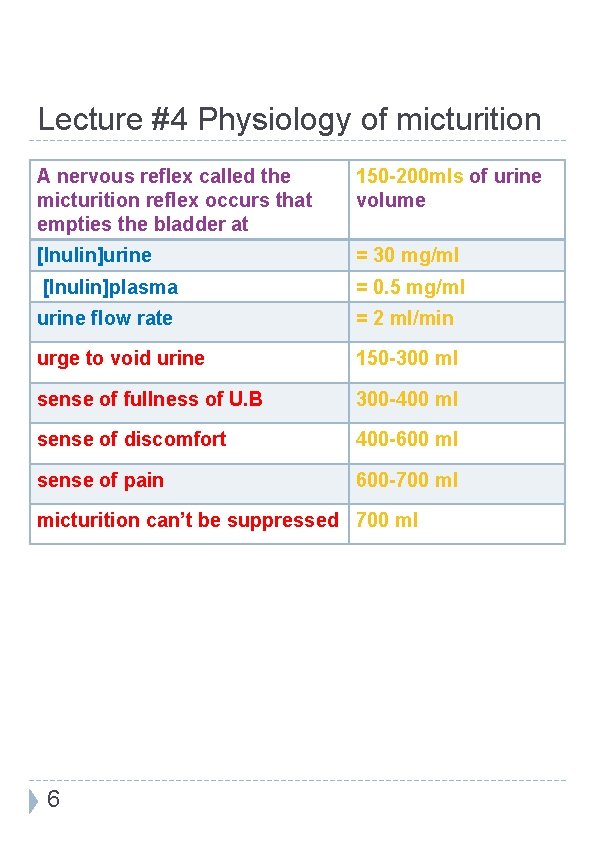
Lecture #4 Physiology of micturition A nervous reflex called the micturition reflex occurs that empties the bladder at 150 -200 mls of urine volume [Inulin]urine = 30 mg/ml [Inulin]plasma = 0. 5 mg/ml urine flow rate = 2 ml/min urge to void urine 150 -300 ml sense of fullness of U. B 300 -400 ml sense of discomfort 400 -600 ml sense of pain 600 -700 ml micturition can’t be suppressed 700 ml 6
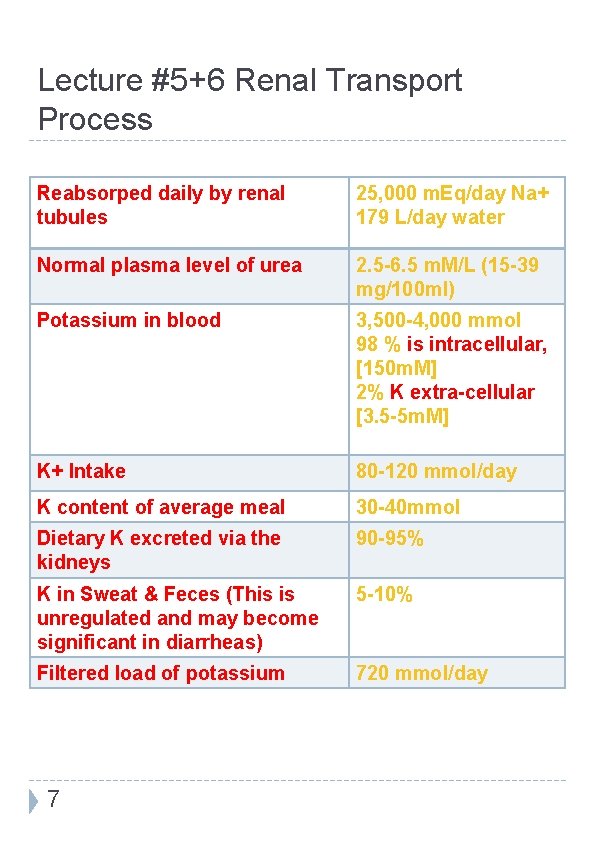
Lecture #5+6 Renal Transport Process Reabsorped daily by renal tubules 25, 000 m. Eq/day Na+ 179 L/day water Normal plasma level of urea 2. 5 -6. 5 m. M/L (15 -39 mg/100 ml) Potassium in blood 3, 500 -4, 000 mmol 98 % is intracellular, [150 m. M] 2% K extra-cellular [3. 5 -5 m. M] K+ Intake 80 -120 mmol/day K content of average meal 30 -40 mmol Dietary K excreted via the kidneys 90 -95% K in Sweat & Feces (This is unregulated and may become significant in diarrheas) 5 -10% Filtered load of potassium 720 mmol/day 7

Lecture #8 Urine Concentration Mechanism diluting tubule fluid 150 m. Osm/kg water Water reabsorption % 65% in Proximal convoluted tubule 20 -25% in Thin Descending limb ZERO in thick and thin Ascending limb Osmolality of medullary tissue high up to 1200 m. Osm/kg Bu medullary blood flow less than 5% Lecture #9 Basics acid base p. H of water 7 Normal p. H -log [0. 00000004] M=7. 4 ECF [Na+] 145 m. M/L Normal BLOOD p. H 7. 35 – 7. 45 p. H range Compatible with human life (6. 8 -7. 8) 8
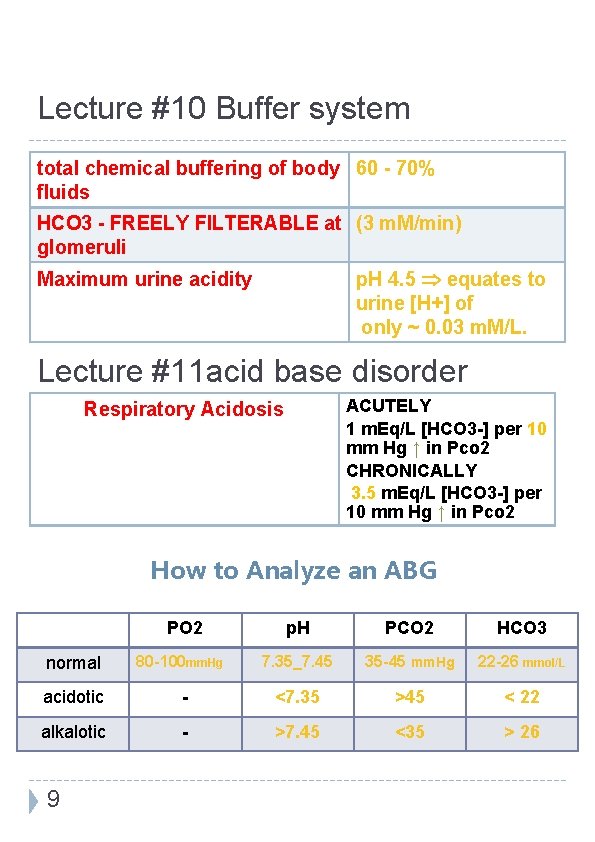
Lecture #10 Buffer system total chemical buffering of body 60 - 70% fluids HCO 3 - FREELY FILTERABLE at (3 m. M/min) glomeruli p. H 4. 5 equates to urine [H+] of only ~ 0. 03 m. M/L. Maximum urine acidity Lecture #11 acid base disorder ACUTELY 1 m. Eq/L [HCO 3 -] per 10 mm Hg ↑ in Pco 2 CHRONICALLY 3. 5 m. Eq/L [HCO 3 -] per 10 mm Hg ↑ in Pco 2 Respiratory Acidosis How to Analyze an ABG PO 2 normal 80 -100 mm. Hg p. H PCO 2 HCO 3 7. 35_7. 45 35 -45 mm. Hg 22 -26 mmol/L acidotic - <7. 35 >45 < 22 alkalotic - >7. 45 <35 > 26 9

- Slides: 10