
PHYSIOLOGY OF THE PROPRIOCEPTORS IN BALANCE ITS PATHWAYS

PHYSIOLOGY OF THE PROPRIOCEPTORS IN BALANCE & ITS PATHWAYS DR SYED SHAHID HABIB MBBS DSDM PGDCR FCPS Professor Dept. of Physiology College of Medicine & KKUH
OBJECTIVES At the end of this lecture you should be able to: • • • Identify the major sensory pathways Describe the components, processes and functions of the sensory pathways Appreciate the dorsal column system in conscious proprioception Describe the pathway of spinocerebellar tract in subconscious proprioception from muscles, tendons and joints Differentiate between sensory and motor ataxia
PROPRIOCEPTION Latin proprius, meaning "one's own", "individual" and perception, is the sense of the relative position of neighbouring parts of the body and strength of effort being employed in movement. exteroception, by which one perceives the outside world interoception, by which one perceives pain, hunger, etc. , and the movement of internal organs. MECHANORECEPTORS: which detect mechanical compression or stretching of the receptor or of tissues adjacent to the receptor
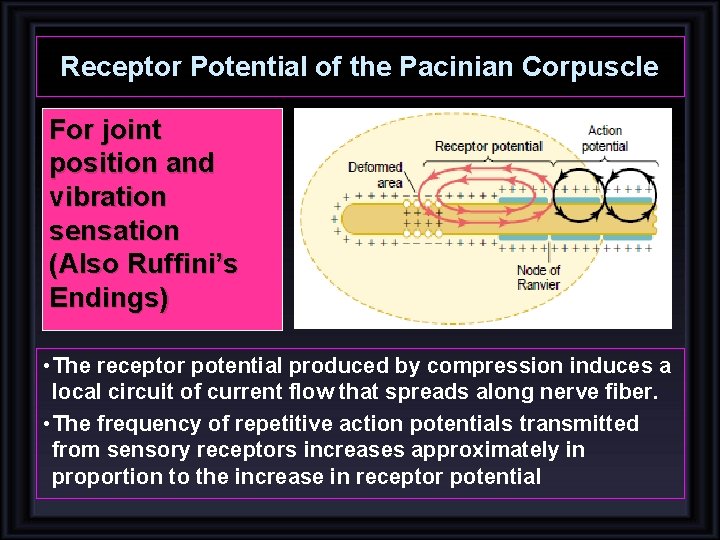
Receptor Potential of the Pacinian Corpuscle For joint position and vibration sensation (Also Ruffini’s Endings) • The receptor potential produced by compression induces a local circuit of current flow that spreads along nerve fiber. • The frequency of repetitive action potentials transmitted from sensory receptors increases approximately in proportion to the increase in receptor potential
Types of proprioception 1 - conscious proprioception reach the level of cerebral cortex sensory area via dorsal column tract. 2 - Subconscious proprioception reach the level of cerebellum via spinocerebellar tracts Where is the location of these tracts?
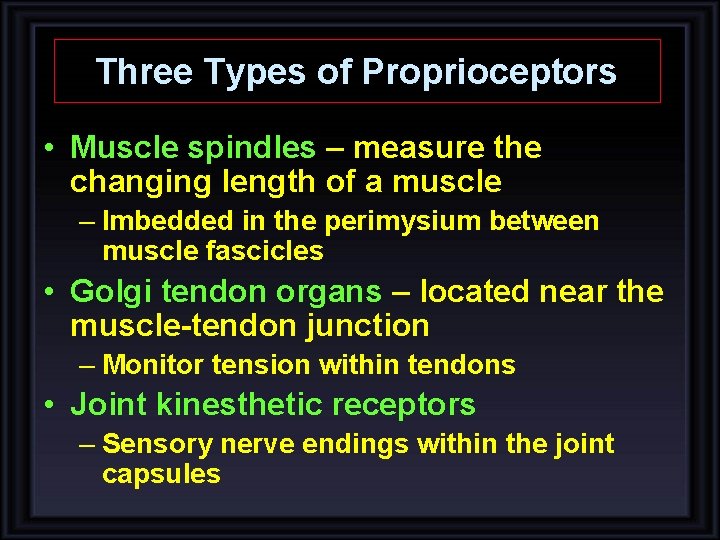
Three Types of Proprioceptors • Muscle spindles – measure the changing length of a muscle – Imbedded in the perimysium between muscle fascicles • Golgi tendon organs – located near the muscle-tendon junction – Monitor tension within tendons • Joint kinesthetic receptors – Sensory nerve endings within the joint capsules
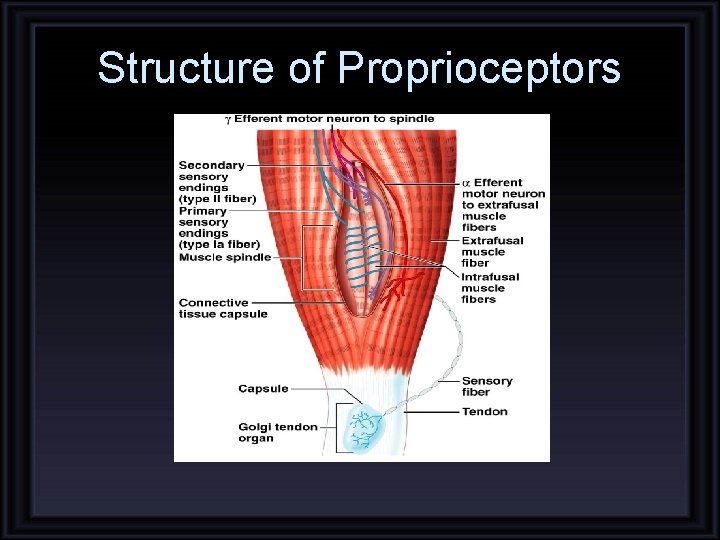
Structure of Proprioceptors
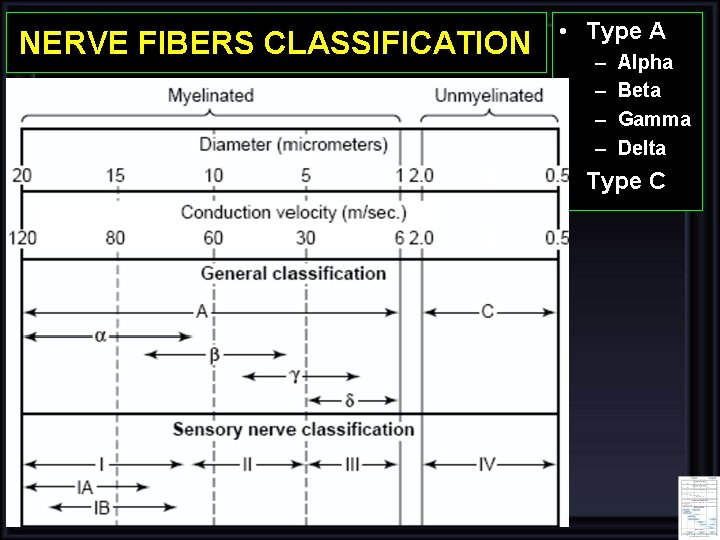
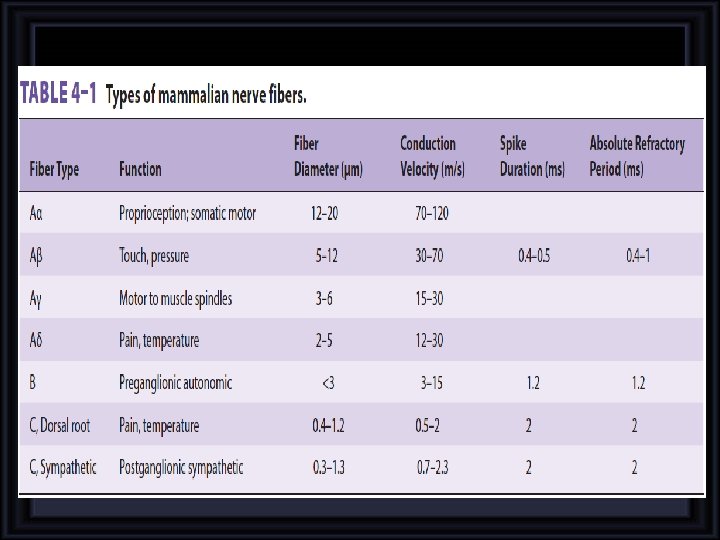
NERVE FIBERS CLASSIFICATION • Type A – – Alpha Beta Gamma Delta • Type C
SENSORY TRACTS • DORSAL COLUMN SYSTEM • ANTEROLATERAL SYSTEM Each system carries different types of sensations which are known as MODALITIES like pain, temperature, fine touch, crude touch, vibration, proprioception etc
1. Dorsal column pathway- carries signal of fine touch, pressure, vibration , stereognsis and proprioception, 2. Spinothalamic pathway- carries signals of pain, temperature, deep pressure, and course touch. 3, 4 - Posterior and anterior spinocerebellar pathways- carry subsconcious proprioception. Dorsal gray horn- to lateral column- to medulla oblongata- to pons – to cerebellum.
DORSAL COLUMN MEDIAL LEMNISCAL SYSTEM 1. Touch sensations requiring a high degree of localization of the stimulus 2. Touch sensations requiring transmission of fine gradations of intensity 3. Phasic sensations like vibratory sensations 4. Sensations that signal movement against skin 5. Joints Position sensations (Proprioception) 6. Pressure sensations requiring fine degrees of judgment of intensity 7. Strereognosis
ANTEROLATERAL SYSTEM Ventral & lateral spinothalamic tracts 1. Pain 2. Thermal sensations, (warmth & cold) 3. Crude touch and pressure sensations capable only of crude localizing ability on the surface of the body 4. Tickle and itch sensations 5. Sexual sensations
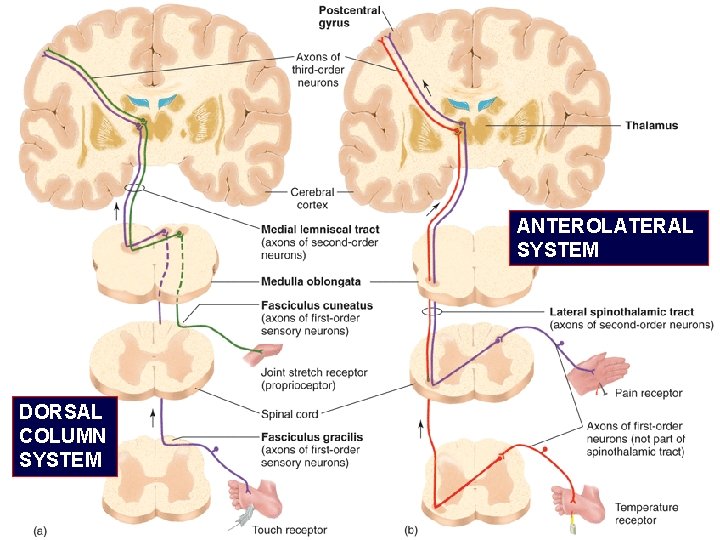
ANTEROLATERAL SYSTEM DORSAL COLUMN SYSTEM
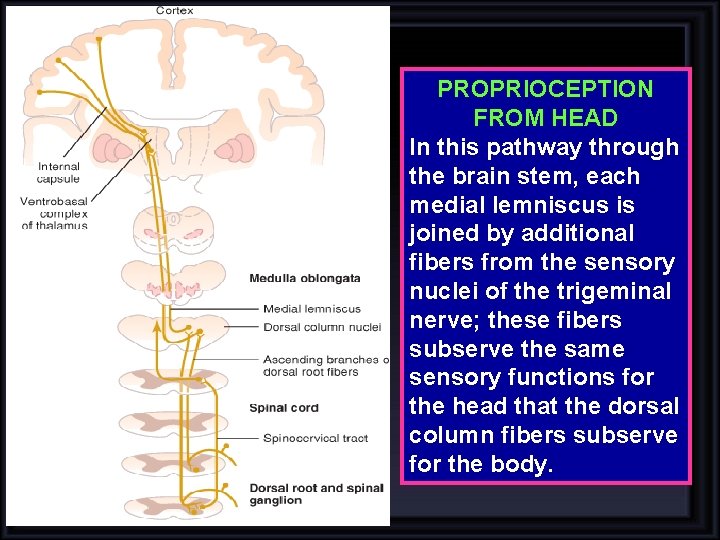
PROPRIOCEPTION FROM HEAD In this pathway through the brain stem, each medial lemniscus is joined by additional fibers from the sensory nuclei of the trigeminal nerve; these fibers subserve the same sensory functions for the head that the dorsal column fibers subserve for the body.
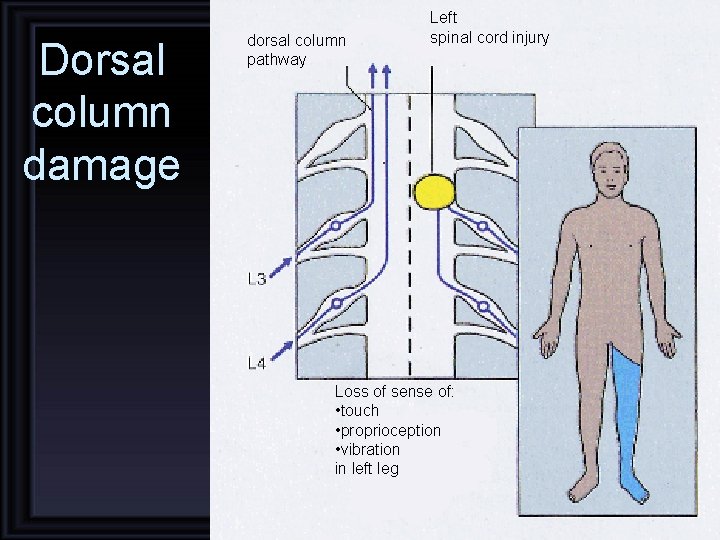
Dorsal column damage dorsal column pathway Left spinal cord injury Loss of sense of: • touch • proprioception • vibration in left leg
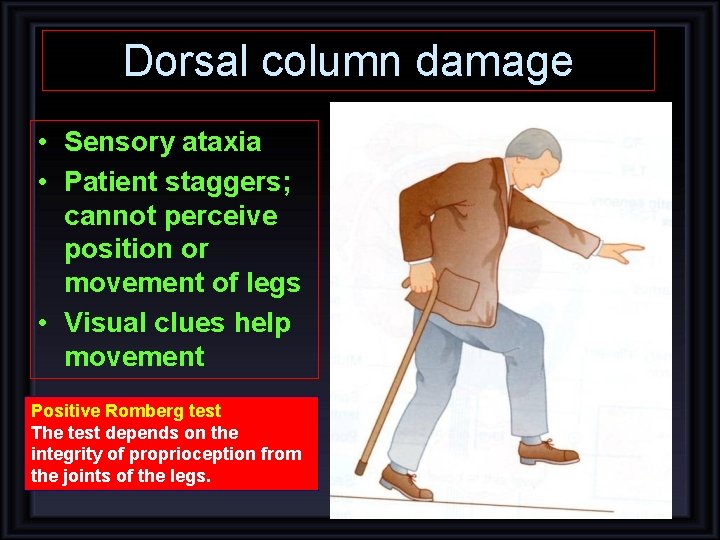
Dorsal column damage • Sensory ataxia • Patient staggers; cannot perceive position or movement of legs • Visual clues help movement Positive Romberg test The test depends on the integrity of proprioception from the joints of the legs.
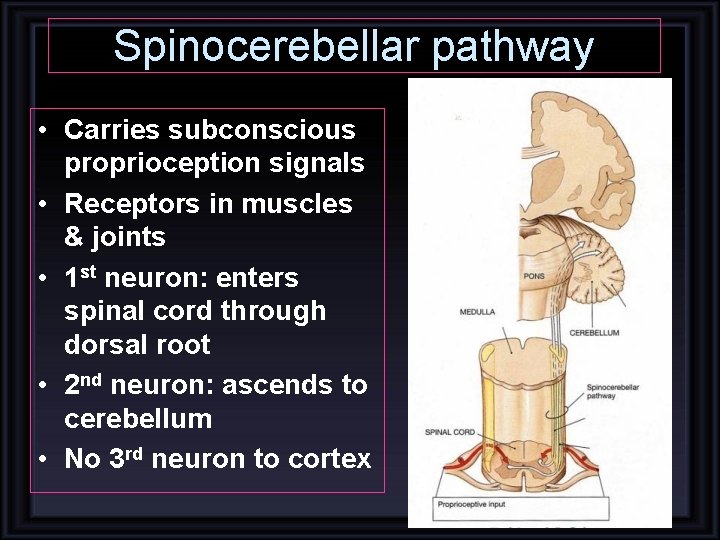
Spinocerebellar pathway • Carries subconscious proprioception signals • Receptors in muscles & joints • 1 st neuron: enters spinal cord through dorsal root • 2 nd neuron: ascends to cerebellum • No 3 rd neuron to cortex
Spinocerebellar tract damage • Cerebellar ataxia – Clumsy movements – Incoordination of the limbs (intention tremor) – Wide-based, reeling gait (ataxia) – Alcoholic intoxication produces similar effects!
Ataxia and Gait Disturbances • Pathophysiology – Result from any condition that affects the central and peripheral nervous systems – Ataxia: Types • Motor ataxia • Sensory ataxia
Ataxia and Gait Disturbances • Motor Ataxia – Caused by cerebellar disorders • Intact sensory receptors and afferent pathways • Integration of proprioception is faulty • Midline cerebellar lesions cause truncal ataxia • Lateral cerebellar lesions cause limb ataxia • Thalamic infarcts may cause contralateral ataxia with sensory loss
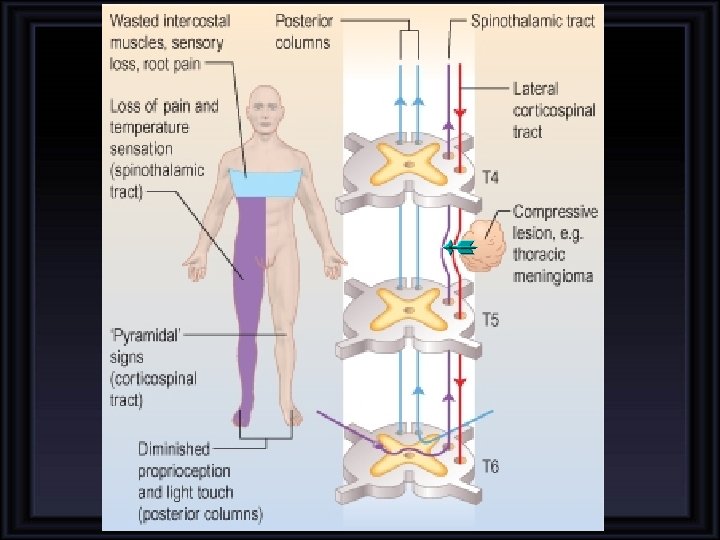
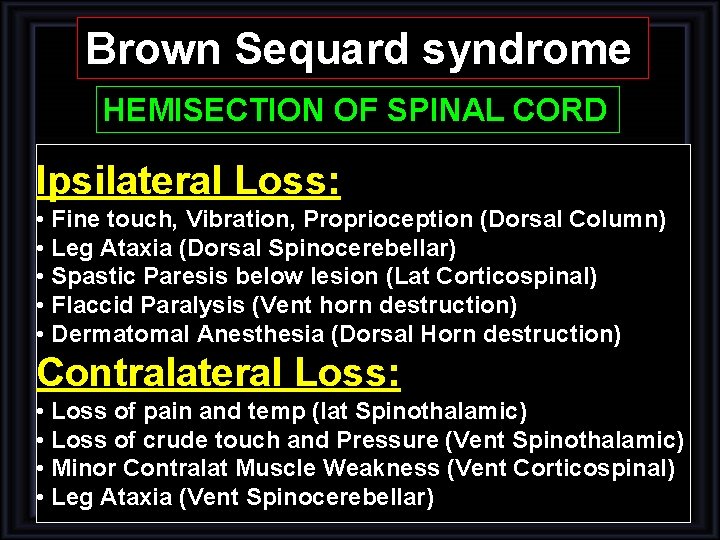
Brown Sequard syndrome HEMISECTION OF SPINAL CORD Ipsilateral Loss: • Fine touch, Vibration, Proprioception (Dorsal Column) • Leg Ataxia (Dorsal Spinocerebellar) • Spastic Paresis below lesion (Lat Corticospinal) • Flaccid Paralysis (Vent horn destruction) • Dermatomal Anesthesia (Dorsal Horn destruction) Contralateral Loss: • Loss of pain and temp (lat Spinothalamic) • Loss of crude touch and Pressure (Vent Spinothalamic) • Minor Contralat Muscle Weakness (Vent Corticospinal) • Leg Ataxia (Vent Spinocerebellar)
- Slides: 23