
Physiology of the Blood Lec 1 General function
Physiology of the Blood Lec 1
General function of blood 1) Nutrients transfer from elemental canal to the tissues. 2) Transfer the metabolic waste substances from the cells to exciter organ. 3) Oxygen transport from lung to tissues. 4) CO 2 transport from lung to tissues. 5) Transport the secretion of endocrine glands to all the body. 6) Regulation of body temperature. 7) Maintenance of concentration of waters and salts in the cells. 8) Regulation of hydrogen ion concentration in the body. 9) Defense of body against microorganisms.
• The blood composed from: plasma and cells • There are 3 types of cells 1 - Erythrocytes "red blood corpuscles" RBC 2 - Leucocytes "white blood cells" WBC 3 - Thrombocytes "platelets"
The Plasma Composition Plasma: is the fluid portions of blood about 55 -70% of blood is plasma and the most important component of plasma as follow: 1. 2. 3. 4. 5. 6. Water Gases (Co 2, O 2, N 2) Protein “albumin, globulin, fibrinogen “ Glucose, lactate and pyruvate. Lipids (fat, lecithin, and cholesterol) Non proteinous nitrogen, (amino acid), urea, uric acid, creatinine, and ammonium salts. 7. Inorganic substances (Na, K, Ca, MC, Cl, SO 4, PO 4, Fe, Mn, Cu, Zn, I) 8. Enzymes, hormones, and vitamins.
PLASMA PROTEINS: 1 -Albumin -60 -80% of plasma proteins and the smallest in size. -They provided the osmotic pressure needed to draw water from the surrounding tissue fluid into capillaries, this action in needed to maintenance blood volume and pressure. 2 -Globulins Plasma proteins constitute 7% to 9%, the types of proteins are: albumin, globulins and fibrinogen. They are grouped into 3 subtypes: alpha α, beta β and gamma Ɣ -alpha and beta globulin are antibodies produced by lymphocytes and function in immunity 3 -Fibrinogen: -Fibrinogen is important clotting factor, -fibrinogen is converted into insoluble thread fibrin.
Plasma volume • A number of regulatory mechanisms in the body maintain homeostasis of the plasma volume. If the body should lose water, the remaining plasma becomes excessively concentrated. Its osmolality increase. This detected by osmoreceptor in the hypothalamus resulting in sensation of thirst and releasing antidiuretic hormone (ADH) from posterior pituitary. This hormone promotes water retention by the kidney.
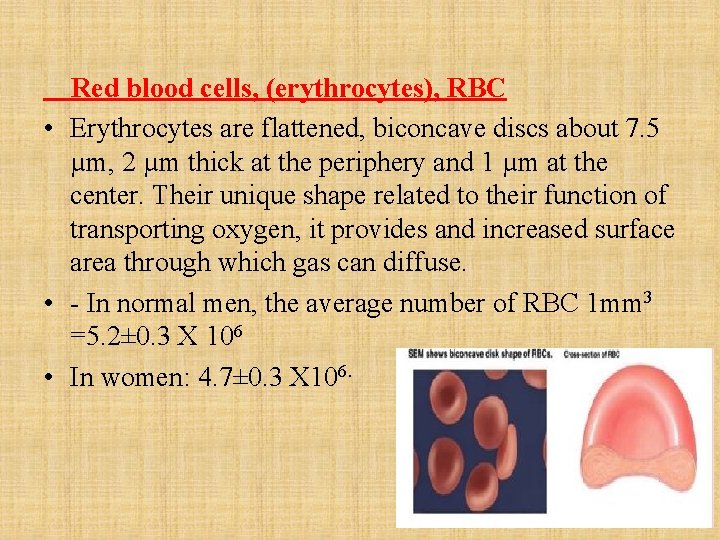
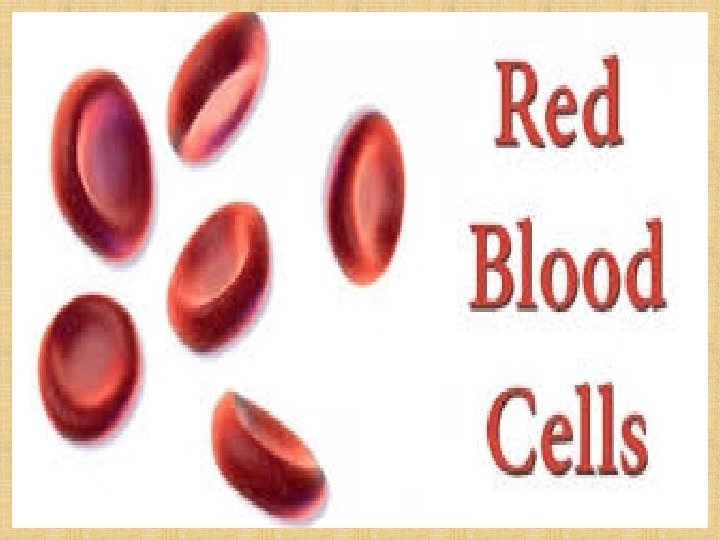
Red blood cells, (erythrocytes), RBC • Erythrocytes are flattened, biconcave discs about 7. 5 µm, 2 µm thick at the periphery and 1 µm at the center. Their unique shape related to their function of transporting oxygen, it provides and increased surface area through which gas can diffuse. • - In normal men, the average number of RBC 1 mm 3 =5. 2± 0. 3 X 10⁶ • In women: 4. 7± 0. 3 X 10⁶.
• Erythrocytes lack nuclei and mitochondria, endoplasmic reticulum and ribosomes, but the cytoplasm contains enzyme can produced ATP& reduced NADPH. Due to lack of mitochondria, erythrocytes do not consume any of the oxygen that they transport. • So erythrocytes have short circulating life span (120 days), the shape of RBC cells can change remarkably as the cell pass through capillaries, further more because the cell has great excess of cell membrane for the quantity of material inside, deformation does not stretch the membrane greatly and consequently does not rupture the cell.
• RBCs have other functions beside transport hemoglobin. For instance, they contain a large quantity of carbonic anhydrase, which catalyze the reaction between CO 2 from tissues to the lung in form of bicarbonate ion. • Also hemoglobin in the cells is an excellent acidbase buffer “as is true of most protein”. So that RBC are responsible for most buffering power of whole cell.
Synthesis of RBC “production of RBC “ • In early few weeks of embryonic life, primitive nucleated RBC are produced in yolk sac. • During middle trimester of gestation, the liver is the main organ for production of RBC also RBC produced by spleen and lymph node. • During the last month of gestation and after birth RBC are produced by bone marrow. • Till 5 years old, all bones produce RBC but after the marrow of long bone become fatty and cannot produce RBCs. • After 20 years, most RBCs are produced by marrow of the membranous bones (such as vertebrae, sternum ribs and ilia).
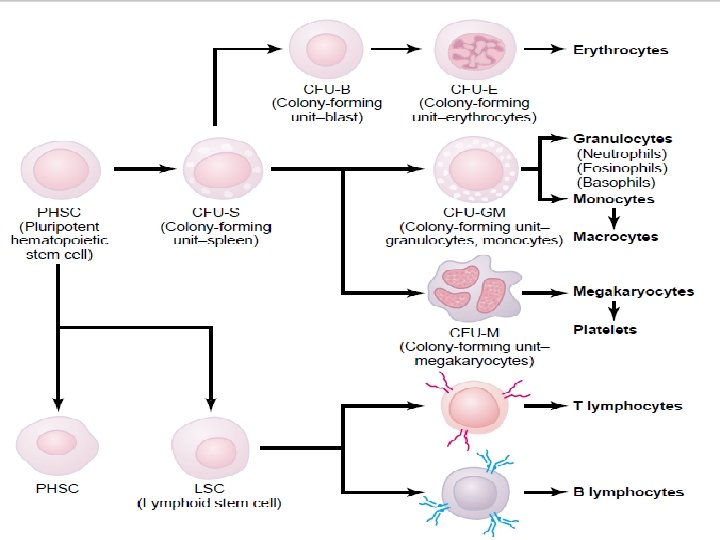
• All blood cells are produced in the bone marrow from precursors known as uncommitted pluripotent hemopoietic stem cells “PHSC'' from which all the cells in circulating blood are derived. These cells differentiate into progenitor cells for different blood cells. Progenitor cells possess the ability to give rise to clones or group of cells and so they are also called colony forming unit-stem cell (CFU-S). When the cells are designed to form a particular type of blood cells, the stem cells are called committed hemopoietic stem cell. Committed stem cells are of two types: 1. Lymphoid stem cell which give rise to lymphocytes 2. Colony forming unit stem cell (CFU-S) which gives rise to blood cells other than lymphocytes.
• Burst forming unit-erythroid (BFU-E) is an erythroid progenitor that is very immature and is considered as a progenitor of CFU-F. • From CFU-E, by differentiation blast cells are produced. The first identifiable blast cell in erythropoiesis is proerythroblast. • Erythropoiesis: The entire process by which red blood are formed in the body is termed Erythropoiesis. While the formation of blood cells in general is termed hemopoiesis
Factors affecting erythropoiesis • 1. Hormones; androgens increase erythropoietin secretion and this is the reason for increased RBC count in male than female While estrogen decreased, thyroxine increased because T 4 increase tissue metabolism leading to decrease oxygen tension leading to increase erythropoietin secretion so anemia is a feature in hypothyroidism. Other hormones such as ACTH, prolactin, growth, vasopressin, serotonin and noradrenaline increase erythropoiesis. 2. Metal; Iron, copper and cobalt are very essential for erythropoiesis. 3. Lipid and proteins 4. Vitamins: vitamins B, C, D and E are necessary for the erythropoiesis for example vit C help the conversion of ferric to ferrous ion. 5. Maturation factor: Vitamin B 12 and Folic acid.
• Vitamin B 12 is also known as extrinsic factor. For the absorption of B 12 from the intestine, Intrinsic factor of castle secreted by the parietal cells of stomach is necessary. Intrinsic factor combines with B 12 to forma complex. This complex attach to receptors in the ileal mucosa which contain cubulin. Cubulin responsible for the uptake of the complex into the enterocyte by endocytosis. Vitamin B 12 is stored in liver. • Action of B 12: B 12 increase DNA synthesis and decrease the maturation time of RBC. It interact with folic acid in the synthesis of DNA. In B 12 deficiency, maturation time is increased and the number of cells is decreased and the cells will be large leading to megaloblastic anemia or pernicious anemia.
• Folic acid is also essential for DNA synthesis and RBC maturation. Also its deficiency is leading to megaloblastic anemia
• Regulation of RBC production • The principle that stimulates RBCs production is circulating hormone called “erythropoietin” mainly formed in the kidney. Erythropoietin secreted in case of hypoxia (low oxygen tension in the tissues). • The factors that decrease oxygen (hypoxia) is: 1) Low blood volume 3) low hemoglobin 5) pulmonary disease 2) anemia 4) poor blood flow 6) very high altitude.

K N A TH U YO
- Slides: 19