
PHYSIOLOGY OF REPRODUCTION DR Hassan Ahmed B V
PHYSIOLOGY OF REPRODUCTION DR/ Hassan Ahmed B. V. Sc, M. D, Ph. D South Valley University
Today we should understand the following topics

REPRODUCTIVE PATTERN IN DIFFERENT SPECIES 1 - Cattle §Non-seasonal poly estrous. §In buffalo signs of heat not clear due to low level of estrogen hormone. In addition, buffalo stay in heat for short period showing silent heat. § Length of estrous: l l Cow and buffalo: 18 – 24 days with average 21 days. Heifer: 18 – 22 days with average 20 days.


2 - Mare §seasonal polyestrous (in spring and winter) near to poles (long day breeder), non-seasonal polyestrous near to equator. § Length of estrous: l 16 – 24 days with average 24 days. §Phases of the cycle l Proestrus: 2 days l Estrus: 6 - 7 days. l Metestrus: 2 days l Diestrus: 12 days
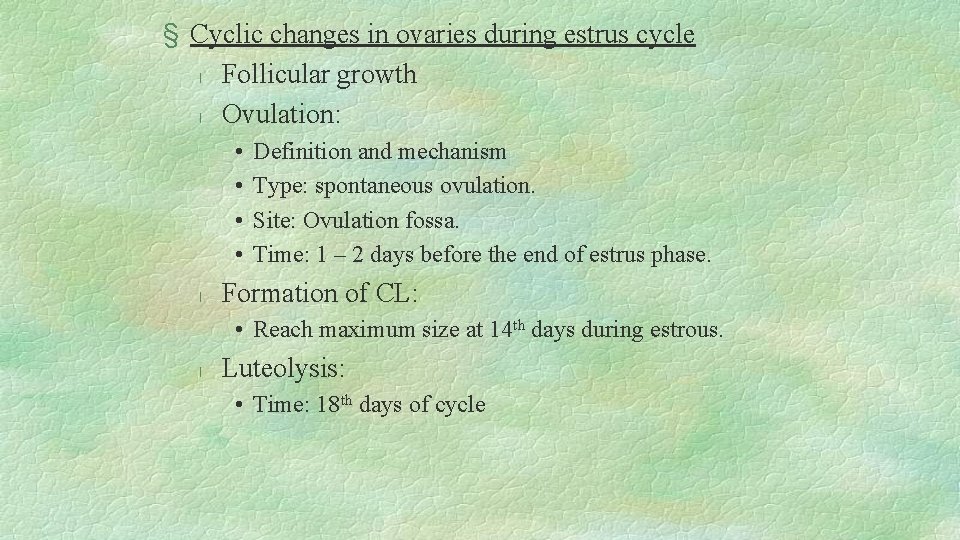
§ Cyclic changes in ovaries during estrus cycle l Follicular growth l Ovulation: • • l Definition and mechanism Type: spontaneous ovulation. Site: Ovulation fossa. Time: 1 – 2 days before the end of estrus phase. Formation of CL: • Reach maximum size at 14 th days during estrous. l Luteolysis: • Time: 18 th days of cycle

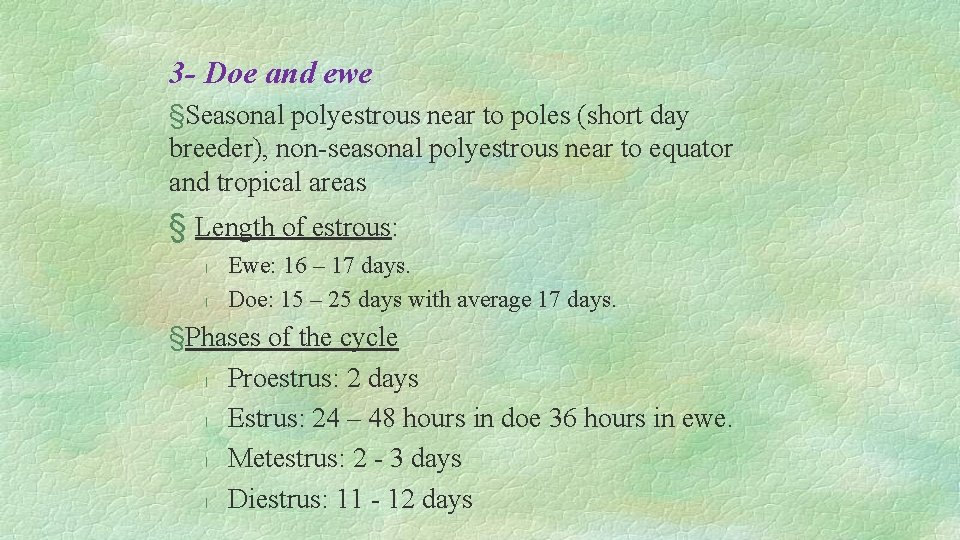
3 - Doe and ewe §Seasonal polyestrous near to poles (short day breeder), non-seasonal polyestrous near to equator and tropical areas § Length of estrous: l l Ewe: 16 – 17 days. Doe: 15 – 25 days with average 17 days. §Phases of the cycle l Proestrus: 2 days l Estrus: 24 – 48 hours in doe 36 hours in ewe. l Metestrus: 2 - 3 days l Diestrus: 11 - 12 days
§ Cyclic changes in ovaries during estrus cycle l Follicular growth l Ovulation: • • l Definition and mechanism Type: spontaneous ovulation. Site: 60% from right ovary. Time: 11 – 18 hrs before the end of estrus phase. Formation of CL: • Reach maximum size at 7 th – 9 th days during estrous. l Luteolysis: • Time: 13 th days of cycle
4 - Bitch §seasonal monosetrous. §Length of estrous: l 6 -8 months. §Phases of the cycle l Proestrus: 9 - 10 days (vaginal bleeding) l Estrus: 9 - 10 days. l Diestrus: 60 days l Anestrus: 3 -5 months.

§ Cyclic changes in ovaries during estrus cycle l Follicular growth l Ovulation: • • l Definition and mechanism Type: spontaneous ovulation. Time: first 3 – 4 days of estrus phase. Ovulation in bitch is continuous process; some follicles extend 12 -72 hours after onset of heat so; estrus phase may overlap metestrus. Formation of CL: • Formed rapidly after ovulation even estrus phase not ended. l Luteolysis: • Time: 30 days after ovulation.
5 - Queen §Seasonal polyestrous. Estrous cycle of queen is restricted to follicular wave without CL formation §Phases of the cycle l Proestrus: 1 – 3 days. (may be not appear) l Estrus: 8 - 10 days. l Interestrous: 3 -14 days (occurs only when in case of no copulation, no ovulation, regression of follicular waves). l Anestrus: 40 days (Copulation and ovulation occur but there is no fertilization (pseudopregnancy).
§ Cyclic changes in ovaries during estrus cycle • Follicular growth in queen in form of follicular wave i. e. development of large amount of graffian follicles. l Ovulation: • Definition and mechanism • Type: induced ovulation. • Time: 30 hrs after copulation.
6 - She-camel §Reproductive cycle in camel is restricted to follicular wave of development, follicular activity all over the year but peak from December to May. §Length of estrous: l 28 days. §Phases of the cycle l l l Growing stage: 10 days, follicular diameter 0. 3 cm. Mature stage: 7 days, follicular diameter 0. 5 – 0. 9 cm Atretic stage: 11 days, follicular diameter more than 0. 9 cm.
§ Cyclic changes in ovaries during estrus cycle l Ovulation: • Definition and mechanism • Type: induced ovulation. • Time: 32 - 40 hrs after copulation. l Formation of CL: • Reach maximum size at 9 th day after copulation. l Luteolysis: • Time: 13 th after copulation.
PHYSIOLOGY OF PREGNANCY, PARTURITION AND LACTATION
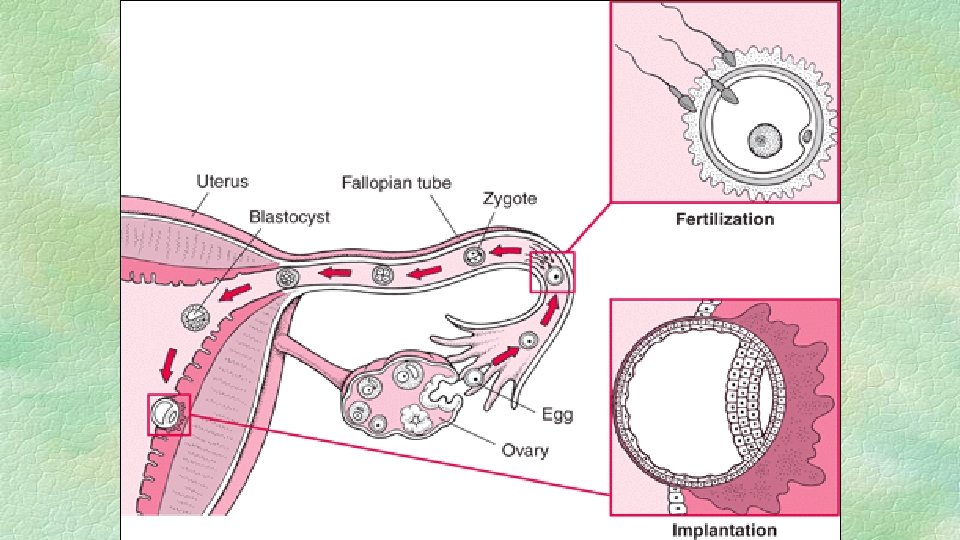
I- Pregnancy It is the period extends from fertilization till birth of the fetus. It divides into three periods: 1 - Period of ovum: l l Duration: 10 – 15 days. This period starts from fertilization and formation of zygote till blastocyst formation. Implantation of zygote into endometrium of uterus within 4 – 5 d. Eight days post-ovulation, zona pellucida rupture leading to formation of cavitation forming blastula then trophoblast and finally blastocyst.
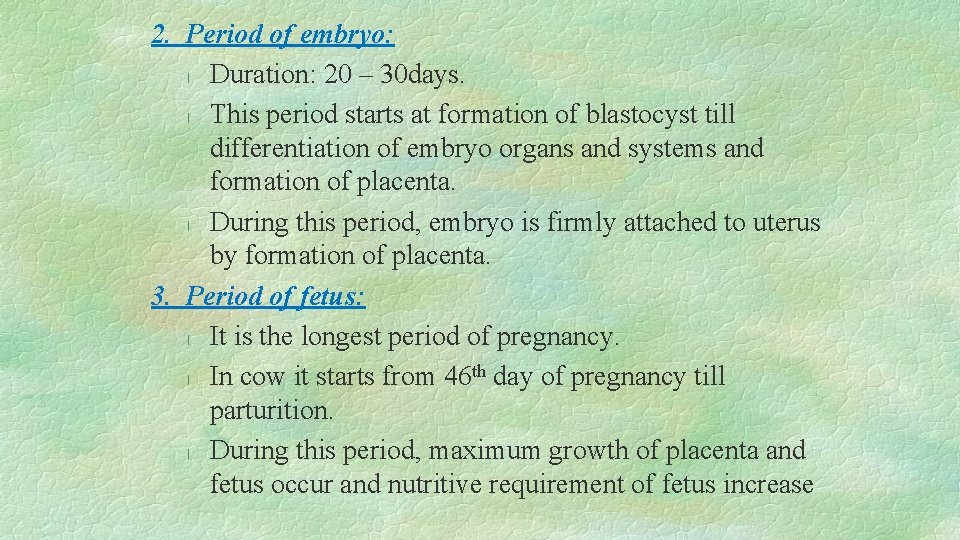
2. Period of embryo: l Duration: 20 – 30 days. l This period starts at formation of blastocyst till differentiation of embryo organs and systems and formation of placenta. l During this period, embryo is firmly attached to uterus by formation of placenta. 3. Period of fetus: l It is the longest period of pregnancy. th l In cow it starts from 46 day of pregnancy till parturition. l During this period, maximum growth of placenta and fetus occur and nutritive requirement of fetus increase
Hormones controlling pregnancy 1. Estrogen and progesterone l l During pregnancy, level of progesterone is high due to it responsible for quietness of the uterus by increase concentration of Mg++ it also helps implantation of zygote. Secreted mainly from CL, then by placenta at late pregnancy. Just before parturition, estrogen level increase to cause uterine contraction so, implantation doesn’t occur in the presence of estrogen. Estrogen also helps in priming the uterus for the action of progesterone.
2. Placental gonadotropins (Gn. H) l Pituitary gonadotropins production drop during pregnancy due to gonadal steroid inhibition (estrogen and progesterone inhibit Gn. H secretion) but placenta releases PMS (in mare) and h. CG (in woman) which are gonadotropin-like hormones. 3. Relaxin hormone l l Produced at late pregnancy by CL and placenta, its secretion increase at the onset of parturition. It widens the pubic bone and facilitates labor; it also softens the cervix (cervical ripening) and relaxes the uterine musculature.
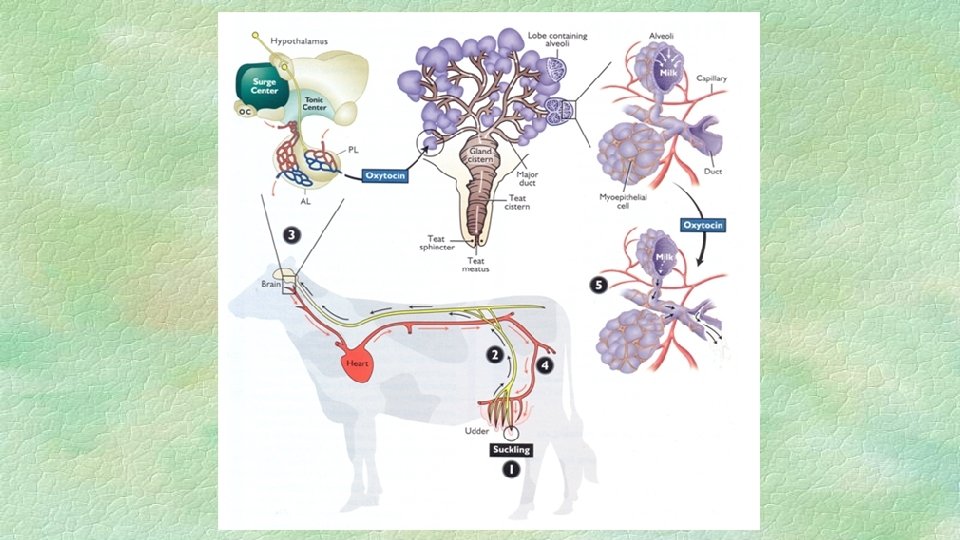
4. Oxytocin l l Secreted from posterior pituitary at late stage of pregnancy initiating parturition process. During pregnancy it secreted in low level causes milk let down.
II. Parturition It is expulsion of the fetus from uterus after full term of pregnancy. Stages of parturition 1. First stage or preparatory stage l During which dilatation of cervix, beginning of myometrium contraction forcing the fetus and fluid filled membrane toward the cervix. l This stage may last for a day or limited for several hours. l The dam is discomfort, restless and her fetal membranes are rupture.
2. Second stage or expulsive stage l Expulsion of the fetus occurs, cervix is completely dilated. l Uterine contraction increase in intensity and frequency and their action is reinforced by abdominal muscles. l Time needed by this stage varies according to species. 3. Third stage l The placenta is expulsed, this occurs very rapidly in mare while, in cow occurs 12 hours after parturition. l In polytocous animals, placenta may be delivered after each fetus or may be expelled after delivery of all fetuses.
§ Hormones of parturition 1. Maternal hormones a. Progesterone hormone • It is responsible for maintenance of pregnancy but its level drop just before parturition to stimulate uterine contraction and prime uterus to action of estrogen and oxytocin. • Progesterone secretion is blocked by interaction between PGF 2α and fetal glucocorticoids.
b. Estrogen hormone • Level of estrogen increase gradually in last period of pregnancy and reach its peak few days before parturition. • Estrogen causes: – – Growth of myometrium. Synthesis of actomyosin to increase the force of uterine contraction. Increase contraction capacity of the uterus. Relaxation of birth canal especially cervix and vagina. c. Adrenal corticoids l l The level rises immediately before parturition in maternal plasma. Their role is neglectable while, fetal adrenal corticoids play an important role in parturition.
2. fetal hormones Fetal adrenal corticoids At late pregnancy, fetal hypothalamus releases CRH. l. CRH stimulates anterior pituitary to secret ACTH which reach fetal adrenal gland to release adrenal corticoids last few hours before parturition. l. Adrenal corticoids stimulate synthesis and release of PF 2α from placenta and endometrium in the same time they increase the level of estrogen hormone. l. PF 2α has luteolytic effect on CL and stop progesterone secretion. l
l l l Adrenal corticoids stimulate surfactant production in the lung to decrease surface tension alveoli allowing expansion and easier breathing after parturition. In some species, gestation period may prolonged due to hypoplasia or aplasia of pituitary gland so, no ACTH secretion and no adrenal corticoids secretion and persistence of progesterone level. In sheep, disease called Groot. Lamsiekte in which the pregnancy prolonged due to ingestion a toxic plant called Salsola tuberculata which has nephrotoxic effect and prevent secretion of adrenal corticoids.
Physical and mechanical factors A. Size and weight of the fetus l Size and weight of the fetus increase gradually until the uterus become distended, this stimulates myometrium contraction and induction of parturition. l It is found that twin pregnancies have short gestation period so; there is inverse relationship between gestation period and size, weight and number of fetus(s).
B. CNS control § Parturition can’t be prevented by denervation of the uterus but parturition process lacks some normal aspects so, intact CNS enhances parturition but not necessary for that.
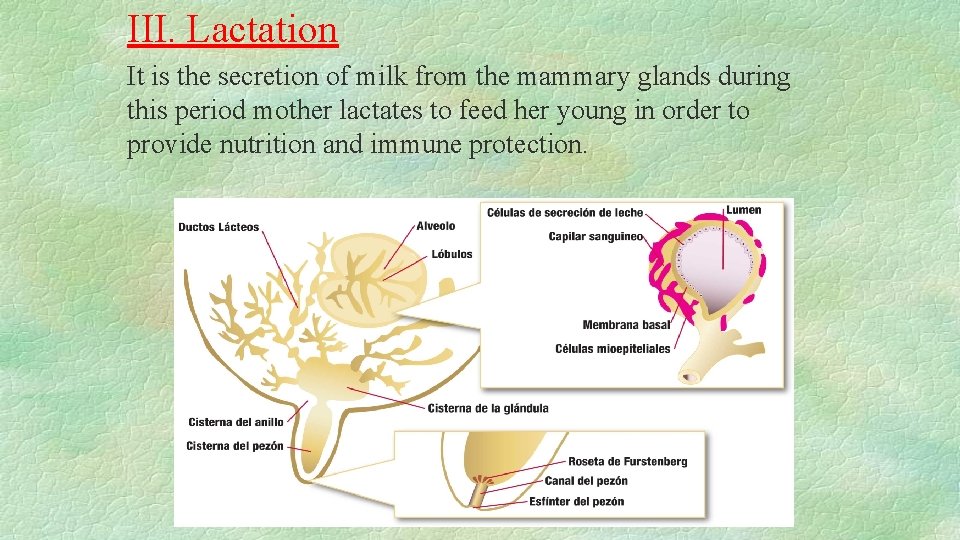
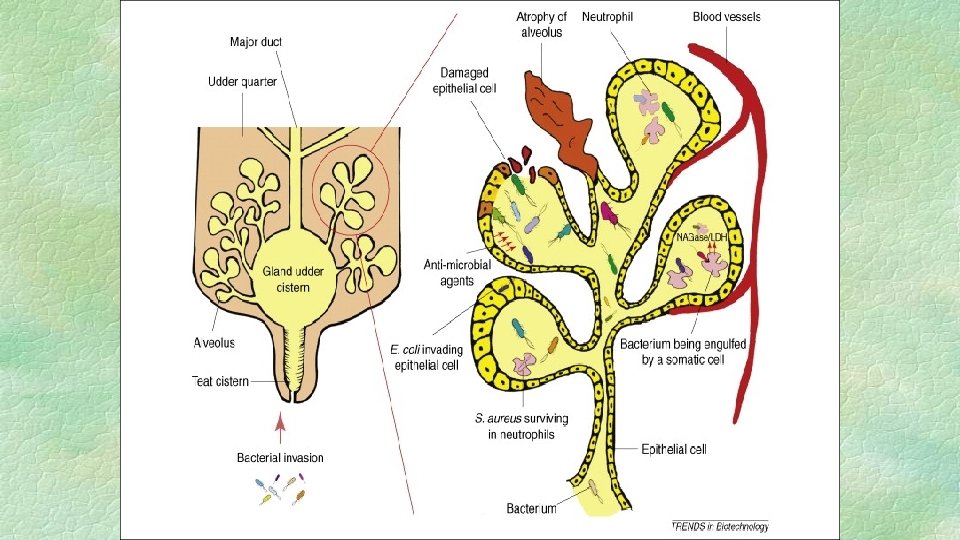
III. Lactation It is the secretion of milk from the mammary glands during this period mother lactates to feed her young in order to provide nutrition and immune protection.
Stages and hormonal control 1. Mammogenesis • It is development and growth of mammary gland from birth to puberty. Starts from fetal stage till early lactation period. Hormonal control According to the effect of hormones on mammogenesis, female animals are classified into: • Animals which the estrogen is primary hormone which stimulates growth of duct system such as mouse, rat, rabbit and cat.
§ Animals in which the estrogen cause growth of duct and lobuloalveolar systems such as guinea pig, cattle and goat. § Animals whose mammary gland growth doesn’t depend on estrogen alone but complete lobuloalveolar development need combination between estrogen and progesterone such as bitch and ferret. § Estrogen hormone, growth hormone and adrenal corticoids are essential for growth of duct system while, progesterone and prolactin hormones are required for lobuloalveolar development.
2. Lactogenesis § It is initiation of milk secretion starts at mid pregnancy to few days postpartum. § Two stages: l First stage: at mid pregnancy during which there is increase mammary enzymatic activity and cytological differentiation of the alveolar cells with limited milk secretion before parturition. l Second stage: begins with the copious secretion of all milk components shortly before parturition and extends throughout several days postpartum in most species.
Hormonal control (Second stage only) • • Lactogenesis under control of prolactin, estrogen, adrenocorticotropic hormone, glucocorticoids and minute effect of growth, thyroid, insulin hormones and prostaglandin. Prolactin is the main hormone, its peak at 24 -48 hrs before parturition. It stimulates gene expression for casein synthesis. Receptors of prolactin and glucocorticoids decreased in presence of progesterone so, lactogenesis is stopped during pregnancy. Prostaglandin increase just before parturition causing luteolysis of CL to decline progesterone level.
3. Galactopoiesis • It is maintenance of milk production few days postpartum till weaning. Hormonal control a. Oxytocin Causing emptying of m. gland by contraction of myoepith. Cells leading to continuous milk secretion. b. Growth H. is galactopoietic in goat and cow inhibited by stress factor. Its effect isn’t direct on m. gland but by direction of nutrients to milk synthesis. c. Prolactin is mainly lactogenic but in high dose it is galactopoietic. d. Adrenal corticoids stimulates cell numbers of
e. Thyroid hormone by stimulation of all metabolic activity. f. Parathyroid hormone stimulates milk yield and increases the concentration of plasma calcium. g. Insulin hormone stimulates galactopoiesis by increasing synthesis of fat, lactose and casein. h. Placental lactogen prolactin-like hormone secreted by placenta of woman (human placental lactogen) and cow. it plays an important role in growth and development of mammary gland. In addition, it stimulates growth of lobuloalveolar system in goat.
Mechanism of milk ejection § Stimulus: Suckling, milking, manipulation of genitalia or application of teat-cups. § Nerve impulse reach hypothalamus to produce oxytocin and ADH (released from p. pituitary). § ADH produced with high osmotic pressure of milk. § Oxytocin stimulates contraction of myoepithelial cells around the alveoli lead to squeezing of the milk out into duct and cisternae and milk ejection.
§ Milk ejection reflex may be inhibited by stress such as fright due to: l l Hyperactivity of mammary adrenergic nerves and activation of sympathetic nervous system leading to vasoconstriction inhibiting oxytocin circulation. Central inhibition and paraventricular nuclei of hypothalamus.
- Slides: 48