
PHYSIOLOGY OF REPRODUCTION DR Hassan Ahmed B V
PHYSIOLOGY OF REPRODUCTION DR/ Hassan Ahmed B. V. Sc, M. D, Ph. D South Valley University
Today’s topics § Testes: Steroidogenesis & spermatogenesis § 2 ndry sex organs: Tubular and glandular § Factors affecting testicular function. § Sperm capacitation. § Acrosomal reaction.
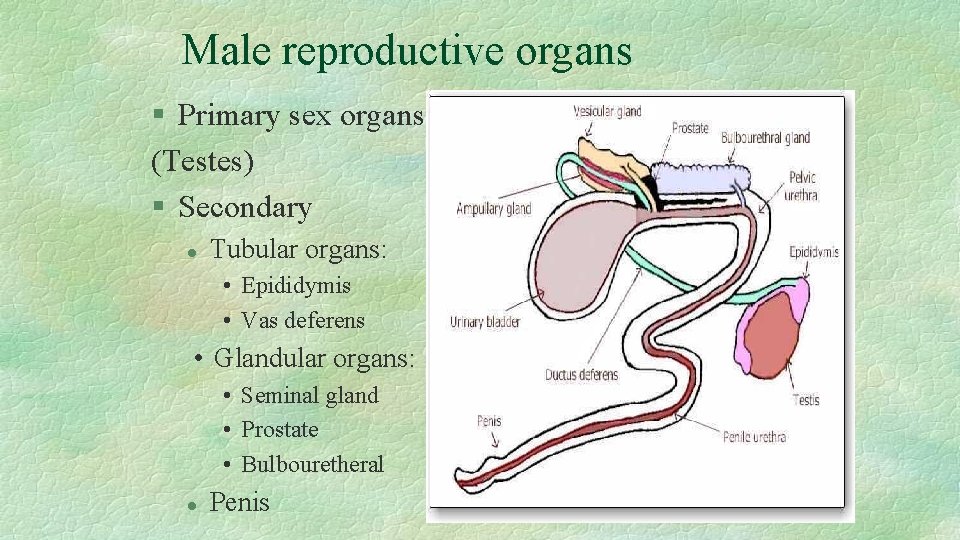
Male reproductive organs § Primary sex organs (Testes) § Secondary l Tubular organs: • Epididymis • Vas deferens • Glandular organs: • Seminal gland • Prostate • Bulbouretheral l Penis
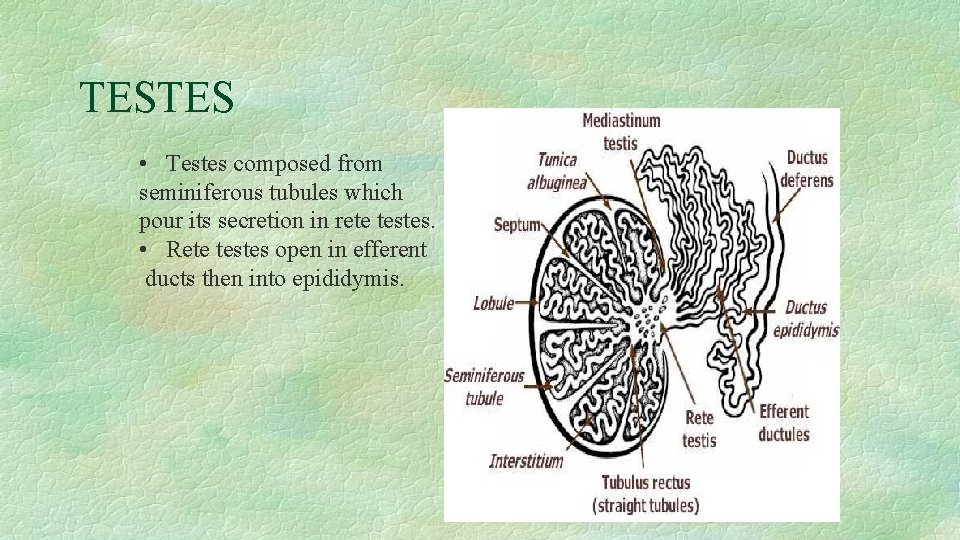
TESTES • Testes composed from seminiferous tubules which pour its secretion in rete testes. • Rete testes open in efferent ducts then into epididymis.

Seminiferous tubules
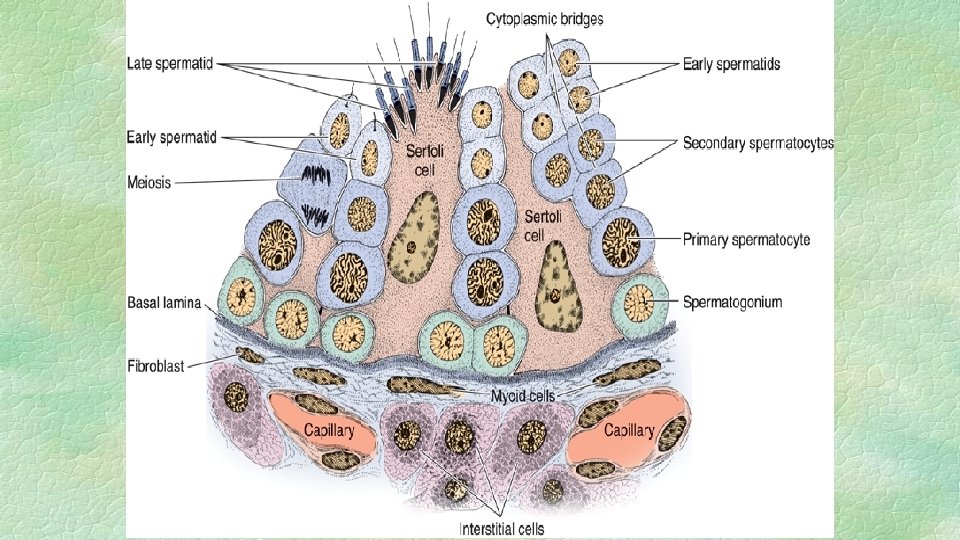
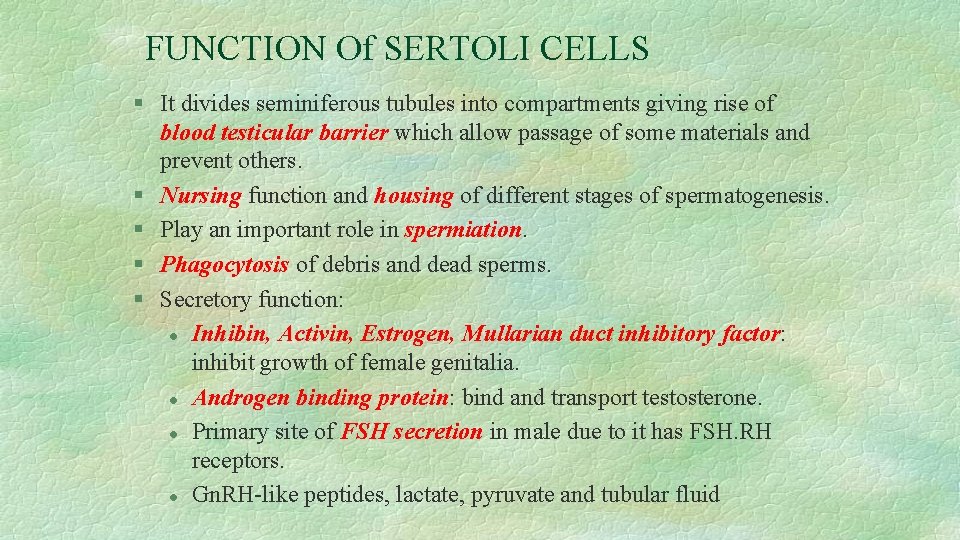
FUNCTION Of SERTOLI CELLS § It divides seminiferous tubules into compartments giving rise of blood testicular barrier which allow passage of some materials and prevent others. § Nursing function and housing of different stages of spermatogenesis. § Play an important role in spermiation. § Phagocytosis of debris and dead sperms. § Secretory function: l Inhibin, Activin, Estrogen, Mullarian duct inhibitory factor: inhibit growth of female genitalia. l Androgen binding protein: bind and transport testosterone. l Primary site of FSH secretion in male due to it has FSH. RH receptors. l Gn. RH-like peptides, lactate, pyruvate and tubular fluid
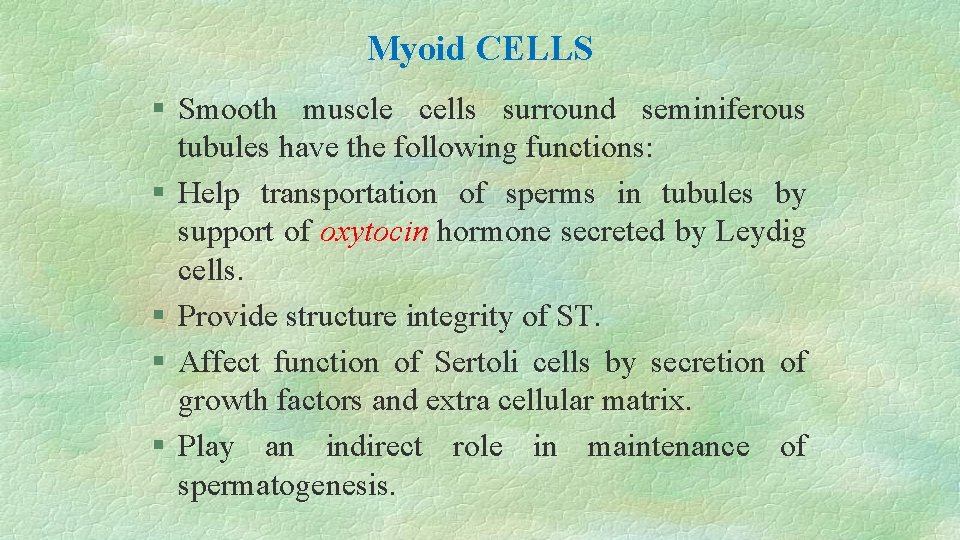
Myoid CELLS § Smooth muscle cells surround seminiferous tubules have the following functions: § Help transportation of sperms in tubules by support of oxytocin hormone secreted by Leydig cells. § Provide structure integrity of ST. § Affect function of Sertoli cells by secretion of growth factors and extra cellular matrix. § Play an indirect role in maintenance of spermatogenesis.
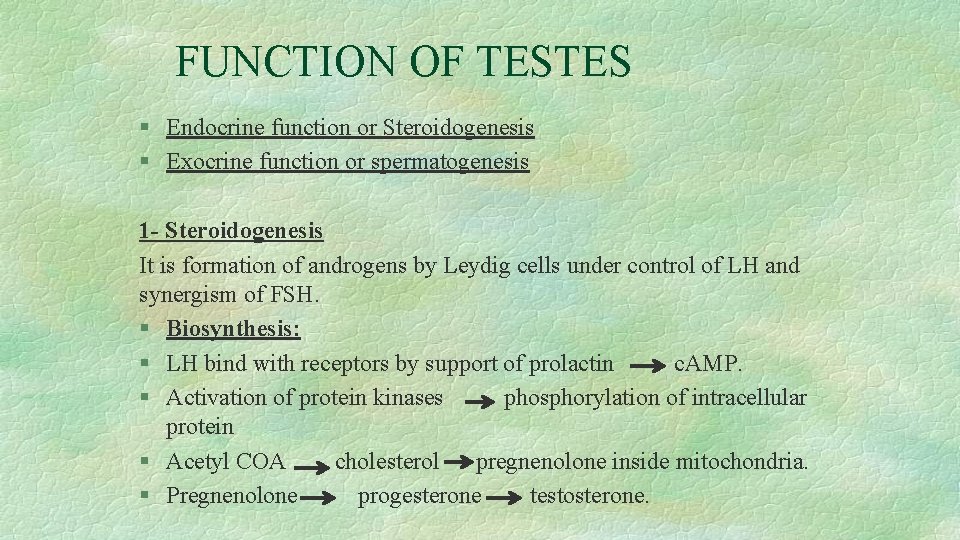
FUNCTION OF TESTES § Endocrine function or Steroidogenesis § Exocrine function or spermatogenesis 1 - Steroidogenesis It is formation of androgens by Leydig cells under control of LH and synergism of FSH. § Biosynthesis: § LH bind with receptors by support of prolactin c. AMP. § Activation of protein kinases phosphorylation of intracellular protein § Acetyl COA cholesterol pregnenolone inside mitochondria. § Pregnenolone progesterone testosterone.

FUNCTIONS OF TESTOSTERONE § In fetal stage, development of male sex organs and descending of testes in scrotum. § In adult, development of primary and secondary sex organs § Responsible for appearance of secondary sex characters as deep voice, wide shoulder and hair distribution. § It is the main hormone responsible for spermatogenesis. § Responsible for sexual desire (libido). § Growth Promotor due to it has anabolic effect. § Precipitation of calcium (Calcification).
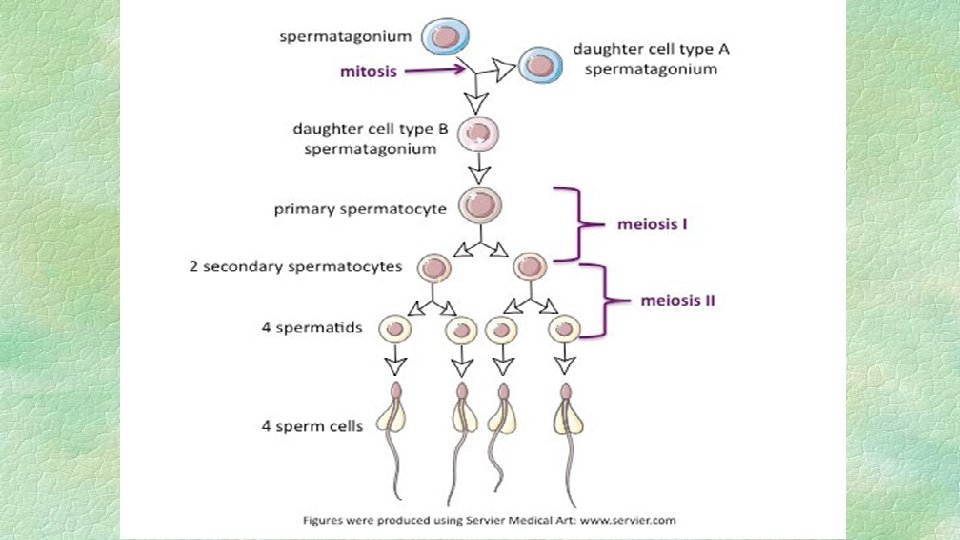
2 - Spermatogenesis Formation of mature spermatozoa from spermatogonia cell in basement membrane of seminiferous tubules into two stages: I. Spermatocytogenesis It is a proliferative stage in which the primitive germ cells multiplied by several mitotic followed by two meiotic divisions to produce the haploid number of chromosomes under control of gametogenic hormone (FSH) and testosterone hormone. This stage composed of 3 phases:
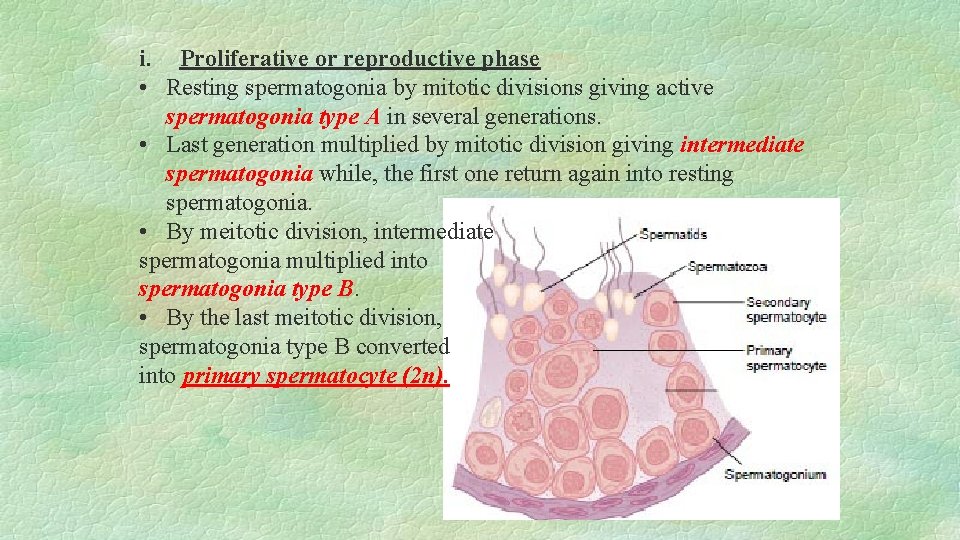
i. Proliferative or reproductive phase • Resting spermatogonia by mitotic divisions giving active spermatogonia type A in several generations. • Last generation multiplied by mitotic division giving intermediate spermatogonia while, the first one return again into resting spermatogonia. • By meitotic division, intermediate spermatogonia multiplied into spermatogonia type B. • By the last meitotic division, spermatogonia type B converted into primary spermatocyte (2 n).
ii. Growth phase § Primary spermatocytes are round cells, their DNA was condensed and homologous chromosomes were paired along the middle of the cell and each chromosome contains identical chromatids. iii. Reduction phase § primary spermatocytes undergo two meiotic divisions to give secondary spermatocyte containing haploid number of chromosomes. § In the first meiotic division (one cell will give two daughter cells), one chromosome of each homologous chromosomes moves to each daughter cell and each daughter cell contains haploid number of chromosomes (n) (Secondary spermatocyte). § In the secondary meiotic division, two daughter cells giving rise of four cells each one contains single chromatid (n) (spermatid).
II. Spermiogenesis § It is a differentiative stage in which the nucleus and cytoplasm of the spermatid undergo morphological changes to give mature sperm. § This stage occurs in seminiferous tubules and end in the epididymis in the following phases: i. Golgi phase § Part of Golgi-apparatus in spermatid condensed to form acrosomal vesicle around the nucleus. § Other part migrates distally to form neck region of sperm.
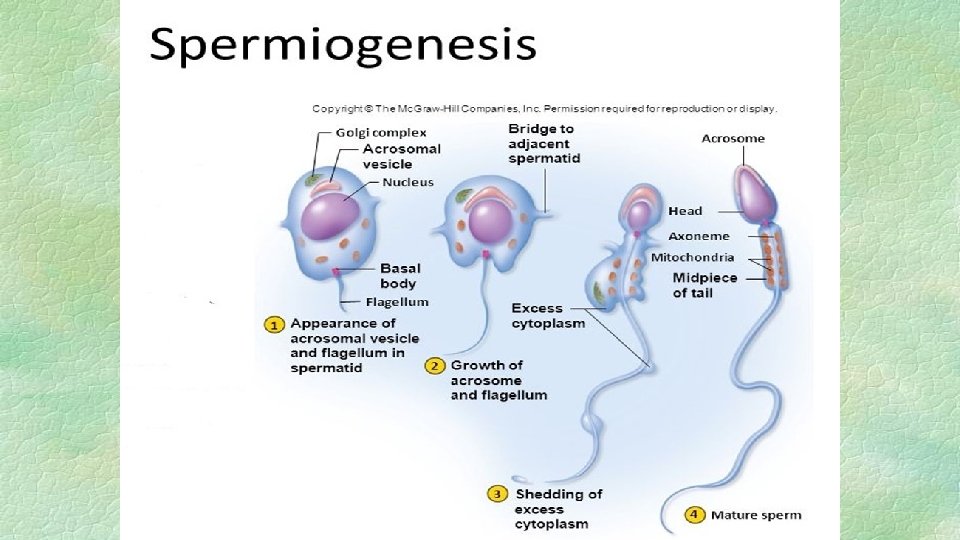

ii. Cap phase § Acrosomal vesicle elongated like a cap to cover anterior 2/3 of nucleus. § Centrioles of the spermatid migrate posterior to nucleus to form proximal and distal centrioles. § The proximal connect the head of sperm with neck while the distal one elongated distally to give tail or axial filament. iii. Acrosomal phase § Acrosomal cap elongated more. § Part of cytoplasm elongated caudally forming caudal part of the sperm.
iv. Maturation phase § Final shape of mature sperm is formed from head, neck, middle piece and tail. § Mitochondria arranged around middle piece. § Part of cytoplasm cast off and separated from sperm. § Excess residual of cytoplasm is found in distal to the middle piece forming distal protoplasmic droplets also found in the upper part of middle piece forming proximal protoplasmic droplets. § Presence of protoplasmic droplets indicates immature sperm.
SECONDARY SEX ORGANS 1. TUBULAR: A. EPIDIDYMIS
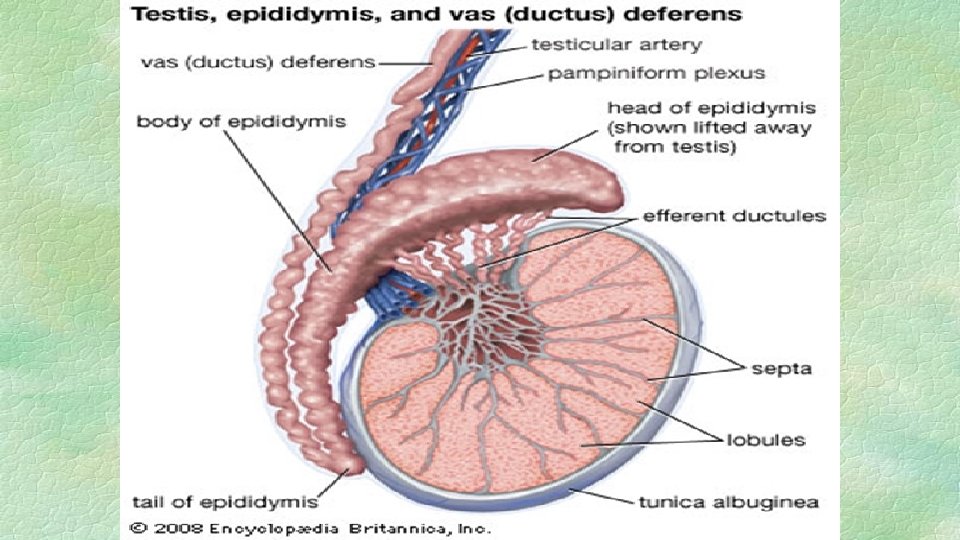
Function § Transportation § Storage § Regulation of spermatogenesis
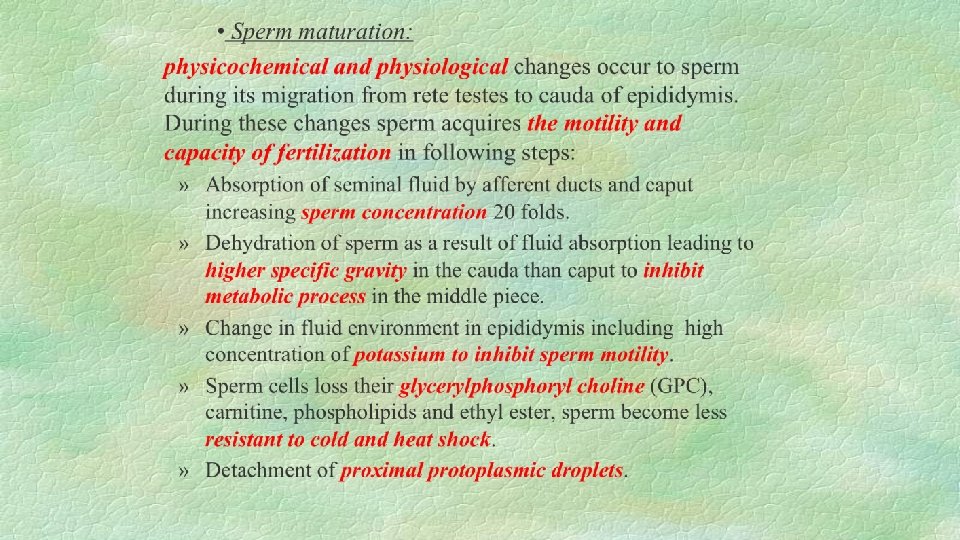
B. Vas deferens Function • Transportation • Storage • Ampulla secrets citric acid • Sperm in ampulla short life due to aerobic glycolysis and high temp. • Bind with seminal vesicle to open in urethra by ejaculatory duct.
2 - Glandular: A. Seminal gland Two elongated sacs located in posterior and inferior aspects of urinary bladder Function • 50% of seminal fluid (sperm vehicle) • High concentration of fructose providing sperm with energy required for motility and viability • Rich in citric acid in combination with potassium, sodium and inositol which is important for maintenance of osmotic equilibration. • Absent in dog and cat
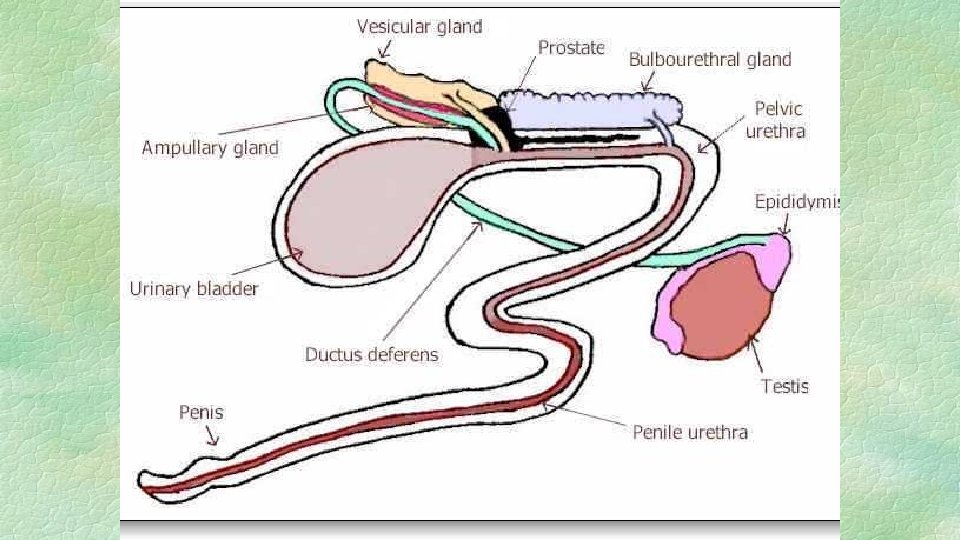
B. Prostate gland Located at pelvic portion of urethra, two parts; body (pars externa) and disseminate (pars interna). Function • Its secretion is slightly alkaline to neutralize the acidity of seminal gland. • Providing optimum Ph (7. 8 – 8. 2) for maximum sperm motility. • Cleans pelvic urethra before ejaculation. • Responsible for specific odour of some animals. • Prostate secretion under control of nervous control timed at ejaculation. • It is found in all animals.

C. Bulbourethral gland or Cowper’s gland Pair of glands found near to ischeal arc and covered by ischeocavernosus muscle. Function • Its secretion is slightly alkaline and viscid helping neutralization and cleaning of extra pelvic urethra from toxic remnant of the urine just before ejaculation. • Responsible for secretion of large amount of fore secretion just before ejaculation. • It is absent in dog.
3 - Penis: Organ of copulation, fibroelastic or musculocavernous Function 1. Erection turgidity and stiffness of the penis caused smell, sight and touch. Mechanism: • • • Pudendal nerve stimulates contraction of erector muscle. Erector muscle press on veins prevent outflow. pelvic splanchnic nerve has two functions; first is vasodilation of penile blood vessels to increase blood flow, second function is stimulates relaxation of retractor penis muscle.
2. Ejaculation Emptying of epididymis, vas deferens and accessory glands by stimulation of glans penis. Mechanism: • 2 nd to 5 th lumber spinal, pudendal and hypogastric nerves cause series of contractions start from vas afferent, epididymis, vas deferens, accessory glands and end with rhythmic contraction of muscle lining urethra.
FACTORS AFFECTING TESTES FUNCTION 1 - HORMONAL FACTOR 1. 2. 3. Pituitary gland Adrenal cortex Thyroid gland 2 - NUTRITIONAL FACTORS Under feeding leading to delaying puberty of all animals, interference of Gn. H production or release and adverse effect on spermatogenesis and steroidogenesis A- Low protein: impairment of libido and decrease semen volume and sperm concentration in each ejaculate
B- Low carbohydrate: low sperm concentration and sperm motility. C- Low energy : reduction of semen volume, sperm concentration and motility due to lack of citric acid, fructose, ergothioneine and inositol. D- Prolonged Vit. A deficiency: impairment of spermatogenesis due to irreversible degeneration of spermatogonia cells in basement of seminiferous tubules, delayed puberty, reduction testes size and weight. E- Vit E (Anti-sterility) deficiency: impairment of spermatogenesis due to atrophy of spermatogonia (reversible), decrease number of live sperm.
F- Vit C deficiency: improved vitality and resistance of spermatozoa so, its deficiency leading to increase sperm abnormalities. G- Minerals - Calcium and phosphorous deficiency has no effect except in severe cases. - Extremely phosphorous deficiency: leading to impairment of testicular function and inhibition of testes development. - Manganese: its deficiency leading to testicular degeneration and absence of libido. - Molybdenum poisoning leading to testicular degeneration. - Zinc deficiency has mild effect on testicular function represented prostatitis, enlarged prostate, prostate cancer, include erectile dysfunction and low testosterone production.
3 - Seasonal variation Seminal quality and male fertility decline in summer and improved in winter but this isn’t clear if seasonal variation has effect on pituitary gland or direct on testes or related to level of thyroid hormones. 4 - Temperature - Optimum sperm production temp. isv 2 -4 o. C below body temperature - High temperature impairs spermatogenesis and steroidogenesis due to high temperature decrease sensitivity of testes to FSH and LH. - The temperature of the testes is regulated by the scrotum as following: § The scrotum lacks subcutaneous fat and is rich in sweat glands. § A two-muscle system lowers and lifts the testis. The tunica dartos is a muscular layer of the scrotum. The cremasteric muscle extends through the inguinal canal, surrounding the spermatic cord.
§ In cold, heat loss is decreased due scrotal surface becomes wrinkled due to contraction of the tunica dartos. § A convoluted network of testicular arteries and veins, the pampiniform plexus, is responsible for counter-current exchange of heat. 5 - Light § Light stimulation power coming through optic nerve and stimulation of supraoptic nuclei in hypothalamus to produce LHRH, which stimulates anterior pituitary to secrete LH, which stimulates Leydig cells to produce testosterone. § Short wave length like red has more gonad-stimulation power than long wavelength.
6 - Psychic factor § Stimulatory as male in contact with female or inhibitory as noise or fear. 7 - Hereditary factor § Cryptorchidism, testicular atrophy and aplasia of duct system inhibit testicular function and decrease sexual desire. 8 - Radiation § Spermatogonia are highly sensitive to ionized radiation while, interstitial cells are relatively resist to radiation. § Exposure of animal to overdose leading to complete sterility, partial fertility or fetal malformation.
- Slides: 35