
Physiology of Renal System Functions of Renal Tubules
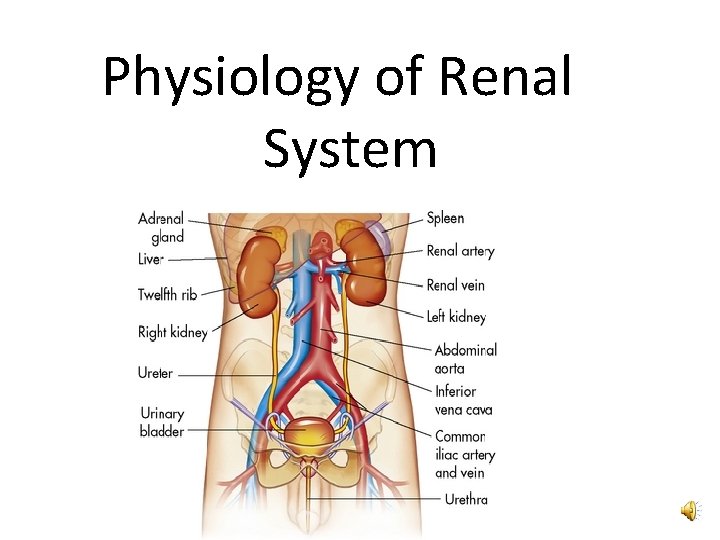
Physiology of Renal System
Functions of Renal Tubules • The loop of Henel • Functions: 1. Reabsorption of 15% H 2 O (in descending limb only it is passive) 2. Reabsorption of 25% Na. Cl (in ascending limb it is active) 3. Absorption of Ca +2 ions from thick ascending limb (medullary nephrons NOT under PTH control)

Functions of Renal Tubules • Distal tubules & collecting ducts: • Functions: 1. Reabsorption of Na & secretion of H + & K + under aldosterone control 2. Absorption of Ca + ions under PTH control) 3. Reabsorption of H 2 O under ADH control 4. Generation of new bicarbonate
Na+ Reabsorption An active process occurs on the basolateral membrane (Na+/K+ ATPase) I. The amount of Na + reabsorped from PCT (65%) & loop of Henle (25%) is kept constant. II. The reabsorption of the remaining 10% by DCT & CD is controlled by: q Aldosterone hormone: that is secreted from adrenal cortex and encourage Na + reabsorption from DCT & CD q Atrial natriuretic peptide: that is secreted by myocardial cells of atria and inhibit Na + reabsorption from CD
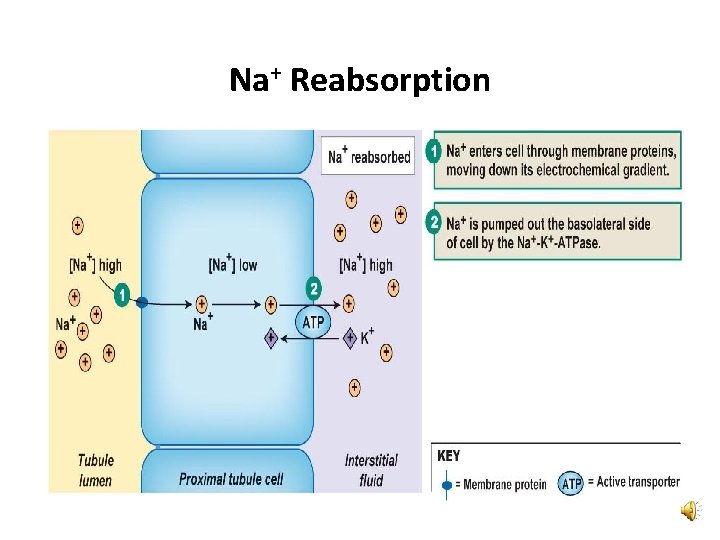
Na+ Reabsorption
Water Reabsorption I. Obligatory: occurs regardless water content of the body 65 % is reabsorped from PCT & 15 % from descending loop of Henle II. The remaining 20% is reabsorped from DCT & CD under control of ADH

III. Tubular Secretion • Tubular secretion is the movement of material from the peritubular capillaries and interstitial space into the nephron tubules • Secretion occurs via diffusion and transcellular mediated transport. – Enables further removal of unwanted substances
III. Tubular Secretion • H + & K + are the most important substances secreted in the tubules. • Other important substances secreted are metabolites such as choline and creatinine and chemicals such as penicillin. • Active transport is required for the movement of the substances from the blood to the cell or out of the cell and into the tubular lumen.
- Slides: 8