
Physiology of Male Reproductive System Dr Hazrat Bilal
Physiology of Male Reproductive System Dr. Hazrat Bilal Malakandi DPT (IPM&R KMU) MSPT* (KMU)
Objectives of the lecture • Physiologic Anatomy of male reproductive system • Spermatogenesis Dr. Hazrat Bilal Malakandi 2
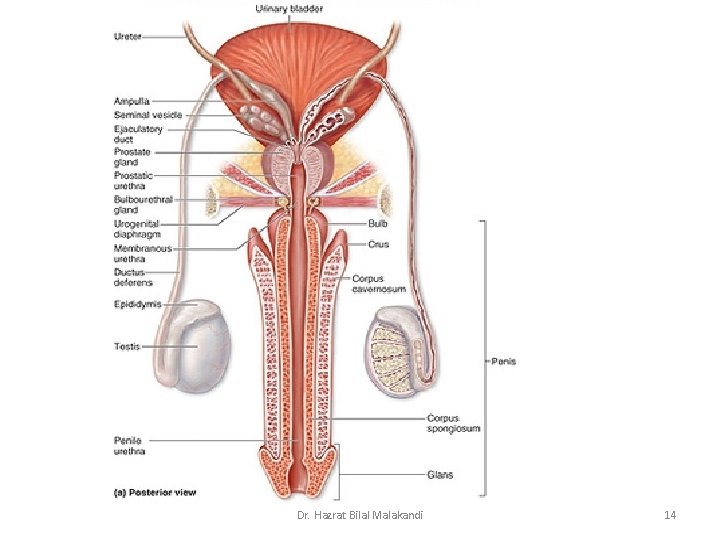
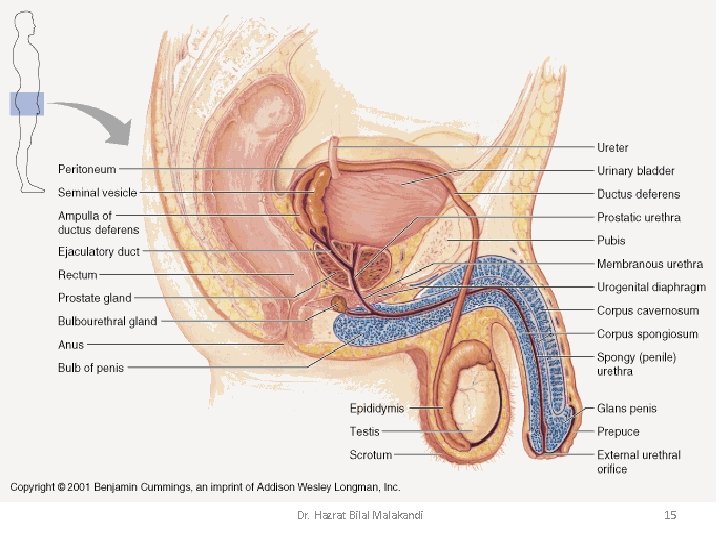
Physiologic Anatomy of male reproductive system Organs of Male reproductive part • Testes • Epididymis • Vas Deferens • Seminal vesicles • Ejaculatory Duct • Prostate Gland • Urethral glands • Bulbourethral gland (Cowper's Gland) Dr. Hazrat Bilal Malakandi 3
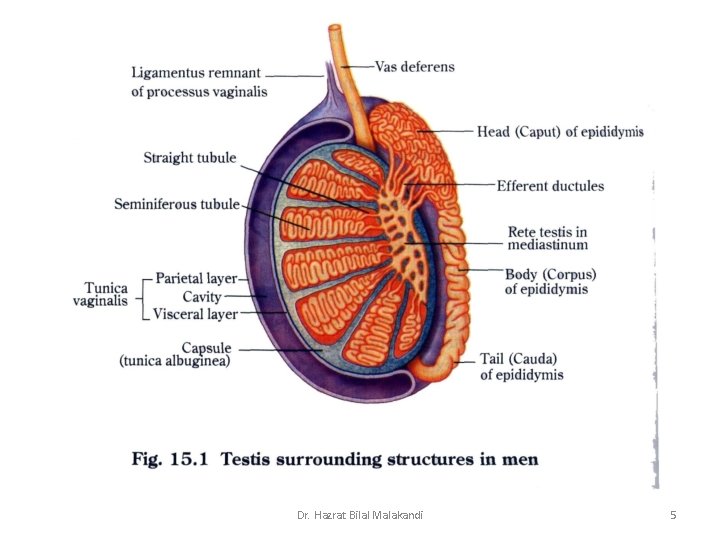
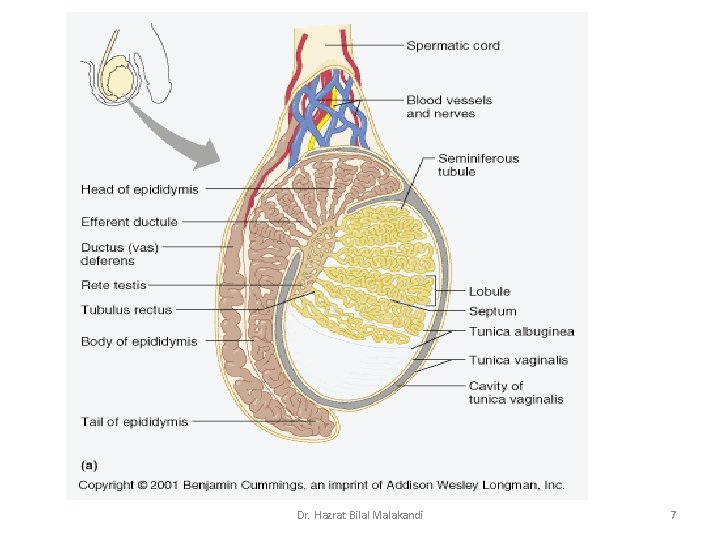
Physiologic Anatomy of male reproductive system Testes • It consist of – Somniferous tubules which are 900 in number, each averaging more than half meter long. They form spermatozoa. – Interstitial cells of leydig: secrete testosterone Dr. Hazrat Bilal Malakandi 4
Dr. Hazrat Bilal Malakandi 5
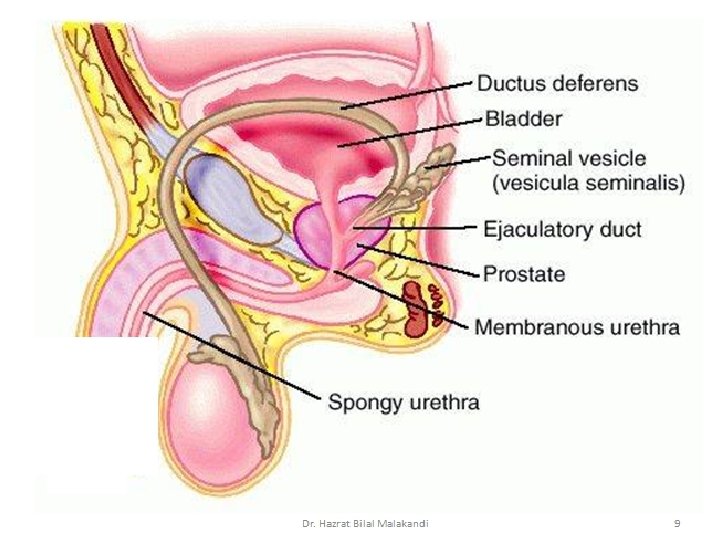
Epididymis • It is 6 m in length • Maturation and little storage of spermatozoa take place here Vas Deferens (ductus deferens) • Store sperms • It enlarges to ampulla of vas deferens immediately before the vas enters the body of the prostate gland. Dr. Hazrat Bilal Malakandi 6
Dr. Hazrat Bilal Malakandi 7
Seminal vesicles • Don’t store spermatozoa • Secrete a fluid that contains – Fructose: nourishes spermatozoa until ferlization – Prostaglandins: aid fertilization by causing contraction in uterus and fallopian tubes to move spermatozoa towards uterus. – Fibrinogen: causes clotting of semen after ejaculation (which is later dissolved by fibrinolysin) Dr. Hazrat Bilal Malakandi 8
Dr. Hazrat Bilal Malakandi 9

Ejaculatory Duct • Receive contents of vas deferens and seminal vesicles and prostatic secretions. Prostate Gland • Secrete a thick milky alkaline fluid that contains – Citric acid – Ca – Acid phosphates – Clotting enzymes – Profibrinolysin Dr. Hazrat Bilal Malakandi 10
• Alkaline nature of prostate secretions – Neutralize acidity of spermatozoa from vas deferens. – Neutralizes vaginal acidity (p. H = 3. 5 -4) – Finally p. H of semen becomes 6 -6. 5 at which sperms are optimally motile. Dr. Hazrat Bilal Malakandi 11
URETHRA Internal urethra • Receives contents of ejaculatory duct. Penile urethra • Receives contents of internal (or prostatic) urethra and secretions of urethral glands and bulbourethral glands. Dr. Hazrat Bilal Malakandi 12

Urethral glands • Located along entire extent of urethra. • Secrete mucus Bulbourethral gland (Cowper's Gland) • Located near of urethra. • Secretes excess mucus Dr. Hazrat Bilal Malakandi 13
Dr. Hazrat Bilal Malakandi 14
Dr. Hazrat Bilal Malakandi 15
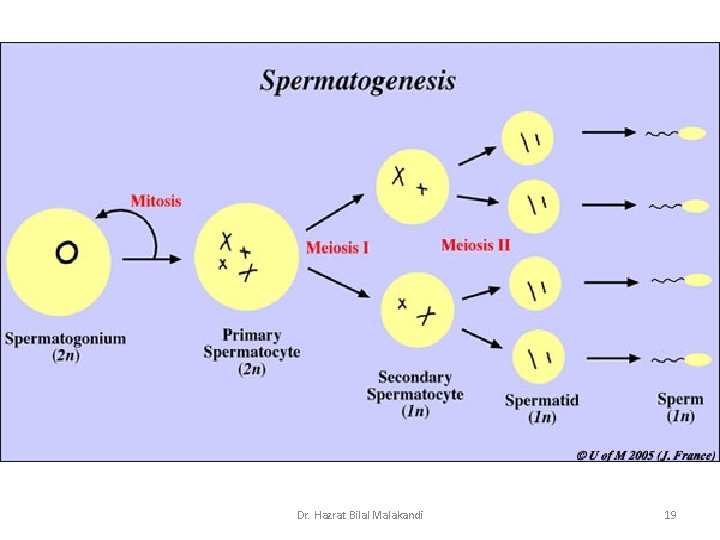
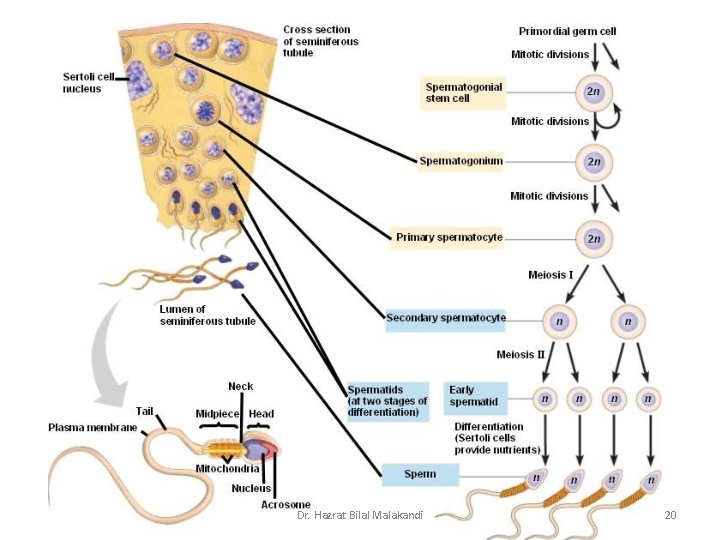
Spermatogenesis • Male version of gametogenesis. • It is the process in which spermatozoa are produced from male primordial germ cells by way of mitosis and meiosis. • Entire process of spermatogenesis takes 74 days. Testes produce 200 to 300 million spermatozoa daily. Dr. Hazrat Bilal Malakandi 16
Location • The initial stages occur within the testes and progress to the epididymis where the developing gametes mature and are stored until ejaculation. • The seminiferous tubules of the testes are the starting point for the process, where stem cells adjacent to the inner tubule wall beginning at the walls and proceeding into the innermost part, or lumen—to produce immature sperm. Maturation occurs in the epididymis. Dr. Hazrat Bilal Malakandi 17
It is divided into two Spermatocytogenesis Spermiogenesis (spermiation) Spermatocytogenesis • Spermatogonium primary spermatocyte (22 pairs + XY) meiosis ❶ secondary spermatocyte (22 pairs + X) or (22 pairs + Y) meiosis ❷ spermatid Spermiogenesis (spermiation) • Spermatid (rounded shape) sperm (with head neck and tail) Dr. Hazrat Bilal Malakandi 18
Dr. Hazrat Bilal Malakandi 19
Dr. Hazrat Bilal Malakandi 20
Role of sertoli cells in Spermatogenesis Sertoli cells are large cells in germinal epithelium. • They secrete a fluid that bathes and nourishes developing and newly formed sperms. • Sertoli cells secrete digestive enzymes that remove most of cytoplasm from spermatid and help to shape it into sperm with head neck and tail. Dr. Hazrat Bilal Malakandi 21

• They secrete three hormones 1. Mullerian inhibitory factor (MIF): secreted during fetal life to inhibit formation of fallopian tubes from mullerian ducts in male fetus 2. Estradiol: (although female sex hormone) stimulate spermatogenesis 3. Inhibin: prevent over secretion of FSH by anterior pituitary glands. Dr. Hazrat Bilal Malakandi 22
Hormonal Stimulation of Spermatogenesis 1. Testosterone: secreted by leydig cells. It stimulate meiotic division of primary spermatocytes to form secondary spermatocytes. 2. LH: secreted by ant. Pituitary gland, stimulate interstitial cells of leyding to secrete testosterone. 3. FSH: stimulate spermiation by sertoli cells, also secreted by ant. Pituitary gland. Without it the conversion of spermatid to sperms (spermiogenesis) will not occur. Dr. Hazrat Bilal Malakandi 23
4. Estradiol: secreted by sertoli cells upon stimulation by FSH. Essential for spermiation. 5. GH: provide background metabolism and promotes early divisions of spermatogonia. Dr. Hazrat Bilal Malakandi 24
Regulation of spermatogenesis • FSH from anterior pituitary gland stimulates sertoli cells increase spermatogenesis and also inhibin secreted negative feedback inhibition of FSH secretion. Dr. Hazrat Bilal Malakandi 25

1 Dr. Hazrat Bilal Malakandi 26
- Slides: 26