
PHYSIOLOGY OF LIVER GALL BLADDER PART 1 DR
PHYSIOLOGY OF LIVER & GALL BLADDER – PART - 1 DR. M. M. KHAN PROF. & HEAD, PHYSIOLOGY
PHYSIOLOGY OF LIVER & GALL BLADDER – PART – 1 1. Functional Anatomy of Liver & Gall Bladder 2. Histology of Liver ---- Hepatic Lobule 3. Blood Flow through Liver 4. Properties of Bile Juice 5. Composition of Bile Juice 6. Enterohepatic Circulation 7. Functions of Bile Juice 8. Functions of Liver 9. Regulation of Secretion of Bile 10. Synthesis of Bile Pigments (Bilirubin) --- Fate of Haemoglobin
PHYSIOLOGY OF LIVER & GALL BLADDER – PART – 2 1. Synthesis of Bile Pigments (Bilirubin) --- Fate of Haemoglobin 2. Liver Function Tests 3. Applied of Liver : (a) Jaundice, or, Icterus (b) Hepatitis (c) Liver Cirrhosis (d) Liver Failure, or, Hepatic Coma 6. Gall Bladder – Its Functional Anatomy 7. Functions of Gall Bladder 8. Regulation of Gall Bladder Contraction & Bile Evacuation 9. Applied of Gall Bladder : (a) Gall Stones (b) Cholecystitis
1. FUNCTIONAL ANATOMY OF HEPATO – BILIARY SYSTEM
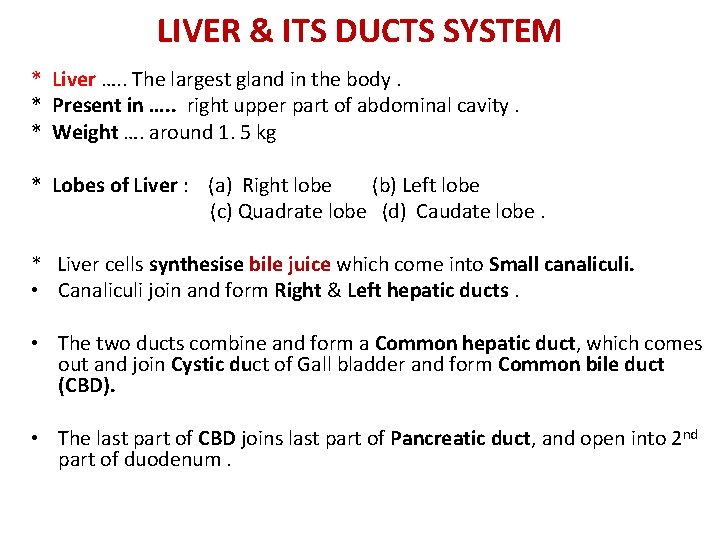
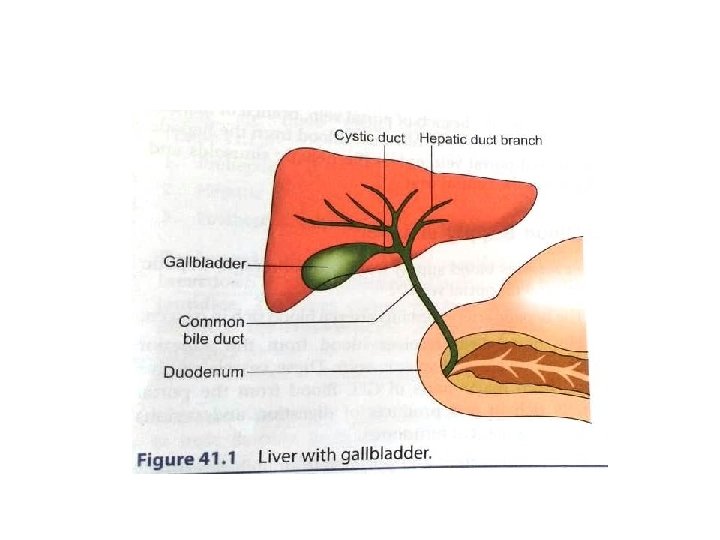
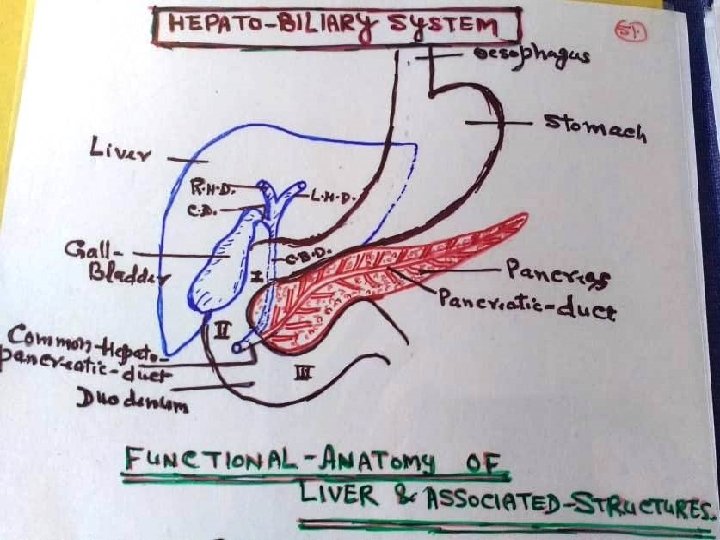
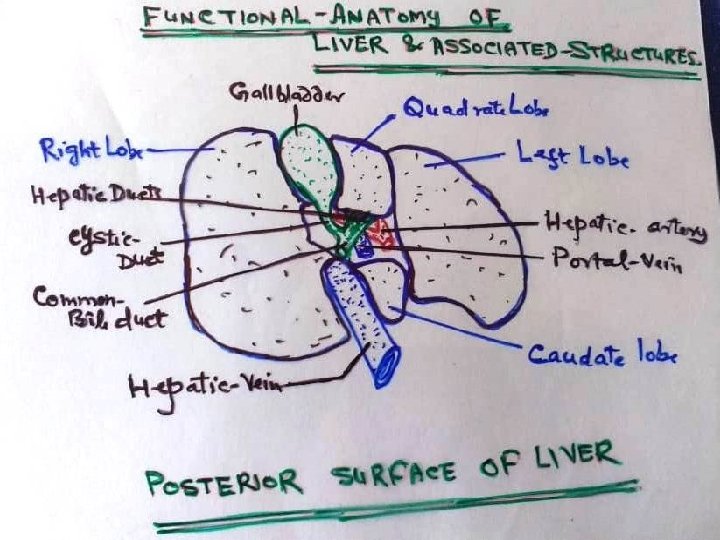
LIVER & ITS DUCTS SYSTEM * Liver …. . The largest gland in the body. * Present in …. . right upper part of abdominal cavity. * Weight …. around 1. 5 kg * Lobes of Liver : (a) Right lobe (b) Left lobe (c) Quadrate lobe (d) Caudate lobe. * Liver cells synthesise bile juice which come into Small canaliculi. • Canaliculi join and form Right & Left hepatic ducts. • The two ducts combine and form a Common hepatic duct, which comes out and join Cystic duct of Gall bladder and form Common bile duct (CBD). • The last part of CBD joins last part of Pancreatic duct, and open into 2 nd part of duodenum.
2. HISTOLOGY OF LIVER HEPATIC - LOBULE
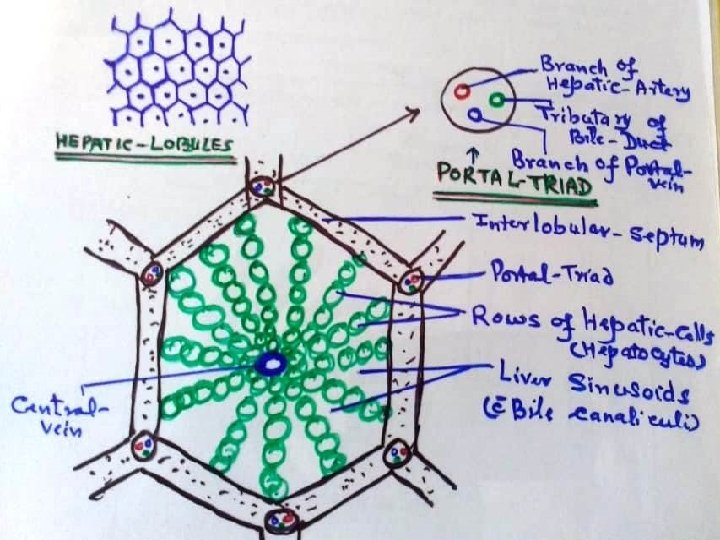
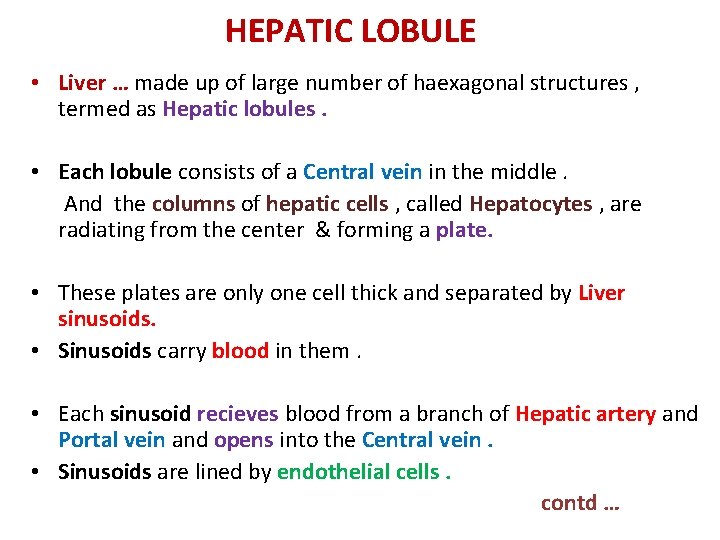
HEPATIC LOBULE • Liver … made up of large number of haexagonal structures , termed as Hepatic lobules. • Each lobule consists of a Central vein in the middle. And the columns of hepatic cells , called Hepatocytes , are radiating from the center & forming a plate. • These plates are only one cell thick and separated by Liver sinusoids. • Sinusoids carry blood in them. • Each sinusoid recieves blood from a branch of Hepatic artery and Portal vein and opens into the Central vein. • Sinusoids are lined by endothelial cells. contd …
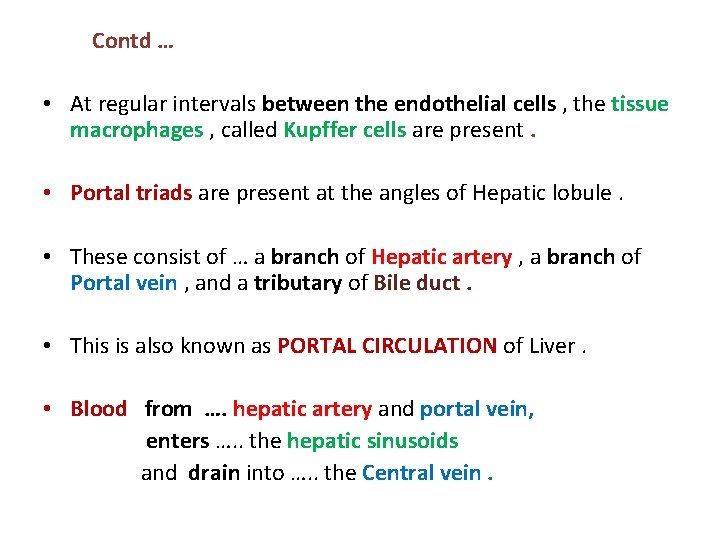
Contd … • At regular intervals between the endothelial cells , the tissue macrophages , called Kupffer cells are present. • Portal triads are present at the angles of Hepatic lobule. • These consist of … a branch of Hepatic artery , a branch of Portal vein , and a tributary of Bile duct. • This is also known as PORTAL CIRCULATION of Liver. • Blood from …. hepatic artery and portal vein, enters …. . the hepatic sinusoids and drain into …. . the Central vein.
3. BLOOD FLOW THROUGH LIVER

BLOOD FLOW THROUGH LIVER • Liver recieves blood - supply …. from two sources : (1) Hepatic artery and (2) Portal vein. • Hepatic artery contains arterial (oxygenated) blood, rich in Oxygen. • Portal vein recieves Venous (deoxygenated) blood from Superior mesenteric vein and Splenic vein. • These vessels receive blood from major part of GIT. • Blood from portal vein is rich in nutrients and various GIT hormones.
Contd …. . • Hepatic artery & Portal vein branch repeatedly and finally enter the sinusoids. • O 2 & nutrients are delivered to hepatic cells through sinusoids. • Substances produced in Liver, waste products , CO 2 and products of metabolism are emptied into sinusoids. • The sinusoids are drained into the Central vein which through the Hepatic vein , ultimately drain into Inferior vena cava.

4. PROPERTIES OF BILE JUICE • Colour : Golden yellow , or , greenish • Volume: 1000 ml (800 -1200 ml) per day , secretion • Reaction: Alkaline • p. H: 8 -8. 6 • Specific – gravity : 1010

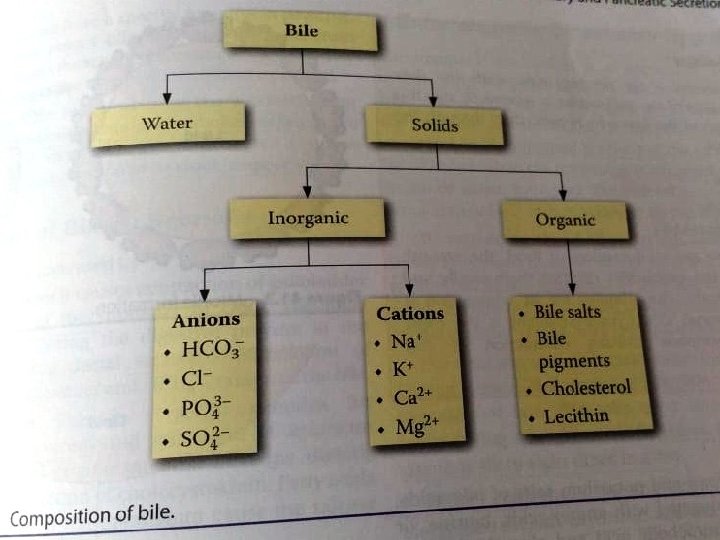
5. COMPOSITION OF BILE JUICE (A). Water - 97. 5% (B). Solids - 2. 5% : (a) Inorganic – Constituents : - Na, K, Cl, Ca, HCO 3 , etc (b) Organic – Constituents : (1. ) Bile acids : (a) Primary : - Cholic acid - Chenodeoxy cholic acid (b) Secondary : - Deoxycholic acid - Lithocholic acid contd ……

COMPOSITION OF BILE JUICE contd … (2. ) Bile salts : (Bile acids + Na/K + Glysine / taurine): - Sodium glycocholate - Potassium glycocholate - Sodium taurocholate - Potassium taurocholate (3. ) Bile pigments : - Bilirubin , Biliverdin (4. ) Cholesterol (5. ) Lecithin (6. ) Fatty acids

6. ENTEROHEPATIC CIRCULATION • - Primary Bile acids - are formed in liver. • - These come in Intestine - through biliary tract , with bile juice • - Secondary Bile acids - are formed in intestine. (I) Cholic - acid (Intestinal bacteria ) Deoxycholic - Acid (II) Cheno deoxy cholic acid (Intestinal Bacteria) Lithocholic - Acid • - Enterohepatic - circulation - These secondary bile - acids , with bile pigments , through portal vein , again enter liver. contd ….

Contd …. • - Bile salts formation in Liver - by secondary bile acids with glycine / taurine and Na+/ K+ (i) Bile acids + glycine - Glycocholic acids (ii) Bile acids + taurine - Taurocholic acid * - Then with Na+ & K+ - (i) Na - glychocoholate , (ii) K - glycocholate, (iii) Na - taurocholate , (iv) K - taurocholate • - Bile salts also reach to Intestine & then to Liver - by Entrohepatic - circulation. • - Some bile salts & bile acids – also excreted through faeces. • - While , some bile - pigment - excreted through urine & faeces (in form of urobilinogen & stercobilinogen, respectively) .


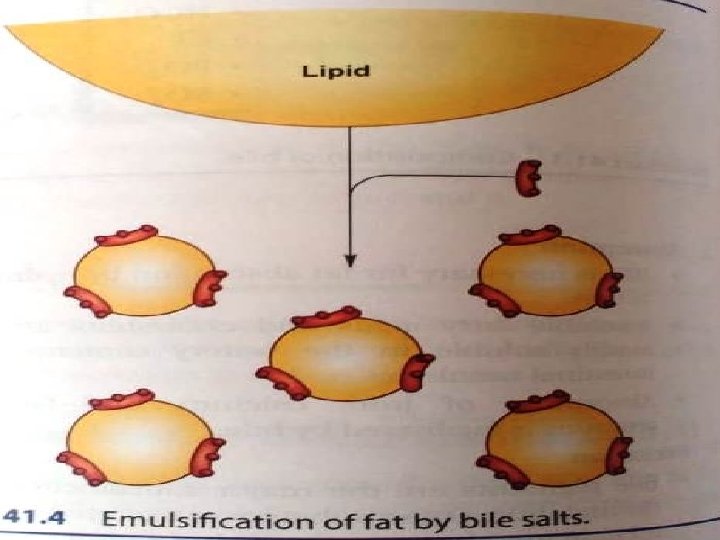
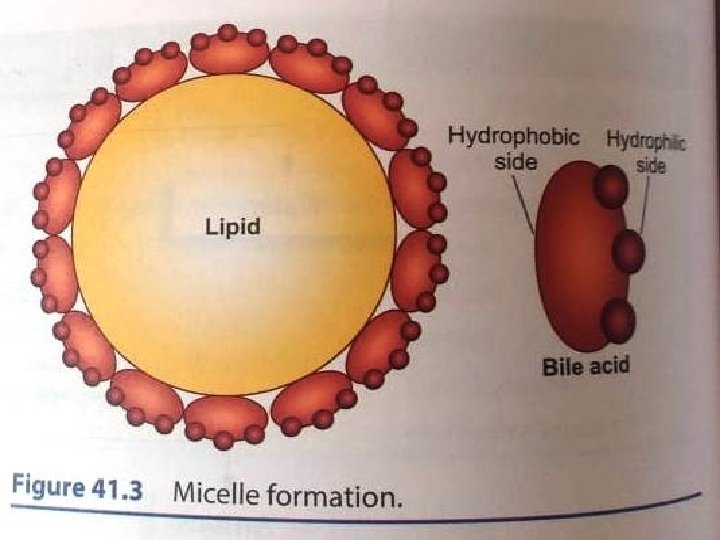
7. FUNCTIONS OF BILE – JUICE : (Mainly due to Bile - Salts) 1. Digestion of fats : It is by Emulsification of fats , i. e. to make insoluble fats -- soluble , in water : (i) by breaking fat globules in minute particles & (ii) by decreasing surface tension of fats particles. - It is necessary process for enzymes to act on lipids. 2. Absorption of fats: - By combining with emulsified lipids , - And making Micelles. Contd …. .
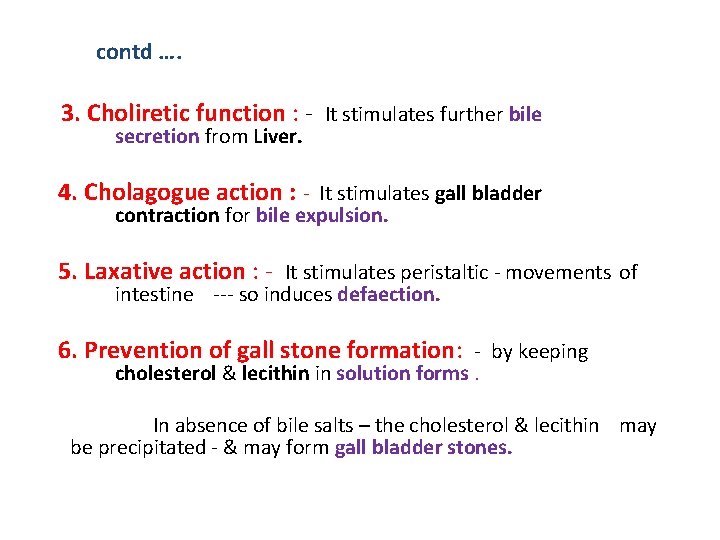
contd …. 3. Choliretic function : - It stimulates further bile secretion from Liver. 4. Cholagogue action : - It stimulates gall bladder contraction for bile expulsion. 5. Laxative action : - It stimulates peristaltic - movements of intestine --- so induces defaection. 6. Prevention of gall stone formation: - by keeping cholesterol & lecithin in solution forms. In absence of bile salts – the cholesterol & lecithin may be precipitated - & may form gall bladder stones.
8. FUNCTIONS OF LIVER (1. ) METABOLIC – FUNCTIONS : It helps in - Metabolism of carbohydrates , protein , fats, vitamins & many hormones, etc. Also helps in Energy metabolism. (2. ) HEAT - PRODUCTION : It is responsible for Maximum heat production , during metabolism. (3. ) SYNTHETIC FUNCTIONS : It helps in - synthesis of : (i) glucose , by gluconeogenesis ; (ii) all plasma proteins , (except Igs ), (iii) many clotting factors , & (iv) steroids , etc. (4. ) SECRETION OF : Bile - (with bile salts, bile pigments, cholesterol, fatty acids & lecithin). (5. ) EXCRETION OF : Bile pigments, cholesterol, heavy -metals (lead, arsenic), toxins, bacteria (of typhoid), viruses, etc. contd …. .
contd … (6. ) HEMOPOEITIC – FUNCTIONS : It helps in : - Haemopoiesis in foetal life - Storage of vit. B 12 , folic -acid & Iron , necessary for erthorpoiesis, - Production of thrombopoeitin - necessary for thrombopoeisis. (7. ) HEMOLYTIC FUNCTIONS : - For Senile RBCs , by Kupffers – cells. (8. ) INACTIVATION OF HORMONES & DRUGS : - Like : - growth - hormone , parathomone , cortisol , insulin , glucagon , oestrogen , & - fat soluble drugs - which are excreted through bile & urine. (9. ) DEFENSIVE FUNCTIONS : - By kupffer’s cells & Interleukins - for bacteria , antigens , etc. (10. ) DETOXIFICATION FUNCTIONS : - For toxic substances , by converting into nontoxic - materials - by Conjugation with glucoronic - acid & sulphates.
9. REGULATION OF BILE SECRETION (A) NERVOUS REGULATION : - By Vagal stimulation . . It results into : (i) Contraction of gall bladder & (ii) Relaxation of ‘sphincter of oddi’ … It results in : Increased bile secretion in duodenum. (B) HUMORAL REGULATION : - Bile secretion is a continuous - process but secretion is less during fasting. - It increases 3 hours after meals. - Its secretion is influenced by some Chemical factors : (i) Choleretics (ii) Cholagogues (iii) Hydrocholeretic agents contd ….

Contd …. (I. ) CHOLERETICS : are substances, which increase the secretion of bile from liver ; e. g. : 1. Acetylcholine , 2. Secretin, 3. chole cytokine , 4. Acid chyme ( in duodenum) 5. Bile Salts (II. ) CHOLAGOUGES : are substances , which increase the contraction of gall bladder …. . so increase expulsion of bile from gall bladder into duodenum ; e. g. : 1. Bile salts , 2. Fatty acids, 3. Inorganic acids , 4. Amino – acids, 5. Calcium - All these substances stimulate : C. C. K. – P. Z. (Cholecystokinin – pancreozymin). - It increases gall bladder contraction. (III. ) HYDROCHOLERETIC AGENTS : which Causes secretion of bile , rich in water (but less solids). e. g. : HCl - acid.
10. SYNTHESIS & CIRCULATION OF BILE PIGMENTS (BILIRUBIN) ( FATE OF HAEMOGLOBIN )

IMPORTANT QUESTIONS 1. Properties, composition and functions of Bile juice. 2. Short notes on : (a) Hepatic lobule (b) Micelles (c) Portal circulation of Liver (d) Enterohepatic circulation (e) Functions of Liver (f) Synthesis of Bile pigments ( Fate of haemoglobin)
THANK YOU …….
- Slides: 35