
Physiology of Excitable tissue L 1 RMP Prof
Physiology of Excitable tissue L 1 RMP Prof. Fakhir Al-Ani fakeralani 2000@yahoo. com

Excitable tissue Tissues that perform action by excitation Many if not all tissues But we will concerned with 1. Nervous tissue: - Motor. - Sensory. 2. Muscular tissue: – Skeletal muscles. – Smooth muscles. – Cardiac muscles.
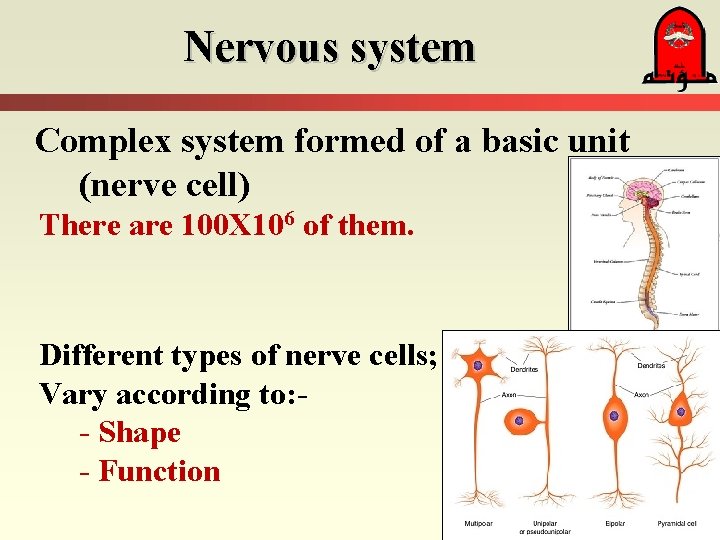
Nervous system Complex system formed of a basic unit (nerve cell) There are 100 X 106 of them. Different types of nerve cells; Vary according to: - Shape - Function
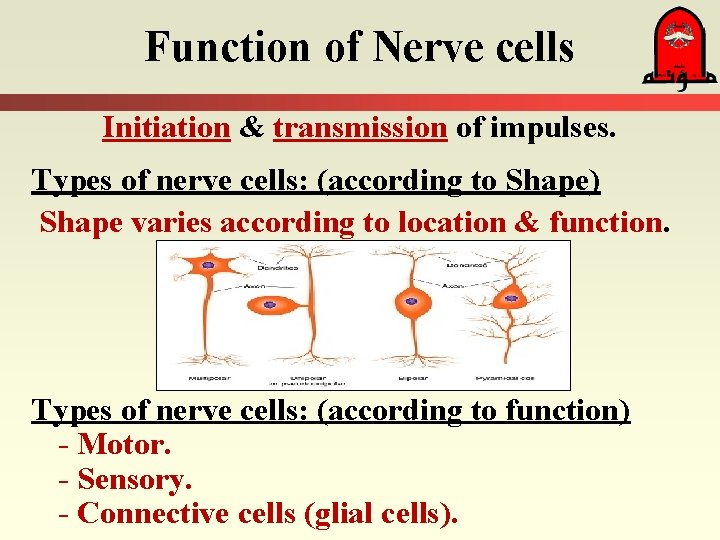
Function of Nerve cells Initiation & transmission of impulses. Types of nerve cells: (according to Shape) Shape varies according to location & function. Types of nerve cells: (according to function) - Motor. - Sensory. - Connective cells (glial cells).
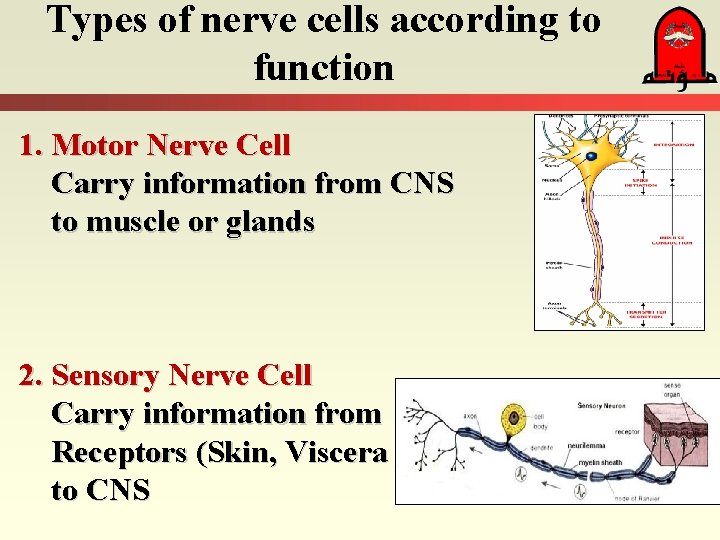
Types of nerve cells according to function 1. Motor Nerve Cell Carry information from CNS to muscle or glands 2. Sensory Nerve Cell Carry information from Receptors (Skin, Viscera to CNS
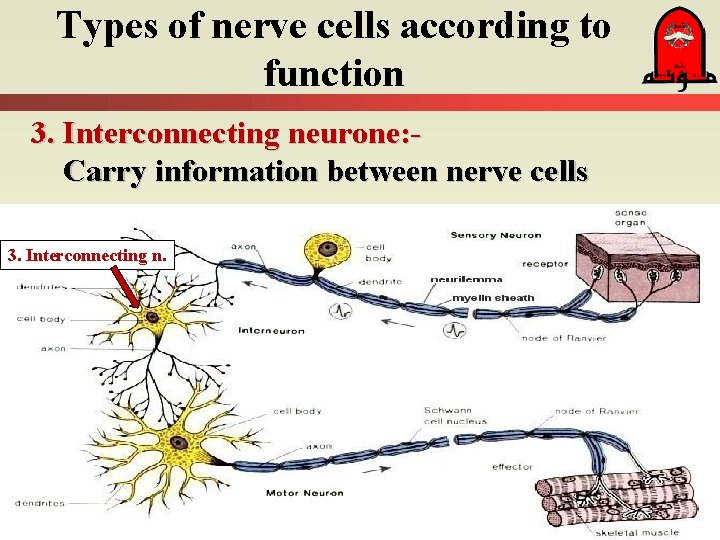
Types of nerve cells according to function 3. Interconnecting neurone: Carry information between nerve cells 3. Interconnecting n.
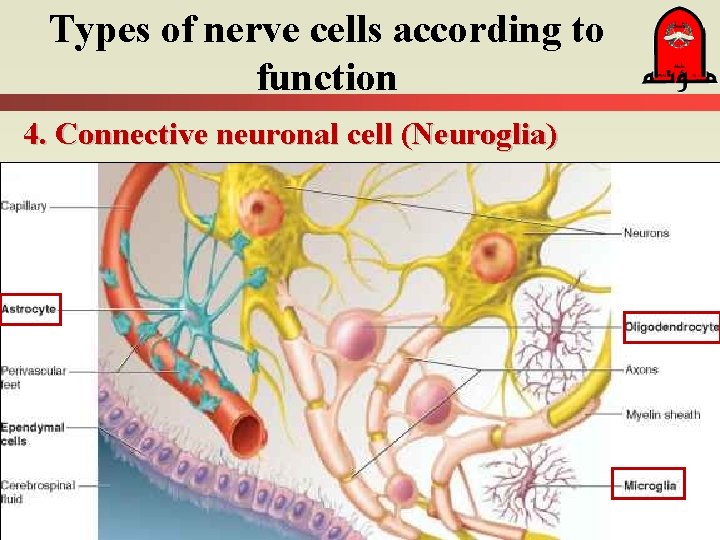
Types of nerve cells according to function 4. Connective neuronal cell (Neuroglia)
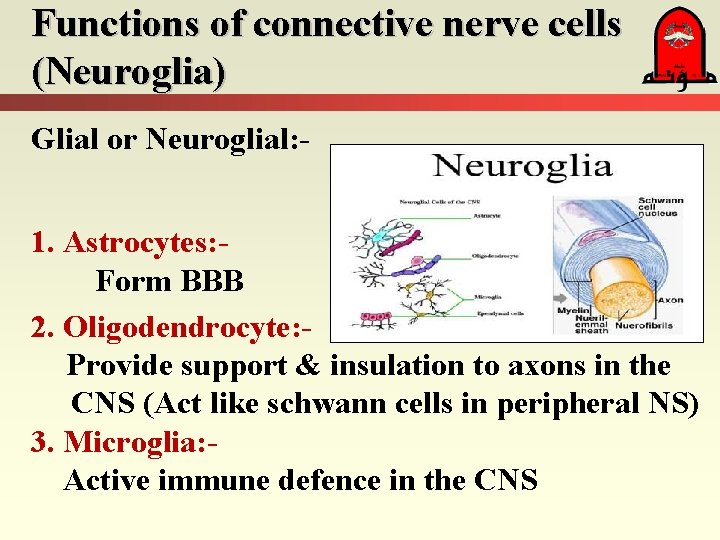
Functions of connective nerve cells (Neuroglia) Glial or Neuroglial: 1. Astrocytes: Form BBB 2. Oligodendrocyte: Provide support & insulation to axons in the CNS (Act like schwann cells in peripheral NS) 3. Microglia: Active immune defence in the CNS
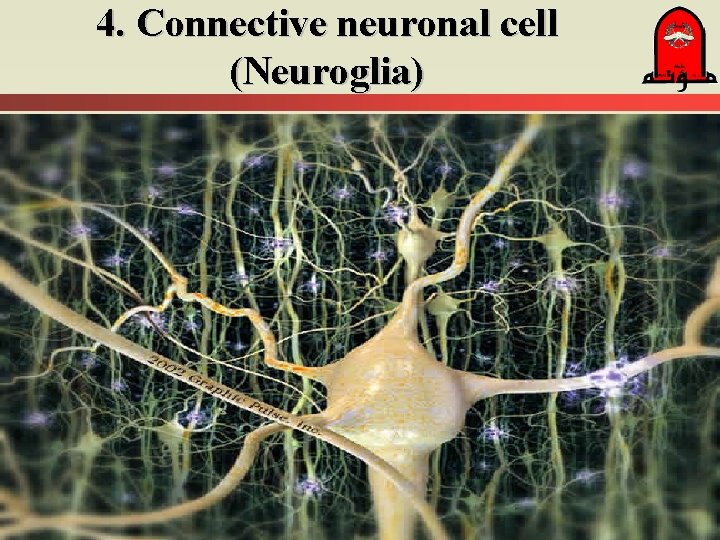
4. Connective neuronal cell (Neuroglia) §
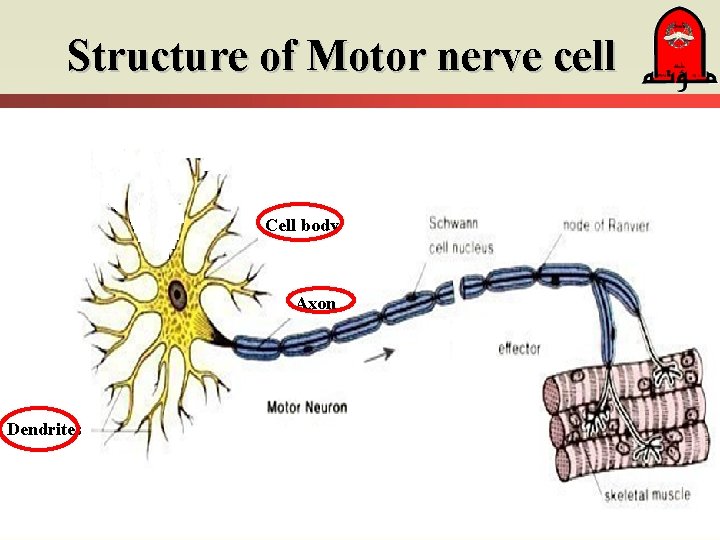
Structure of Motor nerve cell Cell body Axon Dendrites
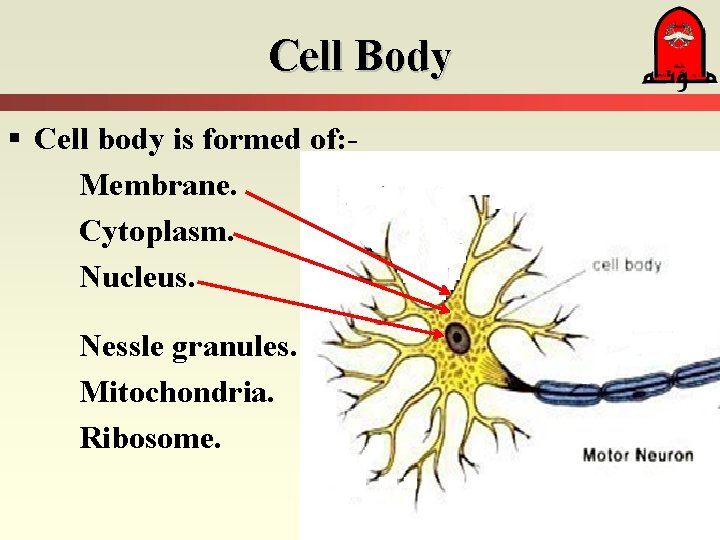
Cell Body § Cell body is formed of: Membrane. Cytoplasm. Nucleus. Nessle granules. Mitochondria. Ribosome.
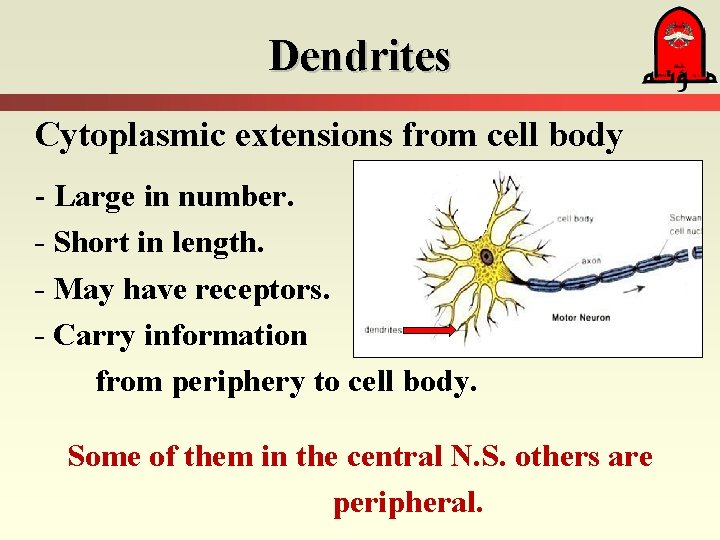
Dendrites Cytoplasmic extensions from cell body - Large in number. - Short in length. - May have receptors. - Carry information from periphery to cell body. Some of them in the central N. S. others are peripheral.
Axon: also cytoplasmic extension. - Usually Single Long extension in motor nerve cell. - Carrying information from cell body to periphery - Attached to muscle at its end through the N. M. J. - Covered by membrane called neurolemma. - May be covered by Myelin sheath from Schwann cells, & in between there are Nodes of Ranvers - At the end of the motor axon there is synaptic knobs, which are full with Neurotransmitters
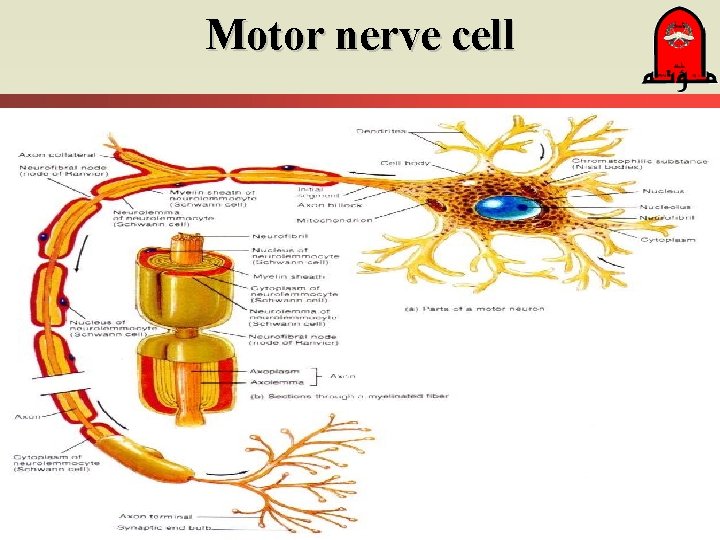
Motor nerve cell
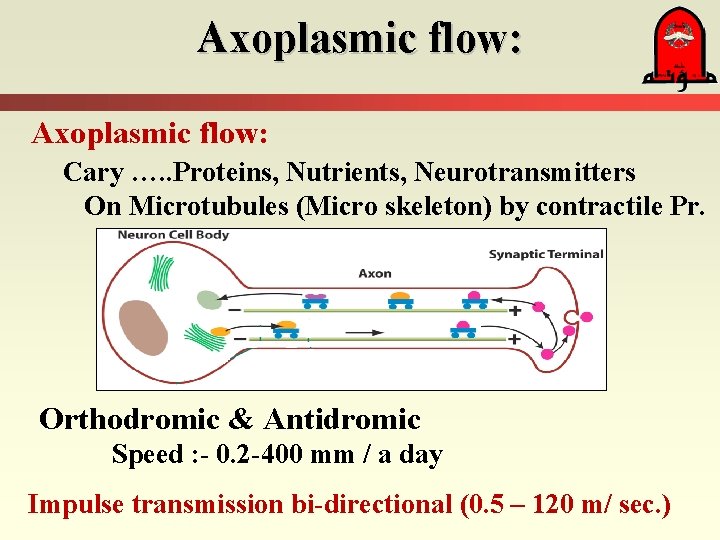
Axoplasmic flow: Cary …. . Proteins, Nutrients, Neurotransmitters On Microtubules (Micro skeleton) by contractile Pr. Orthodromic & Antidromic Speed : - 0. 2 -400 mm / a day Impulse transmission bi-directional (0. 5 – 120 m/ sec. )
Common properties of nerve cells 1. R. M. P. (Resting membrane Potential) 2. Stimulation. 3. The threshold 4. The site of excitation. 5. Excitation & transmission of nerve impulse Local changes Action potential 6. Strength duration curve or the relationship.

Resting Membrane Potential (RMP) Potential difference across the cell membrane. ++++++++++ -----------------Positive charge (out side the cell) outer surface of the membrane Negative charge (inside the cell) inner side of the membrane
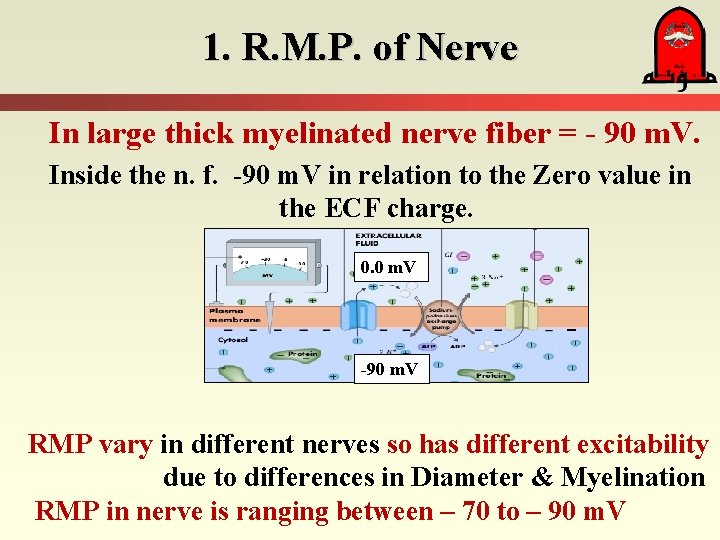
1. R. M. P. of Nerve In large thick myelinated nerve fiber = - 90 m. V. Inside the n. f. -90 m. V in relation to the Zero value in the ECF charge. 0. 0 m. V -90 m. V RMP vary in different nerves so has different excitability due to differences in Diameter & Myelination RMP in nerve is ranging between – 70 to – 90 m. V
Significance of RMP - Make some cell able to generate an action potential (Pacemaker cell, CNS neurons & smooth muscle) - Enable other cells to transmit this action potentials (nerve cell, some smooth muscles & cardiac m. ). - Enable other cells to do function in response to AP (muscles, endocrine cells, cilia, & macrophages) So essential for excitable cell function Removal/changing this RMP will affect cell functions
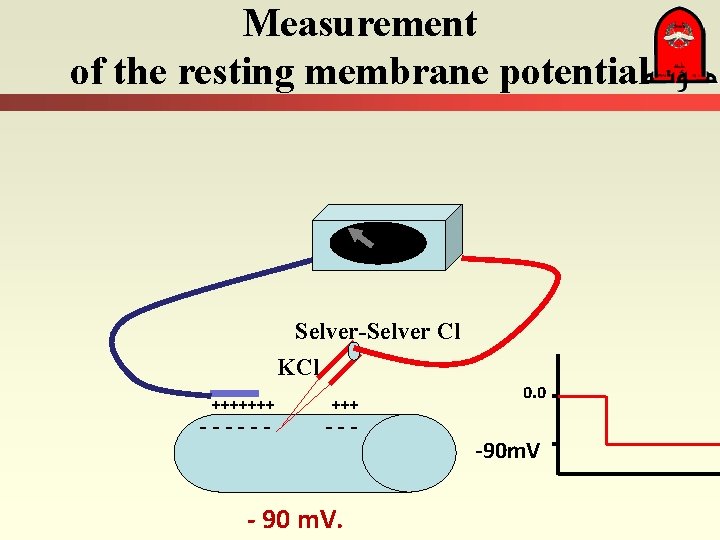
Measurement of the resting membrane potential Selver-Selver Cl KCl +++++++ ------ +++ --- - 90 m. V. 0. 0 -90 m. V

Generation of RMP 1. Unequal distribution of electrolyte across the cell membrane. 2. Semi-permeability or selective permeability of the cell membrane. 3. Presence of Na-K pump. If we change any of these factors it will affect the RMP & So affect cell functions

Generation of RMP 1. Unequal distribution of electrolyte. Na ions (+ve charge) Cl ions (-ve charge Outside > inside Inside > outside Protein (-ve charge) K ions (+ve charge) 2. Selective permeability of cell membrane.
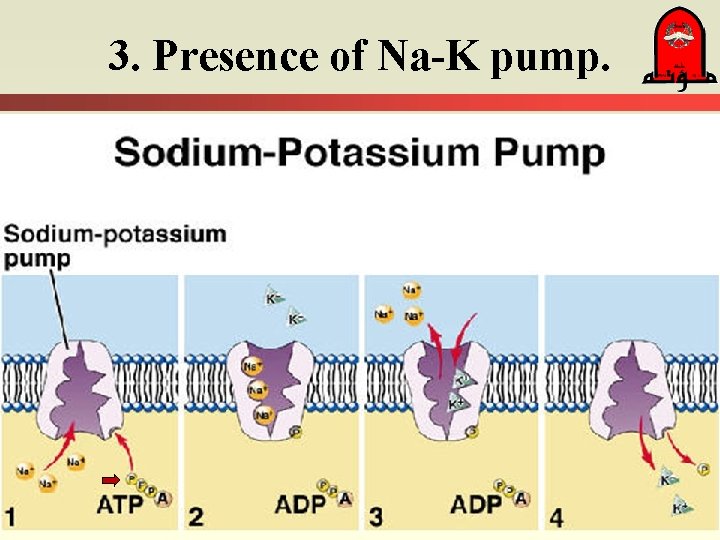
3. Presence of Na-K pump.
3. Effect of Na-KATPase Pump Push 3 Na+ out & replacing them by 2 K+. The net result is: a. b. c. Na out (142 m. Eq/L) & Na in (14 m. Eq/L) K out (4 m. Eq/L) & K in (140 m. Eq/L) Positive charge outside The membrane is not permeable neither to Na ions nor to the most of the Pr. negative ions present inside the cell This chemical gradient Causes potential gradient called Resting membrane potential (RMP)
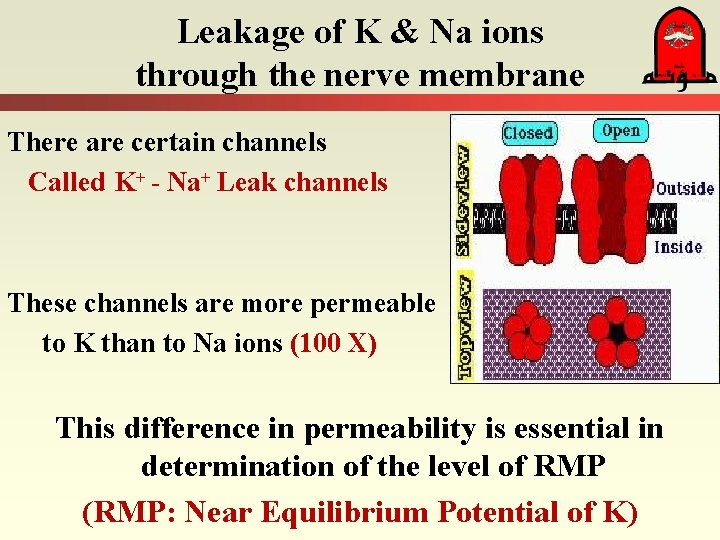
Leakage of K & Na ions through the nerve membrane There are certain channels Called K+ - Na+ Leak channels These channels are more permeable to K than to Na ions (100 X) This difference in permeability is essential in determination of the level of RMP (RMP: Near Equilibrium Potential of K)
Membrane Potential during rest & excitation During Resting state: Membrane potential is near the Equilibrium Potential of K ion - 90 m. V ? On excitation: Membrane potential will be nearer to Na ion potential + 45 m. V. ?

Resting Membrane Potential The RMP is not the same in all excitable cells - Nerve - Cardiac muscle - Skeletal muscle - Smooth muscle = – 70 to – 90 m. V = – 95 m. V = – 50 to – 70 m. V The –ve charge means that Inside the cell there is -90 milli-volt potential in relation to the Zero value in the extracellular fluid charge.
2. Stimulation Nerve signals ------ Impulse & Action potential
- Slides: 28