
Physiology Of Coronary Blood Flow Dr S reekumar

Physiology Of Coronary Blood Flow Dr S reekumar
Outline • Introduction • Coronary microcirculation, resistance beds & autoregulation • Endothelium dependent vasodilation • Measurement of CBF • Coronary collateral circulation • CBF abnormalities with ‘normal’ coronary vessels
Control of Coronary Blood Flow • Pronounced systolic and diastolic coronary flow variations throughout the cardiac cycle • Coronary arterial inflow out of phase with venous outflow • Systole • • • Increases tissue pressure Redistributes perfusion from the subendocardial to the subepicardial layer Impedes coronary arterial inflow Reduces the diameter of intramyocardial microcirculatory vessels Increases coronary venous outflow • Diastole • Coronary arterial inflow increase (a transmural gradient favoring perfusion to the subendocardial vessels) • Coronary venous outflow falls
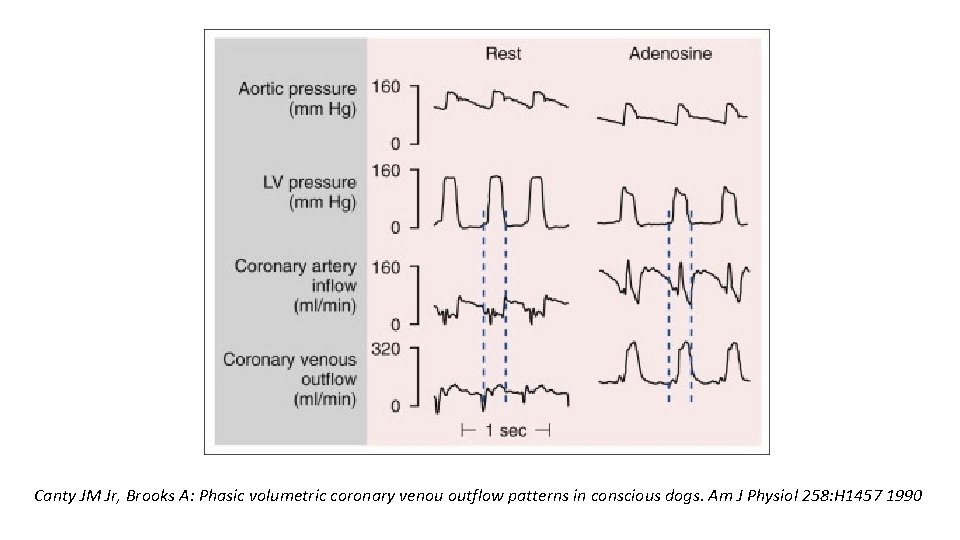
Canty JM Jr, Brooks A: Phasic volumetric coronary venou outflow patterns in conscious dogs. Am J Physiol 258: H 1457 1990
Determinants of Myocardial Oxygen Consumption • Myocardial oxygen extraction near-maximal at rest ( 75% ) • Further increase in oxygen extraction limited • Sympathetic activation • Acute subendocardial ischemia • Increases in myocardial oxygen consumption met by • Proportional increases in coronary flow • Increase in oxygen delivery ( Sp. O 2, Hb )
Coronary Autoregulation • Regional coronary blood flow remains constant • Over a wide range of Cor. Art. Pressure ( Determinants of myocardial oxygen consumption if constant ) • When pressure falls to the lower limit of autoregulation • Coronary resistance arteries are maximally vasodilated • Flow becomes pressure-dependent • Onset of subendocardial ischemia • Resting coronary blood flow • 0. 7 to 1. 0 ml/min/g • Increase to four to five fold during vasodilation
Coronary Reserve • The ability to increase flow above resting values in response to pharmacologic vasodilation • Flow in the maximally vasodilated heart depends on cor. art. press.
Maximum perfusion and coronary reserve reduced • Diastolic time for subendocardial perfusion decreased (tachycardia) • Compressive determinants of diastolic perfusion (preload) increased • Anything that increases resting flow ØSystolic pressure ØHeart rate ØContractility • Reductions in arterial oxygen supply ØAnaemia ØHypoxia
• Subendocardial ischemia in presence of normal coronary – possible • Lower pressure limit of autoregulation - 70 mm Hg (as low as 40 mm Hg) • Lower autoregulatory pressure limit increases during tachycardia ØIncrease in flow requirements ØReduction in the time available for perfusion
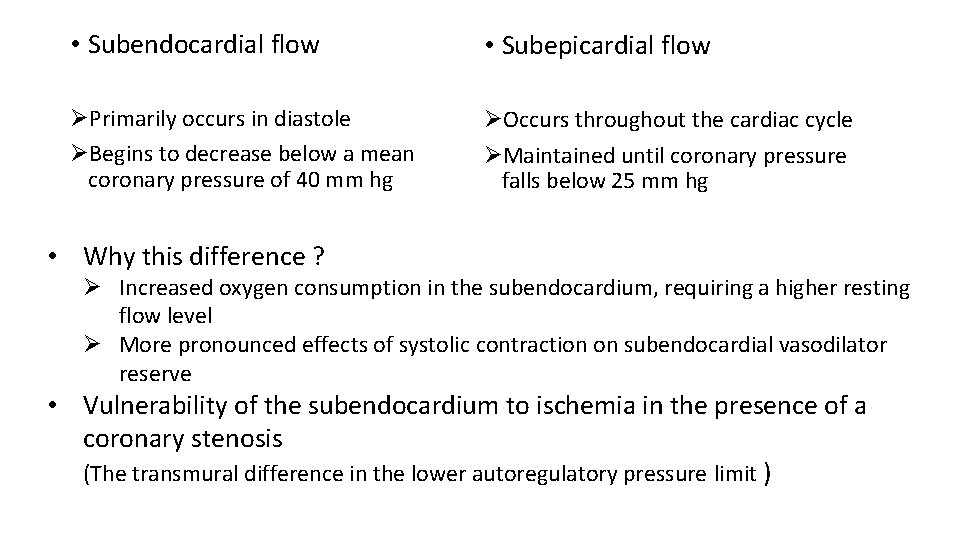
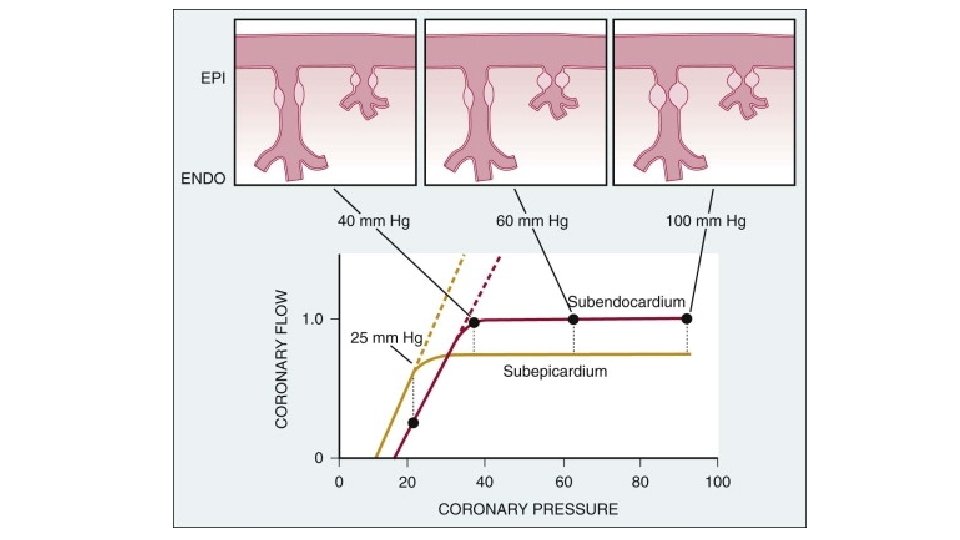
• Subendocardial flow • Subepicardial flow ØPrimarily occurs in diastole ØBegins to decrease below a mean coronary pressure of 40 mm hg ØOccurs throughout the cardiac cycle ØMaintained until coronary pressure falls below 25 mm hg • Why this difference ? Ø Increased oxygen consumption in the subendocardium, requiring a higher resting flow level Ø More pronounced effects of systolic contraction on subendocardial vasodilator reserve • Vulnerability of the subendocardium to ischemia in the presence of a coronary stenosis (The transmural difference in the lower autoregulatory pressure limit )
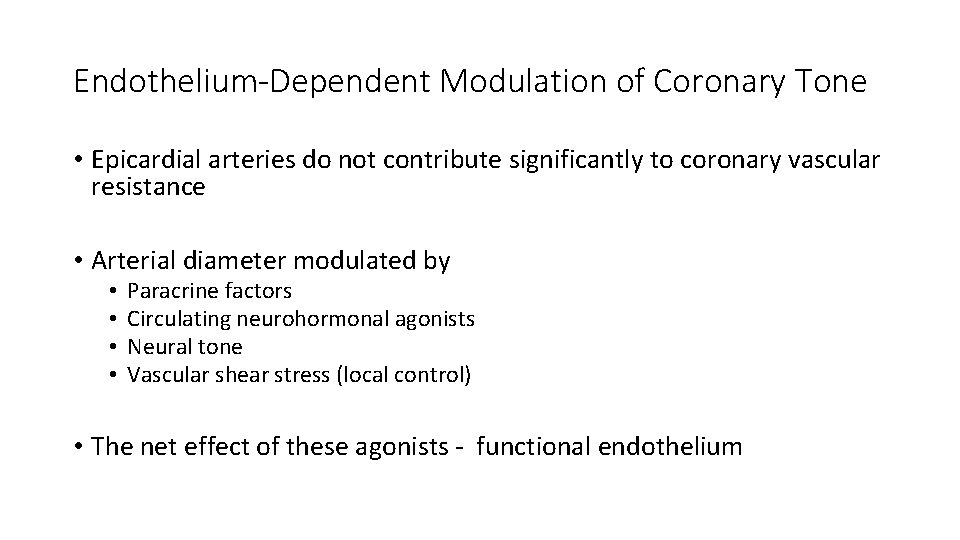
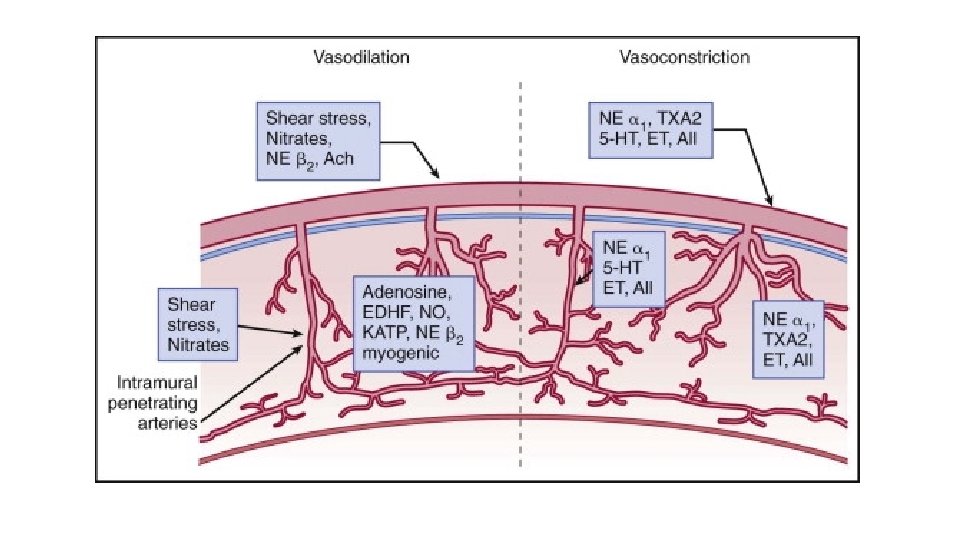
Endothelium-Dependent Modulation of Coronary Tone • Epicardial arteries do not contribute significantly to coronary vascular resistance • Arterial diameter modulated by • • Paracrine factors Circulating neurohormonal agonists Neural tone Vascular shear stress (local control) • The net effect of these agonists - functional endothelium
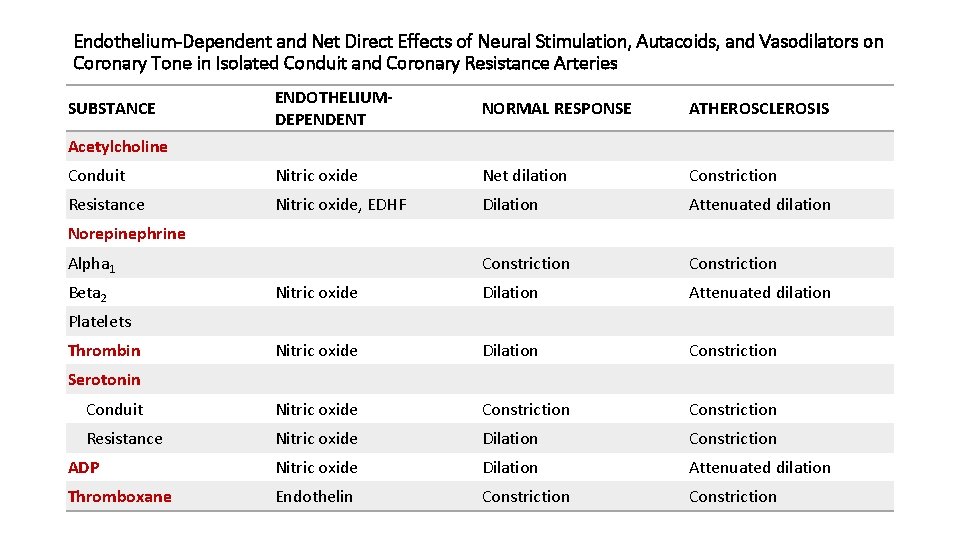
Endothelium-Dependent and Net Direct Effects of Neural Stimulation, Autacoids, and Vasodilators on Coronary Tone in Isolated Conduit and Coronary Resistance Arteries ENDOTHELIUMDEPENDENT NORMAL RESPONSE ATHEROSCLEROSIS Conduit Nitric oxide Net dilation Constriction Resistance Nitric oxide, EDHF Dilation Attenuated dilation Constriction Nitric oxide Dilation Attenuated dilation Nitric oxide Dilation Constriction Conduit Nitric oxide Constriction Resistance Nitric oxide Dilation Constriction ADP Nitric oxide Dilation Attenuated dilation Thromboxane Endothelin Constriction SUBSTANCE Acetylcholine Norepinephrine Alpha 1 Beta 2 Platelets Thrombin Serotonin
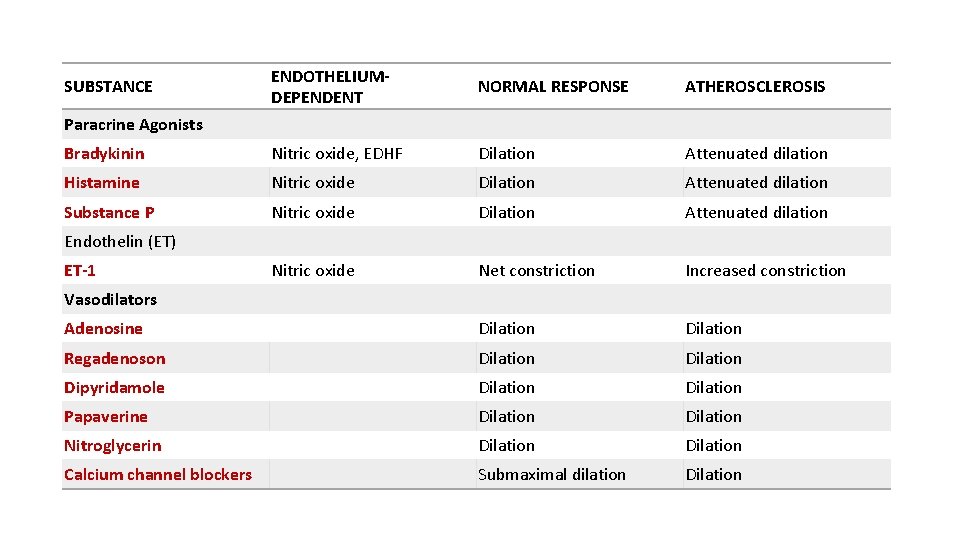
ENDOTHELIUMDEPENDENT NORMAL RESPONSE ATHEROSCLEROSIS Bradykinin Nitric oxide, EDHF Dilation Attenuated dilation Histamine Nitric oxide Dilation Attenuated dilation Substance P Nitric oxide Dilation Attenuated dilation Nitric oxide Net constriction Increased constriction Adenosine Dilation Regadenoson Dilation Dipyridamole Dilation Papaverine Dilation Nitroglycerin Dilation Calcium channel blockers Submaximal dilation Dilation SUBSTANCE Paracrine Agonists Endothelin (ET) ET-1 Vasodilators
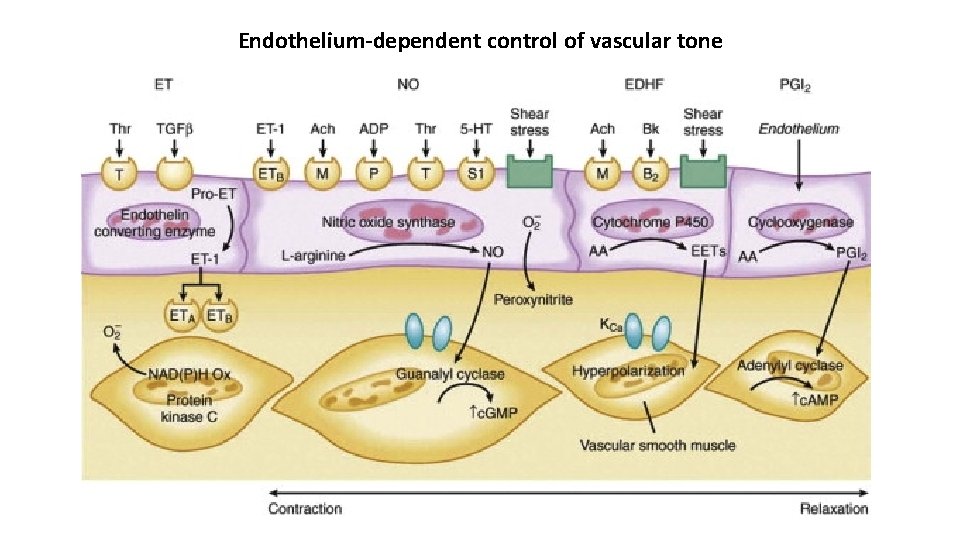
Endothelium-dependent control of vascular tone
Nitric Oxide (Endothelium-Derived Relaxing Factor) • Produced in endothelial cells • L-arginine → citrulline (NO synthase) • Controlled by calcium and calmodulin • Dependent on molecular oxygen, NADPH, tetrahydrobiopterin, ADP, FAD, and flavin mononucleotide • Endothelial NO diffuses abluminally into vascular smooth muscle • Binds to guanylate cyclase → ↑ c. GMP → ↓ intracellular calcium → relaxation
NO-mediated vasodilation • Enhanced by cyclical or pulsatile changes in coronary shear stress • Chronic upregulation of NO synthase in exercise training • Impaired in disease states and in patients with CAD • via inactivation of NO by superoxide anion (oxidative stress) • Hallmark of impaired NO-mediated vasodilation in • Atherosclerosis • Hypertension • Diabetes
Endothelium-Dependent Hyperpolarizing Factor ( EDHF ) • Additional mechanism for selected agonists and shear stress–induced vasodilation • Produced by the endothelium • Hyperpolarizes vascular smooth muscle • Dilates arteries (opening calcium-activated potassium channels) • Biochemical nature unclear ØMetabolite of arachidonic acid metabolism ØEpoxyeicosatrienoic acid ØEndothelium-derived hydrogen peroxide
Prostacyclin • Metabolism of Arachidonic Acid (cyclooxygenase path) • Coronary vasodilator • Fail to alter flow during ischemia distal to a stenosis or limit oxygen consumption in response to increases in metabolism • (overcome by other compensatory vasodilator pathways) • Important determinants of coronary collateral vessel resistance • Inhibiting cyclooxygenase reduces collateral perfusion
Endothelin • The endothelins - ET-1, ET-2, and ET-3 • Peptide endothelium-dependent constricting factors – very potent • Constriction to ET is prolonged • Changes in ET levels mediated through transcriptional control (longer term changes in coronary vasomotor tone) • ET-A and ET-B receptors • ET-A–activation of protein kinase C • ET-B–less pronounced action • Not involved in regulating coronary flow in the normal heart • Imp in pathophysiologic states like heart failure
Determinants of Coronary Vascular Resistance • The resistance to coronary blood flow can be divided into three major components ØR 1 – epicardial conduit artery resistance (normally insignificant) ØR 2 – resistance secondary to metabolic and autoregulatory adjustments in flow (occurs in arterioles and resistance arteries) ØR 3 – time-varying compressive resistance (subendocardial >subepicardial layer)
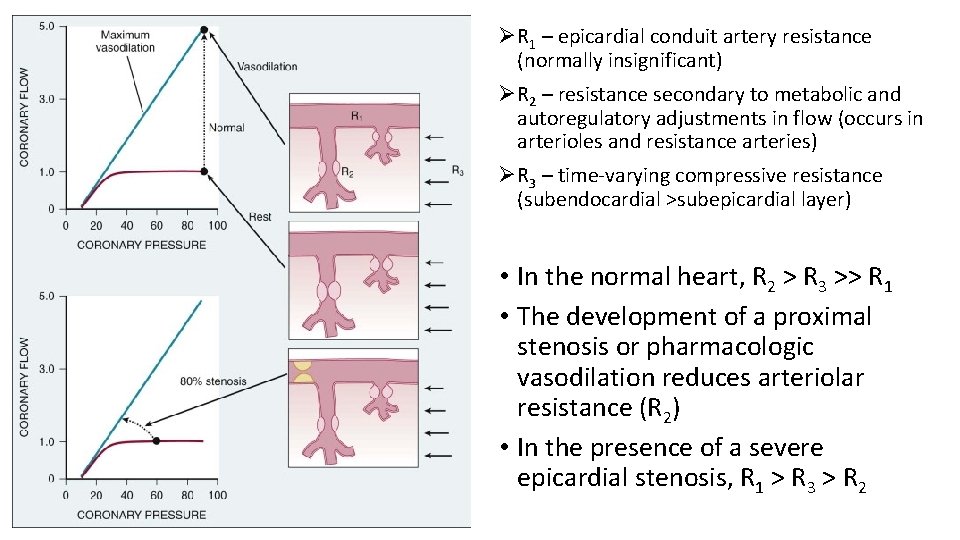
ØR 1 – epicardial conduit artery resistance (normally insignificant) ØR 2 – resistance secondary to metabolic and autoregulatory adjustments in flow (occurs in arterioles and resistance arteries) ØR 3 – time-varying compressive resistance (subendocardial >subepicardial layer) • In the normal heart, R 2 > R 3 >> R 1 • The development of a proximal stenosis or pharmacologic vasodilation reduces arteriolar resistance (R 2) • In the presence of a severe epicardial stenosis, R 1 > R 3 > R 2
R 1 - Epicardial Conduit Artery Resistance • Under normal circumstances, • No measurable pressure drop in the epicardial arteries • Negligible conduit resistance • With the development of hemodynamically significant epicardial artery narrowing • 50% diameter reduction - begins to contribute an increasing component to total coronary resistance • Severely narrowed (more than 90%) - reduce resting flow
R 2 • • Dynamic From microcirculatory resistance arteries and arterioles Distributed throughout the myocardium (20 to 200 µm in diameter) Changes in response to • Physical forces (intraluminal pressure and shear stress) • Metabolic needs of the tissue • Accounts for no more than 20% (Even in the maximally vasodilated heart) • Minimum resistance • Determined by the size and density of arterial resistance vessels • Results in substantial coronary flow reserve in the normal heart
Compressive Resistance (R 3) • Varies with time throughout the cardiac cycle • Related to • Cardiac contraction • Systolic pressure development within the left ventricle • In heart failure • Compressive effects from elevated ventricular diastolic pressure • Elevated extravascular tissue pressure during diastole • Impede perfusion via passive compression of microcirculatory vessels • ↑ preload - ↑back pressure to coronary flow (above venous pressure) • Most prominent in the subendocardium
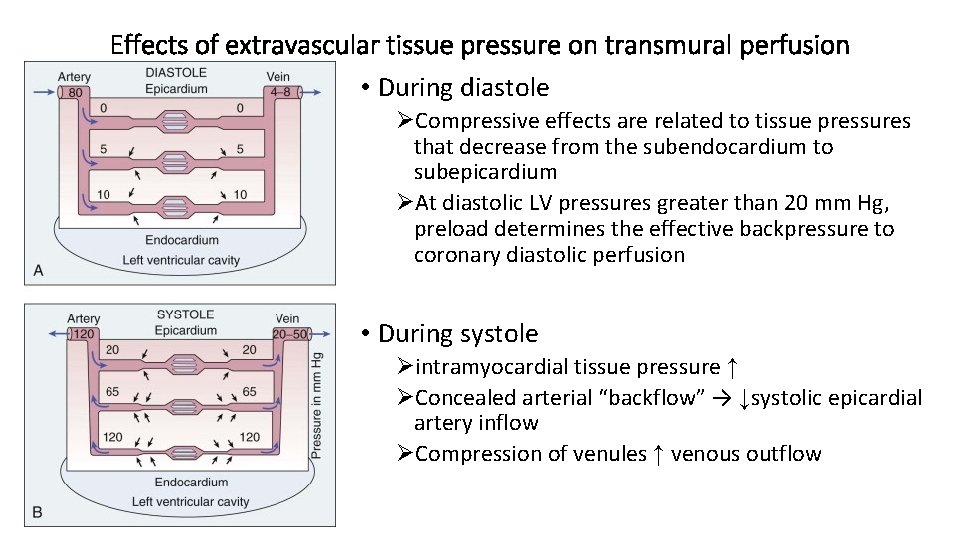
Effects of extravascular tissue pressure on transmural perfusion • During diastole ØCompressive effects are related to tissue pressures that decrease from the subendocardium to subepicardium ØAt diastolic LV pressures greater than 20 mm Hg, preload determines the effective backpressure to coronary diastolic perfusion • During systole Øintramyocardial tissue pressure ↑ ØConcealed arterial “backflow” → ↓systolic epicardial artery inflow ØCompression of venules ↑ venous outflow
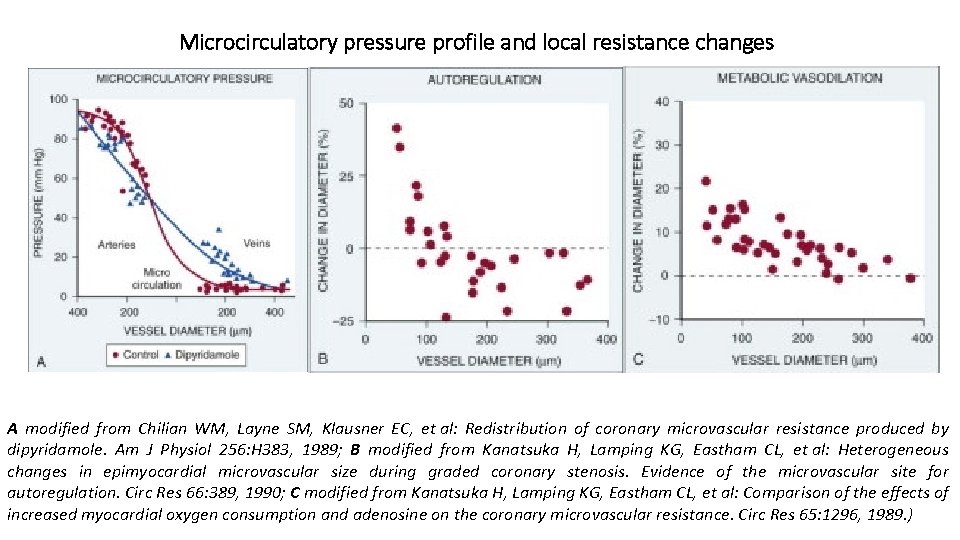
Microcirculatory pressure profile and local resistance changes A modified from Chilian WM, Layne SM, Klausner EC, et al: Redistribution of coronary microvascular resistance produced by dipyridamole. Am J Physiol 256: H 383, 1989; B modified from Kanatsuka H, Lamping KG, Eastham CL, et al: Heterogeneous changes in epimyocardial microvascular size during graded coronary stenosis. Evidence of the microvascular site for autoregulation. Circ Res 66: 389, 1990; C modified from Kanatsuka H, Lamping KG, Eastham CL, et al: Comparison of the effects of increased myocardial oxygen consumption and adenosine on the coronary microvascular resistance. Circ Res 65: 1296, 1989. )
Intraluminal Physical Forces Regulating Coronary Resistance • Important in orchestrating adequate regional tissue perfusion to the distal microcirculation • Differential expression of mechanisms among different sizes and classes of coronary resistance vessels ØMyogenic Regulation ØFlow Mediated Resistance Artery Control
Myogenic Regulation • Ability of vascular smooth muscle to oppose changes in coronary arteriolar diameter ØDistending pressure ↓ - relax ØDistending pressure↑ - constrict • Myogenic tone - property of vascular smooth muscle (occurs across a large size range of coronary resistance arteries ) • Cellular mechanism uncertain • Dependent on vascular smooth muscle calcium entry ( stretch-activated L-type Ca 2+ channels ) • Tend to bring local coronary flow back to the original • Postulated to be important mechanism of the coronary autoregulation • Appears to occur primarily in arterioles smaller than 100 µm
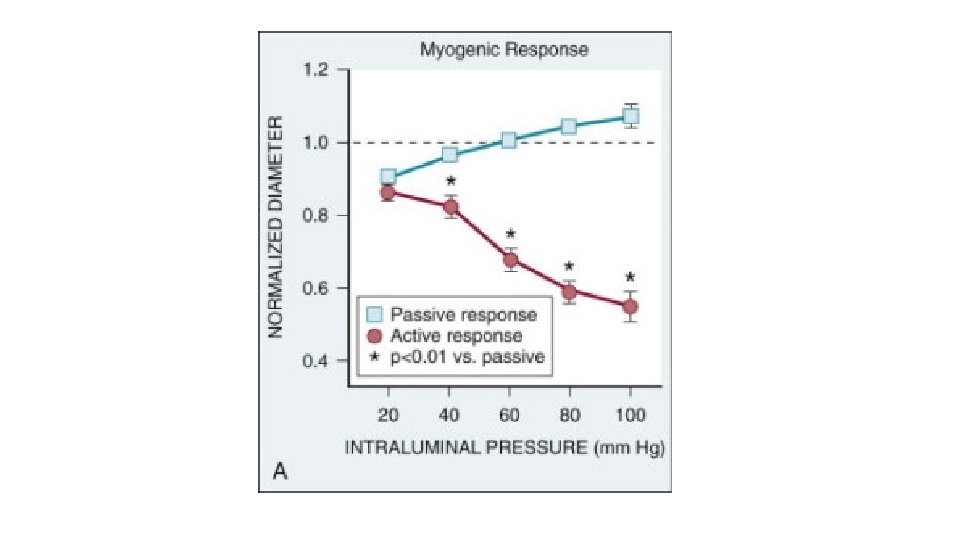
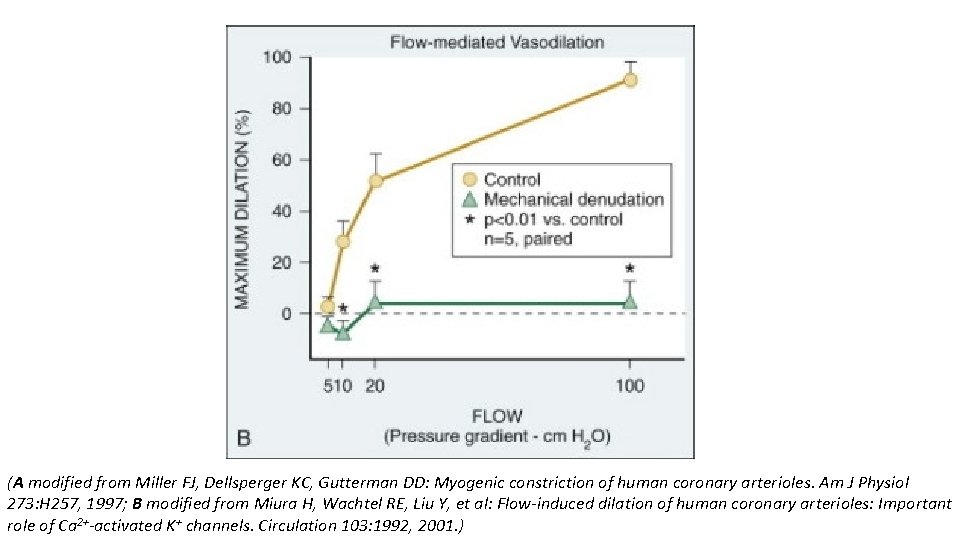
(A modified from Miller FJ, Dellsperger KC, Gutterman DD: Myogenic constriction of human coronary arterioles. Am J Physiol 273: H 257, 1997; B modified from Miura H, Wachtel RE, Liu Y, et al: Flow-induced dilation of human coronary arterioles: Important role of Ca 2+-activated K+ channels. Circulation 103: 1992, 2001. )
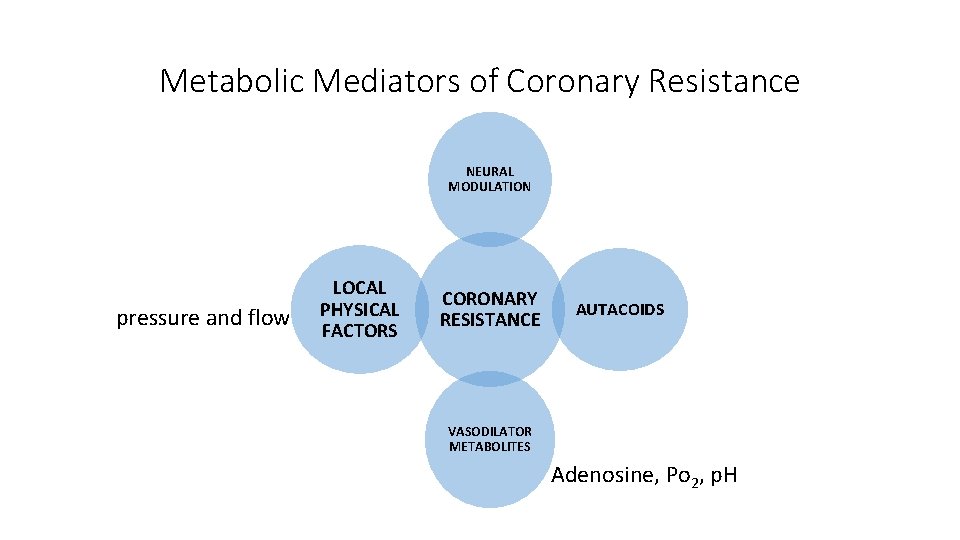
Metabolic Mediators of Coronary Resistance NEURAL MODULATION pressure and flow LOCAL PHYSICAL FACTORS CORONARY RESISTANCE AUTACOIDS VASODILATOR METABOLITES Adenosine, Po 2, p. H
Adenosine • Metabolic mediator of resistance artery control • Released from cardiac myocytes when the rate of ATP hydrolysis exceeds its synthesis during ischemia • Increase with myocardial metabolism • Extremely short half-life (<10 seconds) - rapid inactivation by adenosine deaminase • A 2 receptors on vascular smooth muscle – c. AMP - opens intermediate Ca-activated K channels • Differential effect on coronary resistance arteries, dilating vessels smaller than 100 µm • No direct effect on larger resistance arteries and conduit arteries • Not required for adjusting coronary flow to increases in metabolism or autoregulation • Contribute to vasodilation during hypoxia and during acute exercise-induced myocardial ischemia distal to a stenosis
ATP-Sensitive K+ Channels • Tonically active, contributing to coronary vascular tone under resting conditions • Modulate the coronary metabolic and autoregulatory responses • Common effector rather than sensor of metabolic activity or of autoregulatory adjustments in flow • Reductions in coronary flow after blocking K+-ATP channel Ø By vasoconstriction of the microcirculation that overcomes intrinsic vasodilatory stimuli Ø Seen when other potent vasoconstrictors (e. g. , endothelin or vasopressin) administered at pharmacologic doses
Glibenclamide • Prevent opening of K- ATP • Constriction of arterioles smaller than 100 µm • Reduces coronary flow • Accentuates myocardial ischemia distal to a coronary stenosis (by overcoming intrinsic vasodilatory mechanisms)
Hypoxia • Potent coronary vasodilatory stimulus • Role of local Po 2 in the regulation of arteriolar tone ? • Coronary flow increases in proportion to reductions in arterial oxygen content (reduced Po 2 or anemia) • Twofold increase in perfused capillary density in response to hypoxia
Acidosis • Potent stimulus to produce coronary vasodilation independent of hypoxia • Precise role in the local regulation of myocardial perfusion remains unclear • Increased myocardial metabolism - increased myocardial CO 2 production - tissue acidosis (setting of acute ischemia)
Neural Control of Coronary Conduit and Resistance Arteries • Sympathetic and vagal nerves • Affects tone through • Alter vascular smooth muscle • Stimulating the release of NO from the endothelium • Diametrically opposite effects can occur in the presence of risk factors that impair endothelium-dependent vasodilation
Cholinergic Innervation – normally • Resistance arteries dilate → increases in coronary flow • Conduit arteries → mild coronary vasodilation • Net effect of ØDirect muscarinic constriction of vascular smooth muscle ØEndothelium-dependent vasodilation caused by direct stimulation of NOS ØIncreased flow-mediated dilation from concomitant resistance vessel vasodilation
Cholinergic Innervation – Atherosclerosis • Distinctly different • Resistance vessel dilation to acetylcholine attenuated • Reduction in flow-mediated NO production • Net epicardial conduit artery vasoconstriction • (particularly prominent in stenotic segments)
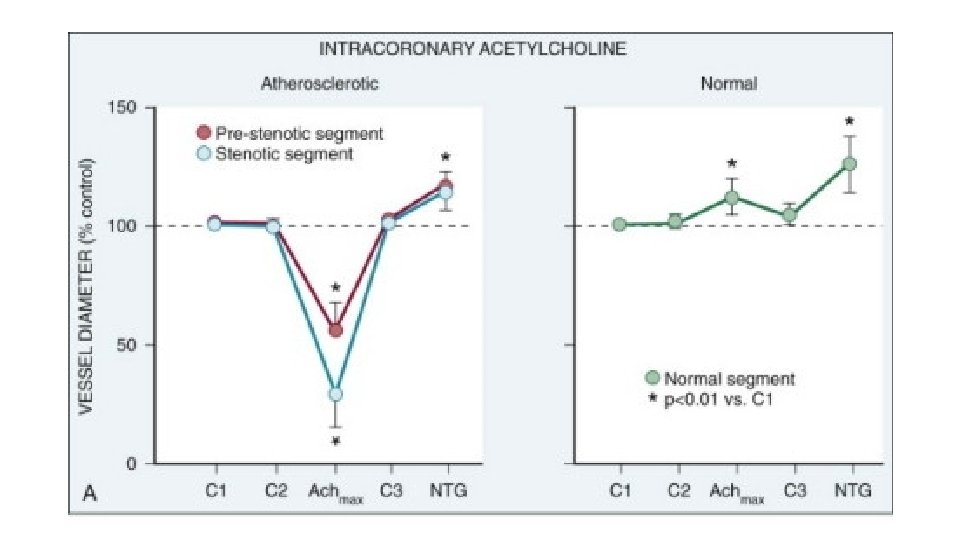
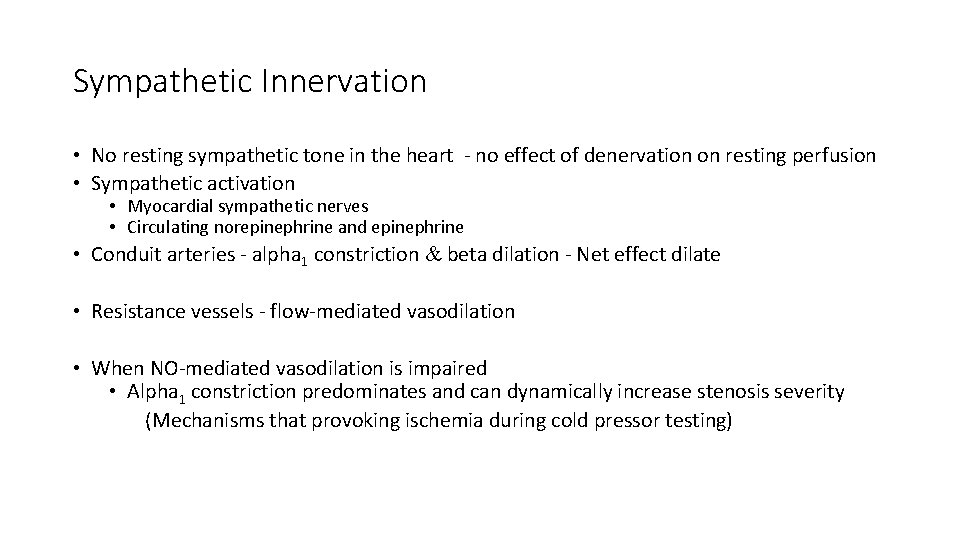
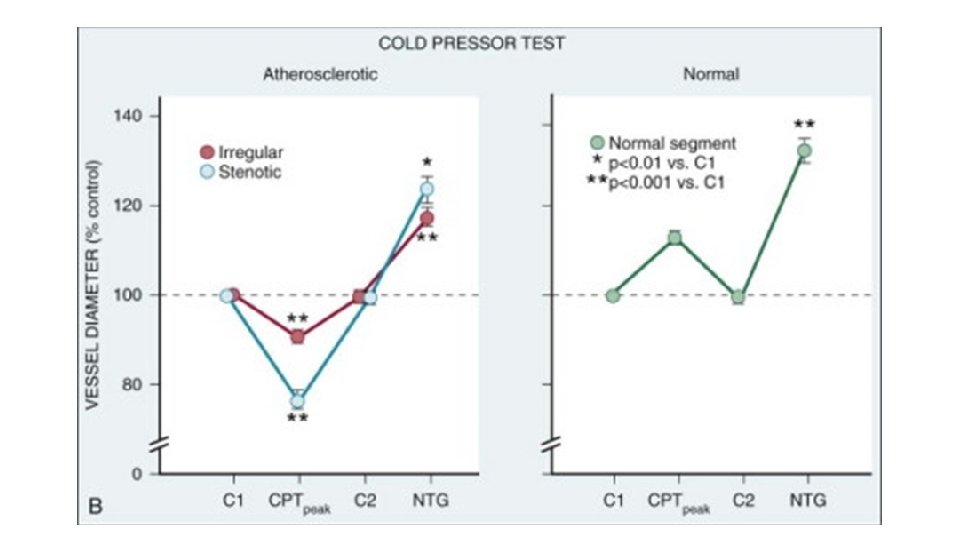
Sympathetic Innervation • No resting sympathetic tone in the heart - no effect of denervation on resting perfusion • Sympathetic activation • Myocardial sympathetic nerves • Circulating norepinephrine and epinephrine • Conduit arteries - alpha 1 constriction & beta dilation - Net effect dilate • Resistance vessels - flow-mediated vasodilation • When NO-mediated vasodilation is impaired • Alpha 1 constriction predominates and can dynamically increase stenosis severity (Mechanisms that provoking ischemia during cold pressor testing)

Paracrine Vasoactive Mediators • Affect coronary tone in normal and pathophysiologic states (Unrelated to normal coronary circulatory control) • Released from epicardial artery thrombi (After activation of the thrombotic cascade initiated by plaque rupture) • Modulate epicardial tone in regions near eccentric ulcerated plaques (leading to dynamic changes in the physiologic significance of a stenosis) • Differential effects on downstream vessel vasomotion dependent on vessel size (conduit arteries versus resistance arteries)
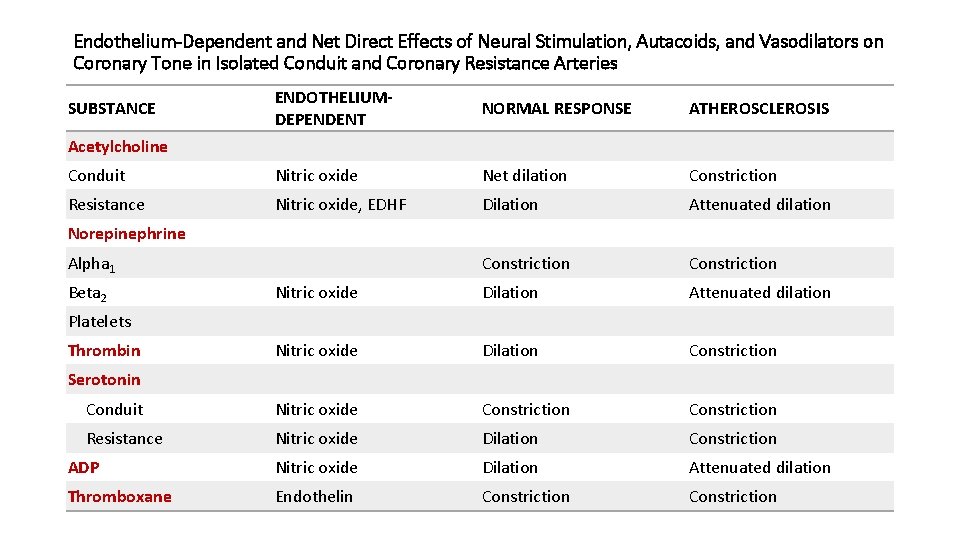
Endothelium-Dependent and Net Direct Effects of Neural Stimulation, Autacoids, and Vasodilators on Coronary Tone in Isolated Conduit and Coronary Resistance Arteries ENDOTHELIUMDEPENDENT NORMAL RESPONSE ATHEROSCLEROSIS Conduit Nitric oxide Net dilation Constriction Resistance Nitric oxide, EDHF Dilation Attenuated dilation Constriction Nitric oxide Dilation Attenuated dilation Nitric oxide Dilation Constriction Conduit Nitric oxide Constriction Resistance Nitric oxide Dilation Constriction ADP Nitric oxide Dilation Attenuated dilation Thromboxane Endothelin Constriction SUBSTANCE Acetylcholine Norepinephrine Alpha 1 Beta 2 Platelets Thrombin Serotonin
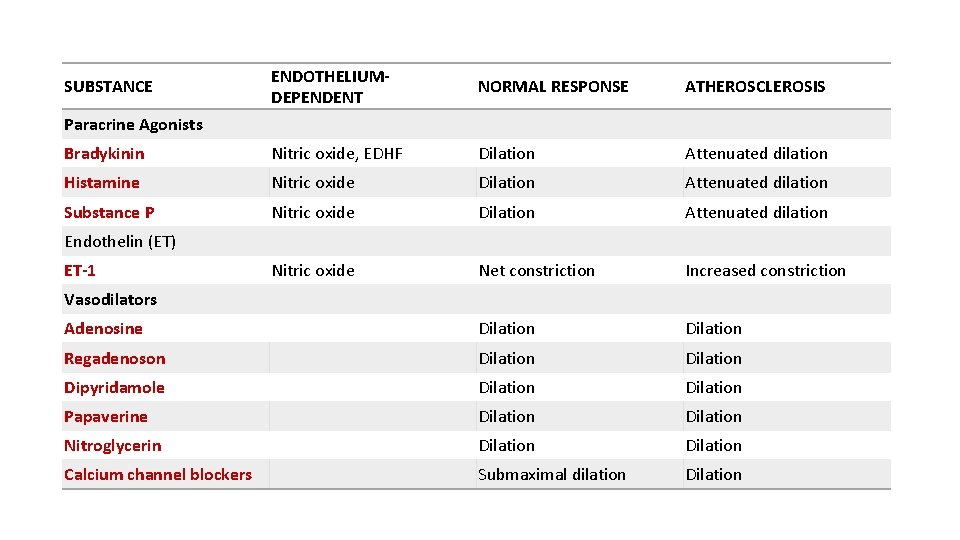
ENDOTHELIUMDEPENDENT NORMAL RESPONSE ATHEROSCLEROSIS Bradykinin Nitric oxide, EDHF Dilation Attenuated dilation Histamine Nitric oxide Dilation Attenuated dilation Substance P Nitric oxide Dilation Attenuated dilation Nitric oxide Net constriction Increased constriction Adenosine Dilation Regadenoson Dilation Dipyridamole Dilation Papaverine Dilation Nitroglycerin Dilation Calcium channel blockers Submaximal dilation Dilation SUBSTANCE Paracrine Agonists Endothelin (ET) ET-1 Vasodilators
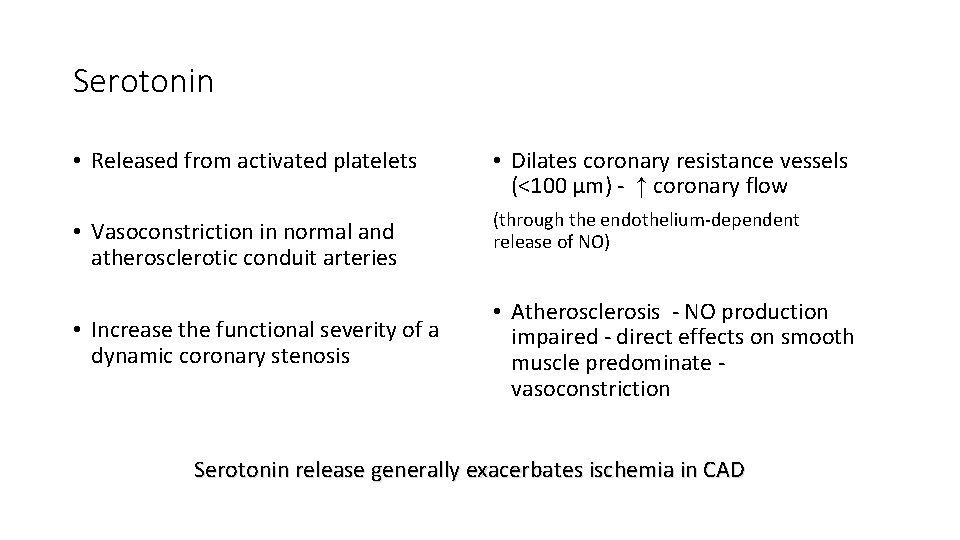
Serotonin • Released from activated platelets • Dilates coronary resistance vessels (<100 µm) - ↑ coronary flow • Vasoconstriction in normal and atherosclerotic conduit arteries (through the endothelium-dependent release of NO) • Increase the functional severity of a dynamic coronary stenosis • Atherosclerosis - NO production impaired - direct effects on smooth muscle predominate vasoconstriction Serotonin release generally exacerbates ischemia in CAD
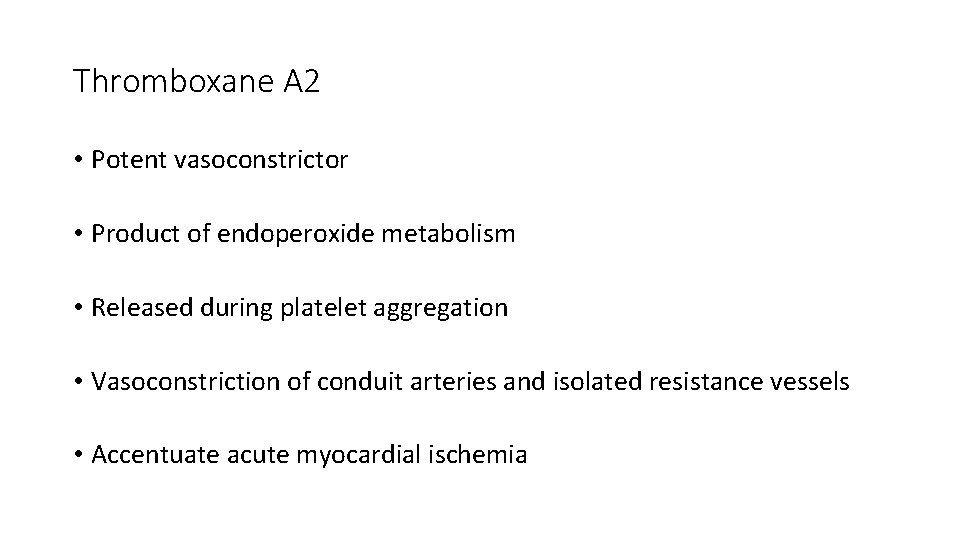
Thromboxane A 2 • Potent vasoconstrictor • Product of endoperoxide metabolism • Released during platelet aggregation • Vasoconstriction of conduit arteries and isolated resistance vessels • Accentuate acute myocardial ischemia
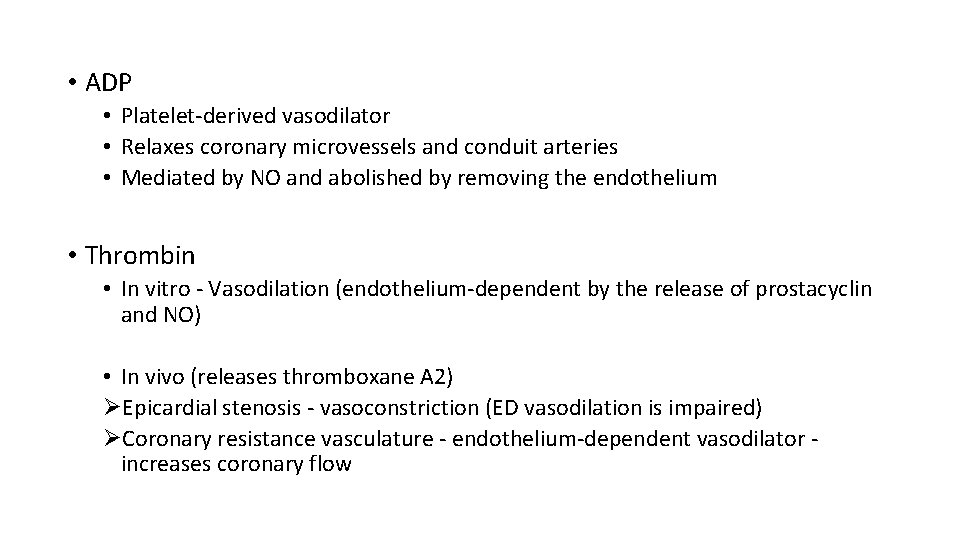
• ADP • Platelet-derived vasodilator • Relaxes coronary microvessels and conduit arteries • Mediated by NO and abolished by removing the endothelium • Thrombin • In vitro - Vasodilation (endothelium-dependent by the release of prostacyclin and NO) • In vivo (releases thromboxane A 2) ØEpicardial stenosis - vasoconstriction (ED vasodilation is impaired) ØCoronary resistance vasculature - endothelium-dependent vasodilator increases coronary flow
Coronary Vasospasm • Transient functional occlusion of a coronary artery - reversible with nitrate vasodilation • Commonly in the setting of a coronary stenosis - dynamic stenosis behaviour - dissociate the effects on perfusion from anatomic stenosis severity • Endothelial disruption plays a role • Normal vasodilation from autacoids and sympathetic stimulation is converted into a vasoconstrictor response because of the lack of competing endothelium-dependent vasodilation • Trigger required (Eg: Thrombus formation or sympathetic activation)
Variant angina with normal coronary arteries or prinzmetal angina • Mechanisms less clear • Sensitization of intrinsic vasoconstrictor mechanisms (animal data) • Coronary arteries demonstrate ØSupersensitivity to vasoconstrictor agonists in vivo and in vitro ØReduced vasodilatory responses
Pharmacologic Vasodilation • Reflect direct actions on vascular smooth muscle • Secondary adjustments in resistance artery tone • Flow-mediated dilation amplify the vasodilatory response • Autoregulatory adjustments can overcome vasodilation in a segment of the microcirculation and restore flow to normal. • Resistance vessel vasodilators used in assessing coronary stenosis severity
Nitroglycerin • Dilates epicardial conduit arteries and small resistance arteries • Not increase coronary blood flow in normal heart (Transient arteriolar vasodilation overcome by autoregulatory escape) • Produce vasodilation of large resistance arteries • Improves the distribution of perfusion to the subendocardium when flowmediated NO-dependent vasodilation is impaired • Heart failure - Improve subendocardial perfusion (by reducing LV EDP through systemic venodilation) • Coronary collateral vessels dilate improve regional perfusion
Calcium Channel Blockers • Coronary vasodilators (vascular smooth muscle relaxation) • Epicardial arteries • Vasodilation similar to nitroglycerin • Prevent coronary vasospasm superimposed on a coronary stenosis • Normal arteries of patients with variant angina • Resistance vessels • • Submaximally vasodilate (Esp dihydropyridine derivatives) Precipitate subendocardial ischemia (in critical stenosis) Transmural redistribution of blood flow Transient tachycardia and hypotension (short half-life formulations of nifedipine)
Adenosine and A 2 Receptor Agonists Dilates coronary arteries (A 2 receptors on vascular smooth muscle) Independent of the endothelium Differential sensitivity of the microcirculation to adenosine, with the Direct effects related to resistance vessel size (restricted to vessels <100 µm • Larger resistance arteries dilate via NO-dependent mechanism (↑ in shear stress) • Single-dose adenosine A 2 receptor agonists (Regadenoson) - as effective as adenosine • Circumvent the need for continuous infusions during myocardial perfusion imaging • •
Dipyridamole ØVasodilation by inhibiting the myocyte reuptake of adenosine released from cardiac myocytes ØActions and mechanisms similar to adenosine Øvasodilation is more prolonged Papaverine ØVasodilator (first agent used for intracoronary vasodilation) ØShort-acting - 2 mts (more prolonged than after adenosine) ØVascular smooth muscle relaxation (inhibiting phosphodiesterase) ØRapid onset of action ØReversed via aminophylline (nonspecific adenosine receptor blocker) ØIndependent of the endothelium
Right Coronary Artery Flow • General concepts of coronary flow regulation for the left ventricle apply to the right ventricle • There are differences related to the extent of the right coronary artery supply to the right ventricular free wall • Arterial pressure supplying the right coronary substantially exceeds right ventricular pressure, minimizing the compressive determinants of coronary reserve. • Right ventricular oxygen consumption is lower than that in the left ventricle, and coronary venous oxygen saturations are higher than in the left coronary circulation. • Because there is considerable oxygen extraction reserve, coronary flow decreases as pressure is reduced and oxygen delivery is maintained by increased extraction. • These differences appear specific to the right ventricular free wall. • In humans, in whom the right coronary artery is dominant and supplies a large amount of the inferior left ventricle, factors affecting flow regulation to the lv myocardium are likely to predominate
Measurement of coronary blood flow • Microsphere radionuclide techniques • MRI, CT and PET • Resting CBF Ø 0. 7 -1 ml/min/g ØGives little information ØNormal in HCM, CAD, DCMP etc (adjusting mechanisms) • CBF in a “stressed” heart brings out the true quality of the coronary vasculature • “STRESS” – Pharmacological / Physiological
Coronary collateral circulation • Arteriogenesis promoted by a chronic coronary occlusion that causes a pressure gradient between the proximal and distal beds in a serial direction • Shear stress acts on preexisting collaterals < 200µm • Growth factors (VEGF) – NO mediated • Capillaries in ischemic region proliferate– little impact on perfusion • Tremendous individual variability in the development and function of collaterals • A sudden thrombosis developing in a chronic critical stenosis may still be minimally destructive – RECRUITABLE COLLATERALS
ABNORMAL CBF WITH NORMAL CORONARY ARTERIES • Microcirculatory impairment ØTachycardia (decreased diastolic time) ØIncreased preload ( compressive determinants) ØIncreased afterload ØIncreased contractility ØDecreased oxygen supply ( anaemia, hypoxia) ØAbnormal endothelium (DM, HTN, DLP, ctds)

K N A H T U O Y
- Slides: 62