
Physiology of Autonomic Nervous System Second Year Medicine


- Slides: 31
Physiology of Autonomic Nervous System Second Year Medicine By Dr. Prof. Abdel Rahman Fahmy Physiology Department
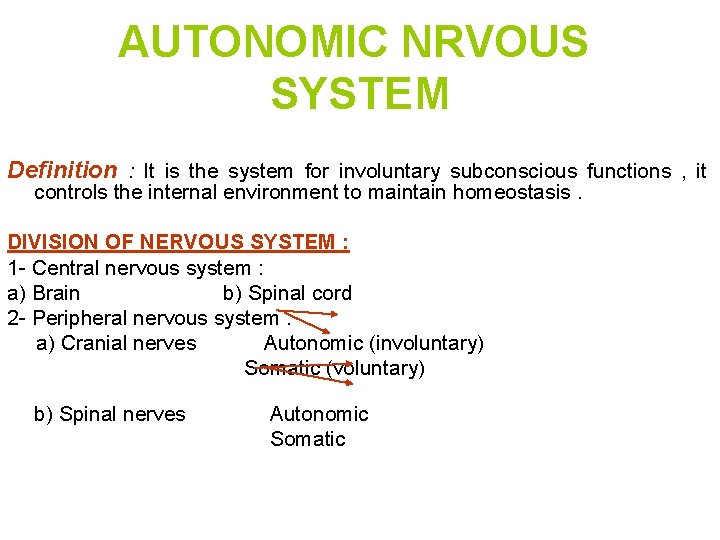
AUTONOMIC NRVOUS SYSTEM Definition : It is the system for involuntary subconscious functions , it controls the internal environment to maintain homeostasis. DIVISION OF NERVOUS SYSTEM : 1 - Central nervous system : a) Brain b) Spinal cord 2 - Peripheral nervous system : a) Cranial nerves Autonomic (involuntary) Somatic (voluntary) b) Spinal nerves Autonomic Somatic
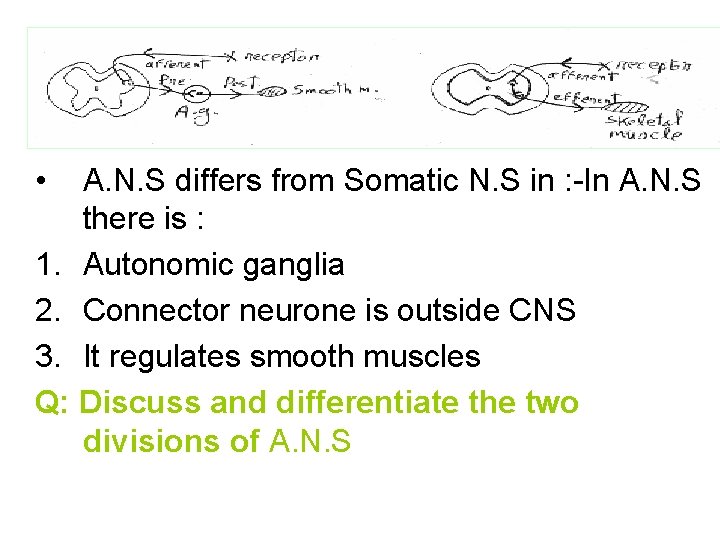
Somatic N. S (voluntary) 1) Innervate skeletal muscles Autonomic N. S (involuntary) 1) Supply smooth muscles, Cardiac and Glands 2) One neurone between C. N. S and 2) Has 2 neurons connected by synapse effector organ between C. N. S & organ 3) Efferent arises from ventral horn 3) Efferent preganglionic arises from cell. lateral horn cells. 4) Chemical transmitter Acetyl choline 4) Either acetyl cholin or norepinephrine.
• A. N. S differs from Somatic N. S in : -In A. N. S there is : 1. Autonomic ganglia 2. Connector neurone is outside CNS 3. It regulates smooth muscles Q: Discuss and differentiate the two divisions of A. N. S
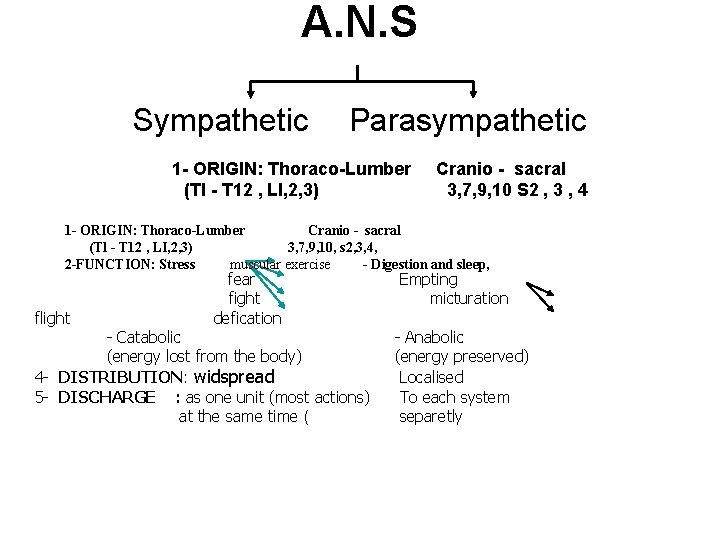
A. N. S Sympathetic Parasympathetic 1 - ORIGIN: Thoraco-Lumber (Tl - T 12 , LI, 2, 3) Cranio - sacral 3, 7, 9, 10 S 2 , 3 , 4 1 - ORIGIN: Thoraco-Lumber Cranio - sacral (Tl - T 12 , LI, 2, 3) 3, 7, 9, 10, s 2, 3, 4, 2 -FUNCTION: Stress muscular exercise - Digestion and sleep, flight fear fight defication - Catabolic (energy lost from the body) 4 - DISTRIBUTION: widspread 5 - DISCHARGE : as one unit (most actions) at the same time ( Empting micturation - Anabolic (energy preserved) Localised To each system separetly
RELATIONSHIP BETWEEN SYMP ATHETC AND PARASYMPATHETIC 1 - RECIPROCAL : once sympathetic is stimulated, parasympaethetic is • inhibited and vise - versa 2 - COMPLEMENTAL : e. g micturation and defication reflex. sympathetic for FILLING and parasympathetic for EVACUATION N. B both sympathetic and parasympathetic together help acurate control over an organ's activity.
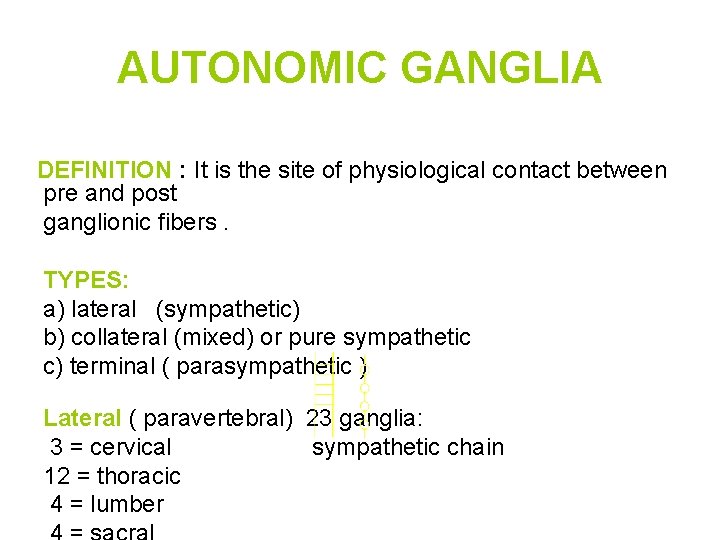
AUTONOMIC GANGLIA DEFINITION : It is the site of physiological contact between pre and post ganglionic fibers. TYPES: a) lateral (sympathetic) b) collateral (mixed) or pure sympathetic c) terminal ( parasympathetic ) Lateral ( paravertebral) 23 ganglia: 3 = cervical sympathetic chain 12 = thoracic 4 = lumber
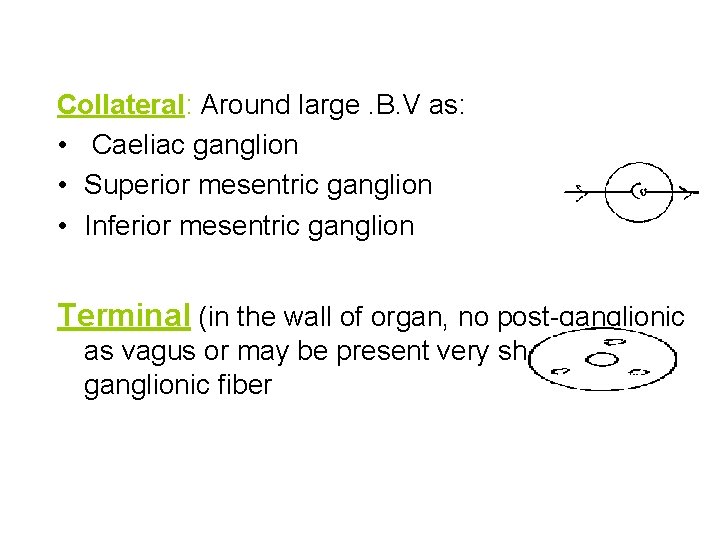
Collateral: Around large. B. V as: • Caeliac ganglion • Superior mesentric ganglion • Inferior mesentric ganglion Terminal (in the wall of organ, no post-ganglionic as vagus or may be present very short postganglionic fiber
Pathway of pre-ganglionic sympathetic 1 - May synapse in first sympathetic fibers: chain ganglion, it enters. 2 - Synapsing in other sympathetic chain ganglia up or down. 3 - Synapse in collateral ganglia. 4 - Synapse in substance of adrenal medulla itself.
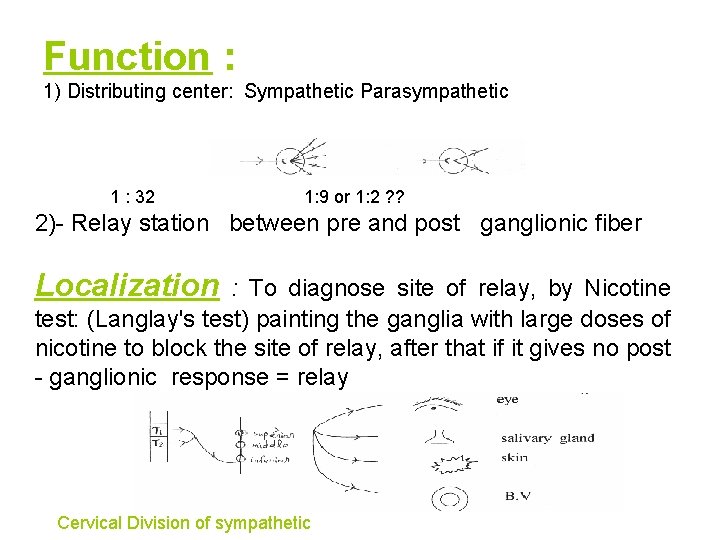
Function : 1) Distributing center: Sympathetic Parasympathetic 1 : 32 1: 9 or 1: 2 ? ? 2)- Relay station between pre and post ganglionic fiber Localization : To diagnose site of relay, by Nicotine test: (Langlay's test) painting the ganglia with large doses of nicotine to block the site of relay, after that if it gives no post - ganglionic response = relay Cervical Division of sympathetic
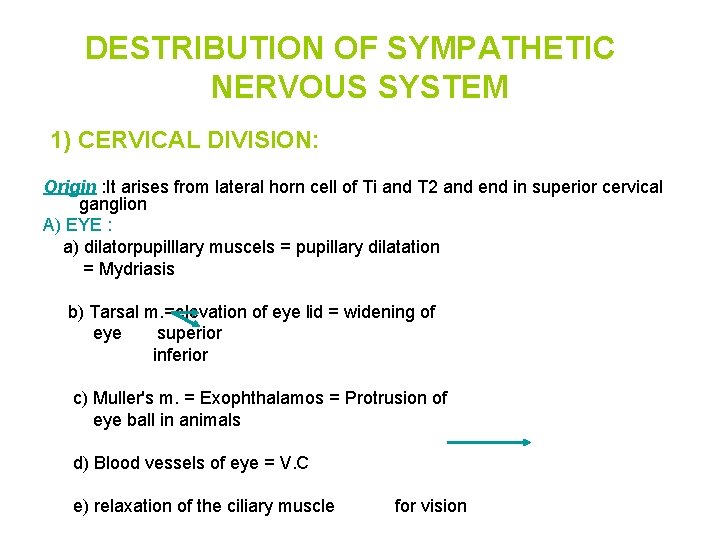
DESTRIBUTION OF SYMPATHETIC NERVOUS SYSTEM 1) CERVICAL DIVISION: Origin : It arises from lateral horn cell of Ti and T 2 and end in superior cervical ganglion A) EYE : a) dilatorpupilllary muscels = pupillary dilatation = Mydriasis b) Tarsal m. =elevation of eye lid = widening of eye superior inferior c) Muller's m. = Exophthalamos = Protrusion of eye ball in animals d) Blood vessels of eye = V. C e) relaxation of the ciliary muscle for vision
B) SALIVARY GLANDS : a) Secretion of small amount of saliva, rich in organic matters (enzymes) i. e viscus saliva. b) Squeezing around acinin of salivary glands push saliva outside C) SKIN : a) Erector pilae m = erection of hairs b) Vaso-conistriction of blood vessels = pallor c) Sweat : Secretion = mental sweat. D) Cerebral blood vessels = vaso-conistriction
• HORNER'S SYNDROME • It Is Cerviacl Sympathectomy : characterized by : 1 -PTOSIS : drop of upper eyelid. 2 - MIOSIS : pupillary constriction. 3 - ANHYDROSIS : dryness of skin 4 -Emrophthalamos 5 - Flushing of the face. ALL THESE EFFECTS ARE AT SAME SIDE OF
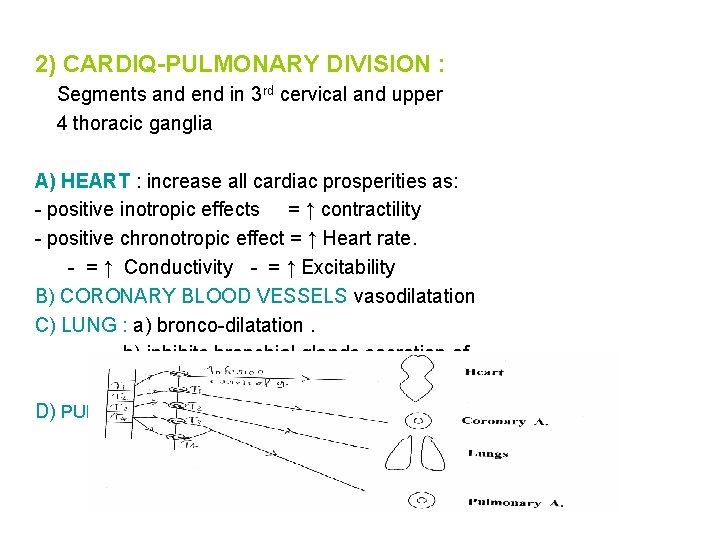
2) CARDIQ-PULMONARY DIVISION : Segments and end in 3 rd cervical and upper 4 thoracic ganglia A) HEART : increase all cardiac prosperities as: - positive inotropic effects = ↑ contractility - positive chronotropic effect = ↑ Heart rate. - = ↑ Conductivity - = ↑ Excitability B) CORONARY BLOOD VESSELS vasodilatation C) LUNG : a) bronco-dilatation. b) inhibits bronchial glands secretion of mucous D) PULMONARY BLOOD VESSELS: vasoconstriction.
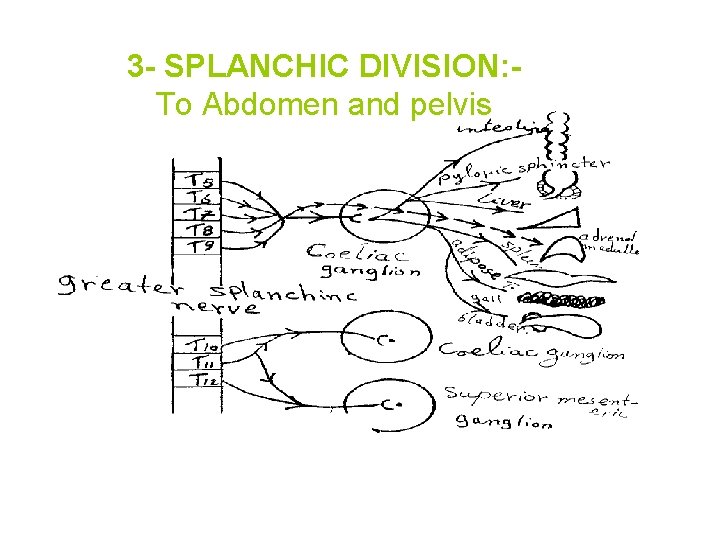
3 - SPLANCHIC DIVISION: To Abdomen and pelvis
– A) Greater Splanchic Nerve : it supplies the abdomen e. g : (From T 5–T 9, relay in caeliac ganglion) a) wall of G. I. T → relaxation of its walls = retention ↓ motility. b) sphincters → its contraction e. g pyloric sphincter of stomach c) liver → glycogenolysis = glycogen converted to glucose. d) adrenal medulla → release of epinephrin and nor epinephrine. e) spleen → contraction & release of RBCs in case of heamorrhage f) adipose tissues → lipolysis. g) inhibite the intestinal juice secretion h) relaxation of gall bladder and contraction of its sphincter. N. B Stimulation of greater splanchic nerve causes two peaks rise in blood pressure : a) First rise due to V. C of visceral blood vessel b) Second peak due to release of catecholamin into blood.
ADRENAL MEDULLA: Supplied by pre-ganglionic sympathetic fibers (greater splanchnic nerve). The circulating catecholamin have same effects of direct sympathetic stimulation, but more prolonged , So body organs can be stimulated by 2 ways, Nervous (direct) & Hormonal (indirect), Also catecholamines can stimulate sites not supplied by direct sympathetic nerves.
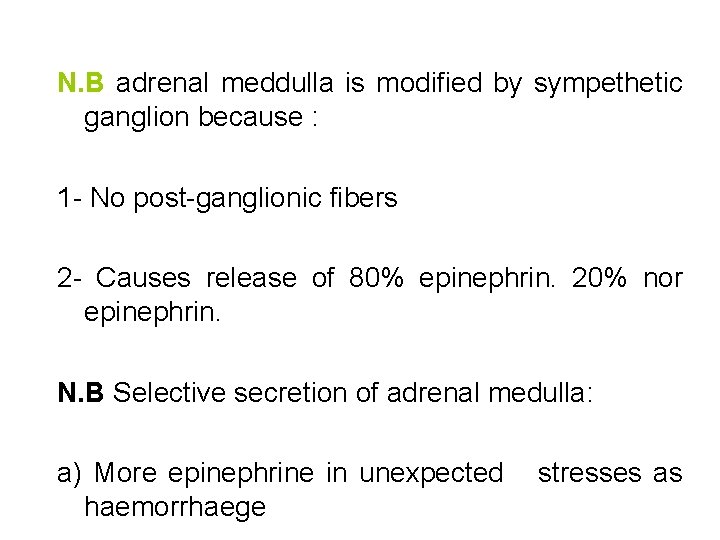
N. B adrenal meddulla is modified by sympethetic ganglion because : 1 - No post-ganglionic fibers 2 - Causes release of 80% epinephrin. 20% nor epinephrin. N. B Selective secretion of adrenal medulla: a) More epinephrine in unexpected haemorrhaege stresses as
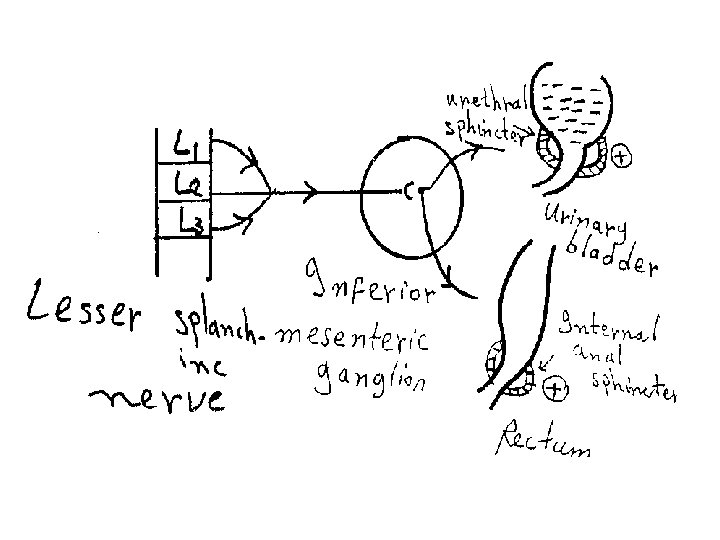
B) Lesser splanchnic nerve: • From LI - L 3, relays in inferior mesentric ganglion It supplies the pelvis e. g-: a) Rectum → retention of stool (+) of internal anal sphincter b) Urinary bladder → retention of urine by relaxation of its wall and contraction of internal uretheral sphincter. c) Sex organs → ejaculation. External genitalia: • In males : Inhibition of erection (v. c of erectile tissue)Ejaculation of semen (contraction of vas deferens, prostate and ejaculatory duct) • In females: - Contraction or relaxation of female genital organ according to the stage of menstrual cycle and level of hormones in blood. N. B Small splanchnic nerve (from T 10 – T 12, relayes in caeliac and superior mesentric ganglion)
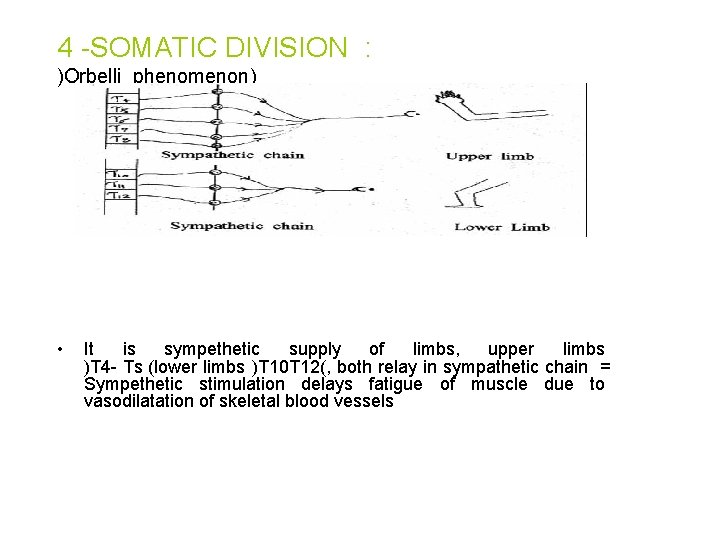
4 -SOMATIC DIVISION : )Orbelli phenomenon) • It is sympethetic supply of limbs, upper limbs )T 4 - Ts (lower limbs )T 10 T 12(, both relay in sympathetic chain = Sympethetic stimulation delays fatigue of muscle due to vasodilatation of skeletal blood vessels
ORGANS SUPPLIED BY SYMPATHETIC ONLY : 1 - Ventricles (vagal escape). 2 - Skin structures 3 - Skeletal B. V. 4 - Dilator pupillary muscles. 5 - Adrenal medulla
ORGANS SUPPLIED BY PARASYMPATHETIC 1 - Constrictor pupillary muscle. 2 - Oesophagus. 3 - Gastric glands. 4 - Erectile tissue. N. B Sympethetic → causes V. C of all blood vessels, except 1. Coronaries. 2. Skeletal blood vessels.
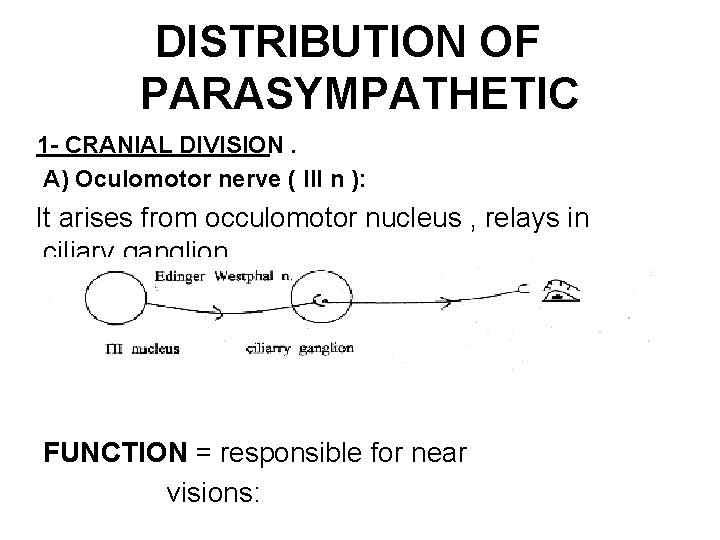
DISTRIBUTION OF PARASYMPATHETIC 1 - CRANIAL DIVISION. A) Oculomotor nerve ( III n ): It arises from occulomotor nucleus , relays in ciliary ganglion FUNCTION = responsible for near visions:
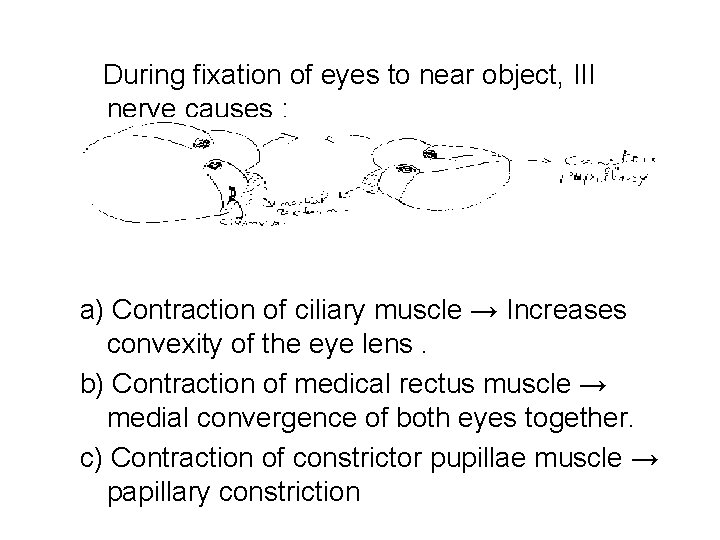
During fixation of eyes to near object, III nerve causes : a) Contraction of ciliary muscle → Increases convexity of the eye lens. b) Contraction of medical rectus muscle → medial convergence of both eyes together. c) Contraction of constrictor pupillae muscle → papillary constriction
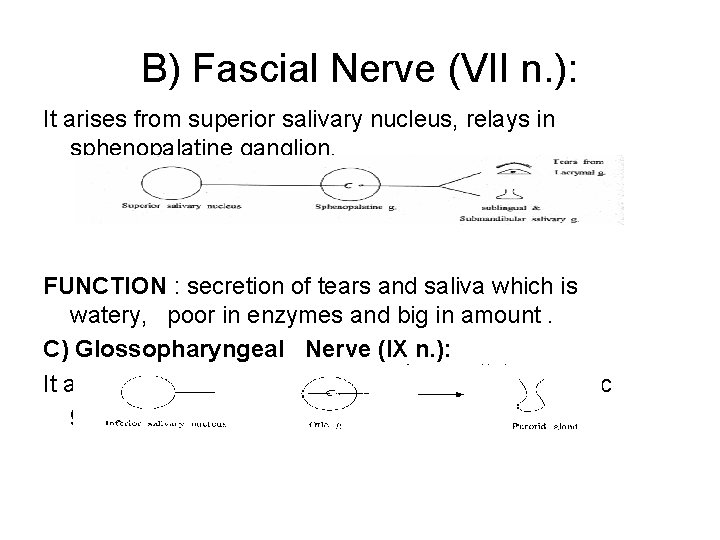
B) Fascial Nerve (VII n. ): It arises from superior salivary nucleus, relays in sphenopalatine ganglion. FUNCTION : secretion of tears and saliva which is watery, poor in enzymes and big in amount. C) Glossopharyngeal Nerve (IX n. ): It arises from inferior salivary nucleus 9 relays in optic ganglion.
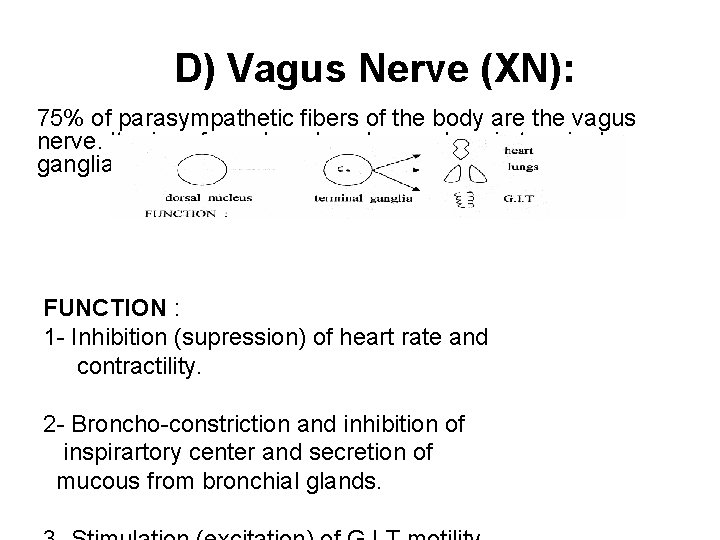
D) Vagus Nerve (XN): 75% of parasympathetic fibers of the body are the vagus nerve. It arises from dorsal nucleus, relays in terminal ganglia. FUNCTION : 1 - Inhibition (supression) of heart rate and contractility. 2 - Broncho-constriction and inhibition of inspirartory center and secretion of mucous from bronchial glands.
EFFECT OF VAGUS NERVE 1 -) ON HEART * Inhibits all cardiac roperties, but it does not supply the ventricles (vagus escape). * Tonic (continuous) effect on the heart , which is more marked in athelets. * Coronary vaso-constriction (V. C ). 2) ON LUNGS: Mentioned before. 3) ON G. I. T: * Evacuation of food (stimulation of G. I. T. motility ). * Evacuation of gall bladder. * Stimulates secretion of: gastric juice , bile , pancreatic juice and mucus (Brunner's glands) * Increased hepatic blood flow.
WHY IT'S CALLED VAGUS ? Because it has : 1 - Afferent & efferent 2 - Stimulatory & inhibitory 3 - Widely distributed
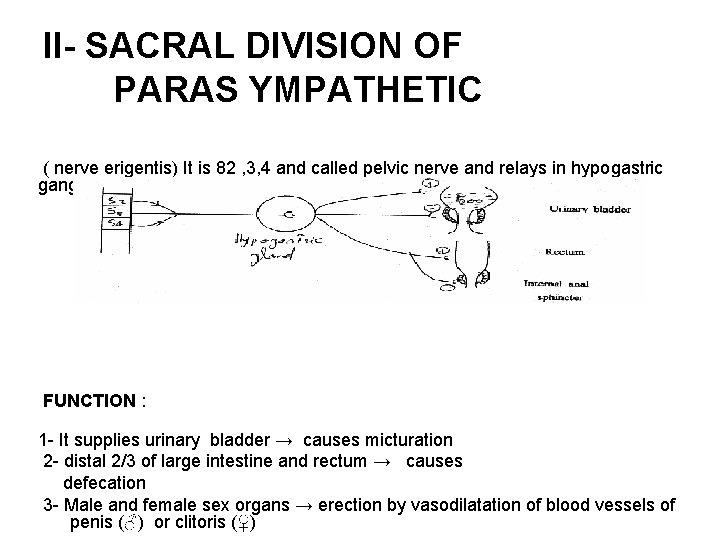
II- SACRAL DIVISION OF PARAS YMPATHETIC ( nerve erigentis) It is 82 , 3, 4 and called pelvic nerve and relays in hypogastric ganglia. FUNCTION : 1 - It supplies urinary bladder → causes micturation 2 - distal 2/3 of large intestine and rectum → causes defecation 3 - Male and female sex organs → erection by vasodilatation of blood vessels of penis (♂) or clitoris (♀)
MICTURATION: • Pelvic nerve causes contraction of wall of urinary bladder and relaxation of internal uretheral sphincter → passage of urine