
Physiology Health Exercise Lesson 11 z The Principles
- Slides: 24
Physiology, Health & Exercise Lesson 11 z. The Principles of Exercise Testing
Principles of exercise testing Include: z Use of maximal and sub-maximal tests z VO 2 max z Exercise stress testing z Cardiac patient rehabilitation 2
Why measure physiological fitness? z To monitor effectiveness of a training programme for an athlete z To monitor recovery from MI 3
How to determine aerobic fitness? z Measure maximum rate at which the body is able to take up and use O 2 maximal testing z Called VO 2 max z Measured in cm 3 kg-1 min-1 z Higher VO 2 max the greater the aerobic fitness of the individual 4
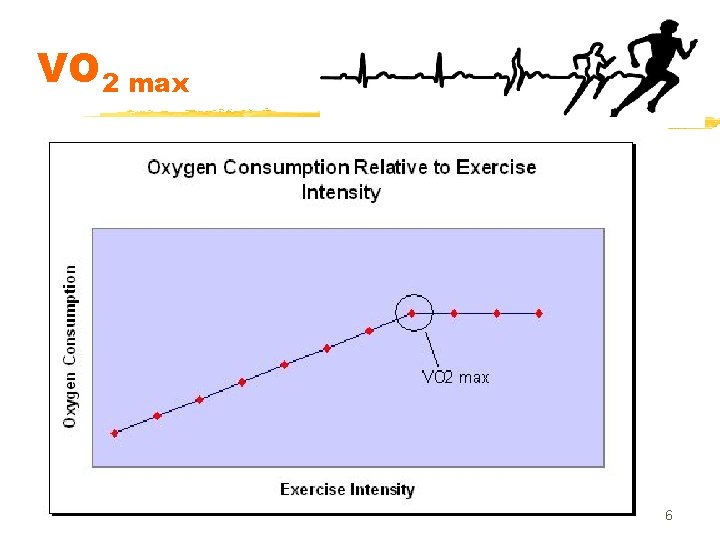
VO 2 max z Measured by getting the person to run on a treadmill whilst breathing in a measured gas supply z As intensity of exercise increased (increasing speed or gradient of treadmill) more O 2 taken in until it reaches a maximum level that does not change even if exercise intensity increased further. 5
VO 2 max 6
VO 2 max z Only suitable for evaluating the fitness of competitive athletes z Also requires expensive lab equipment, technical personnel & medical back up z Instead use sub-maximal tests 7
Sub-maximal testing z Relies on 2 assumptions: y There is a linear correlation between VO 2 max, HR & intensity of exercise y That an individuals maximum HR = 220 - their age z Involves exercise at much lower intensities than maximal testing 8
Sub-maximal testing z Pulse rate & O 2 uptake are measured at various levels of activity z This data used to draw a graph of pulse rate v O 2 uptake z Straight line is drawn and then extrapolated to max HR for that age of person z VO 2 max then predicted from graph 9
Sub-maximal testing z Graph here pulse v vo 2 max 10
Sub-maximal testing z 2 sources of error with sub-maximal testing: y other factors than exercise affect HR e. g. temperature, anxiety, emotions, previous meal etc y 220 - age = maximum HR is not necessarily accurate for everyone as it is only an average 11
Typical VO 2 max values z top endurance athletes usually have a very high VO 2 max around 70 ml/kg/min z average person has a VO 2 max around 35 ml/kg/min z a low VO 2 max < 25 ml/kg/min usually means you would be poor at endurance events 12
Typical VO 2 max values z Can enter your own time and distance into BBC Sport Academy Fitness test website to get your own VO 2 max. For accuracy you need to have covered a distance greater than 1 Km z link to VO 2 max z Fitness test 13
Examples of Sub-maximal tests z Examples of sub-maximal tests are: y Step tests y 20 -metre shuttle run y shuttle walking test 14
Step Tests z simplest & most commonly used z uses steady-state exercise HR or recovery HR to evaluate efficiency of cardiovascular response to exercise z several different protocols but all based on same physiological principles 15
Step Tests y subject steps up & down from a bench or step at a fixed rate for several minutes (3 -5 mins) y height of step & rate of stepping (set by a metronome) vary with different protocols y at end of exercise HR measured for 15 -30 secs at 1 min intervals for 4 mins after exercise stops recovery rate y fitter subject is, lower HR will be immediately after exercise & faster return to resting level 16
Step Tests z can also measure HR continuously during exercise by wearing an HR monitor z can repeat same test after e. g. an exercise programme to indicate an improvement in fitness levels 17
20 -metre shuttle run z z commonly used field test of aerobic fitness however it is maximal & exhaustive only suitable for moderately fit individuals subjects run between markers positioned 20 metres apart at a pace determined by a prerecorded tape 18
20 -metre shuttle run z test starts at a fairly slow pace which increases every minute z subject runs between the 2 markers until they cannot keep up the pace z the number of completed shuttles is recorded and used to predict VO 2 max 19
Shuttle walking test z similar to shuttle run, however subject walks z more suitable for less fit individuals 20
Exercise stress testing z often patients with chronic CHD have normal ECG traces at rest but abnormal ECG traces during exercise z some heart rhythm abnormalities are triggered by exercise z carry out stress tests on a treadmill, when workload increased at an incremental level, while monitoring their ECG z most commonly used protocol is the Bruce Protocol z Bruce protocol 21
Cardiac patient rehabilitation z supervised aerobic exercise sessions are included in all cardiac rehabilitation programmes z also offered advice on diet, smoking, alcohol, stress & relaxation z exercise programmes designed to allow patients to improve their physical fitness levels so that they can cope with the demands of everyday life z each patient will have a tailor made programme based on their ECG but all follow same type of profile 22
Cardiac patient rehabilitation z initially will start with gentle walking about 1 week after the heart attack or surgery z 4 -6 weeks later slightly more vigorous activity can be started & muscle strengthening exercises included z shown that this leads to better recovery and survival rates 23
Question Homework z Describe the effects of exercise training on the cardiovascular system 8 marks z Discuss the principles of exercise testing 7 marks z Hand in- 08/02/10 24