
PHYSIOLOGY 1 LECTURE 20 SKELETAL MUSCLE MOTOR CONTROL
![Receptors in muscle control – Intrafusal fiber types • 1] Nuclear bag fibers –](https://slidetodoc.com/presentation_image_h2/cb98472383dc20c3883158d5d4acd159/image-22.jpg "Receptors in muscle control – Intrafusal fiber types • 1] Nuclear bag fibers –")
- Slides: 55
PHYSIOLOGY 1 LECTURE 20 SKELETAL MUSCLE MOTOR CONTROL
SKELETAL MUSCLE MOTOR CONTROL • Objectives: The student should learn: • 1. The muscle control system (afferents and efferents) • 2. The feedback information required for limb movement • 3. Muscle receptors (muscle spindles, Golgi tendon bodies, free nerve endings) • 4. Afferent / efferent nerve axon types, receptors, and sensitivity
SKELETAL MUSCLE MOTOR CONTROL • 5. Types of muscle spindle fusiform fibers and function • 6. Golgi tendon bodies sensitivity • 7. Overall muscle control system
SKELETAL MUSCLE MOTOR CONTROL • Introduction: – Skeletal muscle control is not a simple matter of command move but rather a complex series of continual feedback loops which supply the brain with continual information on
SKELETAL MUSCLE MOTOR CONTROL • Joint position • State of muscle contraction –Agonists muscle – concentric contraction –Antagonists muscle – eccentric contraction • Degree of tension on tendons • Strain and tension on joints
SKELETAL MUSCLE MOTOR CONTROL – The feedback information supplies the brain with exact information on • Limb position (all the above) • Ground conditions (Visual) • Surroundings (Visual, hearing, touch) • Continual estimates of weights to be lifted or moved
SKELETAL MUSCLE MOTOR CONTROL v. Speed of limb movement • Momentum • Pain • Muscle temperature • Chemical environment of the muscle fibers • Degree of muscle recruitment
SKELETAL MUSCLE MOTOR CONTROL • Allows the motor cortex, cerebellum and spinal column to continually adjust required estimates on force, speed, position, and limb angles needed to accomplish the task required or in the case of repetitive movements to initialize the reverberatory spinal reflexes to accomplish the movement.
SKELETAL MUSCLE MOTOR CONTROL • Receptors in muscle control – Sensory Receptors – (Afferents) The classic studies of Ruffini, Golgi, and Sherrington showed that skeletal muscle was richly endowed with a large variety of sensory receptors.
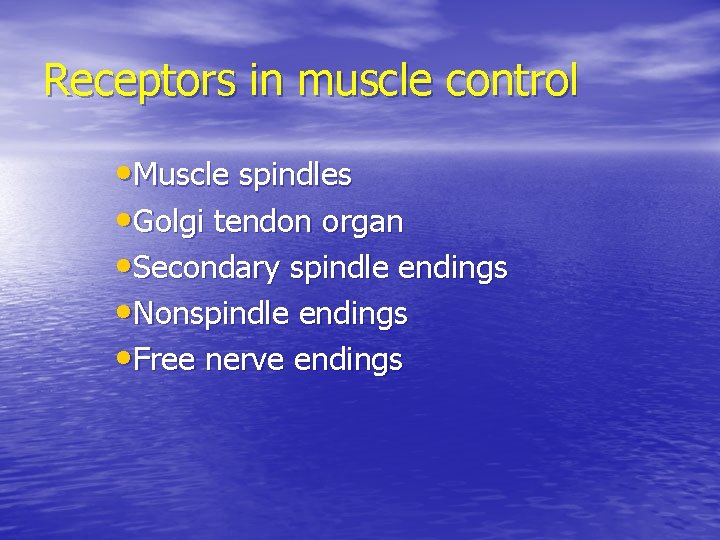
Receptors in muscle control • Muscle spindles • Golgi tendon organ • Secondary spindle endings • Nonspindle endings • Free nerve endings
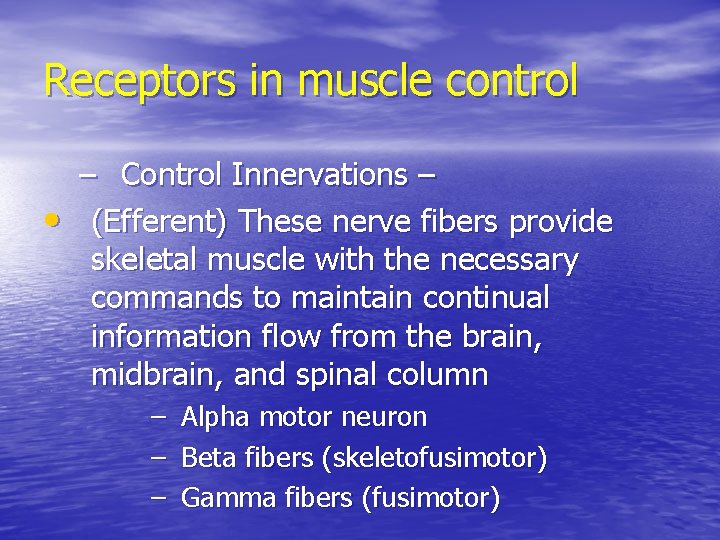
Receptors in muscle control – Control Innervations – • (Efferent) These nerve fibers provide skeletal muscle with the necessary commands to maintain continual information flow from the brain, midbrain, and spinal column – – – Alpha motor neuron Beta fibers (skeletofusimotor) Gamma fibers (fusimotor)
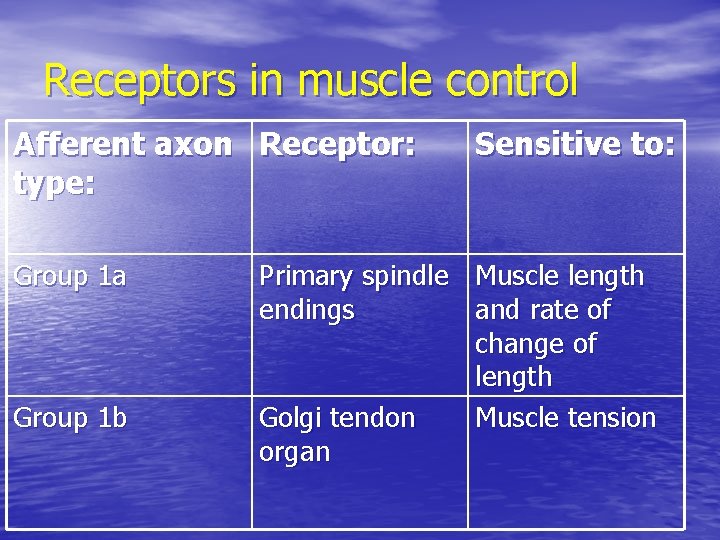
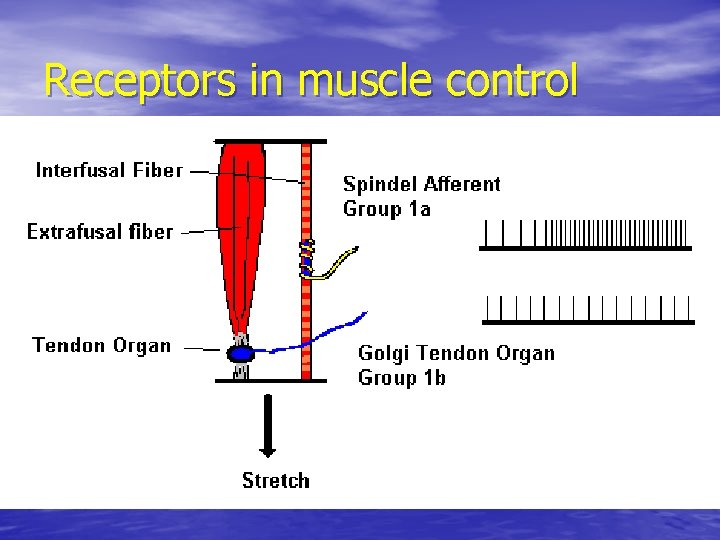
Receptors in muscle control Afferent axon Receptor: type: Group 1 a Group 1 b Sensitive to: Primary spindle Muscle length endings and rate of change of length Golgi tendon Muscle tension organ
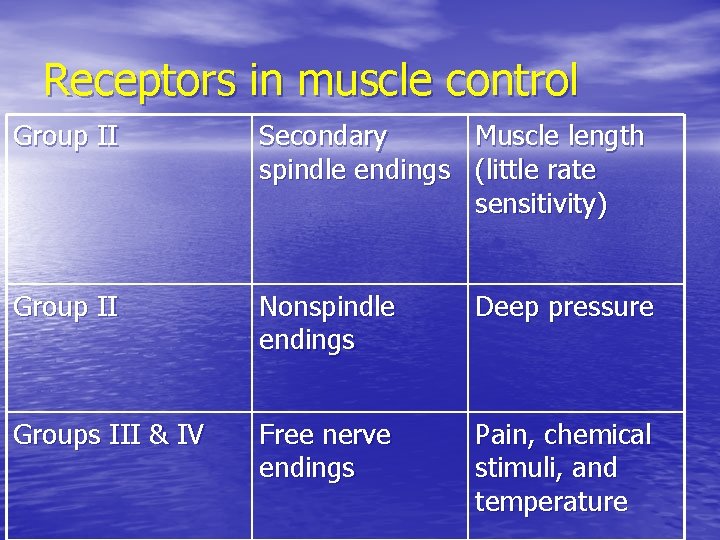
Receptors in muscle control Group II Secondary Muscle length spindle endings (little rate sensitivity) Group II Nonspindle endings Deep pressure Groups III & IV Free nerve endings Pain, chemical stimuli, and temperature
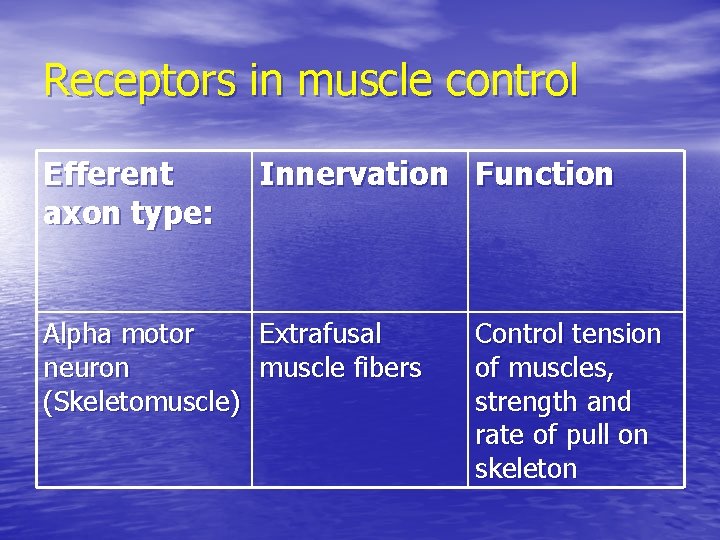
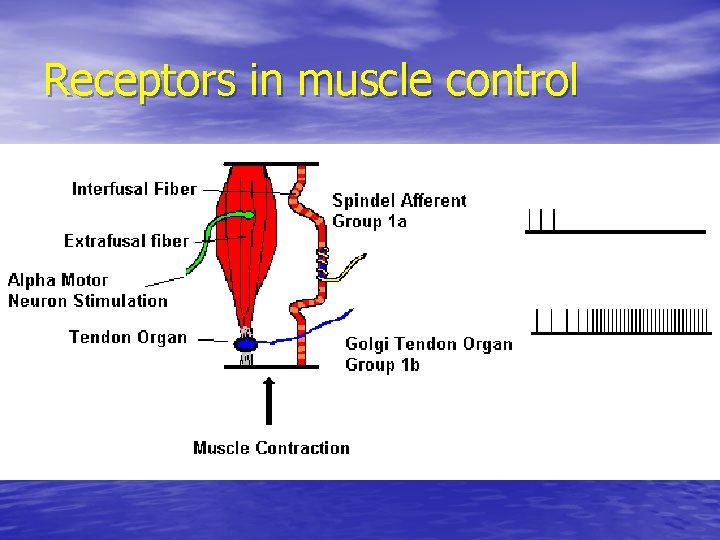
Receptors in muscle control Efferent axon type: Innervation Function Alpha motor Extrafusal neuron muscle fibers (Skeletomuscle) Control tension of muscles, strength and rate of pull on skeleton
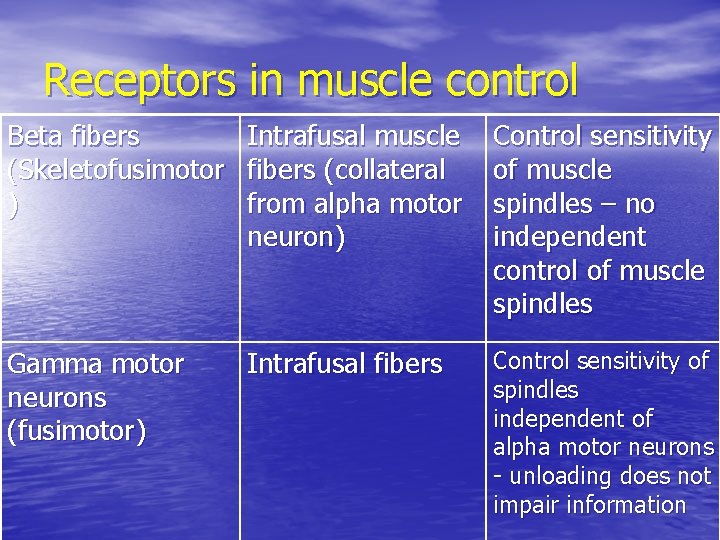
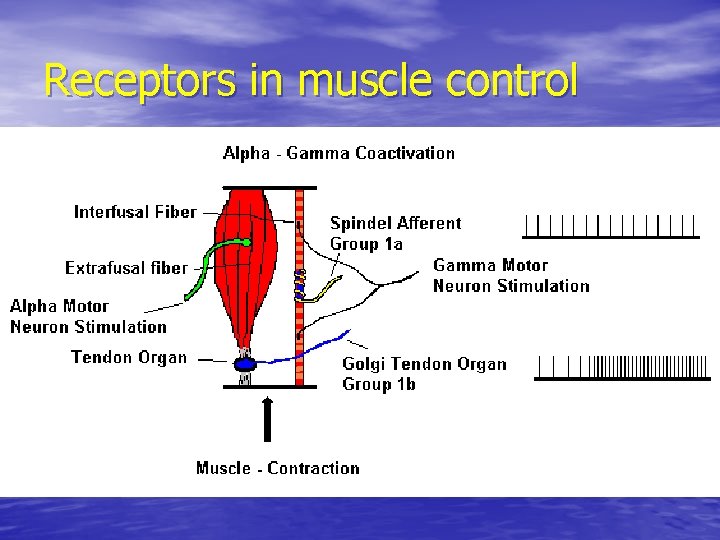
Receptors in muscle control Beta fibers (Skeletofusimotor ) Intrafusal muscle fibers (collateral from alpha motor neuron) Control sensitivity of muscle spindles – no independent control of muscle spindles Gamma motor neurons (fusimotor) Intrafusal fibers Control sensitivity of spindles independent of alpha motor neurons - unloading does not impair information
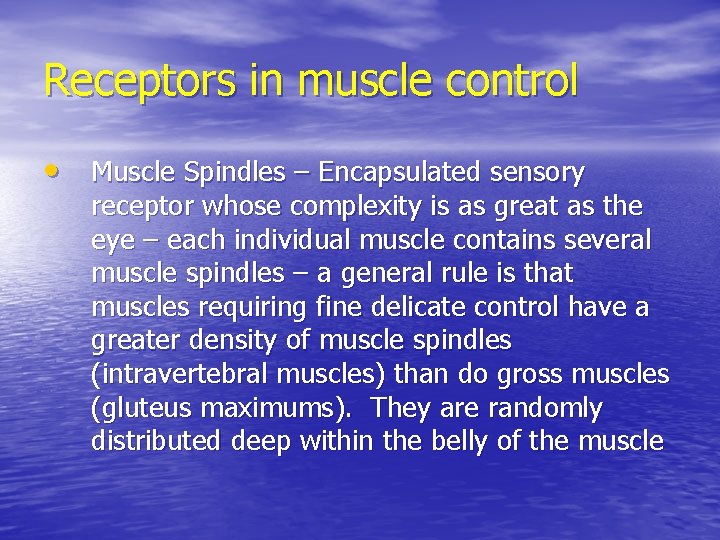
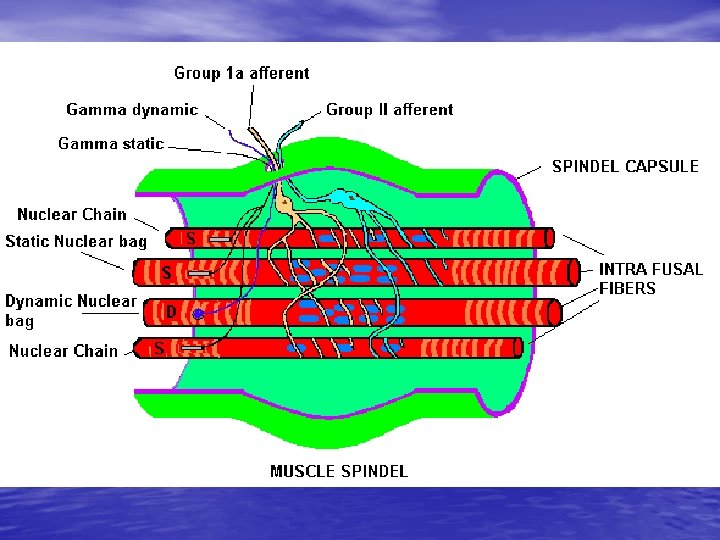
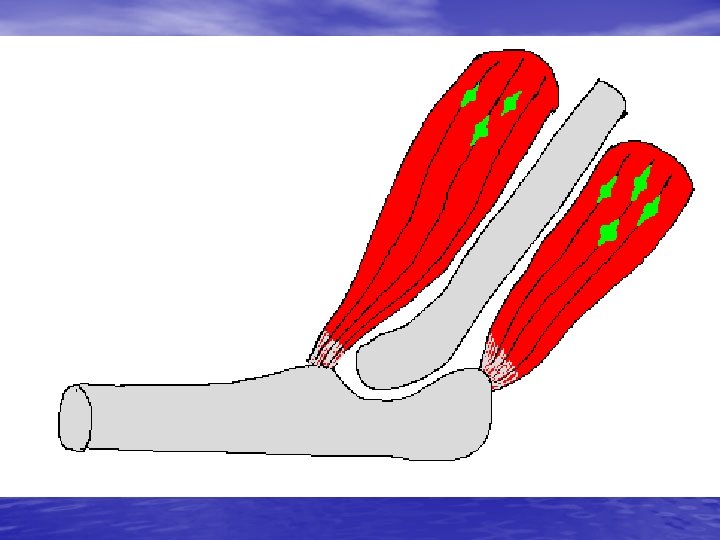
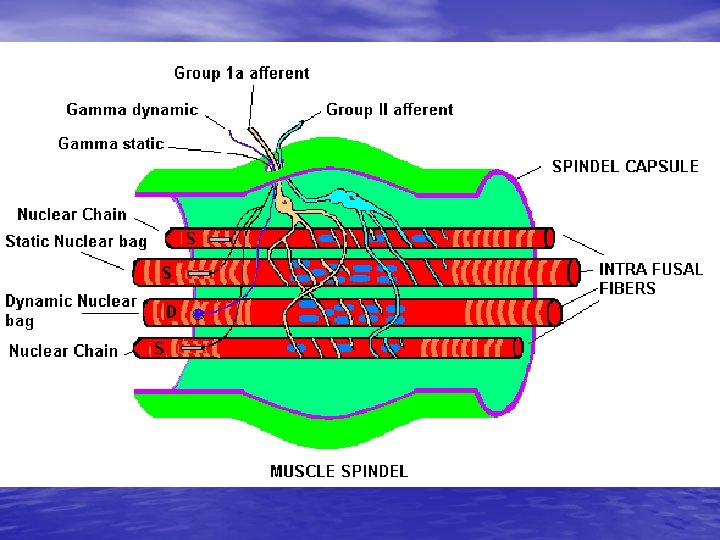
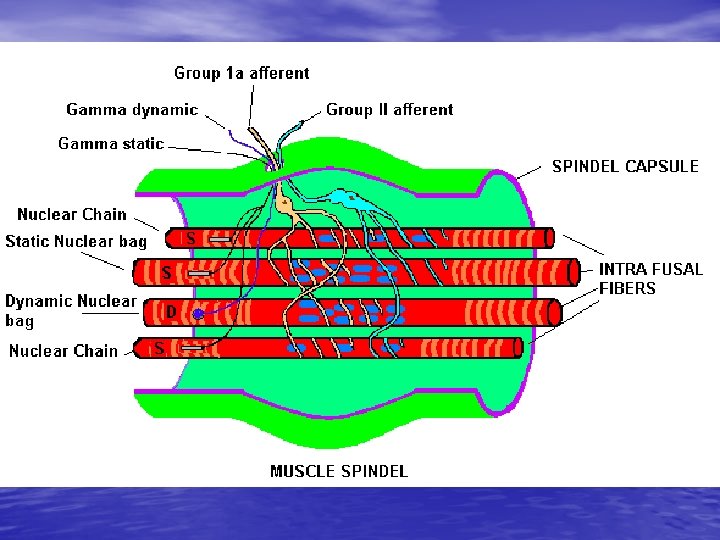
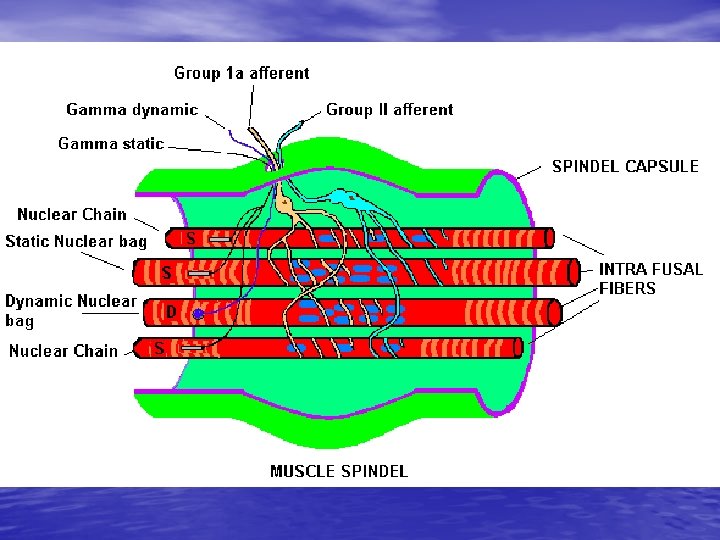
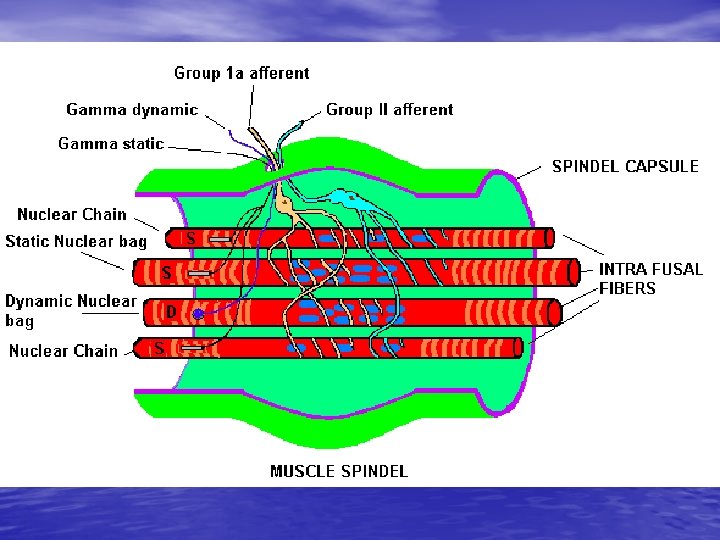
Receptors in muscle control • Muscle Spindles – Encapsulated sensory receptor whose complexity is as great as the eye – each individual muscle contains several muscle spindles – a general rule is that muscles requiring fine delicate control have a greater density of muscle spindles (intravertebral muscles) than do gross muscles (gluteus maximums). They are randomly distributed deep within the belly of the muscle
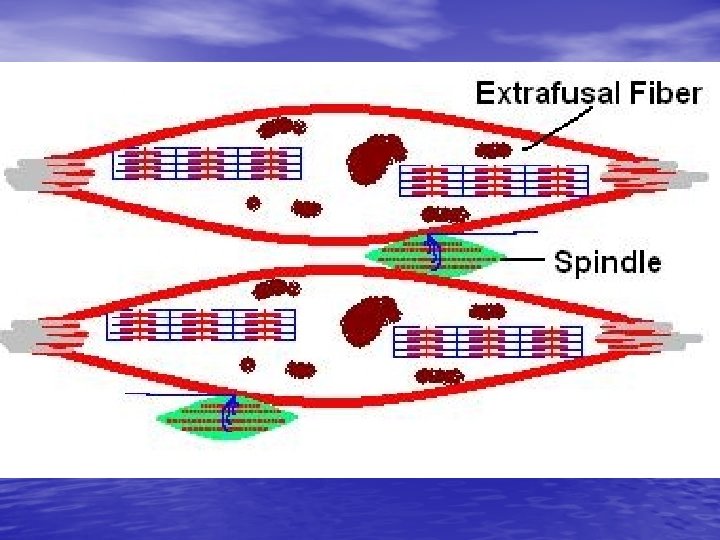
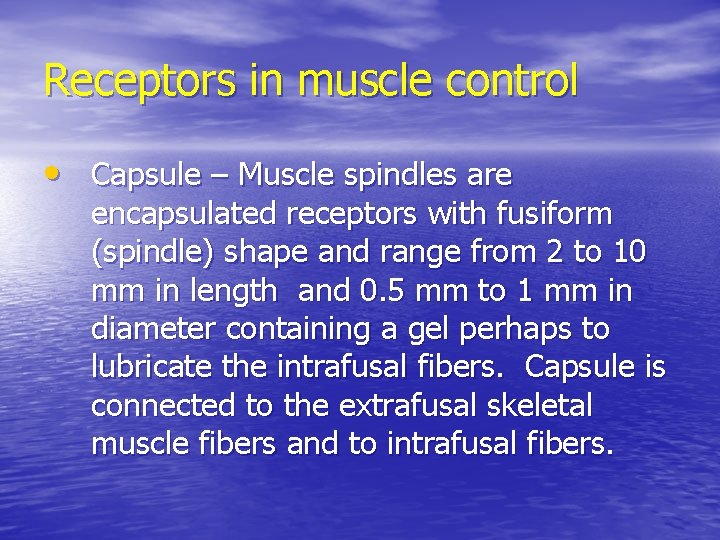
Receptors in muscle control • Capsule – Muscle spindles are encapsulated receptors with fusiform (spindle) shape and range from 2 to 10 mm in length and 0. 5 mm to 1 mm in diameter containing a gel perhaps to lubricate the intrafusal fibers. Capsule is connected to the extrafusal skeletal muscle fibers and to intrafusal fibers.
Receptors in muscle control • Intrafusal fibers – specialized muscle fibers contained within the muscle spindle capsule and embedded at random within the extrafusal skeletal muscle fibers – Range from 2 to 12 per capsule – Intrafusal fibers are arranged in parallel with themselves and with the extrafusal fibers
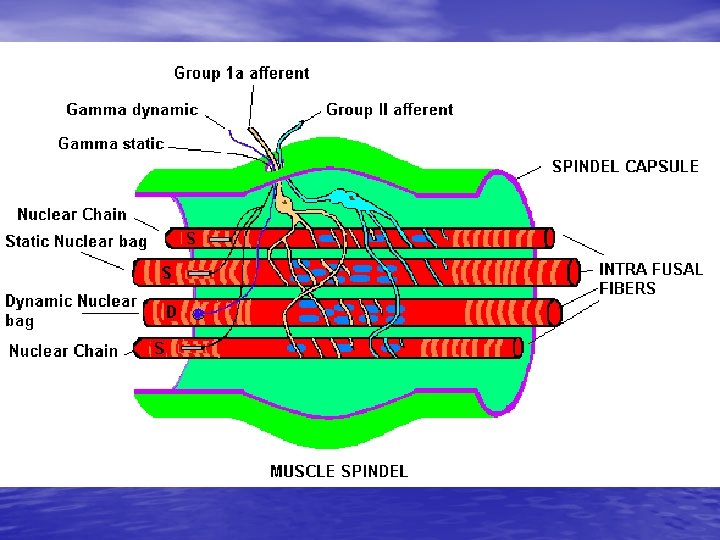
Receptors in muscle control – Intrafusal fiber types • 1] Nuclear bag fibers – contain numerous nuclei • • • concentrated near the center of the fiber and lying parallel with each other – 2 types – one of each in each muscle spindle a] Dynamic fiber – motion sensor b] Static fiber – position sensor 2] Nuclear chain fibers- contain nuclei lined up in series – varying numbers usually 5 in mammals – degree of stretch and strain
Receptors in muscle control • d. Central regions of each fiber are non contractile and innervated by one or more neurons wrapped around the intrafusal fiber (annulospiral endings – primary spindle endings and secondary endings) • e. Polar regions of the intrafusal fibers are contractile – pull on central region from both ends
Receptors in muscle control • Primary spindle endings (afferents) – Group 1 a fiber axon – dendritic endings wrap around all Intrafusal fibers (dynamic and static nuclear bag fibers, and all nuclear chain fibers) - may be one or more but usually just one - and provide feedback information on muscle length and rate of change in muscle length (stretch) – nerve fires continually increase firing rate when stretched and decrease firing rate when relaxed - information on developed muscle tension (force), speed of contraction, and momentum
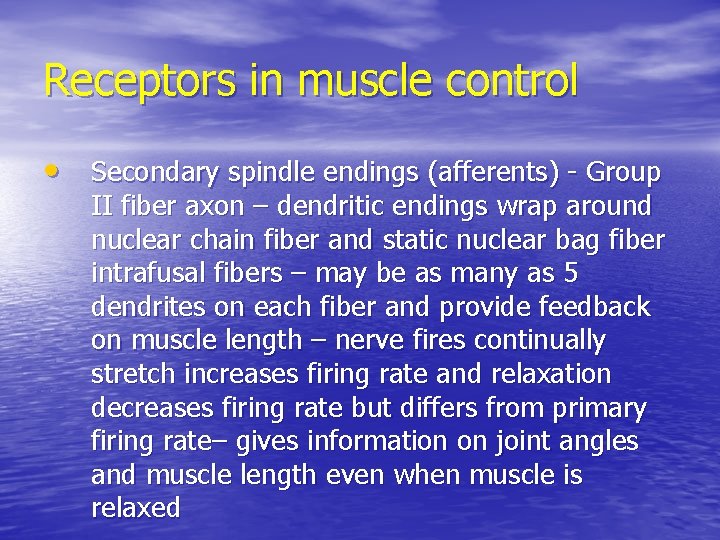
Receptors in muscle control • Secondary spindle endings (afferents) - Group II fiber axon – dendritic endings wrap around nuclear chain fiber and static nuclear bag fiber intrafusal fibers – may be as many as 5 dendrites on each fiber and provide feedback on muscle length – nerve fires continually stretch increases firing rate and relaxation decreases firing rate but differs from primary firing rate– gives information on joint angles and muscle length even when muscle is relaxed
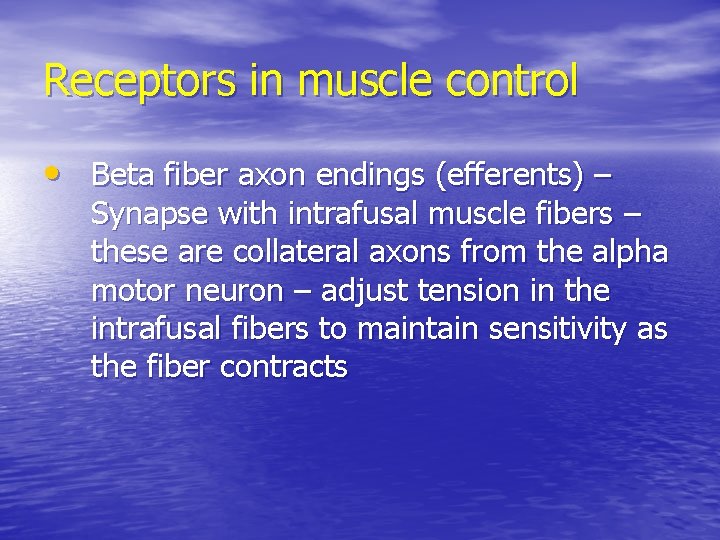
Receptors in muscle control • Beta fiber axon endings (efferents) – Synapse with intrafusal muscle fibers – these are collateral axons from the alpha motor neuron – adjust tension in the intrafusal fibers to maintain sensitivity as the fiber contracts
Receptors in muscle control • Gamma motor neurons (efferents) - Synapse with intrafusal muscle fibers near polar regions – Control spindle sensitivity in unloaded state (non contractile)
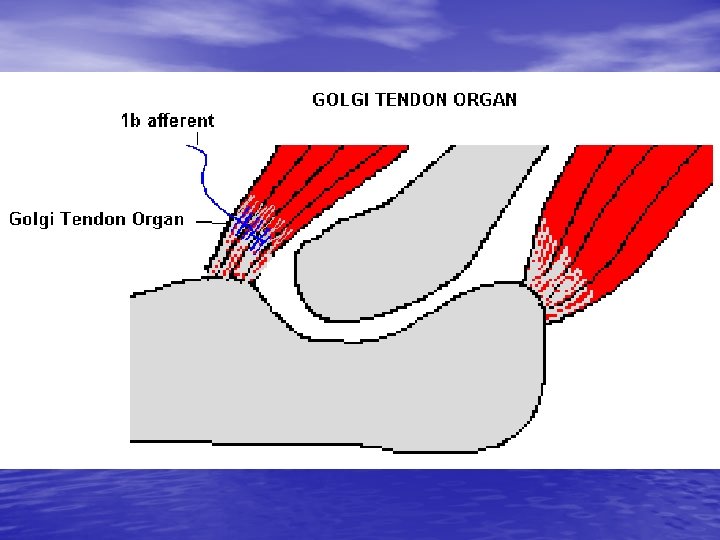
Receptors in muscle control • D. Golgi Tendon Organs - Encapsulated sensory receptor – much simpler than the muscle spindles – • Capsule – Golgi tendon organs are thin encapsulated receptors with an elongated tube shape approximately 1 mm in length and 0. 1 mm in diameter
Receptors in muscle control • Type 1 b nerve fiber enters the capsule and • splits into hundreds of dendritic endings which are associated with collagen fibers at the muscle tendon junction – nerve fires continually – increased firing rate with increased tension and decreased rate with relaxation Collagen fibers twist together at this point so that the Golgi tendon body may associate with as many as 15 different muscle motor units
Receptors in muscle control • Sensitive to minute changes in muscle tension - Stretch of the tendons or passive changes in tension
Receptors in muscle control • Free Nerve Endings – Skeletal muscle is richly endowed with numerous free nerve endings (type II, III, and IV fiber types). However very little is known about these other than type and conjecture as to function.
Receptors in muscle control • Type II fibers – respond mostly to pressure – • • • may be giving information on blood flow and tissue pressures Type III fibers – respond to pain, temperature, and chemical stimuli Type IV fibers - temperature and chemical stimuli There is some evidence that these fibers may also act on the vasomotor and pulmonary centers in the medulla, to signal for increased blood flow and increased breathing rate during exercise.
Receptors in muscle control
Receptors in muscle control
Receptors in muscle control
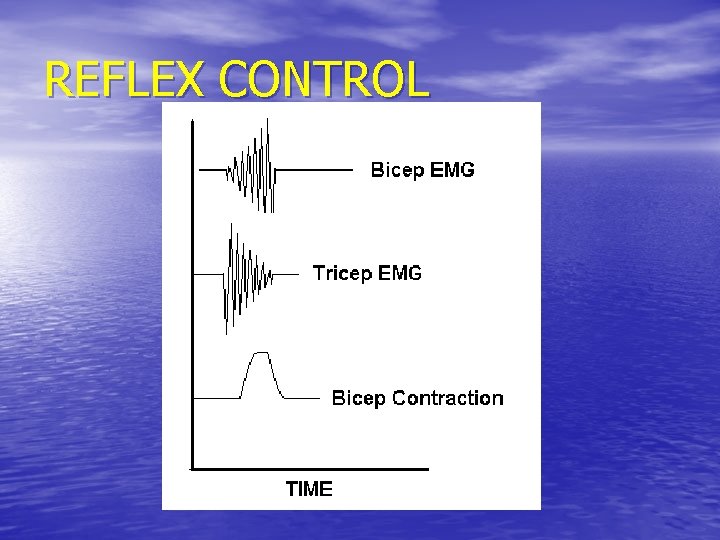
REFLEX CONTROL • Reflex control – When a skeletal muscle is passively stretched it responds with a momentary contraction (Knee jerk reaction to a hammer strike just below the patella) – Classic experiments of Sherrington and Lindel (1924 – 30) on decerebrate cats showed that the stretch reflex has two components and showed reciprocal and synergist innervation
REFLEX CONTROL Brisk phasic component – initiatial stretch of the muscle results in a brief but fairly powerful contraction of the skeletal muscle Weaker but longer lasting component triggered by the new static stretch of the lengthen skeletal muscle fibers Reciprocal innervation – stretch of the agonist muscle fibers produced relaxation in the antagonists muscle
REFLEX CONTROL Synergist innervation – stretch of the agonists muscle fibers also produced contractions in all synergistic muscles
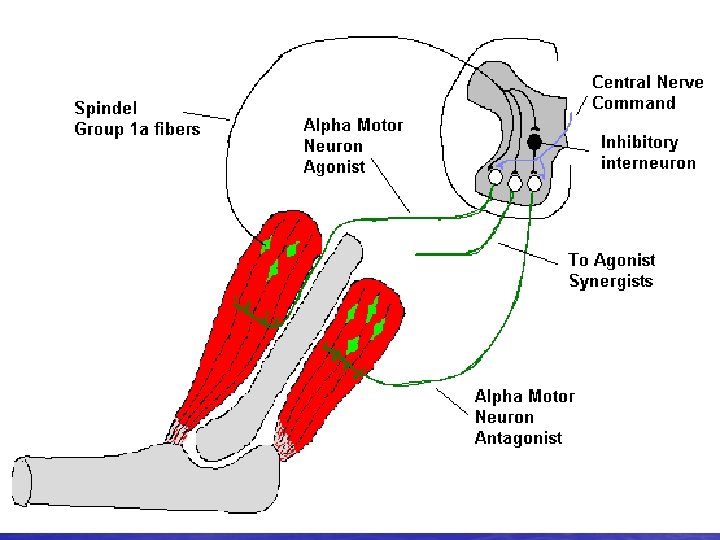
REFLEX CONTROL – Lloyd and Eccles (1946 – 48) showed that group 1 a axons from the muscle spindles pass into the dorsal root of the spinal cord and split into thousands of collaterals • Group 1 a collaterals form an excitatory synapse with every alpha motor neuron acting on the original muscle
REFLEX CONTROL • Group 1 a collaterals form an excitatory • synapse with all synergistic muscle alpha motor neurons (Synergist innervation) Group 1 a collaterals form an excitatory synapse with inhibitory interneurons which synapse with all antagonist muscle alpha motor neurons (Reciprocal innervation)
REFLEX CONTROL – Stretch reflex tends to resists passive lengthing of the muscles from their original resting position – Chiropractically this reflex can be used to test for vertebral and nerve damage – compression or extension of the dorsal root would tend to slow or block the reflex
REFLEX CONTROL – Flexion reflex afferent pathways – Group II fibers from the secondary muscle spindle nerves and some free nerve endings (group III and IV fibers) seem to stimulate homogenous alpha motor neurons and inhibit antagonist muscle alpha motor neurons
REFLEX CONTROL • Motor control mechanism – Central motor command – Alpha motor neuron • Single action potential produces a sub max twitch • Collaterals synapse on agonists muscle alpha motor neurons and on antagonists alpha motor neurons – agonists muscle begins contraction and antagonist muscle begins contraction at same time
REFLEX CONTROL
REFLEX CONTROL • Feedback from muscle spindles, Golgi • tendon organ, and free nerve endings constantly modify central motor command to properly position limb in space and time Feedback from muscle spindles (Group 1 a fibers) excites synergistic muscles to contract in concert
REFLEX CONTROL • Feedback from muscle spindles (Group 1 a fibers) • cause inhibition of antagonists muscle • alpha motor neurons – begins to relax antagonists muscle fibers to allow eccentric contraction Secondary command continues movement while making necessary adjustments based on feedback information to properly align speed and force of the movement
SKELETAL MUSCLE MOTOR CONTROL • Summary • 1. What is the difference between intrafusal and extrafusal fibers? • 2. How does fiber type tie into function? (chart) • 3. What is a muscle spindle body and how does it operate? • 4. What is a Golgi tendon body and how does it operate?
SKELETAL MUSCLE MOTOR CONTROL • Summary cont. • 5. What is reflex control, how does it operate? • 6. How does skeletal muscle control operate, affect on synergistic muscle, agonist muscle and antagonists muscle?