
PHYSIOLOGY 1 LECTURE 10 DIFFUSION Simple Facilitated Active
- Slides: 45
PHYSIOLOGY 1 LECTURE 10 DIFFUSION Simple, Facilitated, Active
DIFFUSION Objectives; n Completion of this material should provide the student with a basic understanding of: n 1. Definition of diffusion 2. Fick’s Law of simple diffusion 3. Significance related to membrane transport 4. Biological membrane and simple diffusion n
DIFFUSION 5. Carrier mediated transport 6. Facilitated diffusion – def. 7. Factors that affect the net rate of diffusion n 8. The laws of osmosis 9. Solute vs. solvent concentrations (inverse relationship) n 10. Osmotic pressure n
DIFFUSION 11. Osmosis vs. tonicity n 12. Active transport, secondary and primary. 13. The active transport mechanism – Na+K+ATPase 14. Properties of active transport systems n 15. Exocytosis – Movement of prepackaged water soluble contents to the outside n
DIFFUSION n 16. Stimulus for fusion of vesicles with membrane 17. Endocytosis – Phagocytosis, Pinocytosis, and receptor mediated endocytosis 18. Epithelial Transport
DIFFUSION What is diffusion? n How is it used by the human body? n
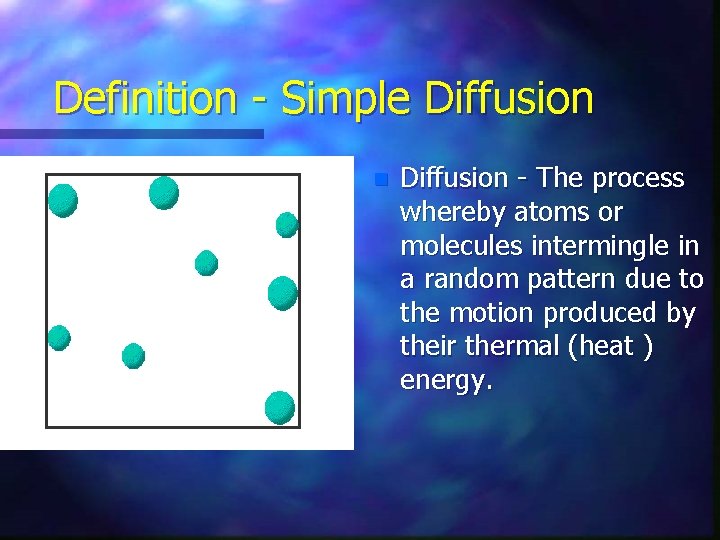
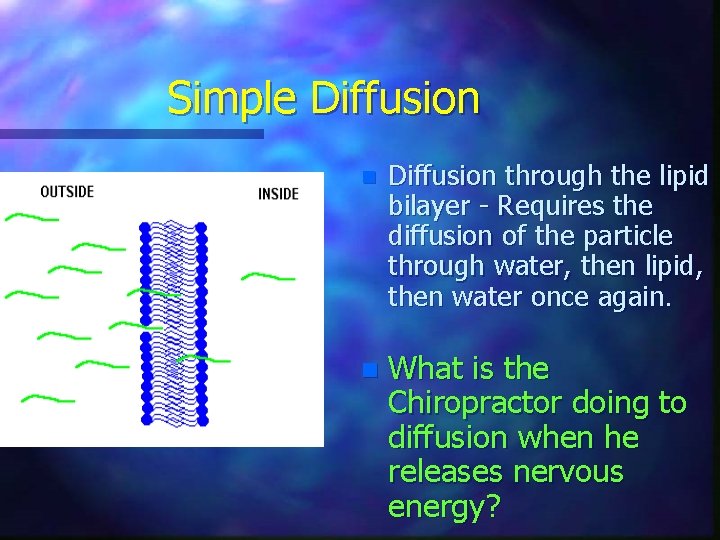
Definition - Simple Diffusion n Diffusion - The process whereby atoms or molecules intermingle in a random pattern due to the motion produced by their thermal (heat ) energy.
Simple Diffusion n Diffusion through the lipid bilayer - Requires the diffusion of the particle through water, then lipid, then water once again. n What is the Chiropractor doing to diffusion when he releases nervous energy?
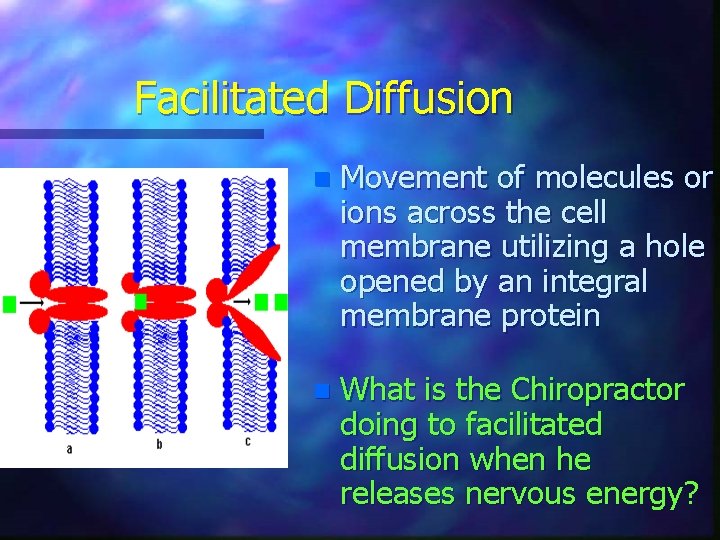
Facilitated Diffusion n Movement of molecules or ions across the cell membrane utilizing a hole opened by an integral membrane protein n What is the Chiropractor doing to facilitated diffusion when he releases nervous energy?
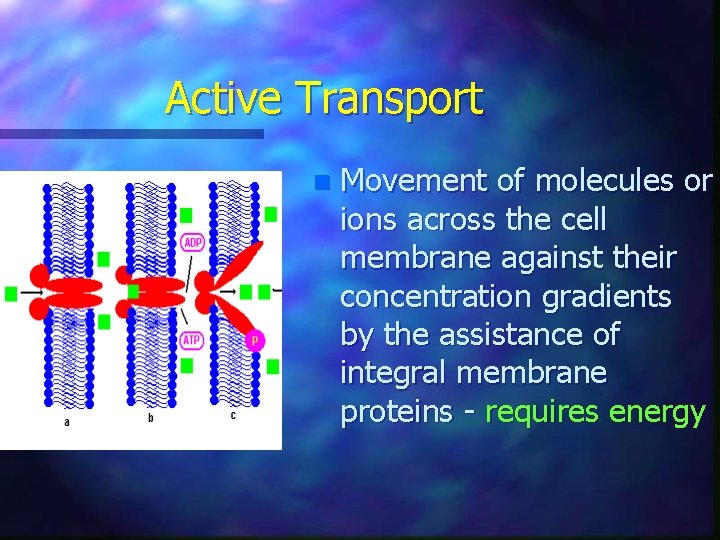
Active Transport n Movement of molecules or ions across the cell membrane against their concentration gradients by the assistance of integral membrane proteins - requires energy
Simple Diffusion - Basic Concept 1. Concentration - The higher the concentration the greater the rate of diffusion n 2. Thermal energy - The higher the temp. the faster molecules move n 3. Molecular Weight - The greater the molecular weight the greater the molecular radius, therefore, the slower the particles will tend to move. n
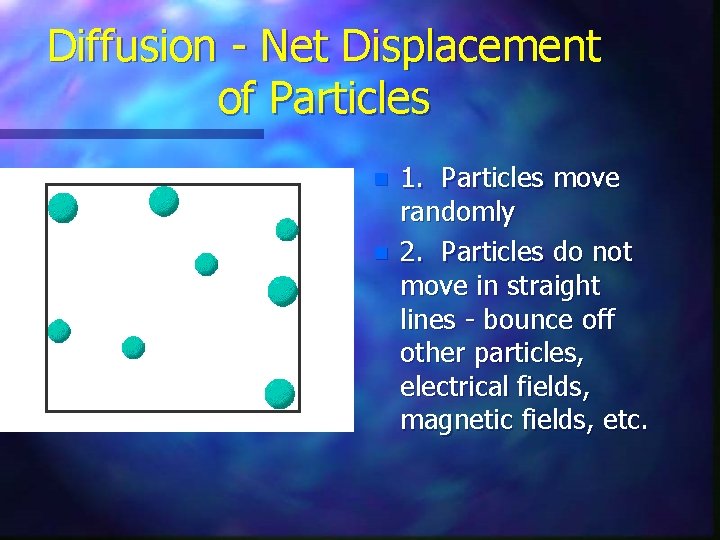
Diffusion - Net Displacement of Particles n n 1. Particles move randomly 2. Particles do not move in straight lines - bounce off other particles, electrical fields, magnetic fields, etc.
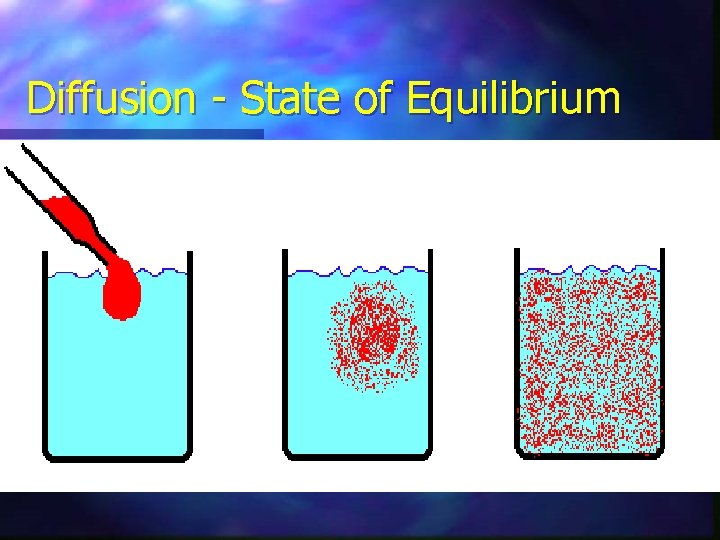
Diffusion - State of Equilibrium n Within any given space and given sufficient time, any concentration of particles added will eventually intermingle with the original particles in the space so that the concentration of the particles taken at any random point within the space is equal to the concentration taken at any other point.
Diffusion - State of Equilibrium
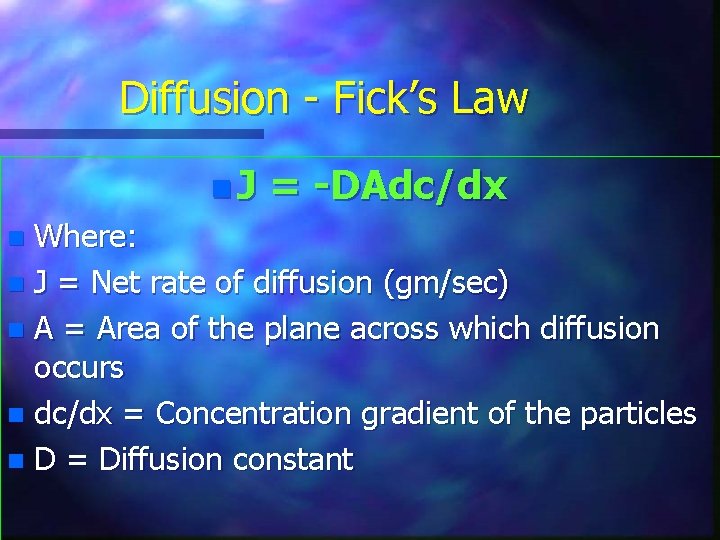
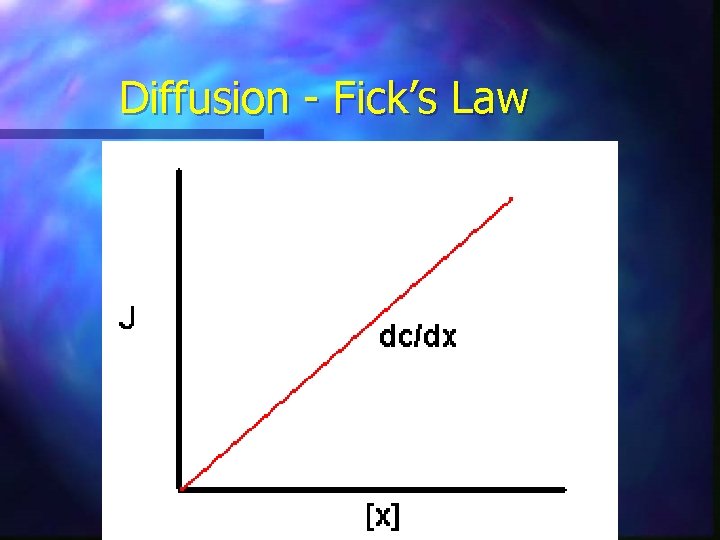
Diffusion - Fick’s Law n. J = -DAdc/dx Where: n J = Net rate of diffusion (gm/sec) n A = Area of the plane across which diffusion occurs n dc/dx = Concentration gradient of the particles n D = Diffusion constant n
Diffusion - Fick’s Law
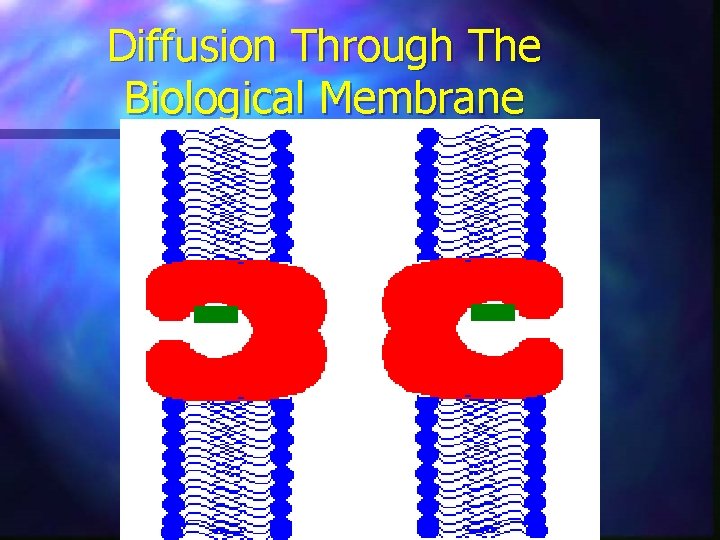
Diffusion Through The Biological Membrane How can we move water soluble particles through a lipid membrane? n The lipids of the biological membrane are not miscible with water. n Barrier to water soluble molecules, most ions, large molecules, and even some lipid soluble molecules have difficulty passing. n Solution - Open a hole through the membrane using an integral membrane protein n
Diffusion Through The Biological Membrane Protein Transporters n Two general types – 1. Channels – 2. Carrier Proteins n
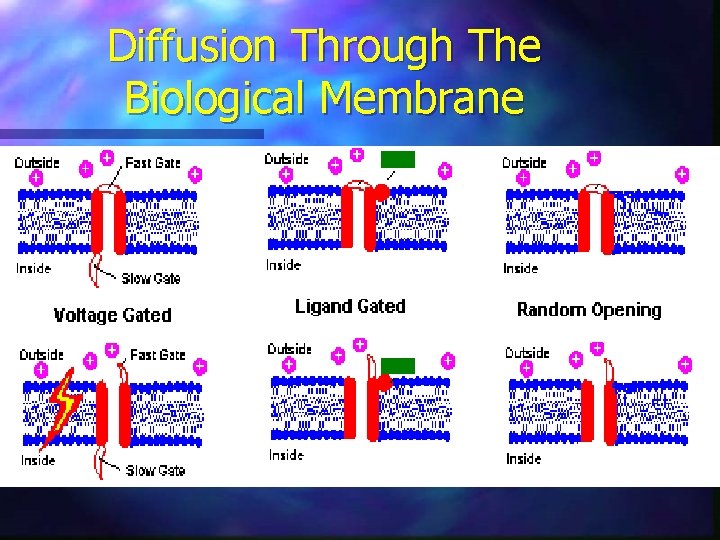
Diffusion Through The Biological Membrane n n n Channel Proteins Voltage Gated - Open and close in response to changes in the electrical state of the membrane Ligand Gated - Open and close in response to the binding of a chemical agent to an allosteric site Random Opening - Open and close apparently randomly - are changed by mechanical manipulation Aquaporins - water channels - provide for exchange of water between the cell interior and the extracellular space.
Diffusion Through The Biological Membrane
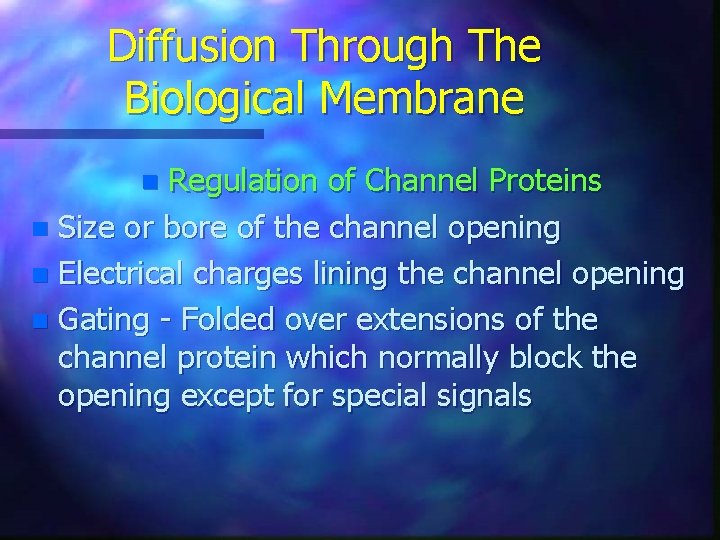
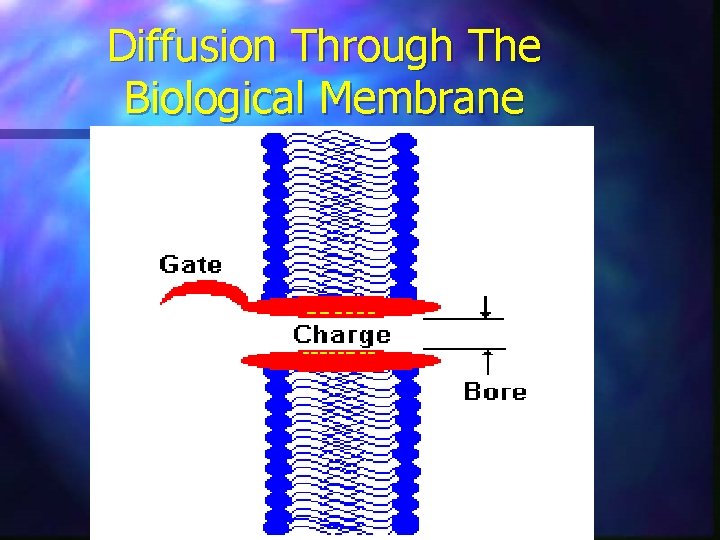
Diffusion Through The Biological Membrane Regulation of Channel Proteins n Size or bore of the channel opening n Electrical charges lining the channel opening n Gating - Folded over extensions of the channel protein which normally block the opening except for special signals n
Diffusion Through The Biological Membrane
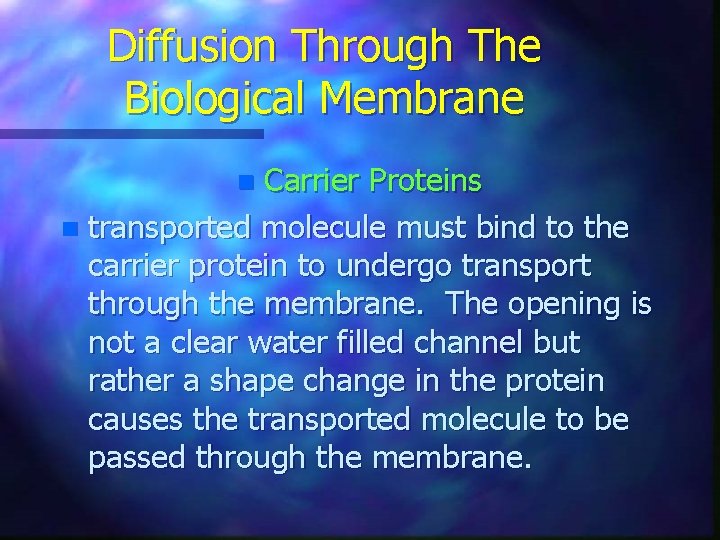
Diffusion Through The Biological Membrane Carrier Proteins n transported molecule must bind to the carrier protein to undergo transport through the membrane. The opening is not a clear water filled channel but rather a shape change in the protein causes the transported molecule to be passed through the membrane. n
Diffusion Through The Biological Membrane
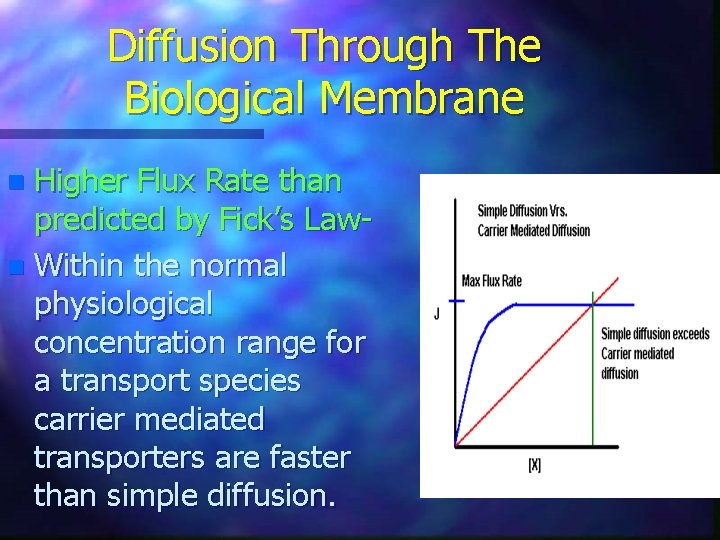
Diffusion Through The Biological Membrane Characteristics of Protein Transporters n 1. Species Specific n 2. Saturation Kinetics n 3. Competition for transport n 4. Obligative Coupling of Fluxes n 5. Higher flux rate than predicted by Fick’s law within the physiological concentration range. n
Diffusion Through The Biological Membrane Species Specific n Most transporters are specific to one transport molecule. However, a few can transport several different molecules of the same type in the same direction or even transport some in one direction and others in the opposite direction. n
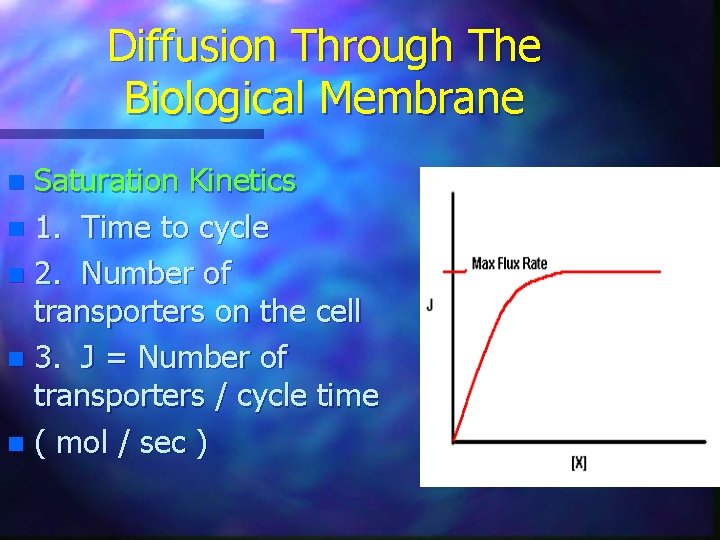
Diffusion Through The Biological Membrane Saturation Kinetics n 1. Time to cycle n 2. Number of transporters on the cell n 3. J = Number of transporters / cycle time n ( mol / sec ) n
Diffusion Through The Biological Membrane Competition for Transport n 1. Competitive Inhibitor - Usually is not transported but blocks access to the transporter for the transport molecule n 2. Non-competitive Inhibitor - Binds to an allosteric site changing the shape of the transport protein preventing it’s normal function usually for long time periods effectively removing the transporter n
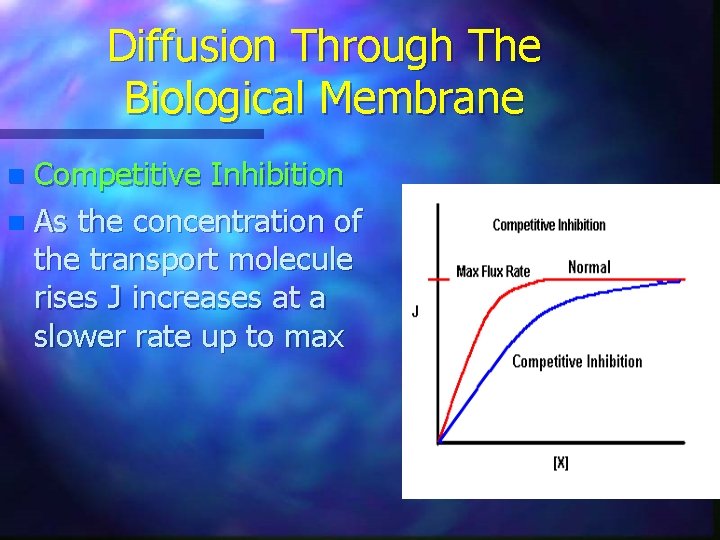
Diffusion Through The Biological Membrane Competitive Inhibition n As the concentration of the transport molecule rises J increases at a slower rate up to max n
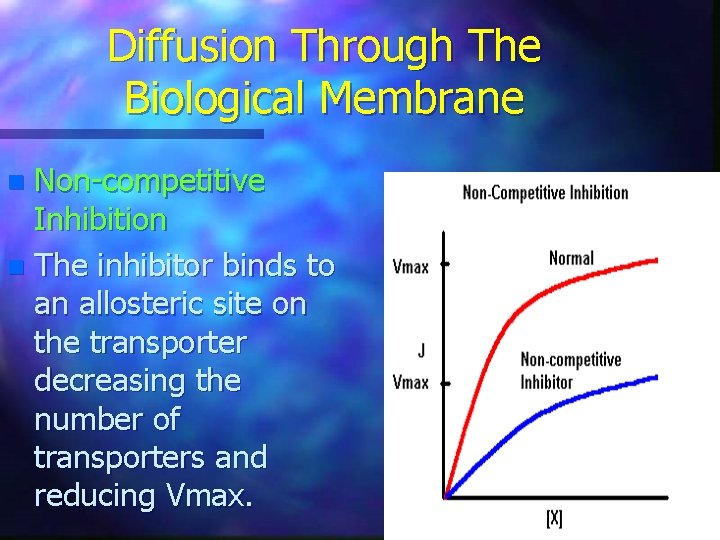
Diffusion Through The Biological Membrane Non-competitive Inhibition n The inhibitor binds to an allosteric site on the transporter decreasing the number of transporters and reducing Vmax. n
Diffusion Through The Biological Membrane Obligative Coupling of Fluxes n In certain protein transporters two or more transport species are moved. The number of each molecule moved is always exact and tied to the movement of the other transport species. Example the Na+K+ATPase moves three Na+ ions out of the cell and two K+ ions into the cell. n
Diffusion Through The Biological Membrane Higher Flux Rate than predicted by Fick’s Lawn Within the normal physiological concentration range for a transport species carrier mediated transporters are faster than simple diffusion. n
Diffusion Through The Biological Membrane Facilitated Diffusion n The process by which biological membranes are opened up by integral membrane proteins allowing transport molecules to move down their concentration gradient. This is a form of carrier mediated transport and therefore, follows all the rules of carrier mediated transport. n
Diffusion Through The Biological Membrane Facilitated Transport Basic Concept n The lipid bilayer of the biological membrane is an effective barrier to simple diffusion of most molecules. In order to meet the cells need for metabolic substrate and building materials the cells open holes in their membranes using integral membrane proteins called transports or channels. n
Diffusion Through The Biological Membrane Rules of Facilitated Transport n 1. Transport molecules move down their concentration gradient n 2. Transport proteins follow all the rules of carrier mediated transport n 3. Channel proteins open up to allow free water diffusion while carrier proteins require the transport molecule to bind in order to undergo the shape change for transport. n
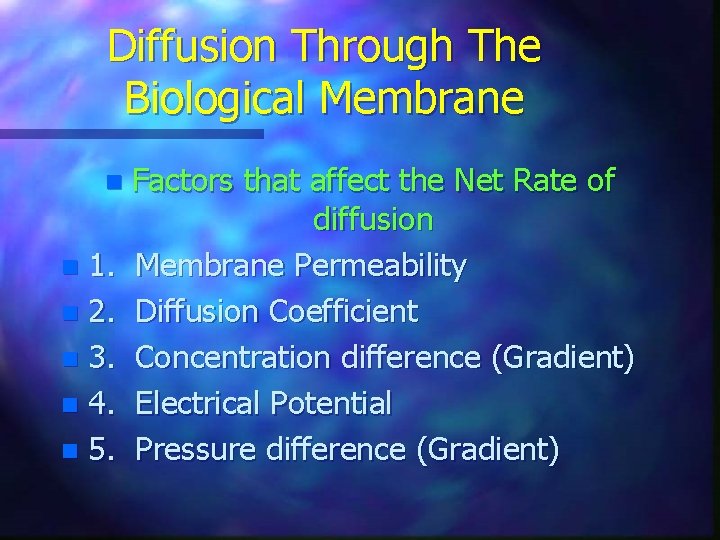
Diffusion Through The Biological Membrane Factors that affect the Net Rate of diffusion n 1. Membrane Permeability n 2. Diffusion Coefficient n 3. Concentration difference (Gradient) n 4. Electrical Potential n 5. Pressure difference (Gradient) n
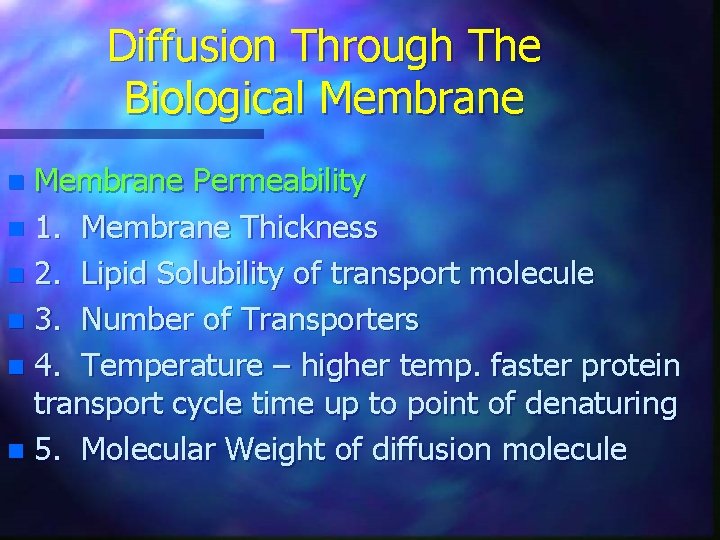
Diffusion Through The Biological Membrane Permeability n 1. Membrane Thickness n 2. Lipid Solubility of transport molecule n 3. Number of Transporters n 4. Temperature – higher temp. faster protein transport cycle time up to point of denaturing n 5. Molecular Weight of diffusion molecule n
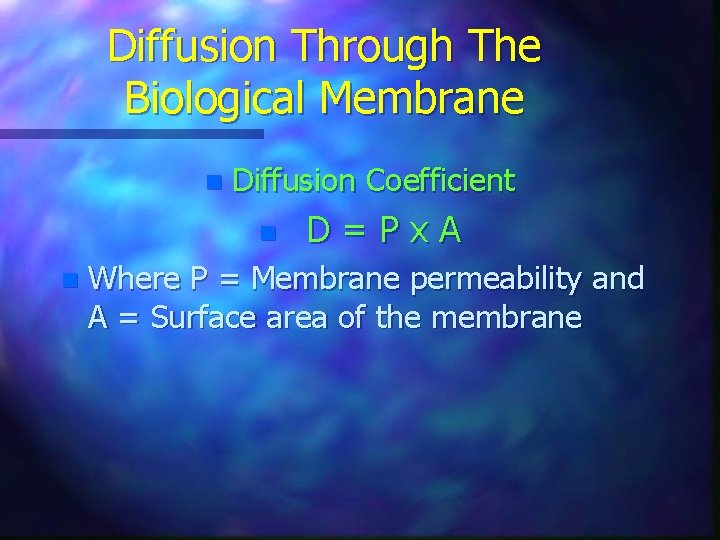
Diffusion Through The Biological Membrane n Diffusion Coefficient D = P x A n Where P = Membrane permeability and A = Surface area of the membrane n
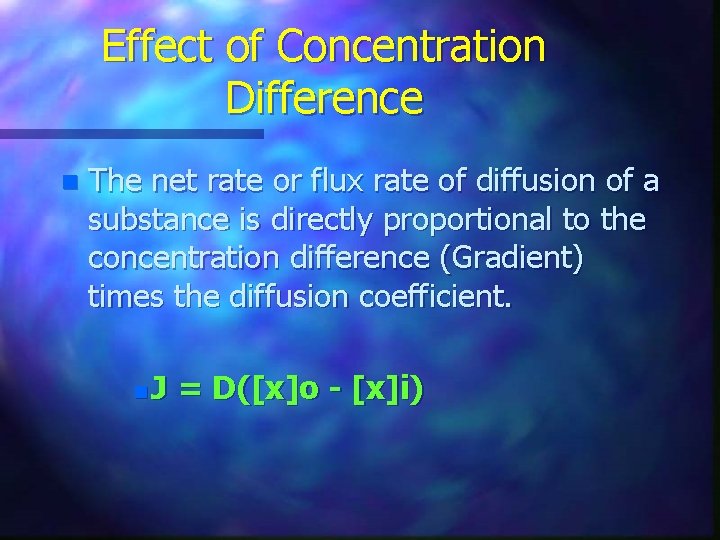
Effect of Concentration Difference n The net rate or flux rate of diffusion of a substance is directly proportional to the concentration difference (Gradient) times the diffusion coefficient. n J = D([x]o - [x]i)
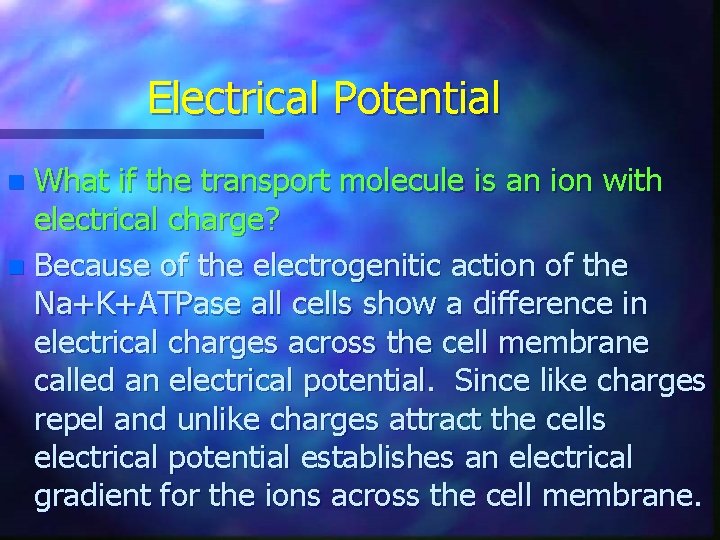
Electrical Potential What if the transport molecule is an ion with electrical charge? n Because of the electrogenitic action of the Na+K+ATPase all cells show a difference in electrical charges across the cell membrane called an electrical potential. Since like charges repel and unlike charges attract the cells electrical potential establishes an electrical gradient for the ions across the cell membrane. n
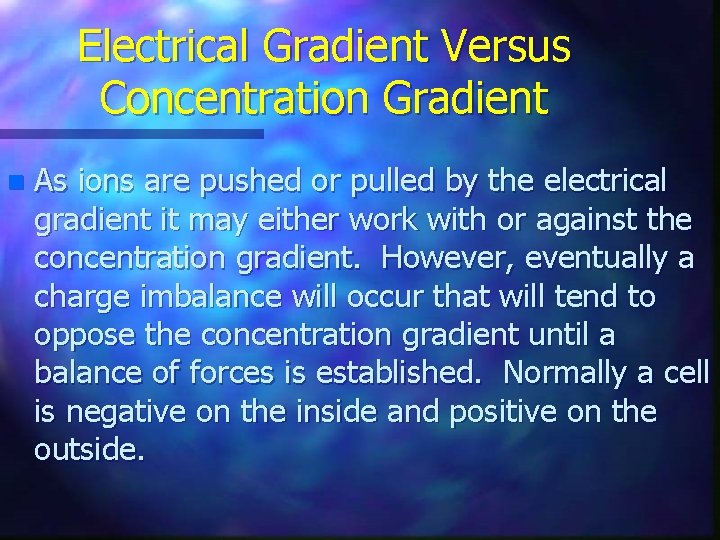
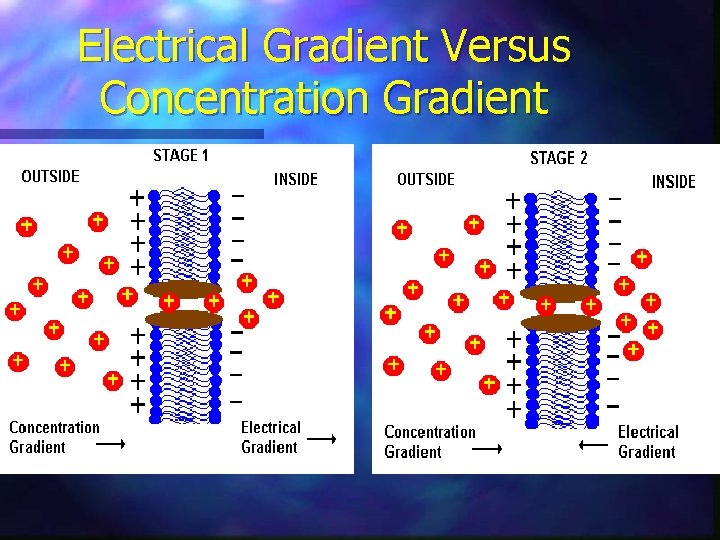
Electrical Gradient Versus Concentration Gradient n As ions are pushed or pulled by the electrical gradient it may either work with or against the concentration gradient. However, eventually a charge imbalance will occur that will tend to oppose the concentration gradient until a balance of forces is established. Normally a cell is negative on the inside and positive on the outside.
Electrical Gradient Versus Concentration Gradient
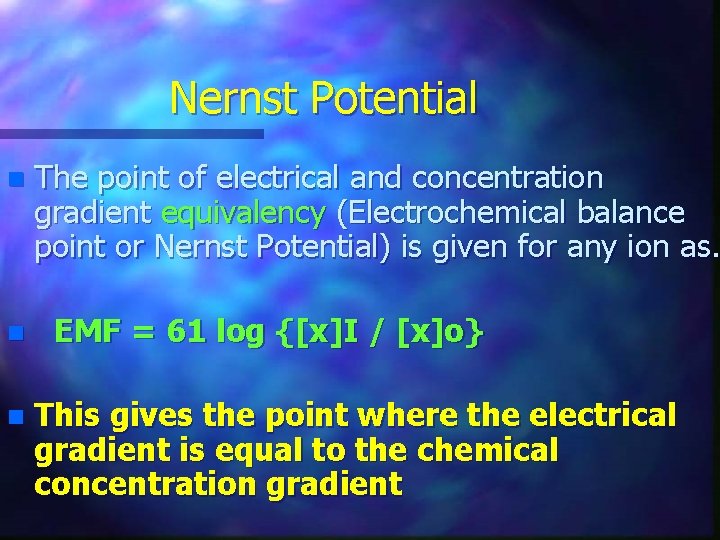
Nernst Potential n The point of electrical and concentration gradient equivalency (Electrochemical balance point or Nernst Potential) is given for any ion as. n EMF = 61 log {[x]I / [x]o} n This gives the point where the electrical gradient is equal to the chemical concentration gradient
Effect of Pressure Differences n An increase in pressure on one side of a cell membrane also means an increase in the net rate of diffusion toward the low pressure side of the membrane.