
Physiologically Based Pharmacokinetic Modeling and Simulation Using Simcyp
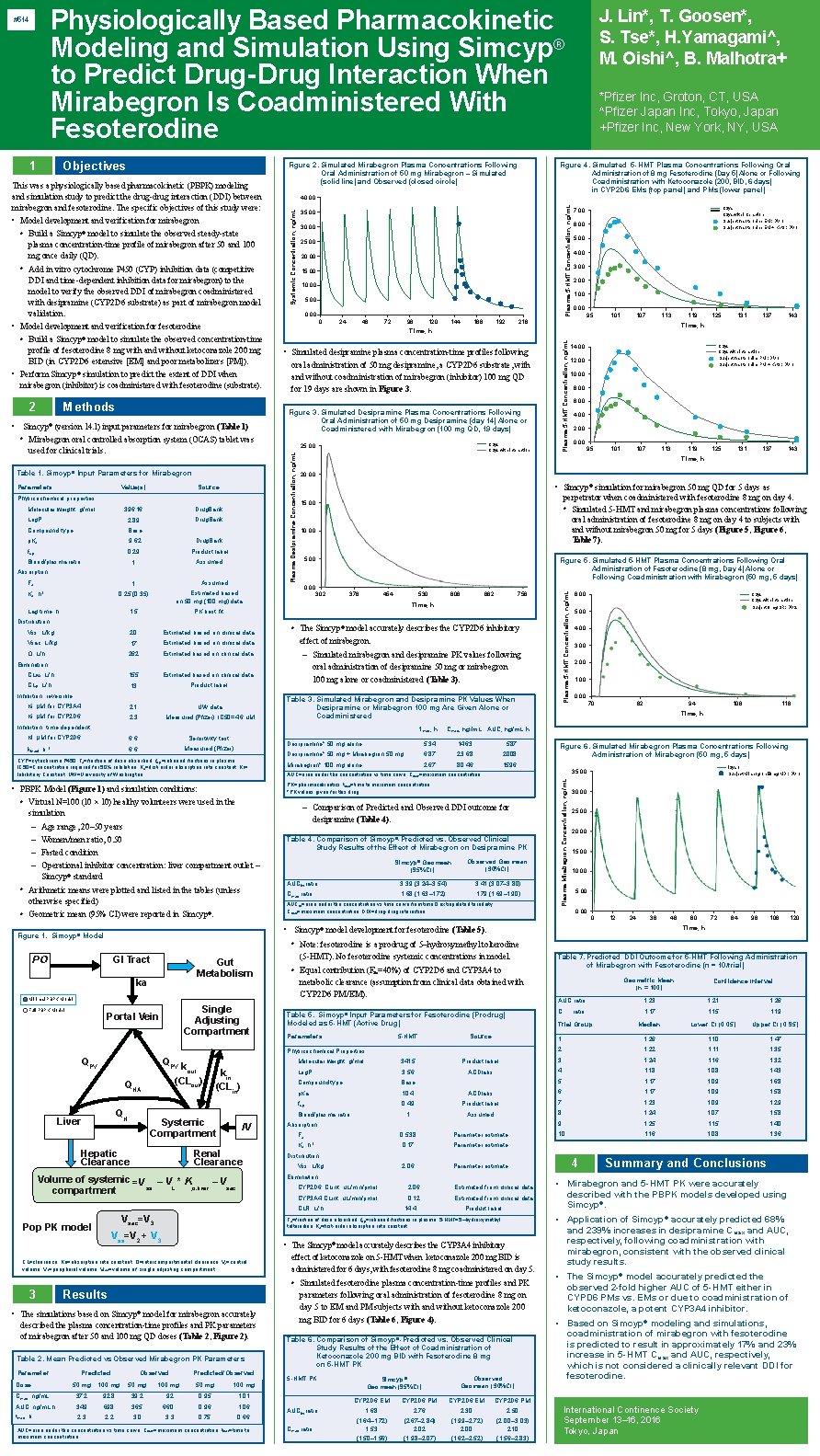
Physiologically Based Pharmacokinetic Modeling and Simulation Using Simcyp® to Predict Drug-Drug Interaction When Mirabegron Is Coadministered With Fesoterodine ° Build a Simcyp® model to simulate the observed steady-state plasma concentration-time profile of mirabegron after 50 and 100 mg once daily (QD). ° Add in vitro cytochrome P 450 (CYP) inhibition data (competitive DDI and time-dependent inhibition data for mirabegron) to the model to verify the observed DDI of mirabegron coadministered with desipramine (CYP 2 D 6 substrate) as part of mirabegron model validation. 40. 00 35. 00 30. 00 25. 00 20. 00 15. 00 10. 00 5. 00 0 • Model development and verification for fesoterodine • Perform Simcyp simulation to predict the extent of DDI when ® mirabegron (inhibitor) is coadministered with fesoterodine (substrate). 2 Methods • Simcyp® (version 14. 1) input parameters for mirabegron (Table 1) ° Mirabegron oral controlled absorption system (OCAS) tablet was used for clinical trials. Table 1. Simcyp® Input Parameters for Mirabegron Parameters Value(s) Source Physicochemical properties 396. 16 Drug. Bank Log. P 2. 89 Drug. Bank Compound type Base p. Ka 9. 62 Drug. Bank fu, p 0. 29 Product label 1 Assumed Molecular weight, g/mol Blood/plasma ratio Absorption Fa Assumed 1 Ka, h-1 0. 25 (0. 35) Estimated based on 50 mg (100 mg) data 1. 5 PK best fit 20 Estimated based on clinical data Lag time, h Distribution Vss, L/kg 17 Estimated based on clinical data 262 Estimated based on clinical data CLPO, L/h 155 Estimated based on clinical data CLR, L/h 13 Product label 21 UW data 2. 3 Measured (Pfizer), IC 50=4. 6 u. M KI, μM for CYP 2 D 6 6. 6 Sensitivity test kinact, h – 1 6. 6 Measured (Pfizer) Vsac, L/kg Q, L/h Elimination Inhibition, reversible Ki, μM for CYP 3 A 4 Ki, μM for CYP 2 D 6 24 48 72 96 120 192 Figure 3. Simulated Desipramine Plasma Concentrations Following Oral Administration of 50 mg Desipramine (day 14) Alone or Coadministered with Mirabegron (100 mg QD, 19 days) CSys with Interaction 25. 00 Women/men ratio, 0. 50 Fasted condition Operational inhibitor concentration: liver compartment outlet – Simcyp® standard ° Arithmetic means were plotted and listed in the tables (unless otherwise specified) 3. 00 2. 00 1. 00 0. 00 95 101 107 113 GI Tract Gut Metabolism ka Minimal PBPK Model Full PBPK Model Single Adjusting Compartment Portal Vein QHA QH Liver kin (CLin) 10. 00 5. 00 Hepatic Clearance IV Renal Clearance 12. 00 10. 00 8. 00 6. 00 4. 00 2. 00 0. 00 95 101 107 113 302 378 454 530 606 682 758 Time, h ° The Simcyp® model accurately describes the CYP 2 D 6 inhibitory effect of mirabegron. – Simulated mirabegron and desipramine PK values following oral administration of desipramine 50 mg or mirabegron 100 mg alone or coadministered (Table 3). Table 3. Simulated Mirabegron and Desipramine PK Values When Desipramine or Mirabegron 100 mg Are Given Alone or Coadministered 5. 34 14. 63 587 Desipramine* 50 mg + Mirabegron 50 mg 6. 87 23. 68 2008 Mirabegron* 100 mg alone 2. 67 80. 46 1596 Table 4. Comparison of Simcyp®-Predicted vs. Observed Clinical Study Results of the Effect of Mirabegron on Desipramine PK Simcyp® Geomean (95%CI) Observed Geomean (90%CI) AUCinf ratio 3. 39 (3. 24– 3. 54) 3. 41 (3. 07– 3. 80) Cmax ratio 1. 68 (1. 63– 1. 72) 1. 79 (1. 69– 1. 90) 6. 00 3 5. 00 4. 00 3. 00 2. 00 1. 00 0. 00 70 82 94 • The simulations based on Simcyp® model for mirabegron accurately described the plasma concentration-time profiles and PK parameters of mirabegron after 50 and 100 mg QD doses (Table 2, Figure 2). Table 2. Mean Predicted vs Observed Mirabegron PK Parameters Parameter Dose Predicted Observed 100 mg Predicted/Observed 50 mg 100 mg Cmax, ng/m. L 37. 2 92. 8 39. 2 92 0. 95 1. 01 AUC, ng/m. L·h tmax, h 349 698 365 660 0. 96 1. 06 2. 3 2. 2 3. 0 3. 3 0. 75 0. 66 AUC=area under the concentration vs time curve; Cmax=maximum concentration; tmax=time to maximum concentration. 106 118 Figure 6. Simulated Mirabegron Plasma Concentrations Following Administration of Mirabegron (50 mg, 5 days) ISys 1 Subject Mirabogron 50 mg MD : DV 1 35. 00 30. 00 25. 00 20. 00 15. 00 10. 00 5. 00 12 24 36 48 60 72 84 96 108 120 Time, h ° Equal contribution (Fm=40%) of CYP 2 D 6 and CYP 3 A 4 to metabolic clearance (assumption from clinical data obtained with CYP 2 D 6 PM/EM). Table 7. Predicted DDI Outcome for 5 -HMT Following Administration of Mirabegron with Fesoterodine (n = 10/trial) Geometric Mean (n = 100) Confidence Interval AUC ratio 1. 23 1. 21 1. 26 Table 5. Simcyp Input Parameters for Fesoterodine (Prodrug) Modeled as 5 -HMT (Active Drug) C max ratio 1. 17 1. 15 1. 19 Median Lower CI (0. 05) Upper CI (0. 95) Parameters 1 1. 26 1. 10 1. 47 2 1. 22 1. 11 1. 35 ® 5 -HMT Source Trial Group Molecular weight, g/mol 341. 5 Product label 3 1. 24 1. 16 1. 32 Log. P 3. 56 ACDlabs 4 1. 18 1. 08 1. 43 Compound type Base 5 1. 17 1. 09 1. 68 p. Ka 10. 4 ACDlabs 6 1. 17 1. 09 1. 58 fu, p 0. 49 Product label 7 1. 23 1. 09 1. 29 1 Assumed 8 1. 24 1. 07 1. 58 9 1. 25 1. 15 1. 40 10 1. 16 1. 08 1. 36 Absorption Fa Ka, h-1 0. 538 Parameter estimate 0. 17 Parameter estimate 2. 06 Parameter estimate Distribution Vss, L/kg 2. 06 Estimated from clinical data 0. 12 Estimated from clinical data 14. 4 Product label • The Simcyp® model accurately describes the CYP 3 A 4 inhibitory Results 143 CSys with Interaction Subject 8 mg SR : DV 2 0 Fa=fraction of dose absorbed; fu, p=inbound fractions in plasma; 5 -HMT=5–hydroxymethyl tolterodine; Ka=first-order absorption rate constant. CL=clearance; Ka=absorption rate constant; Q=intercompartmental clearance; V 2=central volume; V 3=peripheral volume; Vsac=volume of single adjusting compartment. 137 0. 00 ° Note: fesoterodine is a prodrug of 5–hydroxymethyl tolterodine (5 -HMT). No fesoterodine systemic concentrations in model. CYP 3 A 4 CLint, u. L/min/pmol Vss=V 2 + V 3 131 Time, h AUC=area under the concentration vs time curve; Cmax=maximum concentration; CLR, L/h Pop PK model 125 Cmax , ng/m. L AUC, ng/m. L·h Desipramine* 50 mg alone CYP 2 D 6 CLint, u. L/min/pmol Vsac=V 3 119 0. 00 Elimination Volume of systemic =V – V * K –V ss L p: liver sac compartment 143 Figure 5. Simulated 5 -HMT Plasma Concentrations Following Oral Administration of Fesoterodine (8 mg, Day 4) Alone or Following Coadministration with Mirabegron (50 mg, 5 days) Blood/plasma ratio Systemic Compartment 137 perpetrator when coadministered with fesoterodine 8 mg on day 4. ° Simulated 5 -HMT and mirabegron plasma concentrations following oral administration of fesoterodine 8 mg on day 4 to subjects with and without mirabegron 50 mg for 5 days (Figure 5, Figure 6, Table 7). 15. 00 Physicochemical Properties QPV k out (CLout) QPV 131 CSys with Interaction Subject fesoterodine PM : DV 1 Subject fesoterodine PM + Keto : DV 1 • Simcyp model development for fesoterodine (Table 5). PO 125 14. 00 ® Figure 1. Simcyp® Model 119 Time, h • Simcyp® simulation for mirabegron 50 mg QD for 5 days as AUCinf=area under the concentration vs time curve from time 0 extrapolated to infinity; Cmax=maximum concentration; DDI=drug-drug interaction. ° Geometric mean (95% CI) were reported in Simcyp®. 4. 00 20. 00 – Comparison of Predicted and Observed DDI outcome for desipramine (Table 4). Age range, 20– 50 years 5. 00 Time, h PK=pharmacokinetics; tmax=time to maximum concentration. *PK values given for this drug. ° Virtual N=100 (10 × 10) healthy volunteers were used in the simulation 6. 00 216 oral administration of 50 mg desipramine, a CYP 2 D 6 substrate, with and without coadministration of mirabegron (inhibitor) 100 mg QD for 19 days are shown in Figure 3. tmax , h • PBPK Model (Figure 1) and simulation conditions: – – 168 • Simulated desipramine plasma concentration-time profiles following Inhibition, time dependent CYP=cytochrome P 450; Fa=fraction of dose absorbed; fu, p =inbound fractions in plasma; IC 50=Concentration required for 50% inhibition; Ka=first-order absorption rate constant; Ki= Inhibitory Constant; UW=University of Washington. 144 CSys with Interaction Subject fesoterodine EM : DV 1 Subject fesoterodine EM + Keto : DV 1 7. 00 Time, h Plasma Desipramine Concentration, ng/m. L ° Build a Simcyp® model to simulate the observed concentration-time profile of fesoterodine 8 mg with and without ketoconazole 200 mg BID (in CYP 2 D 6 extensive [EM] and poor metabolizers [PM]). *Pfizer Inc, Groton, CT, USA ^Pfizer Japan Inc, Tokyo, Japan +Pfizer Inc, New York, NY, USA Plasma 5 -HMT Concentration, ng/m. L • Model development and verification for mirabegron J. Lin*, T. Goosen*, S. Tse*, H. Yamagami^, M. Oishi^, B. Malhotra+ Figure 4. Simulated 5 -HMT Plasma Concentrations Following Oral Administration of 8 mg Fesoterodine (Day 5) Alone or Following Coadministration with Ketoconazole (200, BID, 6 days) in CYP 2 D 6 EMs (top panel) and PMs (lower panel) Plasma 5 -HMT Concentration, ng/m. L This was a physiologically based pharmacokinetic (PBPK) modeling and simulation study to predict the drug-drug interaction (DDI) between mirabegron and fesoterodine. The specific objectives of this study were: Figure 2. Simulated Mirabegron Plasma Concentrations Following Oral Administration of 50 mg Mirabegron – Simulated (solid line) and Observed (closed circle) Plasma 5 -HMT Concentration, ng/m. L Objectives Plasma Mirabegron Concentration, ng/m. L 1 Systemic Concentration, ng/m. L #514 effect of ketoconazole on 5 -HMT when ketoconazole 200 mg BID is administered for 6 days, with fesoterodine 8 mg coadministered on day 5. ° Simulated fesoterodine plasma concentration-time profiles and PK parameters following oral administration of fesoterodine 8 mg on day 5 to EM and PM subjects with and without ketoconazole 200 mg BID for 6 days (Table 6, Figure 4). Table 6. Comparison of Simcyp®-Predicted vs. Observed Clinical Study Results of the Effect of Coadministration of Ketoconazole 200 mg BID with Fesoterodine 8 mg on 5 -HMT PK AUCinf ratio Cmax ratio Simcyp® Geomean (95%CI) Observed Geomean (90%CI) CYP 2 D 6 EM CYP 2 D 6 PM 1. 68 (1. 64– 1. 72) 1. 53 (1. 50– 1. 56) 2. 76 (2. 67– 2. 84) 2. 02 (1. 98– 2. 07) 2. 30 (1. 99– 2. 72) 2. 00 (1. 62– 2. 52) 2. 50 (2. 00– 3. 03) 2. 10 (1. 56– 2. 83) 4 Summary and Conclusions • Mirabegron and 5 -HMT PK were accurately described with the PBPK models developed using Simcyp®. • Application of Simcyp® accurately predicted 68% and 239% increases in desipramine Cm ax and AUC, respectively, following coadministration with mirabegron, consistent with the observed clinical study results. • The Simcyp® model accurately predicted the observed 2 -fold higher AUC of 5 -HMT either in CYPD 6 PMs vs. EMs or due to coadministration of ketoconazole, a potent CYP 3 A 4 inhibitor. • Based on Simcyp® modeling and simulations, coadministration of mirabegron with fesoterodine is predicted to result in approximately 17% and 23% increase in 5 -HMT Cm ax and AUC, respectively, which is not considered a clinically relevant DDI for fesoterodine. International Continence Society September 13– 16, 2016 Tokyo, Japan
- Slides: 1