
Physicsbased Calculation of the Prompt Neutron Spectrum Brief

Physics-based Calculation of the Prompt Neutron Spectrum ・Brief Review of Fission Physics ・Classification of Problems with Neutron Emission from FFs ・Sequential Evaporation ・Angular Anisotropy in the CM-system of FF ・Neutron emission During Acceleration ・Scission Neutrons ・Yrast levels ・Application of the Multimodal MN-Model to Bimodal Fission ・My interest in Thorium Utilization ・Summary Takaaki Ohsawa (大澤孝明) School of Science and Engineering Kinki University, Osaka, Japan
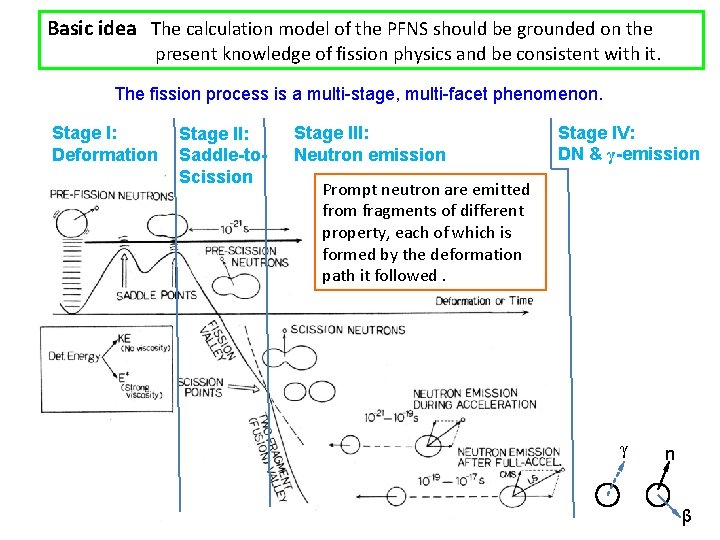
Basic idea The calculation model of the PFNS should be grounded on the present knowledge of fission physics and be consistent with it. The fission process is a multi-stage, multi-facet phenomenon. Stage I: Deformation Stage II: Saddle-to. Scission Stage III: Neutron emission Stage IV: DN & γ-emission Prompt neutron are emitted from fragments of different property, each of which is formed by the deformation path it followed. γ n β
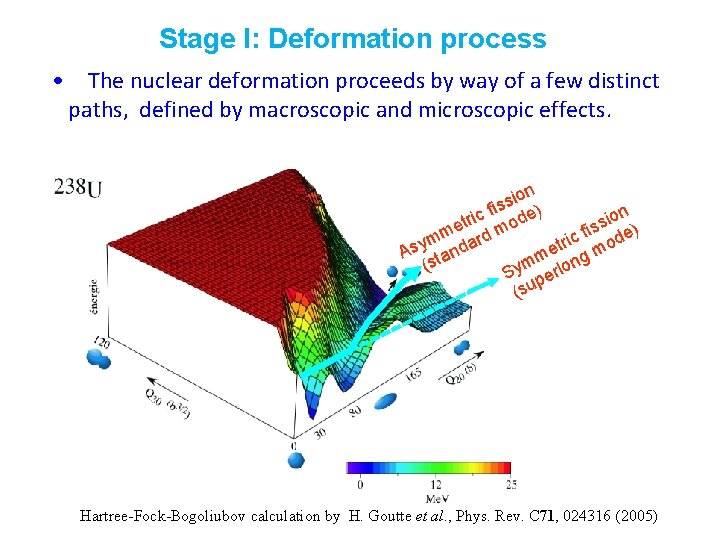
Stage I: Deformation process • The nuclear deformation proceeds by way of a few distinct paths, defined by macroscopic and microscopic effects. ion s s fi e) c on i i d r t s o fis de) me rd m c m i y a etr g mo As tand m n m (s Sy perlo (su Hartree-Fock-Bogoliubov calculation by H. Goutte et al. , Phys. Rev. C 71, 024316 (2005)
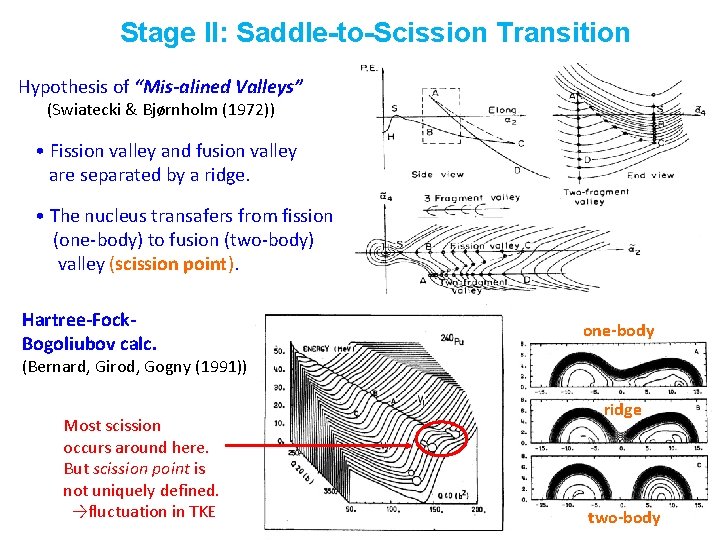
Stage II: Saddle-to-Scission Transition Hypothesis of “Mis-alined Valleys” (Swiatecki & Bjørnholm (1972)) • Fission valley and fusion valley are separated by a ridge. • The nucleus transafers from fission (one-body) to fusion (two-body) valley (scission point). Hartree-Fock. Bogoliubov calc. one-body (Bernard, Girod, Gogny (1991)) Most scission occurs around here. But scission point is not uniquely defined. →fluctuation in TKE ridge two-body
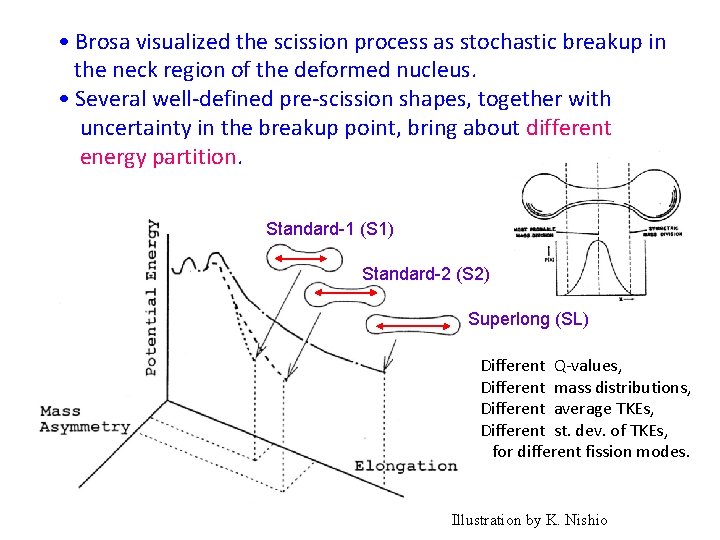
• Brosa visualized the scission process as stochastic breakup in the neck region of the deformed nucleus. • Several well-defined pre-scission shapes, together with uncertainty in the breakup point, bring about different energy partition. Standard-1 (S 1) Standard-2 (S 2) Superlong (SL) Different Q-values, Different mass distributions, Different average TKEs, Different st. dev. of TKEs, for different fission modes. Illustration by K. Nishio

TKE and TXE Distributions of Primary Fragments (based on the data of H. -H. Knitter et al. for U-235(nth, f) ) TKE TXE Three groups of primary fragment pairs with different excitation energies. Since neutron emission starts from these three groups of primary FF pairs, prompt neutron emission calculation should take the fact into account.
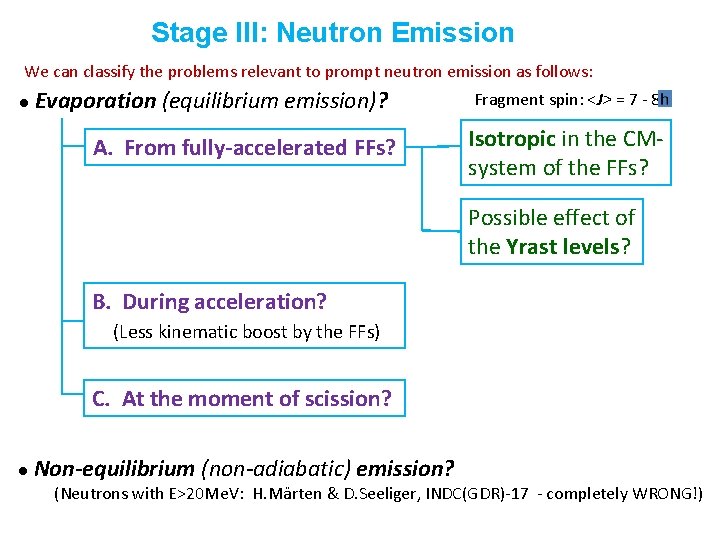
Stage III: Neutron Emission We can classify the problems relevant to prompt neutron emission as follows: ● Evaporation (equilibrium emission)? A. From fully-accelerated FFs? Fragment spin: <J> = 7 - 8 Isotropic in the CMsystem of the FFs? Possible effect of the Yrast levels? B. During acceleration? (Less kinematic boost by the FFs) C. At the moment of scission? ● Non-equilibrium (non-adiabatic) emission? (Neutrons with E>20 Me. V: H. Märten & D. Seeliger, INDC(GDR)-17 - completely WRONG!)
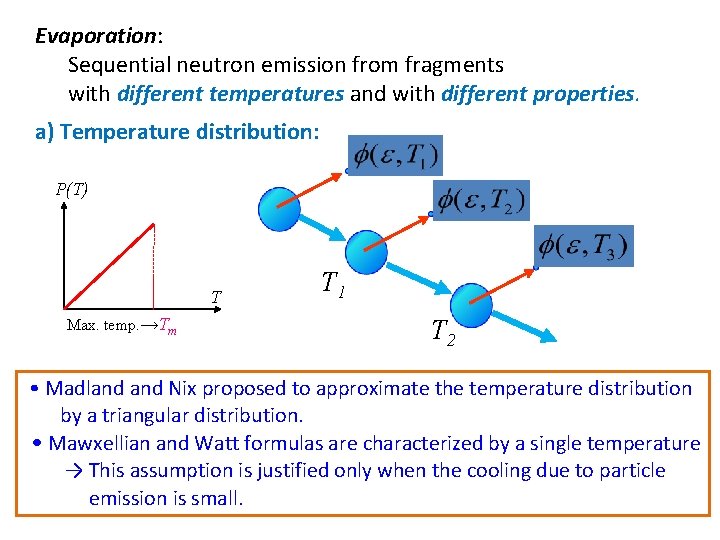
Evaporation: Sequential neutron emission from fragments with different temperatures and with different properties. a) Temperature distribution: P(T) T Max. temp. →Tm T 1 T 2 • Madland Nix proposed to approximate the temperature distribution by a triangular distribution. • Mawxellian and Watt formulas are characterized by a single temperature → This assumption is justified only when the cooling due to particle emission is small.
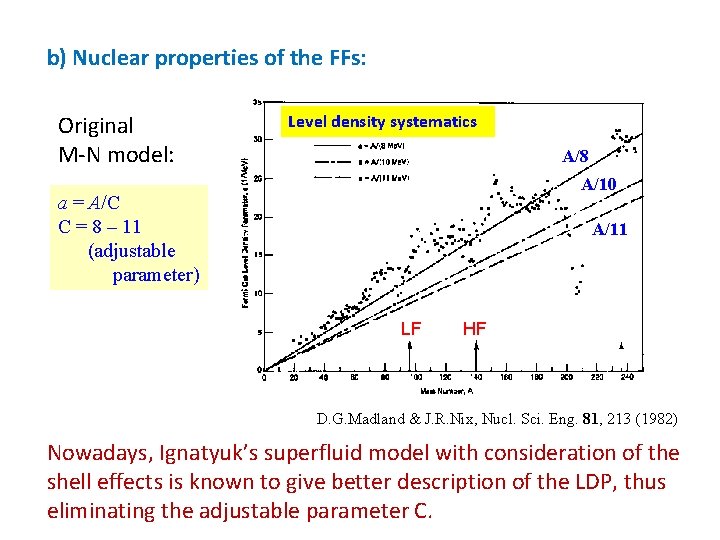
b) Nuclear properties of the FFs: Original M-N model: Level density systematics A/8 A/10 a = A/C C = 8 – 11 (adjustable parameter) A/11 LF HF D. G. Madland & J. R. Nix, Nucl. Sci. Eng. 81, 213 (1982) Nowadays, Ignatyuk’s superfluid model with consideration of the shell effects is known to give better description of the LDP, thus eliminating the adjustable parameter C.
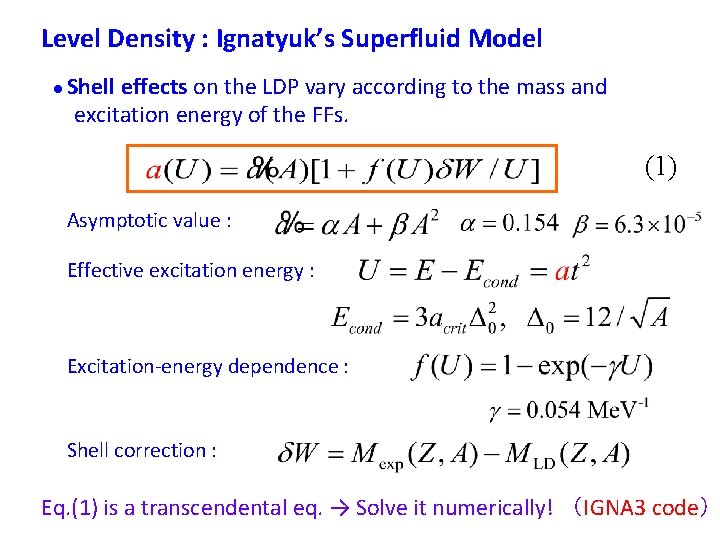
Level Density : Ignatyuk’s Superfluid Model ● Shell effects on the LDP vary according to the mass and excitation energy of the FFs. (1) Asymptotic value : Effective excitation energy : Excitation-energy dependence : Shell correction : Eq. (1) is a transcendental eq. → Solve it numerically! (IGNA 3 code)
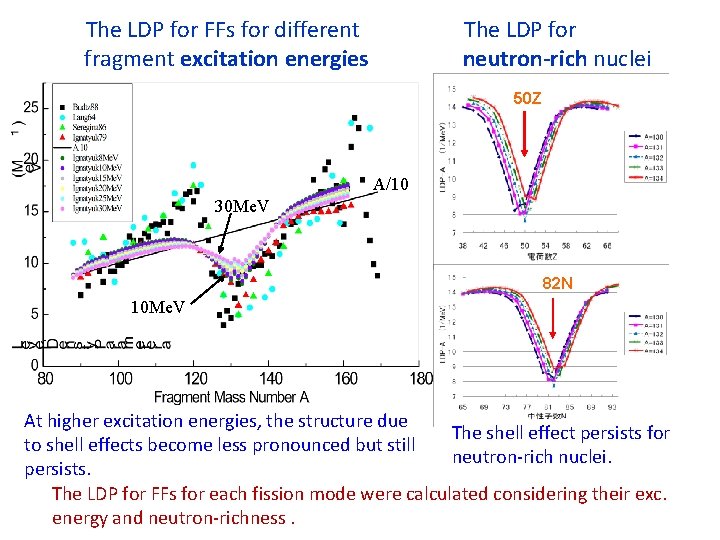
The LDP for FFs for different fragment excitation energies The LDP for neutron-rich nuclei 50 Z A/10 30 Me. V 82 N 10 Me. V At higher excitation energies, the structure due The shell effect persists for to shell effects become less pronounced but still neutron-rich nuclei. persists. The LDP for FFs for each fission mode were calculated considering their exc. energy and neutron-richness.
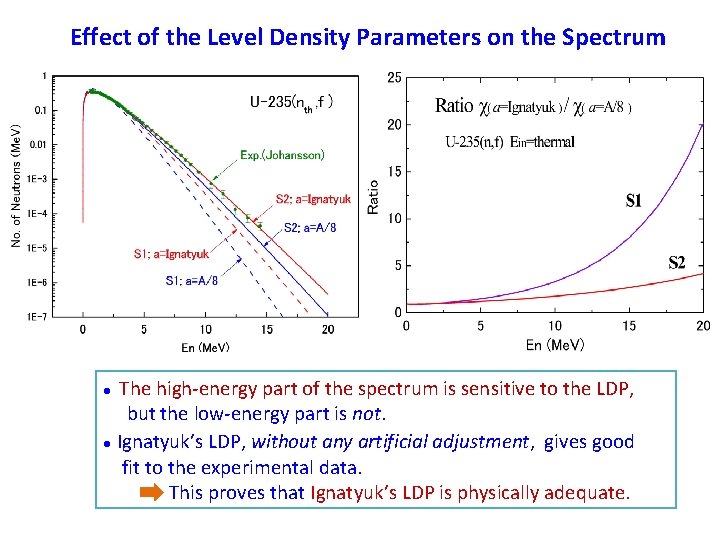
Effect of the Level Density Parameters on the Spectrum ● The high-energy part of the spectrum is sensitive to the LDP, but the low-energy part is not. ● Ignatyuk’s LDP, without any artificial adjustment, gives good fit to the experimental data. This proves that Ignatyuk’s LDP is physically adequate.
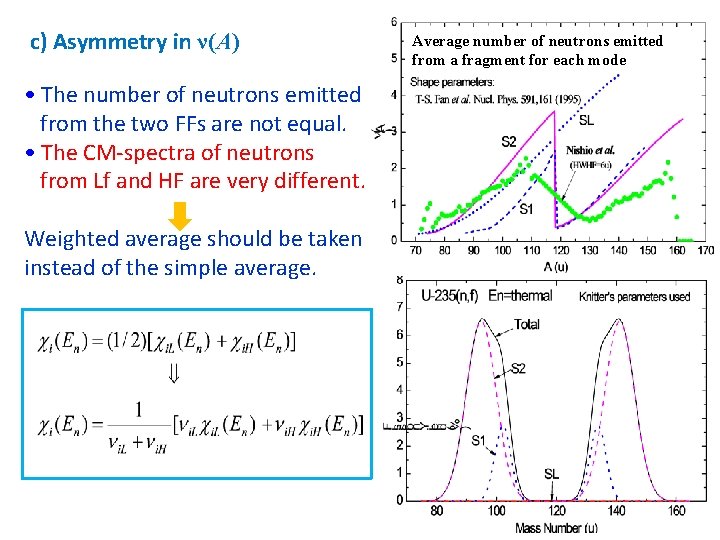
c) Asymmetry in ν(A) • The number of neutrons emitted from the two FFs are not equal. • The CM-spectra of neutrons from Lf and HF are very different. Weighted average should be taken instead of the simple average. Average number of neutrons emitted from a fragment for each mode
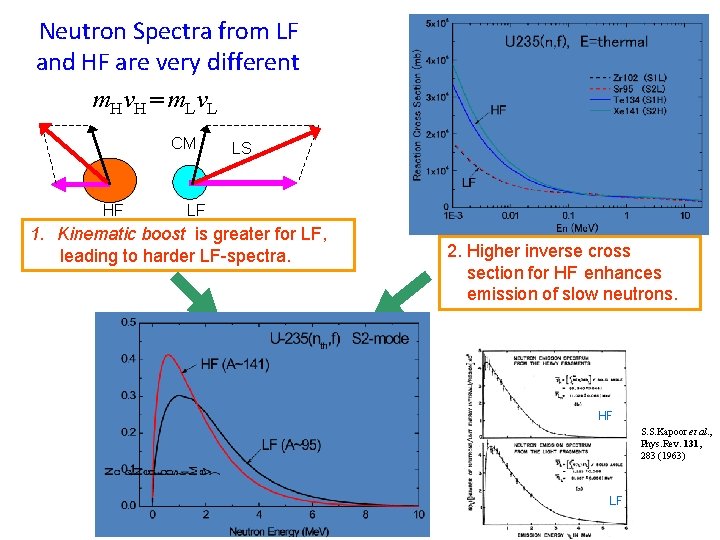
Neutron Spectra from LF and HF are very different m. Hv. H=m. Lv. L CM HF LS LF 1. Kinematic boost is greater for LF, leading to harder LF-spectra. 2. Higher inverse cross section for HF enhances emission of slow neutrons. HF S. S. Kapoor et al. , Phys. Rev. 131, 283 (1963) LF
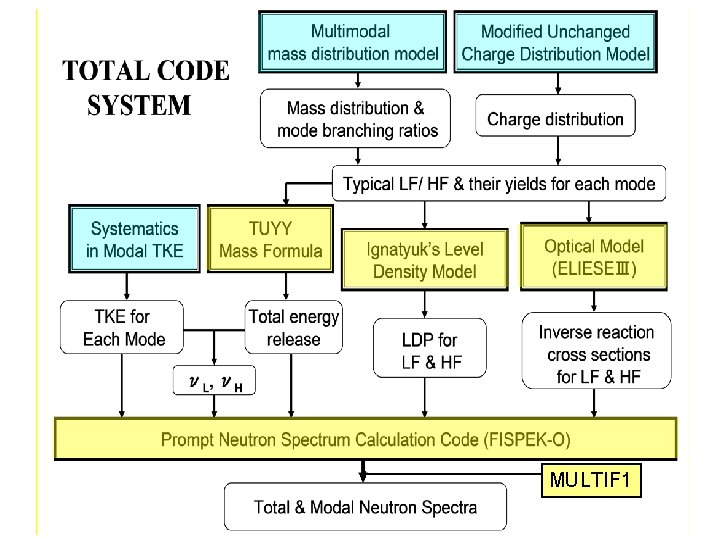
MULTIF 1
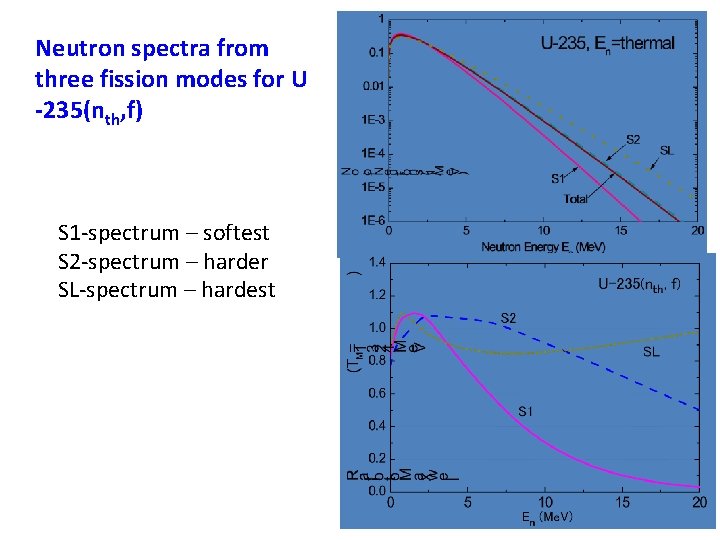
Neutron spectra from three fission modes for U -235(nth, f) S 1 -spectrum – softest S 2 -spectrum – harder SL-spectrum – hardest
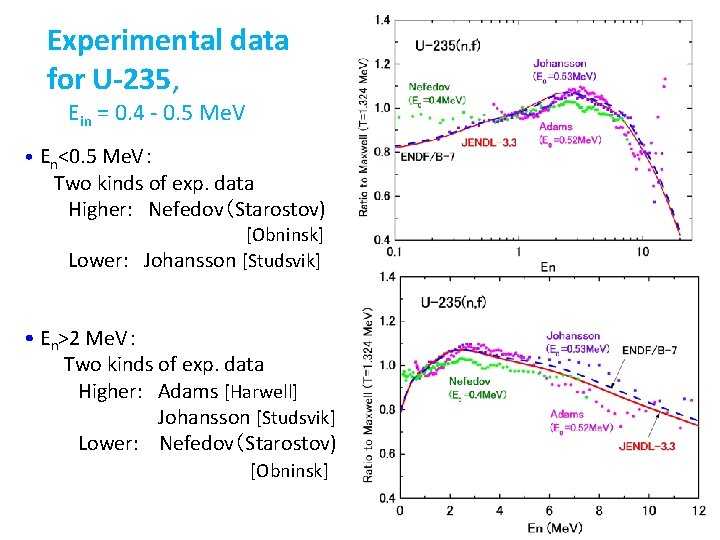
Experimental data for U-235, Ein = 0. 4 - 0. 5 Me. V • En<0. 5 Me. V: Two kinds of exp. data Higher: Nefedov(Starostov) [Obninsk] Lower: Johansson [Studsvik] • En>2 Me. V: Two kinds of exp. data Higher: Adams [Harwell] Johansson [Studsvik] Lower: Nefedov(Starostov) [Obninsk]
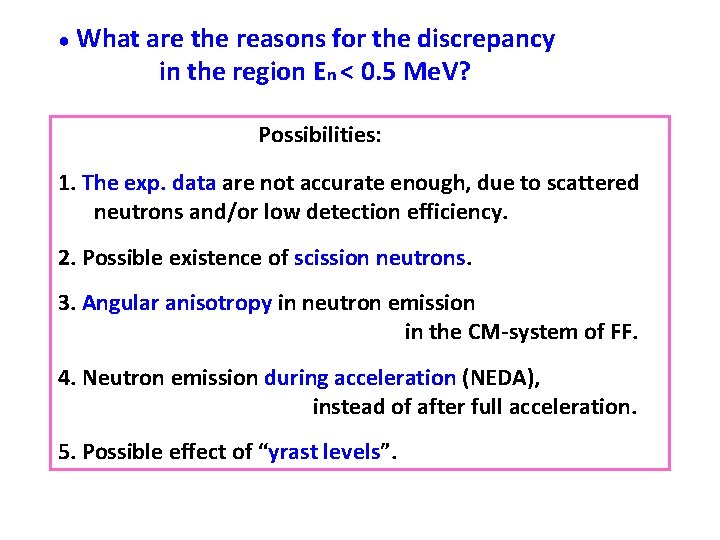
● What are the reasons for the discrepancy in the region En < 0. 5 Me. V? Possibilities: 1. The exp. data are not accurate enough, due to scattered neutrons and/or low detection efficiency. 2. Possible existence of scission neutrons. 3. Angular anisotropy in neutron emission in the CM-system of FF. 4. Neutron emission during acceleration (NEDA), instead of after full acceleration. 5. Possible effect of “yrast levels”.
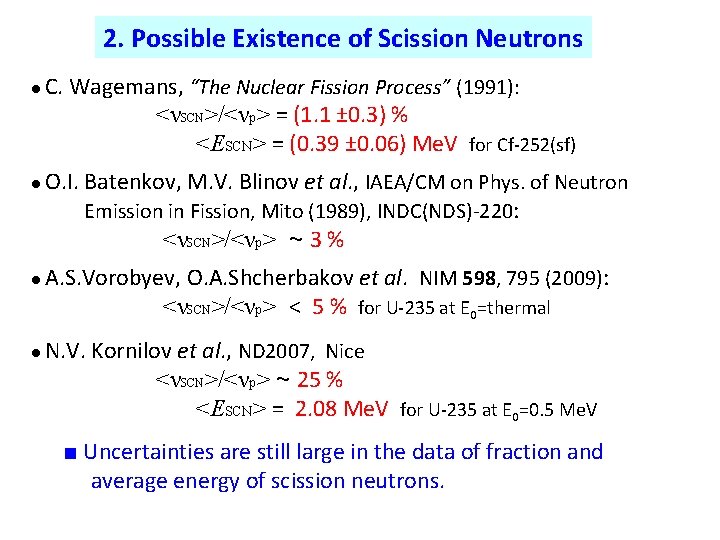
2. Possible Existence of Scission Neutrons ● C. Wagemans, “The Nuclear Fission Process” (1991): <νSCN>/<νp> = (1. 1 ± 0. 3) % <ESCN> = (0. 39 ± 0. 06) Me. V for Cf-252(sf) ● O. I. Batenkov, M. V. Blinov et al. , IAEA/CM on Phys. of Neutron Emission in Fission, Mito (1989), INDC(NDS)-220: <νSCN>/<νp> ~ 3 % ● A. S. Vorobyev, O. A. Shcherbakov et al. NIM 598, 795 (2009): <νSCN>/<νp> < 5 % for U-235 at E 0=thermal ● N. V. Kornilov et al. , ND 2007, Nice <νSCN>/<νp> ~ 25 % <ESCN> = 2. 08 Me. V for U-235 at E 0=0. 5 Me. V ■ Uncertainties are still large in the data of fraction and average energy of scission neutrons.
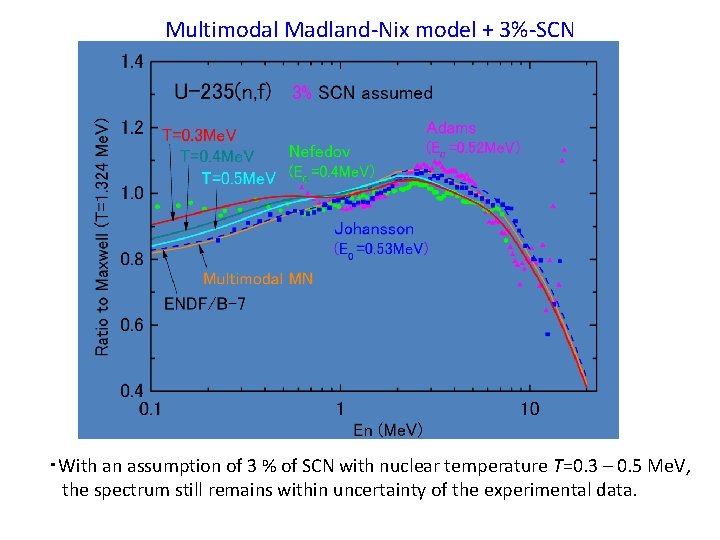
Multimodal Madland-Nix model + 3%-SCN ・With an assumption of 3 % of SCN with nuclear temperature T=0. 3 – 0. 5 Me. V, the spectrum still remains within uncertainty of the experimental data.
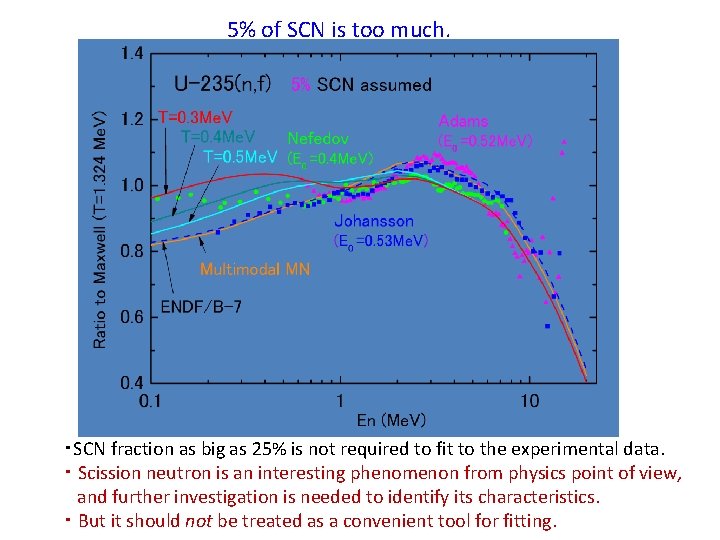
5% of SCN is too much. ・SCN fraction as big as 25% is not required to fit to the experimental data. ・ Scission neutron is an interesting phenomenon from physics point of view, and further investigation is needed to identify its characteristics. ・ But it should not be treated as a convenient tool for fitting.
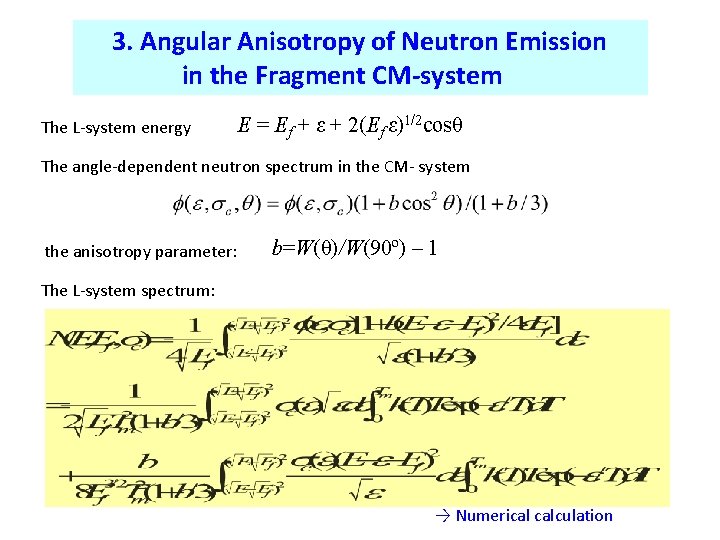
3. Angular Anisotropy of Neutron Emission in the Fragment CM-system The L-system energy E = Ef + ε + 2(Ef ε)1/2 cosθ The angle-dependent neutron spectrum in the CM- system the anisotropy parameter: b=W(θ)/W(90º) – 1 The L-system spectrum: → Numerical calculation
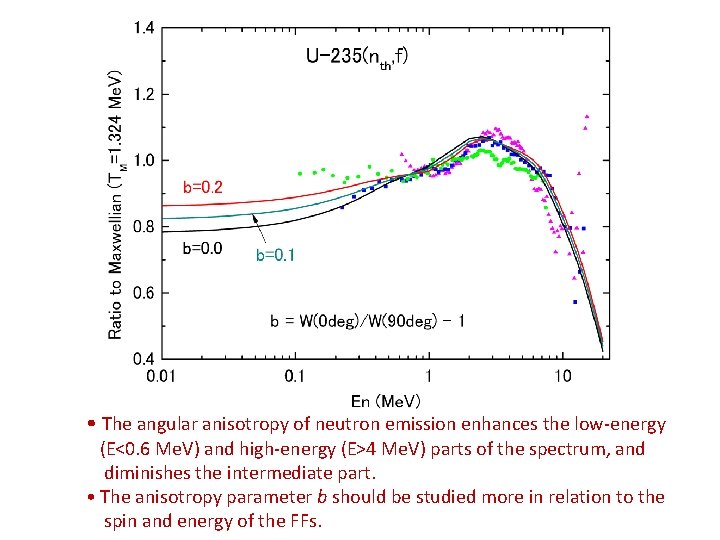
• The angular anisotropy of neutron emission enhances the low-energy (E<0. 6 Me. V) and high-energy (E>4 Me. V) parts of the spectrum, and diminishes the intermediate part. • The anisotropy parameter b should be studied more in relation to the spin and energy of the FFs.

4. Neutron Emission During Acceleration (NEDA) ・Certain fraction of prompt neutrons may be emitted before full acceleration of FF [V. P. Eismont, Sov. At. Energy 19, 1000 (1965)] ●Time after scission t as a function of x = E/Ek, the ratio of the FF-KE relative to its final value Ek ●Decay of the FFs by neutron emission [T. Ericson, Advances in Nuclear Physics 6, 425 (1960)] If n-emission time > acceleration time t → NE after full acceleration < t → NE during acceleration
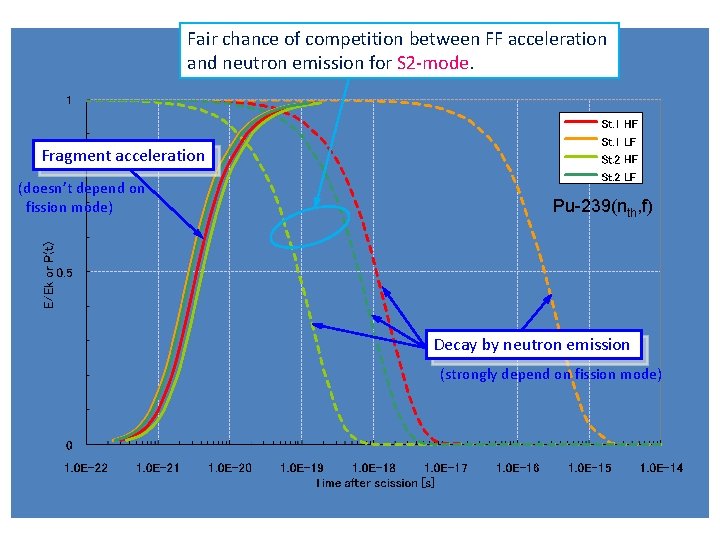
Fair chance of competition between FF acceleration and neutron emission for S 2 -mode. Fragment acceleration (doesn’t depend on fission mode) Pu-239(nth, f) Decay by neutron emission (strongly depend on fission mode)
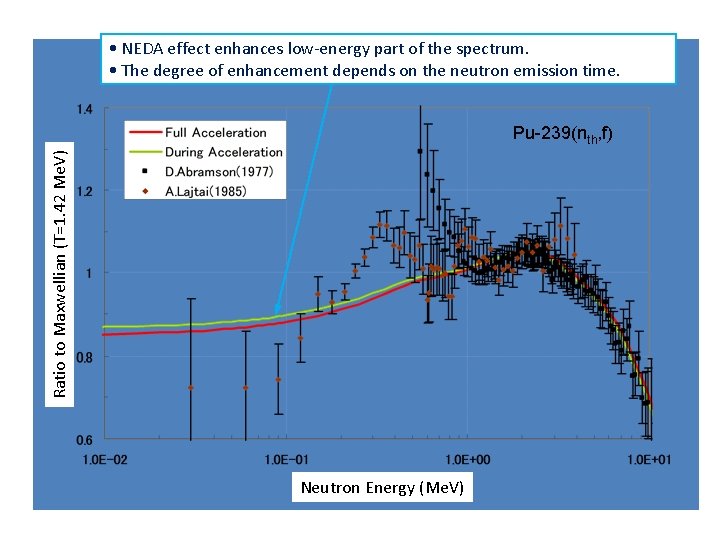
• NEDA effect enhances low-energy part of the spectrum. • The degree of enhancement depends on the neutron emission time. Ratio to Maxwellian (T=1. 42 Me. V) Pu-239(nth, f) Neutron Energy (Me. V)
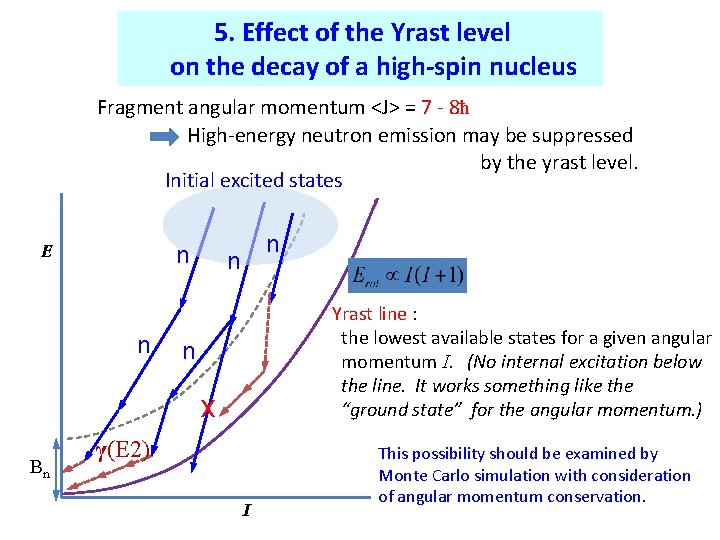
5. Effect of the Yrast level on the decay of a high-spin nucleus Fragment angular momentum <J> = 7 - 8ħ High-energy neutron emission may be suppressed by the yrast level. Initial excited states E n n Yrast line : the lowest available states for a given angular momentum I. (No internal excitation below the line. It works something like the “ground state” for the angular momentum. ) n x Bn γ(E 2) I This possibility should be examined by Monte Carlo simulation with consideration of angular momentum conservation.

Application of the Multimodal Madland-Nix Model to Bimodal Fission Interests in Heaviest Actinides 1. Sudden switchover from asymmetric to symmetric fission ーWhat will be the impact of the modal change on the PFNS? 2. Recent interest in heavy actinides in astronuclearphysics ーFormation and fission of heavy actinides should be considered in the nucleosynthesis in supernovae.
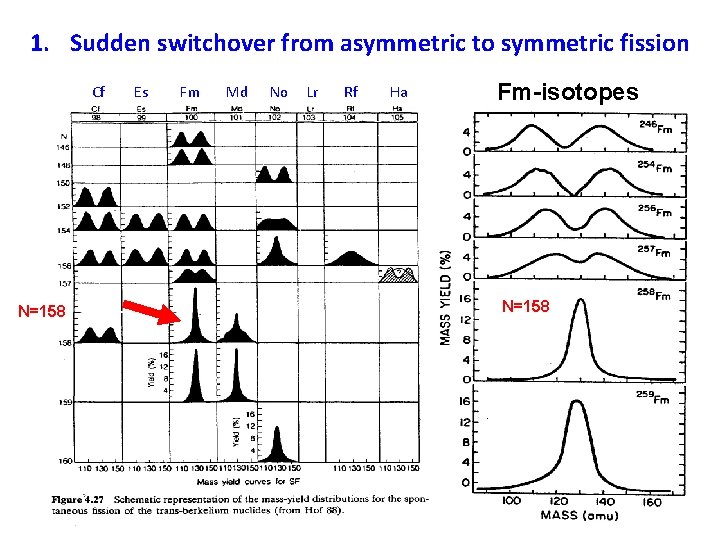
1. Sudden switchover from asymmetric to symmetric fission Cf N=158 Es Fm Md No Lr Rf Ha Fm-isotopes N=158

Deformation Energy Surface for Fm-258 New path leading to elongated fragments (S 1) Old path 50% New path leading to spherical fragments (SS) P. Moller et al. , Nucl. Phys. A 492, 349 (1989)
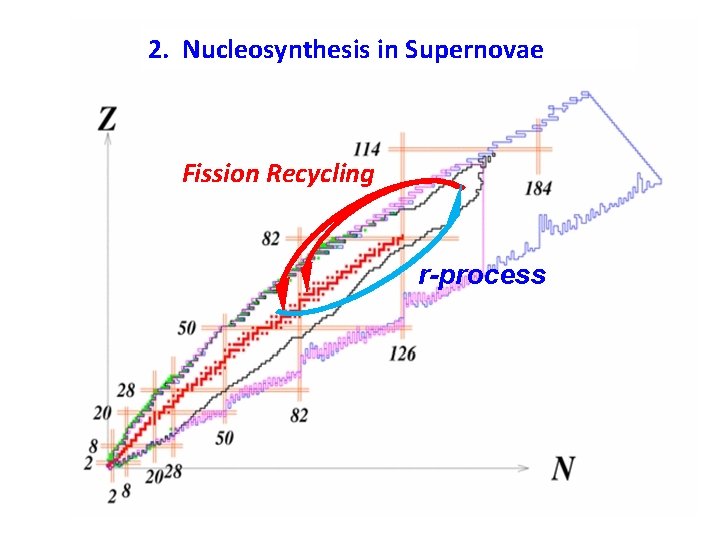
2. Nucleosynthesis in Supernovae Fission Recycling r-process
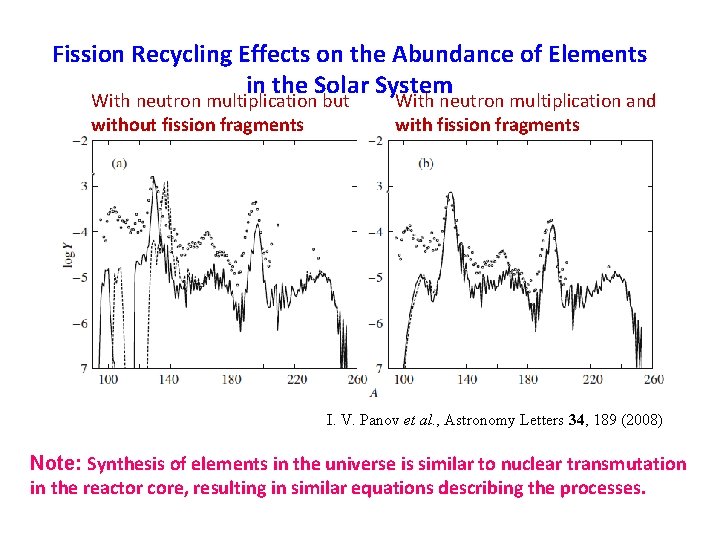
Fission Recycling Effects on the Abundance of Elements in the Solar System With neutron multiplication but without fission fragments With neutron multiplication and with fission fragments I. V. Panov et al. , Astronomy Letters 34, 189 (2008) Note: Synthesis of elements in the universe is similar to nuclear transmutation in the reactor core, resulting in similar equations describing the processes.
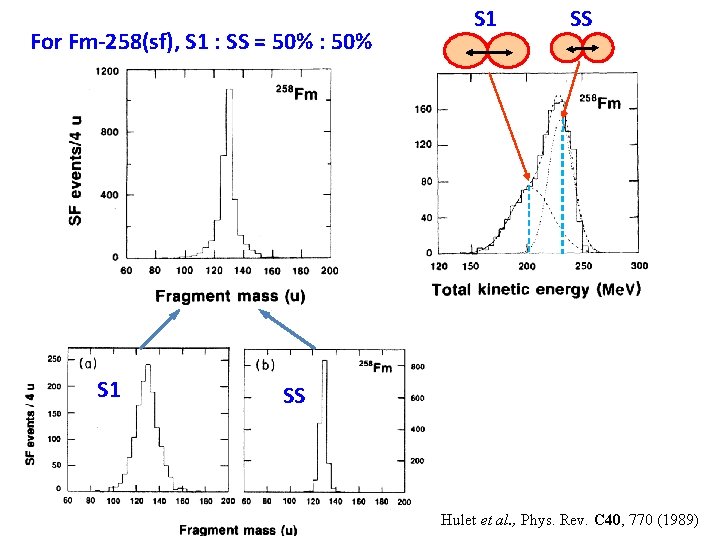
For Fm-258(sf), S 1 : SS = 50% : 50% S 1 SS SS Hulet et al. , Phys. Rev. C 40, 770 (1989)
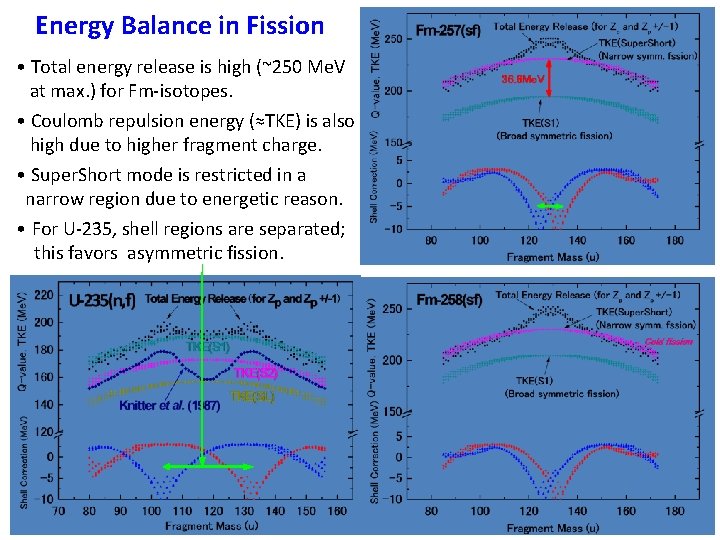
Energy Balance in Fission • Total energy release is high (~250 Me. V at max. ) for Fm-isotopes. • Coulomb repulsion energy (≈TKE) is also high due to higher fragment charge. • Super. Short mode is restricted in a narrow region due to energetic reason. • For U-235, shell regions are separated; this favors asymmetric fission.
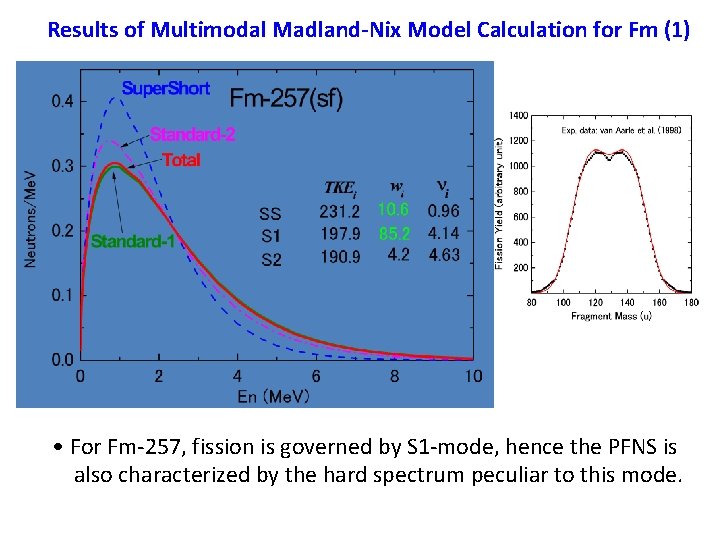
Results of Multimodal Madland-Nix Model Calculation for Fm (1) • For Fm-257, fission is governed by S 1 -mode, hence the PFNS is also characterized by the hard spectrum peculiar to this mode.
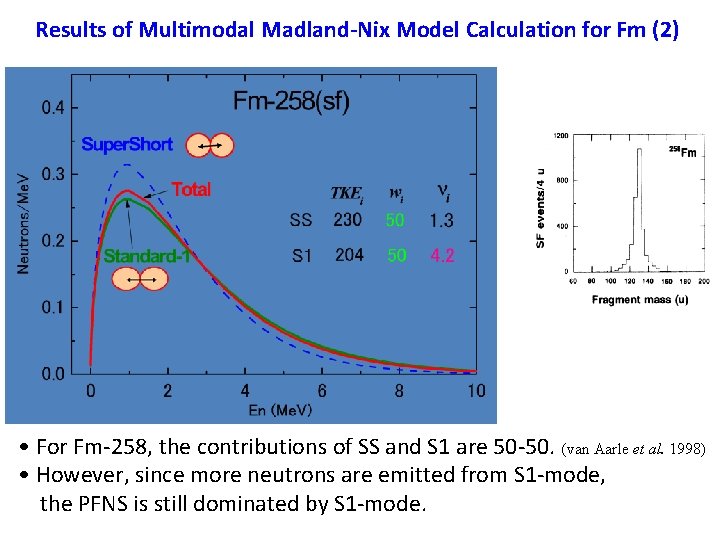
Results of Multimodal Madland-Nix Model Calculation for Fm (2) • For Fm-258, the contributions of SS and S 1 are 50 -50. (van Aarle et al. 1998) • However, since more neutrons are emitted from S 1 -mode, the PFNS is still dominated by S 1 -mode.

• Sudden softening of the spectra for Fm-259 is due to complete switchover to the Super. Short mode (cold fission). • Thus, fission modal change causes a big change in PFNS.
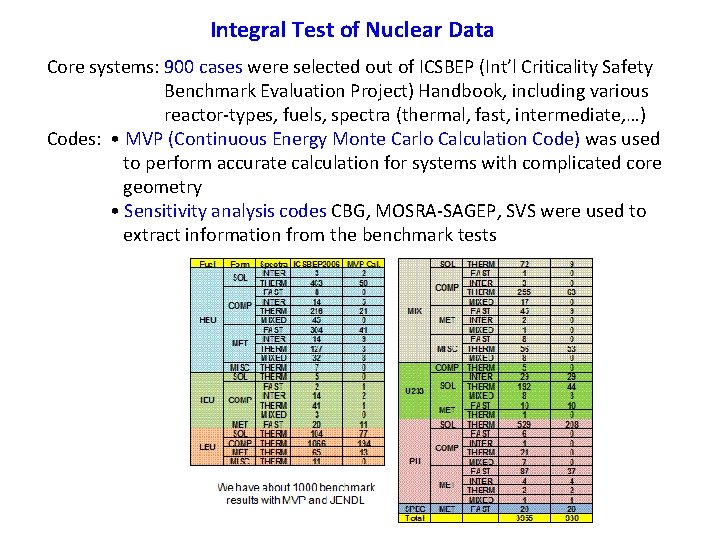
Integral Test of Nuclear Data Core systems: 900 cases were selected out of ICSBEP (Int’l Criticality Safety Benchmark Evaluation Project) Handbook, including various reactor-types, fuels, spectra (thermal, fast, intermediate, …) Codes: • MVP (Continuous Energy Monte Carlo Calculation Code) was used to perform accurate calculation for systems with complicated core geometry • Sensitivity analysis codes CBG, MOSRA-SAGEP, SVS were used to extract information from the benchmark tests
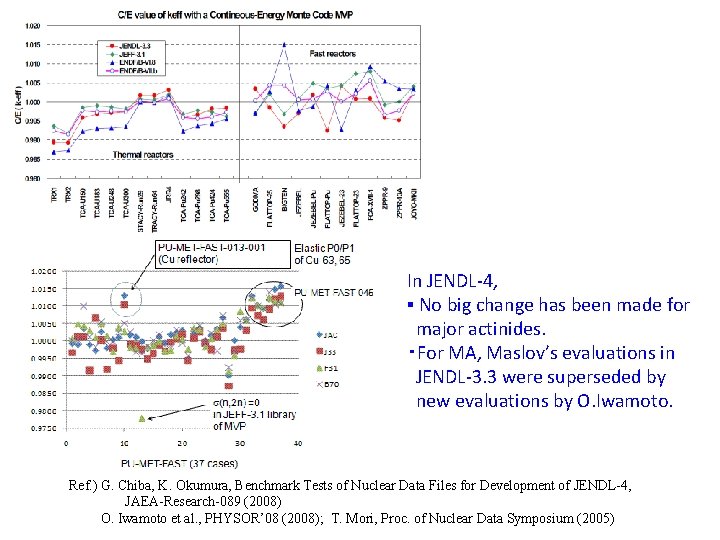
In JENDL-4, ▪ No big change has been made for major actinides. ・For MA, Maslov’s evaluations in JENDL-3. 3 were superseded by new evaluations by O. Iwamoto. Ref. ) G. Chiba, K. Okumura, Benchmark Tests of Nuclear Data Files for Development of JENDL-4, JAEA-Research-089 (2008) O. Iwamoto et al. , PHYSOR’ 08 (2008); T. Mori, Proc. of Nuclear Data Symposium (2005)
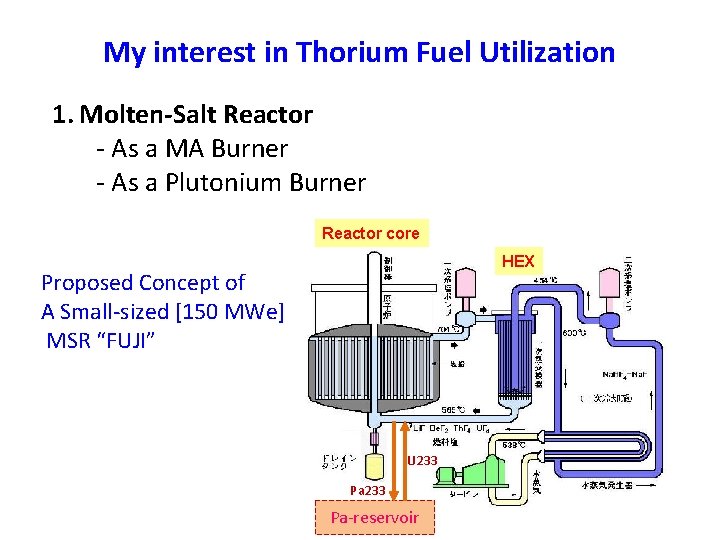
My interest in Thorium Fuel Utilization 1. Molten-Salt Reactor - As a MA Burner - As a Plutonium Burner Reactor core HEX Proposed Concept of A Small-sized [150 MWe] MSR “FUJI” U 233 Pa-reservoir
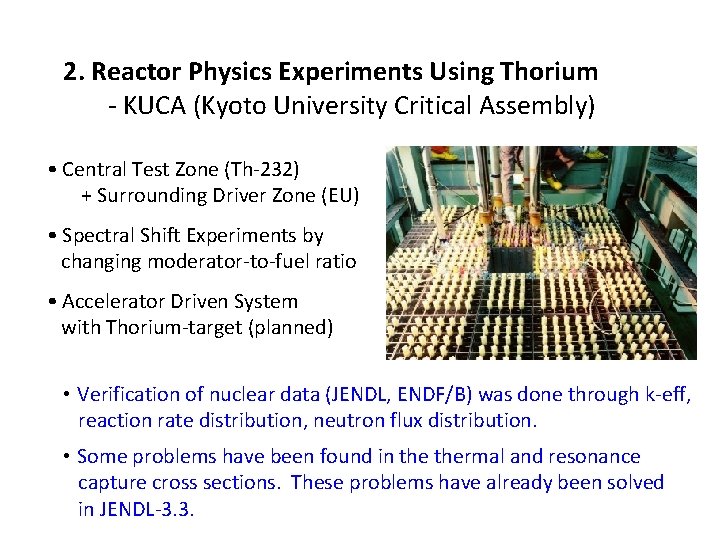
2. Reactor Physics Experiments Using Thorium - KUCA (Kyoto University Critical Assembly) • Central Test Zone (Th-232) + Surrounding Driver Zone (EU) • Spectral Shift Experiments by changing moderator-to-fuel ratio • Accelerator Driven System with Thorium-target (planned) • Verification of nuclear data (JENDL, ENDF/B) was done through k-eff, reaction rate distribution, neutron flux distribution. • Some problems have been found in thermal and resonance capture cross sections. These problems have already been solved in JENDL-3. 3.
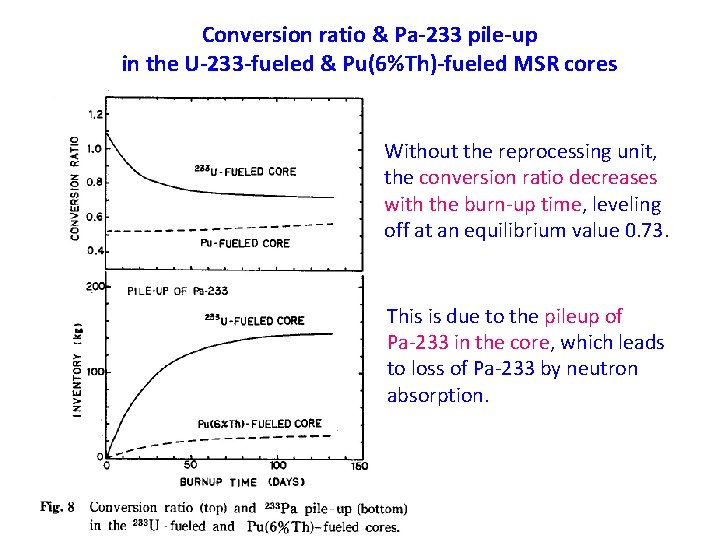
Conversion ratio & Pa-233 pile-up in the U-233 -fueled & Pu(6%Th)-fueled MSR cores Without the reprocessing unit, the conversion ratio decreases with the burn-up time, leveling off at an equilibrium value 0. 73. This is due to the pileup of Pa-233 in the core, which leads to loss of Pa-233 by neutron absorption.
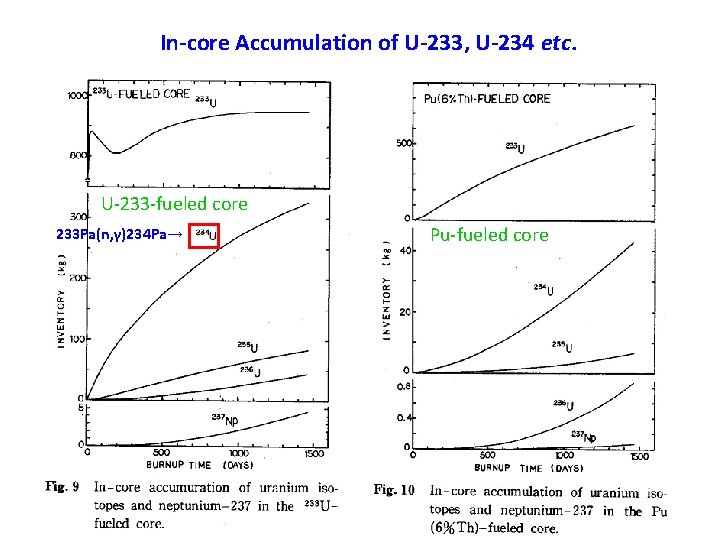
In-core Accumulation of U-233, U-234 etc. U-233 -fueled core 233 Pa(n, γ)234 Pa→ Pu-fueled core
For Th-loaded of Accumulation hard-spectrum Pa-233 in the. ADS, thermal Pa-233 corecan is not desirable, fission to produce due to two energy. reasons: 1 - From neutron economy point of view, a considerable fraction* of neutrons are lost by Pa-233(n, γ), rather than by Th-232(n, γ). This also reduces the neutron flux in the core region. (* ~1. 9% at 131 days of burn-up) 2 - From fuel economy point of view, capture by Pa-233 implies loss of Pa-233 that would otherwise convert into U-233.
Summary 1. The Multimodal Madland-Nix Model provides a method of calculating the PFNS, based on the multimodal analysis of fission. Therefore it can be applied to evaluation of PFNS for actinides and transactinides as well as for exotic nuclides far from betastability line. 2. The methodology incorporates requirements from basic physics, such as energy conservation and shell effects, as well as other aspects of fission physics, such as mass and TKE distributions. 3. In order to finalize the remaining question of scission neutrons, and angular anisotropy of neutron emission, multi-parameter coincident measurement of angular and energy distributions of neutrons and FFs are required.
4. For Th-cycle nuclides, the quantity as well as quality of nuclear data is not so good as for U-Pu cycle. The author hopes some experimentalists will take on the work of measuring the PFNS, as well as mass & TKE distributions for Th-232, Pa-233 and U-233 with improved accuracy.
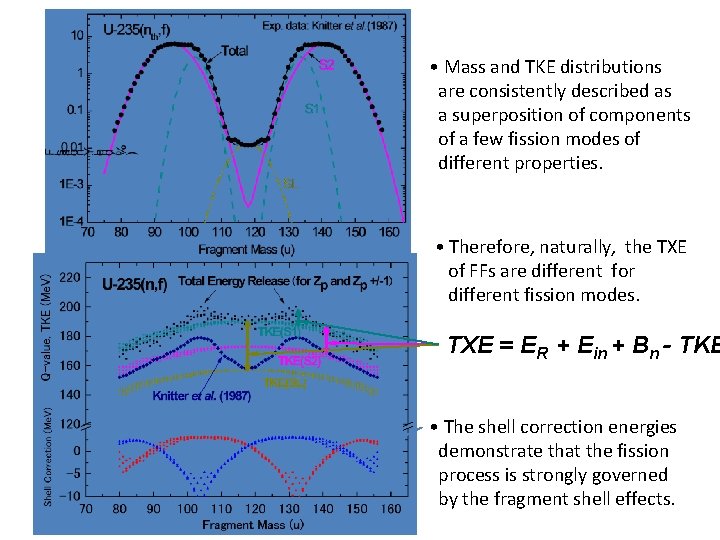
• Mass and TKE distributions are consistently described as a superposition of components of a few fission modes of different properties. • Therefore, naturally, the TXE of FFs are different for different fission modes. TXE = ER + Ein + Bn - TKE • The shell correction energies demonstrate that the fission process is strongly governed by the fragment shell effects.
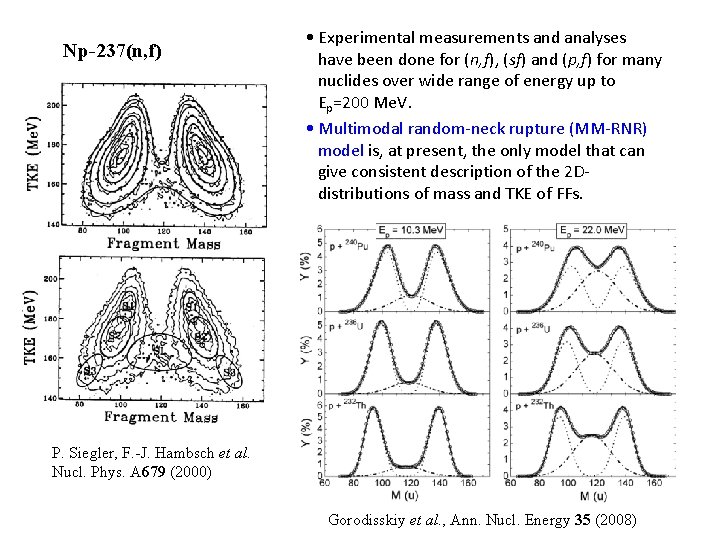
Np-237(n, f) • Experimental measurements and analyses have been done for (n, f), (sf) and (p, f) for many nuclides over wide range of energy up to Ep=200 Me. V. • Multimodal random-neck rupture (MM-RNR) model is, at present, the only model that can give consistent description of the 2 Ddistributions of mass and TKE of FFs. P. Siegler, F. -J. Hambsch et al. Nucl. Phys. A 679 (2000) Gorodisskiy et al. , Ann. Nucl. Energy 35 (2008)
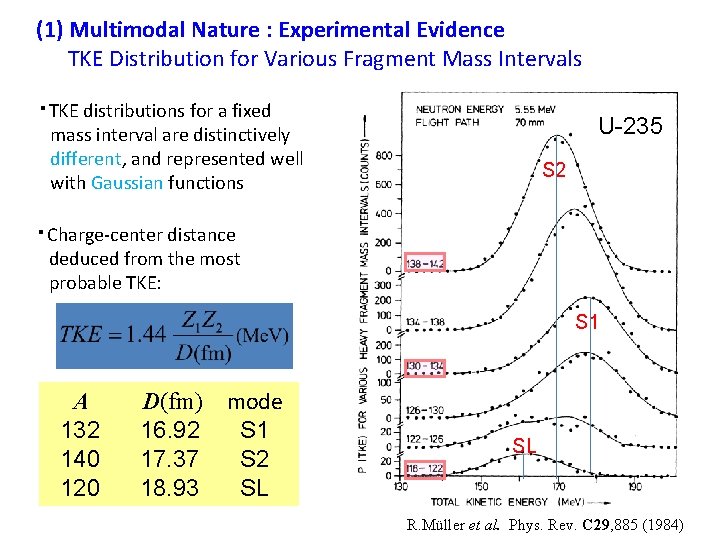
(1) Multimodal Nature : Experimental Evidence TKE Distribution for Various Fragment Mass Intervals ・TKE distributions for a fixed U-235 mass interval are distinctively different, and represented well with Gaussian functions S 2 ・Charge-center distance deduced from the most probable TKE: S 1 A 132 140 120 D(fm) 16. 92 17. 37 18. 93 mode S 1 S 2 SL SL R. Müller et al. Phys. Rev. C 29, 885 (1984)
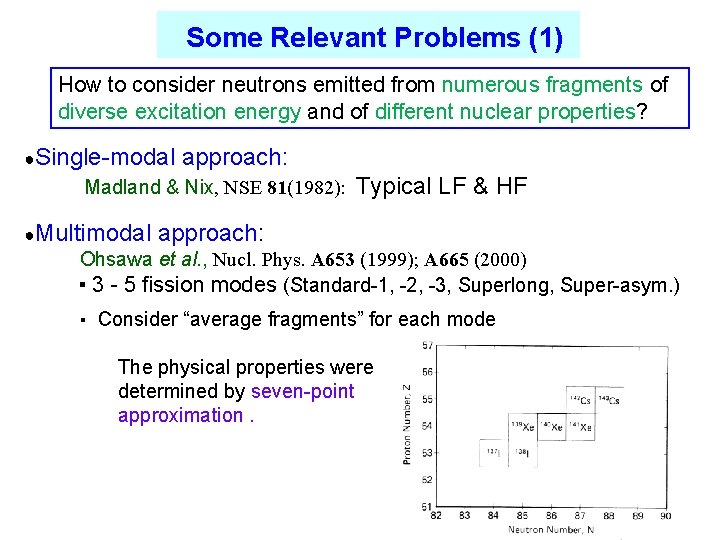
Some Relevant Problems (1) neutrons emitted from numerous fragments of How to consider diverse excitation energy and of different nuclear properties? ●Single-modal approach: Madland & Nix, NSE 81(1982): ●Multimodal Typical LF & HF approach: Ohsawa et al. , Nucl. Phys. A 653 (1999); A 665 (2000) ▪ 3 - 5 fission modes (Standard-1, -2, -3, Superlong, Super-asym. ) ▪ Consider “average fragments” for each mode The physical properties were determined by seven-point approximation.
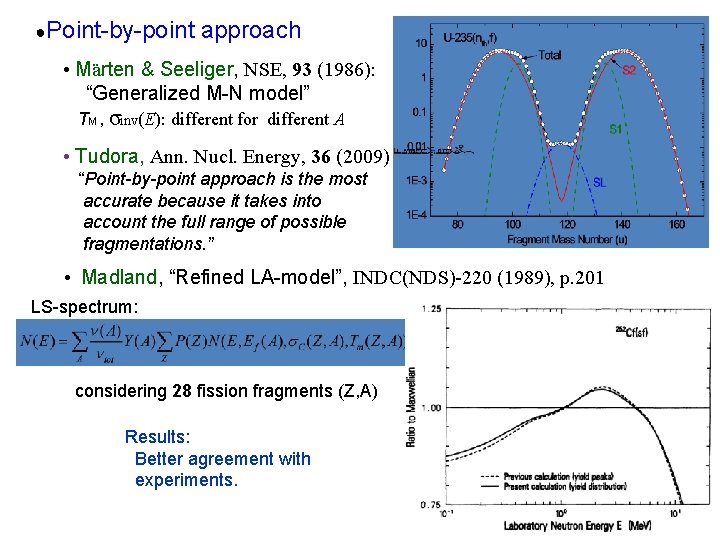
●Point-by-point approach • Märten & Seeliger, NSE, 93 (1986): “Generalized M-N model” TM, σinv(E): different for different A • Tudora, Ann. Nucl. Energy, 36 (2009) “Point-by-point approach is the most accurate because it takes into account the full range of possible fragmentations. ” • Madland, “Refined LA-model”, INDC(NDS)-220 (1989), p. 201 LS-spectrum: considering 28 fission fragments (Z, A) Results: Better agreement with experiments.
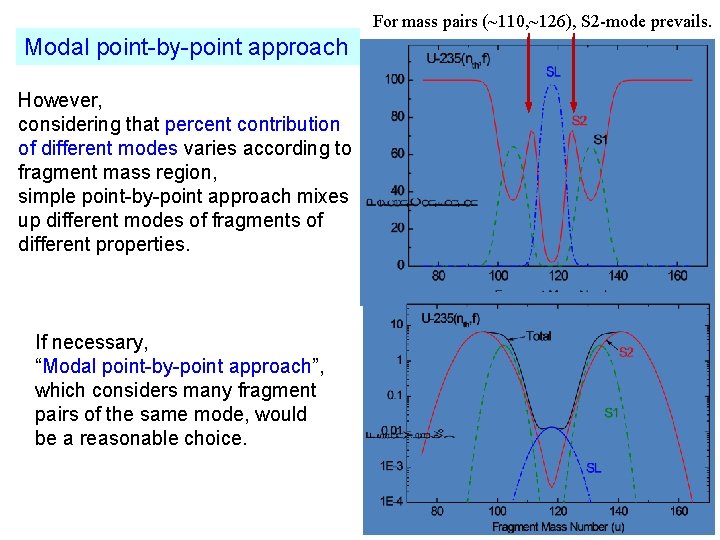
For mass pairs (~110, ~126), S 2 -mode prevails. Modal point-by-point approach However, considering that percent contribution of different modes varies according to fragment mass region, simple point-by-point approach mixes up different modes of fragments of different properties. If necessary, “Modal point-by-point approach”, which considers many fragment pairs of the same mode, would be a reasonable choice.
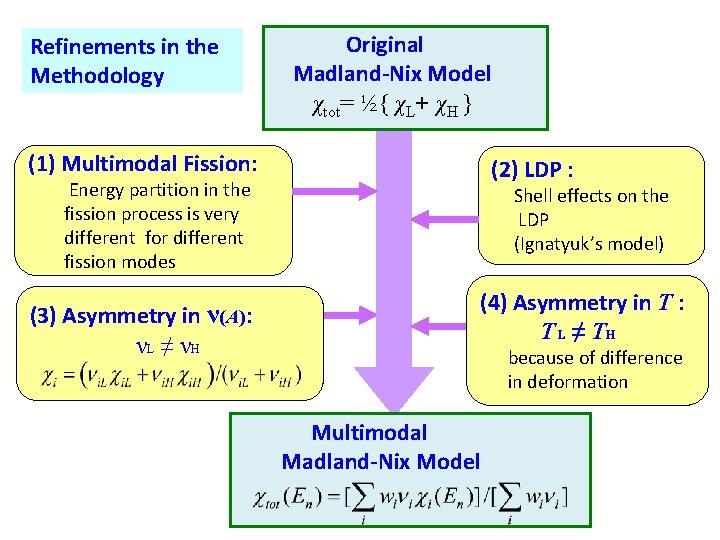
Refinements in the Methodology Original Madland-Nix Model χtot= ½{ χL+ χH } (1) Multimodal Fission: (2) LDP : Energy partition in the fission process is very different for different fission modes (3) Asymmetry in ν(A): νL ≠ νH Shell effects on the LDP (Ignatyuk’s model) (4) Asymmetry in T : T L ≠ TH because of difference in deformation Multimodal Madland-Nix Model
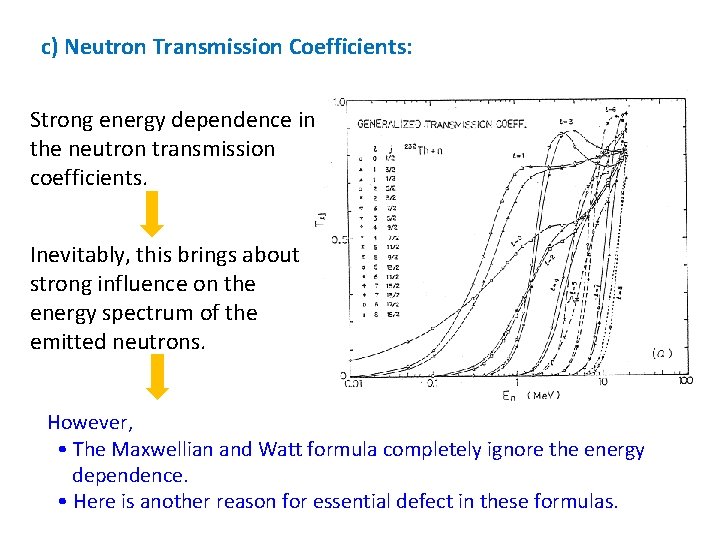
c) Neutron Transmission Coefficients: Strong energy dependence in the neutron transmission coefficients. Inevitably, this brings about strong influence on the energy spectrum of the emitted neutrons. However, • The Maxwellian and Watt formula completely ignore the energy dependence. • Here is another reason for essential defect in these formulas.
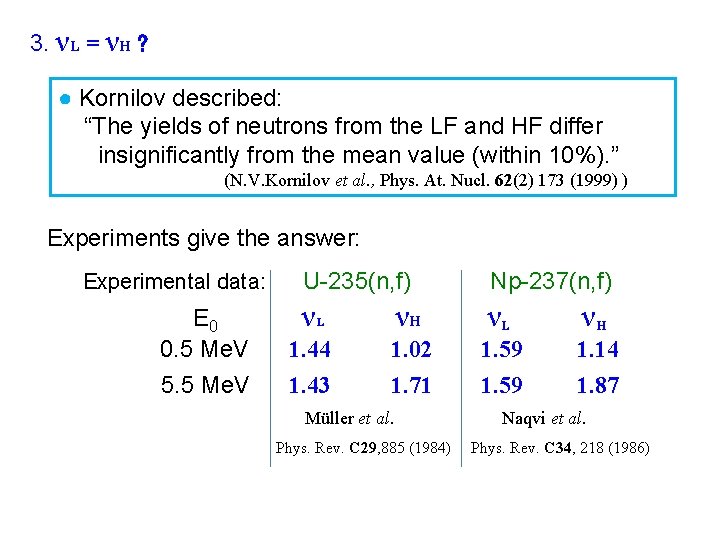
3. νL = νH ? ● Kornilov described: “The yields of neutrons from the LF and HF differ insignificantly from the mean value (within 10%). ” (N. V. Kornilov et al. , Phys. At. Nucl. 62(2) 173 (1999) ) Experiments give the answer: Experimental data: U-235(n, f) Np-237(n, f) ν νH ν ν E 0 0. 5 Me. V 1. 44 1. 02 1. 59 1. 14 5. 5 Me. V 1. 43 1. 71 1. 59 1. 87 L Müller et al. Phys. Rev. C 29, 885 (1984) L H Naqvi et al. Phys. Rev. C 34, 218 (1986)
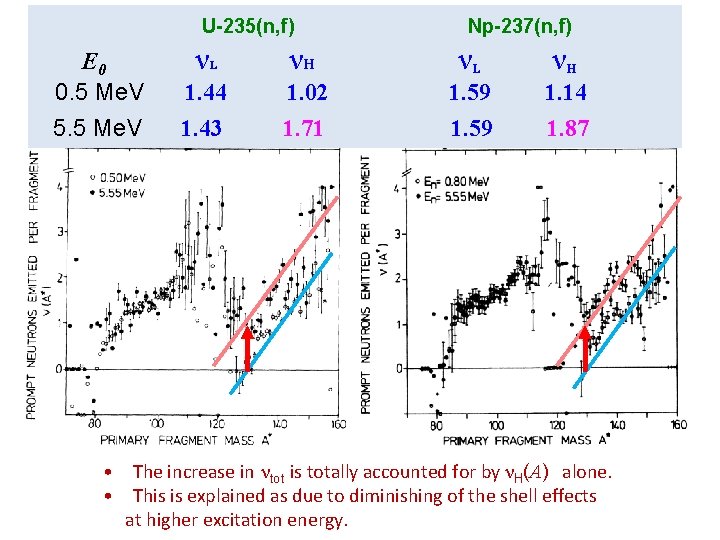
U-235(n, f) Müller et al. (1984) E 0 νL νH 0. 5 Me. V 1. 44 1. 02 5. 5 Me. V 1. 43 1. 71 Np-237(n, f) Naqvi et al. (1986) ν L ν H 1. 59 1. 14 1. 59 1. 87 • The increase in νtot is totally accounted for by νH(A) alone. • This is explained as due to diminishing of the shell effects at higher excitation energy.
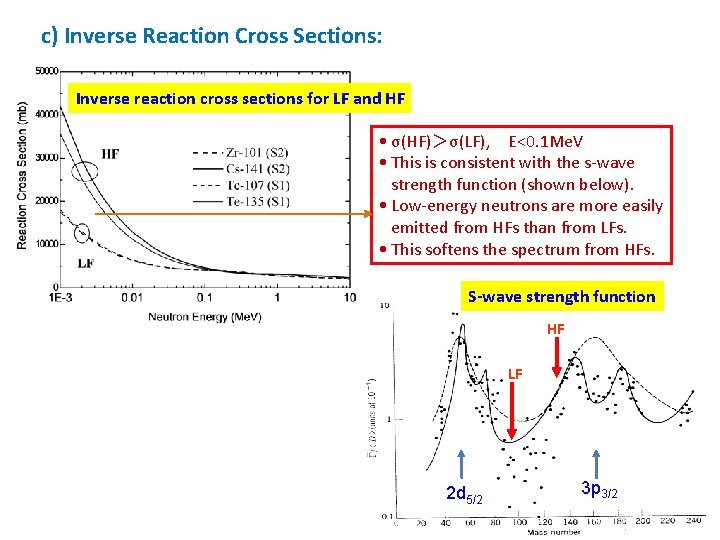
c) Inverse Reaction Cross Sections: Inverse reaction cross sections for LF and HF • σ(HF)>σ(LF), E<0. 1 Me. V • This is consistent with the s-wave strength function (shown below). • Low-energy neutrons are more easily emitted from HFs than from LFs. • This softens the spectrum from HFs. S-wave strength function HF LF 2 d 5/2 3 p 3/2
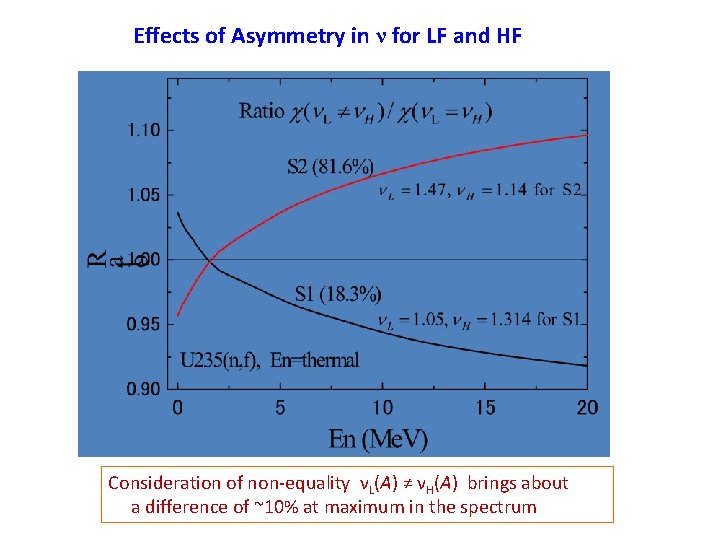
Effects of Asymmetry in ν for LF and HF Consideration of non-equality νL(A) ≠ νH(A) brings about a difference of ~10% at maximum in the spectrum
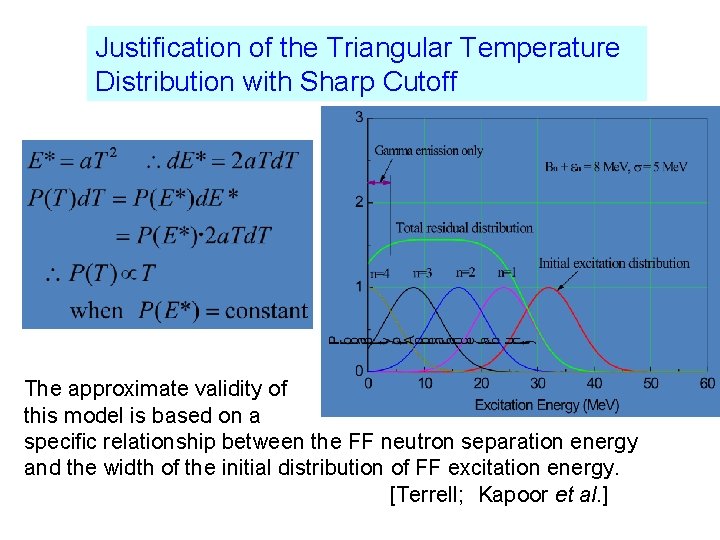
Justification of the Triangular Temperature Distribution with Sharp Cutoff The approximate validity of this model is based on a specific relationship between the FF neutron separation energy and the width of the initial distribution of FF excitation energy. [Terrell; Kapoor et al. ]
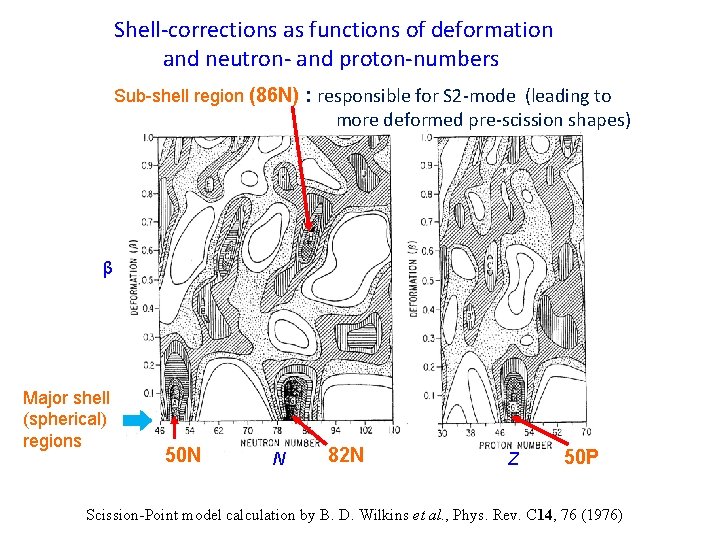
Shell-corrections as functions of deformation and neutron- and proton-numbers Sub-shell region (86 N) : responsible for S 2 -mode (leading to more deformed pre-scission shapes) β Major shell (spherical) regions 50 N N 82 N Z 50 P Scission-Point model calculation by B. D. Wilkins et al. , Phys. Rev. C 14, 76 (1976)

(4) Asymmetry in the Nuclear Temperature ・T. Ohsawa, INDC(NDS)-251 (1991), IAEA/CM , Vienna, 1990. p. 71. ・T. Ohsawa and T. Shibata, Nucl. Data for Sci. Tech. , Jülich, p. 965 (1992) ・P. Talou, Proc. ND 2007, Nice (2008) E*CN=Bn+En E*L= Eint L + DL E*H= Eint H + DH E*L=a. LT 2 L E*H=a. HT 2 H The nuclear temperatures of the two FFs at the moment of neutron emission are generally not equal, if the deformation is different at scission. TXE = <ER> + Bn + En ー TKE = a. CNT 2 m = a. LT 2 L + a. HT 2 H = (a. LRT 2 + a. H)T 2 H where RT=TL/TH : temperature ratio
- Slides: 61