
Physics Topic 10 Notes 2 1 of 8
- Slides: 17
Physics Topic 10 Notes 2 1 of 8 © Boardworks Ltd 2009
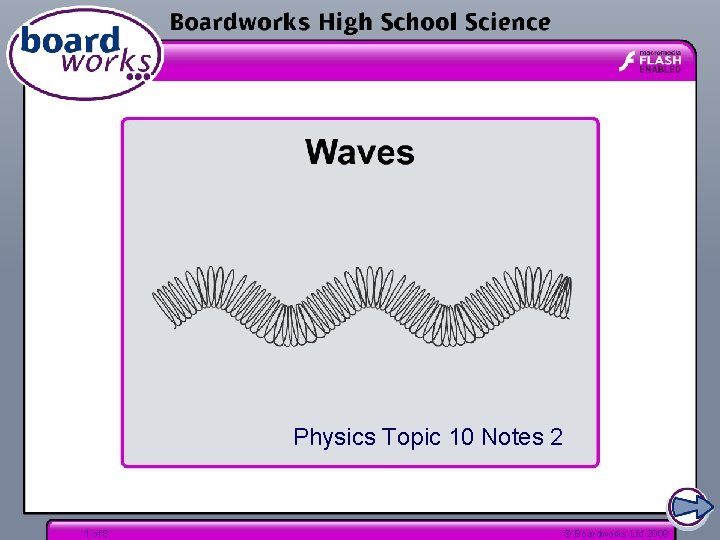
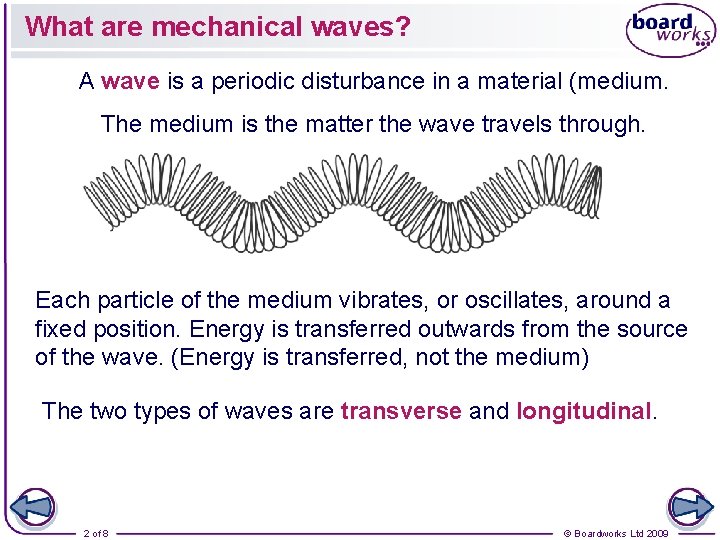
What are mechanical waves? A wave is a periodic disturbance in a material (medium. The medium is the matter the wave travels through. Each particle of the medium vibrates, or oscillates, around a fixed position. Energy is transferred outwards from the source of the wave. (Energy is transferred, not the medium) The two types of waves are transverse and longitudinal. 2 of 8 © Boardworks Ltd 2009
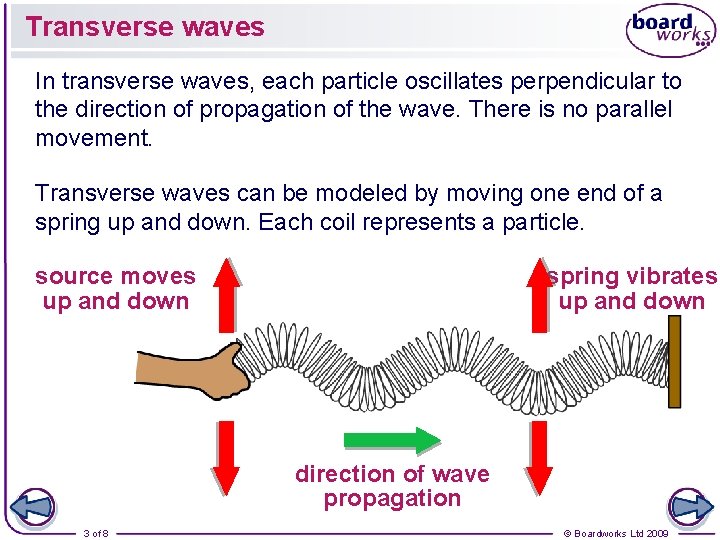
Transverse waves In transverse waves, each particle oscillates perpendicular to the direction of propagation of the wave. There is no parallel movement. Transverse waves can be modeled by moving one end of a spring up and down. Each coil represents a particle. source moves up and down spring vibrates up and down direction of wave propagation 3 of 8 © Boardworks Ltd 2009
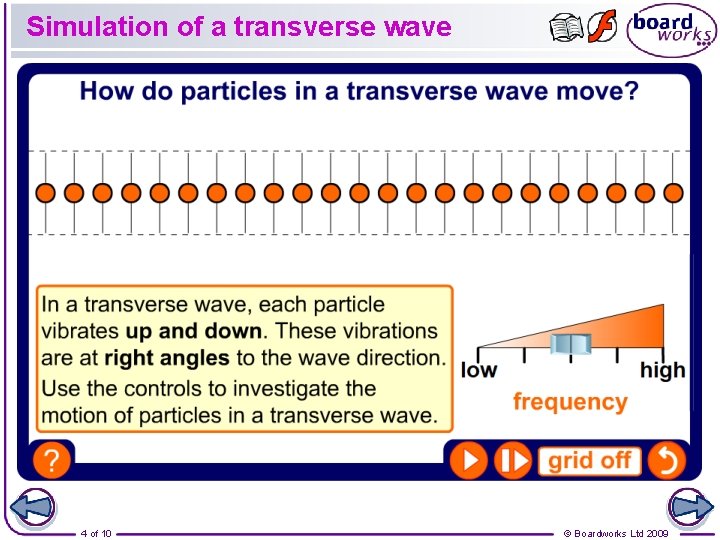
Simulation of a transverse wave 4 of 10 © Boardworks Ltd 2009
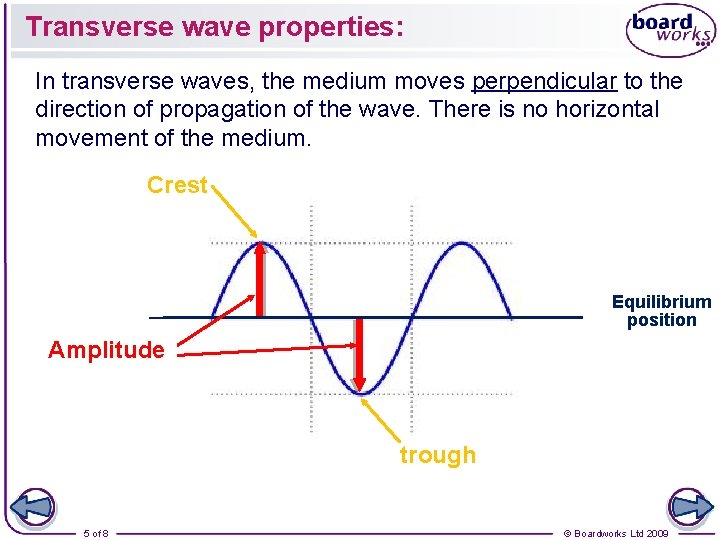
Transverse wave properties: In transverse waves, the medium moves perpendicular to the direction of propagation of the wave. There is no horizontal movement of the medium. Crest Equilibrium position Amplitude trough 5 of 8 © Boardworks Ltd 2009
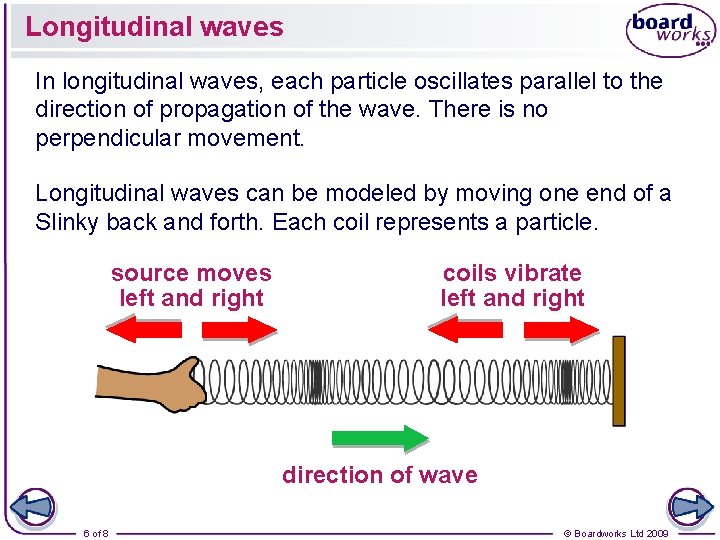
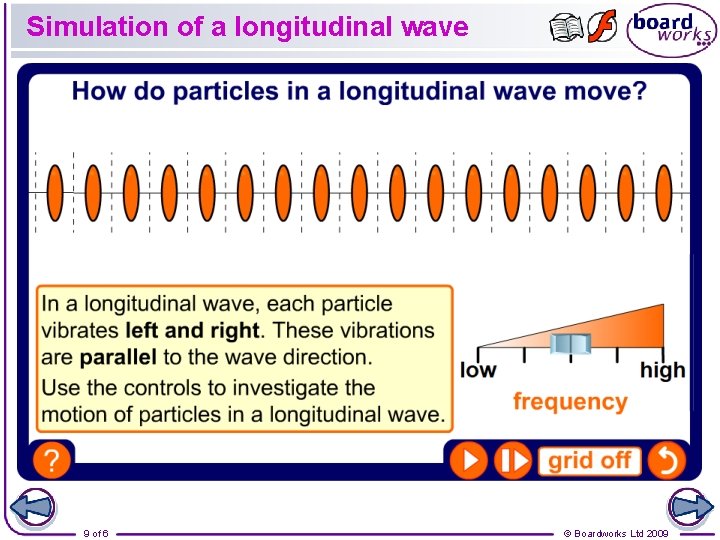
Longitudinal waves In longitudinal waves, each particle oscillates parallel to the direction of propagation of the wave. There is no perpendicular movement. Longitudinal waves can be modeled by moving one end of a Slinky back and forth. Each coil represents a particle. source moves left and right coils vibrate left and right direction of wave 6 of 8 © Boardworks Ltd 2009
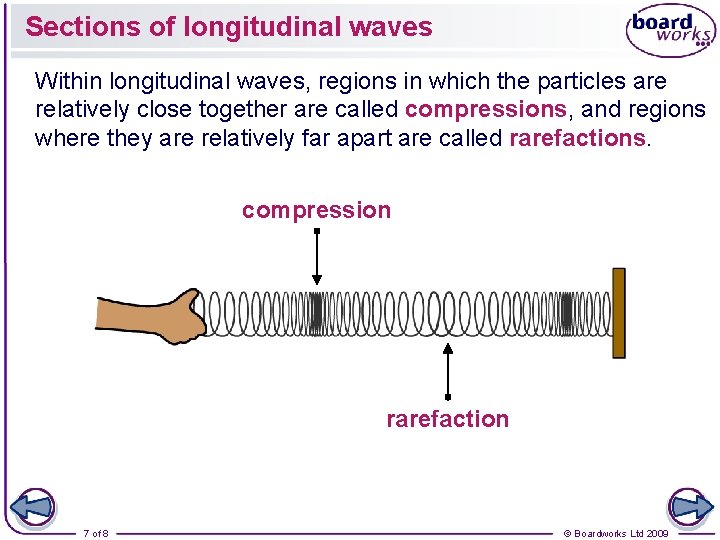
Sections of longitudinal waves Within longitudinal waves, regions in which the particles are relatively close together are called compressions, and regions where they are relatively far apart are called rarefactions. compression rarefaction 7 of 8 © Boardworks Ltd 2009
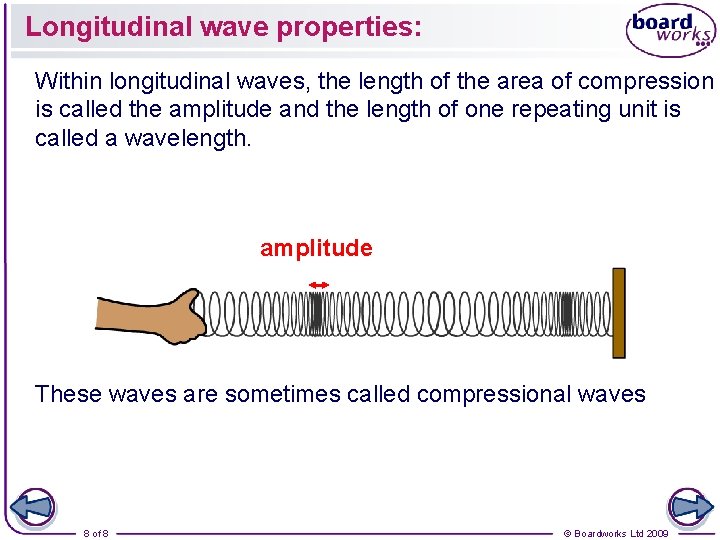
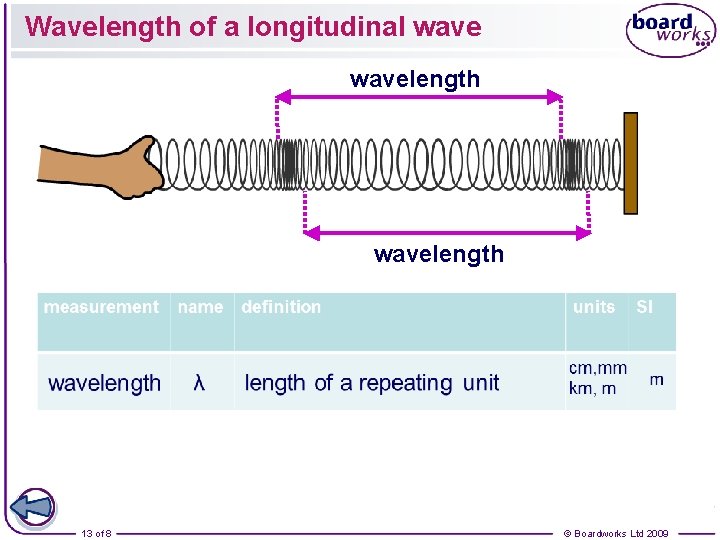
Longitudinal wave properties: Within longitudinal waves, the length of the area of compression is called the amplitude and the length of one repeating unit is called a wavelength. amplitude These waves are sometimes called compressional waves 8 of 8 © Boardworks Ltd 2009
Simulation of a longitudinal wave 9 of 6 © Boardworks Ltd 2009
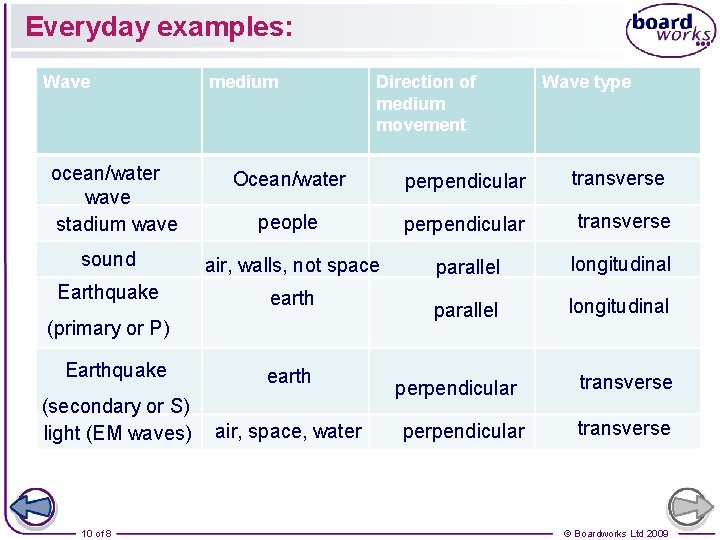
Everyday examples: Wave ocean/water wave stadium wave medium Direction of medium movement Wave type Ocean/water perpendicular transverse people perpendicular transverse sound air, walls, not space parallel longitudinal Earthquake earth parallel longitudinal (primary or P) Earthquake earth (secondary or S) light (EM waves) air, space, water 10 of 8 perpendicular transverse © Boardworks Ltd 2009
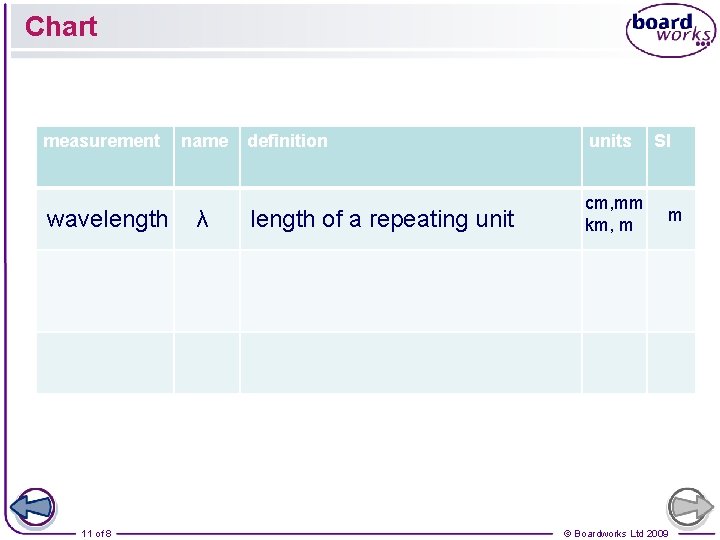
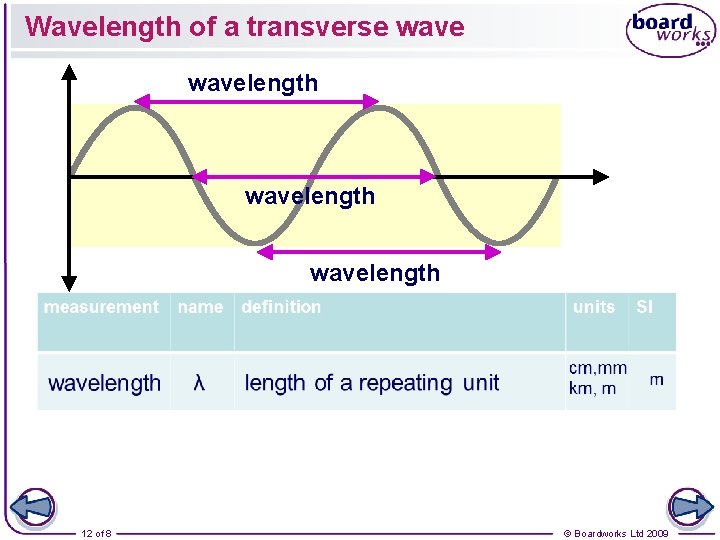
Chart measurement wavelength 11 of 8 name λ definition units length of a repeating unit cm, mm km, m SI m © Boardworks Ltd 2009
Wavelength of a transverse wavelength 12 of 8 © Boardworks Ltd 2009
Wavelength of a longitudinal wavelength 13 of 8 © Boardworks Ltd 2009
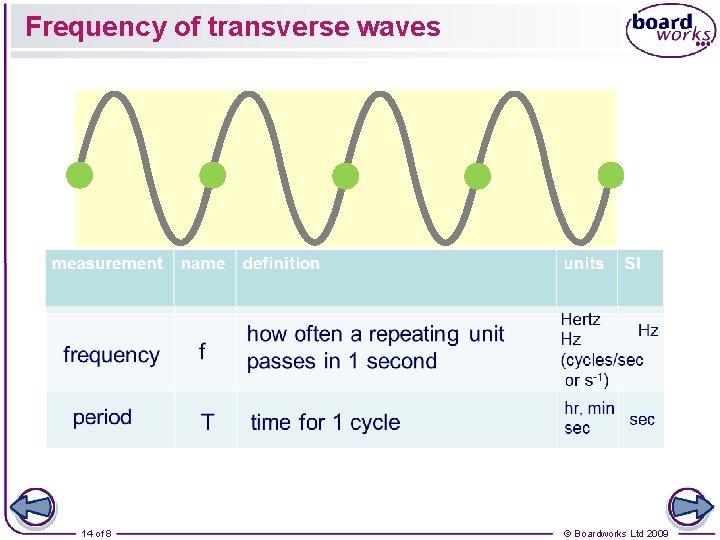
Frequency of transverse waves 14 of 8 © Boardworks Ltd 2009
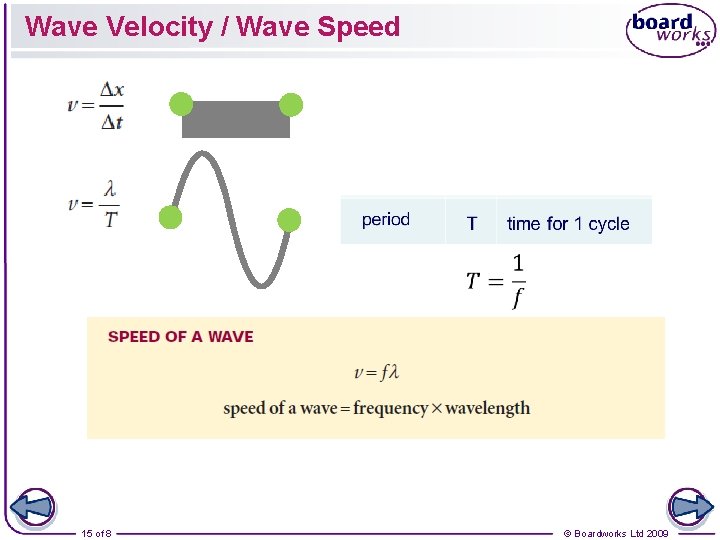
Wave Velocity / Wave Speed 15 of 8 © Boardworks Ltd 2009
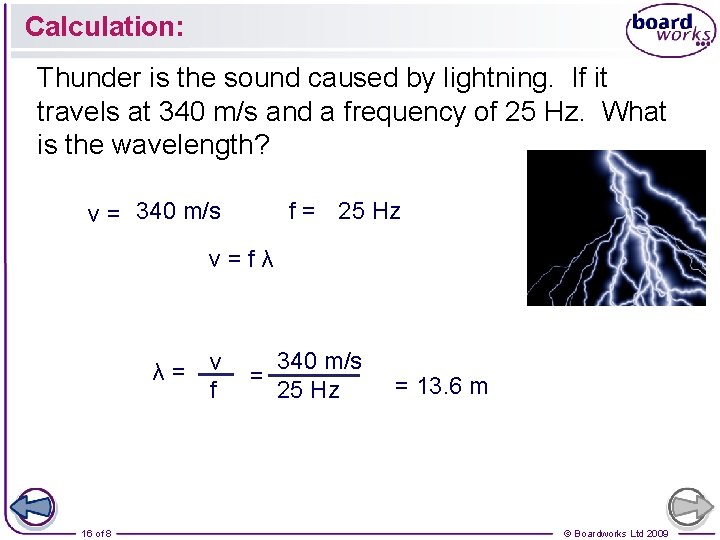
Calculation: Thunder is the sound caused by lightning. If it travels at 340 m/s and a frequency of 25 Hz. What is the wavelength? f = 25 Hz v = 340 m/s v = f λ λ = v f 16 of 8 340 m/s = 25 Hz = 13. 6 m © Boardworks Ltd 2009
Mechanical vs. EM waves Mechanical waves are the oscillation of particles in a physical medium. They cannot transmit energy in a vacuum (like space). They can be either transverse or longitudinal. Examples include sound waves, earthquake (P, S and L) waves and water waves. Electromagnetic (EM) waves are produced by the acceleration of charged particles, and, unlike mechanical waves, can transmit energy through a vacuum. They are always transverse waves. Examples include microwaves, X-rays and visible light. 17 of 8 © Boardworks Ltd 2009