
PHYSICS Thermal properties and temperature 2 LEARNING OBJECTIVES
PHYSICS – Thermal properties and temperature (2).
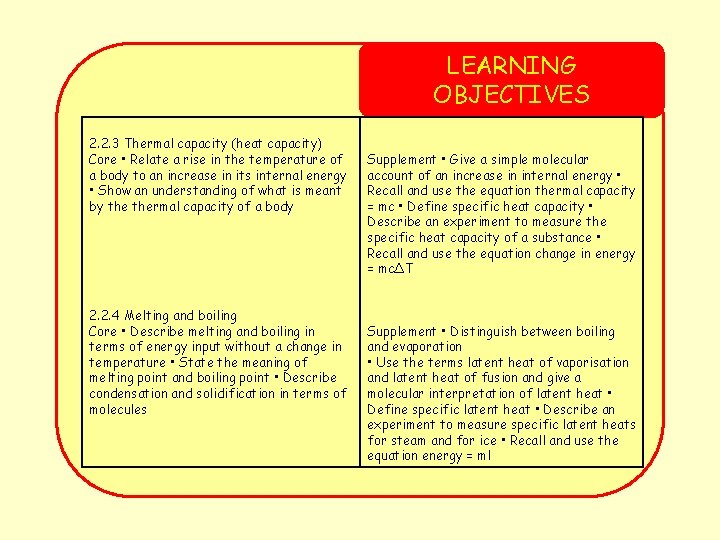
LEARNING OBJECTIVES 2. 2. 3 Thermal capacity (heat capacity) Core • Relate a rise in the temperature of a body to an increase in its internal energy • Show an understanding of what is meant by thermal capacity of a body 2. 2. 4 Melting and boiling Core • Describe melting and boiling in terms of energy input without a change in temperature • State the meaning of melting point and boiling point • Describe condensation and solidification in terms of molecules Supplement • Give a simple molecular account of an increase in internal energy • Recall and use the equation thermal capacity = mc • Define specific heat capacity • Describe an experiment to measure the specific heat capacity of a substance • Recall and use the equation change in energy = mc∆T Supplement • Distinguish between boiling and evaporation • Use the terms latent heat of vaporisation and latent heat of fusion and give a molecular interpretation of latent heat • Define specific latent heat • Describe an experiment to measure specific latent heats for steam and for ice • Recall and use the equation energy = ml
Thermal (heat) capacity What requires more energy to heat up by 1 o. C?
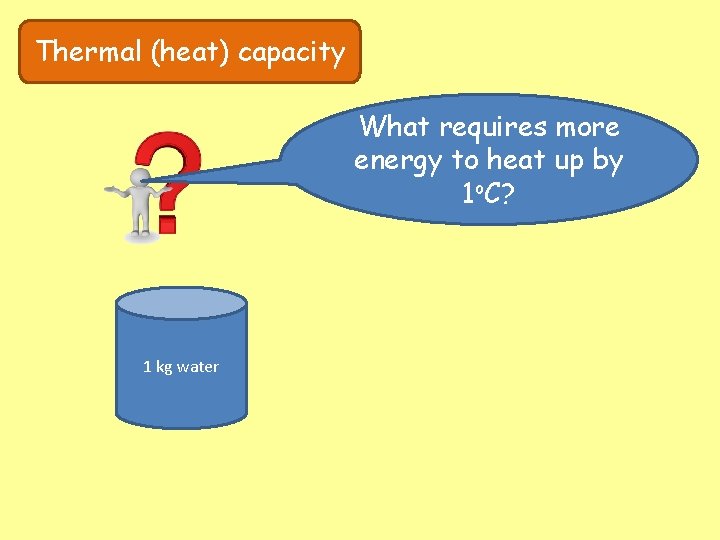
Thermal (heat) capacity What requires more energy to heat up by 1 o. C? 1 kg water
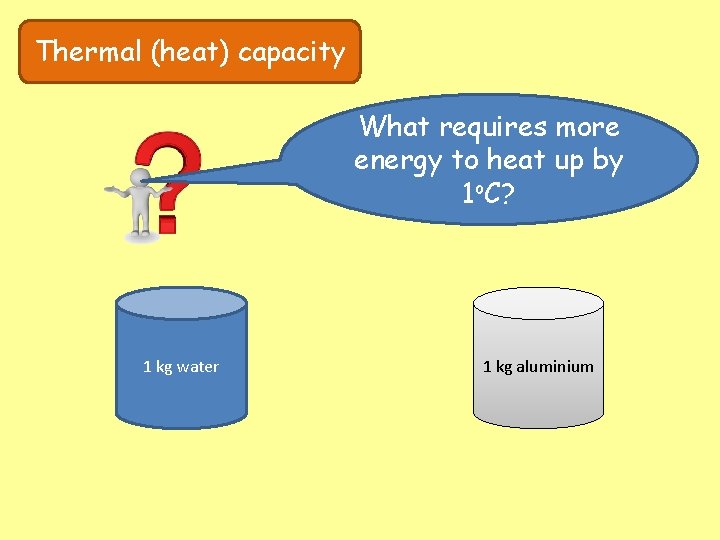
Thermal (heat) capacity What requires more energy to heat up by 1 o. C? 1 kg water 1 kg aluminium
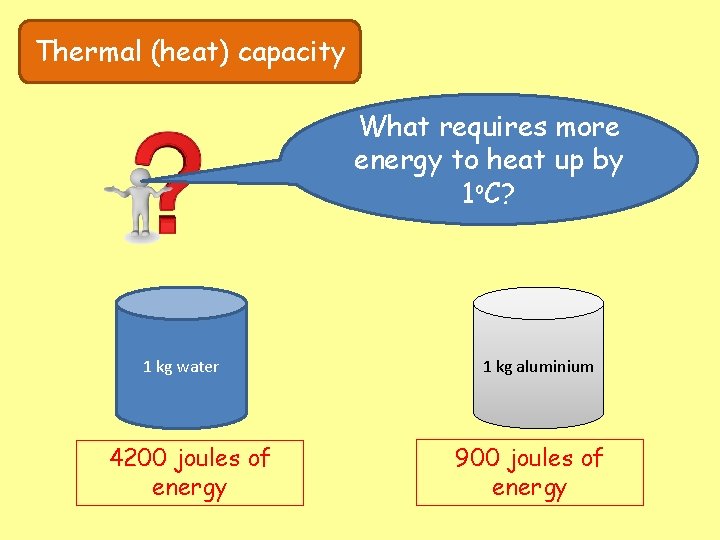
Thermal (heat) capacity What requires more energy to heat up by 1 o. C? 1 kg water 4200 joules of energy 1 kg aluminium 900 joules of energy
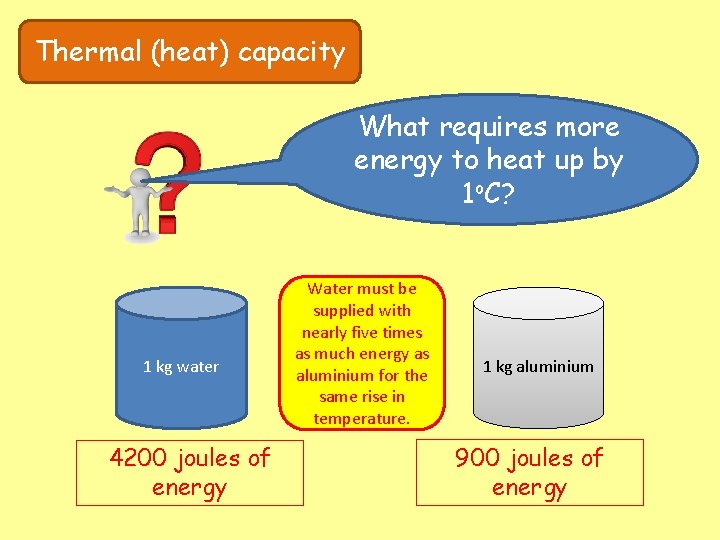
Thermal (heat) capacity What requires more energy to heat up by 1 o. C? 1 kg water 4200 joules of energy Water must be supplied with nearly five times as much energy as aluminium for the same rise in temperature. 1 kg aluminium 900 joules of energy
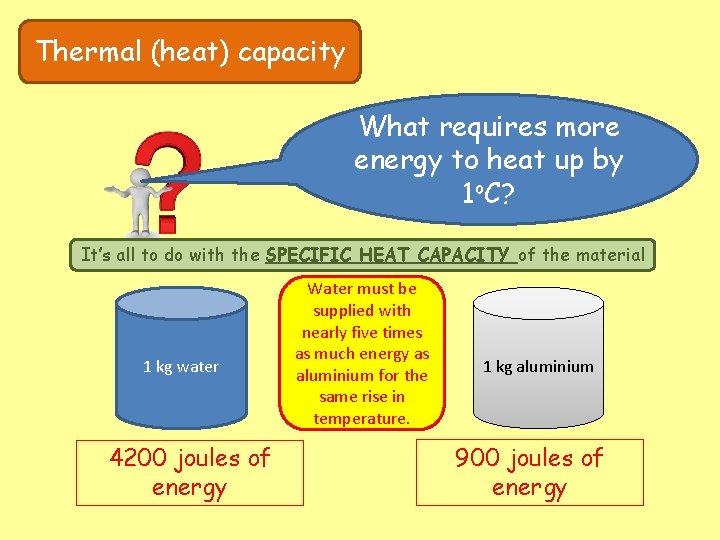
Thermal (heat) capacity What requires more energy to heat up by 1 o. C? It’s all to do with the SPECIFIC HEAT CAPACITY of the material 1 kg water 4200 joules of energy Water must be supplied with nearly five times as much energy as aluminium for the same rise in temperature. 1 kg aluminium 900 joules of energy
Thermal (heat) capacity The specific heat capacity of a substance is the amount of energy needed to change the temperature of 1 kg of the substance by 1 o. C.
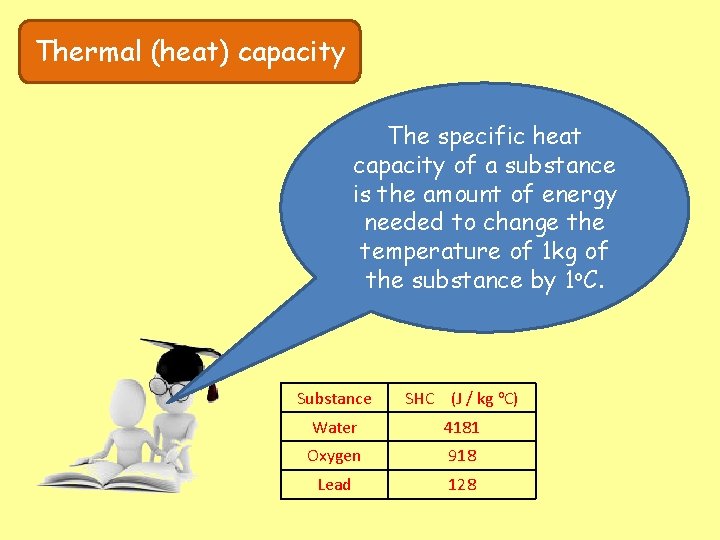
Thermal (heat) capacity The specific heat capacity of a substance is the amount of energy needed to change the temperature of 1 kg of the substance by 1 o. C. Substance SHC (J / kg o. C) Water 4181 Oxygen 918 Lead 128
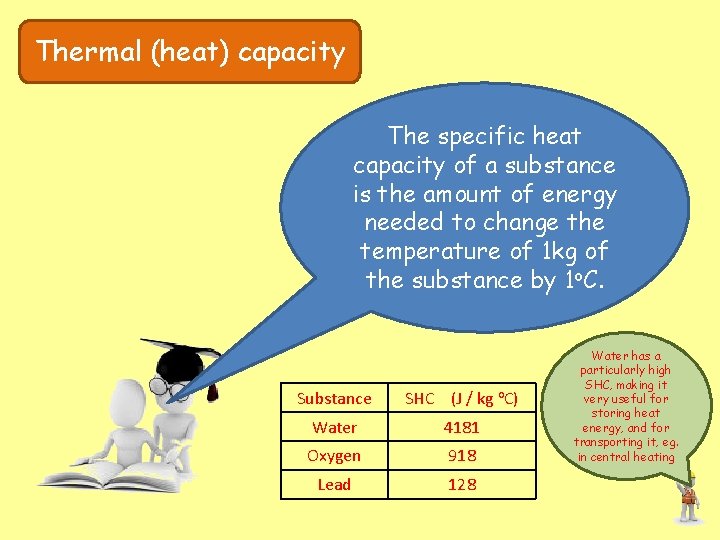
Thermal (heat) capacity The specific heat capacity of a substance is the amount of energy needed to change the temperature of 1 kg of the substance by 1 o. C. Substance SHC (J / kg o. C) Water 4181 Oxygen 918 Lead 128 Water has a particularly high SHC, making it very useful for storing heat energy, and for transporting it, eg. in central heating
Thermal (heat) capacity The equation (just what you wanted!)
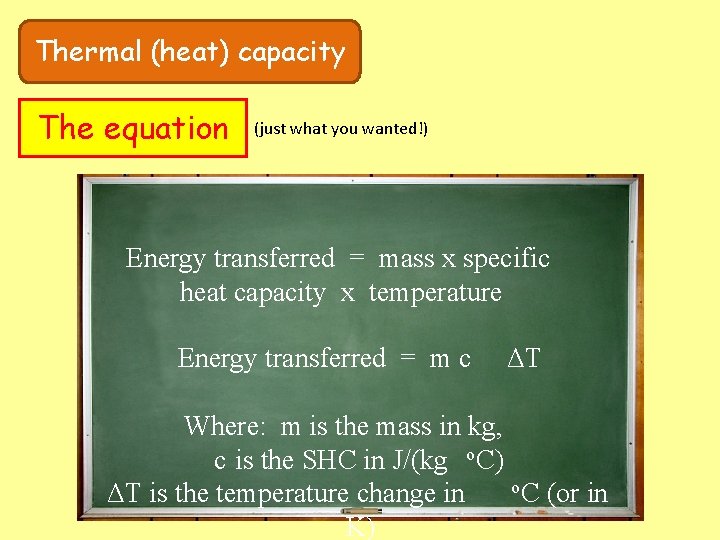
Thermal (heat) capacity The equation (just what you wanted!) Energy transferred = mass x specific heat capacity x temperature Energy transferred = m c ΔT Where: m is the mass in kg, c is the SHC in J/(kg o C) o C (or in ΔT is the temperature change in K)
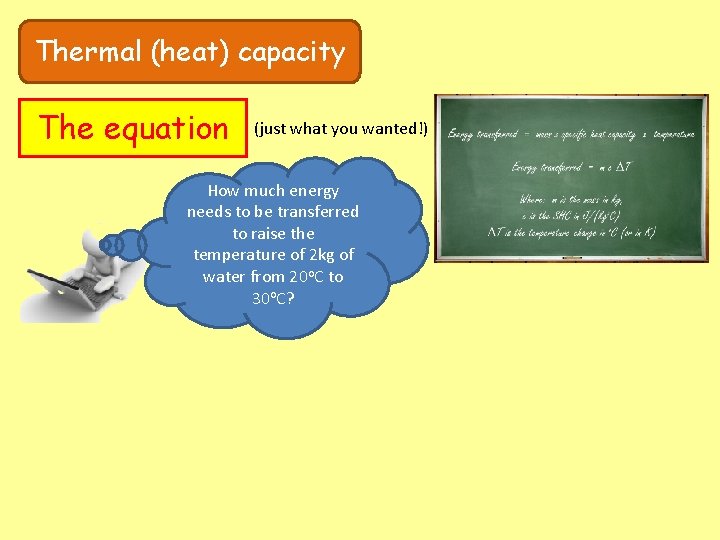
Thermal (heat) capacity The equation (just what you wanted!) How much energy needs to be transferred to raise the temperature of 2 kg of water from 20 o. C to 30 o. C?
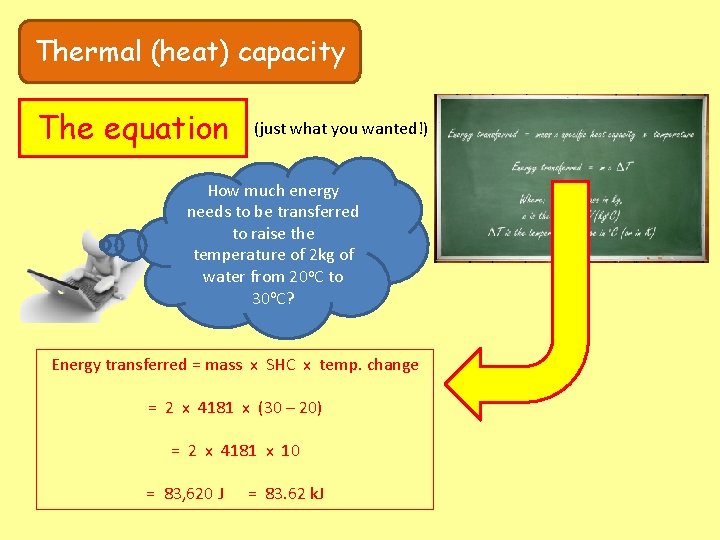
Thermal (heat) capacity The equation (just what you wanted!) How much energy needs to be transferred to raise the temperature of 2 kg of water from 20 o. C to 30 o. C? Energy transferred = mass x SHC x temp. change = 2 x 4181 x (30 – 20) = 2 x 4181 x 10 = 83, 620 J = 83. 62 k. J
Thermal (heat) capacity So what’s this ‘thermal capacity’ bit?
Thermal (heat) capacity Thermal capacity = mass x SHC So what’s this ‘thermal capacity’ bit?
Thermal (heat) capacity Thermal capacity = mass x SHC eg. If there is 3 kg of water in a kettle: Thermal capacity = 3 x 4181 = 12, 543 J/o. C So what’s this ‘thermal capacity’ bit?
Thermal (heat) capacity Thermal capacity = mass x SHC eg. If there is 3 kg of water in a kettle: Thermal capacity = 3 x 4181 = 12, 543 J/o. C So what’s this ‘thermal capacity’ bit? This means that for every 1 o. C rise in temperature of the water in the kettle, 12, 543 J of energy need to be supplied.
Measuring specific heat capacity
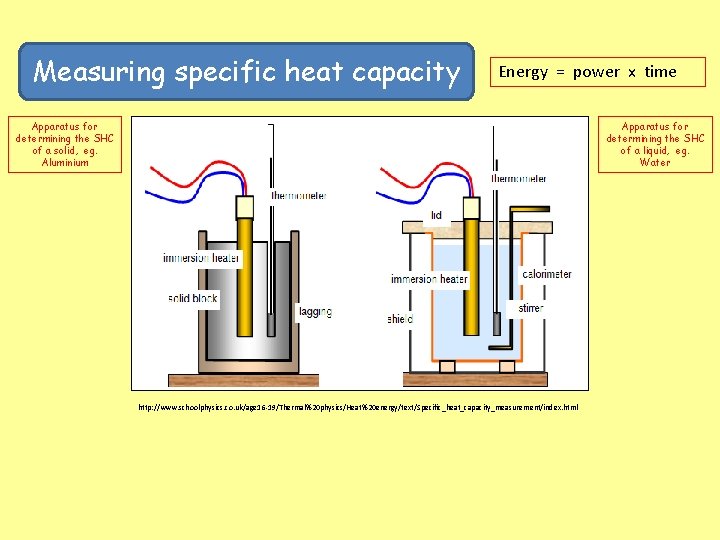
Measuring specific heat capacity Energy = power x time Apparatus for determining the SHC of a solid, eg. Aluminium Apparatus for determining the SHC of a liquid, eg. Water http: //www. schoolphysics. co. uk/age 16 -19/Thermal%20 physics/Heat%20 energy/text/Specific_heat_capacity_measurement/index. html
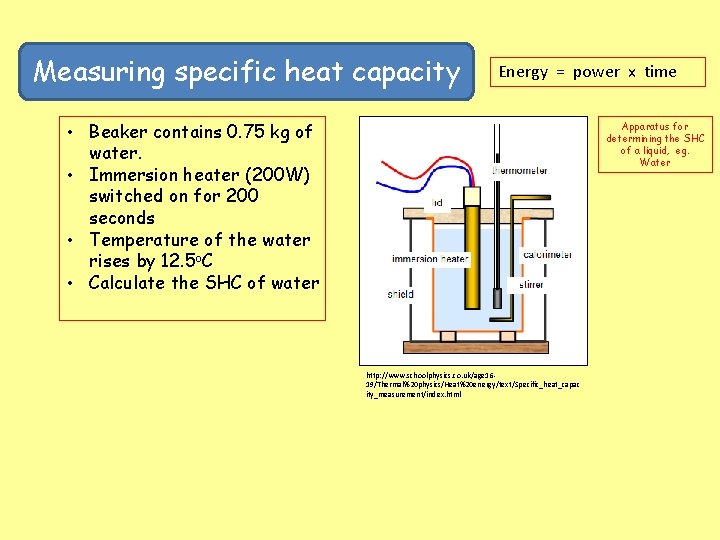
Measuring specific heat capacity Energy = power x time • Beaker contains 0. 75 kg of water. • Immersion heater (200 W) switched on for 200 seconds • Temperature of the water rises by 12. 5 o. C • Calculate the SHC of water Apparatus for determining the SHC of a liquid, eg. Water http: //www. schoolphysics. co. uk/age 1619/Thermal%20 physics/Heat%20 energy/text/Specific_heat_capac ity_measurement/index. html
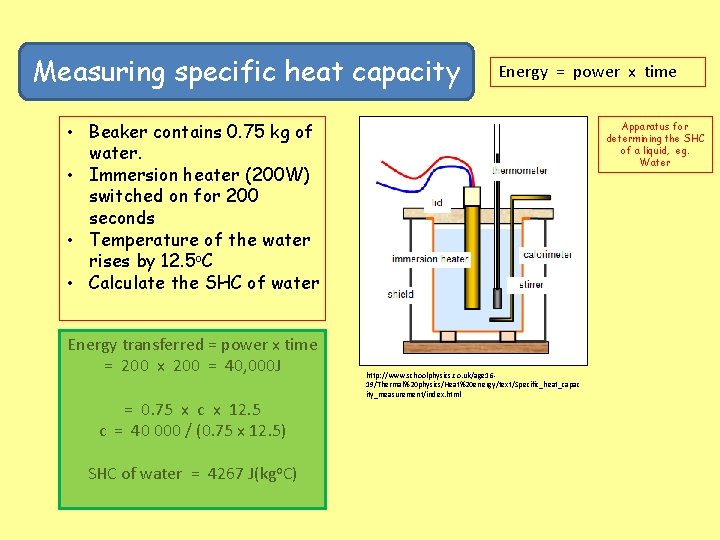
Measuring specific heat capacity Energy = power x time • Beaker contains 0. 75 kg of water. • Immersion heater (200 W) switched on for 200 seconds • Temperature of the water rises by 12. 5 o. C • Calculate the SHC of water Energy transferred = power x time = 200 x 200 = 40, 000 J = 0. 75 x c x 12. 5 c = 40 000 / (0. 75 x 12. 5) SHC of water = 4267 J(kgo. C) Apparatus for determining the SHC of a liquid, eg. Water http: //www. schoolphysics. co. uk/age 1619/Thermal%20 physics/Heat%20 energy/text/Specific_heat_capac ity_measurement/index. html
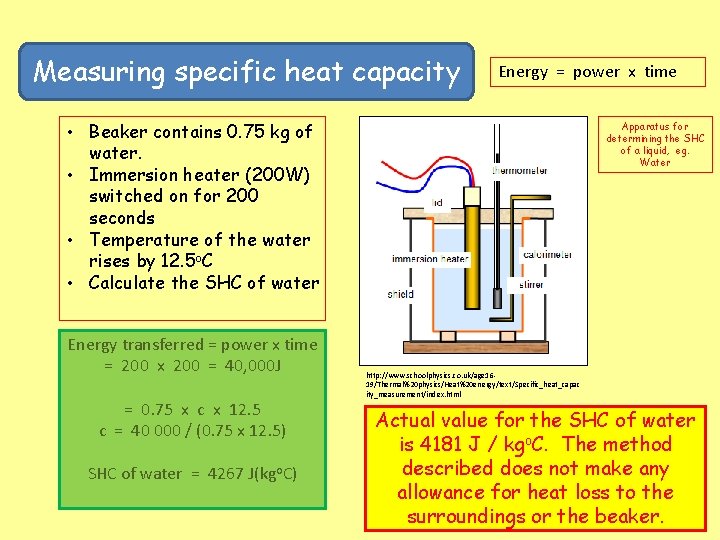
Measuring specific heat capacity Energy = power x time • Beaker contains 0. 75 kg of water. • Immersion heater (200 W) switched on for 200 seconds • Temperature of the water rises by 12. 5 o. C • Calculate the SHC of water Energy transferred = power x time = 200 x 200 = 40, 000 J = 0. 75 x c x 12. 5 c = 40 000 / (0. 75 x 12. 5) SHC of water = 4267 J(kgo. C) Apparatus for determining the SHC of a liquid, eg. Water http: //www. schoolphysics. co. uk/age 1619/Thermal%20 physics/Heat%20 energy/text/Specific_heat_capac ity_measurement/index. html Actual value for the SHC of water is 4181 J / kgo. C. The method described does not make any allowance for heat loss to the surroundings or the beaker.
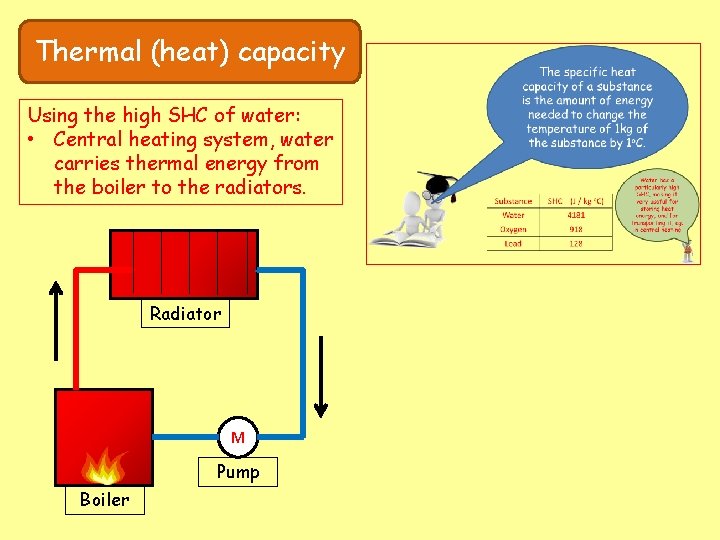
Thermal (heat) capacity Using the high SHC of water: • Central heating system, water carries thermal energy from the boiler to the radiators. Radiator M Pump Boiler
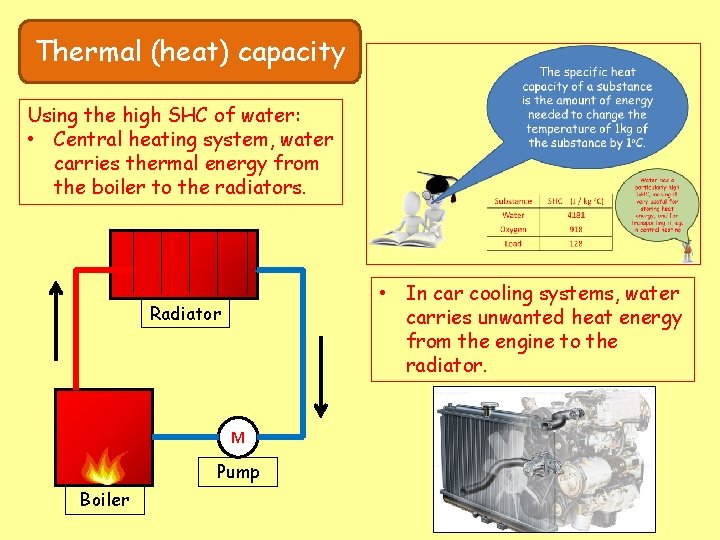
Thermal (heat) capacity Using the high SHC of water: • Central heating system, water carries thermal energy from the boiler to the radiators. • In car cooling systems, water carries unwanted heat energy from the engine to the radiator. Radiator M Pump Boiler
LEARNING OBJECTIVES 2. 2. 3 Thermal capacity (heat capacity) Core • Relate a rise in the temperature of a body to an increase in its internal energy • Show an understanding of what is meant by thermal capacity of a body 2. 2. 4 Melting and boiling Core • Describe melting and boiling in terms of energy input without a change in temperature • State the meaning of melting point and boiling point • Describe condensation and solidification in terms of molecules Supplement • Give a simple molecular account of an increase in internal energy • Recall and use the equation thermal capacity = mc • Define specific heat capacity • Describe an experiment to measure the specific heat capacity of a substance • Recall and use the equation change in energy = mc∆T Supplement • Distinguish between boiling and evaporation • Use the terms latent heat of vaporisation and latent heat of fusion and give a molecular interpretation of latent heat • Define specific latent heat • Describe an experiment to measure specific latent heats for steam and for ice • Recall and use the equation energy = ml
Latent Heat
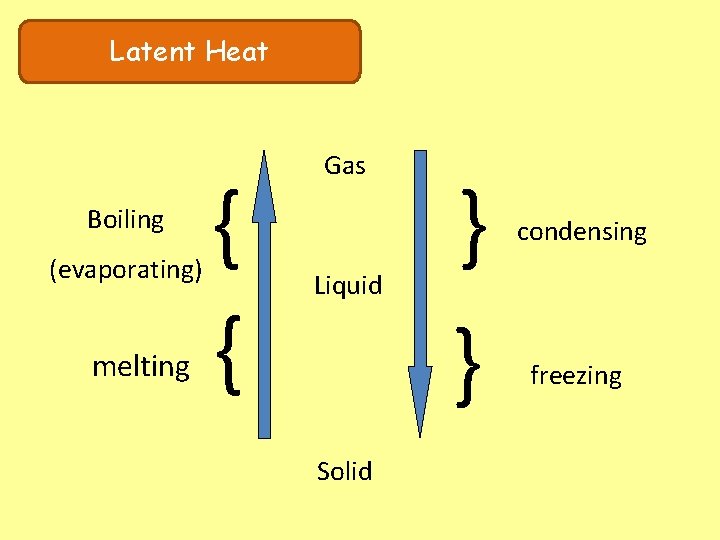
Latent Heat Boiling (evaporating) melting { { Gas Liquid Solid } } condensing freezing
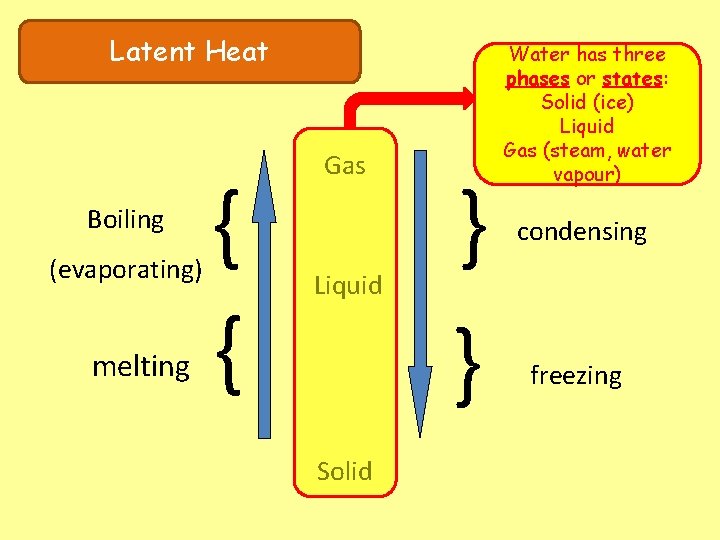
Latent Heat Boiling (evaporating) melting { { Gas Liquid Solid } } Water has three phases or states: Solid (ice) Liquid Gas (steam, water vapour) condensing freezing
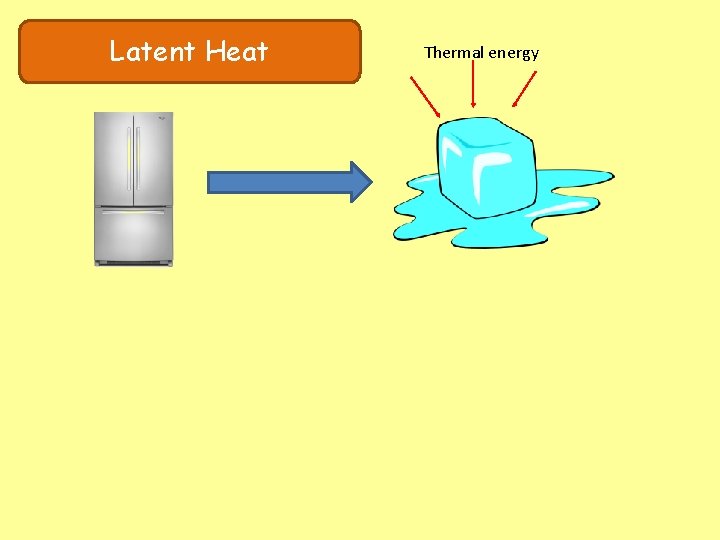
Latent Heat Thermal energy
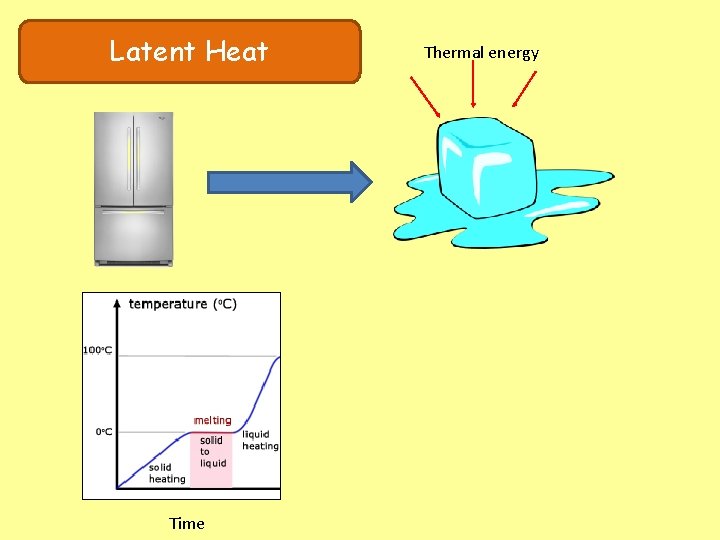
Latent Heat Time Thermal energy
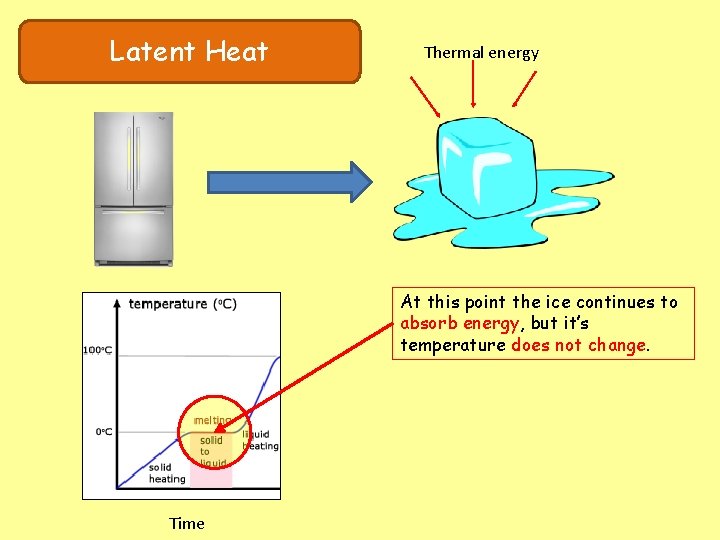
Latent Heat Thermal energy At this point the ice continues to absorb energy, but it’s temperature does not change. Time
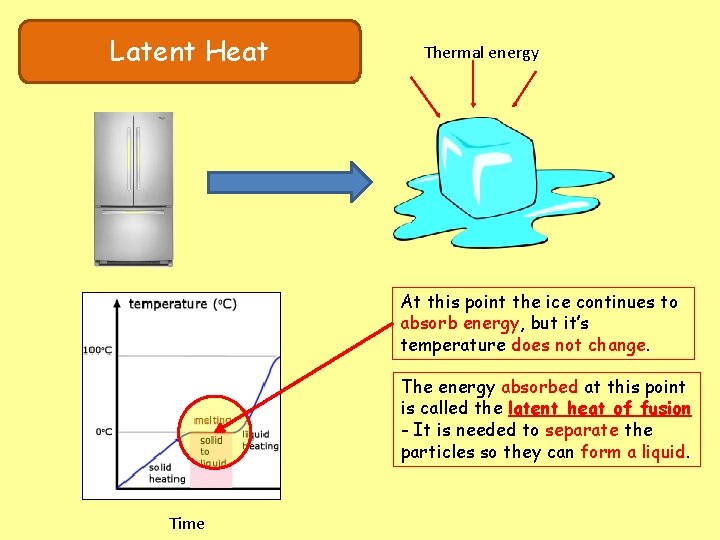
Latent Heat Thermal energy At this point the ice continues to absorb energy, but it’s temperature does not change. The energy absorbed at this point is called the latent heat of fusion - It is needed to separate the particles so they can form a liquid. Time
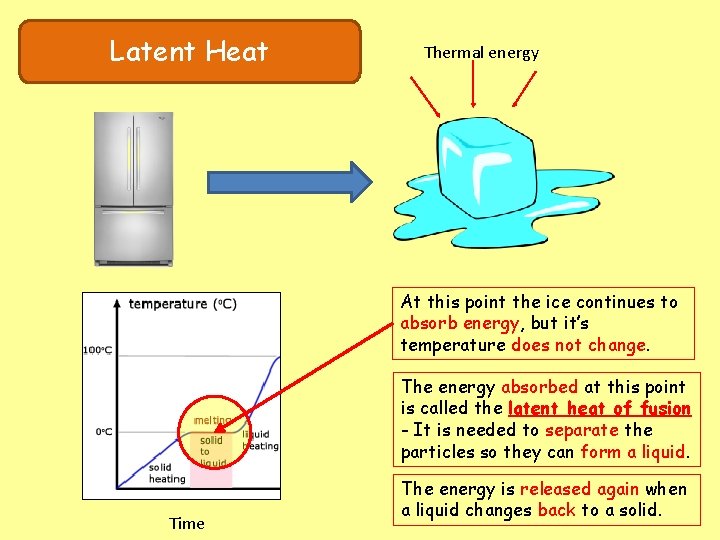
Latent Heat Thermal energy At this point the ice continues to absorb energy, but it’s temperature does not change. The energy absorbed at this point is called the latent heat of fusion - It is needed to separate the particles so they can form a liquid. Time The energy is released again when a liquid changes back to a solid.
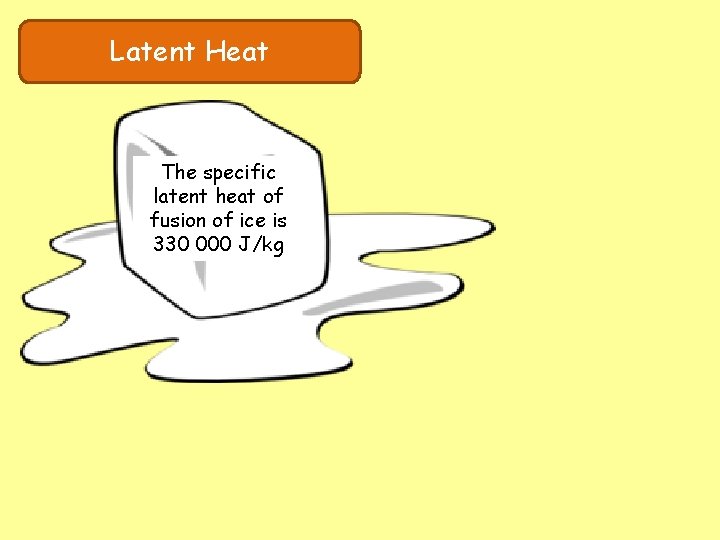
Latent Heat The specific latent heat of fusion of ice is 330 000 J/kg
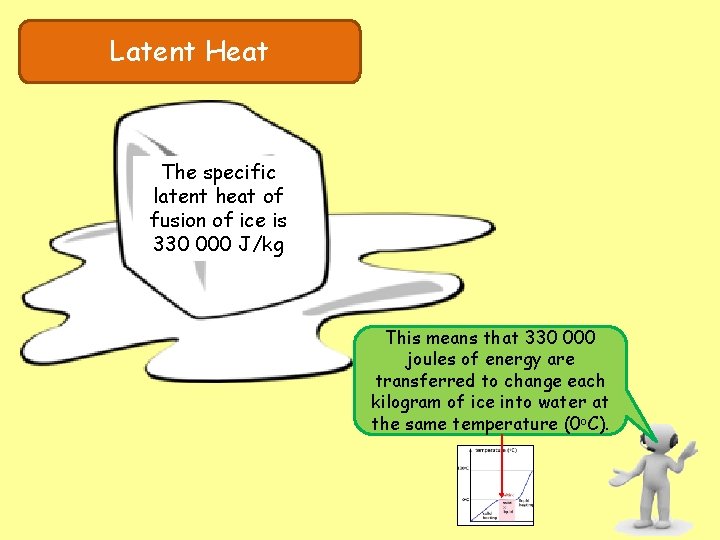
Latent Heat The specific latent heat of fusion of ice is 330 000 J/kg This means that 330 000 joules of energy are transferred to change each kilogram of ice into water at the same temperature (0 o. C).
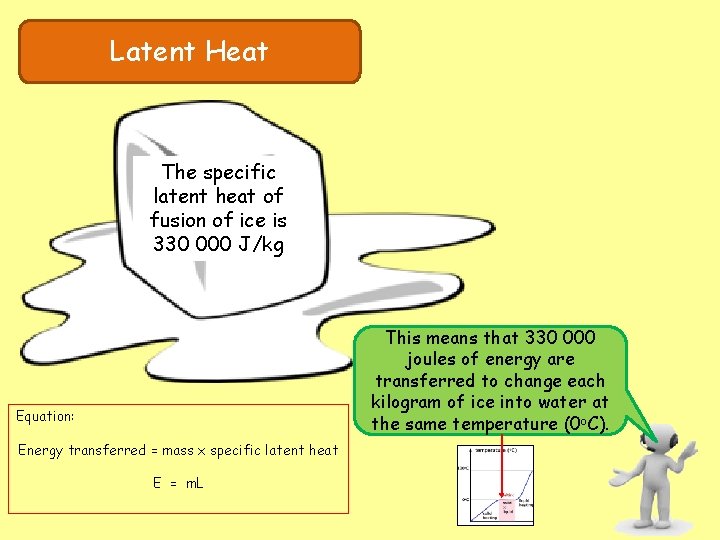
Latent Heat The specific latent heat of fusion of ice is 330 000 J/kg This means that 330 000 joules of energy are transferred to change each kilogram of ice into water at the same temperature (0 o. C). Equation: Energy transferred = mass x specific latent heat E = m. L
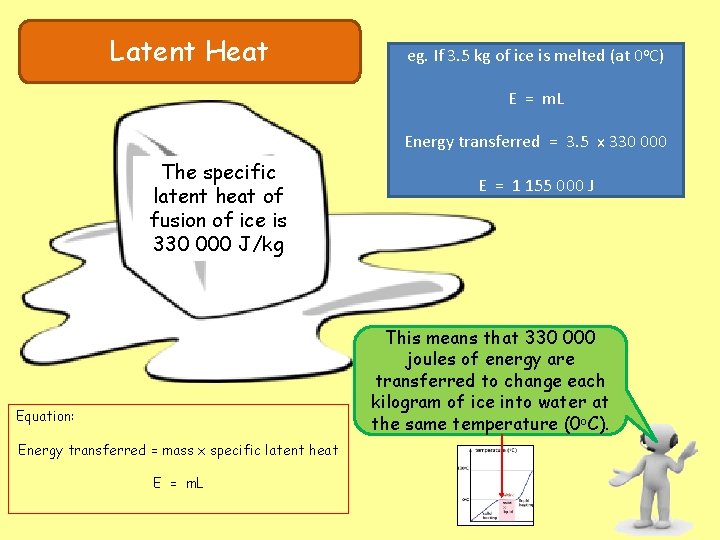
Latent Heat eg. If 3. 5 kg of ice is melted (at 0 o. C) E = m. L Energy transferred = 3. 5 x 330 000 The specific latent heat of fusion of ice is 330 000 J/kg E = 1 155 000 J This means that 330 000 joules of energy are transferred to change each kilogram of ice into water at the same temperature (0 o. C). Equation: Energy transferred = mass x specific latent heat E = m. L
Latent Heat Measuring the specific latent heat of fusion of ice.
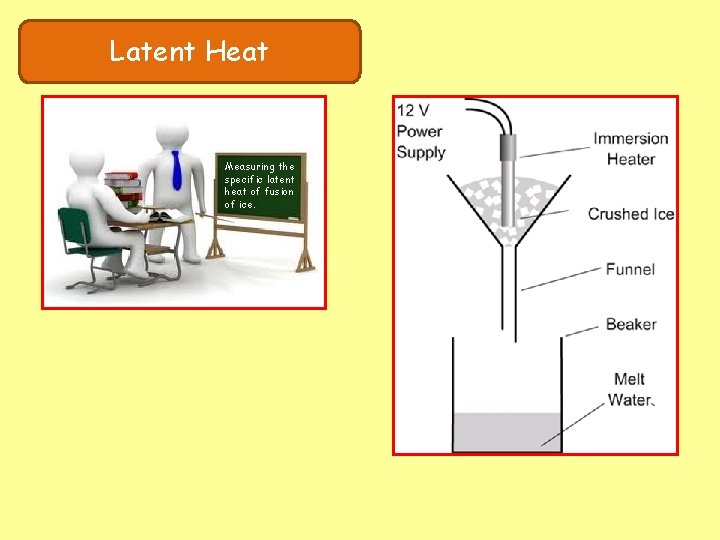
Latent Heat Measuring the specific latent heat of fusion of ice.
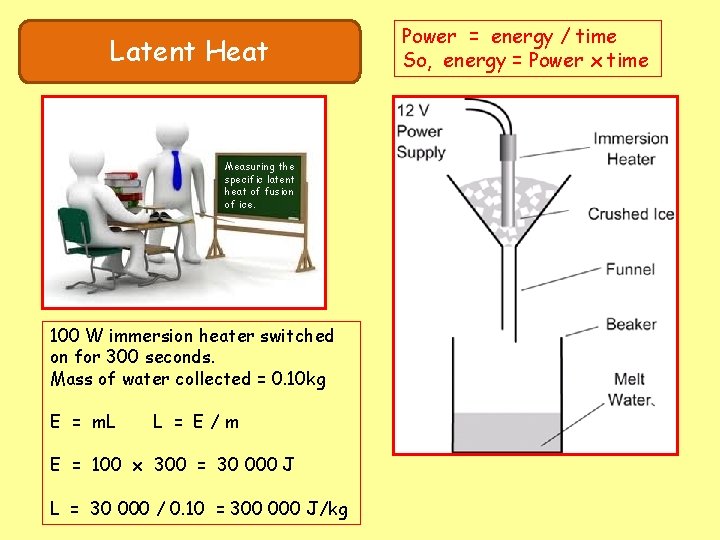
Latent Heat Measuring the specific latent heat of fusion of ice. 100 W immersion heater switched on for 300 seconds. Mass of water collected = 0. 10 kg E = m. L L = E/m E = 100 x 300 = 30 000 J L = 30 000 / 0. 10 = 300 000 J/kg Power = energy / time So, energy = Power x time
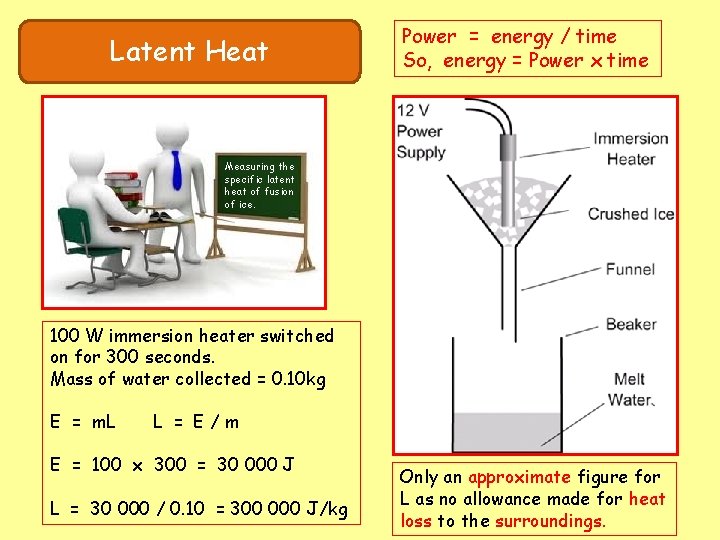
Latent Heat Power = energy / time So, energy = Power x time Measuring the specific latent heat of fusion of ice. 100 W immersion heater switched on for 300 seconds. Mass of water collected = 0. 10 kg E = m. L L = E/m E = 100 x 300 = 30 000 J L = 30 000 / 0. 10 = 300 000 J/kg Only an approximate figure for L as no allowance made for heat loss to the surroundings.
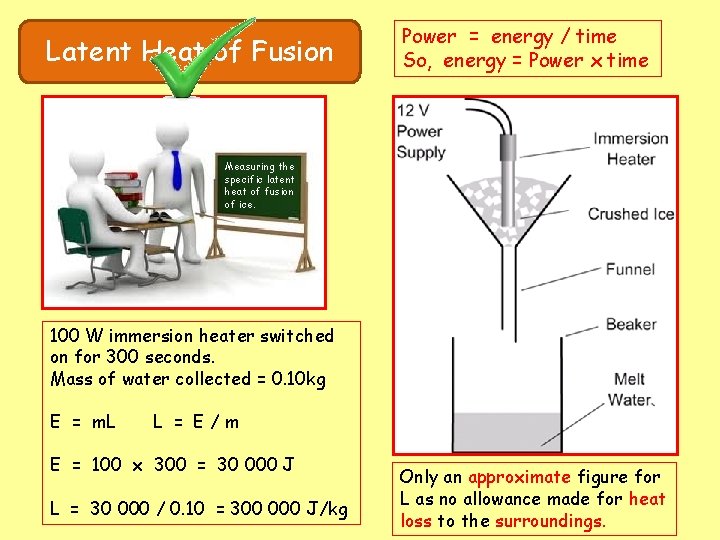
Latent Heat of Fusion Power = energy / time So, energy = Power x time Measuring the specific latent heat of fusion of ice. 100 W immersion heater switched on for 300 seconds. Mass of water collected = 0. 10 kg E = m. L L = E/m E = 100 x 300 = 30 000 J L = 30 000 / 0. 10 = 300 000 J/kg Only an approximate figure for L as no allowance made for heat loss to the surroundings.
Latent Heat of Vaporization
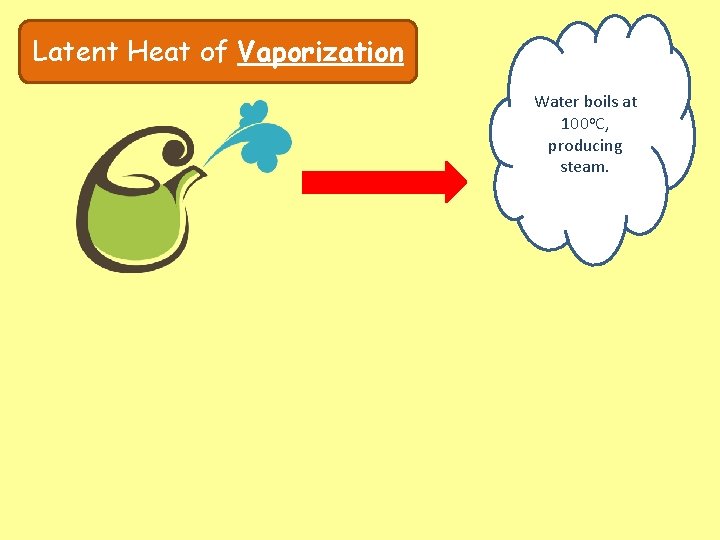
Latent Heat of Vaporization Water boils at 100 o. C, producing steam.
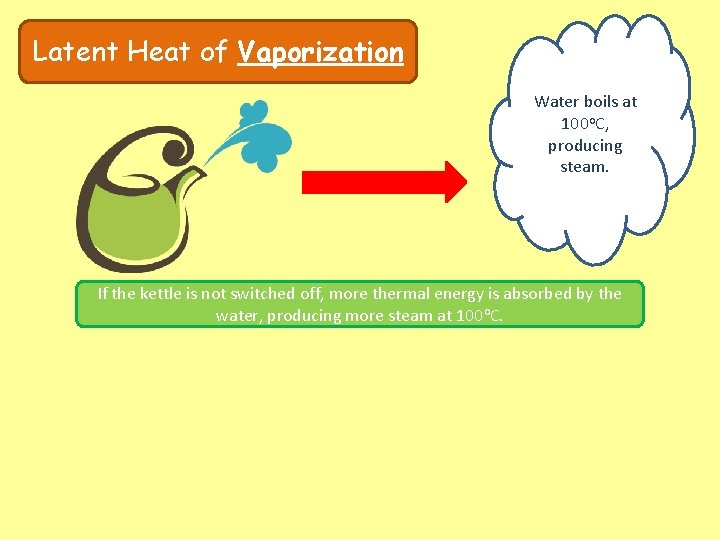
Latent Heat of Vaporization Water boils at 100 o. C, producing steam. If the kettle is not switched off, more thermal energy is absorbed by the water, producing more steam at 100 o. C.
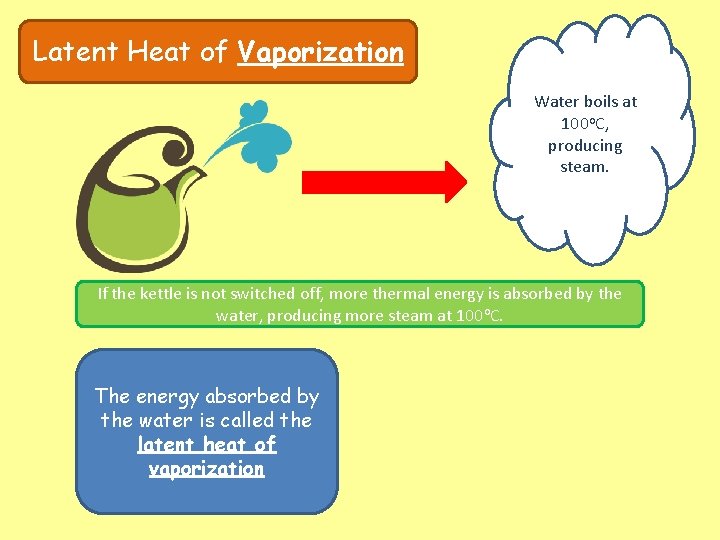
Latent Heat of Vaporization Water boils at 100 o. C, producing steam. If the kettle is not switched off, more thermal energy is absorbed by the water, producing more steam at 100 o. C. The energy absorbed by the water is called the latent heat of vaporization
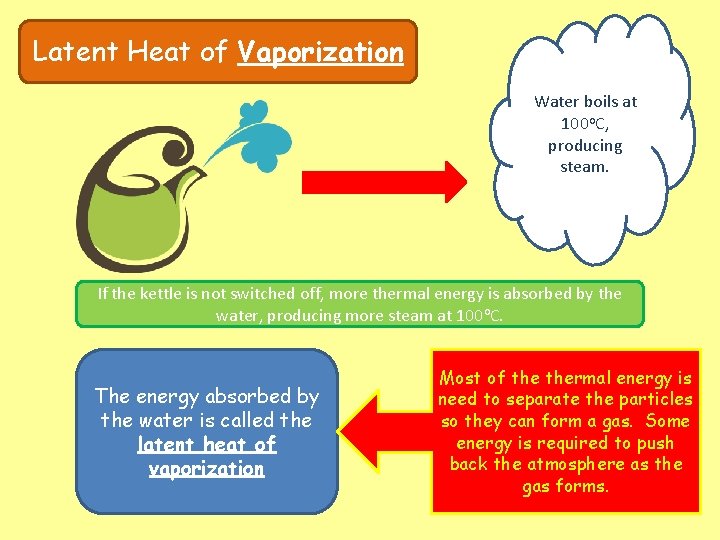
Latent Heat of Vaporization Water boils at 100 o. C, producing steam. If the kettle is not switched off, more thermal energy is absorbed by the water, producing more steam at 100 o. C. The energy absorbed by the water is called the latent heat of vaporization Most of thermal energy is need to separate the particles so they can form a gas. Some energy is required to push back the atmosphere as the gas forms.
Latent Heat of Vaporization The specific latent heat of vaporization of water is 2 300 000 J/kg
Latent Heat of Vaporization The specific latent heat of vaporization of water is 2 300 000 J/kg This means that 2 300 000 joules of energy are transferred to change each kilogram of liquid water into steam at the same temperature (100 o. C).
Latent Heat of Vaporization The specific latent heat of vaporization of water is 2 300 000 J/kg Same equation as for the specific latent heat of fusion: E = m. L But this time ‘L’ is the specific latent heat of vaporization. This means that 2 300 000 joules of energy are transferred to change each kilogram of liquid water into steam at the same temperature (100 o. C).
Latent Heat of Vaporization Measuring the specific latent heat of vaporization of water.
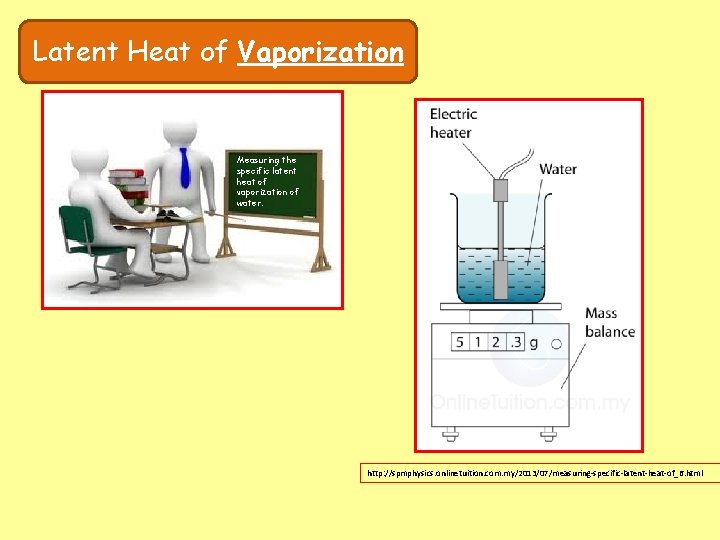
Latent Heat of Vaporization Measuring the specific latent heat of vaporization of water. http: //spmphysics. onlinetuition. com. my/2013/07/measuring-specific-latent-heat-of_6. html
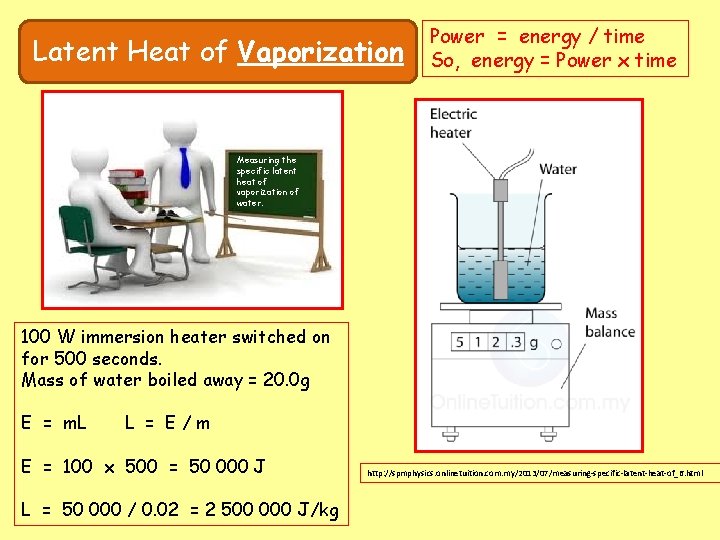
Latent Heat of Vaporization Power = energy / time So, energy = Power x time Measuring the specific latent heat of vaporization of water. 100 W immersion heater switched on for 500 seconds. Mass of water boiled away = 20. 0 g E = m. L L = E/m E = 100 x 500 = 50 000 J L = 50 000 / 0. 02 = 2 500 000 J/kg http: //spmphysics. onlinetuition. com. my/2013/07/measuring-specific-latent-heat-of_6. html
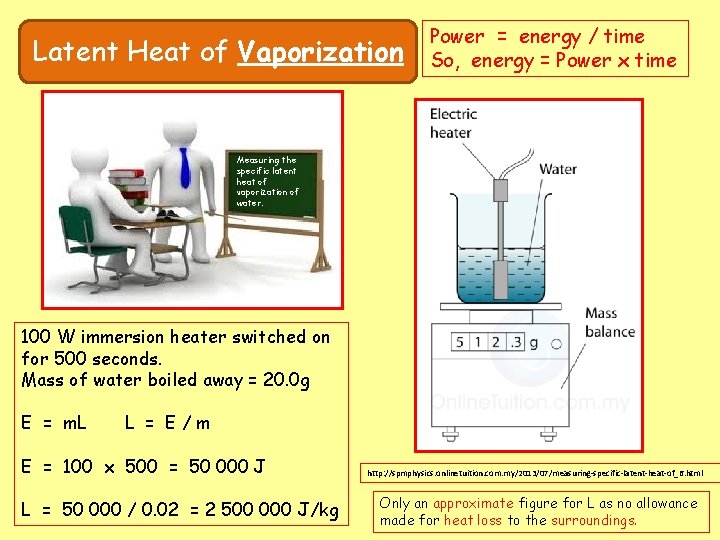
Latent Heat of Vaporization Power = energy / time So, energy = Power x time Measuring the specific latent heat of vaporization of water. 100 W immersion heater switched on for 500 seconds. Mass of water boiled away = 20. 0 g E = m. L L = E/m E = 100 x 500 = 50 000 J L = 50 000 / 0. 02 = 2 500 000 J/kg http: //spmphysics. onlinetuition. com. my/2013/07/measuring-specific-latent-heat-of_6. html Only an approximate figure for L as no allowance made for heat loss to the surroundings.
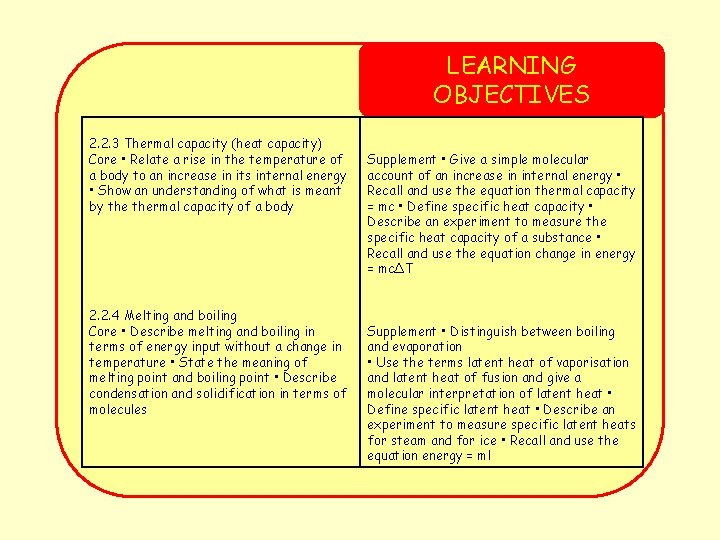
LEARNING OBJECTIVES 2. 2. 3 Thermal capacity (heat capacity) Core • Relate a rise in the temperature of a body to an increase in its internal energy • Show an understanding of what is meant by thermal capacity of a body 2. 2. 4 Melting and boiling Core • Describe melting and boiling in terms of energy input without a change in temperature • State the meaning of melting point and boiling point • Describe condensation and solidification in terms of molecules Supplement • Give a simple molecular account of an increase in internal energy • Recall and use the equation thermal capacity = mc • Define specific heat capacity • Describe an experiment to measure the specific heat capacity of a substance • Recall and use the equation change in energy = mc∆T Supplement • Distinguish between boiling and evaporation • Use the terms latent heat of vaporisation and latent heat of fusion and give a molecular interpretation of latent heat • Define specific latent heat • Describe an experiment to measure specific latent heats for steam and for ice • Recall and use the equation energy = ml
PHYSICS – Thermal properties and temperature (2).

- Slides: 59